Connect with us

Published

on

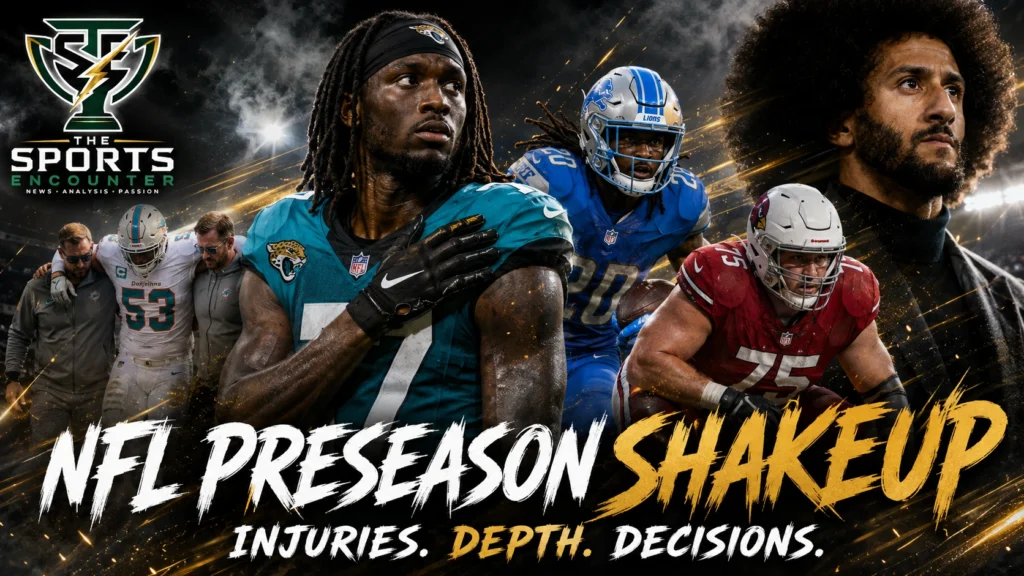
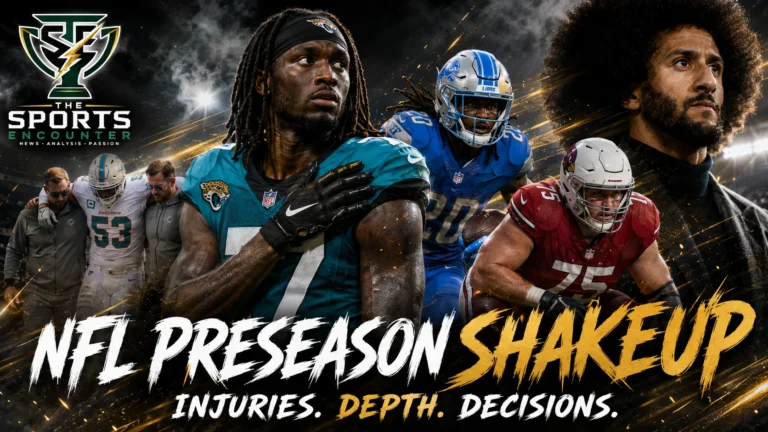
The final week of the NFL preseason delivered another reminder of how quickly roster plans can change. Miami Dolphins rookie Trey Moore is headed for ankle surgery, Jacksonville Jaguars receiver Brian Thomas Jr. escaped what appears to be a more serious shoulder injury, Detroit met with veteran running back Kareem Hunt amid a growing backfield problem, and Arizona secured starting center Hjalte Froholdt through 2028. Away from the roster scramble, former quarterback Colin Kaepernick was named the Muhammad Ali Center’s 2026 Humanitarian of the Year.

Those developments arrived on Tuesday, August 25, with the regular season moving close enough that teams can no longer treat injuries, depth questions and contract decisions as abstract training-camp concerns.

Miami has already lost a promising rookie for an extended period. Jacksonville appears to have avoided a potentially damaging injury to one of its most important offensive players. Detroit is considering veteran help because its running-back room has been hit repeatedly, while Arizona has removed one significant future question by extending the player who has started every game at center since arriving in 2023.

The broader pattern should be familiar to anyone who has followed The Sports Encounter’s NFL training-camp injury and roster coverage: August plans rarely survive August intact.

NFL August 25 Developments at a Glance

Team/Player Development Immediate Meaning
Miami Dolphins / Trey Moore Left ankle surgery required Rookie expected to miss an extended period
Jacksonville Jaguars / Brian Thomas Jr. Shoulder injury scare in joint practice Coach Liam Coen says receiver appears to be all right
Detroit Lions / Kareem Hunt Veteran running back visited team Detroit exploring depth amid multiple backfield injuries
Arizona Cardinals / Hjalte Froholdt Two-year extension Starting center under contract through 2028
Colin Kaepernick Muhammad Ali Humanitarian of the Year Recognition for activism and community work

Trey Moore’s Surgery Gives Miami an Early Defensive Setback

The most significant football injury of the day belongs to Trey Moore.

The Dolphins rookie linebacker will undergo surgery on his left ankle after being injured during Miami’s 26-3 preseason loss to the New York Giants on Saturday.

Head coach Jeff Hafley indicated Tuesday that Miami hopes Moore can return at some stage during the season, but he also made clear that the recovery will take time.

That places the fourth-round pick’s rookie year on hold just as Miami was preparing to transition from evaluation into regular-season planning.

Moore arrived with an intriguing production profile. The Miami Dolphins’ official rookie profile credits him with 30.5 sacks, 50 tackles for loss and 175 total tackles across 57 college games at UTSA and Texas.

Miami selected him with the 130th overall pick in April after Moore developed from a highly productive UTSA pass rusher into an SEC defender at Texas.

His injury matters because rookies taken in the middle rounds often use preseason football to force themselves into rotational roles before veterans have completely established the depth chart.

Moore had that opportunity.

Now Miami must plan its early-season defensive rotation without knowing exactly when he will return.

Miami Has Already Seen How Quickly Depth Can Become a Problem

The Dolphins are hardly alone in dealing with August attrition.

The Sports Encounter recently covered how former Miami lineman Kion Smith joined the San Francisco 49ers as another team responded to its own depth concerns.

Those individual roster moves can appear minor when viewed in isolation.

They become more important once injuries begin accumulating.

Moore was unlikely to enter Week 1 carrying the same defensive responsibility as an established starter, but his versatility gave Miami another option across the edge and linebacker levels.

That type of flexibility becomes especially useful once the regular season begins and teams have fewer available bodies than they carried through camp.

Miami concludes its preseason against Atlanta before opening the regular season at Las Vegas on September 13.

The Dolphins now have to decide how much of Moore’s expected workload can be redistributed internally and whether another roster move is required before Week 1.

Brian Thomas Jr. Injury Scare Could Have Been Far More Damaging

Jacksonville received a more encouraging injury update Tuesday.

Brian Thomas Jr. landed on his shoulder during the first 11-on-11 play of the Jaguars’ joint practice with the Tampa Bay Buccaneers.

Trainers examined him, and Thomas briefly returned for another play before Jacksonville removed him from the remainder of the session.

Head coach Liam Coen characterized the decision as precautionary and said Thomas appeared to be all right.

That distinction is enormously important for Jacksonville.

Thomas is not merely another receiver competing for snaps.

His 2024 rookie season produced 87 receptions, 1,282 yards and 10 touchdowns after the Jaguars selected him 23rd overall.

His second season was far less productive. Thomas finished 2025 with 48 catches for 707 yards and two touchdowns, missed three games and tied for second in the NFL with 10 drops.

Jacksonville entered this summer trying to reconnect the explosive rookie version of Thomas with Trevor Lawrence.

An extended shoulder absence now would have interrupted that work at almost the worst possible time.

Jacksonville Needs the 2024 Version of Thomas Back

The significance of the injury scare becomes clearer when placed beside Jacksonville’s broader offseason.

The Jaguars have spent camp trying to stabilize an offense that needs more dependable production around Lawrence.

The Sports Encounter has already tracked Jacksonville’s roster uncertainty through stories such as Trystan Colon’s retirement before his Jaguars career could begin.

Thomas carries a much larger offensive role.

If he can recover the vertical explosiveness and confidence that defined his rookie year, Jacksonville gains a receiver capable of changing coverages before the ball is snapped.

If the drops and inconsistent availability of 2025 continue, the offense becomes easier to defend.

That is why holding him out Tuesday was an easy decision.

The Jaguars do not need Thomas proving his toughness in an August joint practice.

They need him available when Jacksonville opens the regular season against Cleveland on September 13.

Kareem Hunt Visits Detroit as Lions’ Backfield Starts Running Out of Healthy Options

Detroit’s problem is less about one injury than the cumulative effect of several.

Veteran free-agent running back Kareem Hunt visited the Lions on Tuesday as the club considered adding depth behind Jahmyr Gibbs.

Isiah Pacheco is dealing with an MCL sprain.

Sione Vaki has been managing a back issue.

Jabari Small is in concussion protocol.

Raheem Blackshear was placed on injured reserve Monday.

That is enough damage to turn an available veteran into a legitimate roster consideration.

The NFL’s official August 25 news roundup confirmed Hunt’s visit as Detroit assessed its running-back depth before the regular season.

Hunt Would Give Detroit Familiar Production Without Changing Gibbs’ Role

The attraction is fairly straightforward.

Hunt is 31, so Detroit would not be signing him as the centerpiece of the running game.

That job belongs to Gibbs.

What Hunt can provide is experience, short-yardage reliability and enough pass-catching ability to prevent the offense from becoming one-dimensional when Gibbs leaves the field.

He rushed for 611 yards and eight touchdowns across 17 games with Kansas City last season.

Across his NFL career, Hunt has 5,775 rushing yards and 55 rushing touchdowns, along with 267 receptions for 2,209 yards and 18 receiving scores.

He also knows Pacheco from their time together with the Chiefs.

The larger question is how urgently Detroit believes it needs external help.

The Lions have become one of the league’s most closely watched teams, and The Sports Encounter recently examined the organization’s wider transition when Detroit appointed Richard Haddad as its new president and CEO.

The football operation is dealing with a much more immediate calculation.

Healthy running backs are disappearing faster than the preseason calendar.

TSE Analysis: Detroit’s Hunt Visit Is Really About Protecting Gibbs

The most important reason to add Hunt may have little to do with Hunt himself.

It concerns Gibbs.

When a backfield loses depth, the temptation is to increase the starter’s workload because he is the most trusted available player.

That can solve an immediate problem while creating a larger one later.

Detroit has a long season ahead and should have postseason ambitions.

Using Gibbs excessively in September because the reserve group was damaged in August would be a poor trade.

A veteran such as Hunt could absorb carries that Detroit would rather not place on its most important running back.

That is what roster depth is supposed to do.

Hjalte Froholdt Extension Gives Arizona Something August Injuries Cannot Take Away

While Miami, Jacksonville and Detroit were reacting to physical uncertainty, Arizona created contractual certainty.

The Cardinals signed center Hjalte Froholdt to a two-year extension that keeps him under contract through 2028.

The Arizona Cardinals officially confirmed the extension Tuesday and noted that Froholdt has started all 51 games during his three seasons with the franchise.

The reported value of the agreement is $20 million over two years, although Arizona’s own announcement did not disclose the financial terms.

That distinction is worth maintaining.

The contract length is official.

The dollar figure remains reported.

Froholdt’s Value Is Easier to See Through Availability Than Highlights

Centers rarely dominate NFL highlight packages.

Their importance becomes obvious when they are missing.

Froholdt has not missed a start since joining Arizona in 2023.

He played at least 98 percent of the Cardinals’ offensive snaps in each of his first three seasons with the franchise and became a team captain in 2025.

That durability carries even more value for a team that has already experienced offensive-line injuries this preseason.

The Sports Encounter’s training-camp coverage of offensive-line uncertainty around the league has repeatedly shown how quickly one injury can disturb an entire blocking structure.

Arizona has chosen to secure the player responsible for making protection calls and helping coordinate the line before the snap.

That is less glamorous than signing a star receiver.

It may be considerably more useful.

Froholdt’s Deal Fits the NFL’s Wider August Contract Economy

Late summer is not exclusively about cuts and injuries.

It is also when teams identify players they do not want reaching future contract uncertainty.

Arizona has already seen Froholdt produce three seasons of availability.

That reduces the projection risk usually attached to extensions.

The deal also arrives during a period in which NFL franchise economics continue moving sharply upward.

The Sports Encounter recently reported how NFL team valuations surged as the Dallas Cowboys reached $15.5 billion.

Growing league revenues do not eliminate salary-cap decisions, but they reinforce the extraordinary financial environment surrounding roster construction.

Teams still have to decide which players deserve long-term security.

Arizona has decided Froholdt does.

Colin Kaepernick’s Muhammad Ali Award Extends a Very Different NFL Story

The day’s fifth major NFL-related development belongs outside the usual injury and transaction cycle.

Colin Kaepernick will receive the Muhammad Ali Center’s Humanitarian of the Year award in Louisville on November 7.

The former San Francisco 49ers quarterback was selected for his advocacy around racial injustice and his work supporting underserved communities, including through the Know Your Rights Camp.

Kaepernick has not played in the NFL since the 2016 season, yet his connection to the league remains unusually powerful because his protest during the national anthem became one of the most consequential intersections of sports, race and politics in modern American athletics.

He began kneeling during the anthem in 2016 to protest police brutality and racial inequality.

The gesture drew support, criticism and national political attention while influencing other athletes across American sports.

The Ali Connection Gives the Award More Meaning Than a Generic Honor

The recognition carries unusual symbolism because Muhammad Ali understood the professional cost of public conviction better than almost any American athlete.

Ali sacrificed prime competitive years after refusing induction into the U.S. military during the Vietnam War and remained one of sport’s defining political voices long after returning to boxing.

Kaepernick’s career followed a very different path, but the comparison around athlete activism is obvious.

He has repeatedly argued that the consequences attached to his protest were secondary to the reason for protesting.

That is why an award carrying Ali’s name has a different resonance than a conventional sports honor.

The Sports Encounter’s coverage of the 2026 Pro Football Hall of Fame class recently examined another way the NFL remembers influential careers after the playing years end.

Kaepernick’s recognition comes through activism rather than Canton, but it similarly demonstrates how an athlete’s significance can continue after his final snap.

Kaepernick Still Occupies a Unique Place in NFL History

Kaepernick’s final NFL season came a decade ago with San Francisco.

He later filed a grievance alleging that NFL teams had colluded to prevent him from being signed because of his activism. The case ended with a confidential settlement in 2019.

His football résumé remains substantial enough to be remembered independently of the protest.

Kaepernick helped lead the 49ers to Super Bowl XLVII and reached another NFC Championship Game before his career changed direction.

Yet the reason his name still carries global recognition is broader than wins and passing statistics.

Few NFL players have ever influenced political and cultural conversation at the scale he did.

August NFL Football Is Becoming a Roster Survival Exercise

Tuesday’s developments fit a pattern that has dominated the month.

Injuries have changed depth charts.

Veterans have found new opportunities.

Rookies have lost them.

Teams have begun deciding which players belong in their longer-term plans.

The Sports Encounter’s earlier NFL roster roundup featuring Stefon Diggs and Jalon Walker showed the same collision between additions and losses.

Two weeks later, the stakes are higher because the regular season is much closer.

A minor camp issue in July can be treated patiently.

The same problem in late August can change a Week 1 game plan.

The Preseason Has Already Produced More Than Box-Score Evaluation

That is why preseason coverage should extend beyond final scores.

The Sports Encounter’s NFL Preseason Week 1 wrap focused on players such as Fernando Mendoza, Drew Allar and Cam Ward because August games are primarily evaluation environments.

The deeper consequences often emerge several days later.

Coaches review tape.

Medical tests reveal injuries.

Depth charts move.

Veterans get phone calls.

Contracts are signed.

Trey Moore’s surgery and Detroit’s meeting with Hunt are direct products of that process.

Roster Pressure Will Only Increase From Here

NFL teams are moving toward final roster construction, which means every remaining practice has consequences.

Players near the bottom of depth charts are competing for employment.

Coaches are balancing development against the danger of injuries.

Front offices are monitoring other teams for players who could become available.

The Sports Encounter’s training-camp roundup featuring Maxx Crosby, Kirk Cousins and Cam Taylor-Britt captured how rapidly circumstances were already changing earlier in August.

The final preseason stage compresses those decisions even further.

TSE Verdict: The Most Important NFL Story Tuesday Was Depth

Five separate headlines can easily look unrelated.

Four of Tuesday’s developments actually revolve around the same football problem.

Miami lost a rookie it hoped to develop into a defensive contributor.

Jacksonville protected its leading receiver after a shoulder scare.

Detroit invited a 31-year-old running back for a visit because injuries have reduced its options behind Gibbs.

Arizona paid to preserve continuity at the position responsible for organizing the middle of its offensive line.

Different teams. Different positions. Different responses.

The underlying issue is roster resilience.

The healthiest 53-man roster on paper in July rarely remains intact by September.

Teams that survive the NFL season are usually the ones capable of absorbing disruption without allowing one injury to distort the entire structure.

Miami must now prove it can do that without Moore.

Jacksonville hopes Thomas never becomes that problem.

Detroit may be preparing for it before Week 1.

Arizona has bought itself one piece of long-term certainty.

Kaepernick’s award sits outside that weekly calculation, but it offers a useful reminder that NFL careers can continue generating consequences long after the roster decisions stop.

What Happens Next?

Miami will move forward with Moore’s surgery and establish a clearer rehabilitation timeline once the procedure is complete.

Jacksonville will monitor Thomas’ shoulder ahead of the regular-season opener against Cleveland.

Detroit must decide whether Hunt’s visit becomes a contract or whether the Lions trust their current backfield to recover in time.

Arizona can move toward Week 1 knowing Froholdt’s future is settled through 2028.

Kaepernick will receive his humanitarian award in Louisville on November 7.

For the rest of the league, the immediate calendar keeps moving toward the point where evaluation ends and the games begin to count.

Frequently Asked Questions

What happened to Dolphins rookie Trey Moore?

Moore suffered a left ankle injury during Miami’s preseason loss to the New York Giants and will require surgery. Head coach Jeff Hafley said the Dolphins hope he can return during the season, but he is expected to miss an extended period.

Is Brian Thomas Jr. seriously injured?

The Jaguars do not currently believe so. Thomas landed on his shoulder during a joint practice with Tampa Bay and was held out afterward as a precaution. Liam Coen said he appeared to be all right.

Why did Kareem Hunt visit the Detroit Lions?

Detroit is dealing with multiple running-back injuries behind Jahmyr Gibbs, including an MCL sprain for Isiah Pacheco. Hunt visited as the Lions consider adding experienced depth.

Did the Lions sign Kareem Hunt?

No signing had been announced at the time of publication. Hunt visited the team as a free agent.

How long is Hjalte Froholdt under contract with Arizona?

The Cardinals signed Froholdt to a two-year extension that keeps him under contract through the 2028 season.

How much is Hjalte Froholdt’s extension worth?

The deal has been reported at two years and $20 million. Arizona officially confirmed the two-year extension but did not disclose its financial value in the club announcement.

What award will Colin Kaepernick receive?

Kaepernick will receive the Muhammad Ali Center’s 2026 Humanitarian of the Year award at a ceremony in Louisville on November 7.

Why was Colin Kaepernick selected for the award?

The Muhammad Ali Center cited his advocacy against racial injustice and his work supporting underserved communities through the Know Your Rights Camp and other initiatives.

When does the 2026 NFL regular season begin for the Dolphins?

Miami opens its regular season on September 13 at Las Vegas.
Jeremy Montes is a Chile-based sports writer covering international cricket, soccer, the Olympic Games, and major sporting events across the Americas. His work focuses on match analysis, player performances, tournament developments, team trends, and the wider sporting stories that shape competition beyond the final score. At The Sports Encounter, Jeremy contributes coverage across major leagues, international tournaments, and developing sports stories, with an emphasis on clear reporting, verified context, and reader-focused analysis. His writing combines match detail with historical perspective, statistical context, and the implications that matter to fans. Based in South America, he also brings a regional perspective to global sports coverage while following the major events, athletes, and competitions driving international interest.

Breaking News

Sadio Mané Inspires Stunning 10-Man Al Nassr Comeback From 2-0 Down Against Al Ettifaq

Sadio Mané inspired a remarkable Al Nassr comeback in Dammam, scoring twice as the defending Saudi Pro League champions recovered from 2-0 down with 10 men to beat Al Ettifaq 3-2.

Published

on

Sadio Mané celebrates after leading 10-man Al Nassr to a 3-2 comeback win over Al Ettifaq in the Saudi Pro League.

Al Ettifaq 2-3 Al Nassr: Sadio Mané scored twice, including a dramatic 90th-minute winner, as 10-man Al Nassr recovered from a 2-0 halftime deficit to beat Al Ettifaq in one of the first extraordinary matches of the 2026-27 Saudi Pro League season.

Al Nassr goalkeeper Bento was sent off after only 12 minutes at EGO Stadium, leaving Ange Postecoglou’s defending champions facing almost an entire match with 10 players. Ondrej Duda and Álvaro Medrán punished them before halftime to put Al Ettifaq firmly in control.

What followed completely changed the story.

Cristiano Ronaldo was withdrawn at the start of the second half as Al Nassr reorganized, Mané pulled one back in the 74th minute, Abdulelah Al-Amri equalized three minutes later, and Mané completed an improbable comeback in the 90th minute.

The 3-2 victory keeps Al Nassr’s perfect start to their Saudi Pro League title defense intact after three matches and gives Postecoglou an early result that may tell him considerably more about his team than either of their comfortable opening victories.

Al Ettifaq vs Al Nassr: Match Facts

Competition 2026-27 Saudi Pro League
Round Matchweek 3
Result Al Ettifaq 2-3 Al Nassr
Venue EGO Stadium, Dammam
Al Ettifaq scorers Ondrej Duda 31′, Álvaro Medrán 45+4′
Al Nassr scorers Sadio Mané 74′, 90′; Abdulelah Al-Amri 77′
Red card Bento, Al Nassr, 12′
Halftime score Al Ettifaq 2-0 Al Nassr
Cristiano Ronaldo Started, substituted at the beginning of the second half
Winning goal Sadio Mané, 90′

How Al Nassr Came Back From 2-0 Down With 10 Men

The first major moment arrived before either team had established control.

Moussa Dembélé broke toward goal in the 12th minute and Bento rushed outside his penalty area in an attempt to stop him. The Al Nassr goalkeeper brought the striker down and referee Mohammed Al-Hoaish produced a straight red card.

Postecoglou immediately had to sacrifice an attacking player, withdrawing Ângelo so substitute goalkeeper Abdulrahman Al-Otaibi could enter.

It changed everything.

Al Nassr had entered the match with Cristiano Ronaldo, João Félix, Kingsley Coman and Mané in an aggressive starting side. Within 12 minutes, their plan had effectively been torn up.

Al Ettifaq eventually took advantage in the 31st minute when Duda struck from outside the area. Medrán then doubled the lead in first-half stoppage time, sending the hosts into the break 2-0 ahead against an opponent already down to 10 men.

At that point, an Al Ettifaq victory appeared considerably more likely than an Al Nassr recovery.

Why Cristiano Ronaldo Was Taken Off at Halftime

Postecoglou made his biggest tactical decision before the second half began.

Ronaldo did not return.

Abdullah Al-Khaibari replaced the Al Nassr captain as the visitors added another midfielder and attempted to restore some balance to a side that had been playing short-handed since Bento’s dismissal.

The decision was striking because Ronaldo had only recently returned to Saudi Pro League action. He scored after coming off the bench in Al Nassr’s 4-0 victory over Al Riyadh, continuing a remarkable late-career chapter that has stretched well beyond his final FIFA World Cup campaign with Portugal.

Taking him off while trailing by two goals could easily have become the defining criticism of Postecoglou’s night.

Instead, the shape change helped create the conditions for one of Al Nassr’s best comebacks in recent memory.

Sadio Mané Changed the Match in Sixteen Minutes

Al Nassr remained 2-0 behind deep into the second half. They were still a man short, the clock was disappearing and Al Ettifaq had every reason to believe the points were secure.

Then Mané changed the entire contest.

The Senegal international struck in the 74th minute to cut the deficit to 2-1. Rather than treating the goal as consolation, Al Nassr immediately pushed for another.

Three minutes later, Al-Amri made it 2-2.

A match that had seemed almost beyond recovery at halftime was suddenly level, and the psychological pressure flipped. Al Ettifaq were no longer protecting a comfortable lead against 10 men. They were trying to prevent a collapse.

Mané delivered the final blow in the 90th minute, converting after Sami Al-Najei’s contribution to complete his brace and put Al Nassr 3-2 ahead.

From 2-0 down in the 73rd minute to 3-2 ahead in the 90th, Al Nassr had overturned the game in roughly a quarter of an hour while still playing with 10 men.

Al Ettifaq 2-3 Al Nassr: Goal Timeline

Minute Event Score
12′ Bento sent off for Al Nassr 0-0
31′ Ondrej Duda scores for Al Ettifaq 1-0
45+4′ Álvaro Medrán scores for Al Ettifaq 2-0
46′ Abdullah Al-Khaibari replaces Cristiano Ronaldo 2-0
74′ Sadio Mané scores for Al Nassr 2-1
77′ Abdulelah Al-Amri equalizes 2-2
90′ Sadio Mané scores the winner 2-3

Mané Became the Player Al Nassr Needed

The most interesting part of Mané’s performance was its timing.

Al Nassr did not require another attacker to dominate a comfortable match. They needed somebody to change a contest that had gone badly wrong.

Ronaldo was gone. Bento was gone. The team was two goals behind away from home and approaching the final 15 minutes.

Mané responded with two goals.

His first gave Al Nassr belief. His second converted belief into three points.

That matters for a team carrying greater expectations after winning the 2025-26 Saudi title. Ronaldo remains its most recognizable figure and one of football’s biggest global personalities, something reflected throughout The Sports Encounter’s assessment of his extraordinary World Cup career, but championship teams eventually need match-winners beyond their biggest star.

Mané provided exactly that in Dammam.

João Félix Quietly Played an Important Role

Mané will dominate the headlines, but João Félix also deserves attention.

The Portuguese attacker remained involved as Al Nassr tried to manufacture opportunities with fewer players and helped connect an attack operating without Ronaldo for the entire second half.

That ability to retain attacking threat after losing both a goalkeeper and the team’s captain illustrates the depth available to Postecoglou.

Saudi football continues to accumulate that type of quality. Al Hilal’s recent pursuit of Aston Villa striker Ollie Watkins showed how aggressively leading Saudi clubs continue to look for established international talent, while the league’s strongest teams are simultaneously preparing for demanding continental campaigns.

Al Nassr’s squad has enough individual quality to win matches in several ways. Tuesday night demonstrated something harder to purchase: the ability to survive disorder.

Postecoglou’s Halftime Gamble Worked

Postecoglou inherited a championship team, but defending a title presents a different problem from winning one.

Opponents know the standard. Expectations increase. Every dropped point becomes part of the title conversation earlier than it normally would.

His response after Bento’s dismissal therefore deserves scrutiny beyond the final score.

Removing Ronaldo at halftime could have looked unnecessarily conservative with Al Nassr two goals behind. The Australian instead appeared to prioritize restoring midfield structure before chasing the match.

Al Nassr became harder to exploit and eventually found enough stability to attack without turning every lost possession into another Al Ettifaq opportunity.

The comeback does not prove that every decision was perfect. Winning after falling 2-0 behind does not erase the defensive problems that produced such a difficult position in the first place.

It does show that Postecoglou was willing to make a major decision involving his captain when the match required a different tactical solution.

Why This Win Matters in the Saudi Pro League Title Race

Both teams arrived with six points from their opening two league matches.

Al Ettifaq had beaten Al Riyadh 4-2 before edging Al Fateh 1-0, giving Arthur Papas’ team a perfect opening to the campaign. The Saudi Pro League’s official platform had identified Al Ettifaq among the clubs making an unbeaten start to the new season.

Al Nassr had been equally convincing.

The defending champions opened by defeating Al Fateh 3-0 and followed that with a 4-0 win over Al Riyadh. Ronaldo scored after coming off the bench in the second match, his first league appearance of 2026-27.

The official 2026-27 Saudi Pro League schedule contains 306 matches across 34 rounds, so no August result decides a championship.

Some early results still reveal characteristics that become important much later.

Al Nassr have now shown they can win comfortably when controlling a game and win chaotically when almost everything goes against them.

That is useful evidence for a defending champion.

Saudi Football’s Competitive Depth Is Becoming Harder to Ignore

There is another reason this match matters.

Al Ettifaq did not spend 90 minutes hoping to survive against the champions. They went after Al Nassr, exploited the numerical advantage and came within minutes of taking all three points.

The result fits a wider Saudi football environment in which competitive ambition is spreading beyond a small collection of internationally recognizable clubs.

Al Ahli, for example, enter the new continental season as back-to-back Asian champions and face another demanding schedule after the AFC Champions League Elite draw paired them with Al Ain among their major league-stage opponents.

The movement of coaches is increasingly significant as well. Matthias Jaissle’s success with Al Ahli helped establish his reputation before his reported move toward Newcastle United, a development The Sports Encounter examined through the growing connection between Saudi football and the Premier League.

Meanwhile, Saudi clubs continue influencing the international transfer market even when deals do not ultimately happen. Mohamed Salah was repeatedly associated with Saudi interest before his eventual move to Trabzonspor.

The league’s competitive story therefore extends beyond famous arrivals. Matches such as Al Ettifaq against Al Nassr matter because they reveal how that investment and ambition translate when points are actually available.

Abdulelah Al-Amri Delivers Another Big Saudi Moment

Al-Amri’s equalizer deserves its own place in the story.

A center back scoring the 77th-minute goal in a 10-man comeback would already be significant. His recent history gives the moment additional context.

The defender also scored for Saudi Arabia during the 2026 World Cup, when the Green Falcons held Uruguay to a 1-1 draw in their tournament opener.

Against Al Ettifaq, his goal arrived only three minutes after Mané had finally broken through.

That speed changed the emotional balance of the match. Al Ettifaq barely had time to absorb conceding once before their two-goal advantage had disappeared completely.

What the Result Means for Cristiano Ronaldo

Ronaldo’s night will attract attention precisely because he was not on the field when the comeback happened.

That should not automatically be turned into a simplistic argument about whether Al Nassr are better without him.

The circumstances were unusual. Al Nassr had lost their goalkeeper, were playing with 10 men and needed a more secure midfield structure after halftime.

Postecoglou made a tactical substitution based on the state of one match.

Ronaldo remains central to the club’s season and continues playing at 41 after an international career in which he became the first male player to score at six World Cups. His life away from football has also entered a new chapter following his recent marriage to Georgina Rodríguez in Portugal.

The more significant football takeaway from Dammam concerns Al Nassr rather than Ronaldo individually.

They found another route to victory when their captain was no longer available to provide it.

Al Nassr Have Passed Their First Serious Stress Test

Winning 3-0 and 4-0 tells a coach plenty about attacking quality. Winning 3-2 after losing a goalkeeper in the 12th minute and trailing by two goals tells him something different.

Al Nassr were forced to change formation, goalkeeper, personnel and attacking priorities during the same match.

They still found three second-half goals.

There are warnings inside the victory. Bento’s decision put his team in unnecessary danger. Al Ettifaq were able to establish control after the dismissal, and a defending champion cannot expect to recover from two-goal deficits regularly.

But there is also something valuable about discovering this early that a team will continue competing when a match appears lost.

Postecoglou will have plenty to correct.

He also leaves Dammam with three points he had almost certainly stopped expecting at halftime.

Final Verdict

Sadio Mané will rightly own the headline.

His 90th-minute winner completed a brace and one of the most dramatic turnarounds of the young Saudi Pro League season.

The larger story belongs to Al Nassr collectively.

They lost Bento after 12 minutes. They conceded twice. Ronaldo was removed at halftime. They remained 2-0 behind until the 74th minute.

Then Mané scored, Al-Amri equalized and Mané struck again.

Al Ettifaq went from protecting a two-goal lead against 10 men to losing all three points in the space of 16 extraordinary minutes.

Championships are never won in August, particularly during a 34-round Saudi Pro League season.

They can still reveal something about the teams trying to win them.

Al Nassr have now started their title defense with three consecutive victories. The third told us considerably more about their resilience than the first two.

FAQs

What was the final score between Al Ettifaq and Al Nassr?

Al Nassr defeated Al Ettifaq 3-2 in their Saudi Pro League Matchweek 3 meeting on August 25, 2026.

Who scored for Al Nassr against Al Ettifaq?

Sadio Mané scored twice, in the 74th and 90th minutes, while Abdulelah Al-Amri scored Al Nassr’s equalizer in the 77th minute.

Who scored for Al Ettifaq?

Ondrej Duda opened the scoring in the 31st minute before Álvaro Medrán made it 2-0 during first-half stoppage time.

Who was sent off for Al Nassr?

Goalkeeper Bento received a straight red card in the 12th minute after bringing down Moussa Dembélé outside the penalty area.

Did Cristiano Ronaldo score against Al Ettifaq?

No. Ronaldo started the match but was replaced by Abdullah Al-Khaibari at the beginning of the second half with Al Nassr trailing 2-0 and playing with 10 men.

Who scored the winning goal for Al Nassr?

Sadio Mané scored the winning goal in the 90th minute, completing his brace and Al Nassr’s comeback from 2-0 down.

How many players did Al Nassr have during the comeback?

Al Nassr played with 10 men from the 12th minute onward following Bento’s red card. All three of their goals were scored while they were a player short.

How have Al Nassr started the 2026-27 Saudi Pro League season?

Al Nassr have won their opening three league matches, beating Al Fateh 3-0, Al Riyadh 4-0 and Al Ettifaq 3-2.

Continue Reading

Breaking News

How $100 US Open Tickets Expose the Growing Cost of Watching Elite Tennis

New York City and the USTA are offering 1,000 discounted US Open tickets for $100 each, highlighting a wider debate over soaring resale prices and whether major tennis events remain affordable for ordinary fans.

Ruben Santos | The Sports Encounter

Published

on

US Open stadium and New York City fans featured in a cinematic graphic about rising ticket prices and the new $100 ticket initiative for local residents.

New York City is stepping into one of the biggest debates surrounding the 2026 US Open: how much should ordinary fans have to pay to watch elite tennis live?

Mayor Zohran Mamdani and the United States Tennis Association have announced that 1,000 discounted US Open tickets will be made available to New York City residents for $100 each, offering local fans access to main-draw sessions that have become increasingly expensive on the secondary market.

The tickets go on sale at 10 a.m. ET on Wednesday, August 26, on a first-come, first-served basis. Eligible New York City residents can purchase up to two tickets each.

The offer covers sessions from August 30 through September 8 and includes tickets for Arthur Ashe Stadium, Louis Armstrong Stadium and grounds admission, depending on availability.

On paper, 1,000 tickets represent only a small fraction of overall US Open attendance. In practice, the initiative has landed at exactly the right moment because ticket affordability has become part of the wider conversation around the tournament.

US Open $100 Ticket Offer: Key Details

Detail Information
Number of discounted tickets 1,000
Price $100 per ticket
Eligibility New York City residents
Purchase limit Maximum two tickets per resident
Sale begins August 26, 2026 at 10 a.m. ET
Eligible sessions August 30 through September 8
Ticket types Arthur Ashe Stadium, Louis Armstrong Stadium and grounds admission
Availability First-come, first-served

Why $100 US Open Tickets Suddenly Feel Like a Bargain

A $100 sports ticket would not normally be described as cheap.

At the 2026 US Open, however, the comparison changes quickly.

Secondary-market prices for the early rounds have risen significantly as demand builds around the final Grand Slam of the season. Grounds passes and stadium seats that originally entered the market at considerably lower face values have been appearing at multiples of those prices.

That pressure has been especially visible around opening-week sessions, when spectators can move between multiple courts and potentially watch several major players in a single day.

The Sports Encounter’s complete US Open 2026 preview already identified ticket demand as part of a tournament carrying unusual star power across both singles draws.

That demand is not difficult to understand.

Novak Djokovic is chasing another piece of Grand Slam history. Aryna Sabalenka is trying to extend her dominance in New York. Venus Williams is back at 46. Carlos Alcaraz remains part of the tournament picture despite an injury-disrupted preparation.

Add New York tourism, weekend demand and the traditional popularity of night sessions, and the resale market becomes extremely aggressive.

The Resale Market Is Where Fan Frustration Grows

The central affordability problem is not simply that the US Open sells premium tickets.

Major sporting events have always charged more for better seats, later rounds and high-profile sessions.

The frustration begins when ordinary admission products become expensive almost immediately after entering the resale market.

Recent secondary-market listings have shown grounds passes selling well above traditional face values, while Arthur Ashe Stadium tickets for opening-week sessions can quickly climb into several hundred dollars.

That leaves families and casual fans with a difficult choice.

Pay significantly more than expected, wait and hope prices fall, or skip the tournament entirely.

The New York City initiative does not solve that market. It creates a limited alternative inside it.

TSE Analysis: 1,000 Tickets Will Not Fix the Problem, but They Expose It

The most revealing thing about the $100 initiative is not the discount itself.

It is the fact that an affordability program feels necessary for one of tennis’ largest and wealthiest events.

The US Open regularly attracts enormous crowds, generates major broadcast revenue, sells premium hospitality packages and benefits from one of the strongest sporting markets in the world.

That success creates a tension familiar across modern professional sports.

Events want maximum commercial value from demand.

Fans still want to feel that attending in person remains realistically possible.

Those interests do not always move together.

When resale prices climb sharply enough, a tournament can remain financially successful while becoming less accessible to the supporters who give it much of its atmosphere.

New York Is Making Fan Access Part of Sports Policy

The US Open announcement is not an isolated city initiative.

Mamdani’s administration has increasingly framed access to major sporting events as a public-interest issue for New Yorkers.

The official New York City announcement explicitly linked the tennis offer to previous attempts to make major events more accessible to local residents.

The underlying argument is straightforward.

New York provides the infrastructure, workforce, public services and audience base that help make major sporting events commercially valuable.

Residents should therefore have some realistic path into the venues hosting them.

That argument becomes more persuasive when the event itself is deeply tied to the city’s identity.

The US Open is not a travelling tournament arriving in New York for one season.

Flushing Meadows has been its permanent home for decades.

The USTA Already Has a Stronger Accessibility Argument Than Many Major Events

It would be unfair to portray the US Open as a tournament interested only in premium customers.

The USTA has invested heavily in Fan Week, which runs from August 23 through August 29.

Grounds admission during Fan Week is free with a Fan Access Pass, giving spectators access to qualifying, practices, family activities and selected mixed-doubles action.

The official US Open Fan Week program includes qualifying involving 128 men and 128 women, player activities and several free events across the National Tennis Center.

That is genuine access.

It also matters because qualifying can produce some of the best value at any Grand Slam.

Fans can stand close to the courts, watch emerging players and established names trying to recover their ranking positions, and experience the venue without paying main-draw prices.

Free Fan Week Shows the USTA Understands the Access Problem

Fan Week has become one of the strongest parts of the US Open experience precisely because it lowers the financial barrier.

The atmosphere is different from a semifinal night inside Arthur Ashe Stadium, but that is part of its appeal.

Players practice on smaller courts.

Qualifiers compete in matches that can determine the direction of entire careers.

Fans can move more freely around the grounds.

The tournament also used Fan Week to elevate mixed doubles this year.

The Sports Encounter examined that strategy when Novak Djokovic and Aryna Sabalenka were announced as a headline mixed-doubles partnership.

Their involvement helped transform what could have been a secondary event into something capable of drawing major crowds before the singles tournament even began.

Demand Is Being Driven by More Than the Main Draw

The 2026 tournament has expanded the number of reasons for spectators to visit Flushing Meadows before August 30.

Mixed doubles, qualifying, exhibitions and player appearances have turned the first week into a larger entertainment product.

The official US Open ticket platform shows how the event now extends across Fan Week, mixed doubles, premium exhibitions and the traditional main draw.

That expansion has advantages.

More events mean more opportunities to attend.

They also mean more demand around the venue.

The result is a US Open that increasingly operates like a major sports festival rather than a two-week tennis tournament.

Venus Williams Adds Another Layer to the Ticket Rush

Few players illustrate the power of nostalgia better than Venus Williams.

The 46-year-old former champion has received another main-draw wildcard, guaranteeing one more appearance at Flushing Meadows.

The Sports Encounter’s analysis of Venus Williams’ US Open return at 46 examined why her presence matters far beyond her current ranking.

Fans who watched Venus become a champion more than two decades ago now have another opportunity to see her compete in New York.

That kind of generational connection drives demand in a way ordinary ranking numbers cannot capture.

A wildcard becomes a ticket-selling story.

Djokovic Is Creating a Different Kind of Demand

Djokovic enters the tournament with history hanging over every match.

His pursuit of a 25th Grand Slam singles title keeps him among the biggest attractions in tennis even at 39.

The uncertainty surrounding his preparation may actually increase interest.

The Sports Encounter recently examined how Djokovic’s Cincinnati defeat raised fresh questions about his US Open readiness.

Fans buying tickets do not know how many more New York campaigns they will get from him.

Scarcity applies to athletes as well as seats.

That can push demand higher whenever an all-time great enters the final stage of a career.

Carlos Alcaraz Adds Uncertainty to the Market

Alcaraz presents almost the opposite story.

He is still young enough to have many US Open appearances ahead of him, but his current participation carries uncertainty because of the wrist injury that disrupted his season.

His withdrawal from Cincinnati intensified those questions.

The Sports Encounter’s report on Alcaraz’s Cincinnati withdrawal and US Open title-defense concerns explained how limited his competitive preparation has become.

If Alcaraz is healthy enough to play, he remains one of the tournament’s biggest attractions.

If he withdraws or struggles physically, a major part of the ticket-value equation changes for sessions in which fans hoped to see him.

That is one of the risks of buying expensive tennis tickets before the order of play is known.

Tennis Tickets Are Different From Most Team-Sport Tickets

That uncertainty deserves more attention in affordability discussions.

A fan buying an NBA or NFL ticket usually knows which teams will appear.

A tennis fan may purchase a session weeks in advance without knowing which players will be assigned to that court.

Seeds can lose early.

Players can withdraw.

Weather can move schedules.

Matches can be reassigned.

A $300 ticket therefore does not guarantee a particular superstar.

It guarantees access to a session.

That makes price inflation especially frustrating when buyers are effectively paying premium prices for an uncertain lineup.

Cincinnati Already Showed How Quickly the Star Picture Can Change

The final warm-up event before New York reinforced that uncertainty.

The Sports Encounter’s Cincinnati Open roundup followed a tournament in which some leading names advanced while others struggled with injuries, form and changing preparation plans.

Our separate look at the biggest Cincinnati disappointments and early exits showed how quickly expected headline matchups can disappear.

The US Open faces the same basic reality on a larger scale.

Fans can pay for star power.

The draw does not promise that star power will survive long enough for them to see it.

The $100 Tickets Are Also a Smart Public-Relations Move

The USTA benefits from the initiative too.

The number of tickets is modest enough that the financial impact should be limited relative to the size of the tournament.

The reputational benefit is much larger.

The organization can point to a concrete program that gives local residents access during a period of rising concern about ticket costs.

That matters when secondary-market prices are generating headlines beyond tennis.

The partnership also allows the USTA to distinguish between the prices it controls and the prices created after tickets enter resale channels.

Those two markets are often blurred together by frustrated supporters.

Resale Economics Are the Harder Problem

Major events face a recurring dilemma when demand exceeds supply.

Keeping face values artificially low can create a huge arbitrage opportunity for resellers.

Raising primary prices can reduce that opportunity but directly makes tickets less affordable.

Restricting resale can discourage speculation but may also make legitimate transfers more difficult.

Dynamic pricing creates another controversy because fans can see prices change while they are trying to buy.

There is no simple fix.

The US Open’s problem is amplified by the size and wealth of the New York market, tourism demand and the global popularity of the players involved.

TSE Analysis: Sports Access Is Becoming a Class Question

The wider concern reaches beyond tennis.

Elite sport increasingly makes more money from premium experiences.

Hospitality lounges, luxury seating, exclusive access packages and high-demand resale markets can generate enormous revenue.

Commercially, the logic works.

Culturally, there is a risk.

A stadium can become filled with people able to pay the highest prices while supporters who built their relationship with the sport through ordinary attendance are pushed toward television.

That changes atmosphere over time.

It also changes who feels that the event belongs to them.

Mamdani’s statement that New Yorkers should be able to watch the world’s best players when those athletes are competing in their city taps directly into that concern.

A Full Day at the US Open Has Value That Television Cannot Replace

Live tennis offers an experience that is difficult to reproduce through a broadcast.

Television focuses on the biggest match.

A grounds ticket lets a spectator build an entirely different day.

A fan can watch a top-10 player practice, sit courtside for an early-round match on an outside court, discover a qualifier, move to doubles and then follow another match from a neighboring stadium.

That freedom is part of what makes early Grand Slam rounds so appealing.

It is also why expensive grounds passes are particularly sensitive.

They were traditionally the democratic entry point into a major.

The Tournament Still Has Affordable Ways In

Fans unable to secure one of the $100 city tickets are not completely shut out.

Fan Week remains the obvious alternative.

Qualifying and many activities are free with the required Fan Access Pass, subject to capacity.

Mixed doubles has also included free-to-attend matches in Grandstand and Louis Armstrong Stadium during the opening stages.

Those options deserve recognition because they make the US Open more accessible than a price discussion based only on Arthur Ashe resale listings would suggest.

Readers can follow the tournament’s matches, qualifying stories and player developments through The Sports Encounter’s Tennis Hub.

The Real Test Comes After the 1,000 Tickets Sell

There is little reason to expect the discounted allocation to last long.

One thousand tickets in a city of millions, attached to one of the world’s biggest tennis tournaments, creates obvious scarcity.

The speed of the sellout may itself become useful information.

If the tickets disappear almost immediately, it will demonstrate how much demand exists around a genuinely lower entry price.

That could strengthen the argument for expanding similar allocations in future years.

The more interesting question is whether this remains a symbolic program or becomes part of a broader access strategy.

What Should Fans Watch Next?

New York City residents interested in the offer should be ready when sales open at 10 a.m. ET on August 26 because availability is first-come, first-served and purchases are limited to two tickets.

The main draw begins August 30.

Before then, qualifying, Fan Week and the mixed-doubles championship continue shaping the tournament.

The sporting story will soon move back toward players and results.

The ticket debate should not disappear with it.

TSE Verdict: Affordable Access Cannot Become a Luxury Product

The US Open has every right to capitalize on enormous demand.

It is one of the world’s premier sporting events and operates inside one of its most expensive cities.

Fans also have every right to question where the commercial ceiling sits.

When a $100 ticket begins to look like a remarkable bargain, the market is telling us something.

The city and USTA deserve credit for creating 1,000 lower-cost opportunities.

The initiative will help real people attend matches they may otherwise have missed.

Its small scale also reveals the size of the affordability problem surrounding major live sport.

The US Open does not need every ticket to be cheap.

It does need enough ordinary fans inside the gates for Flushing Meadows to continue feeling like a sporting event rather than an exclusive entertainment product.

Frequently Asked Questions

How much are the discounted US Open tickets for New York residents?

The tickets cost $100 each.

How many discounted US Open tickets are available?

New York City and the USTA have made 1,000 discounted tickets available.

When do the $100 US Open tickets go on sale?

Sales begin at 10 a.m. ET on Wednesday, August 26, 2026.

Who can buy the discounted tickets?

The offer is available to New York City residents.

How many tickets can one person buy?

Eligible residents can purchase up to two tickets.

Which US Open sessions are included?

The discounted allocation covers main-draw sessions from August 30 through September 8 and can include Arthur Ashe Stadium seats, Louis Armstrong Stadium seats and grounds passes, depending on availability.

Is US Open Fan Week free?

Yes. Grounds admission during Fan Week is free with a Fan Access Pass, although some premium events require separate tickets and all access remains subject to capacity.

When does the 2026 US Open main draw begin?

The men’s and women’s singles main draws begin on Sunday, August 30.

Why are US Open resale tickets so expensive?

High demand, limited seating, New York tourism, premium matchups and secondary-market resale activity can all push prices well above original face values.

Continue Reading

Breaking News

Djokovic and Sabalenka Stunned as US Open Mixed Doubles Rewards the Specialists

Novak Djokovic and Aryna Sabalenka crashed out of the 2026 US Open mixed doubles after Katerina Siniakova and Henry Patten used their doubles experience to win 1-4, 4-2, 10-2.

Miley Rumer | The Sports Encounter

Published

on

Novak Djokovic and Aryna Sabalenka featured in a US Open mixed-doubles graphic after their first-round loss to Katerina Siniakova and Henry Patten.

Novak Djokovic and Aryna Sabalenka arrived at the 2026 US Open Mixed Doubles Championship as the top seeds and one of the most marketable partnerships in the field. They left after 49 minutes, beaten 1-4, 4-2, 10-2 by Katerina Siniakova and Henry Patten in a result that immediately gave the tournament a much sharper competitive identity.

The upset at Arthur Ashe Stadium on Tuesday did more than remove two of the biggest singles stars in tennis from the draw. It reinforced a point the redesigned event was always going to test: celebrity appeal can fill the stadium, but short-format mixed doubles still rewards players who understand spacing, positioning, reflex exchanges and partnership patterns at a specialist level.

Siniakova and Patten entered the main draw through qualifying less than 24 hours earlier. By the end of their first main-draw match, they had eliminated the No. 1 seeds and advanced to the quarterfinals.

The Sports Encounter had already identified Djokovic and Sabalenka as the pairing capable of giving the tournament its biggest spotlight when we examined why their partnership could become the US Open’s headline mixed-doubles attraction.

The first round produced the opposite story.

The stars drew the attention. The doubles players won the match.

Djokovic and Sabalenka vs Siniakova and Patten: Match Facts

Detail Information
Event 2026 US Open Mixed Doubles Championship
Round First round
Venue Arthur Ashe Stadium
Top seeds Aryna Sabalenka and Novak Djokovic
Opponents Katerina Siniakova and Henry Patten
Result Siniakova/Patten won 1-4, 4-2, 10-2
Match duration 49 minutes
Deciding format 10-point match tiebreak
Next round Quarterfinals

The First Set Looked Like the Star Pairing Might Work

Sabalenka and Djokovic opened the match with enough control to justify their No. 1 seeding.

They won the first set 4-1 and initially looked comfortable with the compressed format.

That mattered because neither player was entering the event as a complete doubles novice.

Sabalenka has previously reached world No. 1 in doubles and won major women’s doubles titles, while Djokovic owns an ATP doubles title and has enough net skill, return quality and tactical awareness to adapt quickly to almost any tennis environment.

The pairing had also generated interest well before the tournament began. The Sports Encounter’s US Open 2026 preview placed both players among the defining personalities of New York, even before the mixed-doubles draw added another layer to their stories.

For a set, the partnership looked capable of turning that attention into a run.

Then the match changed.

Siniakova and Patten Started Playing the Geometry Better

The most important difference was not raw shot quality.

It was court understanding.

Doubles compresses space differently from singles. The middle of the court becomes more valuable. Returns need to be controlled rather than merely powerful. The first volley often determines the entire point. Players have to read the partner as much as the opponent.

Siniakova and Patten are built for those decisions.

Siniakova is one of the most accomplished doubles players of her generation. She completed a Career Golden Slam in women’s doubles, has won multiple major titles and added a Wimbledon mixed-doubles championship in 2025.

Patten is also a multiple Grand Slam men’s doubles champion and shares the top of the doubles rankings with Harri Heliovaara.

The US Open’s official profile of Siniakova and Patten outlined the depth of their doubles credentials before qualifying even began.

Once the match moved away from the opening-set rhythm, those instincts started to matter more.

The Second Set Changed the Match Without Looking Dramatic

Siniakova and Patten took the second set 4-2.

That scoreline is easy to underestimate.

In a conventional best-of-three match, losing a six-game set can still leave room for gradual recovery.

The US Open’s mixed-doubles format removes most of that breathing space.

From qualifying through the semifinals, sets are played to four games, no-ad scoring is used, and a 10-point match tiebreak replaces the third set.

The official US Open mixed-doubles format therefore increases the value of every mini-run.

Once Siniakova and Patten forced the deciding tiebreak, there was no long third set available for Djokovic and Sabalenka to reset.

Ten points became the season.

The 10-2 Tiebreak Was the Real Statement

The deciding score was emphatic.

Siniakova and Patten won the match tiebreak 10-2.

That margin matters because match tiebreaks often become chaotic. One good return, one net cord or one double fault can swing the entire sequence.

This one became increasingly one-sided.

The doubles specialists handled the quick exchanges better and prevented the top seeds from turning the finish into a sequence of individual shot-making battles.

That is precisely where mixed doubles can expose even great singles players.

Djokovic is one of the best returners tennis has produced.

Sabalenka can overpower almost any opponent from the baseline.

Neither strength automatically solves a doubles pattern when the other side is closing space faster, reading the net better and making cleaner first decisions.

TSE Analysis: This Result Helps the New Format More Than a Predictable Star Win Would Have

The US Open has deliberately built mixed doubles around recognizable names.

That strategy is easy to understand.

Star partnerships attract spectators who might otherwise ignore the discipline.

Serena Williams and Carlos Alcaraz, Iga Swiatek and Casper Ruud, Jessica Pegula and Taylor Fritz, Djokovic and Sabalenka all give the event immediate commercial visibility.

The problem with an entirely celebrity-driven event would emerge if specialist doubles players became decorative participants.

Tuesday’s result pushed strongly against that possibility.

Siniakova and Patten had to earn their place through qualifying.

They then beat the top seeds.

That gives the format competitive credibility.

The tournament can market stars without guaranteeing them progress.

Siniakova and Patten Earned Their Main-Draw Place the Hard Way

The route into Tuesday’s match makes the upset more impressive.

Siniakova and Patten were not direct main-draw entrants.

They had to qualify.

On Monday, they defeated Tatjana Maria and Valentin Vacherot 4-1, 4-2 before beating Peyton Stearns and Christian Harrison by the same 4-1, 4-2 scoreline.

Those victories earned them a main-draw place against the top seeds.

The US Open confirmed their qualifying run before they moved straight into Arthur Ashe Stadium the following day.

That means the pair entered the Djokovic-Sabalenka match with two competitive doubles matches already behind them.

That preparation may have mattered.

Match Rhythm Was an Advantage the Top Seeds Did Not Have

Siniakova and Patten had already spent Monday solving the exact tactical problems this format creates.

Short sets.

No-ad points.

Quick changes of momentum.

Compressed pressure.

Djokovic and Sabalenka were encountering those specific competitive rhythms together for the first time.

That does not fully explain the result, but it helps explain why the qualifiers looked increasingly comfortable after losing the opening set.

The difference between knowing the rules and having already played under them can be significant.

Djokovic’s Exit Adds Another Uncomfortable US Open Preparation Question

For Djokovic, the defeat carries a second layer because his singles preparation has already been uneven.

The 39-year-old entered New York after a brief Cincinnati campaign in which he lost to Thiago Tirante after struggling physically in the Ohio heat.

The Sports Encounter examined those concerns in detail after Djokovic’s Cincinnati defeat raised questions about his match sharpness and conditioning.

Mixed doubles is not a reliable predictor of singles form.

The movement patterns are different. The sets are shorter. The tactical demands change.

Still, Djokovic would probably have welcomed additional competitive court time before the singles tournament begins.

Instead, his mixed-doubles involvement ended after one match.

Djokovic’s Bigger Objective Remains Grand Slam No. 25

That is the context that matters most.

Djokovic is still chasing a record-extending 25th Grand Slam singles title.

The Sports Encounter had already framed his return to Ohio as a major preparation checkpoint in our analysis of why Cincinnati mattered to Djokovic’s US Open record chase.

He did not receive the volume of singles matches he wanted there.

Now he will not receive an extended mixed-doubles run either.

The benefit is reduced physical load.

The cost is another missed competitive repetition.

At 39, balancing those two considerations has become central to almost every Djokovic tournament.

Sabalenka’s Singles Outlook Is Far More Important Than This Loss

Sabalenka’s exit should be interpreted differently.

Her mixed-doubles defeat does little to weaken her singles credentials.

She remains one of the strongest hard-court players in the women’s game and enters the US Open period with the power, serve and New York experience required to challenge for another title.

The wider North American swing has already shown how volatile the women’s field can become. The Sports Encounter’s National Bank Open quarterfinal analysis followed a tournament in which Sabalenka and several other major contenders disappeared earlier than expected.

Mixed doubles adds another result to that summer without necessarily changing the singles hierarchy.

The Serena Williams and Carlos Alcaraz Factor Is Now Even Bigger

The early exit of the No. 1 seeds increases attention on another superstar partnership.

Serena Williams and Carlos Alcaraz were awarded a wildcard into the main draw and entered one of the tournament’s most anticipated pairings.

They face qualifiers Erin Routliffe and Lloyd Glasspool, another partnership carrying elite doubles experience.

That matchup now carries an obvious warning.

Fame will not solve the format.

Williams possesses extraordinary doubles credentials, including 14 Grand Slam women’s doubles titles with Venus Williams, so her situation is different from that of a singles specialist learning doubles on the fly.

Alcaraz, however, is entering another tactical environment at a delicate point in his singles preparation.

The Sports Encounter has already tracked his difficult build-up after Alcaraz withdrew from Cincinnati because of his wrist problem.

The mixed-doubles event now gives him competitive court time before the singles draw begins.

The Williams Sisters Already Showed Why Doubles Chemistry Matters

Serena’s return to doubles competition has also provided a useful recent reference point.

She reunited with Venus Williams in Cincinnati, where the sisters lost 2-6, 6-1, 10-8 to Marta Kostyuk and Peyton Stearns.

The Sports Encounter covered that return in our Cincinnati Open wrap featuring the Williams sisters’ doubles comeback.

The sisters won the first set but could not finish the match tiebreak.

That result and Tuesday’s Sabalenka-Djokovic defeat illustrate the same structural reality.

Short-format doubles gives very little time to recover once momentum changes.

The US Open’s Reimagined Mixed Doubles Experiment Needed This Kind of Upset

The tournament was redesigned to make mixed doubles more visible.

The field is smaller.

The schedule is concentrated.

Arthur Ashe Stadium is involved.

The prize money is significant.

The winning team will receive $1 million, while first-round teams earn $40,000.

That is a serious competitive incentive.

It also changes how players approach a discipline that has often existed in the shadow of singles at Grand Slam tournaments.

The event’s second year is therefore testing whether mixed doubles can become appointment viewing rather than a side attraction.

An upset of the No. 1 seeds helps.

The Tournament Still Needs the Specialists to Matter

There is a delicate balance involved.

If every headline focuses exclusively on singles stars, specialist doubles players become invisible.

If the event lacks recognizable stars, casual interest can disappear.

The best version combines both.

Tuesday offered that combination.

Djokovic and Sabalenka brought the audience.

Siniakova and Patten supplied the result.

That gives readers a reason to learn who the doubles specialists are.

Siniakova’s Résumé Deserves More Attention

Siniakova’s career is especially relevant to that conversation.

She has built one of the strongest modern doubles records in women’s tennis.

Her achievements include major championships across all four Grand Slam tournaments, Olympic gold and the No. 1 doubles ranking.

She also owns mixed-doubles success, including the 2025 Wimbledon title and Olympic mixed-doubles gold.

Her movement at net, anticipation and ability to redirect pace make her exactly the type of player who can punish teams relying too heavily on baseline quality.

The Sports Encounter’s wider tennis coverage hub follows the sport beyond singles headlines, including doubles, Grand Slam storylines, tactical analysis and player development.

Patten Gives the Partnership Another Specialist Layer

Patten brings a similar level of doubles familiarity from the men’s side.

He has won multiple Grand Slam men’s doubles titles and operates naturally around fast net exchanges.

That matters in mixed doubles because the male player is often asked to cover significant middle space while still respecting the return patterns of the female opponent.

His partnership with Siniakova gives both players defined responsibilities.

They do not have to invent a doubles identity while playing.

That difference became increasingly visible in the deciding tiebreak.

Venus Williams’ US Open Return Adds Another Doubles-Era Connection

The mixed-doubles event is also unfolding during a US Open already filled with generational crossover.

Venus Williams has received a singles wildcard at 46, extending her relationship with Flushing Meadows more than 25 years after she first reached the final there.

The Sports Encounter examined what Venus’ 2026 US Open wildcard means for her extraordinary New York career.

Serena is returning in mixed doubles.

Djokovic is chasing another singles major at 39.

Meanwhile, Alcaraz, Sabalenka and the younger generation remain at the center of the modern game.

The mixed-doubles championship has become one of the places where those eras overlap most visibly.

What This Upset Says About Short-Format Tennis

The result also demonstrates why compressed formats produce different risk calculations.

In ordinary Grand Slam singles, elite players have time to solve problems.

Five-set men’s matches can last hours.

Women’s singles offers full six-game sets and conventional third sets.

Here, a poor five-minute stretch can remove an entire set.

No-ad scoring increases the value of single points.

A 10-point match tiebreak can turn the deciding phase into little more than a handful of return games and net exchanges.

That structure increases volatility.

It also increases the value of doubles instincts because there is less time to learn them during the match.

TSE Verdict: The Upset Gave the Event Competitive Credibility

The easiest outcome for the tournament commercially would have been a deep run from Djokovic and Sabalenka.

The more useful outcome competitively may have been exactly what happened.

A qualifying team built around elite doubles experience defeated the No. 1 seeds on Arthur Ashe Stadium.

The result told the field that the event cannot be won through reputation.

It told spectators that the doubles specialists deserve attention.

It also gave the US Open something every new format needs: uncertainty.

Djokovic and Sabalenka may have been the biggest names in the draw.

They were not the best team on Tuesday.

Siniakova and Patten were.

What Happens Next?

Siniakova and Patten advance to the quarterfinals, where they are scheduled to face Elina Svitolina and Gael Monfils.

The remaining first-round matches and quarterfinals continue Tuesday, with the semifinals and final scheduled for Wednesday night at Arthur Ashe Stadium.

The championship team will split $1 million.

For Djokovic and Sabalenka, attention now shifts back to the singles tournament and the much larger individual objectives awaiting them at Flushing Meadows.

For the mixed-doubles event, the first major upset has already delivered something valuable.

The format has a story of its own.

Frequently Asked Questions

Who beat Novak Djokovic and Aryna Sabalenka in US Open mixed doubles?

Katerina Siniakova and Henry Patten defeated Djokovic and Sabalenka 1-4, 4-2, 10-2 in the first round.

How long did the Djokovic-Sabalenka mixed-doubles match last?

The match lasted 49 minutes at Arthur Ashe Stadium.

Were Djokovic and Sabalenka the top seeds?

Yes. Aryna Sabalenka and Novak Djokovic were the No. 1 seeds in the 2026 US Open Mixed Doubles Championship.

Who are Katerina Siniakova and Henry Patten?

Siniakova and Patten are elite doubles players with multiple Grand Slam titles and top-level doubles rankings. They reached the main draw through qualifying before defeating the top seeds.

What is the US Open mixed-doubles scoring format?

From qualifying through the semifinals, matches use sets to four games, no-ad scoring and a 10-point match tiebreak instead of a third set. The final uses conventional six-game sets with no-ad scoring and a match tiebreak in place of a third set.

How much prize money do the US Open mixed-doubles champions receive?

The winning team receives $1 million in prize money.

Are Serena Williams and Carlos Alcaraz playing mixed doubles?

Yes. Serena Williams and Carlos Alcaraz received a wildcard into the 2026 US Open mixed-doubles main draw.

Who do Siniakova and Patten play next?

They are scheduled to face Elina Svitolina and Gael Monfils in the quarterfinals.

Continue Reading

FIFA World Cup 2026 Hub

Leandro Paredes and Argentina players during the fallout from the 2026 FIFA World Cup final as FIFA announces suspensions and disciplinary sanctions. Leandro Paredes and Argentina players during the fallout from the 2026 FIFA World Cup final as FIFA announces suspensions and disciplinary sanctions.
Breaking News4 days ago

FIFA Hits Argentina with Heavy World Cup Sanctions as Paredes Gets 10-Game Ban

FIFA has handed Argentina major disciplinary sanctions after the 2026 World Cup final brawl, including a 10-game suspension for Leandro...

Gianni Infantino at the center of a cinematic FIFA power struggle as UEFA, AFC and CONCACAF weigh a possible no-confidence move against the FIFA president. Gianni Infantino at the center of a cinematic FIFA power struggle as UEFA, AFC and CONCACAF weigh a possible no-confidence move against the FIFA president.
Breaking News5 days ago

Can FIFA Oust Gianni Infantino? Regional Powerhouses Now Weigh Historic No-Confidence Vote

Gianni Infantino is facing the most serious political challenge of his FIFA presidency as UEFA, the AFC and CONCACAF discuss...

AFC President Sheikh Salman and Qatar football officials depicted in a dramatic split-screen graphic as the Gianni Infantino crisis deepens divisions inside Asian football. AFC President Sheikh Salman and Qatar football officials depicted in a dramatic split-screen graphic as the Gianni Infantino crisis deepens divisions inside Asian football.
Editor's Choice1 week ago

AFC-Qatar Rift Deepens as Infantino Crisis Divides Asian Football

AFC President Sheikh Salman bin Ebrahim Al-Khalifa has hit back at Qatar after its football federation challenged the confederation’s stance...

Kevin Lamour and Gianni Infantino feature in a FIFA governance graphic highlighting Lamour’s departure after criticism of the abandoned World Cup investment plan. Kevin Lamour and Gianni Infantino feature in a FIFA governance graphic highlighting Lamour’s departure after criticism of the abandoned World Cup investment plan.
Breaking News1 week ago

Why FIFA COO Kevin Lamour Was Shown the Exit Way

FIFA COO Kevin Lamour has left the organization weeks after accusing staff of being deceived over the abandoned FIFA Forward...

Gianni Infantino pictured against an Ireland football backdrop as the FAI withdraws support for his FIFA re-election campaign. Gianni Infantino pictured against an Ireland football backdrop as the FAI withdraws support for his FIFA re-election campaign.
Breaking News2 weeks ago

Ireland Turns on Infantino as FIFA Election Revolt Spreads Beyond Europe’s Heavyweights

Ireland has withdrawn its support for Gianni Infantino’s re-election as FIFA president, adding another national association to a widening governance...

Donald Trump backs Gianni Infantino as UEFA, AFC and CONCACAF intensify pressure on the FIFA president ahead of the 2027 election. Donald Trump backs Gianni Infantino as UEFA, AFC and CONCACAF intensify pressure on the FIFA president ahead of the 2027 election.
Breaking News2 weeks ago

Donald Trump Comes to Gianni Infantino’s Rescue as FIFA Crisis Turns Political

Donald Trump has thrown his support behind Gianni Infantino as UEFA, AFC and CONCACAF deepen their challenge to the FIFA...

Gianni Infantino appears under intense scrutiny as UEFA, AFC and CONCACAF challenge his FIFA leadership over the abandoned World Cup commercial rights stake-sale plan. Gianni Infantino appears under intense scrutiny as UEFA, AFC and CONCACAF challenge his FIFA leadership over the abandoned World Cup commercial rights stake-sale plan.
Editor's Choice2 weeks ago

UEFA, AFC and CONCACAF Turn on Infantino as FIFA Crisis Becomes a Fight for His Presidency

UEFA, the AFC and CONCACAF have jointly accused FIFA President Gianni Infantino of breaking trust over the abandoned World Cup...

Gianni Infantino stands under intense scrutiny in a cinematic FIFA leadership crisis scene, surrounded by press cameras, officials, global football imagery, and the headline “Infantino Under Pressure.” Gianni Infantino stands under intense scrutiny in a cinematic FIFA leadership crisis scene, surrounded by press cameras, officials, global football imagery, and the headline “Infantino Under Pressure.”
Editor's Choice2 weeks ago

FIFA Says Infantino Is Being Undermined as Leadership Crisis Turns Into a Battle Over Legitimacy

FIFA has escalated its defense of Gianni Infantino, warning of a concerted effort to undermine its president as the fallout...

Lionel Messi raises both index fingers toward the sky in Argentina’s No. 10 jersey during a match, illustrating the uncertainty around when the 39-year-old legend will retire from international football. Lionel Messi raises both index fingers toward the sky in Argentina’s No. 10 jersey during a match, illustrating the uncertainty around when the 39-year-old legend will retire from international football.
Editor's Choice2 weeks ago

When Will Lionel Messi Retire? Argentina President Says Only Messi Has the Answer

Lionel Messi’s retirement remains an open question after his eight-goal 2026 World Cup. Argentina president Claudio Tapia says only Messi...

Cinematic FIFA governance graphic showing a somber football executive at a FIFA Congress podium, a glowing FA letter stamped “Support Withdrawn,” the headline “FA Turns Against Infantino,” international flags, a connected globe, and The Sports Encounter logo. Cinematic FIFA governance graphic showing a somber football executive at a FIFA Congress podium, a glowing FA letter stamped “Support Withdrawn,” the headline “FA Turns Against Infantino,” international flags, a connected globe, and The Sports Encounter logo.
Breaking News3 weeks ago

English FA Turns Its Back on Gianni Infantino, Withdraws Support for Re-Election

The English FA has formally withdrawn its support for Gianni Infantino’s bid for another term as FIFA president, adding major...

A suited FIFA official bows at a crisis meeting beneath a fractured world football graphic, surrounded by delegates, torn $4.2 billion deal papers and the headline “World Cup Not for Sale.” A suited FIFA official bows at a crisis meeting beneath a fractured world football graphic, surrounded by delegates, torn $4.2 billion deal papers and the headline “World Cup Not for Sale.”
Editor's Choice3 weeks ago

FIFA President Apologizes to Member Nations After FIFA World Cup Selloff Plan Fails to Inspire

FIFA has apologized to its member associations after abandoning a controversial plan to sell a 20% stake in a new...

Gianni Infantino stands under pressure as FIFA officials hold crisis talks in Morocco following the rejected World Cup commercial stake sale proposal. Gianni Infantino stands under pressure as FIFA officials hold crisis talks in Morocco following the rejected World Cup commercial stake sale proposal.
Breaking News3 weeks ago

Infantino in Survival Mode After World Cup Stake Sale Idea Results in Global Revolt

Gianni Infantino’s abandoned World Cup commercial rights proposal has triggered an internal FIFA revolt, lost European support, and drawn a...

Gianni Infantino stands isolated at a FIFA podium as Arsène Wenger, Mattias Grafstrom, Prince Ali and divided football officials surround him, with fractured blue-and-red VFX imagery, The Sports Encounter logo, and the headline “Allies Break Ranks.” Gianni Infantino stands isolated at a FIFA podium as Arsène Wenger, Mattias Grafstrom, Prince Ali and divided football officials surround him, with fractured blue-and-red VFX imagery, The Sports Encounter logo, and the headline “Allies Break Ranks.”
Editor's Choice3 weeks ago

Crisis Plagues FIFA as Wenger, Grafstrom and Federations Break Ranks

Gianni Infantino’s grip on FIFA is under growing pressure after senior officials, European federations and former allies distanced themselves from...

Gianni Infantino stands between representatives of smaller football nations and the rejected UEFA and CONCACAF blocs, with a glowing world map, voting imagery, and the headline “Small Nations, Big Power” beneath The Sports Encounter logo. Gianni Infantino stands between representatives of smaller football nations and the rejected UEFA and CONCACAF blocs, with a glowing world map, voting imagery, and the headline “Small Nations, Big Power” beneath The Sports Encounter logo.
Editor's Choice3 weeks ago

Infantino Looks to Smaller Nations After UEFA, CONCACAF Snub

Gianni Infantino’s FIFA future may depend on smaller and emerging nations after UEFA and CONCACAF lost confidence in his leadership....

Gianni Infantino appears under a fractured World Cup trophy as UEFA, AFC, and other football stakeholders reject FIFA’s failed private investment stake plan. Gianni Infantino appears under a fractured World Cup trophy as UEFA, AFC, and other football stakeholders reject FIFA’s failed private investment stake plan.
Editor's Choice3 weeks ago

FIFA’s World Cup Stake Plan Failed in Three Days. The Damage to Gianni Infantino May Last Much Longer

FIFA’s attempt to sell a 20% stake in a new World Cup commercial entity collapsed within days after a global...

Cinematic tribute to Cristiano Ronaldo’s World Cup career, showing his rise, record-breaking goals and six-tournament journey on one side, and his emotional final farewell with Portugal on the other, under the headline “Goals. Records. Farewell.” with The Sports Encounter logo. Cinematic tribute to Cristiano Ronaldo’s World Cup career, showing his rise, record-breaking goals and six-tournament journey on one side, and his emotional final farewell with Portugal on the other, under the headline “Goals. Records. Farewell.” with The Sports Encounter logo.
Editor's Choice3 weeks ago

Cristiano Ronaldo’s World Cup Career: Goals, Records and Final Farewell

Cristiano Ronaldo became the first man to score in six FIFA World Cups, but football’s greatest tournament never gave him...

Cinematic VFX featured image showing fictionalized World Cup legend silhouettes walking toward a glowing stadium tunnel, with farewell confetti, The Sports Encounter logo, and the headline “The Last Dance: World Cup Legends Say Goodbye.” Cinematic VFX featured image showing fictionalized World Cup legend silhouettes walking toward a glowing stadium tunnel, with farewell confetti, The Sports Encounter logo, and the headline “The Last Dance: World Cup Legends Say Goodbye.”
Editor's Choice3 weeks ago

The Golden Generation Saying Goodbye After the FIFA World Cup 2026

The 2026 World Cup did more than crown a champion. It marked the emotional farewell of a generation that shaped...

Cinematic tribute to Neymar Jr.’s World Cup journey, showing his Brazilian flair and rainbow-flick skill on one side and his pain, injuries and emotional heartbreak on the other, with the headline “Skill. Pain. Legacy.” and The Sports Encounter logo. Cinematic tribute to Neymar Jr.’s World Cup journey, showing his Brazilian flair and rainbow-flick skill on one side and his pain, injuries and emotional heartbreak on the other, with the headline “Skill. Pain. Legacy.” and The Sports Encounter logo.
Editor's Choice4 weeks ago

Neymar’s World Cup Career: Skill, Pain, and the Rainbow Flick Legacy

Neymar carried Brazil’s World Cup hopes across four tournaments, producing unforgettable goals while enduring injuries, criticism and elimination heartbreak. His...

Cinematic FIFA World Cup 2030 graphic showing the golden trophy at the center of a global football revolt, with protesting delegates, distressed executives, collapsing financial charts, torn investment documents, and the headline “World Cup 2030: Not for Sale?” alongside The Sports Encounter logo. Cinematic FIFA World Cup 2030 graphic showing the golden trophy at the center of a global football revolt, with protesting delegates, distressed executives, collapsing financial charts, torn investment documents, and the headline “World Cup 2030: Not for Sale?” alongside The Sports Encounter logo.
Editor's Choice4 weeks ago

Is the FIFA World Cup 2030 Not for Sale Anymore?

FIFA’s proposal to sell a minority stake in a $20 billion World Cup commercial company appears to have collapsed after...

A cinematic World Cup 2030 graphic compares a 48-team format with a proposed 64-team expansion, surrounded by national teams, global flags, the trophy, and contrasting calls to grow or protect the tournament. A cinematic World Cup 2030 graphic compares a 48-team format with a proposed 64-team expansion, surrounded by national teams, global flags, the trophy, and contrasting calls to grow or protect the tournament.
Editor's Choice4 weeks ago

FIFA Explores 64-Nation World Cup for 2030: Is Another Expansion Worth It?

FIFA is examining whether the 2030 World Cup should expand from 48 to 64 teams. The proposal could increase global...

ASEAN Championship 2026

English Premier League 2026

NHL 2026

The Hundred 2026

Wimbledon 2026

French Open 2026

Lanka Premier League 2026

Global Super League 2026

The World of LeBron James

NFL 2026-27

Boxing Gloves On

US Open 2026

Breaking News