Connect with us
Miley Rumer | The Sports Encounter

Published

on

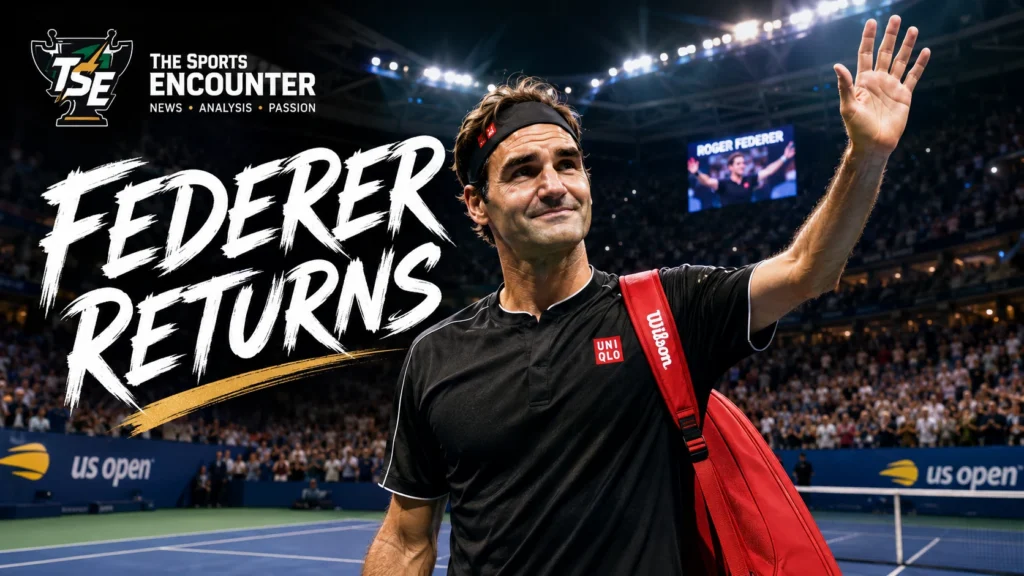
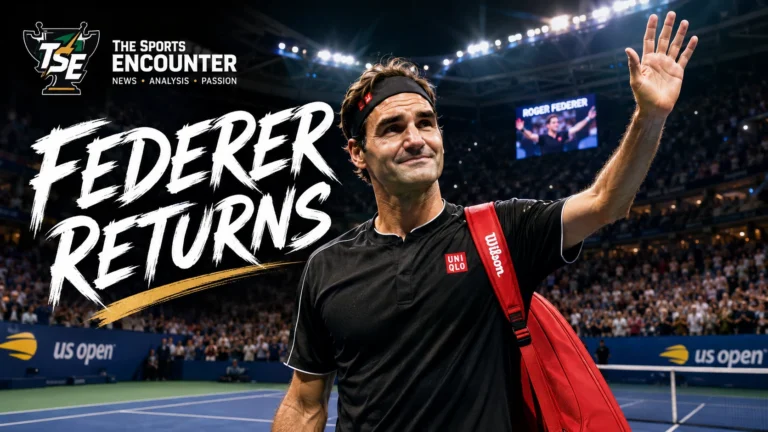
Roger Federer is coming back to Arthur Ashe Stadium.

Not for another US Open title run. Not for a wild card. Not for an attempt to reverse retirement.

Federer will return to the court at Flushing Meadows on Tuesday night for a special exhibition that gives New York something it never properly received when one of the greatest players in tennis history disappeared from its Grand Slam stage seven years ago.

The event, officially titled “Roger Federer: An Icon Returns to New York,” brings Federer together with fellow US Open champions Andy Roddick, Andre Agassi and John McEnroe inside Arthur Ashe Stadium on August 25.

For Federer, however, the evening carries far more meaning than another legends exhibition.

His last US Open appearance came in 2019, when Grigor Dimitrov defeated him in five sets in the quarterfinals. At the time, there was no reason for the crowd to treat it as goodbye.

Federer was expected back.

He never returned as a player.

The COVID-disrupted 2020 season passed without him in New York. His final Grand Slam appearance came at Wimbledon in 2021. Persistent knee problems eventually closed the competitive chapter of a career that had given the US Open one of its most dominant eras.

Tuesday therefore provides something remarkably rare in professional sport: an opportunity to give a great career the farewell one of its most important venues never knew it was missing.

The official US Open Federer exhibition page confirms that the five-time champion will return to Arthur Ashe Stadium alongside Roddick, Agassi and McEnroe.

Roger Federer Returns to US Open: Key Details

Event Roger Federer: An Icon Returns to New York
Date Tuesday, August 25, 2026
Venue Arthur Ashe Stadium, Flushing Meadows
Participants Roger Federer, Andy Roddick, Andre Agassi, John McEnroe
Federer’s last US Open match 2019 quarterfinal vs Grigor Dimitrov
US Open titles 5
Consecutive US Open titles 5, from 2004 through 2008
Singles main draw begins August 30, 2026

New York Never Knew It Was Saying Goodbye in 2019

This is what separates Federer’s return from a routine retired-champion exhibition.

There was no farewell ceremony in 2019.

No prolonged standing ovation built around the knowledge that this would be the last time.

No final walk around Arthur Ashe Stadium.

No microphone waiting for Federer to thank a New York crowd that had watched him dominate the tournament for more than a decade.

Instead, there was a quarterfinal defeat.

Dimitrov beat Federer 3-6, 6-4, 3-6, 6-4, 6-2.

Federer was 38 years old, but he remained a legitimate Grand Slam contender. Earlier that summer, he had held championship points against Novak Djokovic in the Wimbledon final.

The assumption that Federer would return to New York was entirely reasonable.

History went another way.

The pandemic reshaped the 2020 season.

Knee surgery reshaped Federer’s career.

By the time retirement became reality in 2022, Flushing Meadows had already gone three years without seeing him compete.

That left the US Open with an unusual piece of unfinished business.

One of the most important champions in tournament history had never really said goodbye to the place where he once seemed almost unbeatable.

Federer Says the Return Gives Him the Goodbye He Never Had

Federer understands the unfinished nature of the story himself.

Speaking in New York before the exhibition, he described the night as an opportunity to finally thank the crowd properly.

“It really gives me a true opportunity to say thank you, goodbye.”

Reuters reported from Flushing Meadows that Federer admitted feeling nervous about playing again after such a long absence from full sets, while also making clear that his return should not be interpreted as the beginning of a competitive comeback.

That distinction is important.

This is not a comeback disguised as nostalgia.

It is closure.

When Federer was asked whether Serena Williams’ return to competition might tempt him into accepting a US Open singles wild card, his answer was emphatic.

There will be no Federer comeback to the professional tour.

There will simply be one more Federer night in New York.

Five Straight US Open Titles Still Separate Federer From Everyone Else

The farewell matters because Federer’s relationship with the US Open was extraordinary even by the standards of his career.

He won the men’s singles championship five consecutive times between 2004 and 2008.

No other man or woman has matched that streak during the Open Era.

Year Final Opponent Result
2004 Lleyton Hewitt Federer won 6-0, 7-6, 6-0
2005 Andre Agassi Federer won in four sets
2006 Andy Roddick Federer won in four sets
2007 Novak Djokovic Federer won in straight sets
2008 Andy Murray Federer won 6-2, 7-5, 6-2

The US Open’s official Federer record archive lists him alongside Pete Sampras and Jimmy Connors with five Open Era men’s singles championships, but Federer stands alone in winning all five consecutively.

Chris Evert came closest in the Open Era with four consecutive women’s titles from 1975 through 1978.

Among the men, John McEnroe won three straight from 1979 through 1981.

Ivan Lendl won three from 1985 through 1987.

Federer won five.

The Opponents Make Federer’s Five-Year Run Even More Impressive

Federer’s streak was not built during an empty period of men’s tennis.

His championship opponents tell the opposite story.

Lleyton Hewitt was already a former world No. 1 and US Open champion.

Andre Agassi was one of the defining players of the previous generation.

Andy Roddick carried the American challenge and possessed one of the most destructive serves tennis had seen.

Novak Djokovic was beginning the rise that would eventually transform the historical record book.

Andy Murray would become a multiple Grand Slam champion and world No. 1.

Federer beat all five during one uninterrupted championship streak.

Forty Consecutive Wins Turned New York Into Federer Territory

The five championships only tell part of the story.

Federer won 40 consecutive US Open matches between the beginning of his 2004 championship run and the 2009 final.

Juan Martín del Potro finally stopped him in one of the defining finals of that era, winning in five sets after Federer came within one match of a sixth consecutive championship.

That defeat ended the title streak.

It did not end Federer’s relevance in New York.

He reached another final in 2015 before losing to Djokovic and continued making deep runs until his final appearance four years later.

Federer Returns While Djokovic Is Still Chasing History

The timing creates an extraordinary generational contrast.

Federer returns as part of the US Open’s history.

Djokovic remains part of its competitive present.

The Sports Encounter recently examined Djokovic’s latest North American hard-court return and the US Open stakes surrounding it.

The connection is difficult to ignore.

Federer spent years establishing records that appeared almost impossible to reach.

Djokovic spent much of the following decade reaching and surpassing many of them.

One Federer mark still appears unusually secure.

Five consecutive US Open singles titles.

Since Federer’s championship run ended, no man has won even two consecutive US Open singles titles.

That gives the record a different weight almost two decades later.

The Current US Open Looks Nothing Like Federer’s Final One

The tournament Federer returns to in 2026 has changed dramatically from the one he left in 2019.

Carlos Alcaraz enters as defending men’s champion.

Aryna Sabalenka arrives as defending women’s champion.

The North American hard-court swing has produced new contenders and disrupted the hierarchy immediately before New York.

The Sports Encounter’s complete US Open 2026 preview examines the schedule, title favorites, Fan Week, mixed doubles, injury questions and major storylines surrounding the final Grand Slam of the season.

Federer’s place inside that landscape is unique.

He cannot win the tournament.

He can remind everyone what winning it five years in succession once looked like.

Coco Gauff Arrives in New York With Cincinnati Momentum

The women’s side of the US Open has also changed significantly during the final warm-up event.

Coco Gauff captured Cincinnati by defeating Jessica Pegula, strengthening her position among the leading American contenders entering New York.

The Sports Encounter’s Coco Gauff Cincinnati title analysis examines how her victory, Pegula’s run and the performances of Iga Swiatek, Aryna Sabalenka, Elena Rybakina and Linda Noskova reshaped the women’s US Open race.

That competitive story will dominate the next three weeks.

Federer’s exhibition sits alongside it rather than competing with it.

New York is simultaneously celebrating its past and preparing to determine its next champions.

Arthur Fils Brings a New Generation Into the Men’s Conversation

The men’s field provides an even clearer illustration of how much time has passed since Federer last competed here.

Arthur Fils won his first Masters 1000 championship in Cincinnati, defeating Frances Tiafoe in the final and moving himself into a far more prominent position before the US Open.

Our Arthur Fils Cincinnati championship analysis examines what the title means for a men’s field increasingly shaped by players who were still teenagers or junior prospects during Federer’s final years.

That is another reason Tuesday night carries weight.

The sport has moved on.

Federer has too.

The exhibition allows the two timelines to meet briefly without pretending they still belong to the same competitive era.

Brandon Nakashima Is Another Sign of the Changing ATP Order

American tennis arrives at its home Grand Slam with several intriguing contenders.

Brandon Nakashima entered Cincinnati after reaching the Montreal final and then continued his run by defeating Taylor Fritz to reach another Masters semifinal.

The Sports Encounter covered that breakthrough in our report on Nakashima’s Cincinnati victory over Fritz.

Federer once spent his US Open years trying to stop American champions such as Roddick and Agassi.

Now Roddick and Agassi will be standing on the same side of the generational divide as Federer while a new American group prepares for the main draw.

Tuesday Also Connects Federer’s Return to the New Mixed-Doubles Experiment

Federer’s exhibition is not the only major Arthur Ashe Stadium attraction during Fan Week.

The redesigned US Open Mixed Doubles Championship is bringing singles superstars and established doubles specialists together under a shortened scoring format.

The Sports Encounter’s Cincinnati doubles wrap and US Open mixed-doubles preview explains how the competition fits into New York’s expanded Fan Week program.

That creates an unusual day at Arthur Ashe Stadium.

The current generation will compete for an official championship.

Later, Federer and three fellow US Open champions will return for an exhibition built almost entirely around history and memory.

Federer and Serena Williams Return for Very Different Reasons

Serena Williams’ competitive return adds another layer to the day.

Two athletes who defined overlapping generations of tennis are back at Flushing Meadows at almost the same time, but their situations are fundamentally different.

Williams has returned to competition.

Federer has not.

That distinction is why the wild-card question directed at Federer was inevitable and why his rejection was so decisive.

His body has already made the competitive decision for him.

The exhibition asks something far less demanding.

Hit the ball.

Enjoy Arthur Ashe Stadium.

Allow New York to say goodbye properly.

Federer Admits the Tennis Itself Contains Plenty of Uncertainty

There is still a sporting curiosity surrounding the event.

Federer told reporters that he has barely played full sets in recent years and does not know exactly what his level will look like under the Arthur Ashe Stadium lights.

That uncertainty makes the evening more interesting rather than less.

For most of his career, Federer made technically difficult tennis appear unusually simple.

Tuesday will show a different version.

The movement will not resemble 2006.

The recovery speed will not resemble 2008.

The timing may occasionally disappear.

None of those things can reduce what the crowd remembers.

Injuries Explain Why Federer Has No Interest in a Real Comeback

Federer’s final competitive years were repeatedly interrupted by knee problems.

That history is why comparisons with other returning stars can become misleading.

A professional comeback requires far more than the ability to hit elite-quality groundstrokes for an exhibition.

Best-of-five-set Grand Slam tennis demands repeated explosive movement, recovery between matches and the ability to trust the body under stress.

Federer has no interest in testing those limits again.

Injury uncertainty remains one of the major themes of the current men’s US Open too. The Sports Encounter followed Jannik Sinner’s knee problems during the North American swing, another reminder of how physically unforgiving modern elite tennis remains.

Federer already lived through that battle.

He has no reason to restart it.

New York Was Different From Wimbledon, and That Is Why It Mattered

Federer will always be associated most strongly with Wimbledon.

Eight titles make that unavoidable.

The US Open revealed another side of his greatness.

New York asks players to adapt.

Matches can start late.

Conditions can be hot and humid.

The crowds are loud.

Aircraft pass overhead.

Movement and noise surround the court.

The tournament rewards players who can maintain internal calm without demanding external calm.

Federer became exceptional at that.

His five-year run was not elegance protected from chaos.

It was elegance functioning inside chaos.

The 2008 Championship May Be the Most Important of Federer’s Five

The first four championships established the dynasty.

The fifth protected Federer’s season.

He arrived in New York in 2008 after losing his Wimbledon crown to Rafael Nadal in one of the greatest matches ever played and after Djokovic had won the Australian Open.

Questions were beginning to emerge about whether Federer’s dominance was ending.

He answered by winning another US Open.

His path included a five-set fourth-round battle against Igor Andreev, victory over Djokovic in the semifinals and a straight-sets win over Andy Murray in the final.

The title gave Federer five consecutive championships in New York.

He eventually extended the winning streak to 40 matches before Del Potro stopped him in 2009.

The Exhibition Reunites Four Different Chapters of US Open History

The supporting cast makes Tuesday considerably more interesting than a Federer solo appearance.

Andy Roddick

Roddick won the 2003 US Open and remains one of the central figures of the American generation Federer repeatedly had to overcome.

Federer defeated him in the 2006 US Open final and repeatedly stood between Roddick and additional major championships.

The statistical rivalry was one-sided.

The contrast in personalities and styles made it memorable.

Andre Agassi

Agassi won the US Open in 1994 and 1999 and faced Federer in the 2005 final.

That match already felt generational at the time.

Agassi represented one era of American tennis.

Federer represented the new global order.

More than two decades later, they return to the same stadium together.

John McEnroe

McEnroe won four US Open singles titles and remains one of the personalities most closely connected with New York tennis.

His presence stretches the exhibition’s historical timeline even further.

Tuesday will connect multiple generations of US Open champions on the same court.

The Ticket Market Shows Federer’s Pull Has Barely Faded

Retirement has done little to weaken Federer’s appeal.

Reuters reported that resale listings for the exhibition had climbed above $2,000 on Ticketmaster ahead of the event.

That is remarkable for an exhibition during Fan Week.

Fans are not paying for ranking points.

They are not buying the possibility of another Federer Grand Slam title.

They are buying another opportunity to see the service motion, the forehand, the one-handed backhand and the movement that defined so many nights at Arthur Ashe Stadium.

They are buying one more memory.

Federer’s Return Comes During a North American Hard-Court Reset

The current tennis season has produced its own upheaval before New York.

Gauff won Cincinnati.

Fils won the men’s title.

Nakashima pushed deeper into the Masters conversation.

Elena Rybakina also spent the North American swing building Grand Slam momentum before Cincinnati, including her comeback victory over Gauff in Toronto. The Sports Encounter covered that match in our Rybakina-Gauff National Bank Open semifinal report.

Those are the names occupying the current competitive conversation.

Federer no longer needs to be part of it.

His relevance comes from the standard against which generations continue to be measured.

Federer’s US Open Dynasty by the Numbers

Statistic Federer Record
US Open singles titles 5
Championship years 2004, 2005, 2006, 2007, 2008
Consecutive titles 5
Consecutive US Open match wins at peak 40
Consecutive finals 6, from 2004 through 2009
Open Era record for consecutive US Open titles Yes
Last US Open appearance 2019
Last US Open result Quarterfinal

TSE Analysis: The Fact This Is Not a Comeback Makes It Better

Tennis does not need Roger Federer to return to professional competition.

His career does not contain an unfinished statistical argument.

Twenty Grand Slam singles titles changed the sport.

Eight Wimbledon championships established a record.

Five consecutive US Opens created a streak nobody has matched during the Open Era.

His rivalry with Rafael Nadal transformed global interest in tennis, and Djokovic’s emergence turned that rivalry into the defining three-way competition of modern men’s tennis.

Nothing Tuesday night can materially add to those achievements.

That is precisely why the exhibition works.

The purpose is not to manufacture another competitive chapter.

It is to give the previous one its missing final page.

New York never knew Federer’s 2019 defeat was goodbye.

This time, everybody knows.

Arthur Ashe Stadium Gets One More Federer Night

The strokes may not be as sharp.

The movement will not look like Federer at his physical peak.

Federer himself has admitted he does not know exactly how the tennis will feel after such a long period away from full-set competition.

None of that is likely to matter when he walks onto Arthur Ashe Stadium.

The crowd will remember.

It will remember the five championships.

It will remember the 40-match winning streak.

It will remember Federer beating Agassi, Roddick, Djokovic and Murray during an era when September in New York so often ended with the same man holding the trophy.

And this time, when Federer leaves the court, everyone will understand what the moment means.

That is the difference between 2019 and 2026.

The Sports Encounter Verdict

Roger Federer’s return to the US Open matters because Federer and New York had unfinished business.

His competitive relationship with Flushing Meadows ended without ceremony even though few players have shaped the tournament more profoundly.

Five consecutive championships remain unmatched in the Open Era.

Forty consecutive victories turned the US Open into his territory for half a decade.

Six straight finals kept him at the center of the tournament even after the winning streak ended.

Then, after a quarterfinal loss in 2019, he simply never came back.

Tuesday changes the ending.

Federer will share Arthur Ashe Stadium with Roddick, Agassi and McEnroe, three champions who understand exactly what New York means.

The current generation will compete around them for a Grand Slam Federer once owned.

For one evening, however, the draw can wait.

Arthur Ashe Stadium belongs to Roger Federer again.

Frequently Asked Questions

Is Roger Federer returning to play at the 2026 US Open?

Federer is returning to the court at the US Open for a special exhibition on August 25, but he is not returning to professional singles competition.

When is Roger Federer playing at the US Open?

The “Roger Federer: An Icon Returns to New York” exhibition takes place Tuesday, August 25, inside Arthur Ashe Stadium.

Who will play alongside Roger Federer?

Federer will be joined by Andy Roddick, Andre Agassi and John McEnroe.

When did Roger Federer last play at the US Open?

Federer last competed at Flushing Meadows in 2019, losing to Grigor Dimitrov in the quarterfinals.

How many US Open titles did Federer win?

Federer won five US Open men’s singles titles.

Which years did Federer win the US Open?

He won five consecutive championships from 2004 through 2008.

Does Federer hold the record for most consecutive US Open titles?

Yes. Federer is the only player, man or woman, to win five consecutive US Open singles championships during the Open Era.

Will Roger Federer accept a US Open singles wild card?

No. Federer has emphatically ruled out a return to professional singles competition.

When does the 2026 US Open singles main draw begin?

The men’s and women’s singles main draws begin Sunday, August 30.

Miley Rumer is a St. Clairsville, Ohio-based sports journalist and The Sports Encounter’s U.S. correspondent, covering the NHL, NBA, NFL, MLB, MLS, and major sporting stories across North America. Her work focuses on player performance, team identity, rivalries, roster decisions, tournament developments, and the human stories that shape how fans experience sport. At The Sports Encounter, Miley contributes breaking news, match coverage, analysis, and feature stories across American and international sport, including major soccer and tennis events. Her reporting combines clear news judgment with performance context, historical perspective, and an understanding of the fan conversations surrounding teams and athletes. Based in the United States, she brings a grounded North American perspective to coverage of the leagues, competitions, and personalities driving global sports interest.

Breaking News

Lions FC Destroy North Sunshine Eagles 4-0 as Australia Cup Fairytale Ends

Lions FC powered into the Hahn Australia Cup 2026 semifinals with a 4-0 win over North Sunshine Eagles, ending the tournament’s standout underdog run.

Published

on

Lions FC players celebrate a 4-0 Australia Cup quarterfinal win over North Sunshine Eagles at a floodlit stadium.

Lions FC are through to the Hahn Australia Cup 2026 semifinals after overwhelming North Sunshine Eagles 4-0 at Luxury Paints Stadium, ending one of the competition’s great underdog runs and moving the Queensland club within one victory of the final.

North Sunshine Eagles had spent the past month proving that knockout football could bend around them. They won away from home on their national-stage debut, survived 120 scoreless minutes against the previous season’s finalists and watched goalkeeper Rory Brian repeatedly rescue their campaign when elimination appeared close.

Lions FC never allowed this quarterfinal to develop into that kind of contest.

The NPL Queensland side attacked the match aggressively, converted their superiority into a commanding advantage and completed a 4-0 victory that sends them into the Australia Cup semifinals for the first time.

Football Australia’s official Australia Cup match report confirmed the comprehensive victory and Lions’ progression to the final four.

For readers who followed this matchup from the beginning, The Sports Encounter’s Lions FC vs North Sunshine Eagles quarterfinal preview identified the central danger before kickoff: if North Sunshine could survive the early pressure, the psychology of the match might begin shifting toward the underdogs.

Lions made sure that never happened.

Lions FC 4-0 North Sunshine Eagles: Match at a Glance

Detail Information
Competition Hahn Australia Cup 2026
Round Quarterfinal
Result Lions FC 4-0 North Sunshine Eagles
Venue Luxury Paints Stadium, Queensland
Lions FC level NPL Queensland
North Sunshine Eagles level VPL1
Outcome Lions FC advance to Australia Cup semifinals
Semifinal opponent Winner of Preston Lions vs South Melbourne

The Cup Match North Sunshine Needed Never Developed

The most revealing part of the result is not simply that Lions scored four goals.

It is how completely they removed the conditions that had allowed North Sunshine to become one of the stories of the tournament.

The Eagles’ Round of 16 victory against Heidelberg United had been built around survival, patience and the gradual accumulation of belief.

They remained scoreless for 120 minutes against the 2025 finalists, survived an 80th-minute penalty and eventually won 4-3 in the shootout after Rory Brian produced an extraordinary goalkeeping performance.

The official Australia Cup account of the Heidelberg upset recorded Brian saving the regulation-time penalty and another two during the shootout.

That victory gave North Sunshine a psychological blueprint for the quarterfinal.

Stay alive. Absorb pressure. Let the favorite become frustrated. Give Brian opportunities to make saves. Wait for the game to become emotionally uncomfortable.

Lions destroyed that blueprint by making their superiority count early enough that North Sunshine never reached the stage where belief could begin influencing the contest.

TSE Analysis: Lions Learned the Most Important Lesson From Heidelberg

The warning signs were available before kickoff.

Heidelberg had discovered what happens when a stronger side allows North Sunshine to remain alive.

Even after the Eagles failed to create sustained attacking pressure, the longer the score remained level, the more dangerous the tie became for the favorite. By the time penalties arrived, North Sunshine were competing in precisely the environment they wanted.

Lions approached the problem differently.

They did not treat possession as control by itself. They used territorial pressure to force North Sunshine deeper and then turned that pressure into goals rather than allowing the visitors to settle into another defensive marathon.

That distinction explains why this quarterfinal became so different from the Heidelberg match.

The Eagles could survive without much of the ball.

They could not survive while conceding repeatedly.

Lions FC Are No Longer a Cute Australia Cup Story

There is another reason this 4-0 result deserves attention.

Lions FC have now eliminated Perth Glory, Melbourne City and North Sunshine Eagles during their national-round campaign.

The first victory required penalties.

The second was a 2-0 win against Melbourne City.

The third has produced four unanswered goals in an Australia Cup quarterfinal.

That progression matters.

Lions initially demonstrated that they could survive against professional opposition. They then showed they could beat an A-League side in regulation. Now they have handled the pressure of entering a national quarterfinal as favorites.

Those are three very different knockout tests.

The Sports Encounter highlighted that development in our quarterfinal analysis before the match, noting that the 2-0 victory over Melbourne City had changed the meaning of Lions’ campaign.

This result changes it again.

Being Favorites Created a Different Kind of Pressure

Against Perth Glory and Melbourne City, Lions could embrace the role normally occupied by Member Federation clubs in the Australia Cup.

The professional team carried the expectation.

Lions could attack the opportunity.

North Sunshine reversed that dynamic.

Suddenly Lions were the established NPL leaders playing at home against a club from Victoria’s second state tier. Their previous Cupsets meant very little once they became the team expected to progress.

That can be an uncomfortable transition for an underdog.

Some teams thrive when they have nothing to lose but become hesitant once they are asked to control a knockout match.

Lions showed no such hesitation.

The 4-0 scoreline is therefore evidence of more than attacking quality. It shows a team capable of changing psychological roles without losing its football identity.

North Sunshine’s Fairytale Deserves More Than the Final Score

A four-goal defeat is a brutal ending, but it should not become the defining image of North Sunshine’s tournament.

The Eagles were making their first appearance on the national stage.

They opened by traveling to South Australia and defeating FK Beograd 3-2 in a match where all five goals arrived after halftime.

Football Australia’s official Round of 32 review documented that breakthrough victory, which immediately gave North Sunshine a place in the national tournament’s wider story.

Then came Heidelberg.

The Eagles faced the 2025 finalists, survived extra time and became only the second second-tier Member Federation club in Australia Cup history to reach the final eight.

That achievement cannot be erased by what happened in Queensland.

North Sunshine arrived at the quarterfinal because they repeatedly earned the right to be there.

Rory Brian Finally Met a Problem Goalkeeping Could Not Solve

Brian entered the quarterfinal as arguably the most important individual player in North Sunshine’s run.

Against Heidelberg, he had saved a penalty during regulation and another two in the shootout.

That performance created a fascinating question before the Lions match.

Could he keep North Sunshine alive long enough for doubt to creep into the home side?

The answer was no, but that should not be interpreted as a failure of the goalkeeper.

A keeper can rescue a team from individual chances. It becomes considerably harder when the opponent establishes sustained attacking control and repeatedly reaches dangerous areas.

North Sunshine needed the entire defensive structure to survive.

Lions broke it.

The 4-0 Result Stands Apart From the Other Quarterfinals

The first three Australia Cup quarterfinals have produced three very different routes into the semifinals.

Sydney FC became the first team through after Takahiro Sekine’s goal secured a tense 1-0 victory over SD Raiders. The Sports Encounter covered how the NPL NSW side made the A-League club work for almost every minute in our Sydney FC vs SD Raiders quarterfinal report.

Melbourne Victory required even more patience.

APIA Leichhardt kept them scoreless through 90 minutes before substitute Harry Sawyer finally found the breakthrough in extra time. Our Melbourne Victory vs APIA Leichhardt report examined how Victory survived a genuine knockout test before securing their semifinal place.

Lions have taken the opposite route.

They have produced the most emphatic quarterfinal result of the tournament so far.

Australia Cup 2026 Semifinal Picture

Quarterfinal Result/Status Semifinal Outcome
SD Raiders vs Sydney FC Sydney FC won 1-0 Sydney FC advanced
APIA Leichhardt vs Melbourne Victory Melbourne Victory won 1-0 after extra time Melbourne Victory advanced
Lions FC vs North Sunshine Eagles Lions FC won 4-0 Lions FC advanced
Preston Lions vs South Melbourne August 26 Winner faces Lions FC

The semifinal bracket has therefore begun taking shape.

Sydney FC and Melbourne Victory will meet in one semifinal, creating a heavyweight A-League contest after both professional clubs survived difficult quarterfinals.

Lions FC will face the winner of Preston Lions vs South Melbourne in the other semifinal.

Lions Are Guaranteed a Member Federation Semifinal

The structure of the remaining bracket makes Lions’ achievement even more interesting.

Preston Lions and South Melbourne are both Member Federation clubs.

Whoever emerges from that final quarterfinal will meet Lions rather than an A-League opponent.

That guarantees a Member Federation club a place in the 2026 Australia Cup final.

For Lions, the opportunity is enormous.

They have already beaten two professional opponents, but their route to the final will now run through another club outside the A-League.

That does not make the semifinal easy.

It makes it historic.

Preston Lions vs South Melbourne Now Carries Another Layer

The final quarterfinal on August 26 will determine who travels into the other side of the semifinal bracket.

Preston have already produced one of the tournament’s major Cupsets by eliminating 2025 Australia Cup winners Newcastle Jets before later defeating Brunswick Juventus 4-1.

South Melbourne have their own giant-killing credentials after eliminating Adelaide United.

Either opponent will arrive against Lions with evidence that they can survive national knockout football.

That means Lions cannot interpret the 4-0 quarterfinal as proof that the semifinal will follow the same pattern.

The challenge changes again.

The Sydney FC-Melbourne Victory Semifinal Creates a Fascinating Contrast

One half of the bracket will contain two of Australia’s biggest professional clubs.

The other will guarantee a Member Federation finalist.

That is close to an ideal Australia Cup semifinal structure.

Sydney and Victory bring A-League history, professional squads and one of Australian football’s most recognizable rivalries.

The Sports Encounter’s APIA vs Melbourne Victory quarterfinal preview had already identified the possibility of a Sydney-Victory semifinal before Victory survived at Leichhardt Oval.

Now it is confirmed.

On the opposite side, Lions and either Preston or South Melbourne will carry the Member Federation game to within 90 minutes of the trophy match.

Why Lions’ Route Matters to the Australia Cup

The Australia Cup works best when the national hierarchy becomes temporarily negotiable.

That does not mean every A-League club needs to lose.

It means clubs from different levels need a credible route to competing with one another.

Lions have provided one of the clearest examples in 2026.

Perth Glory could not eliminate them.

Melbourne City could not eliminate them.

North Sunshine could not turn the quarterfinal into another underdog survival story.

Now Lions are one match away from the final.

The tournament’s official fixtures and results center will confirm the final semifinal matchup once Preston Lions and South Melbourne complete the quarterfinal stage.

The Continental Prize Is Getting Closer

The stakes also extend beyond the Australia Cup trophy.

The competition provides a pathway into Asian football, which gives the later rounds unusual significance for Member Federation clubs.

For an A-League team, continental competition is part of the professional ecosystem.

For a club such as Lions FC, the possibility of reaching that environment would carry an entirely different scale of sporting significance.

The Sports Encounter has followed Asian soccer beyond Australia throughout the season, including the growing influence of the AFC within global football’s changing power structure.

Lions are still several steps away from turning their Cup run into continental football.

After Tuesday night, however, those steps no longer feel theoretical.

TSE Verdict: Lions Solved the Problem Before It Became Dangerous

The most impressive part of Lions’ quarterfinal was their refusal to allow North Sunshine’s previous achievements to dictate the emotional shape of the match.

The Eagles had already demonstrated that they could survive pressure.

They had shown they could win away from home.

They had beaten the previous year’s finalists.

They had a goalkeeper who had already changed one knockout tie almost single-handedly.

All of that became dangerous only if Lions allowed the game to remain close.

They did not.

That is the difference between simply being the stronger team and performing like one when elimination is possible.

Lions have now survived penalties against Perth Glory, beaten Melbourne City in regulation and demolished North Sunshine while carrying the expectation of favoritism.

Three knockout rounds have asked three different questions.

So far, Lions have answered every one.

What Happens Next?

Lions FC can now watch Wednesday’s final quarterfinal knowing exactly what awaits.

Preston Lions or South Melbourne will stand between them and the Australia Cup final.

Sydney FC and Melbourne Victory occupy the other side of the semifinal bracket.

For North Sunshine Eagles, the national run ends after two victories, one unforgettable penalty shootout and a first appearance that took them further than almost anyone could reasonably have expected.

The Sports Encounter will continue following the tournament through the final quarterfinal and both semifinals as the 2026 Australia Cup moves toward its decisive stage.

Frequently Asked Questions

Who won Lions FC vs North Sunshine Eagles?

Lions FC defeated North Sunshine Eagles 4-0 in the Hahn Australia Cup 2026 quarterfinal at Luxury Paints Stadium.

Did Lions FC reach the Australia Cup semifinals?

Yes. The victory sends Lions FC into the Australia Cup semifinals for the first time.

Who will Lions FC play in the semifinal?

Lions FC will face the winner of the Preston Lions vs South Melbourne quarterfinal.

Who are the other Australia Cup semifinalists?

Sydney FC and Melbourne Victory have already qualified and will face each other in one semifinal.

How did North Sunshine Eagles reach the quarterfinal?

North Sunshine defeated FK Beograd 3-2 in the Round of 32 before eliminating 2025 finalists Heidelberg United 4-3 on penalties following a 0-0 draw after extra time.

Was this North Sunshine Eagles’ first Australia Cup national-stage campaign?

Yes. The Eagles won two matches during their first appearance on the national stage before their run ended against Lions FC.

Which A-League clubs have Lions FC beaten in the 2026 Australia Cup?

Lions eliminated Perth Glory on penalties in the Round of 32 and then defeated Melbourne City 2-0 in the Round of 16.

What was the biggest Australia Cup quarterfinal win so far in 2026?

Lions FC’s 4-0 victory over North Sunshine Eagles is the largest winning margin through the first three quarterfinals.

When is Preston Lions vs South Melbourne?

The final Australia Cup 2026 quarterfinal is scheduled for August 26, with the winner advancing to face Lions FC.

Continue Reading

Breaking News

Kristjan Asllani Opens Door to Al-Jazira Move as UAE Club Advances Inter Talks

Al-Jazira have advanced talks with Inter for Kristjan Asllani, with the Albania midfielder reportedly open to a move to Abu Dhabi.

Jawad Hussain | The Sports Encounter

Published

on

Kristjan Asllani pictured in an Inter Milan setting as Al-Jazira pursue the Albania midfielder in transfer talks.

Al-Jazira’s pursuit of Inter Milan midfielder Kristjan Asllani has accelerated, with the Albania international reportedly open to moving to Abu Dhabi as negotiations continue over a possible transfer to the UAE Pro League.

Al-Jazira are trying to add another European-based player in his prime years to a squad carrying serious domestic and continental ambitions.

The Abu Dhabi club have moved for Kristjan Asllani, the 24-year-old Albania midfielder who remains under contract with Inter Milan after spending time away from San Siro.

Reports around the negotiations have developed quickly. Al-Jazira have progressed beyond an initial expression of interest, while Asllani is now reportedly receptive to the possibility of continuing his career in the UAE.

No completed transfer has been officially announced at the time of publication, so the current position remains clear: Al-Jazira are in advanced discussions, Asllani is reportedly open to the move, but the deal is not yet complete.

Kristjan Asllani to Al-Jazira: Transfer Status

Detail Current Situation
Player Kristjan Asllani
Age 24
Nationality Albania
Current club Inter Milan
Interested club Al-Jazira
League ADNOC Pro League
Position Central/deep-lying midfielder
Negotiations Advanced, according to current transfer reporting
Player stance Reportedly open to the move
Officially completed? No

Why Al-Jazira’s Move for Asllani Deserves Attention

Asllani is not the type of player Gulf clubs once waited until the later stages of a European career to recruit.

He is 24, has played in Serie A, has trained and competed inside Inter’s first-team environment and already carries senior international experience with Albania.

The official Lega Serie A player profile lists Asllani as an Albania international midfielder born in March 2002, underlining just how young he remains compared with the veteran-profile signings historically associated with Gulf football.

That age profile is one of the most important parts of the story.

Al-Jazira would be acquiring a player who could potentially remain central to the squad for several seasons rather than providing a short-term name-recognition boost.

Al-Jazira Are Building in a Much More Competitive UAE Market

The timing of the pursuit matters because the UAE Pro League has started the new season with several clubs showing serious ambition.

The official UAE Pro League Al-Jazira profile lists the Abu Dhabi club among the competition’s major institutions, playing at Mohammed bin Zayed Stadium.

Al-Jazira’s domestic position means they are competing in a league where Al-Ain, Shabab Al-Ahli, Al-Wasl, Al-Nasr and other clubs also expect to challenge near the top.

The Sports Encounter recently examined that competitiveness after Al-Nasr defeated Al-Wahda 1-0 in the ADNOC Pro League, a result that highlighted how quickly pressure can build during the opening weeks of the UAE season.

Al-Jazira therefore cannot treat recruitment as a branding exercise. Every major signing has to improve the team structurally.

Asllani Would Strengthen the Part of the Team That Controls Matches

Asllani’s profile is particularly useful because he operates through central midfield rather than relying on explosive attacking numbers.

He is comfortable receiving the ball in deeper areas, circulating possession and helping a team progress through the first two lines of pressure.

Those qualities matter against opponents who defend compactly and force technically stronger teams to create through patient build-up.

Al-Jazira already possess attacking talent. A midfielder capable of organizing possession could improve the relationship between the defensive line and the forwards.

What Asllani could bring

  • Calm possession from deep midfield.
  • Progressive passing through central areas.
  • Experience against high-level European opposition.
  • Positional discipline when Al-Jazira dominate the ball.
  • International experience despite being only 24.

That combination makes him a more interesting target than a purely commercial marquee signing.

His Serie A Experience Gives the Deal Added Weight

Asllani emerged in Italy and built his reputation as a technically composed midfielder before joining Inter.

Official Lega Serie A match records also show his ability to influence games directly. He scored for Inter against Hellas Verona in May 2025 and completed 93 percent of his passes in that match, according to the competition’s official data.

Those numbers offer a useful glimpse of the type of midfielder Al-Jazira are pursuing.

His role is built around control and decision-making rather than constant attacking involvement.

That kind of football intelligence often translates particularly well into leagues where stronger teams spend large stretches of matches facing organized defensive blocks.

UAE Clubs Are Operating in a Much Bigger Gulf Football Market

Al-Jazira’s pursuit also sits inside a wider regional shift.

Saudi Arabia’s enormous recruitment drive has changed the transfer environment across the Gulf.

UAE clubs may not spend at the same scale, but they are increasingly competing for international talent who can improve the level of domestic football.

The Sports Encounter recently examined that regional evolution in our Gulf Champions League 2026-27 draw analysis, where UAE, Saudi and Qatari clubs were placed into direct regional competition.

The importance of those comparisons should increase as clubs from neighboring leagues meet more regularly.

Better recruitment gives UAE teams a stronger chance of holding their own against Saudi and Qatari opposition rather than relying exclusively on domestic success.

Al-Jazira Have Already Been Tested by Saudi Opposition

Al-Jazira know how demanding that regional comparison can become.

They were beaten 4-1 by Al-Ittihad in the AFC Champions League Elite preliminary stage earlier this month.

The Asian Football Confederation’s official match report confirmed that Steven Bergwijn scored twice as Al-Ittihad eliminated the Abu Dhabi club at Mohammed bin Zayed Stadium.

That defeat gave Al-Jazira a direct look at the level of individual quality Saudi clubs can now deploy.

It also creates context for the Asllani pursuit.

If Al-Jazira want to compete more effectively against the strongest regional teams, adding technically secure players with European experience is a logical response.

Saudi Recruitment Has Changed Expectations Across the Region

The strongest example remains the Saudi Pro League.

Cristiano Ronaldo’s move to Al-Nassr changed global perceptions of the league and accelerated an extraordinary recruitment cycle.

The Sports Encounter examined that influence in our detailed look at Cristiano Ronaldo’s career and Saudi chapter.

The next phase has moved beyond superstar veterans.

Saudi clubs are increasingly pursuing players with major European value still remaining.

Al-Hilal’s attempt to sign Ollie Watkins from Aston Villa provided another example of a Gulf club targeting a Premier League player who remains capable of influencing elite-level football immediately.

Al-Jazira’s interest in Asllani follows the same underlying principle at a different financial scale.

The objective is sporting value now, with enough age on the player’s side to create value over several seasons.

The Gulf Transfer Market Is Becoming More Interconnected

Movement is also happening between Gulf leagues rather than only from Europe into the region.

That gives UAE clubs access to a much broader player pool than before.

Saudi clubs continue importing elite talent, while UAE teams can recruit directly from Europe or potentially benefit from players moving within the Gulf ecosystem.

The Sports Encounter has been tracking that development through regional transfer stories including Thomas Partey’s move to Al-Shabab and other major Saudi additions.

Those deals matter to UAE football because they raise the standard of opposition the country’s clubs may eventually face in regional and Asian competitions.

Continental Football Raises the Stakes for Al-Jazira

Al-Jazira’s ambitions cannot be judged only through the domestic league.

The club remains part of a UAE football system increasingly exposed to AFC competition.

The Sports Encounter’s coverage of the AFC’s growing influence inside global football governance showed how much Asian football has evolved politically as well as competitively.

At club level, the consequences are more straightforward.

UAE teams need deeper squads, stronger midfield control and enough quality to survive matches against opponents carrying substantial international experience.

Asllani would help Al-Jazira address exactly that type of challenge.

Al-Jazira’s History Creates Expectations

Al-Jazira are not approaching this season as a club simply trying to establish itself in the top flight.

They have won major domestic honors and previously competed regularly in Asia.

The UAE Pro League has also highlighted Al-Jazira among the competition’s historically successful clubs, including their record-setting points totals from previous championship seasons.

That history creates expectations whenever the club enters the transfer market.

A move for Asllani would therefore fit a club accustomed to thinking beyond short-term survival.

The UAE Needs More Players Arriving Before Their Final Career Phase

There is a broader league-level benefit if the transfer is completed.

A 24-year-old Albania international arriving from Inter’s books would send a different message about the UAE Pro League.

The league already has international recognition, but attracting more players in their prime years would strengthen its credibility.

That is one reason Saudi Arabia’s market has changed so dramatically.

Players no longer automatically view Gulf football only as the final stop of a career.

The Sports Encounter’s analysis of Matthias Jaissle’s success at Al-Ahli and subsequent European interest showed that career movement can also work in the opposite direction.

A player or coach can succeed in the Gulf and remain relevant to European football afterward.

Asllani’s International Experience Adds Another Layer

Asllani has already represented Albania at senior international level, giving him experience in matches where tactical discipline and controlled possession are especially important.

That background should help him adapt to games where Al-Jazira are expected to dominate but cannot afford careless turnovers.

International football also exposes players to different tactical structures and match rhythms, something that can be valuable inside a squad containing several nationalities.

Al-Jazira would therefore be recruiting experience beyond the number of club appearances alone.

Al-Jazira Cannot Call the Transfer Complete Yet

The most important editorial distinction remains the status of the deal.

Asllani is not yet an Al-Jazira player.

The clubs have not officially announced a completed transfer.

Negotiations can still change because of payment structures, contract clauses, medical examinations or the player’s final agreement.

That is why the language around this story matters.

Asllani is reportedly open to the move.

Al-Jazira are actively pursuing him.

The transfer has not been completed.

What Would the Transfer Mean for Inter?

For Inter, the move would provide clarity around a player whose route to regular first-team football has remained difficult.

Asllani has been part of elite squads but has often faced heavy competition for midfield minutes.

A permanent or structured move away could give him the regular role that has been difficult to secure in Milan.

Inter, meanwhile, would gain greater certainty over the composition of their midfield group.

The Sports Encounter’s coverage of the wider FIFA and AFC power struggle has shown how interconnected global football has become off the field. Transfer movement between Italy and the UAE is another example of that interconnected market at club level.

Why Al-Jazira Must Get the Structure Right

The financial details of any eventual agreement will matter almost as much as the player himself.

Al-Jazira need to balance immediate sporting improvement with long-term squad planning.

A player of Asllani’s age offers potential resale value and several productive seasons, but only if the contract structure remains sustainable.

That is why clubs increasingly use loans, purchase options and conditional obligations to distribute financial risk.

Until Al-Jazira or Inter publish official terms, any reported figures should remain clearly identified as reported rather than confirmed.

What Happens Next?

The next step should determine whether this becomes one of the UAE Pro League’s most interesting summer additions.

Al-Jazira have demonstrated serious interest.

Asllani is reportedly willing to consider Abu Dhabi.

The clubs still need to finish the contractual and financial work required to turn that interest into a completed transfer.

If agreement is reached, Asllani would arrive at a particularly interesting moment for Gulf football.

Saudi Arabia continues to raise the regional transfer ceiling, UAE clubs are strengthening in response and cross-border competitions are creating more direct comparisons between the leagues.

The Sports Encounter’s recent Gulf Champions League preview showed how frequently those comparisons will occur during the coming season.

Final Analysis

Kristjan Asllani would be a significant signing for Al-Jazira because of what he represents rather than simply where he currently plays.

He is 24, technically developed, internationally experienced and young enough to become part of a longer-term sporting plan.

For Al-Jazira, the attraction is obvious.

They would gain a midfielder capable of helping them control possession, organize attacks and compete more effectively against stronger regional opposition.

For Asllani, Abu Dhabi could provide the regular responsibility that has been difficult to guarantee inside Inter’s midfield hierarchy.

The negotiations have moved far enough to deserve serious attention.

They have not moved far enough to call the deal complete.

Frequently Asked Questions

Is Kristjan Asllani joining Al-Jazira?

Al-Jazira are in advanced talks over Asllani and the player is reportedly open to the move, but no completed transfer has been officially announced.

How old is Kristjan Asllani?

Asllani is 24 years old and was born on March 9, 2002.

Which club does Kristjan Asllani play for?

Asllani remains contracted to Inter Milan while his future is being discussed.

What position does Kristjan Asllani play?

He primarily operates as a central or deep-lying midfielder.

Has Kristjan Asllani played in Serie A?

Yes. He has extensive Serie A experience through Inter and other Italian clubs.

Does Asllani play international football?

Yes. He represents Albania at senior international level.

Which league does Al-Jazira play in?

Al-Jazira compete in the UAE’s ADNOC Pro League.

Did Al-Jazira play in the AFC Champions League Elite this season?

Yes. Al-Jazira entered the preliminary stage but lost 4-1 to Al-Ittihad in Abu Dhabi.

Why would Asllani be an important signing for Al-Jazira?

His age, Serie A experience, international background and ability to control possession from midfield would give Al-Jazira a player capable of contributing immediately while still offering long-term value.

Continue Reading

Breaking News

Tijjani Reijnders Scores First Saudi Pro League Goal as Al-Qadsiah Beat NEOM 2-0

Tijjani Reijnders scored on his first Saudi Pro League start as Al-Qadsiah defeated NEOM 2-0, with Mateo Retegui adding a penalty in Tabuk.

Published

on

Tijjani Reijnders celebrates after scoring for Al-Qadsiah in their 2-0 Saudi Pro League win over NEOM.

Tijjani Reijnders scored on his first Saudi Pro League start as Al-Qadsiah defeated NEOM 2-0 in Tabuk on Monday, giving Brendan Rodgers’ side an immediate response to their previous defeat against Al-Ittihad.

Al-Qadsiah’s biggest summer signing has needed very little time to make his first mark on Saudi football.

Reijnders opened the scoring in the 29th minute at King Khalid Sport City Stadium before Mateo Retegui doubled the visitors’ advantage from the penalty spot in the 56th. Al-Qadsiah protected the lead from there to secure their second victory of the 2026-27 Saudi Pro League season.

The Saudi Pro League confirmed that Reijnders was named Man of the Match after scoring on his first full league start.

The result also ended NEOM’s perfect opening after victories in their first two league matches.

NEOM 0-2 Al-Qadsiah: Key Match Facts

Detail Information
Competition Saudi Pro League 2026-27
Matchweek 3
Result NEOM 0-2 Al-Qadsiah
Venue King Khalid Sport City Stadium, Tabuk
First goal Tijjani Reijnders, 29th minute
Second goal Mateo Retegui, 56th minute, penalty
Man of the Match Tijjani Reijnders
Reijnders milestone First Al-Qadsiah and Saudi Pro League goal

Reijnders Needed 29 Minutes to Make His First Saudi Start Count

Reijnders arrived from Manchester City only days before the match, but his first start offered an immediate demonstration of why Al-Qadsiah invested in him.

The Netherlands international drove forward from midfield and found the breakthrough in the 29th minute, giving Al-Qadsiah breathing room after NEOM had applied pressure during the opening phase.

That type of action has long been one of Reijnders’ strengths. He can move possession through central areas without needing to remain permanently close to the penalty box. His ability to carry the ball, accelerate through midfield and arrive at the right moment can change the shape of an attack before the opposition reorganizes.

The official Al-Qadsiah match report confirmed the 29th-minute opener and Retegui’s penalty after halftime.

Why Reijnders Gives Al-Qadsiah Something Different

The value of Reijnders goes beyond the goal itself.

He gives Rodgers a midfielder capable of receiving possession under pressure, moving beyond the first defensive line and advancing the ball without forcing Al-Qadsiah into predictable passing sequences.

That profile matters in a league where several clubs now possess enough technical quality to defend aggressively and punish slow build-up.

Saudi football’s tactical development has accelerated alongside its recruitment drive. The Sports Encounter previously examined how Matthias Jaissle turned Al-Ahli into an Asian power, showing how coaching sophistication has grown alongside investment in players.

Reijnders should help Al-Qadsiah operate with greater control through central midfield rather than relying only on transition moments.

Mateo Retegui Gives Al-Qadsiah the Cushion They Needed

Reijnders’ opener changed the match, but Al-Qadsiah still needed a second goal to establish control.

That arrived in the 56th minute when Mateo Retegui converted from the penalty spot.

The goal gave Rodgers’ side enough separation to manage the remaining half-hour while forcing NEOM to become increasingly aggressive.

Retegui’s presence is another reason Al-Qadsiah deserve serious attention this season. A team containing a proven international striker, Reijnders in midfield and experienced defenders has significantly more quality than Al-Qadsiah’s historical position in Saudi football might suggest.

NEOM’s First Defeat Is an Early Reality Check

NEOM entered Matchweek 3 with six points from six and an opportunity to extend their perfect opening.

Instead, they found themselves facing a more experienced midfield and a team that made its most important attacking moments count.

The defeat should not erase NEOM’s encouraging start, but it does demonstrate how quickly the difficulty rises against clubs carrying deeper international quality.

That wider competitive depth is becoming one of the most interesting stories in Saudi football.

The Sports Encounter’s recent Gulf Champions League 2026-27 analysis examined the same theme from a regional perspective, with NEOM preparing to represent Saudi Arabia against clubs from Qatar, Oman and Yemen.

That competition will provide another test of whether Saudi investment is strengthening the league beyond its traditional headline clubs.

Al-Qadsiah Responded Exactly as Brendan Rodgers Needed

The timing of the victory matters because Al-Qadsiah had lost 1-0 to Al-Ittihad in their previous league match.

Another defeat would have created an uncomfortable early gap in a competition where the strongest clubs are capable of producing long winning runs.

Instead, Al-Qadsiah traveled to Tabuk, kept a clean sheet and defeated a team that had opened the campaign with two victories.

That is the sort of response Rodgers will expect from a squad assembled with ambitions beyond mid-table security.

Rodgers himself arrived in Saudi Arabia with a long European coaching résumé, another example of the league attracting managers as well as players with significant experience outside the region.

The Asian Football Confederation documented Rodgers’ appointment when he took charge of Al-Qadsiah, placing the move within the wider development of Saudi club football.

The Saudi Pro League Is Becoming Much Deeper

The early weeks of the season are already showing why Saudi football can no longer be reduced to four clubs and a few superstar names.

Al-Qadsiah have invested heavily. NEOM have constructed an ambitious squad. Al-Ettifaq remain competitive. Al-Ahli, Al-Hilal, Al-Nassr and Al-Ittihad continue operating with elite domestic expectations.

At the center of the league’s global rise remains Cristiano Ronaldo. The Sports Encounter’s in-depth look at Cristiano Ronaldo’s career and Saudi chapter examined how his move to Al-Nassr helped transform international perceptions of the competition.

The league’s next phase will depend increasingly on what happens below the biggest names.

Al-Qadsiah and NEOM are important because they test whether investment is creating genuine depth rather than concentrating quality at the top.

Saudi Clubs Are Targeting Players With Prime Years Still Ahead

Reijnders also fits another changing recruitment pattern.

Saudi clubs are increasingly targeting players who still have substantial careers ahead of them rather than waiting until the final stage of elite European careers.

The Sports Encounter has seen the same pattern in Al-Hilal’s pursuit of Aston Villa striker Ollie Watkins, where the Saudi club moved aggressively for a forward still capable of producing at Premier League level.

The broader Saudi interest in elite European talent has also affected transfer markets beyond completed deals. When Saudi money became part of the uncertainty around Vinicius Jr, it helped create pressure around one of Real Madrid’s most valuable assets before he ultimately committed his future to the club.

The Sports Encounter covered that resolution in our report on Vinicius Jr signing a new Real Madrid contract through 2032.

Reijnders has already crossed the bridge from European football into the Saudi league. His first start now has a goal and a Man of the Match award attached to it.

Saudi Arabia’s Domestic Growth Is Feeding a Bigger Football Ecosystem

The Saudi Pro League’s development is also connected to the country’s wider football structure.

The Saudi Arabian Football Federation oversees a domestic system that now contains increasing investment across professional clubs, national teams, youth development and continental participation.

The competitive effect is beginning to show in different ways.

Saudi Arabia’s national team entered the 2026 World Cup with expectations shaped by the domestic league’s growth, and The Sports Encounter covered their disciplined 1-1 World Cup draw with Uruguay as an example of the country’s capacity to compete against established international opposition.

The following match against Spain exposed the gap that still exists at the highest level. Our report on Saudi Arabia’s 4-0 defeat to Spain showed how quickly elite opponents can punish structural weaknesses.

Domestic growth therefore matters because the national team ultimately benefits from a stronger competitive environment at club level.

Al-Qadsiah Need Consistency Before the Title Talk Becomes Real

One impressive away win is not enough to establish a title challenge.

Saudi Arabia’s leading clubs have enough quality and depth to produce sustained runs across several months, and Al-Qadsiah must prove they can match that consistency.

Reijnders should become increasingly influential as he adjusts to Rodgers’ tactical demands and develops relationships with the players around him.

His first start provided an encouraging beginning, but the bigger question is whether he can help Al-Qadsiah control difficult games repeatedly.

The club finished among the strongest teams in Saudi Arabia last season, and expectations have risen accordingly.

Winning in Tabuk after losing the previous round was therefore more than a routine three points.

It was an early test of how seriously Al-Qadsiah intend to be taken.

What Comes Next for NEOM?

NEOM now have to respond to their first defeat without allowing one match to disrupt what had been an encouraging start.

The challenge is especially interesting because their ambitions stretch beyond the Saudi league.

Their place in the expanded Gulf Champions League will eventually bring direct comparisons with Al-Duhail and other regional opponents.

That competition may tell us more about the depth of NEOM’s project than domestic results alone.

For now, the lesson from Al-Qadsiah is straightforward: possession and ambition mean little when the opposition controls the most decisive moments.

Final Analysis

Tijjani Reijnders could hardly have asked for a better first Saudi Pro League start.

He scored the opening goal, earned Man of the Match honors and helped Al-Qadsiah respond immediately after their previous defeat.

The performance also carried a broader significance.

Al-Qadsiah are trying to move beyond the identity of an ambitious outsider and become a club capable of consistently troubling Saudi Arabia’s strongest teams.

Reijnders was recruited to help make that possible.

His first league start offered an encouraging glimpse of what Al-Qadsiah could become when their midfield has enough mobility, control and confidence to dictate the important phases of a match.

For NEOM, the defeat provides an early reminder that building an ambitious squad does not immediately erase the competitive hierarchy.

For Al-Qadsiah, it was exactly the kind of away victory a serious challenger needs.

Frequently Asked Questions

What was the NEOM vs Al-Qadsiah score?

Al-Qadsiah defeated NEOM 2-0 in their Saudi Pro League Matchweek 3 fixture in Tabuk.

Who scored for Al-Qadsiah against NEOM?

Tijjani Reijnders scored in the 29th minute before Mateo Retegui converted a penalty in the 56th minute.

Was this Tijjani Reijnders’ first Saudi Pro League goal?

Yes. Reijnders scored his first Al-Qadsiah and Saudi Pro League goal on his first league start for the club.

Who was Man of the Match?

Reijnders received the Man of the Match award after opening the scoring and delivering an influential midfield performance.

Who coaches Al-Qadsiah?

Former Liverpool and Celtic manager Brendan Rodgers is Al-Qadsiah’s head coach.

What does the result mean for NEOM?

It was NEOM’s first Saudi Pro League defeat of the 2026-27 season after winning their opening two matches.

How many points do Al-Qadsiah have after three matches?

Al-Qadsiah have six points from their opening three Saudi Pro League matches, with two victories and one defeat.

Continue Reading

FIFA World Cup 2026 Hub

Leandro Paredes and Argentina players during the fallout from the 2026 FIFA World Cup final as FIFA announces suspensions and disciplinary sanctions. Leandro Paredes and Argentina players during the fallout from the 2026 FIFA World Cup final as FIFA announces suspensions and disciplinary sanctions.
Breaking News4 days ago

FIFA Hits Argentina with Heavy World Cup Sanctions as Paredes Gets 10-Game Ban

FIFA has handed Argentina major disciplinary sanctions after the 2026 World Cup final brawl, including a 10-game suspension for Leandro...

Gianni Infantino at the center of a cinematic FIFA power struggle as UEFA, AFC and CONCACAF weigh a possible no-confidence move against the FIFA president. Gianni Infantino at the center of a cinematic FIFA power struggle as UEFA, AFC and CONCACAF weigh a possible no-confidence move against the FIFA president.
Breaking News5 days ago

Can FIFA Oust Gianni Infantino? Regional Powerhouses Now Weigh Historic No-Confidence Vote

Gianni Infantino is facing the most serious political challenge of his FIFA presidency as UEFA, the AFC and CONCACAF discuss...

AFC President Sheikh Salman and Qatar football officials depicted in a dramatic split-screen graphic as the Gianni Infantino crisis deepens divisions inside Asian football. AFC President Sheikh Salman and Qatar football officials depicted in a dramatic split-screen graphic as the Gianni Infantino crisis deepens divisions inside Asian football.
Editor's Choice1 week ago

AFC-Qatar Rift Deepens as Infantino Crisis Divides Asian Football

AFC President Sheikh Salman bin Ebrahim Al-Khalifa has hit back at Qatar after its football federation challenged the confederation’s stance...

Kevin Lamour and Gianni Infantino feature in a FIFA governance graphic highlighting Lamour’s departure after criticism of the abandoned World Cup investment plan. Kevin Lamour and Gianni Infantino feature in a FIFA governance graphic highlighting Lamour’s departure after criticism of the abandoned World Cup investment plan.
Breaking News1 week ago

Why FIFA COO Kevin Lamour Was Shown the Exit Way

FIFA COO Kevin Lamour has left the organization weeks after accusing staff of being deceived over the abandoned FIFA Forward...

Gianni Infantino pictured against an Ireland football backdrop as the FAI withdraws support for his FIFA re-election campaign. Gianni Infantino pictured against an Ireland football backdrop as the FAI withdraws support for his FIFA re-election campaign.
Breaking News2 weeks ago

Ireland Turns on Infantino as FIFA Election Revolt Spreads Beyond Europe’s Heavyweights

Ireland has withdrawn its support for Gianni Infantino’s re-election as FIFA president, adding another national association to a widening governance...

Donald Trump backs Gianni Infantino as UEFA, AFC and CONCACAF intensify pressure on the FIFA president ahead of the 2027 election. Donald Trump backs Gianni Infantino as UEFA, AFC and CONCACAF intensify pressure on the FIFA president ahead of the 2027 election.
Breaking News2 weeks ago

Donald Trump Comes to Gianni Infantino’s Rescue as FIFA Crisis Turns Political

Donald Trump has thrown his support behind Gianni Infantino as UEFA, AFC and CONCACAF deepen their challenge to the FIFA...

Gianni Infantino appears under intense scrutiny as UEFA, AFC and CONCACAF challenge his FIFA leadership over the abandoned World Cup commercial rights stake-sale plan. Gianni Infantino appears under intense scrutiny as UEFA, AFC and CONCACAF challenge his FIFA leadership over the abandoned World Cup commercial rights stake-sale plan.
Editor's Choice2 weeks ago

UEFA, AFC and CONCACAF Turn on Infantino as FIFA Crisis Becomes a Fight for His Presidency

UEFA, the AFC and CONCACAF have jointly accused FIFA President Gianni Infantino of breaking trust over the abandoned World Cup...

Gianni Infantino stands under intense scrutiny in a cinematic FIFA leadership crisis scene, surrounded by press cameras, officials, global football imagery, and the headline “Infantino Under Pressure.” Gianni Infantino stands under intense scrutiny in a cinematic FIFA leadership crisis scene, surrounded by press cameras, officials, global football imagery, and the headline “Infantino Under Pressure.”
Editor's Choice2 weeks ago

FIFA Says Infantino Is Being Undermined as Leadership Crisis Turns Into a Battle Over Legitimacy

FIFA has escalated its defense of Gianni Infantino, warning of a concerted effort to undermine its president as the fallout...

Lionel Messi raises both index fingers toward the sky in Argentina’s No. 10 jersey during a match, illustrating the uncertainty around when the 39-year-old legend will retire from international football. Lionel Messi raises both index fingers toward the sky in Argentina’s No. 10 jersey during a match, illustrating the uncertainty around when the 39-year-old legend will retire from international football.
Editor's Choice2 weeks ago

When Will Lionel Messi Retire? Argentina President Says Only Messi Has the Answer

Lionel Messi’s retirement remains an open question after his eight-goal 2026 World Cup. Argentina president Claudio Tapia says only Messi...

Cinematic FIFA governance graphic showing a somber football executive at a FIFA Congress podium, a glowing FA letter stamped “Support Withdrawn,” the headline “FA Turns Against Infantino,” international flags, a connected globe, and The Sports Encounter logo. Cinematic FIFA governance graphic showing a somber football executive at a FIFA Congress podium, a glowing FA letter stamped “Support Withdrawn,” the headline “FA Turns Against Infantino,” international flags, a connected globe, and The Sports Encounter logo.
Breaking News3 weeks ago

English FA Turns Its Back on Gianni Infantino, Withdraws Support for Re-Election

The English FA has formally withdrawn its support for Gianni Infantino’s bid for another term as FIFA president, adding major...

A suited FIFA official bows at a crisis meeting beneath a fractured world football graphic, surrounded by delegates, torn $4.2 billion deal papers and the headline “World Cup Not for Sale.” A suited FIFA official bows at a crisis meeting beneath a fractured world football graphic, surrounded by delegates, torn $4.2 billion deal papers and the headline “World Cup Not for Sale.”
Editor's Choice3 weeks ago

FIFA President Apologizes to Member Nations After FIFA World Cup Selloff Plan Fails to Inspire

FIFA has apologized to its member associations after abandoning a controversial plan to sell a 20% stake in a new...

Gianni Infantino stands under pressure as FIFA officials hold crisis talks in Morocco following the rejected World Cup commercial stake sale proposal. Gianni Infantino stands under pressure as FIFA officials hold crisis talks in Morocco following the rejected World Cup commercial stake sale proposal.
Breaking News3 weeks ago

Infantino in Survival Mode After World Cup Stake Sale Idea Results in Global Revolt

Gianni Infantino’s abandoned World Cup commercial rights proposal has triggered an internal FIFA revolt, lost European support, and drawn a...

Gianni Infantino stands isolated at a FIFA podium as Arsène Wenger, Mattias Grafstrom, Prince Ali and divided football officials surround him, with fractured blue-and-red VFX imagery, The Sports Encounter logo, and the headline “Allies Break Ranks.” Gianni Infantino stands isolated at a FIFA podium as Arsène Wenger, Mattias Grafstrom, Prince Ali and divided football officials surround him, with fractured blue-and-red VFX imagery, The Sports Encounter logo, and the headline “Allies Break Ranks.”
Editor's Choice3 weeks ago

Crisis Plagues FIFA as Wenger, Grafstrom and Federations Break Ranks

Gianni Infantino’s grip on FIFA is under growing pressure after senior officials, European federations and former allies distanced themselves from...

Gianni Infantino stands between representatives of smaller football nations and the rejected UEFA and CONCACAF blocs, with a glowing world map, voting imagery, and the headline “Small Nations, Big Power” beneath The Sports Encounter logo. Gianni Infantino stands between representatives of smaller football nations and the rejected UEFA and CONCACAF blocs, with a glowing world map, voting imagery, and the headline “Small Nations, Big Power” beneath The Sports Encounter logo.
Editor's Choice3 weeks ago

Infantino Looks to Smaller Nations After UEFA, CONCACAF Snub

Gianni Infantino’s FIFA future may depend on smaller and emerging nations after UEFA and CONCACAF lost confidence in his leadership....

Gianni Infantino appears under a fractured World Cup trophy as UEFA, AFC, and other football stakeholders reject FIFA’s failed private investment stake plan. Gianni Infantino appears under a fractured World Cup trophy as UEFA, AFC, and other football stakeholders reject FIFA’s failed private investment stake plan.
Editor's Choice3 weeks ago

FIFA’s World Cup Stake Plan Failed in Three Days. The Damage to Gianni Infantino May Last Much Longer

FIFA’s attempt to sell a 20% stake in a new World Cup commercial entity collapsed within days after a global...

Cinematic tribute to Cristiano Ronaldo’s World Cup career, showing his rise, record-breaking goals and six-tournament journey on one side, and his emotional final farewell with Portugal on the other, under the headline “Goals. Records. Farewell.” with The Sports Encounter logo. Cinematic tribute to Cristiano Ronaldo’s World Cup career, showing his rise, record-breaking goals and six-tournament journey on one side, and his emotional final farewell with Portugal on the other, under the headline “Goals. Records. Farewell.” with The Sports Encounter logo.
Editor's Choice3 weeks ago

Cristiano Ronaldo’s World Cup Career: Goals, Records and Final Farewell

Cristiano Ronaldo became the first man to score in six FIFA World Cups, but football’s greatest tournament never gave him...

Cinematic VFX featured image showing fictionalized World Cup legend silhouettes walking toward a glowing stadium tunnel, with farewell confetti, The Sports Encounter logo, and the headline “The Last Dance: World Cup Legends Say Goodbye.” Cinematic VFX featured image showing fictionalized World Cup legend silhouettes walking toward a glowing stadium tunnel, with farewell confetti, The Sports Encounter logo, and the headline “The Last Dance: World Cup Legends Say Goodbye.”
Editor's Choice3 weeks ago

The Golden Generation Saying Goodbye After the FIFA World Cup 2026

The 2026 World Cup did more than crown a champion. It marked the emotional farewell of a generation that shaped...

Cinematic tribute to Neymar Jr.’s World Cup journey, showing his Brazilian flair and rainbow-flick skill on one side and his pain, injuries and emotional heartbreak on the other, with the headline “Skill. Pain. Legacy.” and The Sports Encounter logo. Cinematic tribute to Neymar Jr.’s World Cup journey, showing his Brazilian flair and rainbow-flick skill on one side and his pain, injuries and emotional heartbreak on the other, with the headline “Skill. Pain. Legacy.” and The Sports Encounter logo.
Editor's Choice4 weeks ago

Neymar’s World Cup Career: Skill, Pain, and the Rainbow Flick Legacy

Neymar carried Brazil’s World Cup hopes across four tournaments, producing unforgettable goals while enduring injuries, criticism and elimination heartbreak. His...

Cinematic FIFA World Cup 2030 graphic showing the golden trophy at the center of a global football revolt, with protesting delegates, distressed executives, collapsing financial charts, torn investment documents, and the headline “World Cup 2030: Not for Sale?” alongside The Sports Encounter logo. Cinematic FIFA World Cup 2030 graphic showing the golden trophy at the center of a global football revolt, with protesting delegates, distressed executives, collapsing financial charts, torn investment documents, and the headline “World Cup 2030: Not for Sale?” alongside The Sports Encounter logo.
Editor's Choice4 weeks ago

Is the FIFA World Cup 2030 Not for Sale Anymore?

FIFA’s proposal to sell a minority stake in a $20 billion World Cup commercial company appears to have collapsed after...

A cinematic World Cup 2030 graphic compares a 48-team format with a proposed 64-team expansion, surrounded by national teams, global flags, the trophy, and contrasting calls to grow or protect the tournament. A cinematic World Cup 2030 graphic compares a 48-team format with a proposed 64-team expansion, surrounded by national teams, global flags, the trophy, and contrasting calls to grow or protect the tournament.
Editor's Choice4 weeks ago

FIFA Explores 64-Nation World Cup for 2030: Is Another Expansion Worth It?

FIFA is examining whether the 2030 World Cup should expand from 48 to 64 teams. The proposal could increase global...

ASEAN Championship 2026

English Premier League 2026

NHL 2026

The Hundred 2026

Wimbledon 2026

French Open 2026

Lanka Premier League 2026

Global Super League 2026

The World of LeBron James

NFL 2026-27

Boxing Gloves On

US Open 2026

Breaking News