Babar Azam Left Stranded as West Indies Pacers Script Big Win in 1st Test Against Pakistan
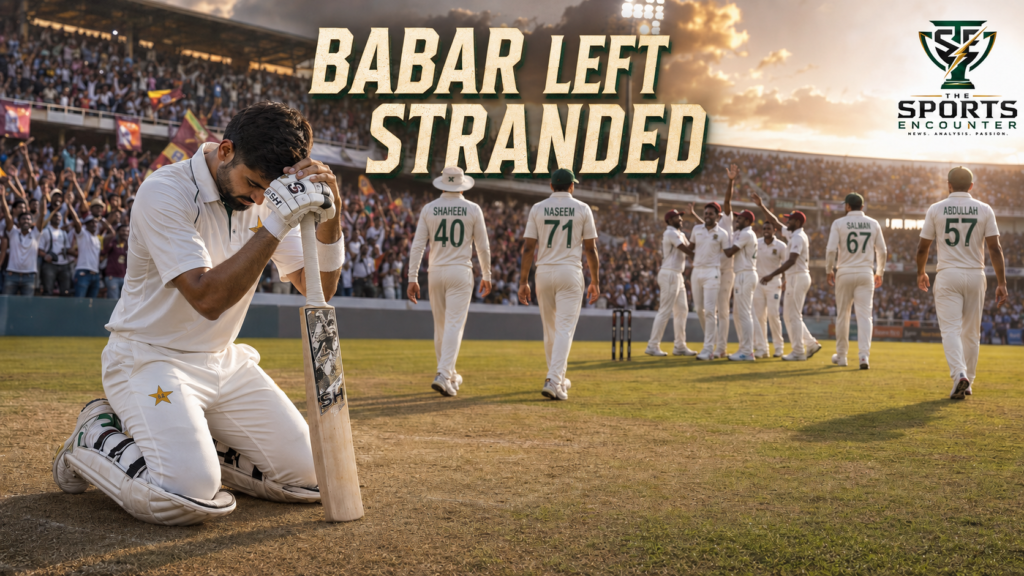
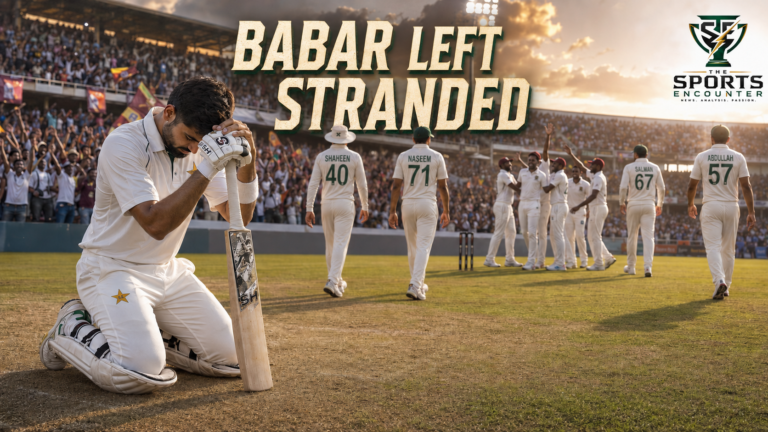
Babar Azam carried his bat for an unbeaten 58, but Pakistan’s batting collapsed around him as Jayden Seales powered West Indies to a 90-run victory in the first Test at Tarouba.
West Indies defeated Pakistan by 90 runs at the Brian Lara Cricket Academy after Jayden Seales claimed five wickets and Babar Azam carried his bat for an unbeaten 58 in a failed chase of 211.
Babar Azam stood at one end for nearly three and a half hours, watching Pakistan’s pursuit of 211 disintegrate around him.
He survived the new ball, reached his half-century, fought through the pressure created by a rapidly shrinking batting order, and even found unlikely support from Mohammad Abbas. None of it was enough.
West Indies dismissed Pakistan for 120 in 40.2 overs to win the first Test by 90 runs at Tarouba and take an unassailable 1-0 lead in the two-match series. The result also handed the hosts 12 ICC World Test Championship points while Pakistan left the inaugural Test at the Brian Lara Cricket Academy with nothing.
Jayden Seales finished with 5-20 from 14.2 overs, including six maidens, while Justin Greaves followed his first-innings five-wicket haul with another two crucial wickets. Kemar Roach removed two batters, and Shamar Joseph accounted for one as the West Indies pace attack shared all 10 wickets.
The scorecard will show another Pakistan batting collapse. The deeper story concerns the isolation of Babar, the physical limitations affecting first-innings centurion Shan Masood, and a batting lineup that failed to match the discipline shown by its own bowlers.
West Indies vs Pakistan 1st Test scorecard
| Team | First innings | Second innings | Result |
|---|---|---|---|
| West Indies | 311 | 181 | Won by 90 runs |
| Pakistan | 282 | 120 | Target: 211 |
- Player of the Match: Justin Greaves, 5-27, 20 and 2-12
- West Indies’ leading batter: Shai Hope, 92
- Pakistan’s leading batter: Shan Masood, 109
- Best bowling figures: Mohammad Abbas, 5-22
- Series position: West Indies lead 1-0 with one Test remaining
- WTC points: West Indies 12, Pakistan 0
Babar Azam fights alone as Pakistan collapse
Pakistan began the final innings requiring 211, a challenging target on a surface that continued to reward accurate fast bowling but one that still appeared reachable if the top order could absorb the opening spells.
That hope lasted only a few overs.
Imam-ul-Haq edged Roach behind for three at 5-1. Test debutant Azan Awais followed for the same score after Seales found his outside edge. Salman Agha was trapped lbw for a six-ball duck, leaving Pakistan 25-3 inside eight overs.
By lunch, they were 28-3. Babar had already become the central figure in the chase, not because Pakistan had constructed a platform for him, but because nearly every other specialist batter had failed to stay with him.
Mohammad Rizwan offered brief resistance before Greaves bowled him for 11. Aamer Jamal was trapped lbw for a 12-ball duck by the same bowler. Roach then removed Ali Usman for two, reducing Pakistan to 53-6.
Six wickets had fallen before the team reached one-quarter of its target.
Babar continued to leave carefully outside off stump and punished the occasional loose delivery. His nine boundaries came without reckless expansion or desperate slogging. He reached 50 from 81 balls, but the milestone carried little celebration because Pakistan were already nine wickets down.
The series had begun as a red-ball reset under Babar’s restored captaincy. His unbeaten 58 showed the technical control and personal responsibility Pakistan needed from him. The innings also revealed how little support existed around the captain when the match reached its most demanding phase.
Shan Masood’s injury changed Pakistan’s chase
The most damaging absence was not recorded as a missing name on the scorecard.
Shan Masood had scored a gritty 109 in Pakistan’s first innings, becoming the first Test centurion at the Brian Lara Cricket Academy. His 155-run partnership with Imam brought Pakistan back from 1-1 and created an opportunity to move beyond West Indies’ 311.
An injury, however, prevented Masood from occupying his usual position at the top of the order in the chase. By the time he entered at No. 8, Pakistan were already 53-6 and the original structure of the innings had disappeared.
Masood attempted to survive rather than dominate. He made three from 15 balls before Seales removed him, with Shamar Joseph taking the catch.
It would be unfair to claim Masood alone would have carried Pakistan to 211. The West Indies quicks were too accurate, and the rest of Pakistan’s batting was too fragile for one hypothetical partnership to erase every problem.
Still, his injury had a major tactical cost. Pakistan lost the opener who had spent 184 balls understanding the pitch in the first innings. Babar was denied the teammate best equipped to share the new-ball burden, manage the chase and build a serious partnership.
The contrast was painful. Masood had provided Pakistan’s longest and most important innings of the match. When the same team needed him again, he could only appear after six wickets had fallen.
Mohammad Abbas exposes the scale of Pakistan’s batting failure
The most revealing Pakistan statistic did not belong to Babar or Masood.
Mohammad Abbas scored 23 from 33 balls and became the team’s second-highest scorer in the fourth innings. His contribution was also the joint fourth-highest individual score by a Pakistani across the entire Test.
That figure explains the defeat more clearly than any tactical theory.
Only Babar, Abbas and Rizwan reached double figures during the chase. Five players were dismissed for two runs or fewer, including three ducks. Pakistan’s nine dismissed batters contributed just 49 runs between them.
Abbas joined Babar at 71-9 and helped add 49 for the final wicket, the largest partnership of the innings. The stand delayed West Indies and took Pakistan from complete humiliation to a slightly more respectable total, but it never placed the outcome in genuine doubt.
The end came when Seales brought one back into Abbas and struck his front pad. The batter reviewed the decision, but ball tracking showed the delivery brushing the outside of leg stump. The umpire’s call stood, giving Seales his fourth Test five-wicket haul and confirming West Indies’ 90-run victory.
Justin Greaves broke Pakistan twice
Seales delivered the decisive spell on the final day, but Justin Greaves had already altered the direction of the Test.
Pakistan appeared well placed at 244-4 in their first innings, with Masood completing his seventh Test century. A substantial lead remained possible. Greaves then dismantled the lower order with a remarkable sequence of five consecutive wicket-maiden overs.
Masood, Jamal, Ali Usman, Rizwan and Abbas all fell to Greaves as Pakistan lost five wickets for 23 runs. More specifically, five wickets disappeared for 15 runs between 244-4 and 259-8.
Pakistan eventually reached 282, conceding a 29-run first-innings lead when they had briefly looked capable of controlling the match. Greaves finished with 5-27 from 11 overs, including six maidens.
He returned in the second innings to dismiss Rizwan and Jamal, ending the match with seven wickets and 20 useful runs.
“This performance is right up there,” Greaves said after receiving the Player of the Match award. “I put my best foot forward whenever it is about to get the team over the line.”
His performance supported the advantage he created with his first-innings five-for. West Indies did not simply wait for Pakistan to collapse. Greaves manufactured the opening and Seales finished the job.
Pakistan’s fast bowlers deserved a better result
Pakistan’s decision to reshape the bowling attack largely worked.
Mohammad Abbas, Khurram Shahzad, Mohammad Ali and Aamer Jamal took all 20 West Indies wickets. None relied on extreme speed. They succeeded through seam movement, control and sustained pressure.
Mohammad Ali collected 4-50 in the first innings, while Abbas produced 5-22 from 15.5 overs in the second. West Indies slipped to 93-7 before Shamar Joseph changed the complexion of the match with 38 from 27 balls.
Joseph struck four sixes and added 61 with Roach for the eighth wicket. Those lower-order runs lifted West Indies to 181 and pushed the target to 211. On a better batting surface, that partnership might have been treated as a useful bonus. At Tarouba, it proved decisive.
Abbas deserved more than defeat after taking eight wickets in the match and contributing the second-highest score in Pakistan’s chase. His 5-22 also placed him on the venue’s first Test honours board alongside Masood, Greaves and Seales.
Pakistan’s bowlers completed their primary assignment by taking 20 wickets. The batting unit failed to convert that work into a competitive result.
All 40 wickets fall to fast bowling at Tarouba
The inaugural Test at the Brian Lara Cricket Academy produced a remarkable piece of Caribbean history.
According to former West Indies leg-spinner Samuel Badree, this was the first Test in the Caribbean in which fast bowlers claimed all 40 wickets.
West Indies selected Jomel Warrican, but the left-arm spinner bowled 18 overs across the match without taking a wicket. Pakistan’s specialist slow bowler, debutant Ali Usman, was also wicketless.
The match belonged to seam movement, disciplined lengths and batters’ ability to survive repeated examination around off stump. Greaves and Seales earned five-wicket hauls for West Indies, while Abbas registered Pakistan’s only five-for.
The milestone added further significance to the first Test staged at a venue more familiar with white-ball cricket. Tarouba’s opening red-ball contest immediately produced its own identity.
Pakistan’s away Test crisis gets worse
The defeat extended Pakistan’s run to eight consecutive Test losses away from home. They have now gone three years without an overseas Test victory.
That record cannot be blamed on one difficult pitch, one injury or one destructive spell.
Pakistan entered the series after returning the Test captaincy to Babar Azam. Leadership changed, the pace attack changed, and younger players were given opportunities. The same batting weaknesses remained visible when the ball moved and the match demanded patience.
The visitors lost six wickets for 38 runs after reaching 244-4 in the first innings. They then collapsed to 71-9 in the second. Those were separate innings, but the underlying issue was identical: once a set batter or established partnership disappeared, Pakistan had no mechanism for slowing the collapse.
The second Test offers a chance to draw the series, but Pakistan cannot win it. West Indies have already secured at least a share of the contest and will enter the final match with greater confidence in both their pace attack and lower-order resilience.
Final verdict: Babar stayed, but Pakistan never built around him
Babar’s unbeaten 58 will be remembered as a captain’s resistance, although it could not become a match-winning innings because Pakistan never gave it the necessary support.
Masood’s injury removed the batter best prepared to stand beside him. Rizwan was the only specialist teammate to reach double figures, and Abbas had to perform a role that should never have fallen to the No. 11.
West Indies were sharper in the passages that defined the match. Hope and Hodge built the first-innings total, Joseph and Roach stretched the lead when Pakistan threatened to regain control, Greaves destroyed the first innings, and Seales settled the second.
Pakistan also produced four worthy individual performances through Masood, Babar, Abbas and Mohammad Ali. The difference was that West Indies connected their contributions. Pakistan’s best efforts remained isolated.
Babar was the last specialist batter standing. By the time Abbas was struck on the pad at 120, he was also the only Pakistani left with whom the captain could have continued the fight.
That final image captured Pakistan’s Test more accurately than the 90-run margin: Babar unbeaten at one end, his teammates gone, and another away match slipping into a familiar pattern.
Explore more cricket news and analysis from The Sports Encounter, including our examination of what history suggested about Pakistan’s fourth-innings chase and the wider legacy of Pakistan’s greatest Test-era performances against West Indies. Full match figures can be reviewed through the official first Test scorecard.
Breaking News
‘Clicky Ponting’ Cricket Scandal Explained: How a Finger Click Allegedly Created a Fake Wicket
An English amateur cricketer is accused of clicking his fingers to imitate an edge and deceive an umpire. We explain the incident, MCC Law 41 and the sanctions that may follow.
A viral club cricket video appears to show a close-in fielder clicking his fingers as the ball passes the bat, allegedly creating a false edge sound that helped convince the umpire to give the batter out. The incident is now under formal investigation.
A strange dismissal in English amateur cricket has raised serious questions about deception, umpiring and the Spirit of Cricket.
The North Yorkshire and South Durham Cricket League has opened an investigation following a formal complaint about alleged incidents during a Division Two match between Saltburn Cricket Club’s second XI and Norton Cricket Club’s second XI on Saturday, July 25, 2026.
Video footage circulating online appears to show a Saltburn close-in fielder clicking his fingers at almost the exact moment the ball passes the batter’s outside edge. The wicketkeeper catches the delivery, the fielding side appeals and the umpire raises his finger.
The batter, reportedly Noman Shabir, immediately appears confused by the decision and gestures toward the nearby fielder. His reaction suggests he believed the sound heard by the umpire came from the finger click rather than contact between bat and ball.
Saltburn won the match by 159 runs. However, the result has been overshadowed by an allegation that goes far beyond an umpire making an ordinary mistake.
If the finger click was deliberate and intended to imitate the sound of an edge, it would represent an attempt to manufacture evidence for a dismissal.
That is why a brief movement of two fingers has created such a major controversy.
What Happened in the Alleged Finger-Click Incident?
In cricket, a batter can be dismissed caught when the ball touches the bat or a hand holding the bat before being legally caught by a fielder.
During caught-behind appeals, the umpire often relies heavily on sound. A faint edge may produce a small noise that can be difficult to distinguish from the bat hitting the ground, clothing moving or another sound near the wicket.
Professional matches offer technological assistance through tools such as UltraEdge. Most recreational cricket does not have that protection.
The viral video appears to show the following sequence:
- The bowler delivers the ball outside the batter’s off stump.
- The batter plays at the delivery.
- A close-in fielder appears to click his fingers as the ball passes the bat.
- The wicketkeeper catches the ball.
- Several fielders appeal for a catch.
- The umpire gives the batter out.
- The batter protests and points toward the fielder.
The allegation is that the finger click simulated the sound of bat hitting ball and influenced the umpire’s decision.
Online users have given the controversy several nicknames, including “Clickgate” and “Clicky Ponting,” a reference to former Australian captain and celebrated slip fielder Ricky Ponting.
The jokes have helped the footage travel around the world, but the underlying accusation is serious. It concerns a possible deliberate attempt to deceive a match official and unfairly remove an opponent from the game.
Readers interested in unusual moments that can influence a dismissal can also examine whether a bee disrupted Joe Root’s concentration immediately before his dismissal.
Finger-Click Controversy at a Glance
| Detail | Information |
|---|---|
| Competition | North Yorkshire and South Durham Cricket League Division Two |
| Match | Saltburn CC 2nd XI vs Norton CC 2nd XI |
| Date | July 25, 2026 |
| Allegation | A fielder clicked his fingers to imitate the sound of an edge |
| Immediate outcome | The batter was given out caught behind |
| Match result | Saltburn won by 159 runs |
| League response | Formal investigation opened |
| Applicable cricket law | MCC Law 41 on unfair play |
| Possible consequences | Warning, fine, suspension, points deduction or other disciplinary action |
| Current status | The allegations remain under investigation |
Why Would Clicking Fingers Fool an Umpire?
Caught-behind decisions are among the most difficult judgments in cricket, particularly without video or sound technology.
The umpire must watch several things within a fraction of a second:
- The bowler’s front foot
- The position of the ball
- The batter’s movement
- Possible contact with the bat
- The wicketkeeper’s catch
- The fielding side’s appeal
A very thin edge may not visibly change the ball’s direction. Sound can therefore become the strongest clue available to the umpire.
A finger click timed precisely as the ball passes the bat could create a convincing false signal. When that sound is followed by the wicketkeeper catching the ball and several fielders appealing together, the umpire may reasonably connect the noise with an edge.
This is what makes the alleged act especially troubling. It appears designed to exploit the normal limitations of an amateur umpire.
The official has only one chance to make the decision. The fielder, if the allegation is proven, would have deliberately introduced false information into that process.
Cricket regularly produces difficult decisions even when everyone acts honestly. A recent example came when an umpire’s-call decision helped confirm West Indies’ Test victory over Pakistan. That type of judgment is part of the game. Manufacturing an artificial sound would be fundamentally different.
What Does MCC Law 41 Say About Deliberate Deception?
The incident potentially falls under MCC Law 41, which governs unfair play in cricket.
Law 41.4 states that it is unfair for a fielder deliberately to attempt to distract the striker while the batter is preparing to receive or receiving a delivery.
Law 41.5 goes further. It prohibits a fielder from willfully attempting, through words or actions, to distract, deceive or obstruct either batter after the striker has received the ball.
The exact provision applied would depend on when the umpire believed the click occurred. However, deliberate deception is clearly covered by the law.
If an umpire detects such conduct during play, the available response can include:
- Calling and signaling a dead ball
- Preventing a dismissal from that delivery
- Awarding five penalty runs to the batting team
- Informing the fielding captain and both batters
- Reporting the incident to the relevant cricket authority
Under Law 41.5, the batters may also be credited with any runs completed before the offense and may be allowed to decide which batter faces the next delivery.
The crucial issue is intent. An accidental click, clap or movement would not automatically amount to cheating. The umpire or disciplinary panel would need to determine whether the player acted willfully to create a false impression.
That is precisely what the league’s investigation must establish.
Modern cricket frequently debates whether new playing conditions improve or weaken competitive fairness. The Sports Encounter recently examined that wider issue in its analysis of the IPL Impact Player rule and its effect on genuine all-rounders.
Why Was It Against the Spirit of Cricket?
Cricket’s laws define what players may and may not do. The Spirit of Cricket establishes a wider expectation about how they should behave.
Players can appeal confidently when they genuinely believe a batter is out. They may celebrate, encourage the bowler and apply pressure within the rules.
Creating a false sound to manufacture an edge crosses a different line.
It potentially violates the Spirit of Cricket in several ways.
It Attempts to Deceive the Umpire
The umpire’s decision should be based on what happened during the delivery. Introducing a fake sound deliberately corrupts that decision-making process.
It Denies the Batter a Fair Contest
The batter is entitled to continue batting unless dismissed under the Laws of Cricket. A manufactured edge could end an innings without the ball ever touching the bat.
It Misuses the Appeal System
An appeal asks the umpire to rule on a genuine cricket event. If a player first creates false evidence and then appeals, the appeal becomes part of the deception.
It Exploits the Limitations of Recreational Cricket
Amateur matches rarely have television replays, stump microphones or ball-tracking systems. Fair play therefore depends heavily on honesty among players.
It Damages Trust
Cricket cannot function if every small sound near the bat becomes suspicious. Umpires must be able to trust that fielders are appealing based on what they genuinely saw or heard.
The allegation therefore concerns more than gaining one wicket. It threatens the trust that allows recreational matches to take place.
Cricket has confronted similar questions about legal skill and prohibited manipulation before. The Sports Encounter’s examination of Ian Botham’s career and the historical ball-tampering debate shows how deeply allegations of unfair play can affect reputations long after the match ends.
Readers can follow more controversies, match reports, player comparisons and tactical analysis through The Sports Encounter’s cricket news and analysis hub.
Why the Umpire Should Not Become the Main Target
The footage has led to criticism of the decision, but the umpire should not carry the main blame if deliberate deception is established.
An umpire working without technological assistance must judge a faint edge through sight and sound. A well-timed click could be extremely difficult to identify from the middle.
The official may have heard a noise, seen the ball enter the wicketkeeper’s gloves and observed a confident collective appeal. Those signals normally support a caught-behind decision.
Players also have a responsibility to avoid placing umpires in deliberately manufactured situations.
The investigation should therefore examine the alleged conduct that preceded the decision rather than treating an apparently deceived official as the central offender.
Even at the highest level, officiating controversies can overshadow the actions that produced the decision. The distinction between an official making a reasonable judgment and a participant knowingly creating a false impression must remain clear.
Could the Batter Be Reinstated After the Match?
Usually, an umpire may correct a decision promptly if convinced an error has occurred. Once play has moved on and the match has concluded, reinstating a batter is far more complicated.
The North Yorkshire and South Durham Cricket League is investigating cheating accusations made against an amateur player who is alleged to have clicked his fingers to trick umpires into giving wickets pic.twitter.com/ih8IYeZda0
— Sky News (@SkyNews) July 28, 2026
The dismissal remains part of the official scorecard unless the competition authority uses its regulatory powers to amend the record or match outcome.
A disciplinary panel may punish misconduct without rewriting every event that followed it. Alternatively, league regulations may permit adjustments to points or results if the misconduct materially affected the competition.
No such decision has been announced in this case.
Saltburn’s 159-run victory also means the league would need to consider whether the disputed dismissal had a realistic effect on the final result. The disciplinary issue can remain serious even if officials conclude that Saltburn probably would have won anyway.
Cheating does not become acceptable because the winning margin was large.
What Punishment Could the Player Receive?
The league has not announced a charge, finding or punishment. Any player involved must therefore be treated as innocent unless the allegation is proven through the formal process.
If the investigation concludes that a fielder deliberately clicked his fingers to create a false edge, several sanctions may be available under recreational cricket disciplinary procedures.
Formal Warning or Reprimand
A disciplinary panel could record an official warning, particularly if it considered the incident isolated and at the lower end of misconduct.
Financial Penalty
Recreational cricket regulations can allow fines and administrative costs, depending on the rules adopted by the league and the classification of the offense.
Playing Suspension
A confirmed attempt to deceive an umpire could result in a ban for a specified number of matches or weeks. The length would depend on the seriousness of the conduct, whether it happened more than once and whether the player had any previous disciplinary record.
League Points Deduction
If the panel determines that the misconduct involved wider team participation or materially affected competition integrity, Saltburn could face a points deduction.
That would be particularly significant because the club was reported to be leading Division Two by 17 points when the controversy emerged.
Alteration of the Match Result
Competition authorities may have powers to adjust points or alter a result in serious cases. This would require a separate assessment of the applicable league rules and the effect of the alleged misconduct.
Expulsion in an Extreme Case
Some recreational cricket disciplinary frameworks allow a participant to be expelled from a league for sufficiently serious or repeated misconduct. This would ordinarily sit at the most severe end of possible sanctions.
The authorities may also consider aggravating factors, including whether the alleged action was planned, repeated, supported by teammates or previously used in other matches.
Recent cricket cases show that authorities usually distinguish between an isolated breach and wider leadership or cultural failure. That principle also appeared in The Sports Encounter’s coverage of the disciplinary questions surrounding Ben Stokes and England’s leadership.
Could Other Players Be Punished?
Potentially, but only if evidence establishes their involvement.
Unbelievable. Clicky Ponting must be the biggest cheat in cricket history. How long has he been doing this? How many batsmen’s days has he ruined? https://t.co/XptHEfE9uo
— Piers Morgan (@piersmorgan) July 28, 2026
A wicketkeeper or another fielder should not automatically be punished merely for appealing. Cricket teams regularly appeal together when close-in fielders believe they have heard an edge.
The disciplinary question would concern what each player knew and intended.
Investigators may examine:
- Whether teammates knew a fake sound would be created
- Whether the tactic had been discussed before the match
- Whether similar incidents occurred previously
- Whether players continued appealing despite knowing there was no edge
- Whether team officials or captains became aware of the conduct
- Whether relevant footage or other evidence was removed or withheld
Claims about similar incidents have appeared in media coverage, but they remain allegations. Each incident would require separate evidence and proper review.
Responsibility may also extend beyond the individual if investigators find evidence of coordination. A captain or club official cannot be held accountable merely because the player belonged to the team. Authorities would need evidence showing knowledge, encouragement or a failure to act after becoming aware of the conduct.
What Has the League Said?
The North Yorkshire and South Durham Cricket League confirmed that it received a formal complaint and started a full investigation.
Its statement said:
“The league have received a formal complaint regarding alleged incidents in a division two game on Saturday 25 July 2026. A full investigation has been initiated and until such time as the formal processes are complete no further comment will be made.”
That restrained response is appropriate. Viral footage can generate immediate public judgment, but disciplinary authorities must review the complete video, hear from the umpires, speak to the players and allow those accused to respond.
The investigation may also need to determine whether the finger movement visible in the footage produced the sound heard, whether the timing was intentional and whether it influenced the umpire.
Questions involving player conduct, governing-body rules and public judgment require careful handling. A similar need for evidence and proportionate judgment appeared when The Sports Encounter examined how Ben Stokes’ conduct affected England’s leadership culture and public trust.
Why Amateur Cricket Depends So Heavily on Player Honesty
Professional cricket can review close decisions through multiple camera angles, stump microphones, ball-tracking systems and edge-detection technology.
Club cricket operates in a different environment.
An amateur umpire may work alone at one end without access to replay technology. Camera footage, if it exists, may be recorded for streaming or coaching rather than formal decision reviews. Players therefore carry a greater responsibility to preserve the integrity of the contest.
This does not mean players should withdraw every close appeal or correct every decision that benefits them. Honest disagreements will always exist.
The line is crossed when a participant intentionally manufactures the evidence that prompts the decision.
Recreational sport survives because competitors generally accept that winning has limits. Once deception becomes normalized, leagues must invest more heavily in monitoring, disciplinary systems and technology simply to reproduce the trust players should have protected themselves.
The wider importance of safeguarding standards and clearly defined conduct rules can also be seen in the regulations surrounding teenage cricketer Vaibhav Sooryavanshi and senior dressing rooms. Different situations involve different risks, but both demonstrate why sporting rules depend on participants respecting their purpose.
Final Verdict: A Small Action With a Serious Meaning
The alleged finger click lasted less than a second. Its possible significance stretches much further.
Cricket permits tactical deception in limited forms. A bowler can disguise a slower ball. A batter can use an unexpected shot. A captain may position a fielder to encourage a false stroke.
Those actions test an opponent’s cricketing judgment.
Creating a fake edge sound would serve a different purpose. It would attempt to convince an umpire that an event occurred when it did not.
If the allegation is proven, the conduct would constitute a clear challenge to fair play, respect for match officials and the integrity of recreational cricket. A suspension would be a realistic possibility, while stronger sanctions could follow if investigators find evidence of repetition, planning or wider team involvement.
For now, the distinction between allegation and fact remains essential.
The video has created serious questions. The North Yorkshire and South Durham Cricket League must now determine whether “Clicky Ponting” was an unfortunate visual coincidence, an isolated act of misconduct or evidence of a deliberate method used to manufacture wickets.
Frequently Asked Questions
What did the cricketer allegedly do?
A close-in fielder is accused of clicking his fingers as the ball passed the batter’s bat. The allegation is that the sound imitated a faint edge and contributed to the umpire giving the batter out caught behind.
Is clicking your fingers illegal in cricket?
Clicking your fingers is not automatically an offense. It may become unfair play if a fielder does it deliberately to distract or deceive a batter or umpire during a delivery.
Which cricket law could apply?
MCC Law 41 addresses unfair play, including deliberate attempts by fielders to distract, deceive or obstruct batters.
Could the dismissal be cancelled?
An umpire can correct a decision promptly during a match under certain circumstances. Changing a dismissal after the match has ended would depend on the league’s regulations and disciplinary powers.
What punishment could the player receive?
Possible sanctions may include a reprimand, fine, playing suspension or another disciplinary penalty. More serious consequences, including a points deduction, could be considered if investigators establish repeated conduct or wider team involvement.
Has the player been found guilty?
No. The league has opened an investigation, but no final finding or punishment had been announced at the time of writing.
Breaking News
FIFA and UEFA at Loggerheads: Could the $20 Billion World Cup Plan Trigger a Global Soccer Revolt?
UEFA has opened a direct confrontation with FIFA over its proposed $20 billion World Cup company. The decisive battle will involve the votes and loyalties of soccer’s 211 national associations.
UEFA has declared that the World Cup is “not FIFA’s to sell.” FIFA says private investment will democratize the game. Behind those competing claims, Gianni Infantino and Aleksander Čeferin are entering a battle for the allegiance of national associations across every continent.
TL;DR: Why the FIFA-UEFA Conflict Matters
- FIFA plans to establish FIFA Forward Enterprise, a commercial subsidiary reportedly valued at approximately $20 billion.
- Private investors could purchase non-controlling stakes of up to 20%, potentially raising about $4.2 billion.
- UEFA says the proposal crosses an institutional red line and has urged national associations, leagues, clubs, players, supporters and governments to take the threat seriously.
- No confederation outside Europe has formally joined UEFA’s opposition at the time of publication.
- CONMEBOL could become the most influential swing bloc because of its competitive importance, cultural authority and recent strategic relationship with UEFA.
- CAF, AFC, Concacaf and OFC associations may find FIFA’s promise of up to $20 million in optional development capital difficult to reject.
- UEFA controls only 55 of FIFA’s 211 member-association votes, leaving it unable to defeat the proposal without substantial support from outside Europe.
- The immediate dispute concerns private investment, but the deeper struggle involves FIFA’s authority, UEFA’s influence and the future control of international soccer.
- A European World Cup boycott or breakaway competition remains an extreme and unsupported scenario. UEFA has announced no such plan.
FIFA’s World Cup Investment Plan at a Glance
| Issue | Current position | Why it matters politically |
|---|---|---|
| Proposed company | FIFA Forward Enterprise, or FFE | Would place FIFA’s commercial and event operations inside a dedicated corporate entity |
| Reported valuation | Approximately $20 billion | Creates a financial value around the business operating FIFA competitions |
| Outside investment | Minority, non-controlling stakes of up to 20% | Introduces private shareholders into FIFA’s tournament economy |
| Potential capital raised | Up to approximately $4.2 billion | Gives FIFA substantial resources to distribute across world soccer |
| Expected lead investor | Joshua Kushner’s Thrive Eternal | Adds political and governance scrutiny to an already controversial proposal |
| FIFA’s argument | Private capital can support sustainable and inclusive global development | Appeals strongly to smaller and less wealthy national associations |
| UEFA’s argument | Football’s soul and governance are not assets FIFA can sell | Frames the proposal as an institutional threat rather than a routine investment |
| Possible association benefit | Optional access to up to $20 million in one-off capital | Could make it difficult for UEFA to recruit opposition outside Europe |
| Approval | Expected to involve FIFA’s member associations and FIFA Council | Turns the dispute into a contest for influence across FIFA’s 211-member electorate |
The World Cup Ended, but the Fight for World Soccer Had Already Begun
Less than two weeks after Spain defeated Argentina in the 2026 FIFA World Cup final, the celebration surrounding the largest tournament in soccer history gave way to an institutional confrontation that could shape the sport for years.
FIFA announced plans to create FIFA Forward Enterprise, a new subsidiary that would oversee the commercial and event operations connected to the World Cup and its other competitions. The proposed company would reportedly be valued at approximately $20 billion, with outside investors permitted to purchase minority stakes of up to 20%.
UEFA’s response arrived quickly and carried little of the diplomatic restraint normally associated with disagreements between governing bodies.
European soccer’s leadership said FIFA had crossed a line that football institutions should never cross. Its statement argued that the game’s soul and governance could not become tradable assets and warned that FIFA had provided insufficient transparency about who might benefit financially.
The most important part of UEFA’s response was its intended audience. It did not speak only to European federations. UEFA directly addressed every national association, league, club, player, supporter, government and stakeholder concerned about the game’s future.
That language sounded like more than criticism. It resembled an invitation to organize.
FIFA has presented the proposal as a development initiative capable of channeling billions of dollars into facilities, coaching, grassroots competitions, national teams and women’s soccer. UEFA has recast it as a fight over whether any governing body possesses the moral authority to place an economic stake in the World Cup before private investors.
The confrontation has therefore moved beyond the accounting structure of one subsidiary. FIFA and UEFA are contesting who can legitimately speak for global soccer.
The dispute also follows a World Cup that produced enormous audiences, commercial opportunities and political controversy. The Sports Encounter’s examination of the record 2026 World Cup final viewership in the United States showed why FIFA’s tournament business has become so attractive to investors.
The emotions surrounding the World Cup remain public and communal. The commercial machinery surrounding those emotions is now valued in billions.
Why UEFA Treated FIFA’s Initiative as a Declaration of War
UEFA’s fury cannot be explained by private investment alone. European soccer already operates within a vast commercial system involving broadcasters, sponsors, investment funds, club owners, financial institutions and multinational corporations.
UEFA’s own competitions generate billions. The Champions League has repeatedly expanded its broadcasting inventory, sponsorship reach and match schedule. Europe cannot credibly argue that commercial money is inherently incompatible with soccer.
The difference lies in what FIFA wants to place inside the proposed company.
FIFA Forward Enterprise would reportedly oversee commercial and event operations associated with the World Cup and other FIFA competitions. Private shareholders would acquire an economic interest in the company managing the most valuable events under FIFA’s authority.
FIFA says those investors would remain passive. It would retain sole authority over sporting regulations, governance, competitions and the international match calendar. Outside capital would enter a FIFA subsidiary, not FIFA itself.
UEFA sees that distinction as too narrow.
A shareholder does not require direct control over team qualification, match rules or host selection to influence an organization’s commercial direction. Investors expect the value of their holdings to grow. That expectation can affect revenue targets, sponsorship strategies, event frequency, ticketing models and the commercial priorities surrounding future competitions.
UEFA’s wider concern is institutional. Allowing FIFA to complete the deal could strengthen Infantino’s influence over national associations for years. The billions raised through the transaction would give FIFA additional resources to distribute throughout Africa, Asia, the Caribbean, Oceania and other developing soccer regions.
Europe would retain its wealth, elite clubs and competitive importance. FIFA would strengthen the financial dependence of smaller associations on its development system.
From UEFA’s perspective, the proposal could therefore alter the balance of power between Zurich and Nyon. What FIFA describes as democratization may also consolidate the authority of FIFA’s leadership.
Infantino and Čeferin Are Fighting Over Two Different Visions of Soccer
The personal and institutional relationship between FIFA President Gianni Infantino and UEFA President Aleksander Čeferin has deteriorated through a series of disputes involving tournament expansion, the international calendar, player workload, governance, match operations and political influence.
The FFE proposal has brought those disagreements into one larger confrontation.
Infantino’s vision treats the World Cup as a powerful economic engine that can fund soccer in countries lacking Europe’s mature leagues, media markets and club infrastructure. FIFA argues that the game’s worldwide popularity should create meaningful opportunities throughout all 211 member associations.
Čeferin’s UEFA believes FIFA’s commercial expansion increasingly threatens the boundaries between governance and monetization. European officials fear that decisions affecting tournaments, players and the calendar will become harder to separate from FIFA’s revenue ambitions.
Both sides are defending institutional interests.
UEFA benefits from the most commercially successful club ecosystem in world soccer. Its leading teams attract international audiences, employ many of the world’s best players and generate recurring revenue that no other confederation can match.
FIFA’s power comes from its global electorate and the World Cup. Every national association receives a vote, placing small countries on the same formal electoral level as Germany, Brazil, England, Argentina or the United States.
Infantino’s development strategy speaks directly to that electorate. Čeferin’s strongest arguments involve governance, sporting autonomy, transparency and the cultural ownership of the game.
Their confrontation will be decided by which message national associations find more persuasive.
The political atmosphere surrounding Infantino was already tense before the proposal emerged. His recent defense of the tournament, political relationships and decision-making was examined in The Sports Encounter’s report on Infantino’s response to criticism of the 2026 World Cup.
UEFA Cannot Stop FIFA Alone
UEFA represents 55 national associations, making it one of the largest and most influential confederations within FIFA. Those associations include most of soccer’s wealthiest federations and many of its most successful national teams.
However, 55 votes cannot independently determine an outcome involving FIFA’s 211 members.
| Confederation | Approximate FIFA membership | Likely position at this stage | Political importance |
|---|---|---|---|
| UEFA | 55 | Institutionally opposed | Leads resistance but lacks enough votes to defeat FIFA alone |
| CAF | 54 | No formal collective opposition announced | Development funding gives FIFA a potentially strong position |
| AFC | 46 | No formal collective opposition announced | Large, diverse bloc containing wealthy and developing associations |
| Concacaf | 35 | No formal collective opposition announced | Recent World Cup partnership may reinforce ties with FIFA |
| OFC | 11 | No formal collective opposition announced | Small associations may place exceptional value on FIFA funding |
| CONMEBOL | 10 | No formal collective opposition announced | Small voting bloc with enormous sporting and symbolic importance |
The precise voting process and timetable must still be confirmed. FIFA has said the proposal will be presented to its member associations and the FIFA Council, which it identifies as the final decision-makers.
Whatever procedural route is used, UEFA needs allies.
Its first objective will be maintaining a united European position. That should not be taken for granted. Some UEFA members may share the governing body’s philosophical concerns while remaining interested in FIFA’s financial offer. Smaller European associations can face many of the same infrastructure and development challenges found elsewhere.
UEFA must then secure meaningful support beyond Europe. It could lose even with unanimous European resistance if FIFA preserves its traditional alliances across other confederations.
This explains why UEFA addressed every national association in its statement. The language was designed to move the issue beyond a FIFA-UEFA quarrel and turn it into a global test of governance.
Could CONMEBOL Join UEFA Against FIFA?
CONMEBOL is the most obvious potential partner for UEFA, although no formal South American opposition to FIFA’s proposal had been announced when this article was prepared.
The South American confederation has only 10 FIFA members. Its influence is much greater than that number suggests.
Argentina, Brazil and Uruguay have won multiple World Cups. South America continues to produce a huge share of the players who shape European club soccer. Its national teams carry historical authority that a purely numerical assessment cannot capture.
UEFA and CONMEBOL have also built a closer working relationship through the revival of the Finalissima and cooperation between the two confederations. That relationship gives UEFA a natural channel through which it can discuss a coordinated position.
Several factors could push CONMEBOL toward UEFA.
- Concern that private investment could change the commercial character of the World Cup
- A desire to protect the influence of traditional soccer regions
- Questions about investor rights, transparency and political relationships
- Shared concerns about the international calendar and player workload
- Existing institutional cooperation with UEFA
Other considerations could keep South America aligned with FIFA or at least prevent open confrontation.
CONMEBOL associations benefit from FIFA competitions and development programs. South American leaders may seek additional guarantees or financial concessions instead of joining a public rebellion. They may also hesitate to become dependent on a European strategy that ultimately protects UEFA’s own commercial position.
Infantino understands the symbolic importance of South America. Losing all 10 CONMEBOL votes would not automatically defeat the proposal, but a UEFA-CONMEBOL alliance would transform the narrative.
It would no longer look like wealthy Europe resisting development elsewhere. Two of soccer’s most historically powerful continents would be challenging FIFA together.
Such an alliance could encourage prominent associations in other confederations to demand more information, even if they stopped short of voting against the plan.
Why CAF May Be the Most Difficult Bloc for UEFA to Move
The Confederation of African Football represents 54 FIFA associations. Numerically, it is almost equal to UEFA and could become decisive in any broad vote.
UEFA may attempt to frame the dispute around football sovereignty, transparent governance and protection from private financial influence. Those principles could resonate with African administrators, players and supporters.
FIFA holds a powerful counterargument: money that can build actual soccer infrastructure.
Many African associations operate with limited domestic broadcasting revenue, unstable sponsorship markets and inadequate facilities. An optional program providing access to as much as $20 million could fund technical centers, women’s leagues, youth academies, coaching education and national-team programs.
For some federations, the proposal may feel less like an abstract privatization debate and more like a rare chance to transform their domestic game.
UEFA will struggle if its opposition appears designed to preserve European control over global soccer’s wealth. European clubs already benefit from African talent while many of the countries producing those players lack comparable infrastructure.
To win African support, UEFA would need to answer a practical question: what alternative development model can it offer?
Moral language may start the discussion. It will not automatically outweigh capital capable of building stadiums, training grounds and national academies.
Individual African associations could still demand better transparency. Governments, supporter groups and independent administrators may question the proposed investor structure. A small group could break ranks if legal protections and financial details remain unclear.
A unified CAF challenge to FIFA nevertheless appears difficult without a major change in the political environment.
AFC Contains Both FIFA’s Strongest Prospects and Its Most Complex Risks
The Asian Football Confederation is too diverse to be treated as a single political constituency.
It includes wealthy Gulf countries, major commercial markets such as Japan and South Korea, rapidly growing soccer economies, populous South Asian nations and smaller associations heavily reliant on development funding.
Several AFC members may welcome the commercial ambition behind FFE. Governments and investment institutions across Asia and the Middle East already use sports properties as part of wider economic, tourism and global-influence strategies.
FIFA’s promise to expand participation and fund infrastructure fits the ambitions of associations seeking a larger place within world soccer.
Others may share UEFA’s concerns about transparency and investor influence. Established federations with strong domestic resources have less immediate need for a one-off capital program and may examine the governance structure more critically.
Even then, public criticism remains politically difficult. An association may privately request stronger safeguards while avoiding direct alignment with UEFA.
The most realistic UEFA strategy in Asia may therefore involve encouraging abstentions, procedural delays or demands for disclosure. Persuading the AFC as an institution to lead a confrontation with FIFA would require far more than European outrage.
Concacaf Has Fresh Reasons to Remain Close to FIFA
Concacaf has just completed the largest World Cup ever staged, with the United States, Canada and Mexico sharing hosting responsibilities across 16 cities.
The tournament strengthened FIFA’s commercial position in North America and demonstrated the region’s importance to future soccer growth. It also produced enormous ticketing, tourism, sponsorship and broadcasting opportunities.
The Sports Encounter’s FIFA World Cup 2026 coverage hub documents the sporting and commercial scale of the competition.
Concacaf’s recent operational partnership with FIFA may make a confederation-wide break unlikely. FIFA can argue that FFE would extend the momentum created by the 2026 tournament and attract further investment into emerging soccer markets.
The bloc is not politically uniform.
The United States, Canada and Mexico possess resources and commercial opportunities unavailable to many Caribbean and Central American associations. Smaller members may value FIFA development funding far more than the region’s largest federations.
European lobbying could find a limited audience among associations concerned about governance or ticket affordability. Political leaders may also question whether a global sporting institution should permit private investors to profit from competitions built around national identity.
British Prime Minister Andy Burnham has already argued that the World Cup is not a product and does not belong to investors. Similar interventions from governments outside Europe would increase the political cost of the proposal.
At present, however, Concacaf appears more likely to seek guarantees within FIFA’s plan than to join a UEFA-led rebellion.
OFC’s Votes Could Matter More Than Its Commercial Size
Oceania has 11 FIFA member associations. The confederation commands only a small portion of global soccer revenue, but its votes carry the same formal weight as those of larger countries within the FIFA Congress.
That structure is central to Infantino’s development argument.
Associations across the Pacific face high travel costs, limited populations, small domestic markets and significant infrastructure challenges. FIFA assistance can sustain competitions and national programs that would otherwise struggle to operate.
An additional multimillion-dollar funding opportunity could make OFC one of FIFA’s strongest areas of support.
UEFA might argue that accepting the proposal could trade long-term institutional independence for immediate resources. Smaller associations may respond that soccer cannot develop through principles alone.
OFC illustrates the political genius and central controversy of FIFA’s proposal. The associations asked to judge the plan are also being offered direct access to its financial benefits.
The $20 Million Promise Is FIFA’s Strongest Political Weapon
FIFA says the capital raise could support an optional program allowing member associations to access up to $20 million in one-off funding. Eligible uses could include infrastructure, coaching, national teams, competitions, grassroots soccer and the women’s game.
That money gives Infantino more than a development policy. It gives him a persuasive case before the organizations that will evaluate the proposal.
UEFA will argue that voters should first receive complete information about the investors, shareholder rights, governance safeguards, valuation, financial returns and possible conflicts of interest.
FIFA can answer by asking associations what the funding could accomplish in their countries.
A federation without a national training center may see a route to building one. Another could establish its first sustainable women’s league. Smaller nations could improve coaching standards, pitches, medical facilities or youth competitions.
The political choice is therefore uneven. Wealthy federations can afford to prioritize long-term governance risks. Poorer associations must weigh those risks against immediate development needs.
UEFA’s campaign will gain traction only if it respects that reality. Lecturing smaller associations about the soul of soccer while Europe controls its richest leagues may produce the opposite result.
A more effective opposition would demand disclosure, independent valuation, spending audits, investor restrictions and enforceable protections against commercial interference. That approach could unite associations that want FIFA’s money but remain uncomfortable with its structure.
Could National Associations Break Away From Their Confederations?
Confederations do not always vote as unified blocs. Every national association has its own financial needs, political relationships and leadership priorities.
UEFA’s public position does not guarantee that all 55 European associations will oppose the proposal. Likewise, institutional silence from CAF, AFC, Concacaf, CONMEBOL or OFC does not mean every member supports FIFA.
Several types of association could become important:
- Wealthy federations that do not depend heavily on FIFA funding
- Associations with strong domestic governance requirements
- Countries where governments or parliaments demand scrutiny
- Federations worried about private control of sporting data and commercial rights
- Smaller associations that support development funding but want stronger legal safeguards
- National bodies whose leadership has an uneasy relationship with Infantino
A full rebellion may not be necessary to change the proposal. If enough associations express concern, FIFA could reduce the available stake, publish additional documents, introduce transfer restrictions or strengthen its control provisions.
The opposition’s first victory may therefore be delay rather than defeat.
Time would allow national associations, player unions, leagues, clubs, governments and supporter organizations to examine the plan. It would also give UEFA an opportunity to convert an emotional statement into a coordinated international campaign.
What a UEFA-Led Coalition Could Demand
A credible opposition campaign needs more than a declaration that football is not for sale. It needs specific institutional demands.
- Full investor disclosure: FIFA should identify every beneficial owner, intermediary and participating investment vehicle.
- Publication of shareholder rights: Member associations should see any board rights, vetoes, consent provisions and information privileges.
- An independent valuation: The $20 billion figure should be tested by advisers without a financial interest in completing the transaction.
- Restrictions on future transfers: Investors should not be allowed to sell shares to unidentified third parties without FIFA and member approval.
- Protection of the calendar: Commercial targets should have no role in determining additional competitions or matches.
- Fan-access guarantees: FFE should face enforceable rules around ticket affordability, allocations and official resale practices.
- Player-welfare safeguards: Tournament expansion should require independent medical and workload assessment.
- Audited development spending: Funding must reach soccer programs instead of disappearing through weak governance or political patronage.
- Conflict-of-interest rules: FIFA officials should not receive future employment, equity or financial benefits from the subsidiary without independent review.
- A review or exit mechanism: Member associations should retain a practical means of changing or terminating the structure if investor involvement harms the sport.
These demands could appeal beyond Europe because they do not require associations to reject development funding. They require FIFA to prove that the funding does not come with hidden institutional costs.
Player Workload Could Bring Clubs and Unions Into UEFA’s Camp
UEFA’s strongest potential allies may not be other confederations. Clubs, domestic leagues and player unions already fear that FIFA’s commercial ambitions will produce more fixtures.
The expanded 2026 World Cup featured 48 teams and 104 matches. FIFA can point to greater global representation and record demand. Critics can point to longer travel, increased workload, environmental pressure and a larger commercial inventory.
Private shareholders would benefit if FIFA competitions generated more broadcasting and sponsorship value. Even without formal control, investors would have an economic interest in expansion.
FIFA insists that all calendar and sporting decisions would remain exclusively under its authority. UEFA and player representatives may ask whether FIFA can make those decisions independently while also protecting the valuation of a partly investor-owned business.
The concerns are not theoretical. Even mandatory hydration breaks became part of the tournament’s commercial structure when broadcasters turned stoppages into advertising opportunities. The Sports Encounter explored the tension in its analysis of why World Cup hydration breaks divided players, fans and broadcasters.
UEFA has commercial conflicts of its own. Its expanded club competitions have added fixtures and media inventory. FIFA will use that record to challenge Europe’s moral authority.
Player unions can speak more convincingly. If they conclude that FFE creates further pressure for tournament growth, UEFA’s opposition could develop into a broader labor and governance campaign.
Supporters Could Turn an Administrative Fight Into a Political Crisis
The phrase “not FIFA’s to sell” resonates because supporters do not experience the World Cup as a corporate asset.
They experience it through national identity, family memories, public celebrations, disappointment and shared history. FIFA controls the commercial rights, but it did not independently create the emotional value supporting them.
UEFA has deliberately placed fans at the center of its argument. That strategy could prove effective if the dispute becomes connected to ticket prices, hospitality packages, broadcasting access or the use of supporter data.
The 2026 World Cup demonstrated the tension between enormous demand and affordability. Ticket values changed sharply during the tournament, while premium packages pushed access beyond the reach of many ordinary supporters. Our analysis of the World Cup ticket market and knockout-stage price changes showed how quickly commercial expectations can collide with actual fan demand.
Governments may become involved if supporter pressure grows. European political criticism has already begun. Similar interventions in South America, Africa or North America would make it harder for FIFA to present the dispute as UEFA protecting its own territory.
A global fan coalition would not possess a formal FIFA vote. It could still influence national associations through public pressure, sponsors and political oversight.
Could UEFA Challenge Infantino’s FIFA Presidency?
Infantino is expected to seek reelection, and the FFE dispute may become inseparable from the next FIFA presidential contest.
UEFA could support an alternative candidate, but defeating an incumbent FIFA president requires far more than European unity. A credible challenger would need relationships across Africa, Asia, the Americas and Oceania, along with a development program capable of competing with FIFA’s funding promises.
Opposing private investment would not provide a complete electoral platform. Smaller associations would want to know how the challenger intends to finance infrastructure, women’s soccer, youth programs and national competitions.
Infantino’s position remains strong if most associations view him as the leader who expanded World Cup participation and increased FIFA distributions.
The FFE controversy could weaken him if undisclosed terms, investor privileges or personal conflicts emerge. Reports that he might eventually hold a leadership role in the new enterprise would require particularly careful scrutiny if such a possibility became part of the formal proposal.
No allegation of personal wrongdoing should be inferred without evidence. FIFA still needs to address the potential perception that current officials could help create a valuable company and later benefit through appointments, compensation or influence.
UEFA may use the coming months to test whether dissatisfaction with Infantino extends beyond Europe. If the response remains limited, launching a challenger could expose UEFA’s political weakness. If concerns spread, the investment proposal could become the issue around which an opposition coalition forms.
Could Europe Boycott the World Cup?
A European boycott would be the most dramatic possible escalation. It is also highly speculative.
UEFA has not announced a boycott, threatened to withdraw its teams or proposed a breakaway international tournament. No responsible analysis should present those outcomes as established possibilities at this stage.
Europe supplies many of the World Cup’s leading national teams, commercial markets and star players. A tournament without UEFA members would suffer an enormous sporting and financial blow. European withdrawal would also harm players, supporters, broadcasters and sponsors while exposing national associations to potential disciplinary and legal consequences.
That makes a boycott extremely unlikely unless the dispute expands into a much deeper constitutional crisis.
More realistic forms of resistance include:
- Voting against the proposal
- Requesting a delay
- Demanding publication of the complete transaction documents
- Seeking independent legal and financial reviews
- Coordinating with player unions and domestic leagues
- Lobbying governments and sponsors
- Challenging specific provisions through soccer’s legal structures
- Backing an opponent to Infantino
The boycott scenario still matters as an illustration of the power UEFA holds. FIFA can defeat Europe in a member-association vote, but it cannot easily operate its most valuable tournament without European teams and audiences.
UEFA’s leverage comes from economic and competitive importance. FIFA’s leverage comes from global membership and development funding. Neither institution can fully dominate the other without damaging the game it governs.
Three Realistic Outcomes From the FIFA-UEFA Conflict
1. FIFA Wins Broad Approval
FIFA could secure enough support by emphasizing development funding, retaining formal sporting control and offering further governance assurances. UEFA would remain opposed but politically isolated beyond Europe.
This outcome would strengthen Infantino and demonstrate that FIFA’s global coalition can overcome resistance from its wealthiest confederation.
2. Opposition Forces FIFA to Rewrite the Plan
National associations may support the principle of new investment while demanding stricter controls. FIFA could reduce the stake, limit investor rights, publish more information and create independent monitoring.
This would allow both sides to claim partial success. FIFA would unlock capital, while UEFA could argue that its intervention protected soccer from an unchecked transaction.
3. A Wider Coalition Blocks or Delays the Proposal
If CONMEBOL aligns with UEFA and influential associations in other confederations demand further scrutiny, FIFA could struggle to move quickly.
A delay would push the dispute toward the next presidential election and deepen questions about Infantino’s authority. It could also encourage clubs, unions, governments and supporters to become more directly involved.
FIFA vs UEFA Power-Struggle Scorecard
| Category | FIFA advantage | UEFA advantage | Current edge |
|---|---|---|---|
| Member-association votes | Strong relationships across the global electorate | 55-member European bloc | FIFA |
| Development funding | Up to $20 million in optional capital per association | No comparable alternative announced | FIFA |
| Elite teams and players | Controls the World Cup | Represents many of soccer’s strongest nations and leagues | UEFA |
| Public messaging | Democratization and global participation | Football does not belong to investors | Even |
| Potential external allies | CAF, AFC, Concacaf and OFC associations benefit from funding | CONMEBOL, clubs, leagues, unions and governments could become partners | FIFA |
| Governance argument | Promises sole sporting control | Questions financial influence and lack of transparency | UEFA |
| Immediate political position | Controls the proposal and approval timetable | Has initiated public opposition | FIFA |
What Most Coverage of the FIFA-UEFA Fight Is Missing
The proposal is often described as a dispute over whether FIFA should sell part of the World Cup business.
The more consequential question involves the political structure of world soccer.
FIFA’s authority depends on its ability to represent every national association. UEFA’s influence comes from the economic, historical and competitive power concentrated in Europe. The FFE proposal touches both foundations.
If FIFA secures approval despite UEFA’s campaign, Infantino will have shown that European opposition cannot overcome his wider international coalition. FIFA would gain new capital and potentially deepen its importance to associations requiring development support.
If UEFA recruits CONMEBOL and dissenting associations elsewhere, the plan could become the first serious test of whether Infantino’s global alliance remains secure.
The decisive group may consist of associations that want the promised money but do not fully trust the structure. They do not need to adopt UEFA’s language or reject FIFA’s development goals. Their demands for documents, audits and enforceable safeguards could determine what survives.
The World Cup itself remains the source of everyone’s leverage. FIFA administers it. UEFA supplies many of its biggest teams and markets. Other confederations provide its global legitimacy. Players create its quality, while supporters create its meaning.
No single institution truly owns all of that value.
Final Verdict: UEFA Has Opened a Rebellion, but FIFA Still Holds the Votes
UEFA’s response to FIFA Forward Enterprise was stronger than a conventional objection. By calling on every association and stakeholder to react, it invited world soccer to challenge FIFA’s authority before private capital enters the World Cup’s commercial structure.
The rebellion is not yet global.
No other confederation has formally joined UEFA. FIFA’s promise of substantial development funding gives it a compelling advantage across associations that cannot reproduce Europe’s wealth. Infantino enters the confrontation with the proposal, the financial resources and the broader electoral network.
UEFA possesses different forms of power. European nations, clubs, players, broadcasters and supporters remain essential to the value FIFA wants investors to buy. If UEFA secures CONMEBOL’s support and brings leagues, unions and governments into the campaign, FIFA could face pressure that cannot be measured through votes alone.
The next stage will reveal whether UEFA’s fury becomes a coalition or remains a European protest.
National associations should demand the full investment terms before choosing either side. They need to know who owns the proposed shares, how investors will earn returns, what protections apply to the calendar and whether future FIFA officials could benefit from the company.
FIFA may be able to prove that FFE can fund global development without surrendering sporting authority. UEFA may be able to prove that economic influence can change soccer even when investors never receive formal control.
Until those details emerge, the strongest conclusion is also the simplest: FIFA has not sold a stake yet, UEFA has not built a global alliance yet, and the battle for world soccer’s 211 associations has only begun.
Readers can follow tournament announcements and institutional updates through the official FIFA platform and review European soccer’s position through the official UEFA institutional website.
For continuing reports on international soccer governance, competitions and global developments, visit The Sports Encounter’s soccer news and analysis hub.
Frequently Asked Questions
What is FIFA Forward Enterprise?
FIFA Forward Enterprise is a proposed subsidiary that would manage commercial and event operations connected to FIFA competitions. FIFA reportedly intends to offer private investors minority, non-controlling stakes of up to 20% while retaining authority over governance and sporting decisions.
Why is UEFA opposing FIFA’s $20 billion plan?
UEFA believes the proposal places the commercial future of the World Cup before private shareholders and crosses an institutional boundary. It has also raised concerns about transparency, investor influence and the principle that no governing body owns soccer’s cultural value.
Have other soccer confederations joined UEFA?
No other continental confederation had formally joined UEFA’s opposition at the time of publication. CONMEBOL appears to be the most plausible strategic partner, but any alliance remains unconfirmed.
Can UEFA stop FIFA from approving the plan?
UEFA cannot stop the proposal using its 55 member associations alone. It would need support from CONMEBOL and a meaningful number of associations within CAF, AFC, Concacaf or OFC.
Why could smaller national associations support FIFA?
FIFA says associations could receive optional access to as much as $20 million in one-off capital for infrastructure, grassroots programs, coaching, national teams, competitions and women’s soccer. That offer could have a transformative impact in countries with limited domestic resources.
Could European teams boycott the World Cup?
A boycott remains an extreme and speculative scenario. UEFA has not proposed withdrawing European teams. Voting opposition, legal scrutiny, demands for disclosure and political pressure are considerably more realistic responses.
Breaking News
Malaysia Crush Laos 4-0 to Take Control of Group B
Malaysia beat Laos 4-0 in Kuala Lumpur to make it two wins from two, strengthen their Group B position, and push Laos closer to elimination trouble.
TL;DR
- Malaysia defeated Laos 4-0 at Kuala Lumpur Football Stadium on Tuesday, July 28, 2026.
- Paulo Josué, Endrick, Wan Kuzain, and a Viengxay Sidavong own goal shaped Malaysia’s second straight Group B win.
- Pavithran Gunalan earned Hyundai Player of the Match after another high-impact display.
- Malaysia moved to six points from two matches and next face Thailand in Bangkok.
- Laos remain on zero points after back-to-back defeats to Thailand and Malaysia.
- The accessible official match report did not list individual yellow or red cards, while live coverage only noted that yellow cards were issued late without naming players.
Match Information
| Detail | Information |
|---|---|
| Match | Malaysia vs Laos |
| Competition | ASEAN Hyundai Cup 2026, Group B |
| Result | Malaysia 4-0 Laos |
| Venue | Kuala Lumpur Football Stadium |
| Date | Tuesday, July 28, 2026 |
| Malaysia Scorers | Paulo Josué 45’, Endrick 57’, Viengxay Sidavong 66’ OG, Wan Kuzain 84’ |
| Laos Scorers | None |
| Top Performer | Pavithran Gunalan, Hyundai Player of the Match |
| Turning Point | Paulo Josué’s goal just before halftime after Laos had resisted for 44 minutes |
| Cards | No red cards verified in accessible official/report feeds; yellow-card names were not listed in accessible official match data |
| What It Means | Malaysia lead Group B with six points, while Laos face a difficult qualification path |
Updated Group B Table After Malaysia 4-0 Laos
| Position | Team | Played | Won | Drawn | Lost | Goals For | Goals Against | Goal Difference | Points |
|---|---|---|---|---|---|---|---|---|---|
| 1 | Malaysia | 2 | 2 | 0 | 0 | 6 | 1 | +5 | 6 |
| 2 | Thailand | 1 | 1 | 0 | 0 | 5 | 0 | +5 | 3 |
| 3 | Myanmar | 2 | 1 | 0 | 1 | 5 | 3 | +2 | 3 |
| 4 | Philippines | 1 | 0 | 0 | 1 | 1 | 4 | -3 | 0 |
| 5 | Laos | 2 | 0 | 0 | 2 | 0 | 9 | -9 | 0 |
Table calculated from completed Group B results through July 28: Malaysia 2-1 Myanmar, Laos 0-5 Thailand, Philippines 1-4 Myanmar, and Malaysia 4-0 Laos.
Malaysia Did What Contenders Must Do
Malaysia did not open Laos up immediately. They had to work, wait, and keep pushing until the match finally cracked. That matters because strong tournament teams often reveal themselves through patience before they reveal themselves through goals.
At Kuala Lumpur Football Stadium, Harimau Malaya beat Laos 4-0 to collect their second straight win in ASEAN Hyundai Cup 2026 Group B. The official ASEAN United FC report confirmed Malaysia’s goals through Paulo Josué in the 45th minute, Endrick in the 57th, a Viengxay Sidavong own goal in the 66th, and Wan Kuzain’s free kick in the 84th. It also confirmed Pavithran Gunalan as Hyundai Player of the Match.
The result leaves Malaysia in the strongest early position in Group B. Tan Cheng Hoe’s team now have six points from two matches, while Laos remain without a point after defeats to Thailand and Malaysia. The official report also confirmed Malaysia next face seven-time champion Thailand in Bangkok on Saturday.
For wider regional football context, follow The Sports Encounter’s Soccer coverage and our broader FIFA World Cup 2026 hub, where tournament pressure, group-stage momentum, and knockout qualification stories remain central themes.
Laos Resisted Early, But Malaysia Kept Turning the Screw
The scoreline looks simple now. The opening half did not feel that way.
Malaysia dominated the first 25 minutes without creating the clear breakthrough their control deserved. Laos defended in numbers, stayed compact, and waited for transition chances. Their best first-half moment came in the 26th minute, when Xayasith Singsavang broke behind Malaysia’s defense and forced goalkeeper Azri Ghani into a full-stretch save.
That chance gave Laos a real pulse. It also warned Malaysia that possession alone would not finish the match.
From there, Malaysia increased the pressure. Josué fired a long free kick over. Endrick tested Keo-Oudone Souvannasangso. Josué then came close again from Endrick’s quickly taken corner. Malaysia’s pressure finally paid off in the final minute of the first half, when Sergio Aguero switched the ball to Pavithran Gunalan on the left and Pavithran’s cross allowed Josué to steer in from close range.
That goal changed the match. Laos had held on for almost an entire half. Malaysia entered halftime with the scoreboard finally reflecting the rhythm of play.
The match carried similar tournament logic to Vietnam’s seven-goal opening-day warning, where early control became a message to the rest of the competition.
Pavithran, Josué and Endrick Drove Malaysia’s Best Work
Pavithran Gunalan earned the official Hyundai Player of the Match award, and his influence explained why Malaysia kept finding the left-side route into Laos’ defensive block. His delivery for the opening goal gave Josué the finish Malaysia needed before halftime.
Josué remains one of Malaysia’s most important tournament players because he gives the team presence in the box and quality in tight spaces. His first-half goal was his third in two matches, according to the official ASEAN United FC report.
Endrick also gave Malaysia directness and timing. His first-half shot was saved, but he stayed involved and got his reward after the restart. In the 57th minute, Syafiq Ahmad released Pavithran into space, and Pavithran’s pull-back allowed Endrick to finish for 2-0.
That second goal ended most of Laos’ resistance. It also showed Malaysia’s attacking structure at its cleanest: quick movement wide, an accurate pull-back, and a runner arriving in the right zone.
The Sports Encounter’s report on Indonesia’s 5-1 win over Cambodia made a similar point about how wide delivery and penalty-area timing can turn group-stage pressure into goal difference.
Malaysia’s Bench Added the Final Layer
Malaysia’s third came through pressure rather than a clean finish. Mohamadou Sumareh forced the issue, and Viengxay Sidavong bundled the ball into his own net in the 66th minute. That moment captured Laos’ second-half fatigue. Their shape had held for long periods, but repeated defending eventually produced mistakes.
Wan Kuzain then added the final touch with a clever free kick six minutes from time. The official report described it as the goal that completed Malaysia’s second win in a row.
That fourth goal may matter later. Malaysia’s goal difference now sits at +5, level with Thailand’s early margin but with one extra match played. If Group B tightens, those late goals could become more than decoration.
That is where Malaysia should take real satisfaction. They did not only win. They kept scoring after the match felt safe.
Discipline Report: What Could Be Verified
The official ASEAN United FC match page and report confirmed the result, scorers, venue, date, match timing, and Player of the Match, but the accessible version did not list individual yellow-card or red-card events for Malaysia vs Laos.
VAVEL’s live coverage noted in the 72nd minute that yellow cards were being issued after a series of fouls, but it did not name the booked players in the accessible match text. It also did not report any red card in the match.
For publication, the safest verified wording is: No red cards were confirmed in the accessible official and live-report feeds. Yellow cards were reported late in the second half, but individual names were not available in the accessible official match data at the time of writing.
That wording protects the article from inventing disciplinary details.
What the Result Means for Malaysia’s Qualification Chances
Malaysia are now exactly where they wanted to be before facing Thailand: six points, back-to-back wins, and a healthy goal difference.
Reuters reported before the tournament that Group B contains Thailand, Malaysia, the Philippines, Myanmar, and Laos, and that the top two teams from each group qualify for the semifinals.
That format makes Malaysia’s start hugely valuable. Six points usually put a team within reach of the semifinals, but Group B still has a dangerous shape. Thailand have played only once and already own a +5 goal difference after beating Laos 5-0. Myanmar have three points after losing to Malaysia and beating the Philippines 4-1.
Malaysia’s match against Thailand now becomes more than a prestige game. A draw in Bangkok would keep Malaysia in control of their own qualification route. A win would put them on the edge of the semifinals. A defeat would still leave them alive, but it would bring Myanmar and goal difference back into the conversation.
The Sports Encounter’s recent Myanmar match report, Myanmar Punish Philippines 4-1 as Group B Race Finds Its First Real Twist, gives the other half of the Group B picture after Tuesday’s fixtures.
Laos Are Running Out of Room
Laos have now lost 5-0 to Thailand and 4-0 to Malaysia. They sit bottom with zero points, no goals scored, and nine conceded. Their qualification chances are still mathematically alive, but the path has become extremely narrow.
They need wins against the Philippines and Myanmar, and even that may not be enough without favorable results elsewhere. More importantly, they need a goal quickly. Two matches without scoring can create a deeper problem than the table alone shows.
The encouraging part from the Malaysia match was the first-half resistance. Laos stayed organized for long stretches and created one clear chance through Xayasith. The concern is the second-half drop-off. Once Malaysia scored the second goal, Laos lost the compactness that had kept the match competitive.
For broader tournament rhythm, The Sports Encounter’s ASEAN Championship opening-day report showed how early heavy defeats can damage both goal difference and confidence.
Final Takeaway
Malaysia’s 4-0 win over Laos was a contender’s performance rather than a chaotic attacking show. They controlled the ball, handled one serious scare, found the breakthrough before halftime, and then used the second half to build a result that strengthens both points and goal difference.
Pavithran gave Malaysia width and delivery. Josué gave them a decisive first goal. Endrick added movement and finishing. Wan Kuzain closed the night with quality from a set piece.
Laos competed for a half, but Group B now looks harsh. Two matches, zero points, and minus nine goal difference leave them needing an immediate response.
Malaysia move toward Bangkok with confidence. Thailand will tell us whether Harimau Malaya are merely well-started or genuinely ready to challenge for Group B