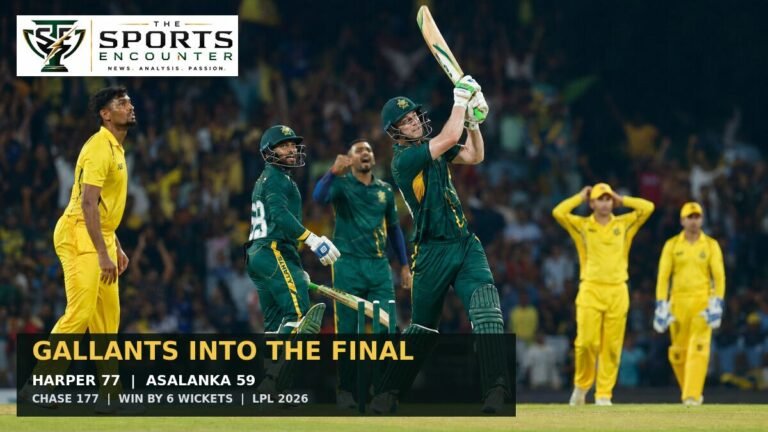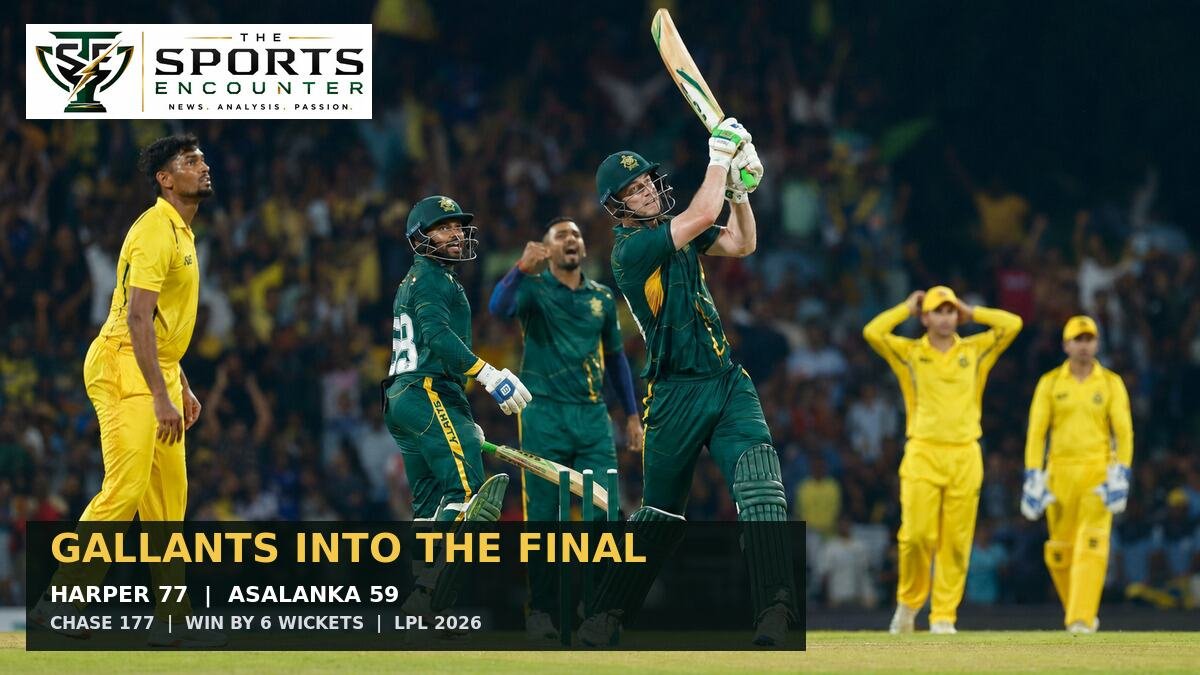
Harper, Arachchige Script 2nd Perfect Night for Galle Gallants in LPL 2026
Sam Harper anchored a 190-run chase before Sahan Arachchige’s unbeaten 38 carried Galle Gallants to a five-wicket win over Colombo Kaps.
Galle Gallants completed their second successful night in Colombo with a five-wicket victory over Colombo Kaps, chasing 190 with four balls remaining in Match 3 of the Lanka Premier League 2026.
Sam Harper shaped the chase with a measured 65 from 45 balls, absorbing pressure after two early wickets before accelerating alongside Charith Asalanka. Sahan Arachchige then took control of the closing stages, striking an unbeaten 38 from only 16 deliveries to carry Galle to 191 for 5 in 19.2 overs.
Colombo had earlier posted 189 for 8 after captain Kusal Mendis made 79 and Ben McDermott added 57. Their 97-run fourth-wicket partnership gave the Kaps a strong platform, but a late collapse prevented them from pushing closer to 200.
Galle’s response combined Harper’s stability with Arachchige’s fearless finishing. The result gave the Gallants two wins from two matches and strengthened their early position in the tournament after their convincing victory over Jaffna Kings in the LPL 2026 opener.
TL;DR
Galle Gallants beat Colombo Kaps by five wickets after chasing 190 in 19.2 overs. Sam Harper scored 65 from 45 balls and earned the Player of the Match award, while Sahan Arachchige smashed an unbeaten 38 from 16 balls. Kusal Mendis had earlier made 79 for Colombo, with Ben McDermott contributing 57. Akif Javed took four wickets, but Colombo’s bowlers could not defend 189.
Colombo Kaps vs. Galle Gallants: Match Summary
| Match detail | Information |
|---|---|
| Competition | Lanka Premier League 2026 |
| Match | Colombo Kaps vs. Galle Gallants |
| Venue | Sinhalese Sports Club Ground, Colombo |
| Colombo Kaps | 189/8 in 20 overs |
| Galle Gallants | 191/5 in 19.2 overs |
| Result | Galle Gallants won by five wickets |
| Player of the Match | Sam Harper |
| Top scorer for Colombo | Kusal Mendis, 79 off 53 |
| Top scorer for Galle | Sam Harper, 65 off 45 |
| Best bowling | Akif Javed, 4/40 |
| Match-winning finish | Sahan Arachchige, 38 not out off 16 |
Colombo Lose Early Wickets but Keep Attacking
Galle captain Dasun Shanaka chose to field, and his decision produced an early reward.
Rubin Hermann struggled to settle before Shanaka bowled him for one in the second over. Colombo did not respond cautiously. Sadeera Samarawickrama attacked Mohammad Nawaz for 15 from seven balls, while Kamindu Mendis struck 10 from five.
Both batters departed during a frantic powerplay, but the Kaps still reached 68 for 3 after six overs.
Samarawickrama fell to Nawaz at 43, and Akif Javed removed Kamindu after Galle successfully reviewed a caught-behind decision. Colombo had lost three wickets, yet their scoring rate remained above 11 runs per over.
Kusal Mendis then began rebuilding alongside Ben McDermott.
Kusal Mendis and McDermott Build the Innings
Mendis started aggressively and relied heavily on his power against spin. His innings included seven sixes, compared with only two fours, an unusual boundary pattern that reflected his willingness to attack down the ground.
McDermott complemented him with cleaner scoring through the field. The Australian reached his half-century from 30 balls, having struck five fours and two sixes.
Their partnership gave Colombo control of the middle overs.
The fourth-wicket pair added 97 runs and carried the score from 65 for 3 to 162. Mendis reached fifty from 34 balls, while McDermott maintained a strike rate above 165 throughout his stay.
Galle’s bowlers found it difficult to break the stand. Vijayakanth Viyaskanth provided the most economical spell, conceding only 24 from four overs, but he could not claim a wicket.
The partnership ended in the 17th over when Eshan Malinga trapped McDermott lbw for 57. Colombo reviewed the decision, but the original call remained.
That dismissal changed the final phase of the innings.
Akif Javed Stops Colombo’s Late Charge
Colombo had reached 161 for 3 after 16 overs and appeared capable of scoring more than 200.
Instead, they lost five wickets for 28 runs.
Akif removed Janith Liyanage for five before producing a productive final over. Malsha Tharupathi and Wanuja Sahan fell from consecutive deliveries, giving the left-arm seamer four wickets.
Mendis was run out for 79 at the beginning of the final over after facing 53 balls. His dismissal removed Colombo’s last established batter at the worst possible moment.
James Neesham finished unbeaten on 12, but the Kaps managed only three runs from the final five balls.
Akif’s figures of 4 for 40 looked expensive, yet his wicket-taking impact prevented Colombo from making full use of their platform. Shanaka also contributed with one wicket and a direct role in Mendis’ run-out.
The late collapse left Colombo on 189 for 8, a strong total without becoming an overwhelming one.
Galle’s Chase Starts With Early Pressure
Galle needed 9.50 runs per over and lost Lasith Croospulle during the third over.
Hasan Mahmud had him caught behind for 17, giving Colombo an early breakthrough. Mehidy Hasan Miraz followed at 50 for 2, caught by Liyanage off Wanuja Sahan after making 13.
Harper remained calm.
The wicketkeeper-batter avoided reckless shots while keeping the required rate under control. He collected boundaries when Colombo missed their lengths and allowed the more aggressive Asalanka to settle.
Galle reached 54 for 2 at the end of the powerplay, leaving the chase evenly balanced.
Harper and Asalanka then added 72 for the third wicket.
Harper Gives Galle Control
Harper’s innings provided the structure that Galle needed.
He reached his half-century from 38 balls, with six fours and one six at that stage. His acceleration became more noticeable once the partnership with Asalanka passed fifty.
Asalanka made 28 from 21 deliveries, including two sixes, before Hasan Mahmud removed him at 122.
His dismissal gave Colombo another opportunity.
Harper departed soon afterward for 65, caught by Neesham off Sahan. At 134 for 4 after 14.5 overs, Galle still needed 56 runs from 31 balls.
The required rate had climbed beyond 10.80 per over, and both established batters had returned to the pavilion.
Arachchige changed the equation almost immediately.
Sahan Arachchige Produces a Fearless Finish
Arachchige attacked from the beginning and refused to allow Colombo’s bowlers to settle.
His unbeaten 38 came from only 16 balls and included seven fours. He scored at a strike rate of 237.50 without hitting a six, finding gaps with placement and timing rather than relying solely on power.
The left-hander’s aggression pushed Galle to 150 in the 16th over.
Shanaka contributed eight from six balls before Neesham bowled him, leaving the Gallants at 163 for 5 after 17.2 overs. Colombo still had a chance, with Galle requiring 27 from 16 deliveries.
Mohammad Nawaz ensured the pressure did not last.
He struck two sixes in his unbeaten 16 from eight balls and supported Arachchige through the decisive final partnership. Together, they completed the chase with four deliveries unused.
Arachchige’s innings gave Galle the closing power that Colombo had lacked. Harper earned the Player of the Match award for anchoring the chase and taking two catches, but the final assault proved equally important.
Colombo’s Bowling Falls Apart at the Wrong Time
Colombo received useful spells from Sahan and Neesham.
Sahan took 2 for 19 from three overs and removed both Miraz and Harper. Neesham conceded 26 from three overs while dismissing Shanaka.
Mujeeb Ur Rahman also offered control, returning 0 for 30 from four overs.
The problem came from the other end.
Binura Fernando conceded 54 without taking a wicket, while Hasan Mahmud gave away 31 from only 2.2 overs despite claiming two wickets. Tharupathi allowed 20 from two overs.
Galle targeted the weaker matchups and ensured Colombo could not build sustained pressure. The Kaps took wickets at useful moments, yet each breakthrough was followed by another aggressive partnership.
The difference between the teams appeared most clearly in the closing overs. Colombo lost wickets and slowed down. Galle lost Harper and Shanaka but continued attacking.
Gallants Show Their Batting Depth Again
Galle entered the chase without relying on a single explosive innings.
Harper controlled the middle, Asalanka supported him, Arachchige changed the tempo, and Nawaz finished the job. Four different batters contributed to the chase at important stages.
That depth follows the pattern established in their first victory, when Asalanka and Shanaka led the batting before Eshan Malinga dominated with the ball. Galle’s evolving campaign can be followed through The Sports Encounter’s dedicated Lanka Premier League coverage.
The Gallants have now shown two different routes to victory.
They defended 213 against Jaffna. One night later, they chased 190 against Colombo.
Harper’s composure made the chase possible, but Arachchige’s finishing gave it authority. Galle are already beginning to look like one of the tournament’s most balanced teams.
Where Colombo Lost the Match
Colombo’s defeat did not come from one isolated mistake.
Their middle-order partnership created a winning position, but the final four overs produced only 28 runs and five wickets. A total above 200 looked realistic before McDermott’s dismissal.
The bowlers then conceded too many boundaries during the final phase of Galle’s chase. Harper’s dismissal offered Colombo a genuine opening, yet they could not contain Arachchige.
Mendis and McDermott gave the Kaps a strong batting foundation. Sahan bowled an excellent spell. Still, Colombo failed to control the most important moments.
Galle did.
That difference delivered their second victory and left Colombo searching for their first points of the LPL 2026 season.
FAQs
Who won Colombo Kaps vs. Galle Gallants?
Galle Gallants won by five wickets after reaching 191 for 5 in 19.2 overs.
Who was Player of the Match?
Sam Harper earned the award after scoring 65 from 45 balls and taking two catches.
How many runs did Kusal Mendis score?
Kusal Mendis made 79 from 53 balls, including two fours and seven sixes.
What did Sahan Arachchige score?
Arachchige struck an unbeaten 38 from 16 balls, hitting seven fours.
Who took the most wickets in the match?
Akif Javed claimed 4 for 40 for Galle Gallants.
How many matches have Galle Gallants won in LPL 2026?
Galle won their opening two matches, beating Jaffna Kings and Colombo Kaps. Their opening victory was also covered in The Sports Encounter’s first LPL match report.
Breaking News
Namibia Take 229 Chase to Final Ball as Pretorius Century Puts Zimbabwe on Brink of Tri-Series Final
Namibia pushed South Africa’s 228/4 deep into the final over, reaching 217/2 after 19.5 overs in a qualification match carrying consequences for all three teams. Lhuan-dre Pretorius’ maiden T20I century had put Zimbabwe close to the final, but Jan Frylinck, Louren Steenkamp and Ruben Trumpelmann kept Namibia alive until the closing moments.
WINDHOEK, September 4, 2026: South Africa appeared to have placed one hand on Zimbabwe’s ticket to the FNB T20 Tri-Series final when Lhuan-dre Pretorius and Connor Esterhuizen powered them to 228 for four in Windhoek.
Namibia refused to allow the qualification race to end quietly.
Jan Frylinck smashed 72 from 36 balls, Louren Steenkamp made 61 before retiring hurt, and the hosts carried an extraordinary chase deep into the final over at the Namibia Cricket Ground. With five deliveries of the 20th over completed, Namibia had reached 217 for two and still needed 12 from the final scheduled ball.
The arithmetic had become almost impossible, but the journey to that point had transformed what looked like a South African batting statement into one of the most gripping matches of the tournament.
Three countries were attached to every run.
South Africa had already secured their place in Sunday’s final. Namibia needed victory to keep their own campaign alive. Zimbabwe had completed all four league matches and could only watch, knowing a South African win would send Sikandar Raza’s team into the September 6 decider.
Pretorius’ maiden T20I century therefore became part of a much larger story. His 101 from 53 balls gave the Proteas a formidable total, but Namibia’s response ensured the identity of South Africa’s final opponent remained unresolved until the last moments of the league stage.
Latest verified match position: Namibia 217/2 after 19.5 overs, chasing 229. Ruben Trumpelmann was unbeaten on 21 from nine balls and captain Gerhard Erasmus was 30 not out from 26.
Namibia vs South Africa Match 6: Latest Verified Score
| Match Detail | Information |
|---|---|
| Tournament | FNB T20 Tri-Series 2026 |
| Match | Match 6, final league match |
| Venue | Namibia Cricket Ground, Windhoek |
| Date | September 4, 2026 |
| Toss | Namibia won the toss and elected to field |
| South Africa | 228/4 in 20 overs |
| Lhuan-dre Pretorius | 101 from 53 balls |
| Connor Esterhuizen | 88 from 40 balls |
| Opening Partnership | 156 runs |
| Namibia, latest verified score | 217/2 after 19.5 overs |
| Jan Frylinck | 72 from 36 balls |
| Louren Steenkamp | 61 from 44 balls, retired hurt |
| Gerhard Erasmus | 30* from 26 balls |
| Ruben Trumpelmann | 21* from 9 balls |
| Equation at 19.5 | Namibia needed 12 runs from the final scheduled ball |
The ICC’s official tournament guide confirms that the three teams play a double round-robin league before the top two meet in Sunday’s final in Windhoek.
This Match Was Really About Three Teams
South Africa and Namibia were the only teams on the field, but Zimbabwe’s tournament was being decided alongside them.
South Africa entered the match already assured of reaching the final after winning both of their games against Zimbabwe. The Proteas had recovered impressively from their opening defeat to Namibia and moved into control of the competition through consecutive victories.
Zimbabwe had completed their four league matches with two wins and two defeats. Both victories came against Namibia, while both losses came against South Africa.
The Sports Encounter explained the equation in detail after Zimbabwe beat Namibia by five wickets in Match 5.
That result took Raza’s side to four points but left qualification outside their control.
The ICC’s official Match 5 report confirmed the crucial condition: a South African victory over Namibia would ensure Zimbabwe reached Sunday’s final.
Namibia had the opposite requirement.
They needed to win.
A victory would take the hosts to four points, creating a three-way tie and bringing net run rate into the qualification calculation. Namibia entered the game with a substantially healthier NRR position than Zimbabwe, giving them control of their route if they could defeat South Africa again.
The final league fixture therefore carried three separate motivations.
| Team | Situation Before Match 6 | What the Result Means |
|---|---|---|
| South Africa | Already qualified for the final | Can finish the league strongly and determine their final opponent |
| Zimbabwe | Four points from four matches | Qualify if South Africa win |
| Namibia | Two points from three matches | Must win to force qualification onto net run rate |
Pretorius’ Maiden Hundred Could Hardly Have Arrived at a Better Time
Lhuan-dre Pretorius had already shaped Zimbabwe’s qualification problem three days earlier.
He made 94 from 51 balls as South Africa beat Zimbabwe by 43 runs, a performance examined in The Sports Encounter’s Match 4 analysis.
That victory damaged Zimbabwe’s net run rate and strengthened South Africa’s control of the tournament.
Pretorius returned against Namibia and went seven runs further.
His maiden T20I century came from 52 balls. He was eventually bowled by Gerhard Erasmus for 101 from 53, having struck five fours and eight sixes at a strike rate above 190.
The timing created an unusual connection between the three teams.
Pretorius had hurt Zimbabwe with 94. Zimbabwe were now relying on his 101 to help South Africa eliminate Namibia.
The same batter had become central to both sides of Zimbabwe’s qualification story.
Connor Esterhuizen Made the First 12 Overs Look Brutal
Pretorius did not construct South Africa’s huge total alone.
Connor Esterhuizen was actually the more destructive batter during much of the opening partnership, hammering 88 from 40 balls at a strike rate of 220.
His innings contained six fours and eight sixes.
South Africa reached 156 before Namibia finally took a wicket, with Jan Balt bowling Esterhuizen at 11.3 overs.
By that stage, the Proteas had created the kind of platform from which 230 or even 250 looked realistic.
The contrast with the teams’ first meeting was striking.
When Namibia stunned South Africa by 18 runs in the tournament opener, it was Frylinck and Steenkamp who dominated the opening partnership. They added 84 and forced the Proteas to chase the game from behind.
Six days later, Pretorius and Esterhuizen reversed the pattern.
South Africa’s 156-run opening stand appeared to have removed much of Namibia’s ability to control the qualification match.
Namibia Pulled the First Innings Back, but 228 Was Still Enormous
Balt deserves credit for preventing South Africa’s opening platform from becoming an even larger total.
He removed Esterhuizen for 88 and then dismissed Dewald Brevis for three.
Rubin Hermann contributed 26 from 21 balls before Ruben Trumpelmann removed him, while Erasmus finally ended Pretorius’ innings in the final over.
South Africa finished at 228 for four.
Namibia had conceded heavily, but the final phase provided at least some encouragement. A score that had threatened to move beyond 240 had been kept within a range that a batting side on a good Windhoek surface could contemplate.
Contemplating 229 and actually chasing it are very different jobs.
Namibia almost bridged that gap.
South Africa Batting Scorecard
| Batter | Runs | Balls | 4s | 6s | Strike Rate |
|---|---|---|---|---|---|
| Lhuan-dre Pretorius | 101 | 53 | 5 | 8 | 190.56 |
| Connor Esterhuizen | 88 | 40 | 6 | 8 | 220.00 |
| Dewald Brevis | 3 | 4 | 0 | 0 | 75.00 |
| Rubin Hermann | 26 | 21 | 3 | 0 | 123.80 |
| Eathan Bosch | 1* | 2 | 0 | 0 | 50.00 |
| Jordan Hermann | 1* | 1 | 0 | 0 | 100.00 |
| Extras | 8 | 4 byes, 2 leg byes, 1 no-ball, 1 wide | |||
| Total | 228/4 in 20 overs | ||||
Namibia Bowling
| Bowler | Overs | Runs | Wickets | Economy |
|---|---|---|---|---|
| Gerhard Erasmus | 3 | 28 | 1 | 9.33 |
| Ruben Trumpelmann | 4 | 38 | 1 | 9.50 |
| JJ Smit | 4 | 50 | 0 | 12.50 |
| Jack Brassell | 2 | 39 | 0 | 19.50 |
| Max Heingo | 3 | 36 | 0 | 12.00 |
| Jan Balt | 4 | 31 | 2 | 7.75 |
Namibia Responded to 229 by Scoring 67 Without Loss in the Powerplay
A chase of 229 leaves very little room for a quiet beginning.
Frylinck and Steenkamp understood that immediately.
Namibia raced to 67 without loss after six overs, maintaining the pressure required to prevent the asking rate from climbing toward an unrealistic level.
That opening phase changed the mood around the ground.
South Africa had scored heavily enough to expect scoreboard pressure to become their most reliable bowler. Namibia denied them that comfort.
Frylinck reached his half-century from only 28 deliveries.
The hosts passed 50 in 5.1 overs and reached 100 after 8.3.
For a chase of this size, those numbers were essential.
Jan Frylinck Produced the Innings Namibia Needed
Frylinck has been one of the most important players in this tournament from the opening afternoon.
He made 60 when Namibia defeated South Africa in Match 1.
His second performance against the Proteas was even more aggressive.
Frylinck made 72 from 36 balls, hitting six fours and five sixes at a strike rate of 200.
He and Steenkamp added 119 for the first wicket before Andile Simelane finally removed him in the 11th over.
That partnership gave Namibia something far more valuable than a respectable response.
It gave them belief that 229 could actually be reached.
The hosts had already shown how dangerous they could become when seemingly beaten. In their first meeting with Zimbabwe, Namibia recovered from 76 for six and came within five runs of chasing 196.
This time, there was no early collapse to repair.
Frylinck and Steenkamp built the chase from the beginning.
Steenkamp’s Retirement Hurt Changed the Match Again
Louren Steenkamp reached his fifty from 37 balls and continued to hold the innings together after Frylinck’s dismissal.
He had made 61 from 44 balls, with five fours and three sixes, when his innings ended through retirement hurt at 167 for one after 16 overs.
The timing was painful.
Namibia had reached the point where wickets were less important than having established batters available for the closing assault.
Steenkamp had spent 44 deliveries reading the pitch and South Africa’s attack. Leaving at that stage forced Namibia to reorganize the chase at exactly the moment when almost every delivery needed to produce value.
Captain Erasmus remained, but the required rate was climbing.
Namibia Made South Africa Pay for 13 Wides
One statistic deserves particular attention in a chase this close.
South Africa had conceded 24 extras by the time Namibia reached 217 for two.
Thirteen of those were wides.
Eight came through byes and another three through leg byes.
Eathan Bosch alone sent down nine wides during his four overs.
Those deliveries mattered because wides do two things during a chase: they add runs and force the bowler to deliver another ball.
South Africa had built a 228-run total that should have given their bowlers a considerable margin for error.
The extras steadily reduced it.
Namibia still needed boundary hitting, but the Proteas repeatedly helped prevent the required rate from becoming completely unmanageable.
JJ Smit Was Sent in to Attack Immediately
Steenkamp’s departure brought JJ Smit into a situation where conventional innings-building had little value.
He responded accordingly.
Smit struck nine from four balls, including a six, before Nqobani Mokoena dismissed him.
Namibia were 191 for two after 17.5 overs.
Thirty-eight runs were still required from 13 deliveries.
The match appeared to be moving back toward South Africa.
Ruben Trumpelmann had another idea.
Trumpelmann Turned the Final Overs Into a Genuine Cliffhanger
Trumpelmann entered with permission to swing.
He reached 21 from only nine balls and helped Namibia pass 200 after 18.4 overs.
At the end of the 19th over, the hosts were 205 for two.
They required 24 from six deliveries.
South Africa remained overwhelming favorites, but Namibia had taken a chase of 229 into the final over with eight wickets officially available and two experienced players at the crease.
The opening five balls produced another 12 runs.
Namibia reached 217 for two after 19.5 overs.
The final scheduled delivery therefore arrived with South Africa effectively holding the match, Zimbabwe watching the doorway to Sunday’s final, and Namibia having forced the qualification race as deep into the evening as it could reasonably go.
Namibia Batting Scorecard at the Latest Verified Ball
| Batter | Runs | Balls | 4s | 6s | Strike Rate |
|---|---|---|---|---|---|
| Louren Steenkamp | 61 | 44 | 5 | 3 | 138.63 |
| Jan Frylinck | 72 | 36 | 6 | 5 | 200.00 |
| Gerhard Erasmus | 30* | 26 | 1 | 1 | 115.38 |
| JJ Smit | 9 | 4 | 0 | 1 | 225.00 |
| Ruben Trumpelmann | 21* | 9 | 1 | 1 | 233.33 |
| Extras | 24 | 8 byes, 3 leg byes, 13 wides | |||
| Latest verified total | 217/2 after 19.5 overs | ||||
South Africa Bowling at 19.5 Overs
| Bowler | Overs | Runs | Wickets | Economy |
|---|---|---|---|---|
| Kwena Maphaka | 4 | 38 | 0 | 9.50 |
| Eathan Bosch | 4 | 43 | 0 | 10.75 |
| Bjorn Fortuin | 3 | 28 | 0 | 9.33 |
| Nqobani Mokoena | 3.5 | 43 | 1 | 11.21 |
| Andile Simelane | 2 | 28 | 1 | 14.00 |
| Nqabayomzi Peter | 3 | 26 | 0 | 8.66 |
The Chase Says Something Important About Namibia
Whatever the official final delivery produces, Namibia have already reinforced one of the central conclusions from this tournament.
They cannot be treated as convenient opposition for Full Member teams travelling through southern Africa.
The Sports Encounter made that argument in its pre-tournament analysis of the three 2027 World Cup co-hosts.
The evidence has accumulated since then.
Namibia beat South Africa in Match 1. They came within five runs of Zimbabwe after recovering from six wickets down. They pushed Zimbabwe again before losing Match 5. Now they have responded to a South African total of 228 for four by carrying the chase to the final ball.
That consistency matters more than one upset.
The official Cricket Namibia announcement framed this tournament as part of a broader effort to strengthen regional competition ahead of the 2027 ICC Men’s Cricket World Cup.
Matches like this provide the strongest argument for keeping that initiative alive.
Zimbabwe Have Experienced the Strangest Qualification Day of All
Zimbabwe could do nothing except watch.
That situation was created by their own results.
They lost twice to South Africa, including the damaging 43-run defeat built around Pretorius’ 94.
They also beat Namibia twice, including a five-run thriller and the five-wicket victory that kept their final hopes alive.
The combination left them on four points without another match to play.
Zimbabwe’s recent T20 cricket has contained plenty of fluctuation. They opened their July series by beating Bangladesh by 32 runs, only to lose the next two games. India later exposed the batting again when Zimbabwe were restricted to 125 for seven in Harare.
Windhoek has produced another lesson in tournament cricket.
Winning two of four matches can keep a team alive.
Losing heavily can remove control over what happens next.
Zimbabwe’s two defeats against South Africa damaged their NRR badly enough that the final league match became something they had to experience as spectators.
Pretorius Has Now Shaped Both Sides of Zimbabwe’s Qualification Story
This is the most interesting individual connection in the tournament.
Pretorius scored 94 against Zimbabwe and helped create the situation in which Raza’s team needed assistance.
Against Namibia, he scored the maiden century Zimbabwe desperately wanted South Africa to produce.
Across the two innings, he has made 195 runs from 104 balls.
The first innings hurt Zimbabwe.
The second could save their tournament.
The ICC’s report on Pretorius’ 94 against Zimbabwe noted that the 20-year-old had spoken with former Proteas batter Heinrich Klaasen about the mental side of T20 batting after beginning the tournament with modest scores.
The response has been immediate.
Pretorius followed scores of nine and 22 with 94 and 101.
Those are no longer promising starts from a young batter. They are innings changing the direction of an international tournament.
Why the Final Over Matters Beyond One Result
The dramatic finish has also validated the competitive structure of the tri-series.
South Africa, Zimbabwe and Namibia are preparing to jointly host the 2027 ODI World Cup. They possess very different cricket economies, player pools and international histories.
The gap in resources did not prevent the final league match from carrying qualification consequences for every participant.
That is precisely the value of meaningful regional competition.
A bilateral series can become flat once one team moves into an unassailable lead.
A three-team league creates dependencies.
Zimbabwe needed South Africa.
South Africa knew their performance would determine their final opponent.
Namibia had to chase 229 because there was no second opportunity waiting on the schedule.
That produced pressure which a friendly or developmental fixture cannot recreate.
The Sports Encounter Verdict
Lhuan-dre Pretorius’ first T20I century looked capable of settling this match before Namibia had faced a delivery.
South Africa had 228 for four. Pretorius had 101. Esterhuizen had 88. Their opening partnership was worth 156.
Namibia’s tournament required a chase of 229.
What followed may be even more significant for Namibian cricket than the eventual result.
Frylinck attacked from the beginning. Steenkamp stayed with him. The pair scored 119 for the opening wicket. Namibia reached 100 before the ninth over, passed 150 in the 15th and still found a way to continue after Steenkamp had to retire hurt.
Erasmus held the chase together while Smit and Trumpelmann attacked around him.
By 19.5 overs, Namibia had reached 217 for two.
The hosts had forced a South African side containing one of the tournament’s best individual innings to keep fighting until the final scheduled delivery.
Zimbabwe, meanwhile, had spent the afternoon watching Pretorius move from the batter who damaged their qualification campaign to the player who could help extend it.
That is what made Match 6 different.
The century mattered.
The chase mattered.
The qualification equation connected them.
For continuing coverage of the tri-series, international cricket and Sunday’s final, visit The Sports Encounter Cricket Hub.
Frequently Asked Questions
What did South Africa score against Namibia in Match 6?
South Africa scored 228 for four from their 20 overs at the Namibia Cricket Ground in Windhoek.
How many runs did Lhuan-dre Pretorius score against Namibia?
Pretorius scored 101 from 53 balls, reaching his maiden T20I century from 52 deliveries. He hit five fours and eight sixes.
How many runs did Connor Esterhuizen score?
Esterhuizen made 88 from 40 balls, including six fours and eight sixes, and shared a 156-run opening stand with Pretorius.
How close did Namibia get in the chase?
At the latest fully verified match position, Namibia had reached 217 for two after 19.5 overs and needed 12 runs from the final scheduled delivery while chasing 229.
How many runs did Jan Frylinck score?
Jan Frylinck scored 72 from 36 balls with six fours and five sixes at a strike rate of 200.
What happened to Louren Steenkamp?
Steenkamp scored 61 from 44 balls before retiring hurt with Namibia at 167 for one after 16 overs.
Why does Namibia vs South Africa matter to Zimbabwe?
Zimbabwe completed their four league matches with four points. An official South African victory over Namibia would send Zimbabwe through to the September 6 final alongside the Proteas.
What happens if Namibia beat South Africa?
A Namibia victory would move the hosts to four points alongside South Africa and Zimbabwe and bring net run rate into the final qualification decision. Namibia entered Match 6 with a substantially stronger NRR position than Zimbabwe.
Have South Africa already qualified for the final?
Yes. South Africa had already secured their place in the tri-series final before the final league match against Namibia.
When is the Namibia T20I Tri-Series final?
The final is scheduled for September 6, 2026, at the Namibia Cricket Ground in Windhoek.
A Celebration of 5000 ODIs
A Celebration of 5000 ODIs Match 16: Olonga Takes Three Wickets as India Fall Three Runs Short
India needed nine runs from two overs with three wickets remaining. Henry Olonga then delivered six balls that transformed Zimbabwe’s World Cup campaign.
India needed nine runs from 12 balls. Robin Singh had survived the repair work, Javagal Srinath had already struck two sixes, and Zimbabwe were turning to a bowler who had struggled to control the ball earlier in the chase.
Henry Olonga had conceded six wides across three overs. His return for the 45th carried obvious risk. India held three wickets and still had another over available.
Six deliveries later, the match was over.
Olonga removed Robin, bowled Srinath and trapped Venkatesh Prasad lbw. India were dismissed for 249, three runs short of Zimbabwe’s 252/9, with six balls of their reduced allocation unused.
The ending alone earns this contest a place in A Celebration of 5000 ODIs. The path toward it adds several more reasons: 90 overs of fluctuating control, 90 extras, India’s costly slow-over-rate penalty, the absence of Sachin Tendulkar, and a match-winning performance from Grant Flower that extended far beyond the final score.
TL;DR
- Zimbabwe beat India by three runs at Grace Road during the 1999 World Cup.
- Andy Flower anchored Zimbabwe’s innings with 68 not out from 85 balls.
- Grant Flower made 45 and conceded only 33 runs from 10 overs to earn Player of the Match.
- India’s slow over rate reduced its chase from 50 overs to 46.
- Sadagoppan Ramesh top-scored for India with 55, while Ajay Jadeja made 43.
- Henry Olonga took three wickets in the 45th over to end India’s chase at 249.
Zimbabwe vs India 1999 World Cup: Match Information
| Detail | Information |
|---|---|
| Match | India vs Zimbabwe, Group A |
| Tournament | 1999 Cricket World Cup |
| Date | May 19, 1999 |
| Venue | Grace Road, Leicester |
| Toss | India won the toss and fielded |
| Zimbabwe | 252/9 in 50 overs |
| India | 249 all out in 45 overs |
| Result | Zimbabwe won by three runs |
| Player of the Match | Grant Flower, 45 and 1/33 |
| Zimbabwe’s top scorer | Andy Flower, 68 not out |
| India’s top scorer | Sadagoppan Ramesh, 55 |
| Best bowling figures | Heath Streak, 3/36; Henry Olonga, 3/22 |
| Turning point | Olonga took three wickets in the 45th over |
| Tournament impact | Zimbabwe earned its second win; India suffered a second consecutive defeat |
Complete Match Scorecard
Zimbabwe Innings: 252/9 in 50 Overs
| Batter | Dismissal | Runs | Balls | 4s | 6s |
|---|---|---|---|---|---|
| Neil Johnson | c Mongia b Srinath | 7 | 10 | 1 | 0 |
| Grant Flower | c Mongia b Jadeja | 45 | 89 | 4 | 0 |
| Paul Strang | b Agarkar | 18 | 26 | 1 | 0 |
| Murray Goodwin | c Robin Singh b Ganguly | 17 | 40 | 3 | 0 |
| Andy Flower | Not out | 68 | 85 | 2 | 0 |
| Alistair Campbell | st Mongia b Kumble | 24 | 29 | 3 | 0 |
| Guy Whittall | b Kumble | 4 | 8 | 0 | 0 |
| Stuart Carlisle | b Srinath | 1 | 2 | 0 | 0 |
| Heath Streak | c Mongia b Prasad | 14 | 18 | 2 | 0 |
| Eddo Brandes | c Mongia b Prasad | 2 | 5 | 0 | 0 |
| Henry Olonga | Not out | 1 | 4 | 0 | 0 |
| Extras | 14 leg byes, 21 wides, 16 no-balls | 51 | |||
| Total | Nine wickets in 50 overs | 252 |
Fall of wickets: 12/1, 45/2, 87/3, 144/4, 204/5, 211/6, 214/7, 244/8, 250/9.
India Bowling
| Bowler | Overs | Maidens | Runs | Wickets |
|---|---|---|---|---|
| Javagal Srinath | 10 | 1 | 35 | 2 |
| Venkatesh Prasad | 10 | 1 | 37 | 2 |
| Ajit Agarkar | 9 | 0 | 70 | 1 |
| Sourav Ganguly | 5 | 0 | 22 | 1 |
| Robin Singh | 2 | 0 | 11 | 0 |
| Anil Kumble | 10 | 0 | 41 | 2 |
| Ajay Jadeja | 4 | 0 | 22 | 1 |
India Innings: 249 All Out in 45 Overs
| Batter | Dismissal | Runs | Balls | 4s | 6s |
|---|---|---|---|---|---|
| Sourav Ganguly | c Brandes b Johnson | 9 | 8 | 2 | 0 |
| Sadagoppan Ramesh | c Goodwin b Grant Flower | 55 | 77 | 3 | 1 |
| Rahul Dravid | c Grant Flower b Streak | 13 | 14 | 2 | 0 |
| Mohammad Azharuddin | c Campbell b Streak | 7 | 11 | 1 | 0 |
| Ajay Jadeja | lbw b Streak | 43 | 76 | 3 | 0 |
| Robin Singh | c Campbell b Olonga | 35 | 47 | 1 | 0 |
| Ajit Agarkar | Run out (Goodwin) | 1 | 5 | 0 | 0 |
| Nayan Mongia | b Whittall | 28 | 24 | 2 | 1 |
| Javagal Srinath | b Olonga | 18 | 12 | 0 | 2 |
| Anil Kumble | Not out | 1 | 1 | 0 | 0 |
| Venkatesh Prasad | lbw b Olonga | 0 | 1 | 0 | 0 |
| Extras | 1 bye, 4 leg byes, 24 wides, 10 no-balls | 39 | |||
| Total | All out in 45 overs | 249 |
Fall of wickets: 13/1, 44/2, 56/3, 155/4, 174/5, 175/6, 219/7, 246/8, 249/9, 249/10.
Zimbabwe Bowling
| Bowler | Overs | Maidens | Runs | Wickets |
|---|---|---|---|---|
| Eddo Brandes | 3 | 0 | 27 | 0 |
| Neil Johnson | 7 | 0 | 51 | 1 |
| Heath Streak | 9 | 0 | 36 | 3 |
| Henry Olonga | 4 | 0 | 22 | 3 |
| Guy Whittall | 4 | 0 | 26 | 1 |
| Paul Strang | 8 | 0 | 49 | 0 |
| Grant Flower | 10 | 0 | 33 | 1 |
India’s 51 Extras Change the Shape of the Match
Zimbabwe’s recognized batters scored only 200 runs between them. India supplied the remaining 51 through 21 wides, 16 no-balls and 14 leg byes.
Ajit Agarkar conceded 70 from nine overs, including five no-balls and four wides. Srinath bowled five no-balls, while almost every frontline option contributed to the extras column.
Those mistakes also slowed the innings. Match officials penalized India four overs for its slow over rate, leaving the team 46 overs to chase 253. In a match decided by three runs, the missing 24 deliveries became impossible to ignore.
Andy Flower Holds Zimbabwe Together
Zimbabwe reached 87/3 before Andy Flower began building the innings around control and placement.
Grant Flower’s 45 had occupied India’s bowlers for 89 deliveries, but his dismissal left Zimbabwe 144/4. Andy then added 60 with captain Alistair Campbell, who contributed 24 from 29 balls.
Three wickets fell for 10 runs after Campbell departed. Andy stayed unbeaten, pushed the total beyond 250 and finished with 68 from 85 balls.
His innings continued a remarkable family contribution to Zimbabwe cricket. The ICC’s history of Zimbabwe’s cricketing brothers identifies the Flower siblings as central figures in the country’s strongest World Cup campaign.
Grant Flower Delivers the Complete Match
Grant’s 45 was slower than Andy’s unbeaten innings, but it gave Zimbabwe stability after Neil Johnson and Paul Strang fell inside the first 10 overs.
His greater influence emerged during India’s chase.
Ramesh and Jadeja had rebuilt from 56/3 with a 99-run fourth-wicket partnership. Grant ended it by dismissing Ramesh for 55, then completed his 10 overs for only 33 runs.
That economy mattered in a chase requiring more than five runs per over. His combined batting and bowling contribution earned him Player of the Match, even though Olonga produced the unforgettable finish.
Heath Streak Breaks India’s Top Order
India played without Sachin Tendulkar, who had returned home following his father’s death. His absence placed greater pressure on Ganguly, Dravid and captain Azharuddin.
All three were gone by the ninth over.
Neil Johnson dismissed Ganguly before Heath Streak removed Dravid and Azharuddin. Streak later trapped Jadeja lbw for 43, finishing with 3/36 from nine overs.
India had recovered from 56/3 to 155/3, but Streak’s third wicket prevented Jadeja from carrying the chase into its closing phase.
Tendulkar returned in India’s next game and scored an emotional unbeaten 140 against Kenya, an innings documented in the ICC’s account of his finest World Cup performances.
Ramesh, Robin and Srinath Take India Within Reach
Ramesh’s 55 gave India its first substantial innings. Jadeja supported him with 43, but their dismissals and Agarkar’s run-out left India 175/6.
Robin Singh then rebuilt with Mongia. After Mongia fell for 28, Srinath attacked, striking two sixes in his 12-ball 18.
India moved to 246/7 and needed seven runs from 10 deliveries. Zimbabwe appeared to have lost control despite repeatedly creating winning positions.
Campbell brought Olonga back.
Henry Olonga Wins the Match in Five Balls
Olonga’s second delivery removed Robin for 35, with Campbell completing the catch.
Srinath survived two more balls before Olonga bowled him with the fifth delivery. Prasad faced the last ball and was trapped lbw for a duck.
Olonga had taken three wickets in five balls. His final figures read 3/22 from four overs, an extraordinary return considering the six wides he had delivered earlier.
The ICC ranks Zimbabwe’s victory among the greatest World Cup upsets, while its review of Zimbabwe’s classic World Cup matches highlights Olonga’s ability to recover from his earlier problems and attack India’s final three wickets.
Why Match 16 Belongs in A Celebration of 5000 ODIs
This match asked both teams to recover repeatedly.
Zimbabwe survived early wickets, India’s middle order rebuilt from 56/3, and Robin and Srinath brought the chase back after it slipped to 175/6. Olonga then turned a likely defeat into victory within one over.
The three-run margin connects the game with Zimbabwe’s earlier World Cup surprises, including Eddo Brandes defending 134 against England in Match 10. It also provides a very different counterpoint to Kapil Dev’s rescue against Zimbabwe in 1983.
The contest followed the two Australia-South Africa classics from the same tournament: Steve Waugh’s survival at Headingley and the tied semifinal at Edgbaston.
Readers can explore every published installment through the A Celebration of 5000 ODIs collection and follow wider historical and current reporting through The Sports Encounter’s cricket coverage hub.
What Happened Next
Zimbabwe later defeated South Africa and reached the Super Six stage for the first time. India recovered to win its next three group matches, but the points carried forward from this defeat damaged its position in the following round.
Grace Road produced the result through accumulated mistakes and small interventions rather than a dominant century or five-wicket haul. India conceded 51 extras, lost four overs and still reached the final nine runs with three wickets available.
Olonga needed one over to make every earlier detail decisive.
Breaking News
Lhuan-dre Pretorius Hits Maiden T20I Century as South Africa Take Control of Namibia-Zimbabwe Final Race
Lhuan-dre Pretorius struck his maiden T20I century at the perfect moment for South Africa, scoring 101 from 53 balls as the Proteas set Namibia 229 in a match that will decide who joins them in the 2026 FNB T20 Tri-Series final. Namibia must win, while Zimbabwe are relying on South Africa to defend the total.
WINDHOEK, September 4, 2026: Lhuan-dre Pretorius chose an extraordinary moment to score his first T20 international century.
South Africa had already secured their place in the 2026 FNB T20 Tri-Series final before facing Namibia in the final league match in Windhoek. For everyone else, however, the tournament remained unresolved.
Namibia needed victory to reach Sunday’s final. Zimbabwe had already completed their four league matches and could do nothing except hope South Africa won. The Proteas themselves had an opportunity to decide whether they would meet Namibia, the team that defeated them in the tournament opener, or Zimbabwe, the side they had already beaten twice.
Into that three-team qualification equation stepped Pretorius.
The 20-year-old struck 101 from 53 balls, reaching his maiden T20I hundred from 52 deliveries, as South Africa made 228 for four from their 20 overs. Connor Esterhuizen supplied an equally important 88 from just 40 balls, and the pair shared a 156-run opening partnership that forced Namibia into a chase of 229 with their place in the final attached to it.
Pretorius had made 94 against Zimbabwe three days earlier. Six runs separated him from a first international hundred that afternoon. Against Namibia, with South Africa suddenly holding enormous influence over the tournament’s final qualification race, he completed the job.
His century therefore carries significance far beyond an individual milestone.
If South Africa defend 228, Zimbabwe advance to the September 6 final. If Namibia chase 229, the hosts move onto four points and are positioned to edge Zimbabwe through net run rate.
South Africa’s young opener has effectively handed both chasing teams their equation.
Namibia vs South Africa: The Qualification Match at a Glance
| Match Detail | Information |
|---|---|
| Tournament | FNB T20 Tri-Series 2026 |
| Match | Match 6, final league fixture |
| Venue | Namibia Cricket Ground, Windhoek |
| Date | September 4, 2026 |
| Toss | Namibia won the toss and chose to field |
| South Africa | 228/4 in 20 overs |
| Lhuan-dre Pretorius | 101 from 53 balls |
| Connor Esterhuizen | 88 from 40 balls |
| Opening Partnership | 156 runs |
| Namibia Target | 229 |
| If Namibia win | Namibia move to four points and are positioned to qualify ahead of Zimbabwe on NRR |
| If South Africa win | Zimbabwe qualify for the final |
| South Africa | Already qualified |
The ICC’s official tournament guide confirms the double round-robin format, with the top two teams progressing to the September 6 final in Windhoek.
Why This Match Matters to South Africa, Namibia and Zimbabwe
Most final league matches matter primarily to the two teams standing on the field.
This one reaches into a third dressing room.
Zimbabwe finished their league program on September 3 by beating Namibia by five wickets. Innocent Kaia’s 72 from 42 balls carried Sikandar Raza’s side to four points, but the result left Zimbabwe’s qualification fate outside their control.
The Sports Encounter’s Match 5 analysis explained the uncomfortable position Zimbabwe had created for themselves. Two wins over Namibia kept them alive, while two defeats against South Africa left their net run rate badly damaged.
The final equation became brutally simple.
What South Africa are playing for
The Proteas are already in Sunday’s final after winning both matches against Zimbabwe.
They can still influence almost everything else.
A victory over Namibia gives South Africa six league points, completes a three-match winning sequence and sends Zimbabwe into the final alongside them.
There is also unfinished business.
Namibia defeated South Africa by 18 runs in the tournament opener, a result examined in our full report on Namibia’s opening-night upset.
The hosts made 163 for nine before restricting the Proteas to 145 for nine. It was Namibia’s second victory from two men’s T20Is against South Africa.
The Proteas therefore entered Match 6 with qualification secured but plenty still available: revenge, momentum, top position and some influence over the identity of their final opponent.
What Namibia are playing for
Namibia’s situation carries far greater urgency.
They entered the match with two points from three games.
Lose, and their tournament ends.
Win, and they move to four points alongside Zimbabwe with a considerably healthier net run rate entering the final fixture.
The hosts have already proved they can beat this South African side. They did it on August 28 through Jan Frylinck’s 60 and disciplined bowling from Ruben Trumpelmann and JJ Smit.
Now they have been asked to do something very different.
Instead of defending 163, they must chase 229.
Pretorius’ century has changed the nature of Namibia’s qualification challenge from winning a T20I into producing one of the most significant successful chases of their tournament.
What Zimbabwe are playing for while watching
Zimbabwe have nothing left to score, bowl or catch.
That may make their situation the most uncomfortable of the three.
Raza’s side finished its four matches with two wins and two defeats. Both victories came against Namibia. Both defeats came against South Africa.
The ICC confirmed after Zimbabwe’s Match 5 victory that a South African win over Namibia would send Zimbabwe into the final. Raza acknowledged afterward that his team would be watching the final league match closely.
Zimbabwe therefore find themselves supporting the same South African side that damaged their qualification position in the first place.
Three days earlier, Pretorius had hammered 94 against them.
Today, they need his century to help finish the job.
The Points Table Before the Final League Result
| Team | Played | Won | Lost | Points | Position Before Match 6 Result |
|---|---|---|---|---|---|
| South Africa | 3 | 2 | 1 | 4 | Qualified |
| Zimbabwe | 4 | 2 | 2 | 4 | Waiting on Namibia vs South Africa |
| Namibia | 3 | 1 | 2 | 2 | Must win |
The Complete Qualification Scenarios After South Africa’s 228/4
| Scenario | South Africa | Zimbabwe | Namibia |
|---|---|---|---|
| South Africa defend 228 | Finish league stage with 6 points | Advance to final on 4 points | Eliminated on 2 points |
| Namibia chase 229 | Remain qualified | Finish level with Namibia on 4 points and vulnerable on NRR | Reach 4 points and are positioned to take second place on NRR |
Why net run rate became Zimbabwe’s problem
Zimbabwe’s difficulty was created largely by the size of their defeats to South Africa.
In Match 2, the Proteas chased Zimbabwe’s 144 for eight in only 13.4 overs, winning by seven wickets. Dewald Brevis hammered an unbeaten 75 from 32 balls as South Africa recovered immediately from their opening defeat against Namibia.
The second meeting inflicted even greater scoreboard damage.
South Africa scored 185 for seven before bowling Zimbabwe out for 142. Pretorius made 94 from 51 balls and Bjorn Fortuin claimed 4 for 24 as the Proteas won by 43 runs.
Our full Match 4 report showed how that result pushed South Africa toward the final while leaving Zimbabwe vulnerable even if they eventually reached four points.
Zimbabwe responded by beating Namibia convincingly in Match 5, but one good chase could not fully erase the earlier damage.
That is why Pretoria’s 228 matters so much today.
Every additional run South Africa put on the board increased the pressure on Namibia while quietly improving Zimbabwe’s prospects from outside the ground.
Pretorius’ 101 Came at Exactly the Right Time for the Proteas
South Africa did not need Pretorius’ century to qualify for the final.
They needed it for almost everything else they wanted from this match.
Namibia had already beaten them once during this tournament and twice in two T20I meetings overall. Another defeat would have given the hosts an extraordinary three-from-three record against the Proteas and sent them into the final with considerable psychological momentum.
Instead, Pretorius and Esterhuizen created immediate pressure.
South Africa reached 70 without loss during the Powerplay and continued above 12 runs per over through much of the opening partnership.
The first wicket did not fall until the score had reached 156.
By then Namibia’s evening had already changed.
They were no longer trying to restrict South Africa to a conventional target around 160 or 170. They were trying to prevent a score around 240 or 250.
Connor Esterhuizen Made Pretorius’ Century Even More Dangerous
Pretorius’ milestone will carry the headline, but Namibia’s tactical problem came from having two destructive openers operating simultaneously.
Esterhuizen made 88 from 40 deliveries, striking six fours and eight sixes.
His strike rate of 220 meant Namibia could not focus their defensive planning entirely on Pretorius.
If they tried to protect the boundary against one batter, the other attacked.
If they attempted to force a quiet over, one boundary quickly became two or three.
The pair put on 156 for the first wicket, one of South Africa’s biggest opening partnerships in T20 international cricket.
The scale of the stand becomes even more meaningful in a qualification match because it denied Namibia the one thing that could have lowered the tension surrounding their chase: early wickets.
South Africa’s Opening Partnership Reversed the First Namibia Match
The contrast with August 28 is striking.
In the tournament opener, Namibia’s Jan Frylinck and Louren Steenkamp added 84 for the first wicket. South Africa then lost Lhuan-dre Pretorius for nine and found themselves 19 for two.
Namibia controlled the game from that point.
Match 6 flipped the structure completely.
Pretorius and Esterhuizen became the dominant opening pair. Namibia spent more than 11 overs waiting for their first wicket.
The original Sports Encounter tri-series preview had identified Pretorius as one of the young South Africans with an opportunity to turn a developmental tour into something more substantial.
His tournament began with nine against Namibia and 22 against Zimbabwe.
His last two innings have produced 94 and 101.
From 94 Against Zimbabwe to 101 When Zimbabwe Needed Him
There is a wonderful irony to the timing.
On September 1, Pretorius did enormous damage to Zimbabwe’s qualification position.
He scored 94 from 51 balls, helping South Africa reach 185 for seven. Fortuin and Duan Jansen then dismantled Zimbabwe’s chase.
That result left Zimbabwe with a severely negative net run rate and reduced their control over qualification.
Three days later, Zimbabwe need the same batter to help rescue their tournament.
Pretorius’ 101 has given South Africa the kind of total that Zimbabwe would have wanted them to build before the match began.
The youngster who helped create Zimbabwe’s problem may now help solve it.
Pretorius’ Maiden T20I Century: The Numbers
| Category | Figure |
|---|---|
| Runs | 101 |
| Balls | 53 |
| Fours | 5 |
| Sixes | 8 |
| Strike Rate | 190.57 |
| Balls to Century | 52 |
| Boundary Runs | 68 |
| Previous T20I Innings | 94 from 51 vs Zimbabwe |
| Runs Across Last Two Innings | 195 |
Pretorius has therefore scored 195 runs from 104 balls across his last two international innings.
Earlier this season, The Sports Encounter also saw his attacking ability in franchise cricket when he struck 52 from 28 balls for London Spirit at Lord’s.
The difference in Windhoek has been duration.
Pretorius has always possessed the ability to score quickly. His last two T20Is suggest he is beginning to remain at the crease long enough for that aggression to shape entire international matches.
South Africa Batting Scorecard
| Batter | Runs | Balls | 4s | 6s | Strike Rate |
|---|---|---|---|---|---|
| Lhuan-dre Pretorius | 101 | 53 | 5 | 8 | 190.57 |
| Connor Esterhuizen | 88 | 40 | 6 | 8 | 220.00 |
| Dewald Brevis | 3 | 4 | 0 | 0 | 75.00 |
| Rubin Hermann | 26 | 21 | 3 | 0 | 123.81 |
| Eathan Bosch | 1* | 2 | 0 | 0 | 50.00 |
| Jordan Hermann | 1* | 1 | 0 | 0 | 100.00 |
How the Tournament Reached This Three-Team Qualification Drama
The final league match has this much significance because almost every earlier result altered the direction of the table.
| Match | Result | Impact on the Final Race |
|---|---|---|
| Match 1 | Namibia beat South Africa by 18 runs | Hosts took early control and immediately put the Proteas under pressure |
| Match 2 | South Africa beat Zimbabwe by 7 wickets | South Africa recovered while Zimbabwe suffered major NRR damage |
| Match 3 | Zimbabwe beat Namibia by 5 runs | All three teams moved to one win and one defeat |
| Match 4 | South Africa beat Zimbabwe by 43 runs | Proteas moved toward qualification; Zimbabwe’s NRR deteriorated further |
| Match 5 | Zimbabwe beat Namibia by 5 wickets | Zimbabwe reached four points but became dependent on Match 6 |
| Match 6 | Namibia chasing South Africa’s 228/4 | The second finalist will be determined |
Zimbabwe’s first win over the hosts was one of the competition’s most dramatic games. Brad Evans helped them survive by five runs after Namibia threatened an extraordinary recovery, a contest covered in our Match 3 report from Windhoek.
That result prevented Namibia from opening a significant gap in the standings.
Five days later, everything has come back to Namibia against South Africa.
Why 229 Changes Namibia’s Approach Completely
Namibia entered the game knowing that any victory would keep their tournament alive.
The target now dictates how that victory must be achieved.
A chase of 229 offers almost no room for a conservative Powerplay followed by late acceleration. The hosts need sustained scoring from the beginning because the required rate starts above 11 runs per over.
Jan Frylinck and Louren Steenkamp are particularly important because they have already demonstrated their ability to attack South Africa’s bowlers.
They added 84 in the first meeting.
Gerhard Erasmus, JJ Smit and the rest of Namibia’s experienced middle order will then have to maintain the tempo rather than rebuild.
That creates the pressure South Africa wanted when they began batting.
Pretorius’ hundred has forced Namibia to play an aggressive version of T20 cricket for almost the entire chase.
South Africa Can Decide Which Team They Face on Sunday
There is an unusual strategic layer for Bjorn Fortuin’s side.
South Africa have already beaten Zimbabwe twice during this tournament.
They have yet to beat Namibia.
If they defend 228, Sunday’s final becomes South Africa versus Zimbabwe, an opponent whose batting they have already restricted to 144 for eight and 142 all out.
If Namibia win, South Africa will meet the only team that has beaten them during the league stage.
The Proteas will not choose their opponent deliberately through the result, but their performance today determines who gets through.
That gives every South African bowler an additional reason to treat the chase as something more consequential than a dead rubber.
Zimbabwe’s Entire Sunday Now Depends on South Africa’s Bowlers
For Zimbabwe, the emotional rhythm of the day must feel strange.
They spent the tournament trying to beat South Africa.
Now they need South Africa to win.
Zimbabwe Cricket cannot change the equation through selection, tactics or another Sikandar Raza innings. The league stage is finished for them.
The ICC’s official Match 5 report made the scenario clear: a Proteas victory ensures Zimbabwe reach the final.
Everything Zimbabwe achieved against Namibia in their two victories will count only if South Africa prevent the hosts from reaching four points.
That is why Pretorius’ century has landed at such a valuable moment for Raza’s side as well.
Zimbabwe could hardly have asked South Africa’s top order for a better first innings.
Namibia Are Playing for More Than a Place in One Final
A successful chase would send Namibia into a final against South Africa after already beating the Proteas in the tournament opener.
That would represent another significant result for a country trying to establish itself more firmly in African cricket.
The wider importance of this tri-series was established before the first ball.
Namibia, South Africa and Zimbabwe will jointly host the 2027 ICC Men’s Cricket World Cup. The official Cricket Namibia tournament announcement described the series as part of a wider attempt to create more regular competitive cricket among African nations.
Namibia have already shown why that model has sporting value.
They beat South Africa in the first match. They pushed Zimbabwe to within five runs in another. Now they have an opportunity to qualify for a final by chasing 229 against a Full Member opponent.
No exhibition match can create that kind of pressure.
Pretorius Has Become South Africa’s Tournament-Changing Batter
Dewald Brevis entered the tournament as perhaps the most obvious destructive threat in South Africa’s experimental squad.
Pretorius has gradually changed that conversation.
His first two scores were nine and 22.
Then came 94.
Now 101.
| Innings | Opponent | Runs |
|---|---|---|
| 1 | Namibia | 9 |
| 2 | Zimbabwe | 22 |
| 3 | Zimbabwe | 94 |
| 4 | Namibia | 101 |
That progression is exactly what South Africa wanted from a tour built around opportunity.
The squad travelled without many established first-choice players. Younger batters were therefore asked to carry genuine international responsibility rather than appear briefly around a senior core.
Pretorius has responded by producing South Africa’s defining batting innings in consecutive matches.
The Sports Encounter Verdict
Lhuan-dre Pretorius has his maiden T20I century, but the number 101 tells only part of Friday’s story.
The timing gives the innings its real weight.
South Africa had already qualified for the final. Namibia had to win. Zimbabwe had finished playing and could only wait.
Pretorius turned those circumstances into a 229-run qualification challenge.
For the Proteas, his century offers a route to revenge against the only team to beat them in the tournament and a chance to carry three consecutive wins into Sunday’s final.
For Namibia, it creates the hardest possible version of their qualification equation. They must chase one of the largest totals of the tournament with elimination waiting if they fail.
For Zimbabwe, the innings has arrived like unexpected assistance from the same player who hurt them three days earlier.
Pretorius’ 94 helped put Zimbabwe’s qualification hopes into South Africa’s hands.
His 101 has given those hands something substantial to defend.
Namibia still have their opportunity, and their earlier victory over the Proteas means nobody should treat the chase as ceremonial. Yet South Africa have placed the hosts exactly where they wanted them: under scoreboard pressure, carrying the expectations of a home crowd and knowing every lost wicket moves Zimbabwe closer to Sunday’s final.
One innings has connected all three teams.
That is why Pretorius’ maiden hundred could eventually be remembered as the performance that decided far more than one T20I.
Follow the tournament, international cricket and qualification analysis through The Sports Encounter Cricket Hub.
Frequently Asked Questions
How many runs did Lhuan-dre Pretorius score against Namibia?
Lhuan-dre Pretorius scored 101 from 53 balls for South Africa in the final league match of the 2026 FNB T20 Tri-Series.
Was this Pretorius’ first T20I century?
Yes. Pretorius reached his maiden T20 international hundred from 52 balls before being dismissed for 101.
What score did South Africa make against Namibia?
South Africa scored 228 for four from 20 overs, setting Namibia a target of 229.
Why is Namibia vs South Africa so important for qualification?
South Africa have already qualified for the final, while Namibia must win to stay alive. Zimbabwe have completed their four league matches and qualify if South Africa beat Namibia.
What happens if South Africa beat Namibia?
South Africa would finish the league stage on six points and Zimbabwe would join them in the September 6 final. Namibia would be eliminated.
What happens if Namibia beat South Africa?
Namibia would move to four points alongside Zimbabwe and are positioned to move ahead of Zimbabwe through net run rate, putting the hosts into the final.
Has Zimbabwe already completed its league matches?
Yes. Zimbabwe finished with two wins and two defeats from four games and cannot influence the final league result themselves.
Has South Africa already qualified for the final?
Yes. South Africa secured qualification before facing Namibia in Match 6.
How many runs did Connor Esterhuizen score?
Connor Esterhuizen made 88 from 40 balls and shared a 156-run opening partnership with Pretorius.
When is the FNB T20 Tri-Series final?
The final is scheduled for September 6, 2026, at the Namibia Cricket Ground in Windhoek.
-
Editor's Choice4 weeks agoPremier League 2026–27 Curtain Raiser: Fixtures, Teams, Title Contenders, Transfers and Season Predictions
-
Editor's Choice4 weeks agoWhen Will Lionel Messi Retire? Argentina President Says Only Messi Has the Answer
-
Editor's Choice4 weeks agoWhich of Last Season’s Premier League Top 10 Can Actually Win the 2026-27 Title?