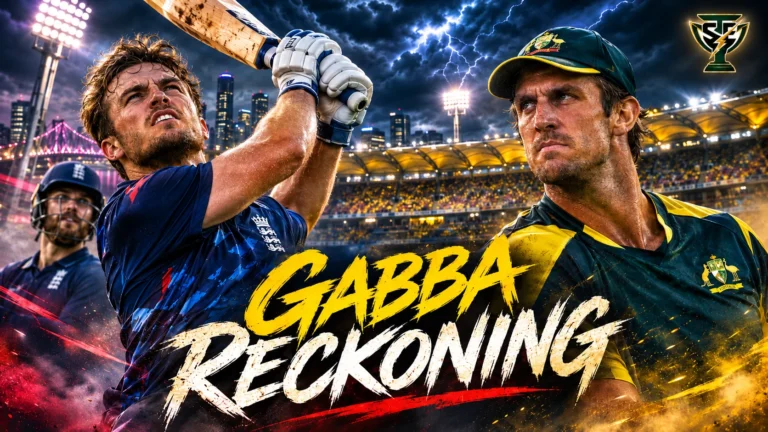
BRISBANE, Australia, November 26, 2026: Mitchell Marsh faces a selection dilemma as Australia prepare to meet England in the third T20I at the Gabba on Friday. His team won a thriller in Melbourne before suffering an eight-wicket defeat on the Gold Coast. With the five-match series level at 1-1, Australia must find a way to disrupt Aneurin Donald and Phil Salt without weakening the batting depth that has rescued them twice.
England needed only 79 legal deliveries to chase 185 at Carrara, striking 16 sixes and leaving 41 balls unused. The challenge for Australia is to take wickets before the visitors establish that kind of momentum again. The Gabba offers extra bounce, potentially helpful early movement and a venue record that favors the hosts, but England’s aggressive batting makes that advantage far from decisive.
Key Takeaways
- Mitchell Marsh faces a selection dilemma as Australia prepare to meet England in the third T20I at the Gabba on Friday.
- England needed only 79 legal deliveries to chase 185 at Carrara, striking 16 sixes and leaving 41 balls unused.
- Australia’s three-wicket victory at the MCG came after England recovered from 13/2 to post 187/9.
- Donald and Salt scored 143 between them from 62 balls in Carrara, with a combined strike rate of 230.65.
Australia vs England: Two Games, Two Very Different Victories
Australia’s three-wicket victory at the MCG came after England recovered from 13/2 to post 187/9. Nikhil Chaudhary took 2/21 and scored 66 from 38 balls before Jack Edwards sealed the chase with a boundary off the penultimate delivery. As TSE’s second-match preview noted, it was Australia’s highest successful men’s T20I chase at the MCG.
The ICC’s second-match record tells a different story. Australia slipped to 58/4 in the powerplay before recovering to 184/8. Donald and Salt then shared 151 in 61 legal balls, leaving just 34 more runs to reach the target. Our Carrara match report details the remarkable assault.
| Measure | Melbourne | Carrara |
|---|---|---|
| First-innings total | England 187/9 | Australia 184/8 |
| Winner | Australia, 3 wickets | England, 8 wickets |
| Balls remaining | 1 | 41 |
| England opening stand | 0 | 151 |
| Donald | 10 (7) | 85 (32) |
| Chaudhary | 66 (38) | 45 (35) |
The first-innings totals differed by only three runs, yet the winning margins differed enormously. At the Gabba, Australia’s best opportunity to change that pattern is to reproduce its early breakthroughs at the MCG rather than rely on a larger total to protect its bowlers.
How Australia Can Break the Donald-Salt Partnership at the Gabba
Donald and Salt scored 143 between them from 62 balls in Carrara, with a combined strike rate of 230.65. Donald cleared the ropes nine times, Salt four. Their partnership reduced the required rate from 9.25 to 3.46 when Donald departed. By then, England had effectively removed scoreboard pressure from its middle order.
Donald arrived on tour after scoring 489 runs at a strike rate of 230.66 for Derbyshire in the 2026 T20 Blast, according to Cricket Australia’s series guide. TSE’s September analysis of England’s leading power hitters identified his extraordinary boundary-scoring potential before the tour.
Australia could use Billy Stanlake’s height to generate steep bounce or Henry Thornton’s swing to challenge the openers’ early footwork. Riley Meredith offers raw pace, but bowling fast into a predictable hitting zone carries considerable risk. Mixing hard lengths with deliveries that threaten the stumps would be a more useful approach than simply retreating into defensive fields.
Adam Zampa also has a role at the Gabba. His three overs cost 43 in the second match. Brisbane’s longer square boundaries could reward a different line and pace, particularly if Australia removes one opener before introducing him. Catching must improve too: Australia dropped six catches in Melbourne and gave Salt an early reprieve at Carrara.
Chaudhary and Edwards: Australia’s Emerging Rescue Act
Chaudhary has contributed 111 runs from 73 balls across the series. Edwards, operating much lower in the order, has made 43 from 19, at a strike rate of 226.32. Their combined 154 runs illustrate why the new-look side’s all-round resources matter, a theme explored in our original squad analysis.
| Player | Runs | Balls | Strike rate |
|---|---|---|---|
| Nikhil Chaudhary | 111 | 73 | 152.05 |
| Aneurin Donald | 95 | 39 | 243.59 |
| Phil Salt | 58 | 31 | 187.10 |
| Jack Edwards | 43 | 19 | 226.32 |
Australia scored 66 in its last five overs at Carrara. That finishing strength should encourage Marsh, but asking the lower order to repair repeated early damage is a dangerous habit. At the Gabba, a productive opening partnership would give Tim David more freedom and allow Edwards to attack from the outset rather than rebuild.
Gabba Pitch and Conditions: Does History Favor Australia?
Australia have won seven of their eight completed men’s T20Is at the ground. England’s sole previous appearance was a 20-run victory over New Zealand during their successful 2022 World Cup campaign. Friday marks their first men’s T20I against Australia at this venue.
The Gabba can reward positive strokeplay once batters adjust to its pace and bounce. In December 2025, Brisbane Heat chased 258 against Perth Scorchers with one ball remaining, setting a Big Bash League record. That domestic result is a reminder of the venue’s scoring potential, not a forecast for Friday’s international.
| Team | Completed matches | Wins | Win percentage |
|---|---|---|---|
| Australia | 8 | 7 | 87.5% |
| England | 1 | 1 | 100% |
England’s one-match sample cannot be compared meaningfully with Australia’s longer record. Early movement, possible weather interruptions and the behavior of the actual match strip could influence the toss. Neither captain can safely assume that chasing will always be easier.
Continue the Cricket Story



Probable Playing XIs and Team News
Australia could replace Lachlan Shaw with Mitchell Owen to add another aggressive batting and seam-bowling option. Stanlake or Thornton could replace Meredith. Xavier Bartlett and Mahli Beardman are already ruled out, while Spencer Johnson is reportedly unavailable with a calf complaint.
England have less reason to change. James Coles filled the spin-bowling vacancy after Will Jacks broke his hand, and Henry Crocombe took 2/40 at Carrara. Adil Rashid is in line for his 156th T20I appearance. England’s depth has supported its success across formats, including the ODI series victory in Hobart and the earlier T20I sweep of Sri Lanka.
Australia (probable): Mitchell Marsh (c), Jake Fraser-McGurk, Sam Harper (wk), Nikhil Chaudhary, Tim David, Lachlan Shaw/Mitchell Owen, Jack Edwards, Joel Davies, Ben Dwarshuis, Adam Zampa, Riley Meredith/Billy Stanlake/Henry Thornton.
England (probable): Phil Salt, Aneurin Donald, Harry Brook (c), Tom Banton, Sam Curran, Jordan Cox (wk), James Coles, Liam Dawson, Jamie Overton, Adil Rashid, Henry Crocombe.
Third T20I Start Time and Remaining Series Schedule
The official match center confirms an 8:15 a.m. GMT start. The winner in Brisbane will need just one victory from the last two games to secure the series, assuming a result on Friday.
| Date | Match | Venue | Local | UK | PKT | IST |
|---|---|---|---|---|---|---|
| Nov. 27 | 3rd T20I | The Gabba, Brisbane | 6:15 p.m. | 8:15 a.m. | 1:15 p.m. | 1:45 p.m. |
| Nov. 29 | 4th T20I | SCG, Sydney | 7:15 p.m. | 8:15 a.m. | 1:15 p.m. | 1:45 p.m. |
| Dec. 2 | 5th T20I | Manuka Oval, Canberra | 7:15 p.m. | 8:15 a.m. | 1:15 p.m. | 1:45 p.m. |
TSE Verdict: The First Six Overs Could Decide the Balance of Power
England enter with momentum, while Australia have the stronger historical venue record. Marsh’s side can make the contest far more even by preserving wickets in its own powerplay and removing at least one of England’s openers early. The Gabba offers Australia the chance to regain control of the series, but Donald and Salt have demonstrated exactly how expensive it can be to let that opportunity slip.