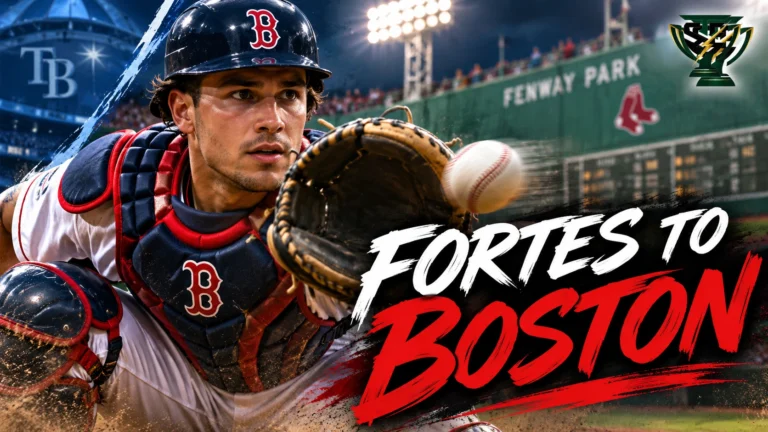
BOSTON, United States, November 19, 2026: The Boston Red Sox have acquired catcher Nick Fortes from the Tampa Bay Rays in exchange for 17-year-old pitching prospect Angel Roa, completing another significant change behind the plate. Boston designated Connor Wong for assignment to accommodate the newcomer, leaving three-time All-Star Adley Rutschman and Fortes as the club’s projected primary catching combination.
The Nick Fortes trade is more revealing than a conventional backup-catcher acquisition. Boston has replaced much of its catching structure within a few months, following its blockbuster deal for Rutschman from Baltimore. Meanwhile, Tampa Bay has converted a member of its American League championship roster into a teenage pitcher while making room for younger catchers. Both clubs are making different calculations about the same position, and the consequences could extend well beyond the opening weeks of the next season.
Key Takeaways
- The Boston Red Sox have acquired catcher Nick Fortes from the Tampa Bay Rays in exchange for 17-year-old pitching prospect Angel Roa, completing another significant change behind the plate.
- Boston confirmed the transaction on November 18, sending Roa to its American League East rival and designating Wong for assignment.
- Fortes played 109 games for Tampa Bay during the 2026 regular season, batting .258 with a .304 on-base percentage and .376 slugging percentage.
- The Nick Fortes trade does not carry the immediate star power of Boston’s acquisition of Rutschman.
Nick Fortes Trade Marks Another Step in Boston’s Catching Overhaul
Boston confirmed the transaction on November 18, sending Roa to its American League East rival and designating Wong for assignment.
Story at a glance
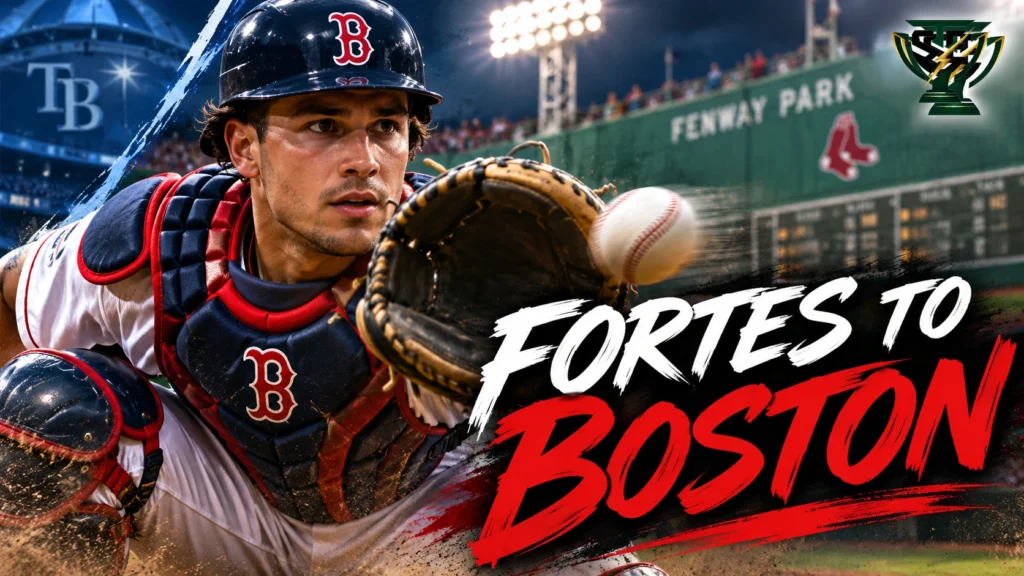
Nick Fortes Trade Marks Another Step in Boston’s Catching Overhaul
Boston confirmed the transaction on November 18, sending Roa to its American League East rival and designating Wong for assignment.
How Boston Rebuilt the Position Around Adley Rutschman
The larger story began before the latest trade.
Nick Fortes Offers More Than His Home Run Total Suggests
Fortes played 109 games for Tampa Bay during the 2026 regular season, batting .258 with a .304 on-base percentage and .376 slugging percentage.
From Miami to Tampa Bay to Boston: Fortes’ Unusual AL East Journey
Fortes’ professional career provides another reason the deal deserves attention.
Why the Rays Can Trade a Catcher After Winning the American League
Tampa Bay’s side of the transaction is particularly interesting because the Rays have recently completed a successful postseason campaign.
The deal creates a clear projected hierarchy. Rutschman remains Boston’s leading catcher, while Fortes arrives to handle backup duties and provide an experienced alternative when the starter rests or fills another lineup role.
Boston’s decision is particularly interesting because Fortes is not arriving as a proven middle-of-the-order hitter. His principal attraction is a combination of major league catching experience, defensive responsibilities and sufficient offensive production to remain useful in a supporting role.
The move also raises questions about Boston’s willingness to exchange future pitching upside for greater certainty at a specialized position.
What Boston Gave Up in the Nick Fortes Trade
| Transaction component | Player | Immediate significance |
|---|---|---|
| Boston receives | Nick Fortes, catcher, 30 | Experienced backup for Adley Rutschman |
| Tampa Bay receives | Angel Roa, right-handed pitcher, 17 | Long-term pitching development prospect |
| Boston roster move | Connor Wong designated for assignment | Opening on the 40-man roster |
| Projected catching combination | Adley Rutschman and Nick Fortes | New primary catching structure |
The Red Sox’s official transaction announcement confirms the players involved and the corresponding roster decision.
Wong’s designation should not be confused with an immediately completed trade or an unconditional release. It begins a roster process through which his next destination must be determined.
For Boston, however, the personnel decision is already significant. The club has chosen to proceed with Fortes rather than preserve Wong’s position on its 40-man roster.
How Boston Rebuilt the Position Around Adley Rutschman
The larger story began before the latest trade.
Boston acquired Rutschman from the Baltimore Orioles at the 2026 trade deadline in a substantial transaction involving established catching talent and several prospects.
The Red Sox sent Carlos Narváez, right-handed pitching prospects Anthony Eyanson and Kyson Witherspoon, outfield prospect Enddy Azocar, and an additional consideration to Baltimore. Catcher Jake Rogers and cash considerations accompanied Rutschman to Boston.
That investment established Rutschman as the central figure in Boston’s catching plans.
A former first overall draft pick, Rutschman had earned three American League All-Star selections before arriving in Boston. His switch-hitting ability, experience managing major league pitching staffs and established offensive track record made him a considerably different proposition from an ordinary midseason depth acquisition.
The Red Sox were acquiring a player expected to influence their lineup and pitching operation, rather than simply fill an available roster position.
Fortes’ arrival now completes another stage of that adjustment.
Boston has moved from the catching group it carried earlier in the season toward a combination built around a prominent starter and an experienced reserve.
That construction reflects an important roster-management principle: a team does not necessarily need two offensively dominant catchers. It needs reliable coverage across a physically demanding position, with enough complementary skills to protect the starter’s workload and maintain defensive continuity.
Rutschman provides the established offensive ceiling. Fortes is expected to contribute experience and support when that first-choice option is unavailable or resting.
Whether the combination performs better than Boston’s previous arrangements will depend on actual results, including defensive execution, pitcher relationships, health and offensive production.
Nick Fortes Offers More Than His Home Run Total Suggests
Fortes played 109 games for Tampa Bay during the 2026 regular season, batting .258 with a .304 on-base percentage and .376 slugging percentage.
He recorded 77 hits in 298 at-bats, including 17 doubles and six home runs, and drove in 35 runs. He also made 78 starts behind the plate.
Those numbers describe a useful supporting player rather than an impact offensive acquisition.
His .680 on-base-plus-slugging percentage was modest, and his six home runs indicate that Boston should not expect him to transform its power production.
However, comparing his offensive output solely with everyday sluggers would miss the role for which he was acquired.
A backup catcher operates under different constraints from a regular first baseman, outfielder or designated hitter. Playing time can be irregular, defensive preparation is substantial, and success often involves making the pitching staff’s work more manageable.
Fortes’ Offensive Record
| 2026 statistic | Nick Fortes | What it reveals |
|---|---|---|
| Games | 109 | Substantial major league experience during the season |
| At-bats | 298 | Meaningful offensive sample |
| Hits | 77 | .258 batting average |
| Doubles | 17 | Extra-base production beyond home runs |
| Home runs | 6 | Limited power contribution |
| Runs batted in | 35 | Supporting offensive production |
| On-base percentage | .304 | Reached base in roughly 30.4% of applicable opportunities |
| Slugging percentage | .376 | Modest extra-base impact |
| OPS | .680 | Combined on-base and slugging production |
The official MLB player record provides Fortes’ career history and detailed statistical information.
An important distinction concerns the defensive value Boston expects from him.
Fortes has experience handling pitching staffs and was valued for his defense when Tampa Bay previously acquired him from Miami. Receiving, blocking and controlling the running game are all relevant to evaluating his contribution.
But experience alone does not prove that every defensive metric will improve after the trade.
Catchers can perform differently in receiving, throwing, blocking and pitcher preparation. Those skills should be assessed separately rather than compressed into an unsupported claim that one player is universally superior.
Boston’s projected improvement is therefore a reasonable roster objective, not an established statistical outcome.
From Miami to Tampa Bay to Boston: Fortes’ Unusual AL East Journey
Fortes’ professional career provides another reason the deal deserves attention.
The Miami-born catcher played college baseball at Mississippi before the Marlins selected him in the fourth round of the 2018 MLB Draft.
He made his major league debut in September 2021 and developed into a regular member of Miami’s catching group.
The Marlins traded him to Tampa Bay in July 2025 for outfielder Matthew Etzel.
That transaction reflected Miami’s changing catching plans and the Rays’ desire to add a player capable of supporting their major league pitching staff.
Tampa Bay subsequently benefited from Fortes’ experience during its successful 2026 campaign.
Now, only a little more than a year after acquiring him, the Rays have sent him to another division rival.
The progression is noteworthy because all three organizations have made different decisions about the same player’s value.
Miami was prepared to move him while developing its catching options. Tampa Bay acquired him as an immediate major league solution. Boston now sees him as an appropriate complement to a high-profile starting catcher.
Fortes has not fundamentally changed positions or become an offensive superstar during those moves. His changing value reflects the needs of the teams evaluating him.
That is a more useful explanation for the sequence than assuming each transaction independently establishes an improvement or decline in his abilities.
Why the Rays Can Trade a Catcher After Winning the American League
Tampa Bay’s side of the transaction is particularly interesting because the Rays have recently completed a successful postseason campaign.
The club won the American League pennant and advanced to the 2026 World Series before losing to the Milwaukee Brewers.
That run was examined in The Sports Encounter’s coverage of Tampa Bay’s ALCS victory over Cleveland, which highlighted Freddy Peralta’s pitching and the team’s ability to overcome a difficult series position.
The subsequent World Series report documented Milwaukee’s championship victory and the conclusion of Tampa Bay’s remarkable postseason.
A championship appearance does not eliminate the need for roster adjustments.
In fact, clubs with established major league depth may be in a position to trade useful reserves when younger players are ready to compete for playing time.
The Rays have catching alternatives, including Liam Hicks and highly regarded prospect Caden Bodine.
Hicks joined Tampa Bay from Miami during the 2026 trade deadline. Bodine advanced through several minor league levels and finished the season on the Rays’ World Series taxi squad.
The existence of those alternatives helps explain why Fortes could become available.
Rather than maintaining multiple catchers whose roles might overlap, Tampa Bay can redistribute playing time while acquiring another young pitcher.
There are still risks. A promising prospect is not guaranteed to become an effective major league catcher, and a developing player may struggle with the demands of a full season.
Trading Fortes therefore reduces an experienced option from the roster while creating an opportunity to test younger alternatives.
The MLB assessment of Tampa Bay’s catching options identifies the depth that made the transaction possible.
Angel Roa Gives Tampa Bay a Different Kind of Value
Boston surrendered a 17-year-old right-handed pitcher who has only recently entered professional baseball.
Angel Roa signed with the Red Sox as an international free agent in January 2026 and began his professional career in the Dominican Summer League.
He appeared in eight games, making two starts, and recorded a 3.22 ERA over 22 1/3 innings.
Roa struck out 21 batters and walked six, according to MLB’s account of the transaction and his first professional season.
Those numbers offer an encouraging starting point, but the sample remains small and comes from an entry-level development environment.
What Roa’s First Professional Season Actually Tells Us
| Measure | Result | Interpretation |
|---|---|---|
| Age at trade | 17 | Considerable development time remains |
| Appearances | 8 | Limited professional experience |
| Starts | 2 | Role not yet firmly established |
| Innings pitched | 22 1/3 | Small sample for projecting performance |
| ERA | 3.22 | Eight earned runs allowed |
| Strikeouts | 21 | 8.46 strikeouts per nine innings |
| Walks | 6 | 2.42 walks per nine innings |
| Strikeout-to-walk ratio | 3.50 | Positive early indicator of control relative to strikeouts |
Original TSE calculations: Strikeouts and walks per nine innings were calculated using the official 22 1/3-inning total. The strikeout-to-walk ratio is 21 divided by six. These figures describe the recorded sample, not a projection of major league ability.
Roa’s 3.50 strikeout-to-walk ratio is encouraging because it suggests he recorded substantially more strikeouts than walks during his first season.
However, 22 1/3 innings cannot establish that he will sustain comparable performance against more experienced professional hitters.
Pitch development, durability, command and progression through higher minor league levels will determine whether Tampa Bay receives significant long-term value.
The Rays are effectively accepting that uncertainty in exchange for a player whose immediate role may have become less important to their roster.
Boston is making the opposite calculation. It is surrendering uncertain future value to strengthen an established major league position.
Boston’s Recent Pitching Decisions Explain the Bigger Strategy
The Fortes acquisition is not occurring in isolation.
Boston’s front office has been making a series of decisions involving pitching talent and roster flexibility.
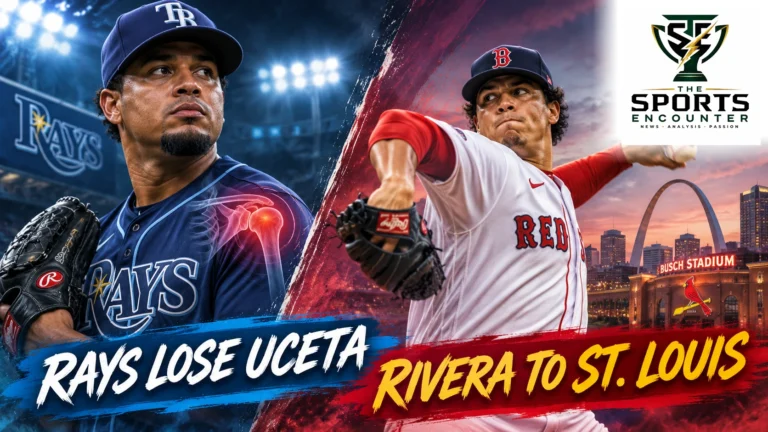
Earlier this month, the organization traded young left-hander Eduardo Rivera to the St. Louis Cardinals for right-hander Juan García.
That move, examined in TSE’s report on the Rivera trade and Tampa Bay’s bullpen concerns, illustrated how Boston was prepared to exchange developing pitching assets to address different organizational priorities.
The departure of veteran starter Sonny Gray also created a separate challenge.
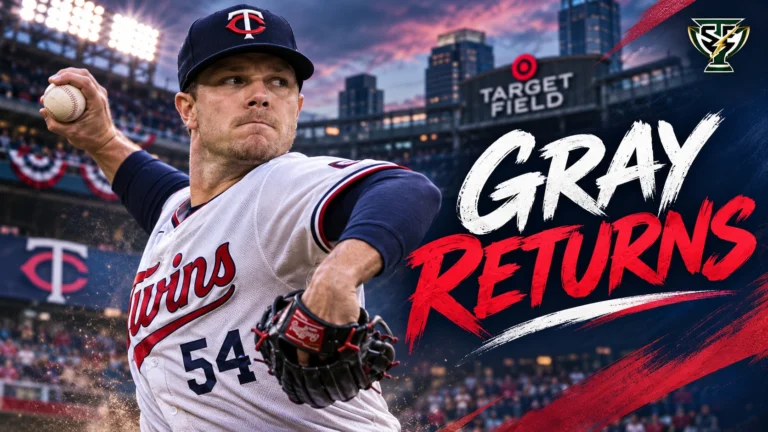
Gray completed an outstanding season with Boston before agreeing to return to Minnesota on a reported two-year contract.
His departure and its implications for Boston’s rotation were examined in The Sports Encounter’s analysis of Gray’s return to the Twins.
Those developments help explain why the catching decision matters.
Boston must evaluate not only who catches its established starters, but also how its catching personnel support pitchers who could assume larger roles as the rotation changes.
A dependable catching partnership may help establish continuity across that transition.
Continue the MLB Story
Nevertheless, there is no verified evidence that Fortes was acquired specifically to work with an individual pitcher or that his arrival will directly compensate for losing Gray.
Those are separate roster challenges whose outcomes will depend on the players Boston ultimately fields.
Is Boston Taking an Unnecessary Risk by Trading Within the AL East?
The transaction also carries a divisional dimension.
Boston and Tampa Bay compete in the American League East, where roster decisions can affect both a team’s own development and the resources available to a direct rival.
Fortes gives Boston an experienced catching option. Roa gives Tampa Bay a young pitcher whose long-term ceiling remains uncertain.
There is no established winner at this stage.
If Fortes performs effectively as Boston’s backup and helps maintain the team’s catching stability, the trade could serve its immediate purpose regardless of whether he produces standout offensive statistics.
If Roa develops into a valuable major league pitcher, Tampa Bay could eventually receive greater long-term value from the exchange.
Both outcomes are possible because the clubs are purchasing different types of baseball value.
Boston is buying greater certainty about a current roster role. Tampa Bay is buying an opportunity for future development.
That difference explains why two division rivals could find the same transaction attractive.
What the Red Sox Must Get Right After the Nick Fortes Trade
Boston’s immediate evaluation should focus on three related questions.
First, can Fortes provide dependable receiving, blocking and game-management work while adjusting to a new pitching staff?
Second, will his offensive production remain sufficient in what could be a more irregular playing role?
Third, can the Red Sox manage Rutschman’s workload without weakening the lineup or compromising defensive continuity when their primary catcher rests?
These questions are more useful than predicting an arbitrary number of wins from a single backup-catcher acquisition.
Tampa Bay faces an equally important set of decisions about the distribution of catching opportunities and Roa’s development path.
The Rays have shown they can reach the World Series through a roster built around varied contributions, pitching depth and selective player acquisition.
That approach was central to their postseason success and remains relevant as the club prepares for another attempt at the American League title.
Boston, meanwhile, is seeking to convert its investments in established talent into a more dependable overall roster.
The broader competition for major league talent is also evident in TSE’s analysis of Seattle’s acquisition of Maikel Garcia, another offseason trade in which the value of a specific positional need was weighed against substantial pitching assets.
Why This Modest Trade Could Reveal a Great Deal About Both Clubs
The Nick Fortes trade does not carry the immediate star power of Boston’s acquisition of Rutschman. Nor does it guarantee a dramatic improvement in the Red Sox’s standing.
Its significance lies in the decisions surrounding it.
Boston has changed its backup catcher, designated an established member of its previous catching group for assignment and surrendered a teenage pitching prospect to reinforce the roster it intends to take into the next season.
Tampa Bay has moved an experienced catcher from its American League championship team because it believes other options can cover the position while a developing pitcher may provide future value.
Both decisions are defensible, but neither is without risk.
The final assessment will depend on Fortes’ usefulness in Boston, the progress of Tampa Bay’s remaining catchers and Roa’s development over the coming seasons.
For now, the transaction illustrates how major league roster building often works beyond the headlines: teams can pursue very different competitive goals through the same deal, and a backup catcher can become an important part of a much larger organizational plan.