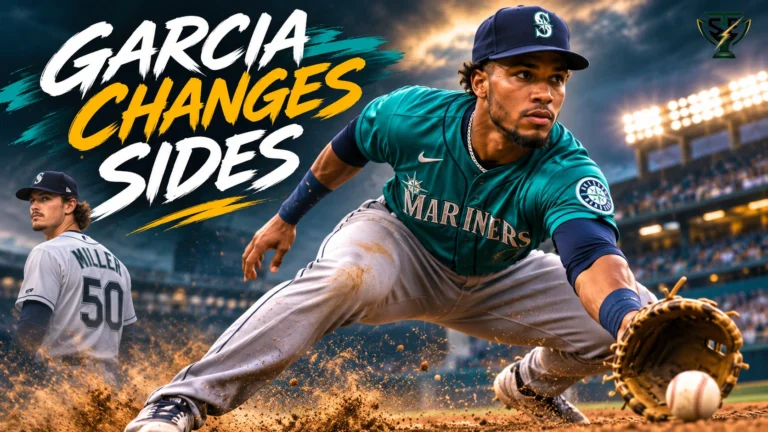
SEATTLE, United States, November 19, 2026: The Seattle Mariners have acquired All-Star third baseman Maikel Garcia from the Kansas City Royals in a six-player trade that sends starting pitcher Bryce Miller and two other major league arms to Kansas City. Seattle also receives right-handed reliever James McArthur and minor league pitcher L.P. Langevin, while the Royals acquire right-hander Logan Evans and left-hander José A. Ferrer. The completed transaction represents one of the winter’s most consequential early roster moves.
The Maikel Garcia trade is particularly revealing because Seattle has surrendered pitching depth to address a position that became a persistent weakness during its disappointing 2026 campaign. Garcia brings Gold Glove defense, a proven ability to contribute offensively and a long-term contract. But he also arrives after injuries reduced his playing time almost by half. Both clubs are betting that the assets they receive will address problems that became too important to ignore.
Key Takeaways
- The Seattle Mariners have acquired All-Star third baseman Maikel Garcia from the Kansas City Royals in a six-player trade that sends starting pitcher Bryce Miller and two other major league arms to Kansas City.
- The Maikel Garcia trade is particularly revealing because Seattle has surrendered pitching depth to address a position that became a persistent weakness during its disappointing 2026 campaign.
- The franchise used 10 different players at third base during 2026.
- Bryce Miller is the centerpiece of Kansas City’s return and the most substantial cost of Seattle’s decision.
Maikel Garcia Trade: Seattle Is Paying for Certainty at Third Base
The most revealing detail is not simply the quality of the player Seattle acquired. It is the type of player the Mariners were prepared to surrender.
Story at a glance
Maikel Garcia Trade: Seattle Is Paying for Certainty at Third Base
The most revealing detail is not simply the quality of the player Seattle acquired. It is the type of player the Mariners were prepared to surrender.
From Royals Breakout to World Baseball Classic MVP
Garcia’s development helps explain why Kansas City’s decision to trade him is significant.
Garcia’s Decline in 2026 Requires Context
A simple comparison of his last two seasons could create the misleading impression that Garcia experienced a severe loss of ability.
Seattle Is Trading Pitching Depth for Everyday Value
Bryce Miller is the centerpiece of Kansas City’s return and the most substantial cost of Seattle’s decision.
Why Kansas City Accepted the Loss of a Gold Glove Infielder
Trading Garcia creates a significant vacancy in the Royals’ infield.
Teams generally protect dependable starting pitchers because replacing their innings can be expensive and unpredictable. Seattle has instead traded Miller, a 28-year-old right-hander with established major league experience, alongside Evans and Ferrer.
That decision suggests the Mariners believe improvement at third base offers greater immediate value than retaining all three pitchers.
The franchise used 10 different players at third base during 2026. Such turnover creates problems beyond individual fielding statistics. A team must repeatedly adjust defensive positioning, batting-order construction and the responsibilities assigned to neighboring infielders.
Garcia offers a credible way to reduce those adjustments. His 2025 American League Gold Glove establishes his defensive credentials, and his experience at shortstop and second base adds useful flexibility.
Seattle’s new manager, Jason Kanzler, inherits a roster attempting to recover from a sharp reversal in results. As The Sports Encounter previously examined in its report on Kanzler’s appointment, the Mariners fell from 90 wins and an American League West title in 2025 to a 76-86 record and a third-place division finish in 2026.
A reliable everyday third baseman could give Kanzler one fewer unresolved position entering his first season in charge.
Why the Maikel Garcia Trade Is More Than a Defensive Upgrade
Garcia’s value cannot be measured solely through spectacular defensive plays. His broader profile is particularly relevant to a team seeking more consistent performances over 162 games.
During his breakout 2025 season, the Venezuelan appeared in 160 games, batted .286 and produced 170 hits, including 39 doubles and 16 home runs. He drove in 74 runs, stole 23 bases and posted a .351 on-base percentage.
Those numbers show a player capable of contributing through contact, extra-base hits, baserunning and defense without relying entirely on home-run production.
That combination is especially valuable when a team already has established power hitters but needs more dependable supporting contributions.
Seattle will hope Garcia can recover that level of offensive consistency while strengthening the infield behind its pitching staff.
From Royals Breakout to World Baseball Classic MVP
Garcia’s development helps explain why Kansas City’s decision to trade him is significant.
Born in La Sabana, Venezuela, Garcia progressed through the Royals’ minor league system after signing with the organization in 2016. He made his major league debut in 2022 and developed into an everyday infielder over the following seasons.
His rise was gradual rather than immediate. Before his 2025 breakout, Garcia had shown defensive promise and speed without consistently producing the offensive numbers expected from an impact third baseman.
That changed when he combined 16 home runs with 23 stolen bases and a .286 batting average, earning his first All-Star selection and a Gold Glove.
The achievement carried historical significance for Kansas City. Garcia became only the second Royals third baseman to win a Gold Glove, following George Brett in 1985.
His international performances strengthened his reputation further.
Garcia helped Venezuela win its first World Baseball Classic championship in 2026, earning tournament MVP honors. He batted .385, collecting 10 hits in 26 at-bats, including two doubles and a home run. He also contributed seven RBIs and three stolen bases across seven games.
Those achievements, documented in the Mariners’ official trade announcement, demonstrate why he entered the offseason with a reputation considerably stronger than his most recent major league statistics might suggest.
Seattle is acquiring a player who has already demonstrated his ability to perform in both a full major league season and a high-pressure international tournament.
The central uncertainty is whether he can reproduce that level while remaining healthy.
Garcia’s Decline in 2026 Requires Context
A simple comparison of his last two seasons could create the misleading impression that Garcia experienced a severe loss of ability.
His home-run total fell from 16 to three, stolen bases declined from 23 to five, and total hits dropped from 170 to 83.
However, he played only 82 games in 2026 after appearing in 160 the previous year. His campaign was interrupted by hamstring problems and a hand injury.
| Statistic | 2025 | 2026 |
|---|---|---|
| Games played | 160 | 82 |
| Hits | 170 | 83 |
| Batting average | .286 | .268 |
| On-base percentage | .351 | .334 |
| Slugging percentage | .449 | .381 |
| Home runs | 16 | 3 |
| RBIs | 74 | 38 |
| Stolen bases | 23 | 5 |
Source: MLB’s official player statistics. The comparison describes actual season totals, not projections or adjusted production.
The batting average declined by 18 points, while his on-base percentage fell by 17 points. His slugging percentage dropped more significantly, by 68 points.
Those changes indicate a genuine reduction in offensive effectiveness, particularly extra-base production, even after accounting for his reduced playing time.
Nevertheless, his lower cumulative totals should not be confused with an equivalent decline in per-game output.
Garcia averaged approximately 1.06 hits per game in 2025 and 1.01 in 2026. His RBIs per game were also comparatively similar, at approximately 0.46 in each season.
These calculations do not eliminate concerns about his power or availability. They show why the full statistical picture is more informative than simply comparing season totals.
His detailed batting record is available through MLB’s official player statistics.
Seattle Is Trading Pitching Depth for Everyday Value
Bryce Miller is the centerpiece of Kansas City’s return and the most substantial cost of Seattle’s decision.
The right-hander made 22 appearances, including 21 starts, in 2026, finishing 4-10 with a 4.17 ERA.
Those numbers do not represent an outstanding season, but they also do not erase the value of an established major league starter capable of covering significant innings.
Miller’s appeal lies partly in his track record and potential to contribute more consistently under a different coaching staff.
Evans adds another right-handed starting option, while Ferrer offers a left-handed bullpen presence.
The structure of the exchange is worth examining.
| Seattle Mariners receive | Kansas City Royals receive |
|---|---|
| Maikel Garcia, third baseman | Bryce Miller, right-handed starter |
| James McArthur, right-handed reliever | Logan Evans, right-handed pitcher |
| L.P. Langevin, minor league right-hander | José A. Ferrer, left-handed reliever |
Seattle receives the strongest established position player in the transaction and two pitchers with differing levels of experience and development.
Kansas City receives three pitchers with major league experience, including two right-handers capable of starting games and a left-handed relief option.
The exchange also demonstrates different approaches to managing roster risk.
Seattle is concentrating much of its expected return in Garcia’s everyday performance. Kansas City is spreading its return across several pitchers who can potentially fill different roles.
Neither structure guarantees success. Starting pitching can deteriorate through injury or performance, while a highly valued position player can struggle to reproduce a previous peak.
Why Kansas City Accepted the Loss of a Gold Glove Infielder
Trading Garcia creates a significant vacancy in the Royals’ infield.
He had established an effective defensive partnership with shortstop Bobby Witt Jr., giving Kansas City an accomplished left side of the diamond.
Witt remains central to the franchise’s ambitions. His importance was explored in TSE’s analysis of the American League MVP race, where his defensive contribution and all-around value featured prominently.
Removing Garcia changes the defensive support surrounding Witt and creates another position Kansas City must address.
Nick Loftin represents one possible internal solution, having gained experience at third base during Garcia’s injury absences. The Royals could also pursue additional help through trades or free agency.
The more interesting question is why Kansas City judged pitching improvement valuable enough to justify that disruption.
Acquiring Miller, Evans and Ferrer gives the club different options for strengthening its staff. Miller offers an established starting profile, Evans provides additional rotation depth, and Ferrer contributes a left-handed alternative for relief situations.
Whether those pieces improve the Royals more than Garcia’s departure weakens them will depend on playing time, run prevention and how effectively Kansas City replaces his defense and offensive production.
This reflects a familiar baseball problem: teams must decide whether their next marginal improvement is more valuable in the field, at the plate or on the mound.
As TSE examined in its analysis of pitching availability and roster management, identifying dependable arms involves more than comparing recent earned run averages.
Kansas City’s return provides options, but those options must produce meaningful innings to justify surrendering an established infielder.
The Contract Gives Seattle a Longer Window to Benefit
Garcia’s contract is another important element of the transaction.
His five-year, $57.5 million agreement runs through the 2030 season and includes a club option for 2031.
That gives Seattle a longer period to benefit from his prime seasons than would be available through a short-term free-agent signing.
The agreement also reduces one form of uncertainty. The Mariners know they have secured a player under an established multiyear arrangement rather than entering an immediate contract negotiation.
However, contractual stability is not the same as guaranteed production.
Garcia must remain healthy and perform well enough for the deal to deliver the value Seattle expects.
The wider financial setting also matters. Major League Baseball is approaching a contentious period of labor negotiations, with disagreements over payroll structures and competitive balance.
The Sports Encounter’s investigation into baseball’s salary-cap dispute examines those financial pressures and the uncertainties surrounding future roster spending.
Garcia’s existing contract gives Seattle clarity about one significant roster commitment, although it does not eliminate uncertainty about the sport’s future economic environment.
Jason Kanzler Inherits a Different Type of Mariners Roster
Seattle’s decision also has implications for its new manager.
Kanzler arrives following an organizational reset prompted by the team’s 14-win decline.
The Mariners won the American League West in 2025 and advanced to Game 7 of the American League Championship Series before losing to Toronto.
Continue the MLB Story

They entered 2026 attempting to take the final step toward the first World Series appearance in franchise history.
Instead, they missed the postseason.
The collapse made change difficult to avoid, but changing managers alone would not address weaknesses in roster construction.
Garcia gives Kanzler a more clearly defined third-base option and an infielder capable of contributing across several aspects of the game.
That could provide a more stable environment for Seattle’s established offensive players, including Cal Raleigh, Julio Rodríguez and Josh Naylor.
At the same time, losing Miller and two other pitchers increases the importance of preserving rotation and bullpen depth through other players.
The Mariners must therefore ensure that the gain in infield quality does not create a corresponding weakness on the mound.
What the Trade Means for Seattle’s Unfinished World Series Pursuit
Few current MLB franchises carry a longer-standing frustration than the Mariners.
Seattle remains the only active major league organization never to reach the World Series.
The 2025 American League Championship Series provided its closest recent opportunity, but losing the final two games against Toronto prolonged that wait.
The 2026 season then demonstrated how quickly a promising contender can lose ground.
The larger historical significance of Seattle’s position was examined in TSE’s World Series feature on the remaining franchises seeking their first championship.
Garcia’s arrival does not guarantee Seattle will return to the postseason. It does, however, address a specific weakness rather than relying solely on the expectation that established players will rebound.
There is a strategic distinction between attempting to improve a team by adding another star hitter and improving its ability to convert routine defensive opportunities while maintaining competitive offensive production.
Garcia offers the potential to contribute to both objectives.
The uncertainty lies in whether that improvement will exceed the value of the pitching Seattle has surrendered.
How the Deal Should Be Judged
Evaluating this transaction immediately through a winner-and-loser label would overlook its different timelines and objectives.
Seattle’s success should be measured by Garcia’s availability, defensive effectiveness, offensive recovery and the performance of the remaining pitching staff.
Kansas City’s return should be measured by Miller’s effectiveness as a starter, the innings contributed by Evans, Ferrer’s performance in relief and the club’s ability to replace Garcia at third base.
Those outcomes cannot be established from the trade announcement.
The deal becomes particularly interesting because Garcia’s value is supported by a proven 2025 peak, while his 2026 campaign introduces questions about durability and offensive regression.
Seattle is effectively wagering that the earlier version of Garcia is a more reliable guide to his future than an injury-shortened season.
Kansas City is wagering that three pitchers can produce more collective value than retaining one of the American League’s accomplished defensive infielders.
The Maikel Garcia trade therefore represents two organizations making different judgments about where their next competitive advantage will come from. Seattle has chosen greater stability at third base at a substantial pitching cost. Kansas City has accepted an infield vacancy to acquire major league arms.
For the Mariners, the deal’s success will ultimately be judged by whether that exchange helps a club still searching for its first World Series appearance become a serious contender again.