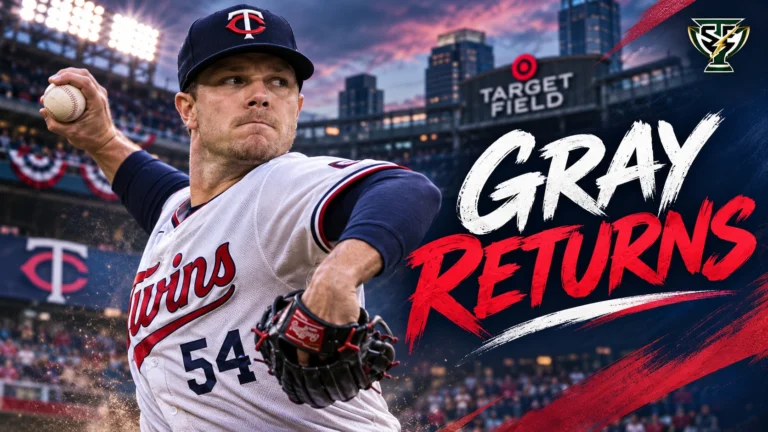
MINNEAPOLIS, United States, November 19, 2026: Sonny Gray is heading back to the Minnesota Twins, agreeing to a two-year contract reportedly worth $55 million after producing one of the finest seasons of his Major League Baseball career with the Boston Red Sox. Minnesota officially announced the return of the 37-year-old right-hander on Wednesday, reuniting with a pitcher who finished second in American League Cy Young Award voting during his previous spell with the franchise in 2023.
The Sonny Gray Twins contract represents an important statement of intent ahead of the 2027 season. Gray led MLB with 18 victories for Boston in 2026, finishing 18-5 with a 2.72 ERA across 29 starts. His addition strengthens a rotation featuring Joe Ryan, Pablo López and Taj Bradley, although it also creates questions about pitching depth, roster flexibility and the club’s payroll strategy. The agreement reportedly includes a player opt-out after 2027, potentially making the reunion shorter than its two-year headline suggests.
TL;DR: Sonny Gray Returns to Minnesota Twins
- Transaction: Minnesota officially signed Sonny Gray to a two-year contract through the 2028 season on November 18, 2026.
- Reported value: $55 million, equivalent to $27.5 million annually on a straight-line average.
- Contract flexibility: Reports indicate a player opt-out after the 2027 season.
- Age: Gray turned 37 on November 7, 2026.
- 2026 performance: 18-5 record, 2.72 ERA, 149 strikeouts and 169 innings in 29 starts for Boston.
- Cy Young recognition: Finished fifth in the 2026 American League voting and second in 2023 while with Minnesota.
- Previous Twins tenure: Posted a 2.90 ERA over 56 starts between 2022 and 2023.
- Rotation effect: Joins a group including Joe Ryan, Pablo López, Taj Bradley and Dean Kremer.
- Biggest uncertainty: Whether Minnesota can turn improved pitching depth into a credible playoff push while navigating the 2027 payroll and labor environment.
Sonny Gray Twins Contract: Confirmed Details and Reported Terms
The Minnesota Twins confirmed that Gray has agreed to return on a contract extending through the 2028 season.
Multiple reports, including reporting cited by MLB.com, place the agreement’s value at $55 million.
Story at a glance
Sonny Gray Twins Contract: Confirmed Details and Reported Terms
The Minnesota Twins confirmed that Gray has agreed to return on a contract extending through the 2028 season.
Why Minnesota Brought Sonny Gray Back After Three Years
Gray’s return carries significance because his original departure followed one of his most impressive major league seasons.
Sonny Gray’s 2026 Red Sox Season Explains the $55 Million Investment
Gray’s performances for Boston provide the strongest justification for Minnesota’s commitment.
The Most Important Question: Can Gray Repeat His Success at 37?
Gray’s 18 victories and 2.72 ERA make the signing attractive, but they should not automatically be treated as a projection for 2027.
Minnesota’s 2027 Rotation Suddenly Looks Much Stronger
Gray joins a Twins pitching group that already contains several established and emerging starting options.
Additional reporting indicates that Gray has the right to opt out after the first season.
The distinction between confirmed and reported details matters. Minnesota has officially announced the contract’s duration, but the financial structure and player opt-out should be attributed to the reporting available at the time of publication.
| Contract detail | Information | Verification status |
|---|---|---|
| Player | Sonny Gray | Confirmed |
| Club | Minnesota Twins | Confirmed |
| Position | Right-handed starting pitcher | Confirmed |
| Agreement date | November 18, 2026 | Confirmed |
| Contract duration | Two years, through 2028 | Officially announced |
| Total value | $55 million | Widely reported |
| Average annual value | $27.5 million | Calculated from reported total |
| Player opt-out | After 2027 | Reported |
| Age entering 2027 | 37 | Verified |
The Minnesota Twins’ official announcement confirms Gray’s return and his previous achievements with the organization.
The move gives Minnesota an established veteran who has remained productive deep into his career, while limiting the guaranteed term compared with the longer contracts frequently awarded to elite free-agent pitchers.
Why Minnesota Brought Sonny Gray Back After Three Years
Gray’s return carries significance because his original departure followed one of his most impressive major league seasons.
Between 2022 and 2023, he made 56 starts for Minnesota and recorded a 16-13 record with a 2.90 ERA across 303.2 innings.
He struck out 300 batters, walked 91 and held opponents to a .226 batting average.
His performance in 2023 earned him an All-Star selection and second place in the American League Cy Young voting behind New York Yankees ace Gerrit Cole.
Gray subsequently left Minnesota for the St. Louis Cardinals, spending the 2024 and 2025 seasons there before joining Boston for 2026.
His return therefore brings a pitcher back to an organization already familiar with his training methods, competitive temperament and ability to manage opposing lineups.
That familiarity could reduce some of the uncertainty commonly associated with acquiring an older free agent.
However, the Twins are not simply signing the same pitcher who left after 2023.
Gray is now three years older, his pitch effectiveness and workload must be assessed against recent performance, and Minnesota’s rotation has changed considerably since his departure.
Sonny Gray’s 2026 Red Sox Season Explains the $55 Million Investment
Gray’s performances for Boston provide the strongest justification for Minnesota’s commitment.
The right-hander finished the 2026 regular season with an 18-5 record, leading MLB in victories.
He recorded a 2.72 ERA, the lowest of his career in a full qualifying season, and struck out 149 batters over 169 innings.
His WHIP was 1.15, reflecting his ability to limit baserunners despite a decline in strikeout rate compared with some of his previous seasons.
The numbers demonstrate that Gray remained effective without needing to dominate opponents through strikeouts alone.
He relied on pitching efficiency, location, movement and an approach suited to navigating lineups multiple times.
Sonny Gray’s 2026 Performance at a Glance
| Statistic | 2026 performance | Significance |
|---|---|---|
| Team | Boston Red Sox | Final season before returning to Minnesota |
| Wins | 18 | Led Major League Baseball |
| Losses | 5 | .783 decision-winning percentage |
| ERA | 2.72 | Career best in a full qualifying season |
| Starts | 29 | Consistent rotation contribution |
| Innings pitched | 169.0 | Substantial workload |
| Strikeouts | 149 | Approximately 7.93 per nine innings |
| Walks | 46 | Approximately 2.45 per nine innings |
| WHIP | 1.15 | Effective baserunner prevention |
| AL Cy Young voting | Fifth | Recognition among the league’s leading pitchers |
Gray’s fifth-place finish in the American League Cy Young voting placed him behind the award’s leading contenders.
That result is documented in The Sports Encounter’s analysis of the 2026 Cy Young Award results, which included Gray among the American League vote recipients.
For Minnesota, his 2026 performance offers evidence that he can still operate effectively as a high-level starting pitcher rather than simply providing veteran depth.
The Most Important Question: Can Gray Repeat His Success at 37?
Gray’s 18 victories and 2.72 ERA make the signing attractive, but they should not automatically be treated as a projection for 2027.
Starting pitchers can experience significant performance changes as they move through their late thirties.
Velocity, recovery between starts, injury risk and the effectiveness of individual pitches all influence how well a veteran maintains his results.
Gray’s strikeout rate declined in 2026, although his overall run prevention remained excellent.
That contrast deserves attention.
A pitcher can produce a strong season despite a reduced strikeout rate by improving control, limiting damaging contact and benefiting from team defense.
However, a lower strikeout rate can also leave less margin for error if command deteriorates or opponents make harder contact.
The Twins must therefore evaluate Gray’s underlying pitch characteristics alongside his final ERA.
The relevant question is not whether he can repeat exactly 18 wins.
It is whether he can continue delivering enough quality innings to justify a prominent place in Minnesota’s rotation.
Minnesota’s 2027 Rotation Suddenly Looks Much Stronger
Gray joins a Twins pitching group that already contains several established and emerging starting options.
Joe Ryan, Pablo López, Taj Bradley and Dean Kremer are among the pitchers who could feature prominently in 2027.
Bailey Ober and several younger pitchers provide additional depth.
That creates competition for rotation places and gives the organization options if injuries affect the season.
It may also influence trade decisions, particularly for pitchers approaching future free agency.
Potential Minnesota Twins Starting Rotation for 2027
| Pitcher | Likely role | Key consideration |
|---|---|---|
| Sonny Gray | Front-line veteran starter | Maintaining effectiveness and availability at 37 |
| Pablo López | Potential front-line starter | Health and recovery after his 2026 elbow injury |
| Joe Ryan | Established rotation starter | Performance, health and future contract decisions |
| Taj Bradley | Starting rotation option | Consistency and continued development |
| Dean Kremer | Starting rotation option | Role and workload |
| Bailey Ober | Rotation depth or competing starter | Potential roster and pitching-depth decisions |
This table identifies potential rotation options, not an officially announced 2027 starting order. Injuries, trades and spring-training performances may change the final group.
MLB’s assessment of the Twins’ offseason needs identified starting pitching as an area with significant depth even before Gray’s arrival.
The addition now creates an opportunity to improve the overall quality of the rotation while preserving enough alternatives to withstand setbacks.
But it also gives Minnesota decisions to make about how best to distribute resources across the rest of the roster.
Pablo López’s Injury Makes Gray’s Arrival More Significant
The Twins were forced to manage much of 2026 without Pablo López, whose elbow injury disrupted their rotation plans.
That absence increased the importance of Ryan, Bradley and other pitching options.
Although López could provide a major boost if he returns successfully, Minnesota cannot assume that a pitcher returning from a serious injury will immediately reproduce his previous workload.
Gray supplies another experienced starter capable of taking significant responsibility.
That reduces the pressure to rely entirely on López’s recovery or the rapid development of younger pitchers.
The acquisition also gives Minnesota greater flexibility in determining which pitchers are best suited to starting roles and which might become available in potential trades.
However, any claim that a particular pitcher will now be traded would be speculative without confirmation from the organization.
What Does Gray’s Departure Mean for the Boston Red Sox?
Boston loses a pitcher who made 29 starts, delivered 169 innings and led the major leagues with 18 victories in 2026.
That is a significant amount of proven production to replace.
Gray’s performance was part of Boston’s improved season and helped strengthen the club’s starting pitching.
He also earned All-MLB Second Team recognition following his successful campaign.
From Boston’s perspective, losing Gray creates a challenge that extends beyond finding another experienced pitcher.
The Red Sox must replace the consistency and run prevention that allowed their rotation to compete across a long regular season.
That need may influence Boston’s approach to the remaining free-agent market or possible trades.
At the same time, the club must manage its wider payroll obligations and the uncertainty surrounding baseball’s next collective bargaining agreement.
The consequences of those proposed changes were examined in TSE’s investigation into MLB’s proposed salary cap and looming labor dispute.
Boston is one of several major-market organizations whose future spending could be affected if MLB and the players’ union eventually agree to a new hard-cap framework.
Those proposed rules have not been enacted, but the uncertainty could influence how clubs assess multiyear commitments.
The Reported Player Opt-Out Gives Sonny Gray Significant Flexibility
The reported contract structure is one of the most interesting elements of the agreement.
A two-year contract provides Gray with additional security after his 2026 success.
But the reported player opt-out after 2027 would allow him to reconsider his future after one season.
If Gray remains highly productive, he could potentially return to the market and negotiate another agreement.
If his performance declines, keeping the second year could offer financial protection, subject to the contract’s final provisions.
That asymmetry is particularly valuable for an older player whose market value can change significantly from one season to the next.
For Minnesota, it means the organization cannot automatically treat Gray’s presence in 2028 as certain merely because the announced contract extends through that year.
TSE Original Analysis: What Minnesota Is Paying for Each Quality Inning
The reported $55 million agreement can be evaluated against Gray’s recent workload, while acknowledging that future performance will differ from historical results.
The straight-line average annual value is $27.5 million.
Dividing that figure by Gray’s 169 innings in 2026 produces an illustrative cost of approximately $162,722 per inning.
That calculation does not represent a guaranteed cost per inning in 2027. It illustrates the scale of Minnesota’s commitment if Gray reproduces last season’s workload.
Reported Contract Value Against Potential Workload
| 2027 innings scenario | Illustrative annual salary | Cost per inning |
|---|---|---|
| 130 innings | $27.5 million | Approximately $211,538 |
| 150 innings | $27.5 million | Approximately $183,333 |
| 169 innings | $27.5 million | Approximately $162,722 |
| 180 innings | $27.5 million | Approximately $152,778 |
TSE signature statistical insight: At the reported average annual value of $27.5 million, Gray would need to pitch approximately 169 innings to match an illustrative cost of $162,722 per inning. If he delivers only 130 innings, the figure rises by roughly 30% to $211,538.
This is a workload-cost comparison, not a measure of player value or expected performance.
Pitching quality, opponent strength, availability during critical games and the club’s other options all affect the actual return on the investment.
The calculation nevertheless highlights why health and innings volume matter so much in contracts for veteran starting pitchers.
Sonny Gray’s Return Arrives During a Busy MLB Free-Agent Market
The signing comes as teams make significant pitching commitments ahead of the 2027 season.
The Chicago White Sox recently agreed to a three-year, $52.5 million contract with Dustin May, providing another example of organizations investing in starting pitching.
TSE examined the risks and opportunities behind that agreement in its report on Dustin May’s move to Chicago.
The Atlanta Braves have also invested in pitching by agreeing to a deal with reliever Evan Phillips.
That signing, covered in TSE’s analysis of Atlanta’s bullpen investment, reflects a different approach to improving run prevention.
Minnesota’s move is distinctive because it adds an established starter to a rotation that already contains multiple credible options.
The question now is whether the Twins can translate pitching depth into a more balanced team.
Does the Sonny Gray Deal Signal a Change in Minnesota’s Spending Strategy?
The acquisition suggests Minnesota is willing to commit substantial money to a recognizable veteran rather than relying exclusively on younger and more affordable players.
However, one contract is not enough to establish a complete change in organizational philosophy.
The Twins still need to manage arbitration salaries, other roster commitments and the future of players approaching free agency.
They also face the possibility of significant changes to baseball’s economic structure through collective bargaining.
The current agreement expires on December 1, 2026, and the owners’ proposal for a salary cap and floor remains disputed by the MLB Players Association.
Those issues create uncertainty for every club making multiyear commitments this offseason.
Minnesota’s decision to sign Gray now demonstrates an immediate willingness to strengthen the roster despite that uncertainty.
It does not guarantee further high-profile spending.
How Gray’s Return Fits Into Minnesota’s Broader Rebuild
The Twins have recently faced difficult decisions about balancing established players, younger talent and financial flexibility.
Signing Gray provides the kind of veteran presence that can help a pitching staff through a long season.
His familiarity with Minnesota may also make the transition easier than it would be for a pitcher joining an unfamiliar organization.
But the Twins’ challenge extends beyond the starting rotation.
Run production, defensive reliability, bullpen availability and player health will also influence whether the club can compete for a postseason place.
A strong rotation can keep games close and reduce pressure on the bullpen, but it cannot compensate for every weakness elsewhere.
That is why Minnesota’s remaining offseason decisions may prove just as important as the Gray signing itself.
The financial complexity of those choices is explored in TSE’s analysis of MLB’s 2026 qualifying-offer decisions, which examines how free agency and compensation rules affect roster planning.
What Sonny Gray Has Achieved Across 14 MLB Seasons
Gray’s career extends well beyond his earlier success with Minnesota.
He debuted with the Oakland Athletics in 2013 and subsequently represented the New York Yankees, Cincinnati Reds, Minnesota Twins, St. Louis Cardinals and Boston Red Sox.
Across 14 major league seasons, he has compiled a 143-107 record with a 3.51 ERA and 2,074 strikeouts in 368 appearances, including 359 starts.
Those figures illustrate the durability and consistency that have helped him remain an effective starter into his late thirties.
His career has included multiple All-Star selections and two top-two finishes in Cy Young voting, alongside his fifth-place result in 2026.
Gray’s official statistics and career history are available through MLB’s player profile.
What Happens Next for the Minnesota Twins?
Gray’s return gives Minnesota an additional front-line option, but it does not settle the club’s 2027 roster.
The organization must still determine how to use its pitching depth, assess López’s recovery and make decisions involving Ryan and other starters.
It must also evaluate whether further offensive or bullpen additions are necessary.
Gray’s contract may provide a degree of certainty in the short term, but its reported opt-out introduces another possible decision after 2027.
The next steps will also unfold against the backdrop of an uncertain MLB labor environment.
For now, however, Minnesota has secured a pitcher who led the major leagues in wins and produced one of the lowest ERAs of his career in the preceding season.
The signing is a meaningful improvement to the team’s available pitching talent, even if the broader competitive consequences remain to be determined.
Continue the MLB Story
Frequently Asked Questions About Sonny Gray’s Twins Contract
Has Sonny Gray signed with the Minnesota Twins?
Yes. The Twins officially announced on November 18, 2026, that Gray had signed a two-year contract through the 2028 season.
How much is Sonny Gray’s new contract worth?
The agreement is reportedly worth $55 million over two years. The Twins have officially confirmed the contract duration, while the reported financial details have been supplied by media sources.
Does Sonny Gray have an opt-out clause?
Reports indicate Gray has a player opt-out after the 2027 season, potentially allowing him to become a free agent again before 2028.
How old is Sonny Gray?
Gray is 37 years old. He was born on November 7, 1989.
How did Sonny Gray perform for the Boston Red Sox in 2026?
He went 18-5 with a 2.72 ERA, 149 strikeouts and a 1.15 WHIP across 169 innings and 29 starts.
Did Sonny Gray win the Cy Young Award?
Gray has not won a Cy Young Award. He finished second in the American League voting in 2023 and fifth in 2026.
When did Sonny Gray previously play for Minnesota?
Gray pitched for the Twins during the 2022 and 2023 seasons, recording a 2.90 ERA across 56 starts.
Who could pitch alongside Sonny Gray in 2027?
Potential Minnesota rotation options include Pablo López, Joe Ryan, Taj Bradley, Dean Kremer and Bailey Ober. The final rotation has not been announced.
Why did Sonny Gray leave Boston?
Gray entered free agency after declining his side of a mutual option for 2027. He subsequently agreed to return to Minnesota following his successful 2026 season with Boston.
Final Verdict: Sonny Gray Returns to Minnesota With More to Prove
The Sonny Gray Twins contract gives Minnesota one of the most accomplished available veteran starters after a season in which he led Major League Baseball with 18 victories.
The reported $55 million commitment reflects his recent performance and the value the Twins place on experienced starting pitching.
His previous success in Minnesota makes the reunion particularly compelling, but his age and the reported player opt-out introduce uncertainties that cannot be ignored.
Gray’s return immediately improves Minnesota’s pitching options. Whether it becomes the foundation of a genuine postseason challenge will depend on his health, the performance of the rest of the rotation and the club’s remaining roster decisions.
Three years after departing Minnesota as an American League Cy Young runner-up, Gray returns with another outstanding season behind him and an opportunity to help reshape the Twins’ next chapter.