Key Takeaways
- The World Boxing Council’s official championship dossier establishes the fighters’ backgrounds, title status and competitive stakes before the contest.
- In September 2025, Terence Crawford defeated Alvarez by unanimous decision and claimed the undisputed super-middleweight championship.
- The victory carried greater emotional significance because of what happened in September 2025.
- A rematch with Terence Crawford would inevitably attract attention because of the significance of their 2025 encounter.
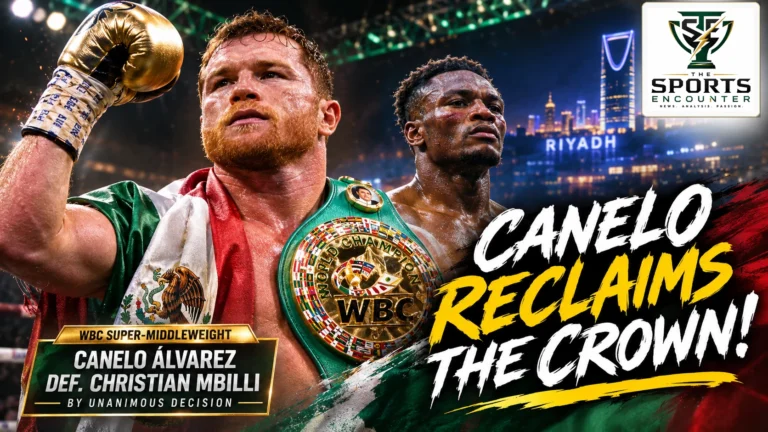
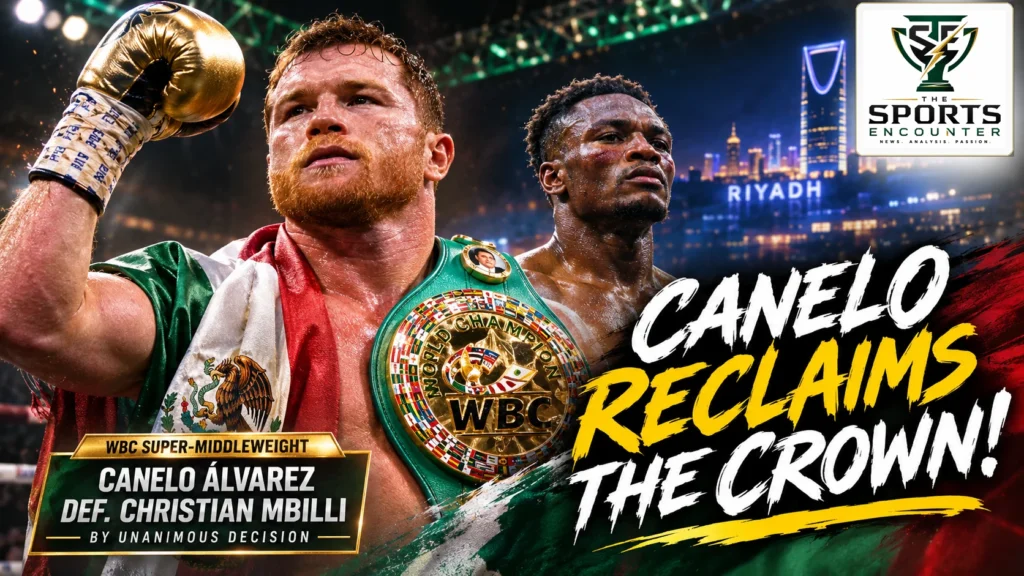
RIYADH, Saudi Arabia, November 1, 2026: Saul “Canelo” Alvarez reclaimed the WBC super-middleweight championship and delivered the first professional defeat of Christian Mbilli’s career with a commanding unanimous-decision victory at Kingdom Arena on October 31. Returning after more than a year outside the ring, the 36-year-old Mexican overcame Mbilli’s relentless forward pressure through accurate counterpunching, disciplined defensive movement and sustained body attacks. The judges scored the 12-round contest 115-112, 116-111 and 117-110, giving Alvarez his 64th professional victory and restoring him to world championship status following his September 2025 defeat against Terence Crawford.
The decisive moments came in the second half of the contest, particularly when a sharp Alvarez uppercut staggered Mbilli in the seventh round and the defending champion lost a point for a punch to the back of the head in the eighth. Mbilli, who entered with 29 victories and one draw, maintained his aggressive approach but struggled to turn punch volume into consistent clean scoring. Alvarez finished strongly to improve his record to 64-3-2, while the French-Cameroonian fighter fell to 29-1-1. The victory restored Canelo’s WBC title but also created fresh questions about his remaining championship ambitions, the future of the 168-pound division and the next challenge facing Mbilli.
Canelo Alvarez vs Christian Mbilli: Fight Result and Key Details
| Fight Detail | Confirmed Information |
|---|---|
| Fight | Saul Alvarez vs Christian Mbilli |
| Date | October 31, 2026 |
| Venue | Kingdom Arena, Riyadh, Saudi Arabia |
| Championship | WBC super-middleweight world title |
| Weight division | 168 pounds |
| Scheduled rounds | 12 |
| Result | Alvarez won by unanimous decision |
| Judge 1 | 115-112 Alvarez |
| Judge 2 | 116-111 Alvarez |
| Judge 3 | 117-110 Alvarez |
| Alvarez record afterward | 64-3-2 |
| Mbilli record afterward | 29-1-1 |
| Championship outcome | Alvarez becomes WBC champion |
The World Boxing Council’s official championship dossier establishes the fighters’ backgrounds, title status and competitive stakes before the contest.
Story at a glance
Canelo Alvarez vs Christian Mbilli: Fight Result and Key Details
The World Boxing Council’s official championship dossier establishes the fighters’ backgrounds, title status and competitive stakes before the contest.
Canelo’s Comeback: Why This Victory Meant More Than Another Belt
For much of his career, Alvarez has been accustomed to entering championship contests as the established star.
Christian Mbilli Entered as an Unbeaten World Champion
Christian Mbilli’s background made the contest particularly intriguing.
The Seventh-Round Uppercut That Changed the Fight
One of the contest’s defining moments occurred in the seventh round.
The Eighth-Round Point Deduction Adds Controversy
The contest also featured a significant refereeing decision.
Canelo’s Comeback: Why This Victory Meant More Than Another Belt
For much of his career, Alvarez has been accustomed to entering championship contests as the established star.
Against Mbilli, the situation was different.
He arrived as a former champion trying to prove that one of the most difficult periods of his professional career had not brought his championship years to an end.
In September 2025, Terence Crawford defeated Alvarez by unanimous decision and claimed the undisputed super-middleweight championship.
The result ended Alvarez’s reign as holder of the division’s four major world titles.
It also raised questions about the Mexican’s ability to compete against elite opponents after a long and demanding career.
Alvarez had undergone elbow surgery in early 2026 and had not fought since the Crawford defeat.
He therefore faced two challenges simultaneously.
The first was physical: returning to championship boxing after a prolonged absence.
The second was tactical: overcoming an aggressive, younger champion who had built his career around relentless pressure and high punching output.
Mbilli was not simply a convenient opponent for a comeback.
He had earned his opportunity through years of impressive performances and had reached the WBC championship level without losing a professional bout.
For Alvarez, reclaiming the title required more than showing that his punches remained powerful.
He needed to demonstrate that his defensive timing, decision-making and ability to adapt were still effective against an opponent determined to force him into exchanges.
Christian Mbilli Entered as an Unbeaten World Champion
Christian Mbilli’s background made the contest particularly intriguing.
Born in Cameroon and representing France, the 31-year-old had built a reputation as one of the most aggressive contenders in the super-middleweight division.
His style depended on advancing behind sustained punching combinations, attacking the body and forcing opponents to defend under pressure.
Mbilli had won his first 29 professional fights before drawing with Lester Martinez in September 2025.
That contest interrupted his winning streak but preserved his unbeaten professional record.
Mbilli subsequently became the full WBC super-middleweight champion after the organization declared its title vacant following Crawford’s departure from the division.
His fight against Alvarez was therefore the first defense of his newly established championship reign.
Why Mbilli’s Aggression Was Expected to Trouble Canelo
Pressure fighters can create particular problems for opponents who prefer to operate at a controlled pace.
By continually advancing, Mbilli attempts to restrict the opponent’s movement and force exchanges near the ropes.
His volume also creates opportunities to score even when individual punches are not especially clean.
Against an older fighter returning from a long layoff, that approach offered a plausible route to victory.
However, pressure creates its own defensive risks.
A fighter who repeatedly advances must avoid becoming predictable.
If the opponent can anticipate the entry and counter accurately, greater punching volume does not necessarily translate into greater scoring success.
That weakness became central to the outcome in Riyadh.
How Canelo Neutralized Mbilli’s Relentless Pressure
Clean Counterpunching Proves More Effective Than Punch Volume
Alvarez did not attempt to match Mbilli punch for punch throughout the contest.
Instead, he relied on an approach that has defined many of his most impressive performances.
He allowed Mbilli to advance, assessed the timing of his attacks and responded with accurately placed counters.
His defensive movement helped reduce the effectiveness of combinations that might have troubled a less experienced opponent.
Mbilli remained aggressive, but aggression alone could not consistently break through Alvarez’s defense.
The Mexican’s body shots also played an important tactical role.
Rather than concentrating exclusively on head punches, he attacked areas that could limit Mbilli’s movement and complicate his attempts to maintain pressure.
The result was a fight in which the defending champion often appeared busier but the challenger produced the cleaner scoring work.
Why Canelo’s Movement Made Such a Difference
Alvarez’s defensive positioning was crucial.
He repeatedly avoided allowing Mbilli to control the exchanges simply through forward movement.
When Mbilli advanced, Alvarez used changes of position and counterpunches to interrupt the rhythm.
That forced the French-Cameroonian fighter to reset instead of continuing his attacks uninterrupted.
It also prevented the fight from becoming the kind of extended close-range contest in which Mbilli could have maximized his physical pressure.
The distinction is important because counterpunching success depends on timing, not merely punching power.
Alvarez demonstrated that his experience still allowed him to recognize opportunities and exploit them against an aggressive opponent.
The Seventh-Round Uppercut That Changed the Fight
One of the contest’s defining moments occurred in the seventh round.
Alvarez landed a sharp uppercut that visibly staggered Mbilli.
The punch was important for both tactical and psychological reasons.
It demonstrated that Mbilli’s forward movement could expose him to powerful counters.
It also reinforced Alvarez’s control at a stage when the defending champion needed to increase his effectiveness.
Mbilli continued fighting and was not stopped.
However, the moment showed that Alvarez could punish predictable entries without having to engage in prolonged exchanges.
The uppercut did not determine the result by itself.
The victory was built over 12 rounds through scoring accuracy, defensive discipline and tactical control.
Nevertheless, the seventh-round sequence provided one of the clearest illustrations of why Alvarez’s strategy was working.
The Eighth-Round Point Deduction Adds Controversy
The contest also featured a significant refereeing decision.
In the eighth round, referee Hector Afu deducted a point from Mbilli following a punch to the back of Alvarez’s head.
The deduction added to the defending champion’s difficulties.
It also generated debate about the referee’s intervention and the circumstances surrounding the decision.
Point deductions can be especially important in championship contests because they change the scoring calculation even if a fighter otherwise performs competitively during the round.
But the deduction should not be confused with the sole reason Alvarez won.
All three judges scored the contest in his favor.
The widest official card gave Alvarez a seven-point advantage, while the closest was three points.
Even allowing for the one-point deduction, the recorded scorecards indicate that Alvarez had established a scoring advantage.
The incident remains a legitimate subject for discussion, but the overall result was consistent with the stronger clean punching and sustained control shown by the challenger.
Canelo vs Mbilli: The Decisive Phases of the Fight
| Phase | Key Development | Tactical Significance |
|---|---|---|
| Opening rounds | Mbilli advanced aggressively and increased punch volume | Tested Alvarez’s movement and defensive readiness |
| Middle rounds | Alvarez increasingly found clean counters and body attacks | Reduced the effectiveness of Mbilli’s pressure |
| Round 7 | Alvarez landed a powerful uppercut | Visibly disrupted Mbilli and reinforced Alvarez’s control |
| Round 8 | Mbilli lost a point for an illegal blow | Added to the champion’s scoring disadvantage |
| Round 10 | Alvarez used his jab and positioning effectively | Limited sustained offensive opportunities for Mbilli |
| Round 12 | Both fighters exchanged punches; Alvarez finished strongly | Protected his advantage through the closing exchanges |
The account of the closing rounds is consistent with The Ring’s detailed round-by-round coverage, which provides additional context about the fight’s momentum and championship outcome.
What Do the Judges’ Scorecards Tell Us?
The unanimous-decision result produced three different winning margins.
| Official Scorecard | Alvarez | Mbilli | Margin |
|---|---|---|---|
| Card 1 | 115 | 112 | 3 points |
| Card 2 | 116 | 111 | 5 points |
| Card 3 | 117 | 110 | 7 points |
TSE statistical observation: Alvarez’s winning margins were three, five and seven points, producing an average margin of five points across the three official scorecards.
The range indicates that the judges agreed on the winner but differed over how decisively he controlled individual rounds.
Boxing scorecards are based on the effectiveness of clean punching, effective aggression, defense and ring generalship under the applicable scoring criteria.
That makes it possible for one fighter to throw more punches without winning the round.
Mbilli’s willingness to initiate exchanges was not in doubt.
However, Alvarez’s ability to land cleaner shots and prevent sustained attacks offered a strong basis for the official decision.
Canelo Becomes World Champion Again After the Crawford Defeat
The victory carried greater emotional significance because of what happened in September 2025.
Terence Crawford had defeated Alvarez and taken the undisputed super-middleweight championship.
For a fighter who had spent years dominating the division, that loss created an unfamiliar situation.
He was no longer the champion everyone else was trying to dethrone.
He was the challenger seeking to restore his standing.
At 36, with more than two decades of professional experience, questions about age and accumulated physical demands were inevitable.
But those questions needed to be tested against performance rather than answered solely through reputation.
Against Mbilli, Alvarez showed that he could still execute a disciplined championship strategy.
He did not need a spectacular knockout to prove the point.
He needed to control a dangerous opponent across 12 rounds.
That was precisely what he achieved.
Why the Victory Does Not Automatically Restore Undisputed Status
There is an important distinction between reclaiming a world title and becoming an undisputed champion.
Alvarez won the WBC super-middleweight championship.
He did not regain all four major belts previously held during his undisputed reign.
The division’s other championship titles remain separate.
Any attempt to become undisputed again would therefore require additional title-unification opportunities, subject to the governing bodies, champions and contractual arrangements.
The victory restored Alvarez to the championship picture, but it did not settle the entire division.
What Canelo’s Return Means for the Super-Middleweight Division
Alvarez’s victory changes the competitive landscape at 168 pounds.
He is once again a current champion rather than a former titleholder seeking relevance.
That gives future opponents a clear incentive to pursue him.
It also creates several possible directions for his career.
| Potential Direction | Sporting Value | Main Complication |
|---|---|---|
| Defend the WBC championship | Establishes the strength of his restored reign | Mandatory-challenger requirements and opponent selection |
| Pursue another major belt | Moves toward renewed title unification | Agreement with other champions and promoters |
| Seek a Crawford rematch | Offers a chance to address his 2025 defeat | Would require Crawford’s participation and fresh negotiations |
| Consider retirement | Allows Alvarez to leave as a reigning champion | Depends entirely on his personal ambitions |
These are potential career pathways, not confirmed negotiations or scheduled fights.
Alvarez did not announce an opponent immediately after the Mbilli victory.
He indicated that he wanted time to recover, continue learning and consider his next steps.
Could a Canelo-Crawford Rematch Become Boxing’s Next Major Attraction?
A rematch with Terence Crawford would inevitably attract attention because of the significance of their 2025 encounter.
Crawford was the boxer who ended Alvarez’s undisputed championship reign.
For Alvarez, reversing that result would offer a different form of sporting achievement from simply defending the WBC belt.
However, a rematch cannot be treated as inevitable.
Its feasibility would depend on both fighters’ plans, divisional circumstances and the availability of suitable contractual terms.
The more immediate question is whether Alvarez wants to build another prolonged championship reign or prioritize a small number of major contests.
That decision will help determine how the 168-pound division develops.
It also reflects a wider trend in modern boxing, where negotiations and commercial arrangements can be as important as rankings when determining which leading fighters meet.
The Sports Encounter has examined similar challenges through its analysis of the uncertainty surrounding Tyson Fury, Anthony Joshua and Oleksandr Usyk.
What Went Wrong for Christian Mbilli?
Mbilli’s first defeat should not be interpreted as evidence that he does not belong among leading super-middleweights.
He entered with an unbeaten record and a reputation for physically demanding pressure fighting.
Against Alvarez, however, the strengths that had carried him through earlier opponents were not enough.
Pressure Without Variety Became Predictable
Mbilli’s willingness to advance remained evident throughout the contest.
But Alvarez repeatedly anticipated his entries and answered with counters.
The champion needed more variety to prevent those responses from becoming predictable.
Changes in tempo, feints, defensive positioning and attack angles could have complicated Alvarez’s timing.
Instead, the Mexican was often able to recognize the offensive pattern and respond.
High Volume Could Not Replace Clean Scoring
Mbilli attempted to make the fight physically demanding.
But championship boxing is not awarded on aggression alone.
When an opponent lands cleaner counters and limits sustained combinations, throwing more punches does not guarantee a scoring advantage.
That was one of the central lessons of the contest.
The Point Deduction Made Recovery Harder
The eighth-round deduction added another obstacle.
It reduced Mbilli’s scoring opportunities at a stage when he was already struggling to establish control.
However, the broader tactical problems existed independently of the referee’s decision.
Even without the deduction, Mbilli would have needed to make significant adjustments to reverse the fight’s momentum.
Can Mbilli Recover From His First Professional Defeat?
At 31, Mbilli has time to rebuild.
His 29 professional victories and previous championship achievements do not disappear because of one defeat.
The challenge is to use the Alvarez contest as evidence of what must improve.
A fighter who depends on forward pressure needs multiple methods of entering punching range.
He also needs defensive solutions when an opponent successfully counters those entries.
Mbilli’s aggression remains a strength.
But the fight demonstrated that elite opponents can neutralize predictable pressure through accurate punching and movement.
His next training period should therefore be judged by whether he develops additional tactical options, not simply whether he becomes more aggressive.
There is considerable precedent across combat sports for talented fighters responding to defeat by changing tactics, opponents and training priorities.
For another example of the importance of adapting after an unsuccessful performance, see TSE’s report on Isaac Cruz defeating Nestor Bravo and calling for a Ryan Garcia fight.
Mexico vs The World: Results From the Supporting Card
The Riyadh event featured more than the main championship fight.
The supporting card presented several international matchups under the Mexico vs The World theme.
Among the confirmed results, Jaime Munguia defended his WBA super-middleweight championship against Nikita Zon.
Rafael Espinoza also retained his WBO featherweight championship, while Reito Tsutsumi produced an early stoppage victory.
| Bout | Winner | Method | Significance |
|---|---|---|---|
| Canelo Alvarez vs Christian Mbilli | Canelo Alvarez | Unanimous decision, 12 rounds | WBC super-middleweight title changes hands |
| Jaime Munguia vs Nikita Zon | Jaime Munguia | Unanimous decision | Retained WBA super-middleweight title |
| Rafael Espinoza vs Ricardo Blandon | Rafael Espinoza | Third-round TKO | Retained WBO featherweight title |
| Reito Tsutsumi vs Raymundo Rojas Garcia | Reito Tsutsumi | Second-round stoppage | Continued unbeaten professional start |
There was also competitive significance in Munguia’s performance.
He survived a difficult sixth round before winning by scores of 117-111, 117-111 and 116-112.
The result maintained his championship position and contributed to the larger picture in the super-middleweight division.
The possibility of future contests involving Alvarez and other current champions provides an additional reason to monitor developments at 168 pounds.
For the original announced card and its competitive context, the WBC’s official Mexico vs The World event preview provides the tournament’s planned lineup. Some originally announced matchups changed before fight night.
Canelo’s Longevity: What 69 Professional Fights Reveal
Alvarez completed his 69th professional contest against Mbilli.
His record now stands at 64 victories, three defeats and two draws.
That means he has won approximately 92.8 percent of his professional fights.
However, win percentage alone cannot explain the significance of his career.
Alvarez has competed across several weight divisions, faced elite opposition and held major world championships over an extended period.
His latest victory was particularly important because it followed a championship defeat and a lengthy absence.
| Career Measure | Before Mbilli | After Mbilli |
|---|---|---|
| Professional victories | 63 | 64 |
| Defeats | 3 | 3 |
| Draws | 2 | 2 |
| Total fights | 68 | 69 |
| WBC super-middleweight status | Former champion | Champion |
| Most recent result | Defeat against Crawford | Victory against Mbilli |
TSE statistical calculation: Alvarez’s 64 wins in 69 professional contests produce a simple win percentage of approximately 92.75 percent. Draws are included in the total number of fights rather than counted as wins.
Alvarez’s commercial significance is also considerable.
His fights have been major international attractions, illustrating how championship boxing combines individual sporting achievement with television rights, sponsorship and event promotion.
The Sports Encounter placed major boxing purses within the wider economics of professional sport in its investigation into the history of the world’s highest-paid athletes.
Why Riyadh Continues to Matter to International Combat Sports
The choice of Riyadh as the venue reflects Saudi Arabia’s growing role in staging major international sporting events.
Boxing promoters have increasingly turned to the Saudi market for high-profile championship contests.
The financial resources available for major events can make difficult matchups commercially possible.
However, substantial investment does not eliminate sporting or logistical challenges.
The Alvarez-Mbilli event took place during a period of heightened regional security concerns.
Other sporting events in Saudi Arabia had experienced scheduling disruptions.
The Six Kings Slam tennis exhibition, for example, was moved from its original October schedule.
TSE previously examined that development in its report on the postponement of Riyadh’s Six Kings Slam.
The broader lesson is that high-profile international events depend on more than financial backing.
Scheduling, security, athlete preparation and contractual stability all influence whether an event can proceed as planned.
The Growing Importance of Tactical Discipline in Modern Combat Sports
Alvarez’s victory also offers a broader lesson about fighting styles.
Aggression and physical conditioning are important, but elite competition requires the ability to recognize an opponent’s strengths and adjust.
Mbilli’s pressure created the possibility of a difficult night.
Alvarez responded by using timing, positional movement and cleaner counters.
That principle extends beyond professional boxing.
Mixed martial arts fighters face similar challenges when opponents adapt to their preferred striking or grappling approach.
TSE examined the importance of tactical flexibility in its coverage of the major results from UFC 331.
Our pre-event analysis of UFC 331’s main matchups likewise explored how contrasting fighting styles can determine competitive outcomes.
These comparisons do not mean boxing and MMA are tactically identical.
They demonstrate that at the highest level of combat sports, technical adaptation is often as important as offensive intensity.
What Should Canelo Do Next?
Alvarez’s victory presents several possibilities but no immediately confirmed next fight.
A WBC title defense would allow him to establish his renewed championship reign.
A unification opportunity would offer a more ambitious route toward rebuilding his status within the division.
A rematch with Crawford would carry substantial historical and commercial interest, although no agreement has been established.
Retirement is another possibility for a fighter who has already achieved extraordinary success and endured more than two decades of professional competition.
But it would be premature to assume that Alvarez intends to retire simply because of his age.
His latest performance demonstrated that he remains capable of competing successfully at world championship level.
He also spoke emotionally after the fight about the people who helped build his career, particularly trainer Eddy Reynoso and the wider Reynoso team.
The victory mattered to him personally as well as professionally.
What Does the Result Mean for Christian Mbilli’s Career?
Mbilli has suffered his first defeat, but his career remains far from finished.
He remains an accomplished fighter with extensive experience against professional opposition.
The immediate concern is how he responds to a loss against one of boxing’s most experienced champions.
His aggression, stamina and work rate remain valuable qualities.
However, the fight demonstrated the need for more varied methods of creating clean scoring opportunities.
A future title challenge may depend on whether he develops stronger defensive responses to counterpunchers.
That process could involve changes in training, opponent selection and tactical preparation.
It would be unfair to judge his entire career on one defeat.
But the loss provides a clear opportunity to identify areas for improvement.
Similar questions arise whenever talented fighters encounter adversity at major international events.
For another example involving the progression of an emerging combat-sports athlete, see TSE’s report on Sakshi Chaudhary’s Asian Games boxing campaign.
Continue the Boxing Story

Frequently Asked Questions About Canelo vs Mbilli
Who Won the Canelo Alvarez vs Christian Mbilli Fight?
Canelo Alvarez defeated Christian Mbilli by unanimous decision in Riyadh on October 31, 2026.
What Were the Judges’ Official Scores?
The judges scored the fight 115-112, 116-111 and 117-110, all in favor of Alvarez.
Which Championship Did Canelo Win?
Alvarez reclaimed the WBC super-middleweight world championship at 168 pounds.
Did Canelo Knock Out Mbilli?
No. The fight lasted all 12 scheduled rounds and was decided by the judges.
What Was the Most Important Punch of the Fight?
One of the decisive moments was Alvarez’s seventh-round uppercut, which visibly staggered Mbilli.
Why Did Mbilli Lose a Point?
Referee Hector Afu deducted a point in the eighth round following a punch to the back of Alvarez’s head.
Was Christian Mbilli Undefeated Before the Fight?
Yes. Mbilli entered with 29 victories and one draw. The Alvarez defeat was his first professional loss.
What Is Canelo’s Professional Record?
Following the victory, Alvarez’s record stands at 64 wins, three defeats and two draws.
How Old Is Canelo Alvarez?
Alvarez was 36 years old when he defeated Mbilli.
Why Had Canelo Been Out of the Ring?
Alvarez had not fought since losing to Terence Crawford in September 2025 and had undergone elbow surgery during 2026.
Is Canelo the Undisputed Super-Middleweight Champion Again?
No. Alvarez reclaimed the WBC title, not all four major championships in the division.
Who Will Canelo Fight Next?
No next opponent was confirmed immediately after his victory over Mbilli.
The Sports Encounter Verdict: Canelo Has Reclaimed the Belt, but His Greatest Challenge May Still Be Ahead
Canelo Alvarez did not need a knockout to deliver a significant statement in Riyadh.
He needed to show that the skills which made him one of boxing’s most successful champions had survived his defeat to Terence Crawford and a prolonged period of inactivity.
Against Christian Mbilli, he did exactly that.
His defense remained effective.
His counterpunching was accurate.
His body attacks helped control the exchanges.
And when Mbilli attempted to impose his preferred style, Alvarez repeatedly found ways to disrupt it.
The unanimous decision was deserved on the evidence of the cleaner punching and sustained tactical control.
Mbilli’s first professional defeat should not obscure his achievements or his potential to challenge for another championship.
But the fight exposed a limitation that he must address if he wants to defeat opponents with Alvarez’s defensive intelligence.
For Canelo, the victory was both a conclusion and a beginning.
It ended the period in which his latest professional result was a championship defeat.
It restored him to the WBC throne.
It also reopened the possibility of major championship fights, unification opportunities and perhaps another encounter with Crawford.
Yet the question is no longer simply whether Alvarez can win a world title.
He has answered that.
The more intriguing question is whether the 36-year-old has enough left to build another meaningful championship reign.
At Kingdom Arena, Canelo reminded boxing that experience, discipline and accuracy remain formidable weapons.
The belt is back around his waist.
What he chooses to do with it will determine the next chapter of his legacy.
Explore more fight results, championship developments and technical analysis in The Sports Encounter’s boxing coverage and revisit our earlier assessment of major boxing matchups and the career stakes surrounding them.