
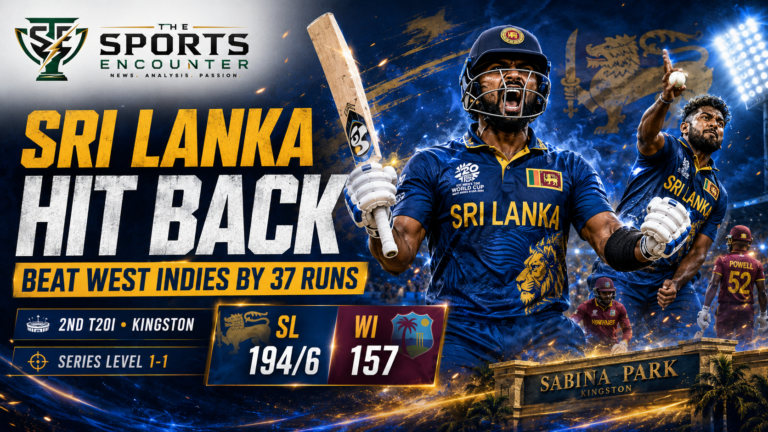
Sri Lanka refused to let their West Indies tour drift away at Sabina Park.
Twenty-four hours after losing the opening T20I, the visitors responded with their most complete short-format performance of the series, beating West Indies by 37 runs to level the three-match contest at 1-1.
Sri Lanka posted 194/6 from their 20 overs before dismissing West Indies for 157 in 18.1 overs. Dasun Shanaka supplied the acceleration that transformed a competitive total into a demanding chase, while the bowling attack made sure West Indies never found enough stability to threaten the target.
For more international cricket news, match analysis, and long-form coverage, visit The Sports Encounter’s Cricket Hub and our latest cricket coverage.
Story at a glance
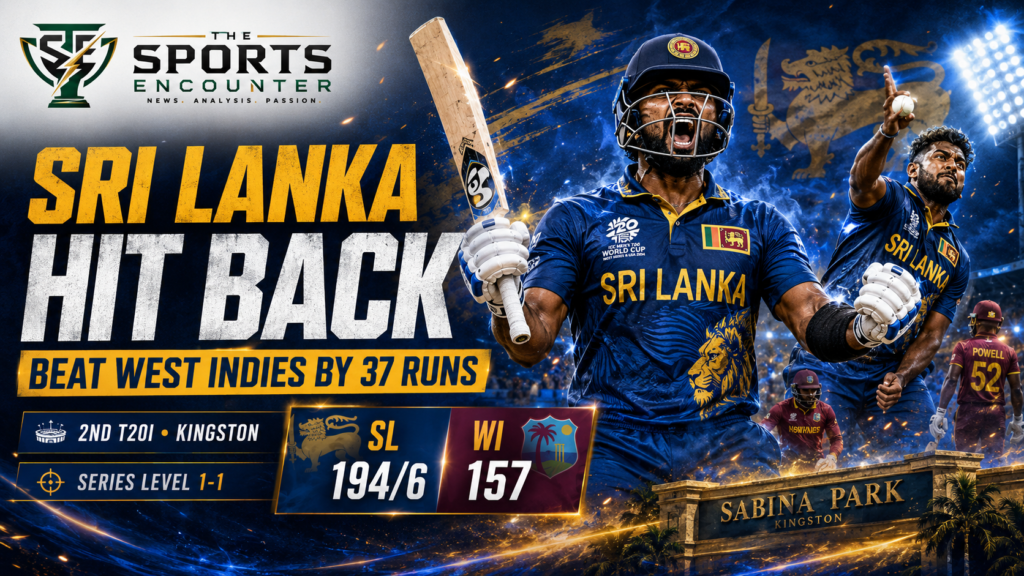
Sri Lanka vs West Indies 2nd T20I: Key Match Details
The complete score and match information are available through the ICC’s official West Indies vs Sri Lanka second T20I match center.
Sri Lanka Needed a Response After Jason Holder’s Opening Blow
The significance of this victory becomes clearer when placed beside the first match.
Kamil Mishara Builds the Platform
Sri Lanka’s total was not created by one late assault.
Dasun Shanaka Changes the Pressure Equation
Every T20 match has a phase where the scoreboard suddenly starts influencing decisions before the ball has even been delivered.
West Indies Start With Power but Lose Control
A target of 195 was difficult, but it was not beyond a West Indies batting lineup built around power.
Sri Lanka vs West Indies 2nd T20I: Key Match Details
| Detail | Information |
|---|---|
| Match | West Indies vs Sri Lanka, 2nd T20I |
| Venue | Sabina Park, Kingston |
| Date | June 14, 2026 |
| Sri Lanka | 194/6 in 20 overs |
| West Indies | 157 all out in 18.1 overs |
| Result | Sri Lanka won by 37 runs |
| Series | Level 1-1 |
| Player of the Match | Dasun Shanaka |
The complete score and match information are available through the ICC’s official West Indies vs Sri Lanka second T20I match center.
Sri Lanka Needed a Response After Jason Holder’s Opening Blow
The significance of this victory becomes clearer when placed beside the first match.
West Indies had opened the series with a seven-wicket victory built around Jason Holder’s 3/18, Shai Hope’s unbeaten half-century, and an aggressive powerplay that immediately pushed Sri Lanka onto the defensive.
The Sports Encounter’s analysis of West Indies’ first T20I victory showed how Holder’s early double strike reduced Sri Lanka’s batting ceiling before Hope controlled the chase.
The second match demanded a different response.
Sri Lanka needed more runs, greater intent through the middle overs, and a bowling performance capable of controlling West Indies’ power hitters.
They delivered all three.
Kamil Mishara Builds the Platform
Sri Lanka’s total was not created by one late assault.
Kamil Mishara gave the innings structure before the middle and lower order accelerated. His half-century ensured Sri Lanka avoided the stop-start pattern that had limited them in the opening match.
That stability mattered because it allowed the hitters around him to attack without feeling that every aggressive shot carried the risk of exposing the tail too early.
Mishara gave Sri Lanka a runway.
Shanaka used it.
Dasun Shanaka Changes the Pressure Equation
Every T20 match has a phase where the scoreboard suddenly starts influencing decisions before the ball has even been delivered.
Shanaka created that phase in Kingston.
Sri Lanka were already building toward a competitive score when the former captain increased the tempo. His late hitting moved the innings from manageable territory toward a total that required West Indies to score at almost 10 runs per over from the beginning.
That difference is significant in T20 cricket.
A chase around 160 gives batters time to assess conditions. A target close to 200 reduces that freedom. Dot balls become more expensive. Quiet overs become difficult to recover from. Wickets create immediate pressure because the required rate continues climbing while a new batter settles.
Shanaka therefore influenced the game beyond his personal contribution.
He changed the kind of chase West Indies had to play.
The ICC’s official squad announcement for Sri Lanka’s West Indies tour had confirmed Shanaka as part of the T20I squad alongside Kusal Mendis, Wanindu Hasaranga, Maheesh Theekshana, Dushmantha Chameera, and other experienced short-format players.
West Indies Start With Power but Lose Control
A target of 195 was difficult, but it was not beyond a West Indies batting lineup built around power.
Rovman Powell tried to keep the chase alive with an aggressive 43. The hosts still had enough hitting around him to believe the target could be reached if one partnership survived long enough to attack the final overs.
That partnership never arrived.
Wickets interrupted every attempt to establish momentum. The required rate continued climbing, and West Indies gradually moved from chasing the target to trying to prevent the game from escaping.
Once that happened, Sri Lanka were able to dictate the terms.
Sri Lanka’s Bowlers Turn Scoreboard Pressure Into Wickets
Shanaka and the batting unit created the opportunity.
Sri Lanka’s bowlers converted it.
Dushmantha Chameera provided pace and wicket-taking threat, while Wanindu Hasaranga gave Sri Lanka control through the middle overs. The attack kept breaking partnerships before West Indies could create the sustained assault required for a chase of this size.
That combination of pace and spin remains one of Sri Lanka’s most useful white-ball weapons.
It also connects to a much wider question around the workload and effectiveness of modern fast bowlers. The Sports Encounter later examined that issue in our analysis of whether modern fast bowlers are losing the traditional Test-bowling craft or simply being managed differently.
Against West Indies, Sri Lanka did not need one spectacular spell. They needed repeated pressure.
Every wicket increased the required rate. Each quiet over forced the next batter to take greater risks. By the closing stages, West Indies were no longer constructing a chase. They were trying to manufacture one.
Why the 37-Run Margin Told the Story
A 37-run defeat in a T20I is substantial.
It showed that West Indies did not merely fall short during the final over. The chase had been losing shape much earlier.
Powell gave the hosts hope, but no batter stayed long enough to create a second phase around him. Against a target of 195, isolated bursts were never likely to be enough.
Sri Lanka understood that and continued attacking wickets rather than simply protecting boundaries.
That tactical choice made the margin look increasingly comfortable.
Sri Lanka Turn a Series Defeat Into a Decider
The result completely changed the three-match series.
West Indies had entered the game with an opportunity to clinch the contest early. Instead, Sri Lanka forced a winner-takes-all final T20I.
The response was particularly important because Sri Lanka had already shown resilience during the wider Caribbean tour. This team had periods where its batting looked fragile, but it also showed an ability to recover quickly from poor performances.
That inconsistency became even clearer later in the tour when West Indies dominated the first Test at North Sound. Amir Jangoo and Roston Chase built a record partnership before the hosts completed an innings victory, which The Sports Encounter covered in our analysis of West Indies’ crushing Test win over Sri Lanka.
The contrast between those results shows why Sri Lanka’s T20I response at Sabina Park mattered. They had the ability to correct a performance quickly, even if sustaining that level across formats remained difficult.
The Final T20I Exposed Sri Lanka’s Other Problem
The series eventually turned again.
After Sri Lanka’s disciplined second-match victory, the deciding T20I produced almost the opposite lesson.
Sri Lanka posted 169 and reduced West Indies to 53/4, placing themselves in a strong position to win the series. Then dropped catches, poor death bowling, and Jason Holder’s five-ball assault changed everything.
West Indies reached 170/5 with two balls remaining to clinch the series, a collapse examined in The Sports Encounter’s full report on how Sri Lanka let the final T20I and the series slip away.
That result makes the second T20I even more revealing in hindsight.
Sri Lanka showed exactly what they could look like when batting intent, bowling discipline, and fielding pressure worked together.
The decider showed how quickly those advantages could disappear when execution broke down.
West Indies’ Home Summer Was About More Than One T20I Series
The Caribbean side also used the Sri Lanka tour as part of a broader attempt to rebuild confidence across formats.
Later in the summer, West Indies completed a 1-0 Test series victory over Sri Lanka before drawing 1-1 with Pakistan. Those results suggested progress after a long period of red-ball inconsistency.
Continue the Cricket Story


Our review of West Indies’ 2026 home Test season examined how Amir Jangoo, Roston Chase, Kemar Roach, and other players helped give the team a more stable foundation.
Different formats require different skills, but the larger theme remained similar.
West Indies were becoming harder to dismiss as a collection of individual talents. There were signs of clearer roles and greater structure.
Jason Holder Remains Part of a Longer West Indies Tradition
The opening and final T20Is both highlighted Jason Holder’s continued importance.
His influence fits a much older Caribbean tradition of all-rounders who can alter matches in more than one discipline.
No modern player should be casually compared with Sir Garfield Sobers, but the value of having a cricketer who can contribute across multiple phases remains deeply embedded in West Indies cricket.
The Sports Encounter explored that history following the death of the legendary all-rounder in our feature on Sir Garfield Sobers and the standard he set for generations of West Indies all-rounders.
Sri Lanka Carried the Lessons Into Their Next Challenges
The Caribbean tour did not provide Sri Lanka with a simple answer about where the team stood.
There were encouraging T20 phases, batting collapses in Test cricket, experienced players under pressure, and younger names trying to establish themselves.
Those questions followed the team into its next major red-ball assignment against India. Ahead of that series, The Sports Encounter examined the injuries, selection problems, and World Test Championship pressure surrounding both teams in our Sri Lanka vs India Test series preview.
Once the series began, Sri Lanka again found themselves forced to recover from a difficult position. Sonal Dinusha and Niroshan Dickwella eventually rescued the first innings sufficiently to avoid the follow-on, which we analyzed in our Day 3 report from the Galle Test.
The recurring theme is resilience.
Sri Lanka have shown that they can fight back.
The harder challenge is avoiding the crisis that makes another rescue necessary.
Key Takeaways From Sri Lanka’s Second T20I Win
- Dasun Shanaka changed the chase before it began. His acceleration pushed Sri Lanka toward a total that forced West Indies into immediate risk.
- Kamil Mishara provided the structure. His innings gave Sri Lanka the stability required for the later hitters to attack.
- West Indies lacked one sustained partnership. Powell threatened, but nobody stayed with him long enough to control the chase.
- Sri Lanka’s bowling attack used the target intelligently. Chameera and Hasaranga kept attacking wickets instead of allowing West Indies to settle.
- The result transformed the series. Sri Lanka moved from facing elimination to entering the final T20I level at 1-1.
Final Verdict
Sri Lanka’s 37-run victory at Sabina Park was the response they needed after losing the opening T20I.
Mishara gave the innings stability. Shanaka supplied the acceleration. The bowlers then made the scoreboard pressure count.
West Indies had enough power to threaten a chase of 195, but they never found the partnership required to make that power sustainable.
The series eventually belonged to the hosts, but the second T20I showed why Sri Lanka remain dangerous when their different skills work together.
For one night in Kingston, their batting, bowling, and tactical discipline aligned.
That was enough to turn a series that appeared to be slipping away into a genuine decider.