
ROTTERDAM, Netherlands, October 23, 2026: American gymnast Skye Blakely completed an extraordinary comeback from two career-threatening injuries to win the women’s all-around gold medal at the 2026 World Artistic Gymnastics Championships on Friday. The 21-year-old scored 55.733 points across four apparatus at Rotterdam Ahoy, finishing 0.534 ahead of Liudmila Roshchina, who took silver with 55.199. China’s Ke Qinqin claimed bronze with 55.032, while Algeria’s Kaylia Nemour finished fourth, only 0.034 points away from the podium.
Blakely’s victory carried significance far beyond her first individual world championship medal. A torn elbow ligament disrupted her attempt to reach the Tokyo Olympics, while a ruptured Achilles tendon ended her Paris 2024 Olympic ambitions just days before the American trials. Two years later, she produced four controlled routines to become the first American woman since Simone Biles in 2023 to win the world all-around title. Her success also arrived 48 hours after China ended the United States’ long winning streak in the women’s team competition by just 0.233 points, making Friday’s individual triumph an important response for American gymnastics.
Skye Blakely Wins 2026 World Gymnastics All-Around Gold in Rotterdam
Blakely entered the final as the second-ranked qualifier behind Nemour.
The Algerian had produced the highest qualifying total of 55.999, with Blakely next on 55.465.
Story at a glance
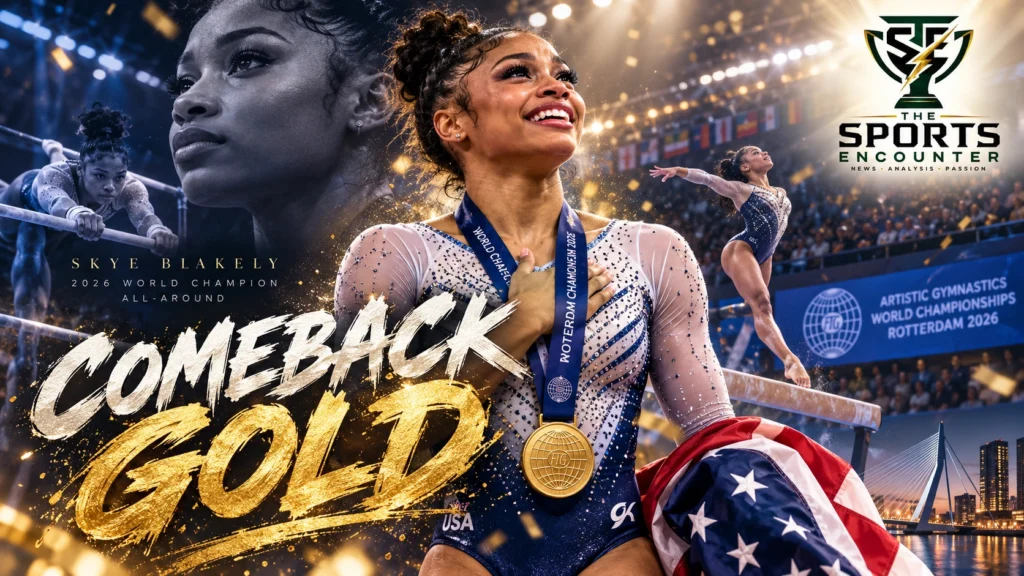
Skye Blakely Wins 2026 World Gymnastics All-Around Gold in Rotterdam
Blakely entered the final as the second-ranked qualifier behind Nemour.
How Blakely Built Her Gold Medal Across Four Apparatus
Blakely’s victory was built on consistency.
The Balance Beam Redemption: From Team-Final Error to Individual Gold
Wednesday’s women’s team final had ended in disappointment for the United States.
Two Olympic Dreams Ended by Injury Before Blakely’s Greatest Night
The emotional significance of Friday’s victory begins years before Rotterdam.
What Blakely Said After Becoming World Champion
Blakely struggled to contain her emotions after completing her floor routine.
Roshchina qualified third, while several established competitors remained close enough to challenge for medals.
The final was therefore expected to demand consistent execution across vault, uneven bars, balance beam and floor exercise.
Blakely delivered exactly that.
She opened with 14.200 on vault, followed by 14.400 on uneven bars.
Her 14.200 on balance beam strengthened her position before she completed the competition with 12.933 on floor.
The four scores combined for a winning total of 55.733.
Roshchina secured silver with 55.199, while Ke completed the podium on 55.032.
Nemour, who had entered as the leading qualifier, finished fourth on 54.998.
2026 World Gymnastics Championships: Women’s All-Around Results
| Position | Gymnast | Country | Score | Behind winner |
|---|---|---|---|---|
| 1 | Skye Blakely | United States | 55.733 | Gold |
| 2 | Liudmila Roshchina | Russian athlete (WG2) | 55.199 | 0.534 |
| 3 | Ke Qinqin | China | 55.032 | 0.701 |
| 4 | Kaylia Nemour | Algeria | 54.998 | 0.735 |
| 5 | Aiko Sugihara | Japan | 54.765 | 0.968 |
| 6 | Elena Colas | France | 54.666 | 1.067 |
| 7 | Claire Pease | United States | 54.232 | 1.501 |
Source: Official championship results and USA Gymnastics reporting. The margins are calculated by subtracting each gymnast’s final score from Blakely’s winning total of 55.733.
The result gave Blakely her first individual world championship medal on her fourth appearance at the event.
She had previously contributed to the United States’ success in team competitions, but Friday gave her an individual world title at the highest level outside the Olympic Games.
The official USA Gymnastics report confirms her apparatus scores, winning total and the seventh-place finish of American teammate Claire Pease.
How Blakely Built Her Gold Medal Across Four Apparatus
Blakely’s victory was built on consistency.
She avoided the major errors that can destroy an all-around title challenge, maintained strong execution and delivered three scores above 14 points.
Her opening vault established a useful foundation.
Blakely scored 14.200, placing herself in a strong position before moving to uneven bars.
There, she produced her highest individual score of the evening.
The 14.400 on bars raised her combined total to 28.600 after two rotations.
That gave her a valuable advantage entering the apparatus that would become particularly meaningful: balance beam.
Skye Blakely’s Gold-Medal Apparatus Scores
| Apparatus | Score | Cumulative score | Share of final total |
|---|---|---|---|
| Vault | 14.200 | 14.200 | 25.5% |
| Uneven bars | 14.400 | 28.600 | 25.8% |
| Balance beam | 14.200 | 42.800 | 25.5% |
| Floor exercise | 12.933 | 55.733 | 23.2% |
| Total | 55.733 | 55.733 | 100% |
TSE calculations: Each apparatus score divided by 55.733 produces the percentage contribution, rounded to one decimal place.
Uneven bars accounted for Blakely’s largest individual contribution, but balance beam provided the most significant competitive and psychological test.
Her performance on the apparatus two days earlier had been far less satisfying.
The Balance Beam Redemption: From Team-Final Error to Individual Gold
Wednesday’s women’s team final had ended in disappointment for the United States.
China defeated the Americans 165.764 to 165.531, winning by only 0.233 points.
The result ended the United States’ long unbeaten run in world championship women’s team finals, a sequence stretching back to its previous defeat in 2010.
China claimed its first women’s team world title since 2006, while Japan took bronze.
Blakely had contributed to the American team’s performance but encountered difficulty on balance beam.
A connection in her routine did not receive the credit expected, affecting her score during a competition decided by a remarkably narrow margin.
Two days later, the same apparatus became central to her individual success.
Blakely delivered a controlled beam routine without a major mistake.
Her score of 14.200 maintained her advantage heading into the final rotation.
That performance was particularly valuable because balance beam requires gymnasts to combine difficult acrobatic elements with precise landings and controlled connections on an apparatus just ten centimeters wide.
Small errors can produce substantial deductions or disrupt the composition of a routine.
Blakely avoided those problems in Friday’s final.
Her performance did not change Wednesday’s team result, but it demonstrated how effectively she could recover from an earlier disappointment.
Women’s Team Final: China vs United States vs Japan
| Medal | Country | Score | Behind China |
|---|---|---|---|
| Gold | China | 165.764 | Winner |
| Silver | United States | 165.531 | 0.233 |
| Bronze | Japan | 164.063 | 1.701 |
China’s victory also secured an important qualification milestone.
China, the United States and Japan earned women’s team quota places for the Los Angeles 2028 Olympics through their results in Rotterdam.
The official USA Gymnastics team-final report confirms the three medal scores and their Olympic qualification consequences.
Blakely’s individual gold now gives the American program another major achievement during a championship already significant for the next Olympic cycle.
Two Olympic Dreams Ended by Injury Before Blakely’s Greatest Night
The emotional significance of Friday’s victory begins years before Rotterdam.
Blakely had established herself as one of America’s most promising gymnasts while still a teenager.
Her technical ability, particularly on uneven bars and balance beam, gave her realistic opportunities to compete for positions on Olympic teams.
But injuries interrupted those opportunities at crucial moments.
The Tokyo Olympic Setback
Blakely’s first major disappointment came during the selection period for the Tokyo Olympics.
In 2021, she suffered a serious elbow ligament injury while warming up for the U.S. Olympic trials.
The injury prevented her from completing the opportunity she had worked toward.
It was a difficult setback for a young gymnast trying to establish herself at the highest level.
She subsequently returned to elite competition and continued developing her routines.
The interruption did not end her Olympic ambitions.
The Paris 2024 Achilles Injury
Three years later, Blakely appeared better positioned than ever to make an Olympic team.
At the 2024 U.S. Gymnastics Championships, she finished second in the women’s all-around behind Simone Biles.
The result made her a strong contender for the five-woman American team preparing for Paris.
But disaster struck shortly before the Olympic trials.
Blakely ruptured her right Achilles tendon while training on floor exercise.
The injury required surgery and ended her Paris 2024 campaign before she could compete for selection.
For the second consecutive Olympic cycle, an injury had prevented her from completing the final stage of a dream she had spent years pursuing.
The psychological consequences were considerable.
Recovery involved more than regaining physical strength. Blakely also needed to rebuild confidence in movements that place enormous stress on the lower body.
Returning to vault and floor exercise after an Achilles rupture presents demanding physical and psychological challenges.
The athlete must regain the explosive power required for takeoffs and landings while developing confidence that the injured area can withstand repeated high-impact skills.
Blakely took a measured approach to rehabilitation and eventually returned to high-level competition.
She did not immediately resume a full elite all-around schedule.
Instead, she spent approximately two years rebuilding the physical and technical foundation necessary to compete across all four apparatus.
That process culminated in Rotterdam.
What Blakely Said After Becoming World Champion
Blakely struggled to contain her emotions after completing her floor routine.
She knew she had produced a performance capable of winning the title.
When the final standings confirmed her victory, the tears returned.
Speaking after the championship, she reflected on the younger versions of herself who had experienced devastating setbacks in 2021 and 2024.
Her message was to continue fighting for the athlete she had been during those difficult moments.
The remarks help explain why this victory carried significance beyond a gold medal.
For Blakely, Rotterdam was the culmination of years spent recovering, training and refusing to abandon the possibility of competing at her best.
The result also reinforced her position within a generation of American gymnasts increasingly establishing their own international identities.
Simone Biles has remained one of the defining figures in the history of gymnastics, but the development of younger elite athletes will be important as the United States approaches another home Olympics.
The Sports Encounter previously examined the broader influence of Black American sporting stars, including Biles, in its feature on how Black athletes became global representatives of American sport.
Blakely’s achievement adds another significant chapter to that sporting history.
The Hidden Statistical Story: Blakely Reversed a 0.534-Point Qualifying Deficit
The gold-medal result becomes even more revealing when compared with Monday’s completed qualification standings.
Kaylia Nemour entered Friday as the highest-ranked gymnast.
Her qualifying total of 55.999 placed her 0.534 points ahead of Blakely, who scored 55.465.
In the final, the situation changed dramatically.
Blakely improved her score to 55.733.
Nemour finished with 54.998.
The American moved from 0.534 behind Nemour to 0.735 ahead.
That represents a 1.269-point change in their relative positions between qualification and the final.
Women’s All-Around: Qualification vs Final
| Gymnast | Qualification | Final | Change | Final position |
|---|---|---|---|---|
| Skye Blakely | 55.465 | 55.733 | +0.268 | 1st |
| Liudmila Roshchina | 55.098 | 55.199 | +0.101 | 2nd |
| Ke Qinqin | 54.699 | 55.032 | +0.333 | 3rd |
| Kaylia Nemour | 55.999 | 54.998 | -1.001 | 4th |
TSE original analysis: Blakely improved by 0.268 points while Nemour’s total declined by 1.001. The combined shift between their performances was 1.269 points. Qualification scores did not carry over into the final, so this is a comparison of performances rather than accumulated championship scoring.
The numbers reveal why consistency mattered.
Blakely did not need to produce the highest single-apparatus score in the competition to become world champion.
She needed four routines strong enough to produce the best combined total.
Nemour had demonstrated outstanding difficulty and scoring potential in qualification.
But Friday showed how one difficult rotation can erase an advantage when the scores reset for the final.
Kaylia Nemour Misses Bronze by Just 0.034 Points
Nemour’s fourth-place finish was one of the most painful outcomes of the women’s all-around final.
The Algerian entered the competition with strong expectations following her outstanding qualification performance.
She is already one of the world’s leading uneven-bars specialists, having won Olympic gold on the apparatus at Paris 2024.
Her ability to combine demanding elements with exceptional execution has made her a contender for major international titles.
In Rotterdam, however, the final began badly.
Nemour encountered difficulty during her vault approach and performed a simpler vault than planned, affecting her opening score.
She subsequently produced outstanding routines on uneven bars and balance beam.
Those performances brought her back into medal contention.
But her final total of 54.998 left her just 0.034 behind China’s Ke Qinqin.
The margin was exceptionally small.
For perspective, 0.034 points represented less than one tenth of one percent of either athlete’s overall score.
The result also ended Nemour’s attempt to become the first African gymnast to win a women’s all-around world championship.
Her failure to reach the podium should not diminish her standing as one of the world’s most technically accomplished gymnasts.
It demonstrates how demanding the four-apparatus format can become even for athletes who possess extraordinary individual skills.
Ke Qinqin Wins Bronze as China’s Young Gymnasts Continue Their Rise
Ke Qinqin’s bronze medal added another important result to China’s successful championship week.
The Chinese women had already won the team world title on Wednesday.
Ke then delivered a consistent all-around performance to finish third individually.
The result was another significant milestone for a gymnast who has already established herself among Asia’s leading competitors.
Earlier in 2026, Ke won the women’s all-around title at the Asian Artistic Gymnastics Championships.
Her score of 56.299 placed her ahead of teammate Zhang Qingying.
She subsequently competed at the Aichi-Nagoya Asian Games, where Japan’s experienced Aiko Sugihara produced one of the host nation’s important gymnastics victories.
The Sports Encounter examined that result in its feature on Sugihara winning the women’s Asian Games all-around title.
Rotterdam provided Ke with another opportunity to demonstrate her quality against the world’s strongest competitors.
Her bronze medal, combined with China’s team gold, reflects the country’s growing strength in women’s gymnastics.
The result is particularly relevant because China has invested heavily in developing gymnasts capable of contributing across multiple apparatus rather than relying exclusively on individual specialists.
Liudmila Roshchina Takes Silver as Russian Gymnastics Returns to the Podium
Roshchina delivered one of the strongest performances of her career to finish second.
The Russian gymnast, competing under the championship’s WG2 designation, scored 55.199.
Her silver medal represented a significant improvement from her 11th-place finish in the women’s all-around at the 2025 World Championships in Jakarta.
Roshchina has also developed extensive international competition experience through the World Cup circuit.
Earlier this year, she won apparatus titles at Antalya, demonstrating her ability to compete successfully on individual events.
Rotterdam required a different kind of performance.
The all-around title demanded consistency across four disciplines, and Roshchina produced enough quality to finish ahead of Ke, Nemour and several other established contenders.
Her success also contributes to a wider conversation about Russian gymnastics returning to major international competition.
Earlier in 2026, Russia won the team classification at the Rhythmic Gymnastics World Championships in Frankfurt after a prolonged absence from that event.
The Sports Encounter explored that development in its report on Russia’s return to the Rhythmic Gymnastics World Championships.
Rhythmic and artistic gymnastics are separate disciplines, with different competitive formats and technical demands.
However, both developments illustrate the changing international competition landscape as Russian athletes regain opportunities to contest major medals.
Claire Pease Finishes Seventh but Gives the United States Another Strong Result
Blakely was not the only American competing in Friday’s final.
Claire Pease finished seventh with 54.232.
The result followed a strong qualification campaign in which Pease had secured a place among the leading all-around finalists.
She also produced the highest floor exercise score of Friday’s competition, receiving 13.733.
Pease’s performance deserves recognition because she is part of the next generation of American gymnasts preparing for major international competitions.
The United States has already qualified a women’s team for Los Angeles 2028 through its silver medal in Rotterdam.
That guarantees the national program a team quota place, although individual Olympic team selections will take place much closer to the Games.
Pease’s seventh-place result and Blakely’s gold therefore provide encouraging evidence of the country’s depth.
Neither result guarantees future selection, but both establish meaningful international performances that can form part of each athlete’s development.
Why Rotterdam Matters for the United States Before Los Angeles 2028
The 2026 World Championships are particularly important because the next Olympic Games will take place in the United States.
Los Angeles will host the 2028 Summer Olympics, creating enormous expectations for American gymnastics.
The national program has enjoyed sustained success across recent generations.
Simone Biles, Sunisa Lee, Jordan Chiles and other leading athletes have established a high competitive standard.
Blakely’s victory adds another accomplished gymnast to the potential pool of future contenders.
At the same time, the result should be assessed without assuming that the 2028 Olympic team has already been decided.
Two years remain before the Games.
Gymnasts will need to manage training, injuries, technical development and national selection requirements.
Blakely’s own career provides a powerful reminder of how quickly circumstances can change.
She was a strong candidate for Paris 2024 before a training injury ended that opportunity.
Rotterdam demonstrates what she can achieve when healthy, but maintaining that level through another Olympic cycle will be a separate challenge.
World Gymnastics 2026: How Rotterdam Fits Into a Changing International Rivalry
The women’s all-around result is part of a championship that has already produced important changes in international gymnastics.
China ended the United States’ dominance in the women’s team final.
Japan won the men’s team title, while Daiki Hashimoto extended his dominance in the men’s all-around competition.
The Sports Encounter examined the men’s qualification results in its analysis of Japan’s strong start in Rotterdam and the rivalry between Hashimoto and Shinnosuke Oka.
Japan’s performances also followed an important Asian Games campaign.
At Aichi-Nagoya 2026, China’s Zhang Boheng defeated Oka and Hashimoto to win the men’s all-around title.
TSE covered that result in its September 21 Asian Games report on Zhang’s victory over Japan’s leading gymnasts.
The results demonstrate how quickly the competitive balance can change between championships.
A gymnast may dominate one event but struggle to reproduce the same performance weeks later.
The same pattern applies to the women’s competition.
Nemour led qualification but finished fourth in the final. Blakely qualified second and won gold. China lost none of its competitiveness despite individual bronze rather than gold.
Each result provides evidence of the sport’s extraordinary depth.
Blakely’s Comeback Joins a Year of Major Gymnastics Milestones
The 2026 season has featured several exceptional achievements across international gymnastics.
At the Commonwealth Games in Glasgow, Canada’s Felix Dolci completed a remarkable six-medal campaign, including four golds.
His performance demonstrated the physical and technical demands of competing repeatedly across different apparatus and finals.
The Sports Encounter documented his achievements in its Commonwealth Games Day 5 analysis.
At the Asian Games, Filipino Olympic champion Carlos Yulo added another important title to his career by winning men’s floor exercise gold.
It was his first Asian Games championship, completing a collection of major international titles that already included Olympic and world championship success.
TSE examined that breakthrough in its September 24 report on Yulo’s historic floor exercise victory.
Blakely’s achievement belongs to the same broader season of important gymnastics milestones.
However, her route to the world title was distinctive.
She was not simply extending an uninterrupted winning streak.
She was returning to the highest level after two separate injuries had prevented her from completing previous Olympic campaigns.
The 2026 all-around title therefore represents both an individual championship and a major milestone in a long rehabilitation journey.
What Happens Next at the 2026 World Gymnastics Championships?
The World Championships continue through Sunday, October 25.
Saturday’s program includes individual apparatus finals, giving several athletes further opportunities to compete for medals.
Blakely and Pease are scheduled to return for additional women’s finals.
The American program also has men competing in apparatus events, including Frederick Richard and Patrick Hoopes.
The championship concludes with the remaining apparatus finals on Sunday.
Official competition dates, apparatus schedules and event information are available through the World Gymnastics championship event page.
For Blakely, the immediate challenge will be maintaining concentration after an emotionally demanding all-around final.
The gold medal is already secured.
Further individual medals would add to her Rotterdam achievements, but they are not required to validate what she accomplished on Friday.
For Nemour, the apparatus finals offer an opportunity to recover from the narrow disappointment of finishing fourth in the all-around.
Her uneven-bars ability makes her one of the major athletes to watch.
For China, the remaining finals provide another opportunity to build on a championship already highlighted by the women’s team title.
Skye Blakely World Gymnastics Gold: Frequently Asked Questions
Who won the women’s all-around gold at the 2026 World Gymnastics Championships?
American Skye Blakely won the title with 55.733 points on October 23, 2026, in Rotterdam, Netherlands.
Who finished second and third behind Skye Blakely?
Liudmila Roshchina finished second with 55.199, while China’s Ke Qinqin took bronze with 55.032.
How old is Skye Blakely?
Blakely is 21 years old. She represents the United States and trains in Texas while competing collegiately for the University of Florida.
Why did Skye Blakely miss the Paris 2024 Olympics?
She ruptured her right Achilles tendon shortly before the American Olympic trials, requiring surgery and ending her opportunity to compete for selection.
What happened to Blakely before the Tokyo Olympics?
She suffered an elbow ligament injury during the 2021 U.S. Olympic trials period, disrupting her attempt to make the team.
What were Blakely’s four apparatus scores in Rotterdam?
She scored 14.200 on vault, 14.400 on uneven bars, 14.200 on balance beam and 12.933 on floor exercise.
Why did Kaylia Nemour finish fourth?
Nemour experienced difficulty on vault before recovering with strong routines on uneven bars and balance beam. Her total of 54.998 left her 0.034 points behind bronze medalist Ke Qinqin.
Did the United States win the women’s team competition?
No. China won with 165.764 points, ahead of the United States on 165.531. Japan finished third with 164.063.
Has the United States qualified a gymnastics team for Los Angeles 2028?
Yes. Its silver medal in the Rotterdam women’s team final secured an Olympic team quota place for Los Angeles 2028.
The Sports Encounter Verdict: Blakely’s Gold Was Won Long Before Rotterdam
Skye Blakely’s 55.733-point victory provides the official measure of her achievement.
The deeper story begins with the years she spent attempting to return to the level she knew she could reach.
An elbow injury disrupted one Olympic dream. An Achilles rupture ended another.
Those setbacks removed opportunities that elite gymnasts spend entire careers pursuing.
Blakely nevertheless returned to training, rebuilt her routines and eventually regained the confidence required to compete across all four apparatus.
Friday demonstrated what that preparation had produced.
She delivered three scores above 14 points, avoided major mistakes and maintained her advantage when the pressure of the all-around final reached its highest point.
Her balance beam performance was especially meaningful after the disappointment of Wednesday’s team final.
The result also revealed the extraordinary margins separating the world’s leading gymnasts.
Roshchina finished 0.534 behind the champion. Ke secured bronze ahead of Nemour by just 0.034.
Those numbers show why consistency can be more important than producing one spectacular apparatus routine.
For the United States, Blakely’s victory restores an individual world title to the program while confirming another major contender as the country prepares for the Los Angeles Olympics.
For Blakely herself, the medal represents a more personal achievement.
She had twice been denied the opportunity to pursue Olympic selection at the decisive moment.
In Rotterdam, she finally completed four routines when it mattered most and left the arena as world champion.
Her next Olympic opportunity remains two years away. What she achieved on Friday is already part of gymnastics history.