
NINGBO, China, October 23, 2026: Elena Rybakina’s first completed match as world No. 1 nearly became an uncomfortable reminder that rankings offer little protection against a determined opponent. The defending Ningbo Open champion overcame a spirited second-set fightback from Polish qualifier Katarzyna Kawa to win 6-1, 3-6, 6-1 on Friday, reaching the WTA 500 semifinals in 1 hour, 45 minutes. Rybakina now faces sixth seed Diana Shnaider on Saturday, October 24, with a place in the final and another successful step in her title defense at stake.
Rybakina struck 29 winners and eight aces, but the match turned when her serving rhythm deteriorated and Kawa began capitalizing on second-set errors. After losing three service games in the middle set, the Kazakh responded by winning the first three games of the decider and closing out the final three. Her reward is a third meeting this year with Shnaider, whom she has beaten twice without dropping a set. The semifinal will test whether Rybakina can sustain the aggression that rescued her quarterfinal against an opponent whose own comeback against Iva Jovic demonstrated considerable tactical resilience.
Rybakina vs Kawa: Ningbo Open 2026 Quarterfinal Result
| Match detail | Verified information |
|---|---|
| Tournament | BNB Ningbo Open 2026 |
| Category | WTA 500 |
| Round | Women’s singles quarterfinal |
| Date | Friday, October 23, 2026 |
| Venue | Ningbo Tennis Center, China |
| Surface | Outdoor hard court |
| Winner | Elena Rybakina, Kazakhstan |
| Opponent | Katarzyna Kawa, Poland |
| World rankings | Rybakina No. 1; Kawa No. 128 |
| Final score | 6-1, 3-6, 6-1 |
| Duration | 1 hour, 45 minutes |
| Next opponent | Diana Shnaider, Russia |
| Semifinal date | Saturday, October 24, 2026 |
Rybakina had entered the quarterfinal without completing a full set in Ningbo this year. She received a first-round bye before advancing when Polina Kudermetova retired while trailing 5-0 in their second-round match.
That unusual route formed the central question in The Sports Encounter’s previous report on Rybakina’s abbreviated Ningbo opener and Kawa’s upset of Belinda Bencic.
Story at a glance

Rybakina vs Kawa: Ningbo Open 2026 Quarterfinal Result
Rybakina had entered the quarterfinal without completing a full set in Ningbo this year. She received a first-round bye before advancing when Polina Kudermetova retired while trailing 5-0 in their second-round match.
Rybakina Wins Six of Seven Games, Then Kawa Changes the Match
The opening set suggested that Rybakina would have little trouble progressing.
How Rybakina Regained Control in the Deciding Set
Rybakina’s response was immediate.
The Hidden Number: Rybakina Won 12 of 14 Games Outside the Second Set
The match contained a particularly revealing statistical contrast.
Kawa Leaves Ningbo With More Than a Respectable Scoreline
The defeat ended Katarzyna Kawa’s singles campaign, but her week deserves recognition.
Friday finally supplied the extended contest that Thursday’s retirement had denied her. The world No. 1 encountered pressure, lost a set, and had to demonstrate that she could recover her attacking rhythm against a player growing increasingly confident.
Rybakina Wins Six of Seven Games, Then Kawa Changes the Match
The opening set suggested that Rybakina would have little trouble progressing.
She raced to a 3-0 lead, used her powerful first serve to establish control and repeatedly forced Kawa to defend from difficult positions.
The Pole managed to hold for 3-1, but Rybakina claimed the next three games to complete a 6-1 opening set.
The defending champion had established the familiar pattern that makes her so difficult to contain: strong serving followed by aggressive groundstrokes that leave opponents with limited opportunities to construct attacks of their own.
Kawa refused to accept that pattern for the entire match.
The second set began with another Rybakina break, but the Pole immediately responded. The most revealing early exchange followed in the third game.
Rybakina built a 40-0 advantage on Kawa’s serve but could not convert her opportunities. Kawa survived the pressure, held for 2-1 and began applying greater pressure on Rybakina’s service games.
That escape changed the competitive mood of the set.
Rybakina’s first serve became less dependable, and unforced errors gave Kawa chances to take control of rallies that the Kazakh had dictated comfortably during the opener.
Kawa broke Rybakina three times during the second set and won it 6-3, forcing a decider against the world’s top-ranked player.
The turnaround deserved genuine credit.
Kawa had arrived as a qualifier ranked No. 128, but her second-set performance demonstrated that she could challenge Rybakina when the favorite’s first-strike game became less effective.
Rybakina vs Kawa: Set-by-Set Statistical Comparison
| Set | Rybakina games | Kawa games | Rybakina share | Key development |
|---|---|---|---|---|
| First | 6 | 1 | 85.7% | Rybakina establishes early control |
| Second | 3 | 6 | 33.3% | Kawa breaks Rybakina three times |
| Third | 6 | 1 | 85.7% | Rybakina restores aggressive play |
| Match total | 15 | 8 | 65.2% | Rybakina wins in three sets |
TSE calculation: Game share equals games won divided by total games played in the relevant set. First and third sets: 6/7 = 85.7%. Second set: 3/9 = 33.3%. Match total: 15/23 = 65.2%. These figures measure games won, not percentage of individual points won.
The numbers reveal how sharply the match changed between sets.
Rybakina dominated the opening and closing stages, but her control disappeared for long enough in the middle set to give Kawa a realistic chance of producing a major upset.
The deciding set therefore became an examination of Rybakina’s ability to reset rather than simply an extension of her early dominance.
How Rybakina Regained Control in the Deciding Set
Rybakina’s response was immediate.
She won the first three games of the deciding set, reestablishing the attacking patterns that had made her so effective in the opener.
Kawa held serve to reduce the deficit to 3-1, but the recovery lasted only one game.
Rybakina captured the final three games to complete a 6-1 set and secure her semifinal place.
What made the response important was the change in execution.
During the middle set, Rybakina had struggled to extract her usual advantage from the serve. In the third, she began winning points more decisively and stopped allowing Kawa to dictate extended passages of play.
The improvement also prevented the match from developing into a prolonged contest of momentum swings.
After taking the opening three games, Rybakina did not permit Kawa to recover sufficiently to threaten another turnaround.
Speaking in her on-court interview, Rybakina acknowledged the earlier difficulty and explained that her serving energy had dropped during the second set.
She also credited Kawa for producing stronger tennis when the contest began to change.
“I’m happy that in the third set I stayed aggressive and kept on playing my game,” Rybakina said.
Her remarks, along with the verified result and match chronology, appear in the WTA’s official Rybakina vs Kawa match report.
The explanation fits the evidence. Rybakina’s strongest periods came when she imposed her attacking game early in rallies and avoided giving Kawa repeated opportunities to attack an inconsistent serve.
The Hidden Number: Rybakina Won 12 of 14 Games Outside the Second Set
The match contained a particularly revealing statistical contrast.
Across the first and third sets, Rybakina won 12 of 14 games.
That represents an 85.7% share of games played during those two sets.
In the middle set, she won only three of nine games, a 33.3% share.
The difference between those game-winning rates was approximately 52.4 percentage points.
That unusually wide gap helps explain why the scoreline looks both comfortable and competitive.
Rybakina was overwhelmingly superior for two sets. Kawa was sufficiently effective during the other to force a deciding set.
The underlying match statistics reinforce that interpretation.
Rybakina’s Key Statistics Against Katarzyna Kawa
| Statistic | Rybakina | Kawa or context |
|---|---|---|
| Winners | 29 | Kawa: 14 |
| Aces | 8 | Rybakina match total |
| First-serve points won | 81% | Rybakina match total |
| Break points converted | 6 of 17 | 35.3% conversion |
| Service breaks conceded | 3 | All during second set |
| Total service breaks in match | 6 won | Kawa won 3 |
| Total games won | 15 | Kawa: 8 |
| Match duration | 105 minutes | Three sets |
Statistics: WTA match reporting and published match data. Break-point conversion is calculated as 6 ÷ 17 × 100 = 35.3%. The winners advantage is 29 minus 14, or 15 additional winners for Rybakina.
Rybakina created 17 opportunities to break serve, converting six of them.
Although a 35.3% conversion rate leaves room for improvement, the volume of opportunities demonstrates how frequently she placed Kawa under pressure.
The greater challenge was maintaining consistency behind her own serve.
Against Shnaider, that issue could become particularly important because the Russian has already shown she can change the pace and shape of rallies rather than rely entirely on baseline power.
Kawa Leaves Ningbo With More Than a Respectable Scoreline
The defeat ended Katarzyna Kawa’s singles campaign, but her week deserves recognition.
The 33-year-old Pole came through qualifying before recovering from a one-sided opening set to defeat Daria Snigur 1-6, 6-2, 6-4.
She then produced the biggest ranking victory of her singles career, beating fifth seed Belinda Bencic 7-5, 6-2.
Bencic entered that match ranked No. 14. Kawa, at No. 128, claimed her first career victory over a top-20 opponent.
That achievement gave her an opportunity to challenge the world No. 1 in the quarterfinals.
Friday demonstrated why her run should be assessed beyond the final result.
Kawa did not simply collect a few games against Rybakina while the favorite remained in control. She broke the defending champion’s serve repeatedly, forced a third set and exposed a period of inconsistency in one of the world’s strongest serving games.
Her second-set resistance provided the competitive examination Rybakina had avoided during the previous round.
The qualifier eventually ran out of answers once Rybakina restored her aggressive rhythm, but her Ningbo campaign included a significant career milestone and a credible challenge against the highest-ranked player in women’s tennis.
Shnaider Beats Iva Jovic to Set Up Another Meeting With Rybakina
Rybakina’s next opponent reached the semifinals through a demanding quarterfinal of her own.
Diana Shnaider defeated fourth-seeded American Iva Jovic 6-3, 4-6, 6-1 in 2 hours, 11 minutes.
The 22-year-old Russian was pushed into a deciding set after Jovic recovered from losing the opener.
Shnaider responded by winning five consecutive games during the final set, turning a competitive contest into a convincing finish.
The result was particularly impressive because she demonstrated several ways to win points.
Shnaider combined powerful groundstrokes with short slices, accurate passing shots and well-timed lobs, repeatedly changing the rhythm of exchanges against an opponent capable of absorbing significant pressure.
Her use of variety was evident during the deciding set, when she mixed pace and depth to pull Jovic forward before exploiting the spaces behind her.
Shnaider won 79% of her first-serve points in the third set and did not face a break point during that final set.
The WTA’s official report on Shnaider’s quarterfinal victory over Jovic documents those tactical exchanges and her recovery after losing the second set.
Her route to the semifinals also included victories over Yulia Putintseva and Alexandra Eala.
Shnaider’s win over Eala was a particularly useful indicator of her ability to handle pressure, with the Russian eventually prevailing 7-5, 6-4.
The Sports Encounter examined the decisive moments in its analysis of Eala’s defeat to Shnaider in the Ningbo Round of 16.
Eala had previously rediscovered form by defeating Diane Parry, a result covered in TSE’s report on the Filipina’s seven-game surge against Parry.
Those results underline an important point about Saturday’s matchup: Shnaider arrives with evidence of her ability to solve different opponents and recover from a setback within a match.
Rybakina and Shnaider: Their Roads to the Ningbo Semifinals
| Round | Elena Rybakina | Diana Shnaider |
|---|---|---|
| First round | Bye | Beat Yulia Putintseva 7-5, 7-6(4) |
| Second round | Led Polina Kudermetova 5-0 before retirement | Beat Alexandra Eala 7-5, 6-4 |
| Quarterfinal | Beat Katarzyna Kawa 6-1, 3-6, 6-1 | Beat Iva Jovic 6-3, 4-6, 6-1 |
| Semifinal | Faces Diana Shnaider | Faces Elena Rybakina |
The differing routes matter because Shnaider has completed three main-draw victories, while Rybakina has completed one full match after receiving a bye and benefiting from an opponent’s retirement.
Additional time on court does not automatically create an advantage. It can improve competitive rhythm while also increasing physical workload.
The central question is which player can reproduce her strongest tennis after being pushed into a third set on Friday.
Rybakina Leads Shnaider 2-0, but Their Previous Matches Offer a Tactical Warning
Rybakina enters Saturday with a clear historical advantage.
The two players have met twice, both times during the 2026 season, and Rybakina has won both encounters in straight sets.
The first meeting came on clay in Stuttgart, where Rybakina won 6-3, 6-4.
She established control immediately, taking 17 of the opening 22 points and finishing the match in 1 hour, 12 minutes.
Their second meeting took place on the hard courts of Cincinnati in August.
Rybakina prevailed 6-4, 6-4, again preventing Shnaider from claiming a set.
The results suggest that Rybakina has previously been able to contain Shnaider’s aggression while protecting her own service games sufficiently to avoid extended periods of pressure.
However, the Ningbo quarterfinal provides Shnaider with a different source of encouragement.
Against Jovic, she displayed tactical variety and the ability to regain control after a difficult second set.
Those qualities could become valuable if Rybakina experiences another temporary serving lapse.
Elena Rybakina vs Diana Shnaider: Head-to-Head Record
| Tournament | Surface | Winner | Score |
|---|---|---|---|
| Stuttgart 2026 | Clay | Rybakina | 6-3, 6-4 |
| Cincinnati 2026 | Hard | Rybakina | 6-4, 6-4 |
| Previous meetings | One clay, one hard | Rybakina 2-0 | Sets won: Rybakina 4, Shnaider 0 |
| Ningbo semifinal | Hard | To be decided | October 24, 2026 |
TSE head-to-head calculation: Across the two completed meetings, Rybakina won 24 games and Shnaider won 15. That gives Rybakina 61.5% of games contested, calculated as 24 ÷ 39 × 100. The calculation excludes any future Ningbo result.
The head-to-head record offers strong evidence of Rybakina’s previous superiority, but it does not guarantee the same outcome.
Shnaider’s recent performances suggest that she can combine attacking power with shorter, more varied exchanges. Rybakina will need to maintain sufficient depth and consistency to prevent those changes of pace from disrupting her preferred patterns.
The WTA’s official Ningbo semifinal preview confirms their 2-0 rivalry record, previous scores and current tournament form.
Why Rybakina’s Return to the Ningbo Semifinals Matters
Rybakina arrived in Ningbo with a familiar objective but under markedly different circumstances from a year earlier.
In 2025, she entered the tournament chasing valuable ranking points and qualification for the season-ending WTA Finals.
She went on to win the title, defeating Ekaterina Alexandrova 3-6, 6-0, 6-2 in the final.
That comeback was one of the defining results of her late-season surge and helped launch an outstanding finish to 2025.
This year, the 27-year-old returned as the world’s top-ranked woman, having already won the Australian Open and US Open.
Her victory over Aryna Sabalenka in New York was examined in The Sports Encounter’s analysis of Rybakina’s US Open championship and historic ascent.
That triumph completed an extraordinary Grand Slam season and confirmed her place at the summit of women’s tennis.
Her ascent was not entirely straightforward.
During the US Open quarterfinals, she had to recover from losing the first set against Zheng Qinwen before winning 3-6, 6-1, 6-4.
TSE examined that result in its report on Rybakina’s comeback against Zheng and the ranking implications.
She then defeated Coco Gauff in another three-set comeback, a match that revealed how improved serving efficiency and return pressure could change the direction of a contest.
Those adjustments were explored in TSE’s tactical analysis of Rybakina’s US Open semifinal against Gauff.
The common connection is Rybakina’s capacity to recover when an opponent disrupts her initial game plan.
Against Kawa, that quality was evident again.
Recent Physical Setbacks Add Another Dimension to Rybakina’s Title Defense
Rybakina’s 2026 achievements have also been accompanied by interruptions to her playing schedule.
She retired from her Cincinnati quarterfinal against Iga Swiatek after suffering an ankle problem, before recovering to compete at the US Open.
Later, her Asian swing was affected by further physical concerns.
She lost early in Beijing and withdrew from Wuhan before returning to Ningbo.
Those earlier events made Friday’s completed match relevant beyond the result.
Rybakina had needed only five games to progress through her first Ningbo appearance after Kudermetova retired. Against Kawa, she finally played a full three-set contest.
There was no verified evidence from Friday’s result that a particular injury caused her second-set serving problems.
Rybakina attributed the drop primarily to reduced serving energy, errors and Kawa’s improved performance.
That distinction matters when evaluating her prospects against Shnaider.
Her ability to complete a demanding contest is encouraging, but only official medical information or future performances can establish how fully she has recovered from earlier physical problems.
What Does Ningbo Mean for the WTA Finals?
Rybakina has already secured her place in the season-ending WTA Finals, so her appearance in Ningbo is not a final attempt to qualify.
The tournament still carries competitive value.
She is defending last year’s title and looking to build momentum before facing the strongest players at the season-ending event.
The wider qualification picture has also changed significantly during the Asian swing.
Continue the Tennis Story
 TennisShnaider Turns Dubai Heartbreak Into Ningbo Revenge, Outlasts Jovic to Set Up Rybakina Semifinal
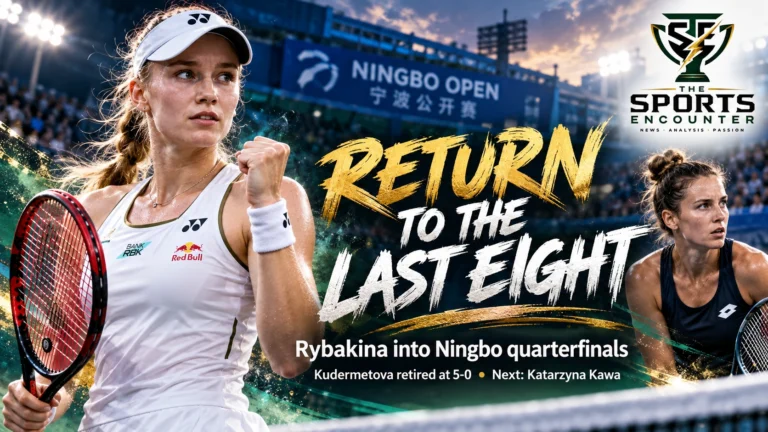 TennisRybakina Needs Just Five Games to Reach Ningbo Quarterfinals, but Kawa Could Be Her Toughest Test Yet
 TennisAlex Eala Ends Three-Match Skid With Ruthless Ningbo Win Over Diane Parry, Setting Up Shnaider Showdown
Iga Swiatek withdrew from Ningbo amid physical concerns, while other contenders experienced setbacks that influenced the final places in the WTA Finals field.
The Sports Encounter examined those developments in its report on Swiatek’s Ningbo withdrawal and the WTA Finals qualification picture.
The broader race, including the positions of Jessica Pegula, Coco Gauff and other leading players, was covered in TSE’s analysis of the 2026 WTA Finals qualification race.
For Rybakina, the immediate objective is considerably simpler: defeat Shnaider, reach another Ningbo final and continue building confidence after a disrupted run of tournaments.
Who Else Reached the Ningbo Semifinals?
Saturday’s other semifinal will feature Leylah Fernandez of Canada against Marie Bouzkova of the Czech Republic.
Fernandez recovered from losing the opening set to defeat Ekaterina Alexandrova 4-6, 6-2, 6-1.
Bouzkova progressed with a 6-3, 6-4 victory over fellow Czech Sara Bejlek.
The semifinal lineup therefore contains the defending champion, a former Ningbo finalist, a player enjoying a strong late-season resurgence and a Czech contender seeking another important final.
Shnaider reached the Ningbo final in 2023 and returned to the semifinals in 2025, demonstrating an established ability to perform well at this tournament.
Rybakina is attempting to return to the final for a second consecutive season and defend the championship she won against Alexandrova last year.
Fernandez and Bouzkova will contest the other place in Sunday’s championship match.
What Should Tennis Fans Watch in Rybakina vs Shnaider?
Three aspects of Saturday’s semifinal could help explain the result.
Will Rybakina Maintain Her First-Serve Effectiveness?
Rybakina won 81% of points played behind her first serve against Kawa, but her second-set deterioration demonstrated that consistency over the full match remains important.
Against Shnaider, she will need to avoid extended periods in which her opponent can attack vulnerable service games.
Can Shnaider Use Variety to Disrupt Rybakina’s Power?
Shnaider’s quarterfinal victory over Jovic featured well-timed slices, lobs and changes in pace.
If she can use those variations effectively, she may force Rybakina to play more points outside her preferred first-strike patterns.
Rybakina’s previous victories suggest that her power and depth have so far been sufficient to overcome that challenge.
Which Player Will Handle Pressure Better After Losing a Set?
Both semifinalists recovered from second-set defeats in their quarterfinals.
Rybakina responded by winning the third set 6-1 against Kawa. Shnaider produced the same deciding-set score against Jovic.
That shared result provides a useful immediate comparison.
Both demonstrated the ability to recover after losing momentum. Saturday will reveal which player can sustain that resilience against a more familiar opponent.
Rybakina vs Kawa and the Ningbo Semifinals: Frequently Asked Questions
Who won Elena Rybakina vs Katarzyna Kawa at Ningbo 2026?
Elena Rybakina defeated Katarzyna Kawa 6-1, 3-6, 6-1 in the women’s singles quarterfinals on October 23, 2026.
How long did Rybakina’s quarterfinal match last?
The match lasted 1 hour, 45 minutes.
How many aces did Rybakina hit against Kawa?
Rybakina recorded eight aces and won 81% of points played behind her first serve.
Why did Rybakina lose the second set?
Her serving effectiveness dropped, and Kawa capitalized on errors and break opportunities. Kawa broke Rybakina’s serve three times to take the second set 6-3.
Who will Elena Rybakina face in the Ningbo semifinals?
Rybakina will face Diana Shnaider, who defeated Iva Jovic 6-3, 4-6, 6-1 in her quarterfinal.
What is Rybakina’s head-to-head record against Shnaider?
Rybakina leads their previous meetings 2-0, winning in straight sets at Stuttgart and Cincinnati in 2026.
When is Rybakina vs Shnaider scheduled?
The Ningbo Open semifinal is scheduled for Saturday, October 24, 2026, in China.
Is Elena Rybakina the defending Ningbo champion?
Yes. She won the 2025 title by defeating Ekaterina Alexandrova 3-6, 6-0, 6-2 in the final.
Who will play in the other Ningbo semifinal?
Leylah Fernandez will face Marie Bouzkova for a place in the final.
The Sports Encounter Verdict: Rybakina Found Her Game Again, but Shnaider Offers Another Test
Rybakina’s victory over Kawa offered a useful examination of the qualities that have carried her to world No. 1.
She dominated the opening set, lost control of the middle one and recovered decisively when the match demanded it.
Kawa deserves credit for creating that pressure. Her performance in the second set transformed a contest that initially appeared one-sided into a genuine competitive challenge.
For Rybakina, the strongest evidence came from her response.
Winning 12 of 14 games across the first and third sets reflected the quality of her attacking tennis when she served effectively and imposed her preferred patterns.
Saturday presents a different problem.
Shnaider has lost both previous meetings, but she arrives after demonstrating considerable tactical range and the ability to recover from a difficult passage of play.
Rybakina has already beaten her on clay and hard courts. Ningbo provides an opportunity to establish whether that advantage can withstand Shnaider’s improving variety and confidence.
The defending champion remains the favorite based on their results and her superior ranking.
Yet the most important question is whether Rybakina can reproduce the standard of her first and third sets without permitting the kind of second-set decline that gave Kawa an opening.
If she succeeds, another Ningbo final awaits. If Shnaider can interrupt that rhythm more consistently than she managed in their previous meetings, Saturday could deliver a much closer contest than their 2-0 head-to-head suggests.