
Research and statistical analysis by Namra10. Figures cover matches played through November 24, 2026.
Since the Asian Club Championship was relaunched as the AFC Champions League in 2002-03, Saudi and Emirati clubs have met 143 times across 24 editions, according to original research compiled by Namra10.
Key Takeaways
- Since the Asian Club Championship was relaunched as the AFC Champions League in 2002-03, Saudi and Emirati clubs have met 143 times across 24 editions, according to original research compiled by Namra10.
- The first Champions League meeting went the Emirati way: Al Ahli Dubai beat Al Ahli of Jeddah 3-2 at home in October 2002 and advanced 5-4 on aggregate in qualifying.
- The 2026-27 Elite season had produced eight meetings through November 24, including the preliminary stage.
- The study covers every match between clubs from the United Arab Emirates and Saudi Arabia in the AFC Champions League and AFC Champions League Elite from the 2002-03 edition through November 24, 2026, including qualifying rounds.
Saudi clubs have won 70 of those matches and Emirati clubs 36, with 37 draws. Behind that wide margin lies a rivalry that has swung from one era to the next, an Emirati club that has held its own, and a striking difference in results by venue.
Story at a glance

A Meeting in Every AFC Champions League Edition
The two countries’ clubs have faced each other in qualifying rounds, group stages, league phases, knockout ties and one final. Not a single edition since 2002-03 has passed without at least one meeting. The overall goal count is 250 to 178 in favor of Saudi clubs.
Five Eras Reveal How the Rivalry Has Changed
Split into five periods, the record looks very different from one to the next.
Al Ain Stand Apart From Other Emirati Clubs
One Emirati club stands apart. Al Ain have played Saudi opposition 44 times, more than any other Emirati side, and have won 19, drawn seven and lost 18, with 68 goals scored and 65 conceded. Among Emirati clubs with more than two such meetings, they are the only one with more victories than defeats.
Saudi and Emirati Clubs Show a Striking Difference by Venue
One of the clearest patterns in the series is the difference in results by match location.
Knockout Ties Favor Saudi Clubs, With Notable Al Ain Exceptions
The two countries’ clubs have met in 18 knockout or qualifying ties, played over two legs or as single matches. Saudi clubs won 13 of those ties and Emirati clubs five.
A Meeting in Every AFC Champions League Edition
The two countries’ clubs have faced each other in qualifying rounds, group stages, league phases, knockout ties and one final. Not a single edition since 2002-03 has passed without at least one meeting. The overall goal count is 250 to 178 in favor of Saudi clubs.
The rivalry is older than the modern format. Al Hilal beat Al Shabab of Dubai 1-0 in a semifinal of the Asian Club Championship played in Doha in December 1991. Al Shabab of Riyadh knocked Al Wasl out of the 1992-93 semifinals in Bahrain on penalties after a 2-2 draw, and Al Shaab of Sharjah beat Al Ittihad on penalties in the 1994-95 Asian Cup Winners’ Cup semifinals. This analysis covers the Champions League era, where the record is comparable across editions. The historical competition structure is documented in the RSSSF Asian Champions’ Cup archive.
The first Champions League meeting went the Emirati way: Al Ahli Dubai beat Al Ahli of Jeddah 3-2 at home in October 2002 and advanced 5-4 on aggregate in qualifying. A few months later, Al Ain beat Al Hilal 1-0 in a group played in Al Ain, on the way to winning the first title of the relaunched competition.
The rivalry remains part of the modern tournament. The 2026-27 AFC Champions League Elite draw brought Al Ain and other leading regional clubs together again.
Five Eras Reveal How the Rivalry Has Changed
Split into five periods, the record looks very different from one to the next.
From 2002-03 to 2008, Emirati clubs were slightly ahead: six wins, six draws and five defeats in 17 matches. The period still produced the rivalry’s only final, in 2005, when Al Ittihad drew 1-1 in Al Ain and won the second leg 4-2 in Jeddah to take the title.
The years 2009 to 2013, when the competition grew to 32 clubs, were the most one-sided. In 36 meetings, Saudi clubs won 23 and Emirati clubs only four, with a goal count of 82 to 37. In 2010, Saudi teams won six of eight meetings. In the 2012 round of 16, Al Hilal beat Baniyas 7-1, the most goals scored by one side in the series.
Between 2014 and 2018, the balance was perfect: 11 wins each and 16 draws in 38 matches, with 46 goals to 48. In terms of victories, it was the best period for Emirati clubs. Al Ain beat Al Ittihad 2-0 and 3-1 in the 2014 quarterfinals. In 2015, Al Ahli Dubai, now Shabab Al Ahli, drew 1-1 in Riyadh and beat Al Hilal 3-2 at home to reach the final. The 12 meetings of 2017 produced seven draws.
From 2019 to 2023-24, a period that included the centralized groups of the pandemic years, Saudi clubs pulled ahead again with 15 wins to nine. The exception was the 2023-24 season, which Al Ain won after eliminating two Saudi clubs.
Since the competition became the AFC Champions League Elite in 2024-25, the gap has widened: 16 Saudi wins, six Emirati wins and two draws in 24 matches, with 50 goals to 28. In the first Elite season, Emirati clubs lost all six meetings, including a 5-4 home defeat for Al Ain against Al Hilal in October 2024, the highest-scoring match between the two countries’ clubs in this competition.
The period coincides with the arrival of high-profile international players in the Saudi Pro League since 2023. The figures alone cannot establish how much individual recruitment decisions contributed to the changing results.
| Period | Matches | Saudi wins | Emirati wins | Draws |
|---|---|---|---|---|
| 2002-03 to 2008 | 17 | 5 | 6 | 6 |
| 2009 to 2013 | 36 | 23 | 4 | 9 |
| 2014 to 2018 | 38 | 11 | 11 | 16 |
| 2019 to 2023-24 | 28 | 15 | 9 | 4 |
| 2024-25 to Nov. 24, 2026 | 24 | 16 | 6 | 2 |
| Total | 143 | 70 | 36 | 37 |
Al Ain Stand Apart From Other Emirati Clubs
One Emirati club stands apart. Al Ain have played Saudi opposition 44 times, more than any other Emirati side, and have won 19, drawn seven and lost 18, with 68 goals scored and 65 conceded. Among Emirati clubs with more than two such meetings, they are the only one with more victories than defeats.
Their most frequent opponent is also the rivalry’s most frequent pairing: Al Ain and Al Hilal have met 16 times. Al Hilal lead with eight wins to six, with two draws and a goal count of 25 to 20. But the ties between them have produced decisive moments.
Al Hilal won the 2014 semifinal first leg 3-0 in Riyadh and advanced 4-2 on aggregate, then won the 2017 quarterfinal 3-0 on aggregate. Al Ain answered in 2024, winning the semifinal first leg 4-2 at home and advancing 5-4 on aggregate.
The other Emirati clubs have found Saudi opposition much harder. Shabab Al Ahli, counting its matches as Al Ahli Dubai, have six wins in 27 meetings. Al Wahda have three in 19 and Al Jazira a single win in 20. Sharjah have three wins in nine meetings, including a 6-0 victory over Al Taawoun in Qatar in September 2020, the largest Emirati victory in the series.
On the Saudi side, Al Hilal have been the main opponent, with 47 meetings against Emirati clubs: 24 wins, 14 draws and nine defeats. Al Ittihad’s record is the most balanced, with nine wins, eight draws and eight defeats in 25 matches.
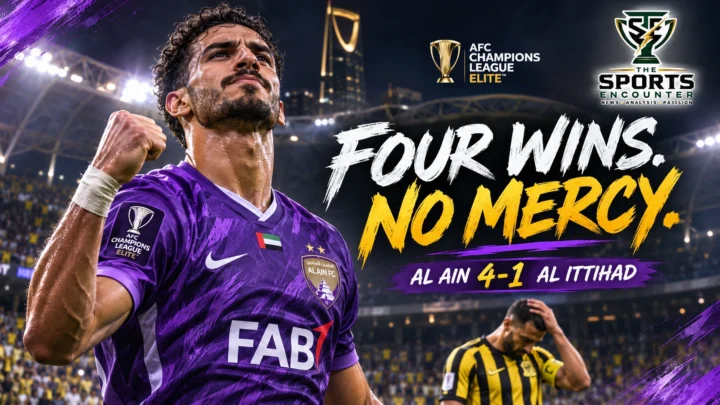
Al Ain’s ability to compete with Saudi opponents has continued into the current season, including their 4-1 victory over Al Ittihad in Jeddah.
Saudi and Emirati Clubs Show a Striking Difference by Venue
One of the clearest patterns in the series is the difference in results by match location.
In the 67 meetings played in the United Arab Emirates, the record is almost even: 22 Emirati wins, 20 draws and 25 Saudi wins. In the 73 played in Saudi Arabia, Emirati clubs won only 12 times, drew 16 and lost 45, with 79 goals scored and 153 conceded.
Emirati clubs therefore won twice as often in matches played in the UAE, 32.8% of the time, as they did in Saudi Arabia, where their winning percentage was 16.4%. The comparison is descriptive rather than proof that home advantage alone caused these differences. Opponent strength, competition format and individual match circumstances can also influence results.
The data counts the centralized matches of 2021 and 2022, all played in Riyadh, as matches in Saudi Arabia even when the Emirati club was the nominal home side. The three matches played in Qatar during the 2020 restart produced two Emirati wins and a draw.
| Venue country | Matches | Saudi wins | Emirati wins | Draws |
|---|---|---|---|---|
| United Arab Emirates | 67 | 25 | 22 | 20 |
| Saudi Arabia | 73 | 45 | 12 | 16 |
| Qatar | 3 | 0 | 2 | 1 |
Knockout Ties Favor Saudi Clubs, With Notable Al Ain Exceptions
The two countries’ clubs have met in 18 knockout or qualifying ties, played over two legs or as single matches. Saudi clubs won 13 of those ties and Emirati clubs five.
Three of the five Emirati successes belong to Al Ain: the 2014 quarterfinal against Al Ittihad and two ties during the 2023-24 title-winning campaign. In the 2024 quarterfinal, Al Ain beat Al Nassr 1-0 at home, lost 4-3 after extra time in Riyadh and won the penalty shootout 3-1. They subsequently eliminated Al Hilal in the semifinal before beating Yokohama F. Marinos in the final.
The other two Emirati successes belong to Al Ahli Dubai, in the 2002-03 qualifying round and 2015 semifinal, against Saudi opponents from Jeddah and Riyadh.
Continue the AFC Champions League Elite Story
 AFC Champions League EliteAl Ain Humiliate Al Ittihad 4-1 in Jeddah to Take Control of AFC Champions League Elite
 AFC Champions League EliteAFC Champions League Elite: Kashima Shut Out Jeonbuk to Seize the East
 AFC Champions League EliteCristiano Ronaldo Hits 987 as 10-Man Al Sadd End Up on the Wrong Side Despite Outshooting Al Nassr
Saudi clubs won two of the three penalty shootouts. Al Ahli of Jeddah beat Al Jazira 4-2 on penalties after a 3-3 draw in Abu Dhabi in the 2012 round of 16 and defeated Shabab Al Ahli 4-3 on penalties in Qatar in 2020. Al Ain’s 2024 shootout against Al Nassr went the other way.
The rivalry also extends to the second-tier continental competition. Sharjah beat Al Taawoun 2-1 on aggregate in the 2024-25 AFC Champions League Two semifinal, losing 1-0 away before winning 2-0 at home, and subsequently won the trophy. In 2025-26, Al Nassr beat Al Wasl 4-0 in the quarterfinals.
The 2026-27 Season Adds Another Chapter
The 2026-27 Elite season had produced eight meetings through November 24, including the preliminary stage. Saudi clubs won five of those encounters, including Al Ittihad’s 4-1 victory over Al Jazira in Abu Dhabi in August and Al Qadsiah’s 5-1 away win against Shabab Al Ahli, documented in the AFC’s official match report.
The three Emirati victories show that the balance can still shift. Al Ain beat Al Nassr 4-0 at home and won 4-1 at Al Ittihad, while Shabab Al Ahli secured a 2-1 victory in Jeddah.
Elsewhere in the campaign, Al Hilal’s victory over Shabab Al Ahli demonstrated the continuing challenge facing Emirati contenders. The Matchday 5 knockout race provides further context.
More meetings remain scheduled before the league phase ends. The historical record gives Saudi clubs a substantial overall advantage, but Al Ain’s results show that individual Emirati teams have repeatedly found ways to challenge that dominance.
Research Methodology and Source Attribution
The study covers every match between clubs from the United Arab Emirates and Saudi Arabia in the AFC Champions League and AFC Champions League Elite from the 2002-03 edition through November 24, 2026, including qualifying rounds. The dataset contains 143 matches, excluding three separately analyzed meetings in the AFC Champions League Two.
A match decided on penalties is counted as a draw, using the score after extra time. Two February 2020 results later annulled by the AFC, Al Wahda 1-1 Al Ahli and Shabab Al Ahli 1-2 Al Hilal, are excluded.
Matches are classified by the country where they were played rather than by the nominal home team. Shabab Al Ahli’s figures include matches played under the former Al Ahli Dubai identity. Al Shabab of Dubai, another club involved in the 2017 merger, is counted separately.
The analysis groups the matches into five periods: 2002-03 to 2008, 2009 to 2013, 2014 to 2018, 2019 to 2023-24, and the Elite editions beginning in 2024-25.
The match-by-match research and original charts were supplied by Namra10, whose team granted The Sports Encounter permission to publish the graphics with source attribution. The supplied dataset includes match dates, results, venues, competition stages and supporting references. The aggregate figures reconcile with the supplied calculations and graphics.
Source attribution: Namra10. Historical reference materials include RSSSF records, AFC competition archives, ESPN match data and contemporary press reports.