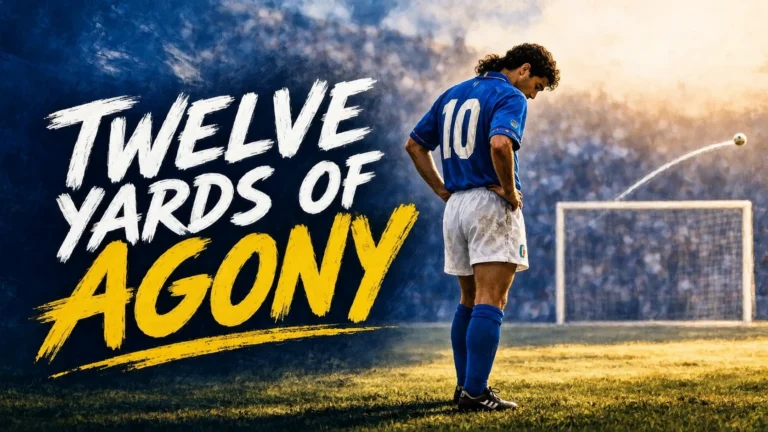
Roberto Baggio was already a national hero when he walked toward the penalty spot at the Rose Bowl in 1994. Seconds later, his shot disappeared above the crossbar, Brazil became world champion, and one of Italy’s greatest players acquired an image that would follow him for the rest of his career. Few sporting situations can reduce years of achievement to a single action quite like a penalty shootout.
The most devastating defeats from 12 yards share something deeper than a missed kick. They involve a championship that appeared within reach, a historic opportunity that might never return, or a collective failure that became unfairly associated with one individual. The Sports Encounter ranks ten such occasions across international and club soccer, including the women’s game.
Key Takeaways
- Roberto Baggio was already a national hero when he walked toward the penalty spot at the Rose Bowl in 1994.
- The most devastating defeats from 12 yards share something deeper than a missed kick.
- According to UEFA’s historical records, FIFA adopted the format in 1970.
- Gary Lineker’s equalizer had kept England’s hopes of reaching a first World Cup final since 1966 alive.
How we rank the biggest penalty shootout heartbreaks
Four factors shape this ranking: the importance of the competition, proximity to victory, historical significance and the lasting consequences for the losing team or player. The order is an editorial judgment rather than a numerical measurement of grief. We consider only matches decided by kicks after play ended, which excludes defeats such as Brazil’s elimination against Norway, where a missed penalty occurred during the match itself.
According to UEFA’s historical records, FIFA adopted the format in 1970. The aim was to provide a sporting alternative to drawing lots. What followed was an unusual form of competition in which a team can survive two hours against eleven opponents and still lose through a sequence of individual confrontations.
10. England vs West Germany: The penalty shootout that began a national obsession
1990 FIFA World Cup semifinal, Turin. Match: 1-1. West Germany won 4-3 on penalties.
Gary Lineker’s equalizer had kept England’s hopes of reaching a first World Cup final since 1966 alive. Paul Gascoigne’s tears, after receiving a booking that would have ruled him out of the final, supplied one enduring image of the night. The decisive kicks supplied another.
Stuart Pearce saw his attempt saved by Bodo Illgner, and Chris Waddle fired over. West Germany converted all four of its kicks and went on to defeat Argentina in the final.
England lost its first major-tournament penalty shootout in Turin. Pearce eventually converted against Spain at Euro 1996, giving him a personal moment of redemption even though the national team would endure further disappointment against Germany days later. Turin became the starting point for decades of debate about preparation and responsibility.
9. United States vs Japan: Two leads and no trophy
2011 FIFA Women’s World Cup final, Frankfurt. Match: 2-2. Japan won 3-1 on penalties.
Alex Morgan put the United States ahead in the second half before Aya Miyama equalized. Abby Wambach restored the American lead in extra time, only for Homare Sawa to redirect a corner into the net in the 117th minute.
The United States then failed to convert its first three attempts in the penalty shootout. Japan’s Ayumi Kaihori saved twice, while Carli Lloyd shot over. Wambach scored, but Saki Kumagai completed Japan’s first world championship.
As UEFA’s contemporary report records, the Americans had enjoyed the better chances. Their defeat illustrates how little an advantage in open play can matter once the contest moves to the spot. The United States recovered to beat Japan in the 2015 final, but that required another four-year cycle.
8. Argentina vs Chile: When Messi briefly walked away
2016 Copa América Centenario final, East Rutherford. Match: 0-0. Chile won 4-2 on penalties.
Argentina had lost the previous year’s Copa América final to Chile by the same method. The centenary tournament offered an immediate chance to reverse that outcome, but neither team scored in 120 minutes.
Arturo Vidal missed Chile’s opening kick, handing Argentina an advantage. Lionel Messi then sent his shot over the bar. Lucas Biglia later failed to convert, and Francisco Silva secured Chile’s second consecutive continental championship.
Messi announced his international retirement after the match, before reversing the decision later that year. The penalty shootout threatened to become the final chapter of his Argentina career. His subsequent Copa América and World Cup triumphs explain why the 2016 defeat remains essential to understanding his eventual place in the debate over soccer’s greatest player.
7. Bayern Munich vs Chelsea: Losing Europe in your own stadium
2012 UEFA Champions League final, Munich. Match: 1-1. Chelsea won 4-3 on penalties.
Thomas Müller gave Bayern the lead in the 83rd minute. Didier Drogba headed Chelsea level five minutes later, and Petr Čech saved an Arjen Robben penalty in extra time. Bayern nevertheless gained another advantage when Manuel Neuer denied Juan Mata at the beginning of the penalty shootout.
Ivica Olić was subsequently denied by Čech, and Bastian Schweinsteiger’s effort was tipped onto the post. Drogba converted Chelsea’s final kick to secure the club’s first European Cup.
Bayern had enjoyed three distinct opportunities to win: a late lead, an extra-time penalty and an advantage during the deciding kicks. Each disappeared in front of its own supporters. The German club returned to win the competition at Wembley the following season, but the Munich defeat remains a powerful example of how repeated chances can compound the disappointment of a final.
6. Chelsea vs Manchester United: One slip from immortality
2008 UEFA Champions League final, Moscow. Match: 1-1. Manchester United won 6-5 on penalties.
Cristiano Ronaldo, whose World Cup career featured a decisive kick against England in 2006, had scored United’s opener, Frank Lampard had equalized, and Petr Čech subsequently saved Ronaldo’s attempt from the spot. John Terry approached Chelsea’s fifth kick knowing a goal would deliver the club’s maiden Champions League title.
His standing foot slipped on the wet surface, and the ball struck the outside of the post. The penalty shootout continued until Edwin van der Sar saved Nicolas Anelka’s effort in the seventh round.
Terry’s miss remains the defining picture, although Anelka’s was the final one. That distinction matters: Terry had a chance to win immediately, whereas Anelka had to score to keep Chelsea alive. The two players were executing the same skill under fundamentally different circumstances. Chelsea’s eventual triumph in Munich four years later closed the club’s unfinished business, but Terry was suspended for that final.
5. France vs Argentina: A hat trick could not save a world title
2022 FIFA World Cup final, Lusail. Match: 3-3. Argentina won 4-2 on penalties.
France trailed by two goals until Kylian Mbappé scored twice in quick succession. Messi restored Argentina’s advantage in extra time, only for Mbappé to complete his hat trick with another penalty. Randal Kolo Muani then had a late opportunity denied by Emiliano Martínez.
Mbappé converted again in the penalty shootout, but Martínez saved Kingsley Coman’s kick and Aurélien Tchouaméni missed the target. Gonzalo Montiel secured Argentina’s third world title.
France’s defeat is particularly remarkable because its leading player had already delivered three goals in the final and converted a third spot kick after extra time. Even that individual contribution could not secure a second consecutive championship for France. It exposes the limits of individual greatness in a team game.
4. England vs Italy: England’s 55-year wait goes on
Euro 2020 final, played in 2021, London. Match: 1-1. Italy won 3-2 on penalties.
Luke Shaw opened the scoring in the second minute, bringing England closer to a first major men’s trophy in 55 years. Leonardo Bonucci equalized after the break. England then led during the penalty shootout after Jordan Pickford saved Andrea Belotti’s attempt.
Marcus Rashford hit the post and Gianluigi Donnarumma saved from Jadon Sancho. Pickford gave England another chance by denying Jorginho, but Donnarumma stopped Bukayo Saka’s fifth kick.
The racist abuse that followed the penalty shootout directed at England’s three unsuccessful takers added a disturbing social dimension to the sporting defeat. No tactical discussion about substitutions or kicking order justifies that treatment. Wembley remains a reminder that accepting responsibility for a team can expose young players to consequences far beyond the pitch.
3. AC Milan vs Liverpool: The trophy that vanished from 3-0
2005 UEFA Champions League final, Istanbul. Match: 3-3. Liverpool won 3-2 on penalties.
Paolo Maldini and Hernán Crespo, who scored twice, gave Milan a three-goal lead by halftime. Liverpool responded through Steven Gerrard, Vladimír Šmicer and Xabi Alonso in a remarkable burst shortly after the interval. Alonso scored from the rebound after Dida saved his penalty.
Jerzy Dudek denied Andriy Shevchenko at close range in extra time and stopped him again in the penalty shootout. Milan had already lost its advantage in open play; its leading striker then encountered the same goalkeeper at two decisive moments.
Continue the Soccer Story



Shevchenko had converted Milan’s winning kick against Juventus in the 2003 final. His contrasting experiences demonstrate the danger of treating one outcome as proof of character. Milan defeated Liverpool in the 2007 final, but its 2005 collapse remains inseparable from Liverpool’s greatest European comeback.
2. Ghana vs Uruguay: The semifinal that almost belonged to Africa
2010 FIFA World Cup quarterfinal, Johannesburg. Match: 1-1. Uruguay won 4-2 on penalties.
Ghana had taken the lead through Sulley Muntari before Diego Forlán equalized. The Black Stars were one kick away from becoming the first African nation to reach a men’s World Cup semifinal after Luis Suárez deliberately handled a goal-bound ball and was sent off in the closing moments of extra time. Asamoah Gyan struck the crossbar with the resulting penalty.
Gyan recovered to convert his team’s opening attempt in the penalty shootout. John Mensah and Dominic Adiyiah were subsequently denied by Fernando Muslera, and Sebastián Abreu sent Uruguay through with a chip.
Gyan’s successful second attempt is frequently overshadowed by his first miss. He had accepted responsibility again, even after losing the opportunity to settle the match himself. The historical significance of what Ghana nearly achieved in Africa’s first World Cup makes this quarterfinal exceptional. Morocco eventually became the continent’s first men’s semifinalist in 2022.
1. Italy vs Brazil: The loneliest walk in World Cup history
1994 FIFA World Cup final, Pasadena. Match: 0-0. Brazil won 3-2 on penalties.
Baggio had scored five times during Italy’s knockout campaign, carrying much of the attacking burden on the road to the final. Yet after 120 scoreless minutes in California, Italy needed him to rescue its chances once more.
Franco Baresi and Daniele Massaro had already failed to convert. Brazil led 3-2 when Baggio stepped forward for Italy’s fifth kick. His shot went over the crossbar, ending the first men’s World Cup final decided by a penalty shootout. Even had he scored, Brazil would still have had a kick available to win the title.
The historical World Cup shootout records list the final score, but the sequence of kicks helps explain why the familiar image is so unfair to Baggio. Italy’s entire campaign had depended heavily on his goals. The final defeat became associated with him despite two earlier misses and the possibility that Brazil could have won anyway.
Why the last kick of a penalty shootout can distort the story
Some painful defeats never even give the biggest star an opportunity to respond. As our retrospective on Neymar’s World Cup career explains, Brazil’s elimination by Croatia in 2022 ended before its designated fifth taker could step forward. A penalty shootout can leave a player exposed to blame or powerless to intervene, depending on the order of the kicks.
Debates about deceptive penalty-taking techniques often focus on the execution of an individual shot. The history of these ten defeats suggests an equally important question: how did the team arrive at a point where everything depended on that execution?
Seven of the ten selected teams lost after leading in the match or holding an advantage at the end of a completed round of the penalty shootout. That observation is specific to this ranking, rather than a claim about all shootouts. It explains why the defeat can feel so different from a match in which the opponent dominated throughout.
The penalty shootout will always produce a final image, whether it is a ball flying over the bar, a goalkeeper making a save or a player standing alone. Soccer history deserves to remember the full journey that preceded that image, including the achievements of the very people who happened to be standing over the ball when it ended.