


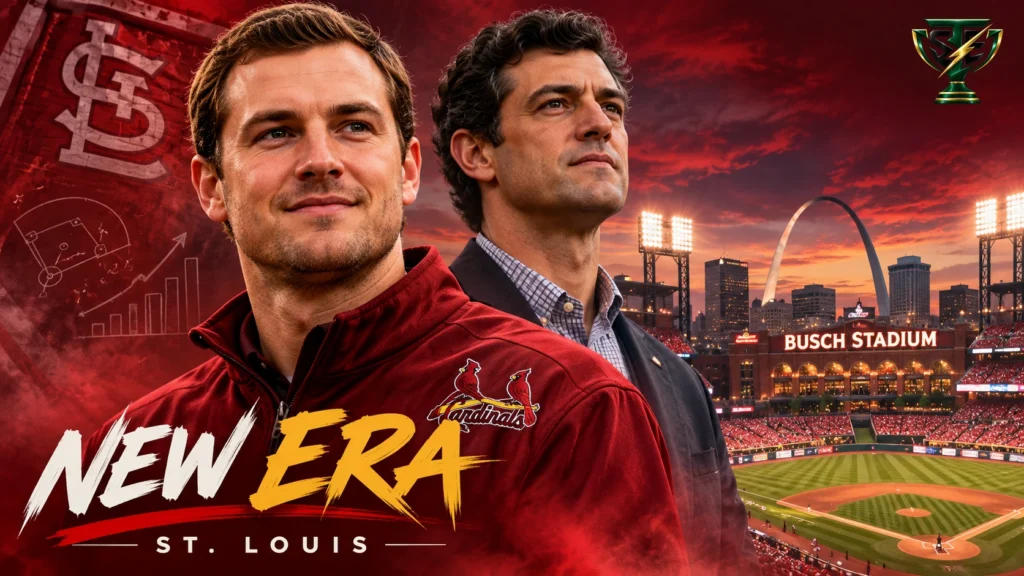
ST. LOUIS, United States, November 6, 2026: The St. Louis Cardinals have handed one of baseball’s most demanding rebuilding jobs to a 34-year-old executive whose reputation was established away from the major league spotlight. Rob Cerfolio was promoted to general manager Friday, replacing the departed Randy Flores and strengthening his partnership with president of baseball operations Chaim Bloom. The appointment follows a 77-85 season, a fourth consecutive year without postseason baseball and another October spent watching other National League contenders compete for a championship. Yet the decision also reflects growing confidence in the club’s younger players and the development system Cerfolio helped rebuild after joining St. Louis in October 2024.
Cerfolio, a former Yale pitcher who spent almost a decade with the Cleveland Guardians, will report to Bloom rather than operate as the Cardinals’ independent head of baseball operations. His promotion comes after Flores left for the Houston Astros, creating an opportunity to retain an executive who had reportedly attracted interest from other organizations. St. Louis saw encouraging progress from Jordan Walker, JJ Wetherholt, Joshua Báez and Leo Bernal during 2026, but those individual breakthroughs have yet to produce a winning season. The challenge for Cerfolio is to turn a developing young core into a sustainable contender while addressing pitching, roster balance and the difficult financial decisions awaiting the franchise.
Cardinals Promote Rob Cerfolio: What Does the New General Manager Actually Control?
The Cardinals confirmed Cerfolio’s appointment on Friday, November 6, establishing a new leadership arrangement within their baseball operations department.
Cerfolio will report to Chaim Bloom, who became president of baseball operations after the 2025 season.
That reporting relationship is important. The general manager is a senior baseball executive, but Bloom remains the organization’s top baseball operations official.
The move is therefore best understood as a promotion within an existing rebuilding structure rather than a complete change in organizational direction.
Cerfolio previously served as assistant general manager for player development and performance. His work included coordinating coaching, scouting, player-development processes and the use of performance information throughout the organization.
Bloom praised his contribution to improving player development and integrating the club’s performance departments.
His promotion follows Randy Flores’ departure for Houston, where Flores has become general manager of the Astros.
St. Louis Cardinals’ Baseball Leadership After the Appointment
| Executive | Position | Primary Organizational Role |
|---|---|---|
| Chaim Bloom | President of Baseball Operations | Overall baseball strategy, leadership and major organizational decisions |
| Rob Cerfolio | General Manager | Senior baseball operations leadership, roster planning and coordination of development strategy |
| Oliver Marmol | Major League Manager | On-field management, player deployment and game preparation |
| Bill DeWitt III | Chief Executive Officer | Organizational executive leadership |
| Bill DeWitt Jr. | Chairman and Principal Owner | Ownership oversight and strategic direction |
| Randy Flores | Departed for Houston Astros | Previously oversaw important scouting and acquisition functions in St. Louis |
The distinction between Bloom’s authority and Cerfolio’s responsibilities matters when evaluating future transactions.
A trade, free-agent signing or organizational restructuring should not automatically be attributed to Cerfolio alone simply because he now holds the general manager title.
The decisions will emerge from a broader leadership group operating within the strategic direction established by Bloom.
The MLB report on Cerfolio’s promotion provides the immediate appointment details and his previous responsibilities.
Who Is Rob Cerfolio? From Yale Pitcher to MLB General Manager at 34
Rob Cerfolio’s career did not follow the conventional path of a former major league player moving into baseball administration.
He grew up in Alabama and played collegiate baseball at Yale University, where he was a pitcher.
The Los Angeles Dodgers selected him in the 34th round of the 2013 MLB Draft, but he did not sign a professional contract.
He completed his studies at Yale in 2014 and moved into baseball operations shortly afterward.
His first major professional opportunity came with Cleveland in 2015.
During almost a decade with the Guardians organization, he progressed through development-related positions and eventually became director of player development.
Cerfolio’s experience in Cleveland gave him exposure to an organization known for emphasizing scouting, pitching development and the identification of undervalued talent.
Those systems have helped the Guardians remain competitive despite operating with different financial resources from baseball’s largest-market franchises.
Rob Cerfolio’s Career Timeline
| Year or Period | Organization | Development |
|---|---|---|
| 2013 | Los Angeles Dodgers / Yale | Selected in 34th round of MLB Draft but did not sign |
| 2014 | Yale University | Completed college education |
| 2015 | Cleveland organization | Began baseball operations career |
| 2019-2021 | Cleveland Guardians | Worked in assistant player-development leadership |
| 2022-2024 | Cleveland Guardians | Served as director of player development |
| October 2024 | St. Louis Cardinals | Appointed assistant GM for player development and performance |
| 2025-2026 | St. Louis Cardinals | Helped coordinate rebuilding of development and performance systems |
| November 6, 2026 | St. Louis Cardinals | Promoted to general manager |
What makes his appointment notable is not simply his age.
At 34, he has already spent more than a decade working within professional baseball organizations, including several years in senior development roles.
That experience distinguishes him from someone entering management immediately after a playing career.
Still, his promotion creates a different set of responsibilities.
Evaluating player-development systems and helping a major league club manage its roster involve overlapping skills, but they are not identical jobs.
Why Did Chaim Bloom Choose Cerfolio?
Bloom’s relationship with Cerfolio predates their current positions in St. Louis.
Cerfolio was among Bloom’s earliest major appointments as the Cardinals prepared to reorganize baseball operations.
The organization had identified weaknesses in its development pipeline and wanted to create stronger connections between scouting, coaching, performance analysis and major league decision-making.
Cerfolio’s reputation centered on that work.
During his previous role, he was involved in coordinating development programs and bringing different departments into closer alignment.
Those responsibilities included helping players understand how changes to mechanics, preparation and individual development plans could improve their performances.
His promotion suggests that Bloom sees those abilities as useful beyond the minor league system.
However, it would be premature to assume that Cerfolio has been given unrestricted authority over trades, contracts or draft decisions.
Those responsibilities will operate within Bloom’s leadership structure.
The Cardinals’ official account of Cerfolio’s October 2024 hiring documents why the organization initially recruited him from Cleveland.
Why Does the Promotion Matter After Four Straight Missed Playoffs?
The Cardinals’ recent competitive record provides the most important context for the appointment.
St. Louis finished 2026 with 77 victories and 85 defeats.
The club placed fourth in the National League Central and missed the postseason for the fourth consecutive season.
Its last playoff appearance came in 2022, and the organization has not won a postseason series since 2019.
Those results are difficult for a franchise with a long history of championship success and sustained competitive expectations.
However, the 2026 record does not tell the entire story.
The Cardinals entered the season in a deliberate rebuilding phase, having reduced several veteran commitments and created more opportunities for younger players.
The organization was not constructed around maximizing immediate wins at the expense of future development.
That explains why management can recognize meaningful progress while acknowledging another losing season.
Cardinals’ Recent Results: Why Progress Has Not Yet Become Wins
| Measure | 2025 | 2026 | Meaning |
|---|---|---|---|
| Wins | 78 | 77 | One fewer victory |
| Losses | 84 | 85 | One additional defeat |
| Winning percentage | .481 | .475 | Slight decline |
| NL Central finish | Fourth | Fourth | Division position unchanged |
| Postseason qualification | No | No | Playoff drought continues |
| Organizational priority | Leadership transition and rebuilding preparation | Young-player development under Bloom | Strategic foundation changed despite similar results |
TSE statistical insight: The Cardinals’ winning percentage fell by approximately 0.6 percentage points from 2025 to 2026, despite the significant changes to their baseball operations structure and young-player opportunities.
The calculation is straightforward. St. Louis won 78 of 162 games in 2025, compared with 77 of 162 in 2026.
That means the franchise has not yet translated its developmental progress into a better regular-season record.
The finding does not establish that the restructuring has failed.
It establishes the performance gap the new general manager must help close.
Other clubs have confronted similar challenges while reorganizing.
The Sports Encounter’s investigation into the Los Angeles Angels’ organizational reset after a 100-loss season examined how management changes and roster weaknesses can become connected.
St. Louis faces different circumstances, but the importance of coordinating leadership decisions with player development applies to both situations.
Jordan Walker: The Breakthrough That Supports Cerfolio’s Reputation
One of the strongest arguments in favor of Cerfolio’s promotion is the improvement of outfielder Jordan Walker.
Walker entered 2026 under pressure after struggling to convert his considerable physical ability into consistent major league production.
His previous problems included excessive strikeouts, inconsistent contact quality and difficulties maintaining an effective offensive approach.
The 2026 season changed that picture.
Walker emerged as a central figure in the Cardinals’ young lineup and delivered his strongest major league campaign.
He also won the Home Run Derby, providing a major individual highlight during a season when the team ultimately missed the postseason.
His improvement followed technical work involving the organization’s coaching and player-development staff.
That collaboration provides evidence of a functioning development process, although it would be inaccurate to credit Cerfolio alone for every improvement.
Walker himself, his coaches and other staff contributed to the progress.
Why Walker’s Development Matters for the Next Cardinals Team
A rebuilding franchise needs more than a collection of promising prospects.
It needs players who develop into reliable major league contributors.
Walker’s progression gives St. Louis a possible cornerstone around whom to build its lineup.
But his 2026 performance creates another challenge.
The Cardinals must determine whether his improved production is sustainable against opponents who will continue adjusting their pitching plans.
They also need to decide whether to pursue a long-term contract extension before his market value changes further.
Those decisions will involve both player evaluation and financial planning.
JJ Wetherholt: Why the Cardinals Have Already Made a Long-Term Commitment
Infielder JJ Wetherholt represents another important part of the organization’s rebuilding strategy.
The former first-round selection became a major contributor during his rookie season, showing the ability to influence games through hitting, on-base production and defensive versatility.
St. Louis moved quickly to secure his future.
In July, the club announced an eight-year contract extension running through the 2034 season.
That agreement provides substantial continuity for a team attempting to build around young talent.
It also demonstrates that the Cardinals’ strategy does not involve avoiding every long-term financial commitment.
Instead, the organization appears willing to invest in players it regards as central to its future.
For Cerfolio and Bloom, the next challenge is determining which other players merit similar confidence.
Leo Bernal, Joshua Báez and Rainiel Rodriguez: The Next Development Test
The Cardinals’ youth movement extends beyond Walker and Wetherholt.
Joshua Báez and Leo Bernal reached the major leagues during 2026, giving the organization additional evidence about the readiness of its prospects.
Bernal’s arrival was particularly significant because catcher is a position that combines hitting responsibilities with complex defensive and game-management demands.
His early performances encouraged optimism about the position’s future.
However, St. Louis also has other catching options, including Iván Herrera, Jimmy Crooks and highly rated prospect Rainiel Rodriguez.
The depth creates opportunities and difficult decisions.
If multiple catchers establish themselves as major league-caliber contributors, the organization must determine how to distribute playing time and whether any could provide value through a different position or a trade.
Rodriguez is one of the most highly regarded prospects in the Cardinals’ system, but his future role should not be treated as guaranteed.
Which Young Players Will Shape St. Louis’ 2027 Plans?
| Player | 2026 Development | 2027 Question |
|---|---|---|
| Jordan Walker | Major offensive breakthrough | Can he sustain production and become a long-term lineup cornerstone? |
| JJ Wetherholt | Strong rookie season and extension through 2034 | Can he build on his first major league campaign? |
| Joshua Báez | Major league debut and development progress | Can he establish a consistent everyday role? |
| Leo Bernal | Impressive introduction at catcher | Can he handle the position over a full season? |
| Rainiel Rodriguez | Highly regarded minor league prospect | When will he be ready, and where will he play? |
| Alec Burleson | Established offensive contributor | Does a long-term extension fit the club’s plan? |
| Masyn Winn | Established infield presence | How does his role fit with the next wave of young players? |
The table represents development questions, not predictions that every player will occupy a particular position next season.
That distinction is essential.
Prospect rankings, successful debuts and promising rookie seasons provide useful evidence, but they do not guarantee continued improvement.
St. Louis must also prepare for injuries, performance fluctuations and the possibility that some players develop more slowly than expected.
The Pitching Problem: Cerfolio’s Most Important Test?
The Cardinals’ young position-player core looks more settled than their pitching outlook.
That imbalance could determine how quickly the team returns to postseason contention.
Reliable starting pitching allows a club to avoid placing excessive pressure on its bullpen.
It also helps the offense remain competitive without requiring large run totals every night.
St. Louis must evaluate its existing starters, developing prospects and potential outside acquisitions before deciding how aggressively to pursue reinforcements.
Cerfolio’s previous work with pitcher development may be useful.
However, improving mechanics and performance systems is different from guaranteeing that a major league rotation will produce enough quality innings.
The organization will need both effective coaching and sound roster decisions.
Eduardo Rivera’s Arrival Offers an Early Example of the Cardinals’ Approach
Just three days before Cerfolio’s promotion, St. Louis acquired left-handed pitcher Eduardo Rivera from the Boston Red Sox in exchange for teenage right-hander Juan García.
Rivera’s major league ERA of 6.30 across ten innings may initially seem discouraging.
However, his minor league numbers offered a different picture.
He recorded a 2.59 ERA with 71 strikeouts across 55⅔ innings at Double-A and Triple-A.
The Sports Encounter’s November 4 investigation into Rivera’s trade to the Cardinals examined why the left-hander’s underlying performance made him an interesting acquisition despite his limited major league results.
The trade was completed before Cerfolio’s promotion, so it should not be described as his first transaction as general manager.
It nevertheless illustrates the type of evaluation challenge the organization’s new leadership will confront.
St. Louis must identify which players possess skills capable of improving with coaching, preparation or altered usage.
That work is especially important for organizations that cannot assume every weakness will be solved by signing an established star.
What Does Cerfolio’s Cleveland Experience Tell Us About His Strategy?
The Cleveland Guardians have developed a reputation for building competitive teams through scouting, pitching development and careful player evaluation.
Cerfolio worked within that structure for almost ten years.
His experience there likely influenced his approach to integrating coaching information, performance analysis and individual player plans.
However, it would be misleading to assume that he can reproduce Cleveland’s entire system in St. Louis simply by holding a more senior position.
Organizations operate under different ownership expectations, financial conditions, staffing arrangements and roster circumstances.
Cleveland’s own 2026 season also illustrates the difference between building a competitive organization and winning a championship.
The Guardians reached the American League Championship Series but were eliminated by the Tampa Bay Rays in six games.
The Sports Encounter’s report on Cleveland’s ALCS elimination documented how Tampa Bay overcame the Guardians to advance to the World Series.
That result offers an important reminder.
Strong player development can create repeated opportunities to compete, but postseason success also requires execution, health and a roster capable of performing against elite opposition.
How Is Cerfolio’s Promotion Different From Other MLB Leadership Changes?
The 2026 offseason has produced several changes in baseball leadership.
Some organizations have favored executives with extensive experience. Others have promoted younger figures with strong development credentials.
St. Louis belongs to the second category, but the structure is distinctive because Cerfolio will report to an established president of baseball operations.
The New York Yankees have taken a contrasting approach by retaining Brian Cashman for a 30th season as general manager.
Our analysis of Cashman’s continued leadership despite the Yankees’ championship drought examined how experience and institutional continuity can coexist with pressure for improved results.
Seattle has made a different decision by hiring Jason Kanzler, a former player-development executive, as its manager.
TSE’s report on Kanzler’s first managerial appointment examined the challenges facing a young leader moving from player development into a role involving direct major league performance.
These examples should not be treated as identical.
Cashman is a general manager with extensive tenure, Kanzler is a field manager, and Cerfolio is a new general manager operating below a president of baseball operations.
They do, however, illustrate how organizations are making different choices about experience, development and accountability.
Why Randy Flores’ Departure Matters
Cerfolio’s promotion followed the departure of Randy Flores to become general manager of the Houston Astros.
Flores spent 11 years working within the Cardinals organization and held important responsibilities involving amateur and professional talent acquisition.
His departure creates more than a change of title.
It removes an experienced executive from St. Louis while placing him in a senior leadership role with another major league organization.
The Cardinals must ensure that the scouting and acquisition functions Flores previously helped oversee remain effective.
The promotion of Cerfolio preserves one important part of the existing management team, but additional responsibilities may need to be redistributed among other executives and staff.
It would be premature to declare the complete post-Flores organizational structure settled without a full and updated assignment of responsibilities.
Should the Cardinals Spend More Aggressively in 2027?
The emergence of several promising young players creates an understandable argument for adding experienced talent.
St. Louis could pursue starting pitching, bullpen reinforcements or position-player upgrades.
However, committing substantial resources before identifying which internal players can sustain their progress carries its own risks.
Bloom has emphasized patience and avoiding shortcuts during the rebuilding process.
The challenge is determining when continued development and a more aggressive roster approach should overlap.
There is no fixed rule.
A team with a young core approaching its competitive peak may benefit from investing in established players.
A club with major uncertainties in its rotation or everyday lineup may be better served by preserving flexibility until those questions become clearer.
What Should Cerfolio Prioritize This Offseason?
| Priority | Why It Matters | Evidence of Progress |
|---|---|---|
| Starting pitching | More dependable innings can support the entire roster | Clearer rotation depth and improved availability |
| Player development | Young contributors must sustain their gains | Continued improvement across major and minor league levels |
| Catching situation | Multiple players competing for related roles | Defined usage plans and effective roster allocation |
| Contract extensions | Important young players may become more expensive | Agreements reflecting realistic value and team priorities |
| Scouting leadership | Flores’ departure creates an organizational transition | Clear responsibilities and continuity of evaluation processes |
| Roster flexibility | Club must balance rebuilding with opportunities to improve | Transactions that strengthen the team without exhausting future resources |
The priorities are editorial recommendations based on the club’s reported position, not a list of decisions Cerfolio has already announced.
Could MLB’s Salary-Cap Dispute Change St. Louis’ Rebuilding Strategy?
The Cardinals are planning for 2027 during an uncertain period for Major League Baseball’s labor relations.
The current collective bargaining agreement is scheduled to expire on December 1, 2026.
MLB owners have proposed a new economic system involving a salary ceiling and spending floor, while the players’ union has opposed a hard cap.
The latest proposal reportedly delays implementation of a potential cap-and-floor arrangement until 2028.
That remains a negotiating position rather than an enacted rule.
The Sports Encounter’s detailed examination of MLB’s salary-cap proposal and the December labor deadline identifies St. Louis among the organizations that could face new spending obligations under the proposed framework.
For Cerfolio, the uncertainty matters because long-term roster decisions may extend beyond the 2027 season.
Extensions, arbitration projections, free-agent contracts and future payroll flexibility must all be considered within the eventual economic environment.
However, there is no basis to claim that the unaccepted proposal already requires the Cardinals to meet a new payroll floor.
Why Milwaukee’s World Series Title Raises Expectations for St. Louis
The Milwaukee Brewers’ 2026 championship provides an uncomfortable comparison for the Cardinals.
Milwaukee won 103 regular-season games and defeated the Tampa Bay Rays in five games to capture its first World Series title.
Its success reinforced the value of player development, strong pitching and effective roster construction.
Our report on Milwaukee’s historic World Series victory documented the contributions of Jacob Misiorowski, Cooper Pratt and William Contreras.
The Brewers’ victory also carries divisional significance.
Milwaukee and St. Louis compete in the National League Central.
That means the Cardinals’ next championship ambitions must account for a rival that has already converted its roster-building strategy into a World Series title.
Milwaukee’s success does not prove that St. Louis should copy every aspect of its approach.
It does, however, establish that strong development and effective decision-making can produce championship results without relying exclusively on the highest payroll in baseball.
The competitive and financial context of that matchup was examined in TSE’s Brewers-Rays World Series preview.
Will Rob Cerfolio Make the Cardinals Contenders in 2027?
It is possible that the Cardinals improve significantly next season.
The young core already contains players who have demonstrated major league ability.
The organization also has prospects who may contribute as they continue developing.
But declaring St. Louis a likely postseason team would require stronger evidence than the promotion of one executive.
The rotation still needs evaluation, position-player development is not guaranteed to continue at the same pace, and competition within the National League Central remains demanding.
A meaningful improvement in the standings would provide one indicator that the rebuilding strategy is working.
However, a single season’s record should not be the only assessment.
Injury luck, player growth, roster changes and opponent strength can influence outcomes.
For a franchise pursuing sustainable success, the objective should be to assemble a roster capable of competing over multiple seasons rather than produce one temporary improvement.
What Will Be the First Test of Cerfolio’s General Manager Tenure?
The immediate test will come through offseason decisions rather than games.
St. Louis must evaluate its 40-man roster, determine which prospects require protection and establish priorities for trades and free agency.
The team must also decide how to manage several players whose contractual situations could become important.
The approaching November 17 qualifying-offer deadline provides wider context for the free-agent market.
The Sports Encounter’s analysis of eight players receiving $23.15 million qualifying offers explains how clubs are evaluating immediate commitments against multiyear possibilities.
Those decisions will influence the market Cerfolio and Bloom must navigate.
However, no specific Cardinals signing should be predicted from the existence of those offers alone.
How Should Cardinals Fans Judge the New General Manager?
The most useful assessment will consider both short-term and long-term evidence.
Winning more games matters, but the franchise also needs a sustainable supply of talent.
Prospects should progress through the system with credible development plans.
Pitching improvements should translate into meaningful major league contributions.
Contracts should reflect expected value and the organization’s competitive priorities.
Scouting and performance departments need enough continuity to function despite executive departures.
Fans should also be able to identify the strategic purpose behind major transactions.
A rebuilding team can make trades for different reasons, but those decisions should contribute to a coherent plan.
For example, acquiring Eduardo Rivera is a different type of move from signing an established free-agent starter to a substantial contract.
Both can be justified, depending on the team’s needs and the evidence behind each decision.
Frequently Asked Questions About Rob Cerfolio and the Cardinals
Who is the new general manager of the St. Louis Cardinals?
Rob Cerfolio was promoted to general manager on November 6, 2026.
How old is Rob Cerfolio?
Cerfolio is 34 years old.
Who does Rob Cerfolio report to?
He reports to Chaim Bloom, the Cardinals’ president of baseball operations.
Who did Cerfolio replace?
His promotion followed the departure of Randy Flores, who became general manager of the Houston Astros.
Where did Cerfolio work before joining the Cardinals?
He worked in the Cleveland Guardians organization from 2015 through 2024, eventually serving as director of player development.
When did Cerfolio join St. Louis?
He joined the Cardinals in October 2024 as assistant general manager for player development and performance.
Did Rob Cerfolio play professional baseball?
He pitched at Yale University and was drafted by the Los Angeles Dodgers in 2013 but did not sign a professional contract.
What was the Cardinals’ record in 2026?
St. Louis finished with 77 wins and 85 defeats, placing fourth in the National League Central.
How many consecutive postseasons have the Cardinals missed?
The Cardinals have missed four consecutive postseasons, from 2023 through 2026.
Who are the Cardinals’ leading young players?
Jordan Walker, JJ Wetherholt, Joshua Báez and Leo Bernal are among the players central to the club’s youth movement, while Rainiel Rodriguez is an important prospect.
Is Chaim Bloom still in charge of baseball operations?
Yes. Bloom remains president of baseball operations, with Cerfolio serving as general manager under him.
Will the Cardinals make the playoffs in 2027?
Their prospects depend on player development, pitching, roster transactions and results. No postseason berth has been guaranteed.
Cardinals Have Chosen Their General Manager. Now the Development Plan Must Produce Wins
Rob Cerfolio’s promotion represents continuity within a franchise that has already committed to rebuilding its development system.
Chaim Bloom has selected an executive who understands that work and has spent much of his professional career connecting coaching, evaluation and player improvement.
The appointment also allows St. Louis to retain a respected member of its baseball leadership after losing Randy Flores to Houston.
But organizational confidence is only the beginning.
The Cardinals finished 2026 with fewer wins than in 2025, missed the postseason for a fourth consecutive year and watched division rival Milwaukee capture the World Series.
Those results provide a clear measure of the competitive distance that remains.
There are reasons for optimism.
Walker has made a substantial breakthrough, Wetherholt has already secured a long-term commitment, and several younger players have begun demonstrating their potential at the major league level.
Yet the pitching staff, roster balance and financial choices surrounding that core will determine how quickly St. Louis can challenge stronger opponents.
Cerfolio’s experience gives him an important foundation for those decisions.
His greatest test will be whether the organization can consistently transform promising development work into major league victories.
The promotion provides the Cardinals with a new general manager. Turning that decision into a return to October will require results on the field, not merely confidence in the front office.