


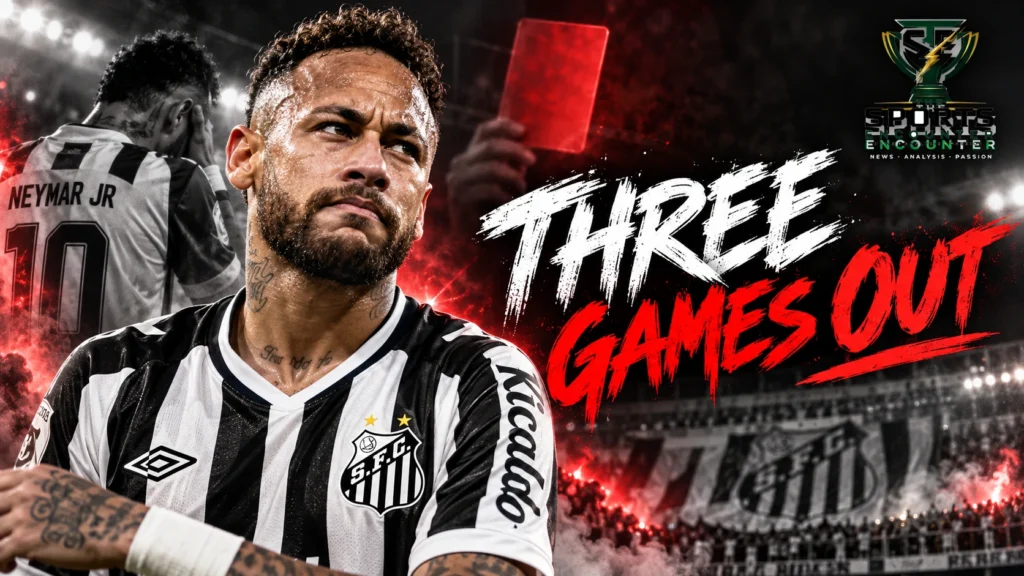
SANTOS, Brazil, October 28, 2026: Neymar has been handed a two-match suspension for covering his mouth during a confrontation with Bahia midfielder Rodrigo Nestor, a ruling that could keep the Santos captain out of three of his club’s final six Brazilian Serie A fixtures. The Superior Court of Sports Justice (STJD) imposed the punishment Wednesday after finding that the 34-year-old had violated Brazil’s so-called Vinícius Jr. protocol during Saturday’s 1-1 draw at Vila Belmiro. Combined with a separate suspension for accumulated yellow cards, the decision leaves Neymar facing a prolonged absence during Santos’ final push for continental qualification.
The ruling creates an unusual controversy because the tribunal punished Neymar’s conduct without establishing that he had made a racist remark. Neymar acknowledged covering his mouth but disputed the suggestion that he was attempting to conceal offensive language, while Nestor described their exchange as disrespectful. The disciplinary commission nevertheless determined that the gesture violated the required standard of conduct. Two members wanted a four-match suspension, but the majority settled on two. Santos can appeal, leaving both the practical consequences and the broader question of proportional punishment open for further examination.
Neymar Suspension: What the STJD Actually Decided
Brazil’s Second Disciplinary Commission handed down its decision on October 28, four days after the incident against Bahia and two days after prosecutors formally announced the disciplinary case.
The ruling was issued by a majority of the commission and concerned Neymar’s conduct during a confrontation with Nestor, rather than a proven finding that he had used racist language.
The STJD’s official October 28 disciplinary announcement confirms the two-match penalty, the circumstances recorded by the referee and the possibility of an appeal to the tribunal’s full panel.
| Key Question | Confirmed Position |
|---|---|
| Player | Neymar, Santos FC captain |
| Opponent involved | Rodrigo Nestor, Bahia midfielder |
| Original match | Santos 1-1 Bahia, October 24, 2026 |
| Venue | Vila Belmiro, Santos, Brazil |
| Competition | Brazilian Serie A, Round 32 |
| Incident | Neymar covered his mouth during a confrontation with Nestor |
| On-field punishment | Direct red card following VAR intervention |
| Disciplinary authority | STJD Second Disciplinary Commission |
| Decision date | October 28, 2026 |
| Tribunal punishment | Two-match suspension |
| Additional availability issue | Separate suspension for accumulation of yellow cards |
| Appeal | Permitted before the STJD’s full panel |
The practical result is that Neymar faces three consecutive league absences unless the disciplinary position changes. How the separate sanctions are applied is important because a two-match tribunal ruling does not necessarily mean he misses only two fixtures.
How a First-Half Argument Became a Halftime Red Card
The dispute began during Santos’ October 24 league meeting with Bahia.
Neymar and Rodrigo Nestor became involved in an exchange after a challenge near the touchline. Neymar received a yellow card during the first half after throwing the ball toward the Bahia midfielder following the incident.
That booking was consequential even before the more serious disciplinary episode. It was Neymar’s third yellow card in the relevant accumulation cycle, meaning he was already facing a suspension for Santos’ next league match.
The confrontation continued around halftime.
Before the second half began, Neymar covered his mouth with his hand while speaking to Nestor. Referee Sávio Pereira Sampaio did not initially identify the gesture himself, but the video assistant referee brought it to his attention.
After reviewing the footage, Sampaio produced a direct red card under the protocol commonly described in Brazil as the Vinícius Jr. rule.
The referee’s match report also recorded a separate development after the dismissal: Neymar moved toward the Bahia bench to confront Nestor and needed to be restrained by teammates.
That account is recorded in the STJD’s official October 26 announcement of the disciplinary charge.
From the Touchline Confrontation to the Tribunal
| When | Development | Immediate Consequence |
|---|---|---|
| Oct. 24, first half | Neymar and Nestor become involved in a confrontation; Neymar throws the ball toward his opponent. | Neymar receives his third yellow card of the accumulation cycle. |
| Oct. 24, halftime | Neymar covers his mouth while speaking to Nestor. | Video officials alert the referee to the gesture. |
| Oct. 24, before second-half restart | The referee reviews the incident and shows Neymar a direct red card. | Santos must continue without their captain. |
| Oct. 24, after dismissal | The referee reports that Neymar approaches Bahia’s bench and is restrained by teammates. | The behavior becomes part of the official disciplinary record. |
| Oct. 26 | STJD prosecutors announce a formal case concerning the Vinícius Jr. protocol. | Neymar is scheduled for a hearing. |
| Oct. 28 | The disciplinary commission rules by majority vote. | Neymar receives a two-match suspension, subject to appeal. |
The chronology establishes why the argument generated more consequences than the original yellow card. Neymar faced separate disciplinary issues arising from the same match, and the tribunal subsequently examined the conduct associated with his sending-off.
It is also important to recognize that the referee’s account of Neymar approaching the opposing bench is evidence of reported behavior after the red card. It does not, by itself, establish what was said during the preceding exchange.
What Is Brazil’s Vinícius Jr. Rule, and Why Does Covering the Mouth Matter?
The Vinícius Jr. protocol is part of Brazil’s broader effort to address situations in which players conceal their mouths while confronting opponents.
The measure is associated with concerns about discriminatory or abusive language that may be difficult to establish when the speaker deliberately prevents cameras and officials from observing lip movements.
Brazil’s football authorities have therefore introduced a disciplinary consequence for intentionally covering the mouth during a confrontation with an opposing player.
The Brazilian Football Confederation’s official explanation of the 2026 rule changes lists deliberate mouth-covering during an argument as conduct that can result in a red card.
The context matters. Footballers regularly cover their mouths during ordinary conversations, tactical discussions and private exchanges. The Brazilian measure is directed at intentional concealment during confrontations, rather than treating every covered conversation as misconduct.
It also belongs to a broader anti-discrimination effort, although it should not be confused with FIFA’s separate crossed-arms anti-racism gesture.
That distinction featured in The Sports Encounter’s analysis of Egypt coach Hossam Hassan’s X-sign controversy during the 2026 World Cup.
The crossed-arms gesture provides a recognizable way to report possible racist abuse. Brazil’s mouth-covering protocol addresses a specific action that could obstruct the ability of officials to investigate what was said.
Those measures serve related objectives but operate differently.
Does Covering the Mouth Prove That a Player Used Racist Language?
No.
A covered mouth prevents direct visual interpretation of speech. It does not establish the content of that speech.
That distinction is central to Neymar’s case.
His punishment followed the tribunal’s assessment of the gesture and the circumstances of the confrontation. No finding in the cited ruling establishes that Neymar used a racist slur against Nestor.
Equating a breach of the mouth-covering protocol with proven racist abuse would go beyond the documented decision.
For readers interested in the broader distinction between ordinary fouls, red-card offenses and disciplinary consequences, TSE’s guide to soccer fouls, misconduct and referee decisions explains how different types of offenses are assessed.
Why the Tribunal Chose Two Matches When Some Officials Wanted Four
The hearing exposed an important disagreement over the severity of Neymar’s conduct.
Prosecutors initially brought the case under Article 191, Section II, of Brazil’s Code of Sports Justice, which deals with failing to comply with requirements imposed by sporting authorities.
That provision carries a financial penalty, with the applicable fine ranging from R$100 to R$100,000.
The prosecution also requested consideration of Article 258, which addresses conduct contrary to sporting discipline or ethics and allows suspensions ranging from one to six matches.
During the hearing, Neymar’s lawyer Marcelo Mendes challenged the argument that the gesture justified the proposed disciplinary punishment.
The defense maintained that Neymar had covered his mouth instinctively during an exchange he regarded as playful rather than confrontational in the manner suggested by the prosecution.
The prosecutors argued that the case concerned the deliberate obstruction of speech visibility during an on-field confrontation, rather than the need to establish the precise words spoken.
That reasoning was central to the majority’s decision.
How the Legal Arguments Shaped Neymar’s Suspension
| Issue | Position or Rule | Significance |
|---|---|---|
| Article 191, II | Failure to comply with a sporting authority’s applicable requirements | The initial charge carried a potential financial penalty. |
| Article 258 | Conduct contrary to sporting discipline or ethics | Provided a possible one-to-six-match suspension framework. |
| Prosecution | Argued that concealing the mouth during confrontation undermined transparency. | Focused the case on observable conduct rather than proving the content of speech. |
| Defense | Disputed the seriousness and intention attributed to the gesture. | Sought acquittal or a lesser sanction. |
| Relator Delmiro Campos | Supported a two-match suspension. | Established the position that ultimately prevailed. |
| Two dissenting auditors | Favored four matches. | Demonstrated disagreement about the appropriate severity. |
| Majority decision | Two-match suspension. | Creates an enforceable first-instance sanction, subject to appeal. |
| Appeal route | Review by the STJD’s full panel | Allows the initial ruling to be challenged. |
The hearing therefore involved two separate questions: whether the conduct breached the applicable disciplinary standard and, if so, how severely it should be punished.
The majority accepted a two-match penalty. Two auditors believed the conduct justified four.
Those differences show that even officials who agree a disciplinary rule applies may disagree substantially over proportionality.
A comparable distinction between an on-field sending-off and additional disciplinary sanctions arose in Spain earlier this month. TSE’s report on Vinícius Júnior’s four-match La Liga suspension examined how separate actions during one match produced separate penalties.
That Spanish case was governed by different disciplinary regulations, so the two punishments should not be treated as interchangeable. The comparison is useful for understanding why the length and legal basis of a suspension require independent examination.
Neymar and Rodrigo Nestor: Two Accounts of the Same Confrontation
Neymar did not deny covering his mouth.
After the Bahia match, he acknowledged making that gesture but disputed the implication that he had said something offensive or attempted to conceal discriminatory language.
He characterized the exchange with Nestor as joking between players.
Nestor offered a more serious account.
In comments cited in the STJD’s original disciplinary announcement, the Bahia midfielder said Neymar had spoken disrespectfully toward him and the club he represented.
Nestor did not publicly provide a complete verbatim account of the disputed conversation in that statement.
The available accounts establish that the players disagreed about the nature of the exchange. The tribunal’s ruling establishes the sanction applied to Neymar’s conduct, not an independently proven transcript of the conversation.
Both perspectives deserve recognition.
Players should be able to challenge disciplinary decisions and explain their intentions. Football authorities also have a responsibility to enforce rules designed to make potentially abusive confrontations easier to assess.
The legitimate debate concerns whether the documented gesture, context and subsequent behavior justify two missed matches.
Vinícius Júnior recently raised another disciplinary fairness debate after receiving a four-match ban in Spain. TSE examined his criticism of refereeing consistency and the treatment of attacking players.
His case and Neymar’s involve different conduct and legal frameworks. Together, however, they illustrate the importance of explaining what a disciplinary authority has established, what a player disputes and which questions remain unresolved.
Which Santos Matches Will Neymar Miss?
The consequences are unusually serious because the ruling comes so late in the season.
Neymar was already unavailable for the October 28 meeting with Palmeiras because of his third yellow card against Bahia.
The direct red card and subsequent STJD ruling add to his disciplinary situation. Reporting following the hearing identifies Palmeiras, Red Bull Bragantino and Coritiba as the three matches he is expected to miss if the current sanctions remain in force.
That would leave his earliest projected return against Grêmio after the November international break.
| Date | Opponent | Round | Neymar’s Position Under Current Ruling |
|---|---|---|---|
| Oct. 28 | Palmeiras | 33 | Unavailable under existing disciplinary restrictions |
| Nov. 2 | Red Bull Bragantino | 34 | Expected to miss |
| Nov. 18 | Coritiba | 35 | Expected to miss if sanctions stand |
| Nov. 22 | Grêmio | 36 | Earliest projected return |
| Nov. 29 | Vitória | 37 | Potentially available |
| Dec. 2 | Botafogo | 38 | Potentially available |
Availability note: This is the reported fixture and suspension position following the October 28 ruling. The schedule and individual eligibility remain subject to official confirmation, possible appeals, postponements and other subsequent developments. Being eligible for a match does not guarantee selection or fitness.
These fixtures carry importance beyond Neymar’s individual situation.
Santos are pursuing a place in the 2027 Copa Libertadores, and consecutive matches without their captain could affect attacking selection, creative responsibilities and the distribution of set pieces.
There is no reliable basis for claiming Santos will lose particular matches because Neymar is unavailable. His absence changes the team’s options, while results will depend on collective execution and the opposition.
TSE Statistical Discovery: Neymar Could Miss Half of Santos’ Remaining League Run-In
The clearest measure of the suspension’s sporting significance comes from comparing the expected absences with Santos’ remaining league calendar.
After the Bahia match in Round 32, the regular 38-round Brazilian Serie A schedule leaves six rounds, numbered 33 through 38.
If Neymar misses three consecutive games and his earliest return is Round 36, he will have been unavailable for half of that remaining scheduled sequence.
| Measure | Figure | Calculation or Meaning |
|---|---|---|
| Scheduled remaining rounds after Bahia | 6 | Rounds 33 through 38 |
| Matches Neymar is expected to miss | 3 | Palmeiras, Bragantino, Coritiba |
| Share of remaining schedule affected | 50% | 3 divided by 6, multiplied by 100 |
| Potentially available remaining matches | 3 | Grêmio, Vitória, Botafogo |
| Share of remaining schedule potentially available | 50% | 3 divided by 6, multiplied by 100 |
| Potential disciplinary reduction through appeal | Unknown | Depends on any subsequent STJD decision |
TSE calculation: Three projected absences across six remaining scheduled league rounds equal 50% of the run-in. The calculation measures scheduled availability, not Neymar’s share of team goals, expected points lost or the probability of qualification.
It is a substantial concentration of missed fixtures at a time when Santos have limited opportunities to improve their league position.
The disciplinary case also introduces uncertainty into squad preparation. Coaches must plan around the existing ruling while remaining alert to the possibility that an appeal could change Neymar’s availability.
Why This Is Neymar’s Second Unusual Rules Controversy in Three Months
Neymar has already experienced another unexpected regulatory intervention during the 2026 Brazilian Serie A season.
In August, he became the first player in Brazil’s top division to be temporarily removed from the pitch under a goalkeeper-treatment rule being trialed to discourage tactical time-wasting.
During Santos’ 3-0 victory over Vasco da Gama, goalkeeper Gabriel Brazão required treatment.
Under the applicable trial, Santos had to nominate an outfield player who would temporarily leave the field after play resumed. When the team failed to do so within the required period, Neymar, as captain, became the automatic choice.
He left for one minute before returning.
There was no red card or disciplinary misconduct finding associated with that temporary removal.
The Sports Encounter documented the episode in our detailed explanation of Neymar’s one-minute goalkeeper-rule absence.
It followed broader proposals examined in TSE’s investigation into goalkeeper-treatment rules and the battle against tactical time-wasting.
The two Neymar incidents have different purposes and consequences.
The August measure sought to reduce the incentive for teams to benefit tactically from goalkeeper injury stoppages. The October protocol seeks to discourage concealment of speech during confrontations.
The first removed Neymar temporarily through a procedural mechanism involving his team. The second produced a direct dismissal and a subsequent disciplinary suspension tied to his own conduct.
Both episodes illustrate how changes to football’s regulatory framework can produce immediate and highly visible consequences.
What Does Neymar’s Ban Reveal About Football’s Disciplinary Consistency?
The appeal process will provide another test of whether the sanction can be explained and defended consistently.
A useful disciplinary decision should identify the conduct established by evidence, the rule applied, the reasons for its interpretation and the basis for selecting the length of punishment.
Those requirements matter when rules address sensitive conduct and when a sporting sanction could affect qualification or the closing stages of a season.
Football has faced other questions about how decisions made during matches relate to subsequent disciplinary proceedings.
In August, Major League Soccer fined Lionel Messi following a confrontation in an Inter Miami match, while a separate red card issued during the same incident was rescinded after review. TSE’s account of the Messi disciplinary case illustrated how different participants in one confrontation may face different outcomes after evidence is examined.
Likewise, the dispute over Folarin Balogun’s World Cup red-card suspension raised questions about the relationship between automatic match bans and discretionary disciplinary powers. Our analysis of FIFA’s reported Balogun rule revision explored those questions in detail.
Neither case determines whether Neymar should receive two matches. They demonstrate why the reasoning behind disciplinary outcomes matters to players, opponents and supporters.
For Neymar, the unresolved issue concerns how much weight the tribunal should give to the observable mouth-covering gesture compared with the disputed context and intention.
For Santos, the urgent issue is availability.
Neymar’s Appeal: What Happens Next?
The STJD ruling was issued at first instance, leaving a formal avenue for Neymar and Santos to challenge the decision before the tribunal’s full panel.
An appeal could focus on the interpretation of the disciplinary provisions, the circumstances of the confrontation or the proportionality of the two-match punishment.
However, filing an appeal should not be confused with automatically canceling the suspension.
The existing punishment remains the operative disciplinary position unless the relevant authority changes it or grants an applicable suspension of enforcement.
At the time of the October 28 announcement, no successful appeal or revised punishment had been confirmed.
For Santos, the practical approach is to plan for Neymar’s absence while monitoring the legal process.
For supporters, the important next developments are straightforward: whether an appeal is formally pursued, whether an interim measure changes eligibility and whether the full panel maintains, reduces or overturns the ruling.
How the Ban Fits Into Neymar’s Final Chapter at Santos
Neymar’s return to Santos has been shaped by attempts to rebuild playing continuity after years of injuries and interruptions.
His 2026 campaign also followed a final World Cup appearance for Brazil, where his role had diminished compared with the expectations surrounding his earlier international career.
TSE’s retrospective of Neymar’s four World Cup campaigns examined the remarkable balance of individual creativity, major injuries, pressure and public criticism that shaped those years.
The current controversy adds a different complication.
Instead of availability being determined principally by physical condition or team selection, the immediate limitation comes through the disciplinary system.
That has sporting consequences for a player who continues to attract considerable attention whenever he appears in a Santos shirt.
Neymar’s playing style has also featured in debates about how football should interpret skill and gamesmanship. Earlier in the year, TSE examined the legality and fairness of stutter-step penalties, including the distinction between permitted deception and prohibited actions.
Those debates have different legal foundations. The common editorial requirement is to distinguish a disputed interpretation of the rules from conduct that officials have actually established.
In this case, the tribunal has imposed a two-match suspension. Neymar’s denial of offensive intent remains part of the record, and the appeal process may determine whether the initial sanction survives.
Neymar Suspension: Frequently Asked Questions
Why was Neymar suspended for two matches?
Brazil’s STJD suspended Neymar for covering his mouth during a confrontation with Bahia midfielder Rodrigo Nestor, conduct the disciplinary commission found to be contrary to the applicable Vinícius Jr. protocol and sporting disciplinary standards.
Did Neymar receive a red card against Bahia?
Yes. Neymar was shown a direct red card before the second half of Santos’ October 24, 2026, match against Bahia after VAR drew the referee’s attention to the mouth-covering gesture.
Was Neymar found guilty of racist abuse?
The reported STJD ruling does not establish that Neymar used racist language. The disciplinary decision concerned the gesture of covering his mouth during the confrontation and the applicable conduct rules.
Who was Neymar arguing with?
Neymar was involved in a confrontation with Rodrigo Nestor, a midfielder for Bahia. The two subsequently gave differing accounts of the nature of their exchange.
How many Santos games will Neymar miss?
Under the October 28 disciplinary position, Neymar is expected to miss three consecutive matches against Palmeiras, Red Bull Bragantino and Coritiba, combining his tribunal suspension with a separate yellow-card accumulation suspension.
When can Neymar return for Santos?
His earliest projected return is against Grêmio on November 22, 2026, provided the schedule and disciplinary position remain unchanged and he is otherwise available for selection.
Can Neymar appeal the two-match suspension?
Yes. The ruling was made at first instance by the STJD’s Second Disciplinary Commission and can be challenged before the tribunal’s full panel.
What is the Vinícius Jr. rule in Brazil?
The protocol allows disciplinary action, including dismissal, when a player intentionally covers the mouth during a confrontation with an opponent, potentially preventing officials from observing what was said.
Why did some tribunal members want Neymar suspended for four matches?
Two members of the disciplinary commission considered the conduct serious enough to justify four matches. The majority instead supported the relator’s proposed two-match punishment.
Could Neymar’s suspension affect Santos’ Copa Libertadores qualification hopes?
It could affect Santos’ attacking options during the final rounds, but the eventual qualification outcome depends on results across the league. No specific points loss or qualification probability can be attributed to Neymar’s absence without further evidence.
The Bigger Question Is Whether the Punishment Will Survive Appeal
Neymar’s two-match suspension has consequences extending well beyond Saturday’s confrontation with Bahia.
Santos face a potentially important stretch without their captain, while Brazil’s disciplinary authorities must be prepared to defend a ruling that divided the commission over the appropriate punishment.
The evidence establishes the mouth-covering gesture, the direct red card, the referee’s account of the subsequent confrontation and the tribunal’s decision.
It does not establish the exact content of every word exchanged between Neymar and Rodrigo Nestor or prove a racist remark.
That distinction should remain central to how the case is discussed.
The next stage belongs to the disciplinary process. If Santos appeal, the full tribunal will have an opportunity to assess the decision and its legal reasoning.
Meanwhile, Neymar faces the prospect of missing three of Santos’ remaining six league rounds.
For a club pursuing continental qualification, that is a substantial sporting consequence from an incident that began as an argument near the touchline.
Whether two matches is the appropriate punishment remains open to debate. What is certain is that Santos must manage the immediate consequences while Neymar considers his remaining legal options.