


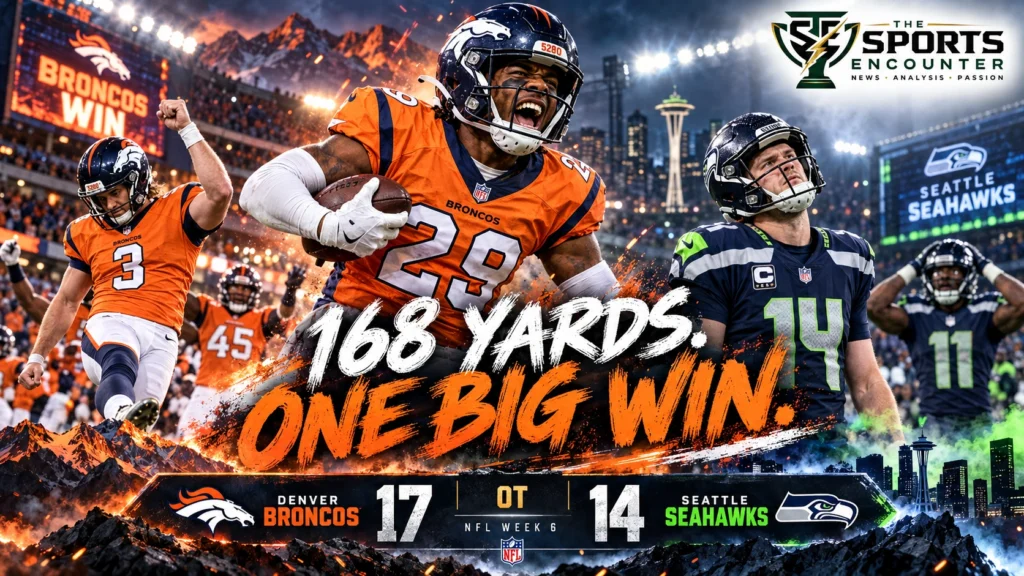
DENVER, United States, October 15, 2026: The Denver Broncos gained just 168 offensive yards, failed to score throughout the second half and surrendered an 11-point lead, yet somehow defeated the defending Super Bowl champion Seattle Seahawks 17-14 in overtime on Thursday night. Ja’Quan McMillian intercepted Sam Darnold in the extra period before Wil Lutz converted a 53-yard field goal, completing a remarkable defensive rescue at Empower Field at Mile High and lifting Denver to 4-2.
Denver’s defense delivered five sacks, 17 quarterback hits and three turnovers despite missing star cornerback Pat Surtain II and safety Talanoa Hufanga. Seattle outgained the hosts 353-168 and produced a frantic fourth-quarter comeback, but Darnold’s two interceptions proved devastating. The Seahawks fell to 3-3, suffering their second defeat in five days, while Denver secured its fourth victory in a game decided by one possession this season. The result revealed both the strength of Sean Payton’s defense and the increasingly uncomfortable limitations of his offense.
Broncos 17-14 Seahawks: NFL Week 6 Match Summary
| Match Detail | Information |
|---|---|
| Competition | 2026 NFL Regular Season, Week 6 |
| Game | Seattle Seahawks at Denver Broncos |
| Date | Thursday, October 15, 2026 |
| Venue | Empower Field at Mile High, Denver |
| Final Score | Denver Broncos 17-14 Seattle Seahawks (OT) |
| Winning Play | Wil Lutz 53-yard overtime field goal |
| Decisive Turnover | Ja’Quan McMillian interception in overtime |
| Denver Record | 4-2 |
| Seattle Record | 3-3 |
Quarter-by-Quarter Score
| Team | Q1 | Q2 | Q3 | Q4 | OT | Total |
|---|---|---|---|---|---|---|
| Seattle Seahawks | 3 | 0 | 0 | 11 | 0 | 14 |
| Denver Broncos | 0 | 14 | 0 | 0 | 3 | 17 |
The result completed the matchup previewed in The Sports Encounter’s October 15 NFL injury report, which identified Denver’s depleted secondary and Seattle’s absence of starting linebacker Drake Thomas as important pregame concerns.
How Did Denver Win With Just 168 Total Offensive Yards?
The most extraordinary part of Denver’s victory is how little offense the Broncos needed to produce.
Bo Nix completed 17 of 27 passes for 107 yards, without a touchdown or interception.
Denver rushed for 74 yards, but sacks reduced its net passing total, leaving the team with only 168 yards of total offense.
Seattle accumulated 353 yards and 24 first downs.
The Broncos managed only 13 first downs, leaving them with an 11-first-down disadvantage.
Broncos vs Seahawks: Team Statistics
| Statistic | Denver | Seattle |
|---|---|---|
| Total Offensive Yards | 168 | 353 |
| First Downs | 13 | 24 |
| Gross Quarterback Passing Yards | 107 | 278 |
| Quarterback Interceptions Thrown | 0 | 2 |
| Turnovers Committed | 0 | 3 |
| Defensive Sacks | 5 | 2 |
| Points | 17 | 14 |
Seattle gained 185 more offensive yards than Denver, more than doubling the Broncos’ production.
Denver also produced no offensive points after halftime.
According to the NFL’s official analysis of the Broncos’ unusually low offensive output, it was the first time since John Elway’s first start in 1983 that Denver won a game while producing fewer than 175 total yards.
That historical comparison underlines how unusual the victory was.
The Broncos generated their touchdowns during two productive second-quarter possessions, then relied almost entirely on defense and special teams.
The defense repeatedly prevented Seattle’s larger yardage total from becoming points.
Denver’s earlier offensive problems were already evident during its opening defeat against Kansas City, when Bo Nix struggled and the Broncos produced only 176 total yards. TSE examined that performance in its analysis of the Chiefs’ 31-10 victory over Denver.
Thursday provided another warning about offensive production, although this time the Broncos survived.
McMillian’s Interception Turned Seattle’s Overtime Opportunity Into Denver’s Victory
Seattle entered overtime with momentum after scoring 11 unanswered points during the closing minutes of regulation.
The Seahawks had forced extra time and were attempting to complete a comeback that appeared improbable for most of the evening.
But Denver’s defense produced one final decisive intervention.
Ja’Quan McMillian read Sam Darnold’s pass, stepped into the throwing lane and intercepted the ball at Seattle’s 43-yard line.
The turnover immediately changed the field-position equation.
Denver’s offense no longer needed to construct a long scoring drive. It needed only enough yardage to create a realistic field-goal opportunity.
Four plays after the interception, Wil Lutz attempted a 53-yard field goal.
He converted it with 4:53 remaining in overtime.
The kick secured Denver’s 17-14 victory and punished Seattle for another turnover in a high-leverage situation.
McMillian’s interception was especially significant because Denver had already lost two of its most important defensive backs before kickoff.
The Defense Created the Winning Opportunity
McMillian did not need to return the interception for a touchdown to make it the game’s most valuable defensive play.
By intercepting Darnold in Seattle territory, he dramatically reduced the amount of offense Denver needed from a unit that had struggled throughout the second half.
That is the central tactical explanation for the final result.
When an offense cannot consistently gain territory through normal possessions, a defensive takeaway near midfield becomes disproportionately important.
Denver’s defense effectively supplied the field position that the offense had been unable to generate.
Five Sacks and 17 Quarterback Hits: Denver’s Defense Played Without Two Stars
Denver’s defensive performance becomes more impressive when its personnel situation is considered.
Cornerback Pat Surtain II and safety Talanoa Hufanga were both unavailable because of ankle injuries.
The absence of Surtain removed a premium coverage defender from a matchup against one of the NFL’s most productive receivers.
Hufanga’s absence created another problem involving safety positioning, communication and defensive flexibility.
The pregame expectation was that Denver might have to compromise between pressuring Darnold and providing additional help for its replacement defensive backs.
Instead, the Broncos repeatedly reached Seattle’s quarterback.
They recorded five sacks and 17 quarterback hits, while forcing three turnovers.
The Broncos’ official postgame analysis confirms that seven different defenders contributed at least half a sack.
Malcolm Roach led the team with four quarterback hits.
Nik Bonitto, Ja’Quan McMillian, Zach Allen, Justin Strnad, Jonah Elliss and Que Robinson were among the players involved in the pass-rush production.
Nik Bonitto’s Forced Fumble Stopped a Promising Seattle Drive
One of Denver’s most important defensive moments occurred during the second quarter.
Seattle had advanced into Broncos territory and appeared capable of narrowing the deficit before halftime.
After Rashid Shaheed caught a pass, Bonitto knocked the ball loose.
Strnad recovered the fumble, ending a possession that could have produced points for the visitors.
That sequence was significant because Seattle’s offense was capable of moving the ball but repeatedly failed to complete productive drives.
Denver’s ability to create turnovers prevented those gains from changing the scoreboard.
Riley Moss Returned as Denver Adjusted Its Secondary
Denver received an important availability boost from cornerback Riley Moss, who was active after missing the previous game with a rib injury.
His return helped restore some defensive depth while Surtain and Hufanga remained sidelined.
The victory does not establish that Denver can operate indefinitely without both stars.
However, it provides strong evidence that the team’s pass rush and replacement defensive backs can function effectively together under difficult circumstances.
That ability to adjust was a central theme in TSE’s earlier Week 4 analysis of Denver’s defensive difficulties against San Francisco and Seattle’s win over the Chargers.
Thursday offered a more encouraging defensive answer for the Broncos.
Seattle’s 11-Point Comeback: How Did the Seahawks Force Overtime?
Seattle initially led 3-0 after Jason Myers converted a 55-yard field goal in the opening quarter.
Denver responded with two second-quarter rushing touchdowns.
J.K. Dobbins scored from four yards to put the Broncos ahead 7-3.
RJ Harvey later added a one-yard touchdown run, extending the lead to 14-3.
Neither team scored in the third quarter.
With Denver’s offense repeatedly failing to sustain drives, Seattle eventually found a route back into the contest.
George Holani’s Touchdown Sparked the Late Fightback
With 5:41 remaining in regulation, George Holani scored on a one-yard run.
Seattle then converted a two-point attempt when Darnold’s tipped pass reached Rashid Shaheed, who completed the catch in the end zone.
The successful conversion reduced Denver’s advantage to 14-11.
Seattle still needed a field goal to tie the game.
Its defense continued to hold Denver’s offense in check, creating another opportunity for Darnold.
Jason Myers eventually converted a 34-yard field goal with three seconds remaining in regulation.
The score was tied 14-14.
Seattle had erased the entire 11-point deficit in the final six minutes, but the comeback had consumed nearly every available opportunity to recover from another mistake.
Sam Darnold’s Two Interceptions Undid 278 Passing Yards
Darnold completed 27 of 51 passes for 278 yards, without a passing touchdown.
The 51 attempts represented a career high.
He was also sacked five times and intercepted twice.
The first interception came late in regulation, when Seattle had a chance to create a potential winning scoring opportunity.
Kris Abrams-Draine made that interception for Denver.
Seattle eventually recovered enough to force overtime, but Darnold’s second interception against McMillian proved decisive.
The quarterback finished with a 52.6 passer rating.
Through six games, Darnold now has seven interceptions, a worrying figure for a defending champion whose successful 2025 campaign depended heavily on controlling avoidable mistakes.
Seattle’s offensive development was one of the central questions in TSE’s season-opening analysis of the Seahawks’ revised offense.
Thursday supplied further evidence that quarterback decision-making and protection remain major concerns.
Jaxon Smith-Njigba Shines Despite Seattle’s Offensive Collapse
Jaxon Smith-Njigba was among the most productive individual players on the field.
He caught 12 passes for 134 yards despite entering the week with an ankle issue.
His performance demonstrated why Seattle’s passing game continues to rely heavily on his route-running, separation and ability to create receiving opportunities.
The 134 receiving yards accounted for approximately 48% of Darnold’s 278 passing yards.
That comparison illustrates how much of Seattle’s aerial production came through one receiver.
Smith-Njigba’s availability mattered, particularly against a Denver secondary missing important starters.
But his success was not enough to overcome the negative effects of sacks, turnovers and stalled possessions.
Earlier in the season, Smith-Njigba produced three touchdown receptions in Seattle’s 31-7 victory over Arizona, a performance covered in The Sports Encounter’s Week 2 NFL analysis.
The contrast is revealing.
Against Arizona, his explosive receiving production translated directly into touchdowns and a comfortable victory.
Against Denver, he accumulated more than 100 yards but could not prevent an overtime defeat.
The receiver’s production remains impressive. Seattle must find ways to turn that production into more reliable team scoring.
Elijah Arroyo’s Shoulder Injury Adds to Seattle’s Personnel Concerns
Seattle also suffered a notable in-game injury.
Tight end Elijah Arroyo injured his shoulder during the second quarter.
The Seahawks subsequently classified him as doubtful to return, according to the team’s official in-game injury update.
The available official update does not establish a confirmed diagnosis or recovery period.
However, losing a tight end during a game can affect the personnel combinations available for both the rushing attack and passing game.
It can also change protection assignments and reduce the number of formations an offense can use comfortably.
Those are potential tactical implications rather than independently established explanations for Seattle’s offensive struggles.
Drake Thomas Was Already Missing, While Riley Moss Returned
Seattle had entered the game without starting linebacker Drake Thomas, who was ruled out with an ankle injury.
Tyrice Knight was expected to take on additional defensive responsibilities in his absence.
Despite that personnel challenge, Seattle’s defense held Denver to only two first downs after halftime and prevented the Broncos from scoring an offensive point during the final two quarters.
Denver, meanwhile, had the benefit of Moss returning while Surtain and Hufanga remained unavailable.
For the upcoming games, the important observable developments will be Arroyo’s medical status, Thomas’ availability and whether Denver can restore its regular starting secondary.
No additional notable in-game injury count is asserted because the available official injury reporting does not establish a complete count with sufficient confidence.
Seattle’s Defense Dominated the Second Half, but the Seahawks Still Lost
Seattle’s defensive effort deserves substantial recognition.
After allowing Denver’s two rushing touchdowns in the second quarter, the Seahawks prevented the hosts from developing any sustained attacking rhythm.
Denver punted on all six meaningful second-half offensive possessions.
The Broncos gained only 30 net yards after halftime and before overtime, according to Seattle’s official postgame defensive analysis.
That dominance gave Seattle the opportunity to erase the 14-3 deficit.
But the visitors’ own offense failed to convert enough opportunities into points.
Seattle’s previous victories had shown how well its defense could protect a lead or finish a difficult game.
Its 13-10 season-opening comeback against New England required a different kind of late defensive discipline, as explained in TSE’s report on Drew Lock’s comeback against the Patriots.
Against Denver, the Seahawks defense gave the offense repeated opportunities to finish the job.
Darnold’s turnovers ultimately prevented Seattle from taking advantage.
What Does Denver’s Win Mean for the AFC West?
The Broncos improved to 4-2, strengthening their position in an AFC West race shaped by Kansas City’s unbeaten start.
Denver has now won four one-possession games this season.
That record demonstrates an ability to execute important late-game sequences, but it does not eliminate the underlying concern about offensive production.
Bo Nix has now thrown for only 230 yards across Denver’s past two games combined, following his 123-yard performance against the Chargers.
The Broncos won both games.
That combination raises a legitimate question about how often their defense can compensate for such limited quarterback production.
The wider coaching problem was examined in TSE’s October 14 analysis of NFL coaches facing mounting pressure, which included Denver’s narrow victory over Los Angeles.
Sean Payton has managed to turn close contests into victories, but his offense still needs to create more reliable opportunities.
Denver’s defensive strength provides a foundation for continued success. The offense must eventually contribute more consistently if the Broncos are to challenge the league’s strongest teams over a full season.
Seattle Fall to 3-3: Has the Defending Champion’s Margin for Error Shrunk?
The Seahawks have lost two consecutive games and are now 3-3.
The defeat is particularly costly because San Francisco entered the week undefeated and had already beaten Seattle 32-29 in Week 5.
Seattle’s championship pedigree remains intact, but its recent performances have exposed repeated difficulties involving turnovers, offensive efficiency and protection.
The Sports Encounter ranked Seattle among the NFL’s leading contenders entering Week 5, based on its defensive quality and early-season achievements, in our independent Week 5 power rankings.
Thursday’s loss provides new evidence that those strengths are being undermined by problems elsewhere in the team.
The defense held Denver below 200 total yards and gave Seattle a realistic chance to win.
The passing game produced 278 yards and a standout receiving performance from Smith-Njigba.
Yet the Seahawks scored only 14 points because sacks, turnovers and missed opportunities repeatedly interrupted productive sequences.
Their next opponent makes those concerns particularly important.
What Happens Next for Denver and Seattle?
Seattle’s next scheduled game is against the Kansas City Chiefs on Sunday, October 25, at Lumen Field.
The matchup gives the Seahawks additional time to review the Broncos defeat and assess Arroyo’s injury before facing an undefeated Kansas City team led by Patrick Mahomes.
The Chiefs also feature Kenneth Walker III, whose departure from Seattle during the offseason changed the Seahawks’ running-back picture.
Walker has made a strong start in Kansas City, including a spectacular performance against Denver in Week 1.
For the Seahawks, the immediate questions concern Darnold’s ball security, pass protection, running-game balance and the availability of injured players.
Denver enters its next preparation period with two consecutive victories, but its offense requires attention.
Payton must evaluate how to create more explosive passing opportunities for Nix without increasing the turnover risk that Denver’s defense has worked so hard to avoid.
The Broncos will also continue monitoring Surtain and Hufanga, whose return would restore important flexibility to the secondary.
Broncos vs Seahawks 2026: Frequently Asked Questions
Who won Broncos vs Seahawks on October 15, 2026?
The Denver Broncos defeated the Seattle Seahawks 17-14 in overtime at Empower Field at Mile High during NFL Week 6.
Who kicked the winning field goal for Denver?
Wil Lutz converted a 53-yard field goal in overtime after Ja’Quan McMillian intercepted Sam Darnold.
How many offensive yards did the Broncos gain?
Denver gained just 168 total offensive yards, despite winning the game.
How many sacks did Denver record against Sam Darnold?
The Broncos sacked Darnold five times and recorded 17 quarterback hits.
How did Sam Darnold perform?
Darnold completed 27 of 51 passes for 278 yards, no touchdowns and two interceptions. He finished with a 52.6 passer rating.
How many receiving yards did Jaxon Smith-Njigba have?
Smith-Njigba caught 12 passes for 134 receiving yards.
Which Broncos defenders missed the game?
Cornerback Pat Surtain II and safety Talanoa Hufanga were inactive because of ankle injuries.
Who was injured during Seahawks vs Broncos?
Seattle tight end Elijah Arroyo suffered a shoulder injury during the second quarter and was listed as doubtful to return.
How did Seattle force overtime?
George Holani scored a one-yard rushing touchdown, Rashid Shaheed caught the two-point conversion and Jason Myers kicked a 34-yard field goal with three seconds remaining in regulation.
What are the Broncos and Seahawks records after Week 6?
Denver improved to 4-2, while Seattle fell to 3-3.
A Defense Good Enough to Win, an Offense That Still Needs Answers
Denver’s victory will be remembered for McMillian’s interception and Lutz’s overtime field goal.
But the larger story is what those plays rescued.
The Broncos gained just 168 yards, failed to score an offensive point after halftime and surrendered a lead that had appeared secure entering the fourth quarter.
Their defense nevertheless created three turnovers, repeatedly pressured Darnold and produced the final opportunity that decided the contest.
Seattle can point to an excellent defensive performance of its own, along with Smith-Njigba’s 134 receiving yards and a late comeback that nearly completed an extraordinary escape.
Those accomplishments could not overcome another damaging interception.
Denver’s record now reads 4-2, an encouraging position after six difficult games. Seattle’s 3-3 record leaves the defending champion confronting increasingly serious questions about its offensive execution.
For the Broncos, the victory reinforces one of football’s oldest principles: a defense capable of controlling decisive moments can compensate for an extraordinary amount of offensive inefficiency.
Whether Denver can keep asking its defense to do quite this much remains the most important question.