


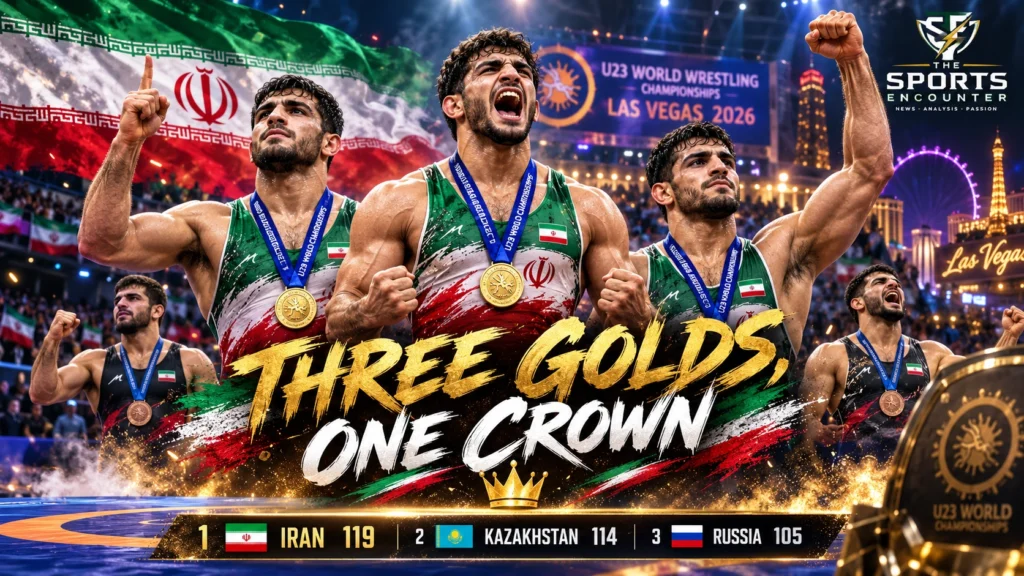
LAS VEGAS, United States, October 15, 2026: Iran overturned a nine-point deficit against Kazakhstan to capture the 2026 U23 World Greco-Roman Wrestling Championship, finishing with 119 team points, three gold medals and two bronzes after a dramatic conclusion to the competition at the Thomas & Mack Center in Las Vegas. Erfan Jarkani and Yasin Yazdi delivered two decisive gold medals on October 14, completing a comeback that left Kazakhstan second with 114 points and Russia third with 105. Abolfazl Mohmedi had earlier won Iran’s first gold, while bronze medalists Mohammad Kamali and Mohammad Hadi Seydi provided crucial contributions to the eventual team victory.
The championship was far closer than Iran’s three gold medals might suggest. Kazakhstan led 64-55 after the first five weight classes, supported by championship victories at 60kg and 72kg. Iran entered the remaining five categories needing to overcome both the points deficit and Kazakhstan’s continued medal challenge. Jarkani defeated Japan’s Manato Nakamura 2-1 in the 63kg final, while Yazdi beat Kazakhstan’s Temirlan Turdakyn 4-0 at 87kg. The latter victory was especially significant because it gave Iran another title while denying a direct rival gold. When the final standings were confirmed, Iran had turned a nine-point disadvantage into a five-point championship victory.
Iran’s U23 Greco-Roman World Championship: Results at a Glance
| Championship Detail | Confirmed Result |
|---|---|
| Competition | 2026 U23 World Wrestling Championships |
| Discipline | Men’s Greco-Roman wrestling |
| Venue | Thomas & Mack Center, Las Vegas, Nevada |
| Greco-Roman competition dates | October 12-14, 2026 |
| World champions | Iran |
| Iran’s team points | 119 |
| Gold medals | 3 |
| Silver medals | 0 |
| Bronze medals | 2 |
| Runner-up | Kazakhstan, 114 points |
| Third place | Russia, 105 points |
| Championship margin | 5 points |
United World Wrestling confirmed Iran’s victory following the completion of all 10 Greco-Roman weight classes. The governing body’s official final-day championship report documents the Iranian gold-medal victories and the concluding team standings.
From Nine Points Behind to Five Points Ahead: How Iran Won the Team Championship
Iran’s victory becomes more impressive when the competition is divided into its two groups of five weight classes.
The opening group covered 60kg, 67kg, 72kg, 82kg and 97kg.
Kazakhstan emerged from those categories with 64 team points.
Iran had 55.
The deficit was particularly significant because the Kazakh team had already secured two gold medals.
Aibek Aitbekov won the 60kg championship, while Yussuf Ashrapov took gold at 72kg.
Both victories strengthened Kazakhstan’s position at the halfway stage.
Iran remained in contention because Mohmedi had won the 82kg title, with Kamali and Seydi adding bronze medals.
Those results prevented Kazakhstan from establishing a larger advantage.
The Team Championship Changed During the Final Five Weight Classes
| Stage | Iran | Kazakhstan | Difference |
|---|---|---|---|
| After first five weight classes | 55 | 64 | Kazakhstan +9 |
| Final team standings | 119 | 114 | Iran +5 |
| Points earned from remaining categories | 64 | 50 | Iran +14 |
Iran therefore gained 14 points on Kazakhstan across the remaining five categories, enough to erase the original deficit and establish the final five-point margin.
The calculation reveals why the competition cannot be explained simply by counting medals.
Both countries won multiple gold medals.
However, results throughout the weight classes also contributed to the national team totals.
Iran accumulated enough points from its remaining competitors to complement the two final-day gold medals.
That broader scoring contribution helped determine the title.
Erfan Jarkani Wins 63kg Gold After Surviving Japan’s Late Challenge
Erfan Jarkani delivered one of Iran’s most important individual performances by defeating Japan’s Manato Nakamura 2-1 in the 63kg final.
The match remained competitive throughout.
Jarkani, an Asian Championships silver medalist, entered the final with an opportunity to secure the first of Iran’s two remaining gold medals.
He established a narrow advantage and had to protect it against Nakamura’s late challenge.
The Japanese wrestler sought a favorable decision as the contest approached its conclusion.
However, the officials did not find a violation that would overturn the result.
Jarkani retained his advantage and became U23 world champion.
Why the 2-1 Victory Mattered Beyond the Gold Medal
Jarkani’s victory provided Iran with an immediate response to Kazakhstan’s opening-day lead.
It also added an individual world title against an opponent representing another major Asian wrestling program.
The narrow margin demonstrated the importance of controlling the decisive scoring exchanges in Greco-Roman wrestling.
One additional scoring action or an adverse refereeing decision could have changed the outcome.
Instead, Jarkani protected the advantage that gave Iran another gold medal.
His performance also continued a productive year following his Asian Championships silver.
The transition from continental runner-up to U23 world champion represents a significant achievement in his developing international career.
Yasin Yazdi Beats Kazakhstan’s Turdakyn 4-0 in the Championship’s Defining Final
Yasin Yazdi’s 87kg victory carried particular significance because he faced a wrestler from Iran’s closest rival in the team standings.
Kazakhstan’s Temirlan Turdakyn had reached the final with an opportunity to add another gold medal to his country’s already impressive championship campaign.
Yazdi prevented that outcome.
The Iranian won 4-0, controlling the final and finishing without conceding a point.
It was his first world-level gold medal.
How Yazdi Controlled the 87kg Final
Yazdi received a par terre opportunity during the opening period but did not convert it into additional points.
That meant he still needed to maintain his discipline and create another scoring opportunity.
He eventually established a decisive advantage and completed the contest with four points.
Iran is U23 World Champion in Greco-Roman Wrestling! 🥇 With 3 gold and 2 bronze medals, Iran triumphs in Las Vegas ahead of Kazakhstan and Russia. 📷 https://t.co/eRPwPCx80b
— Iran Embassy in Australia (@IraninAustralia) October 15, 2026
Turdakyn was unable to produce a scoring response.
The 4-0 result secured Iran’s third gold medal of the competition.
It also directly affected the balance between the two leading national teams.
A Kazakh victory would have strengthened Kazakhstan’s championship position.
Yazdi’s success instead delivered the individual title to Iran and prevented its closest rival from claiming the 87kg crown.
Yazdi’s Route to the Final Demonstrated His Form
The Iranian entered the gold-medal contest after several convincing victories.
He defeated an opponent from Serbia 11-0 before overcoming Azerbaijan’s representative 6-2.
In the semifinal, he beat Norway’s Martin Ljosaak 3-1.
The sequence demonstrated his ability to win through both overwhelming scoring superiority and closer tactical contests.
His final against Turdakyn provided another example of the latter quality.
Yazdi did not need a high-scoring performance.
He needed a controlled victory against a rival whose result would influence the national standings.
He delivered exactly that.
Abolfazl Mohmedi Laid the Foundation With Iran’s First Gold at 82kg
Before Jarkani and Yazdi completed the championship turnaround, Abolfazl Mohmedi had kept Iran’s title challenge alive.
He defeated Armenia’s Martik Petrosyan 2-1 in the 82kg final on October 13.
The victory gave Iran its first gold medal of the tournament.
Mohmedi’s route to the championship demonstrated the consistency required to navigate a world-level knockout competition.
| Stage | Opponent | Result |
|---|---|---|
| Early round | Tornike Mikeladze, Georgia | Won 4-1 |
| Quarterfinal | Mihael Lukac, Croatia | Won 9-0 |
| Semifinal | Ramazan Arapkhanov, Russia | Won 5-0 |
| Final | Martik Petrosyan, Armenia | Won 2-1 |
The semifinal victory was particularly important because it removed a Russian challenger from the gold-medal contest.
Russia eventually finished third in the team standings, and every eliminated contender affected the championship picture.
Against Petrosyan, Mohmedi faced a narrower contest.
He nevertheless protected his lead and secured the gold.
The result ensured Iran remained close enough to Kazakhstan to challenge for the team title during the remaining weight classes.
Mohammad Kamali’s 67kg Bronze: A Recovery After Semifinal Defeat
Mohammad Kamali contributed one of Iran’s two bronze medals at 67kg.
His semifinal defeat against Russia’s Erzu Zakriev was a difficult setback.
Zakriev won 13-2, using powerful throws and superior scoring to reach the final.
However, Kamali recovered in the bronze-medal contest.
He defeated Armenia’s Yurik Hoveyan 6-0.
The result was important for the national team because it converted a semifinal disappointment into a podium finish and valuable classification points.
Why Bronze Medals Can Determine a Team Championship
Iran ultimately won the team title by only five points.
That small margin demonstrates why results outside the gold-medal finals matter.
Had Iran’s wrestlers failed to convert their bronze opportunities, their final team total would have been lower.
The precise change would depend on the applicable team classification rules and finishing positions.
However, Kamali’s victory clearly contributed to the total that allowed Iran to stay within reach of Kazakhstan.
His recovery also reflects a valuable competitive characteristic.
Not every athlete can win gold after reaching a world championship semifinal.
Remaining focused after elimination from the title contest can still produce an important medal for the individual and the national team.
Mohammad Hadi Seydi Wins 97kg Bronze Against Kazakhstan
Iran’s second bronze medal came through Mohammad Hadi Seydi in the 97kg category.
Seydi defeated Kazakhstan’s Nurassyl Amanaly 8-0 by technical superiority.
That result was particularly useful because it came against an athlete from Iran’s direct rival in the team standings.
The victory strengthened Iran’s medal count while denying Kazakhstan the same bronze medal.
Seydi had previously lost 4-1 against Ukraine’s Yehor Yakushenko in the semifinal.
Like Kamali, he responded with an emphatic result in the bronze-medal contest.
His victory provided another contribution during a competition in which Iran could not afford to surrender unnecessary points.
The United World Wrestling report on the opening Greco-Roman finals documents Mohmedi’s title, Kamali’s bronze and Seydi’s victory.
All Five Iranian Medalists at the 2026 U23 Greco-Roman World Championships
| Athlete | Weight | Medal | Medal Match |
|---|---|---|---|
| Erfan Jarkani | 63kg | Gold | Beat Manato Nakamura, Japan, 2-1 |
| Abolfazl Mohmedi | 82kg | Gold | Beat Martik Petrosyan, Armenia, 2-1 |
| Yasin Yazdi | 87kg | Gold | Beat Temirlan Turdakyn, Kazakhstan, 4-0 |
| Mohammad Kamali | 67kg | Bronze | Beat Yurik Hoveyan, Armenia, 6-0 |
| Mohammad Hadi Seydi | 97kg | Bronze | Beat Nurassyl Amanaly, Kazakhstan, 8-0 |
The five medals were spread across different weight categories.
That distribution is significant because a national team cannot depend on success in only one division to establish a competitive position across an entire Greco-Roman championship.
Iran’s gold medalists competed at 63kg, 82kg and 87kg.
The bronze medalists contributed at 67kg and 97kg.
The results demonstrate competitive strength across several divisions, including middleweight and heavier categories.
Kazakhstan’s Two Gold Medals Made Iran’s Victory Far From Certain
Kazakhstan deserves substantial credit for pushing Iran to the final stages of the championship.
The Central Asian country won gold medals at 60kg and 72kg.
Aibek Aitbekov claimed the 60kg title with a 13-4 victory against Azerbaijan’s Elmir Aliyev.
Yussuf Ashrapov then defeated Armenia’s Gaspar Terteryan 4-3 in the 72kg final.
Both results represented major contributions to Kazakhstan’s championship challenge.
Ashrapov Recovers From 3-0 Down to Win Gold
Ashrapov’s victory was among the most dramatic results of the opening Greco-Roman finals.
He trailed Terteryan 3-0 before recovering to win 4-3.
The comeback secured another gold for Kazakhstan and helped establish its nine-point advantage after the first five categories.
Kazakhstan’s strength was also apparent beyond the two champions.
Turdakyn reached the 87kg final before losing to Yazdi.
Other competitors contributed classification points and medals throughout the tournament.
The final 114-point total demonstrates the country’s competitive depth.
Kazakhstan had done enough to remain within five points of the world champions, even after Iran’s successful final-day recovery.
Russia Finish Third Despite Zakriev’s Dominant 67kg Title
Russia completed the Greco-Roman competition with 105 team points, nine behind Kazakhstan and 14 behind Iran.
Its standout champion was Erzu Zakriev at 67kg.
Zakriev dominated his category with a series of technical superiority victories before defeating Türkiye’s Azat Sariyar in the final by fall.
His performance was particularly notable because United World Wrestling reported that he arrived in Las Vegas shortly before competing after difficult travel arrangements and illness.
Despite those problems, he won the world title.
However, Russia’s remaining results were not sufficient to overcome Iran and Kazakhstan in the final team standings.
The difference demonstrates that one exceptional champion cannot independently guarantee a national team title.
Scoring depth across multiple weight categories remains essential.
Final U23 Greco-Roman Team Standings: Iran, Kazakhstan and Russia Lead
| Rank | Country | Team Points |
|---|---|---|
| 1 | Iran | 119 |
| 2 | Kazakhstan | 114 |
| 3 | Russia | 105 |
| 4 | Georgia | 97 |
| 5 | Azerbaijan | 77 |
| 6 | Armenia | 74 |
| 7 | Türkiye | 73 |
| 8 | Ukraine | 56 |
| 9 | Kyrgyzstan | 56 |
| 10 | Japan | 50 |
Official Greco-Roman classification after all 10 weight classes. Ukraine and Kyrgyzstan were level on team points; the reported ranking places Ukraine eighth and Kyrgyzstan ninth.
The USA Wrestling final results and team standings independently confirm the leading nations and their point totals.
What the Final Standings Reveal About Wrestling’s International Balance
Four of the top five countries came from Asia or the Caucasus region, depending on geographic classification.
Iran, Kazakhstan, Azerbaijan and Georgia demonstrated substantial strength across the Greco-Roman categories.
Armenia and Türkiye also finished inside the top seven.
The concentration reflects the established importance of wrestling across several countries in West Asia, Central Asia and Eastern Europe.
However, the results were not restricted to those traditional centers.
Egypt’s Moustafa Alameldin won the 77kg gold medal.
China’s Wenhao Jiang captured the 130kg title.
Georgia’s Koba Karumidze secured gold at 55kg.
The spread of champions demonstrates that world-level Greco-Roman success is not confined to a small group of national teams.
Iran’s Gold Medals Across Two Wrestling Styles Show Competitive Breadth
Iran’s Las Vegas performance follows significant success at the 2026 Asian Games in Japan.
During the concluding wrestling program, Iran’s Yones Emami recovered from a 5-0 deficit to beat Japan’s Yoshinosuke Aoyagi 9-5 in the men’s freestyle 74kg final.
Amirali Azarpira also secured 97kg freestyle gold by defeating Uzbekistan’s Sherzod Poyonov 10-0.
The Sports Encounter’s Asian Games final report documented those two Iranian wrestling golds and the wider performances that shaped the closing day.
Freestyle and Greco-Roman are separate wrestling disciplines with different technical rules.
Success in one does not automatically establish superiority in the other.
Nevertheless, Iran’s recent results provide evidence of international competitiveness across both styles.
Why Greco-Roman Wrestling Requires a Different Technical Approach
Greco-Roman wrestling differs from freestyle because competitors are prohibited from attacking below the waist or using their legs offensively to execute holds.
That places greater emphasis on upper-body control, positioning, throws, lifts and par terre wrestling.
Several Las Vegas finals illustrated the importance of these technical distinctions.
Mohmedi protected a narrow 2-1 advantage against Petrosyan.
Jarkani won by the same score against Nakamura.
Yazdi delivered a controlled 4-0 victory against Turdakyn.
Zakriev produced a more explosive performance, using powerful throws before securing his final victory by fall.
These were different tactical approaches within the same discipline.
The contrast helps explain why wrestling programs benefit from developing athletes with varied strengths across their weight categories.
Asia’s Wrestling Development Is Producing Results Across Generations
Before the 2026 Asian Games, Iran was identified as one of the continent’s established strengths in wrestling and other combat sports.
Our Aichi-Nagoya Asian Games preview examined the competitive position of Iran, Kazakhstan, Uzbekistan and other nations seeking success across the strength and combat disciplines.
The U23 competition provides another perspective.
It evaluates wrestlers below the senior age ceiling rather than the established international stars who dominate Olympic and senior world competitions.
Iran’s three gold medals are therefore particularly meaningful as evidence of success among its emerging athletes.
The achievement does not guarantee future Olympic medals.
It does demonstrate that several Iranian wrestlers are progressing through a demanding international development stage.
Iran’s Championship Shows Why Team Depth Matters More Than Gold Medals Alone
Iran’s final result was built around five medalists and additional classification points.
The first five categories produced one gold and two bronzes.
That left the team nine points behind Kazakhstan.
The remaining categories produced two additional titles and enough points to complete the comeback.
The sequence demonstrates the difference between winning individual championships and winning a national team title.
Individual gold medals are essential achievements.
However, team standings also reward competitors who progress through multiple rounds and finish in important classification positions.
Iran benefited from both dimensions.
Its three champions delivered the highest individual awards.
Kamali and Seydi ensured that semifinal defeats did not eliminate their opportunities to contribute.
The final five-point advantage was therefore the result of contributions across the squad.
How Does Iran’s U23 Triumph Compare With Other Asian Sporting Programs?
Iran’s victory also fits a wider regional pattern in which countries are developing medal prospects across several weight classes and age categories.
Kazakhstan’s two Greco-Roman gold medals and second-place finish provide one example.
Its broader sporting depth was visible during the 2026 Asian Games, where the country challenged established continental powers in multiple individual events.
TSE’s examination of Kazakhstan’s Asian Games performances and medal-table position offers additional context for the country’s wider international competitiveness.
Japan provides another example of a country with an established wrestling tradition, including Olympic champion Akari Fujinami.
Our report on the Asian Games opening and Japan’s leading athletes examined the host nation’s wrestling expectations alongside its broader medal ambitions.
The development of youth and age-group wrestling also matters for nations rebuilding their international programs.
North Korea, for example, included Greco-Roman and freestyle wrestling among the disciplines in its smaller Asian Games delegation.
TSE’s analysis of North Korea’s 2026 delegation explained why concentrating resources in medal-rich sports can be important for smaller teams.
These comparisons concern different events and national programs. They do not form a direct performance ranking against Iran’s U23 Greco-Roman team.
They provide context for how wrestling contributes to national sporting ambitions across the region.
Why the Las Vegas Championship Matters for Iran’s Wrestling Future
The U23 World Championships provide an important competitive bridge between junior achievements and senior international wrestling.
A successful age-group athlete must eventually adapt to competitors with greater experience, physical maturity and technical sophistication.
Iran’s new champions have already demonstrated that they can win against international opposition in their current age category.
Jarkani secured a close world final against a Japanese challenger.
Mohmedi defeated wrestlers from Georgia, Croatia, Russia and Armenia on his route to gold.
Yazdi overcame competitors from several countries before defeating Kazakhstan’s representative in the final.
Those results provide evidence of competitive development across different tactical situations.
The next challenge is sustaining that progress at higher levels.
There is no guarantee that all three champions will immediately become senior world or Olympic medalists.
However, the depth of the championship performance gives Iran several promising athletes around whom to continue developing its Greco-Roman program.
What Happens Next at the 2026 U23 World Wrestling Championships?
Iran’s Greco-Roman championship is complete, but the wider U23 World Wrestling Championships continue through October 18.
The event began in Las Vegas on October 12 with Greco-Roman competition.
Women’s wrestling follows, with men’s freestyle completing the tournament program.
The results in those separate disciplines will determine their own individual medalists and national team classifications.
Iran’s 119-point Greco-Roman title does not automatically give the country the overall lead in women’s wrestling or men’s freestyle.
Those competitions must be assessed independently.
The next important development for Iran will be how its wrestlers perform in the remaining championship events.
Further medals could strengthen the country’s wider assessment of its U23 talent, but they would not change the completed Greco-Roman standings.
Iran’s World Title Was Won Before the Final Standings Were Published
The most revealing moment of the championship was not the presentation of the team trophy.
It was the shift between the opening and concluding weight classes.
Iran trailed Kazakhstan 55-64.
Mohmedi’s gold and the bronze medals from Kamali and Seydi had prevented a larger deficit, but the remaining wrestlers still had to deliver.
Jarkani responded by winning a close 63kg final.
Yazdi then defeated a Kazakh finalist without conceding a point.
Iran’s other competitors added the classification points needed to complete the turnaround.
The final standings recorded Iran 119, Kazakhstan 114 and Russia 105.
The medal table showed three golds and two bronzes.
Behind those numbers was a team that entered the second half of the championship nine points behind and finished five points ahead.
That 14-point swing explains how Iran became U23 Greco-Roman world champions in Las Vegas.
Iran U23 Greco-Roman World Championship 2026: Frequently Asked Questions
Who Won the 2026 U23 Greco-Roman Wrestling World Championship?
Iran won the national team title with 119 points, finishing ahead of Kazakhstan on 114 and Russia on 105.
How Many Gold Medals Did Iran Win?
Iran won three gold medals through Erfan Jarkani at 63kg, Abolfazl Mohmedi at 82kg and Yasin Yazdi at 87kg.
Who Won Iran’s Bronze Medals?
Mohammad Kamali won bronze at 67kg, while Mohammad Hadi Seydi secured bronze at 97kg.
How Did Iran Overtake Kazakhstan?
Iran trailed 55-64 after the first five weight classes but accumulated 64 points across the remaining categories, compared with Kazakhstan’s 50. That 14-point swing produced the final five-point victory.
Who Did Erfan Jarkani Defeat in the 63kg Final?
Jarkani defeated Japan’s Manato Nakamura 2-1 to win the world title.
Who Did Yasin Yazdi Beat for Gold?
Yazdi defeated Kazakhstan’s Temirlan Turdakyn 4-0 in the 87kg final.
Who Did Abolfazl Mohmedi Defeat in the 82kg Final?
Mohmedi defeated Armenia’s Martik Petrosyan 2-1.
Which Gold Medals Did Kazakhstan Win?
Aibek Aitbekov won the 60kg championship, while Yussuf Ashrapov claimed the 72kg title.
Where Were the 2026 U23 Wrestling World Championships Held?
The competition took place at the Thomas & Mack Center in Las Vegas, Nevada, United States.
When Do the 2026 U23 World Wrestling Championships End?
The overall tournament runs from October 12 through October 18, 2026. Greco-Roman concluded on October 14, with women’s wrestling and men’s freestyle continuing afterward.