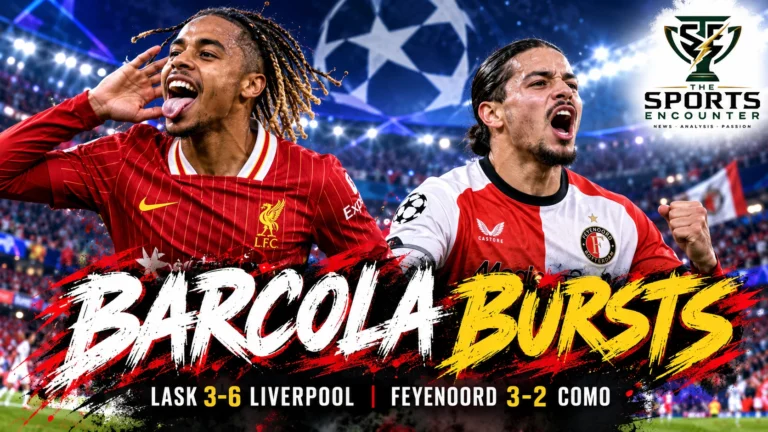
LINZ, Austria, October 14, 2026: Bradley Barcola had waited weeks for his first Liverpool goal. Then he scored three in one Champions League night. The French forward’s hat-trick powered Andoni Iraola’s side to a remarkable 6-3 victory over LASK in Austria, although a chaotic second half exposed defensive problems that six goals could not conceal. In Rotterdam, Feyenoord recovered from an early setback against Como to win 3-2, turning a difficult start to its European campaign into a crucial three-point victory.
The two early UEFA Champions League matches on Wednesday produced 14 goals and contrasting stories of recovery. Liverpool transformed a slow opening into a four-goal advantage shortly after halftime, with Ronald Araújo, Jeremie Frimpong and Lewis Koumas joining Barcola on the scoresheet. But LASK refused to disappear, scoring three times through Robert Ljubičić and Florian Flecker.
At De Kuip, Como threatened to continue its remarkable Champions League debut when Assane Diao scored after 18 minutes. Feyenoord responded almost immediately through Gjivai Zechiël before Anis Hadj Moussa completed the turnaround. An 81st-minute own goal by Como goalkeeper Robert Sánchez gave the Dutch side breathing space, although Anastasios Douvikas reduced the deficit during stoppage time.
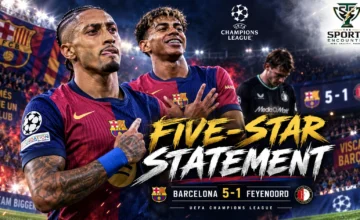
For Liverpool, the result delivered a second victory from two league-phase matches and lifted its points total to six. For Feyenoord, it marked a necessary response to the humiliating 5-1 defeat against Barcelona on Matchday 1.
Story at a glance
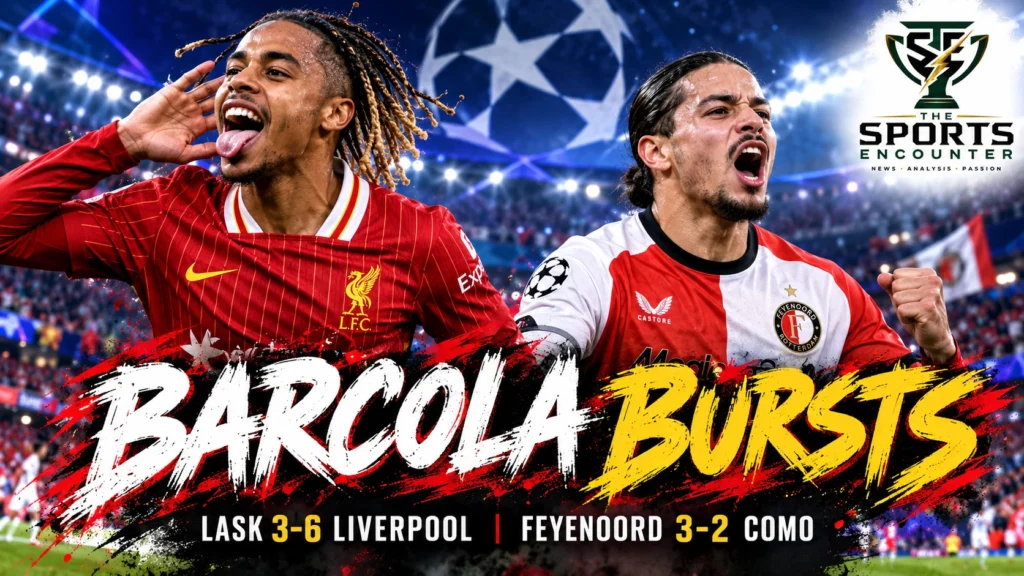
UEFA Champions League Results: October 14, 2026 Early Matches
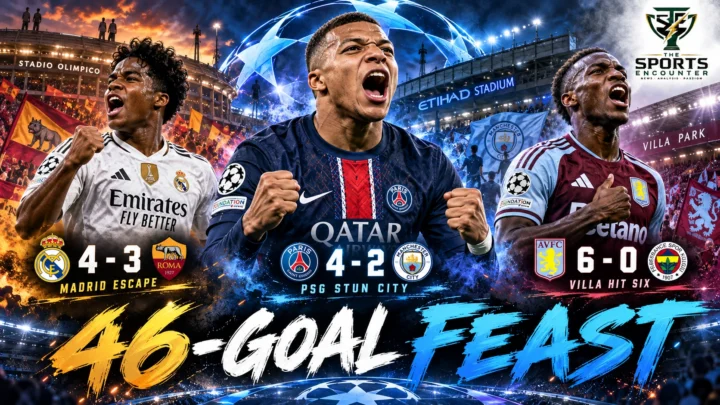
Both matches began at 18:45 Central European Summer Time. Seven additional matches were scheduled for the later kickoff on October 14, including Manchester City against Paris Saint-Germain, Roma against Real Madrid and Aston Villa against Fenerbahçe.
LASK 3-6 Liverpool: Barcola’s Hat-Trick Turns a Difficult Week Into a European Breakthrough
Liverpool arrived in Austria needing a response.
Barcola’s First Liverpool Hat-Trick Arrives in a Nine-Goal Spectacle
Liverpool continued attacking after the interval.
Florian Flecker’s Two Goals Expose Liverpool’s Defensive Weaknesses
LASK refused to abandon the contest.
Liverpool Move to Six Points After Beating Atlético Madrid and LASK
Liverpool opened its Champions League campaign with a 2-1 victory over Atlético de Madrid on September 9.
Como, which had opened its first Champions League campaign with a 4-1 victory over RB Leipzig, suffered its first defeat. LASK remained without a point after losing to AEK Athens in September and Liverpool in October.
The results also underline the importance of the Champions League’s 36-team league-phase format. Liverpool is building an early advantage in the race for direct qualification to the round of 16, while Feyenoord has restored its opportunity to challenge for a knockout place after a damaging start.
The Sports Encounter examines both results, every goal, the leading individual performances, the tactical decisions that shaped the matches and their implications for the next round of fixtures.
UEFA Champions League Results: October 14, 2026 Early Matches
| Match | Final Score | Goalscorers | Venue |
|---|---|---|---|
| LASK vs. Liverpool | 3-6 | LASK: Ljubičić 63′, Flecker 74′, 77′. Liverpool: Araújo 22′, Barcola 24′, 37′, 66′, Frimpong 51′, Koumas 72′. | Raiffeisen Arena, Linz |
| Feyenoord vs. Como | 3-2 | Feyenoord: Zechiël 20′, Hadj Moussa 52′, Sánchez own goal 81′. Como: Diao 18′, Douvikas 90+3′. | De Kuip, Rotterdam |
Both matches began at 18:45 Central European Summer Time. Seven additional matches were scheduled for the later kickoff on October 14, including Manchester City against Paris Saint-Germain, Roma against Real Madrid and Aston Villa against Fenerbahçe.
The official UEFA fixtures and results page provides the complete Matchday 2 schedule.
Tuesday’s nine matches had already delivered major developments. Club Brugge defeated Inter 4-3, Barcelona won 4-1 at Galatasaray, Arsenal defeated Lille 3-0, and Bayern Munich was held 3-3 by Viking.
TSE covered those results in its October 13 Champions League roundup, which provides the broader context for Wednesday’s fixtures.
LASK 3-6 Liverpool: Barcola’s Hat-Trick Turns a Difficult Week Into a European Breakthrough
Liverpool arrived in Austria needing a response.
The Reds had suffered a disappointing domestic defeat against Manchester City and faced a difficult European fixture while several attacking players were unavailable.
Alexander Isak, Cody Gakpo and Dominik Szoboszlai were absent, leaving Iraola with decisions to make about how to organize his frontline.
The manager chose a youthful lineup, with Lewis Koumas leading the attack and Rio Ngumoha and Barcola providing additional attacking options.
Virgil van Dijk was rested, while Ronald Araújo and Jérémy Jacquet started in central defense.
For the opening 20 minutes, LASK competed well enough to suggest that Liverpool would face a difficult evening.
Then the match changed dramatically.
Ronald Araújo Scores His First Liverpool Goal in the 22nd Minute
The breakthrough came through an unexpected source.
Araújo rose to meet a corner delivered by Kostas Tsimikas and directed a powerful header into the net.
The 22nd-minute goal was his first for Liverpool following his arrival from Barcelona on loan during the summer.
It carried additional significance because Liverpool had begun the match without its established central defensive leader, Van Dijk.
Araújo’s ability to contribute in the opposition penalty area added another attacking dimension to a Liverpool side already containing several quick forwards.
The defender’s move from Barcelona had been examined earlier in TSE’s analysis of Araújo joining Liverpool on loan.
His first goal gave the Reds an advantage after a relatively competitive opening period.
It also created the conditions for Barcola’s remarkable evening.
Bradley Barcola Scores His First Liverpool Goal Two Minutes Later
Barcola had been under increasing scrutiny following his high-profile arrival from Paris Saint-Germain.
He had not scored or registered an assist for Liverpool before Wednesday’s game.
Iraola had publicly supported the French forward and Florian Wirtz in the buildup, expressing confidence that both would eventually convert their talent into decisive contributions.
Against LASK, the breakthrough finally arrived.
In the 24th minute, Lewis Koumas helped create an opportunity that Barcola converted to double Liverpool’s lead.
The goal transformed the forward’s evening.
Having waited for his first Liverpool goal, he now had a platform to attack the Austrian defense with greater confidence.
For LASK, conceding twice in three minutes was particularly damaging.
The home side had approached the match hoping to frustrate Liverpool and exploit openings against a rotated lineup.
Instead, it suddenly needed to recover from a two-goal deficit.
Wirtz Creates, Barcola Finishes: Liverpool Lead 3-0 Before Halftime
Barcola struck again in the 37th minute.
This time Florian Wirtz supplied the assist, helping Liverpool extend its advantage to three goals.
The combination was particularly encouraging for Iraola.
Both players had faced questions about their production, and Liverpool needed greater attacking contributions while Isak, Gakpo and Szoboszlai were unavailable.
Wirtz’s involvement showed the value of having a midfielder capable of identifying attacking runs and playing passes into dangerous areas.
Barcola’s finishing provided the complementary quality.
The two combined to exploit a LASK defense increasingly stretched by Liverpool’s movement.
At halftime, the visitors led 3-0.
The score reflected a dramatic turnaround from the competitive opening stages.
Barcola’s First Liverpool Hat-Trick Arrives in a Nine-Goal Spectacle
Liverpool continued attacking after the interval.
Jeremie Frimpong scored in the 51st minute, making it 4-0.
At that point, the result appeared settled.
But the second half would become considerably more chaotic.
Frimpong Makes It Four Before LASK Fight Back
Frimpong’s goal extended Liverpool’s advantage shortly after the restart.
His contribution demonstrated another important feature of Liverpool’s attacking approach.
The team did not rely exclusively on its central forwards to finish chances.
With Frimpong advancing from a wider position, the Reds could create attacking threats through overlapping movement and runs from deeper areas.
LASK struggled to contain the number of players joining Liverpool’s attacks.
However, the home side soon found an opening.
Robert Ljubičić Pulls One Back in the 63rd Minute
Ljubičić scored in the 63rd minute to reduce the deficit to 4-1.
The goal did not immediately threaten Liverpool’s control of the result.
It did reveal that LASK could still create opportunities against the visitors’ defensive structure.
That distinction matters because Liverpool’s attacking success had concealed some problems in its defensive organization.
The absence of Van Dijk and the introduction of younger players contributed to an unfamiliar lineup.
However, squad rotation alone does not explain every defensive mistake.
Liverpool still needed to maintain concentration and positional discipline while protecting a substantial lead.
Barcola Completes His Hat-Trick in the 66th Minute
Barcola responded almost immediately.
Three minutes after Ljubičić’s goal, the French forward scored again to complete his hat-trick.
It was his first career hat-trick and a remarkable way to open his Liverpool scoring account.
The third goal restored a four-goal advantage at 5-1.
For Liverpool, the significance extended beyond one evening’s result.
The team had needed another attacking player to produce goals while its regular forward options were unavailable.
Barcola answered with three.
His performance does not guarantee that every concern about consistency has disappeared.
It provides clear evidence that he can convert opportunities when Liverpool’s attacking structure creates them.
His pace, movement and finishing were central to the victory.
Lewis Koumas Scores Liverpool’s Sixth
Koumas added another goal in the 72nd minute.
The young forward had already assisted Barcola’s first goal and now completed his own attacking contribution.
Liverpool led 6-1.
The score appeared to represent a complete demolition of the Austrian champions.
Yet the final quarter of the match would produce another unexpected development.
Florian Flecker’s Two Goals Expose Liverpool’s Defensive Weaknesses
LASK refused to abandon the contest.
Florian Flecker scored in the 74th minute and struck again in the 77th.
Within three minutes, Liverpool’s advantage had been reduced from five goals to three.
The final score of 6-3 still represented a comfortable victory.
However, the manner in which Liverpool conceded three second-half goals created a separate issue for Iraola to address.
How LASK Found Space After Liverpool’s Changes
Liverpool had controlled the scoreboard for most of the contest, but its defensive concentration deteriorated during the second half.
LASK continued making attacking runs and exploited the spaces that became available.
Yvan Dibango was involved in the attacking moves that produced the home side’s goals.
Flecker’s two finishes gave LASK supporters something to celebrate despite the defeat.
The goals also demonstrated that Liverpool’s defensive organization was not as secure as its attacking performance initially suggested.
The danger of a match like this is that the winning side can focus on scoring six goals while overlooking the conditions that allowed the opposition to score three.
Against more clinical opponents, those mistakes may carry greater consequences.
Why Three Goals Conceded Still Matter in a Three-Goal Victory
Goal difference is an important ranking criterion during the Champions League league phase.
Liverpool collected all three points, and its six goals substantially improved its attacking record.
But conceding three reduced the goal-difference benefit.
A 6-0 victory would have improved Liverpool’s goal difference by six.
The actual 6-3 result improved it by three.
Those differences can become significant if several teams finish level on points.
Defensive reliability therefore has an immediate competitive value, not merely a stylistic one.
What Iraola Should Take From the Victory
The attacking evidence is overwhelmingly positive.
Barcola scored three times, Koumas contributed a goal and an assist, Araújo scored his first Liverpool goal, and Wirtz helped create an important breakthrough.
The younger players delivered the productivity Liverpool needed during a difficult period of squad availability.
The defensive questions are equally clear.
Liverpool must improve concentration after establishing a substantial lead, particularly when the manager changes personnel.
Its next opponents will study how LASK found opportunities during the second half.
The Reds cannot assume another six-goal performance will compensate for similar defensive lapses.
The official UEFA LASK-Liverpool match center provides the competition record for the October 14 fixture.
Liverpool Move to Six Points After Beating Atlético Madrid and LASK
Liverpool opened its Champions League campaign with a 2-1 victory over Atlético de Madrid on September 9.
Alexis Mac Allister and Dominik Szoboszlai supplied the goals in that opening victory.
TSE examined the match in its report on Liverpool’s winning Champions League start against Atlético.
The victory over LASK gives the Reds six points from two matches.
Liverpool has now scored eight goals and conceded four, producing a positive goal difference of four.
That is an encouraging return, especially considering the attacking absences and domestic disappointment preceding the trip to Austria.
Yet four goals conceded in two matches also underline why Iraola cannot treat the team’s defensive structure as settled.
LASK Remain Without a Point
LASK began the league phase with a 1-0 defeat against AEK Athens.
Răzvan Marin scored the winning goal in that opening match.
TSE’s analysis of AEK Athens defeating LASK detailed the Austrian club’s opening setback.
After the Liverpool defeat, LASK has conceded seven goals across two matches and remains on zero points.
Its three goals against Liverpool offer evidence of attacking potential.
But the defensive record creates an increasingly difficult position.
LASK needs to collect points during its remaining six fixtures, beginning with the next trip to Sporting CP.
Feyenoord 3-2 Como: Dutch Recovery Denies Fàbregas Another European Celebration
De Kuip, Rotterdam: Feyenoord entered Wednesday’s match under pressure after a disastrous Champions League opener against Barcelona.
The Dutch club had lost 5-1 at Camp Nou.
That defeat left Giovanni van Bronckhorst’s team needing a positive response in its first home league-phase match.
Como arrived with the opposite experience.
Cesc Fàbregas’s side had defeated RB Leipzig 4-1 in its first Champions League appearance, immediately demonstrating that the Italian newcomers could compete against established European opponents.
The contrast made the Rotterdam fixture particularly important for both clubs.
Feyenoord needed its first points.
Como had an opportunity to extend its perfect start.
The visitors made the first breakthrough.
Assane Diao Gives Como the Lead in the 18th Minute
Como opened the scoring through Assane Diao after 18 minutes.
Jacobo Ramón supplied the assist.
The goal rewarded the Italian side’s attacking intent and appeared to extend the difficulties Feyenoord had experienced against Barcelona.
For Como, the early lead was particularly encouraging because it was the club’s first Champions League away fixture.
Winning away from home presents different demands from playing at the Stadio Giuseppe Sinigaglia.
The visiting team must manage crowd pressure, changes in momentum and an opponent more willing to commit players forward.
Diao’s goal gave Como an excellent start.
However, Feyenoord’s response arrived almost immediately.
Gjivai Zechiël Equalizes Two Minutes Later
In the 20th minute, Gjivai Zechiël scored an impressive equalizer.
Luciano Valente helped create the opportunity, and Zechiël finished to restore parity.
The speed of Feyenoord’s response was one of the most important moments in the contest.
Como had barely established its advantage before the home side erased it.
Feyenoord’s immediate reaction also prevented the visiting team from settling into a more conservative approach with the lead.
At 1-1, the match was effectively reset.
The Dutch club had demonstrated that its attacking approach could produce results against an opponent that had been particularly impressive on Matchday 1.
Why Zechiël’s Goal Was More Than an Equalizer
Feyenoord had conceded five against Barcelona and fallen behind again in Rotterdam.
Another prolonged period trailing could have increased the pressure on the players and management.
Zechiël’s goal prevented that situation from developing.
It also brought the home crowd back into a match that had briefly threatened to follow the same pattern as the opening European defeat.
For a young midfielder, producing an important goal in that environment represents a valuable contribution.
The quality of the finish added to the significance of the moment.
Anis Hadj Moussa Completes Feyenoord’s Turnaround
The decisive shift arrived early in the second half.
Anis Hadj Moussa scored in the 52nd minute, putting Feyenoord ahead 2-1.
The goal completed a turnaround that had begun with Zechiël’s immediate equalizer.
Feyenoord now had the advantage and could approach the remaining minutes with greater tactical flexibility.
Hadj Moussa Provides the Cutting Edge
The Algerian winger has become an important attacking option for Feyenoord.
His ability to challenge defenders and create opportunities from wide areas gives the team a different route to advancing the ball.
Against Como, his goal provided the final action that turned attacking promise into scoreboard control.
The strike was particularly important because the visitors had entered with a reputation for proactive, possession-based football under Fàbregas.
Feyenoord needed to demonstrate that it could threaten Como even when the Italians attempted to manage the ball.
Hadj Moussa delivered the goal that shifted the balance.
Van Bronckhorst’s Response to Barcelona Shows Progress
Feyenoord’s opening Champions League defeat had exposed problems against Barcelona’s attacking movement and technical quality.
The Dutch team was unable to prevent Raphinha and his teammates from generating dangerous opportunities.
TSE documented the setback in its report on Barcelona’s 5-1 victory over Feyenoord.
Against Como, the performance was more competitive.
Feyenoord conceded early but recovered rather than allowing the deficit to grow.
Its attacking players then converted enough opportunities to take control.
The result does not prove that every defensive problem has been solved.
It does show that the team responded effectively to the circumstances of a difficult European start.
Robert Sánchez’s Own Goal Extends Feyenoord’s Advantage
Feyenoord gained greater breathing space in the 81st minute.
Como goalkeeper Robert Sánchez was credited with an own goal, extending the home side’s lead to 3-1.
For the Italian club, it was another frustrating development in a contest that had begun so positively.
Como had taken the lead after 18 minutes, only to concede almost immediately.
It then fell behind early in the second half and faced a two-goal deficit entering the closing stages.
The own goal made its comeback task considerably more difficult.
Why Goalkeeping Decisions Become Decisive in Close European Matches
An own goal attributed to a goalkeeper can arise from several types of incidents, including a deflection off the goalkeeper after a shot strikes the frame or a failed attempt to control an incoming ball.
The goal attribution alone does not establish which technical mistake occurred.
What matters for this match is the consequence.
Feyenoord moved two goals ahead with fewer than ten minutes of regulation remaining.
Como had to commit additional resources forward, increasing the urgency of every remaining attacking possession.
Douvikas Scores in Stoppage Time, but Como Run Out of Time
Como continued attacking and found a late response.
Anastasios Douvikas scored in the third minute of stoppage time, reducing the deficit to 3-2.
The goal demonstrated the visitors’ refusal to concede the contest despite their difficulties.
But it arrived too late to prevent defeat.
Feyenoord held on for its first Champions League victory of the season.
The final result was a narrow victory rather than a comfortable one, and Como’s late goal provided another reminder that the Dutch team must defend more consistently when protecting a lead.
Why Feyenoord Beat Como Despite the Visitors’ Strong Opening
The two teams approached the game with different recent European experiences.
Feyenoord needed to recover from a heavy defeat.
Como was attempting to build on an emphatic victory over RB Leipzig.
The Dutch side’s performance was notable because it survived the moment when those contrasting circumstances might have become decisive.
Diao’s goal could have increased Feyenoord’s uncertainty.
Zechiël’s equalizer prevented that.
Hadj Moussa then supplied the second-half breakthrough, and the later own goal provided enough of a cushion to survive Douvikas’ stoppage-time finish.
Feyenoord’s Response After Conceding Was the Central Turning Point
The difference between falling behind and staying behind is significant.
Feyenoord conceded in the 18th minute but equalized in the 20th.
That response preserved the team’s opportunity to play without chasing the match for an extended period.
It also prevented Como from immediately controlling the pace through its preferred possession sequences.
With the score level, Feyenoord could continue attacking rather than abandon its structure in pursuit of a desperate equalizer.
Como’s Attacking Identity Still Created Problems
Como scored twice away from home in its second Champions League match.
The result should therefore not be interpreted as a complete attacking failure.
The visitors showed that they could threaten through Diao and later Douvikas.
But scoring twice was insufficient because they conceded three.
That balance is now an important issue for Fàbregas.
His team needs to retain its attacking ambition while becoming more resistant to immediate opposition responses and transitions.
Nico Paz and Como’s Creative Responsibility
Nico Paz has become central to Como’s attacking development.
He supplied two assists during the 4-1 victory over Leipzig on Matchday 1, demonstrating his ability to find teammates in advanced areas.
Against Feyenoord, Como again needed creative contributions to threaten a proactive opponent.
However, the team could not preserve its early advantage.
Its broader challenge is converting attractive attacking football into a more dependable combination of goals and defensive results.
TSE analyzed the Italian side’s remarkable European debut in its report on Como’s 4-1 victory over RB Leipzig.
Feyenoord’s First European Win Changes Its League-Phase Prospects
The win over Como gives Feyenoord three points from its opening two Champions League matches.
The club has scored four goals and conceded seven, leaving a goal difference of minus three.
That is still a difficult goal record.
Nevertheless, the three points provide an important foundation after the opening defeat.
Feyenoord’s next challenge is to improve its defensive consistency while continuing to create enough attacking opportunities against stronger opponents.
Como remains on three points after its first defeat.
The Italian club has scored six goals and conceded four across two matches, retaining a positive goal difference of two.
Como’s Progress Remains Significant Despite Defeat
Como is competing in its first Champions League campaign.
That achievement follows a remarkable period of development under Fàbregas and a rapid rise into the upper positions of Italian football.
Continue the UEFA Champions League 2026-27 Story
 UEFA Champions League 2026-27UEFA Champions League Returns: Man City vs. PSG Headlines Barcelona’s Istanbul Test Amid High Stakes
 UEFA Champions League 2026-27Barcelona Tear Feyenoord Apart 5-1 as Yamal’s Champions League Warning Turns Real
 Premier LeagueWhat’s Wrong With Manchester United? Inside the Failures Holding the Red Devils Hostage
The club has already demonstrated that it can defeat established European opposition.
But away matches against teams with strong home support present different challenges.
The result in Rotterdam is therefore a useful test of the team’s development rather than a reason to dismiss its broader progress.
TSE previously examined Como’s growing domestic competitiveness in its report on its Serie A victory over Parma.
Champions League Standings: Liverpool Have Six Points, Feyenoord and Como Three
After the two October 14 early matches, the four participating clubs have contrasting league-phase records.
| Club | Played | Wins | Losses | Goals For | Goals Against | Goal Difference | Points |
|---|---|---|---|---|---|---|---|
| Liverpool | 2 | 2 | 0 | 8 | 4 | +4 | 6 |
| Como | 2 | 1 | 1 | 6 | 4 | +2 | 3 |
| Feyenoord | 2 | 1 | 1 | 4 | 7 | -3 | 3 |
| LASK | 2 | 0 | 2 | 3 | 7 | -4 | 0 |
These are the verified records of the four teams involved in the completed early matches. The table does not claim to represent the final ranking of all 36 teams after every Matchday 2 fixture.
Why Six Points Matter for Liverpool
Liverpool has taken the maximum available points from its first two matches.
Under the Champions League’s league-phase format, the eight highest-ranked teams progress directly to the round of 16.
Teams finishing ninth through 24th enter knockout-phase playoffs, while those below 24th are eliminated.
Six early points therefore give Liverpool an encouraging foundation in the race for a top-eight position.
The club must still face Villarreal, Fenerbahçe, Club Brugge, Porto, Inter and Lens during the remaining six league-phase fixtures.
That schedule provides substantial opportunities to collect points but also includes difficult opponents.
Why Goal Difference Matters to Feyenoord and Como
Feyenoord and Como both have three points.
But Como’s goal difference is positive two, while Feyenoord’s is negative three.
That five-goal difference between their records reflects the contrasting margins of their opening matches.
Feyenoord lost heavily to Barcelona before narrowly defeating Como.
Como won convincingly against Leipzig before losing by one goal in Rotterdam.
Both remain in contention for the knockout positions, but Feyenoord has more work to do to repair its goal difference.
Matchday 3: Liverpool Host Villarreal, Feyenoord Travel to Betis
The next Champions League fixtures take place on October 20 and 21.
For Liverpool, the next match offers another opportunity to strengthen its early position.
For Feyenoord, LASK and Como, Matchday 3 will provide important tests of their ability to recover from disappointing results.
| Date | Fixture | Main Storyline |
|---|---|---|
| October 20 | Liverpool vs. Villarreal | Reds attempt to preserve perfect European start |
| October 21 | Sporting CP vs. LASK | Austrian club seeks first league-phase points |
| October 21 | Como vs. Manchester United | Italian newcomers return home after Rotterdam defeat |
| October 21 | Real Betis vs. Feyenoord | Dutch side attempts to build on its first win |
Liverpool’s Next Test Could Be More Demanding
Villarreal presents a different tactical challenge from LASK.
Liverpool cannot assume the same volume of attacking opportunities will be available.
The Reds must also improve defensive concentration after allowing three goals in Austria.
A third consecutive victory would place Liverpool in an increasingly strong position to challenge for direct qualification.
Feyenoord Face a Difficult Trip to Real Betis
Feyenoord’s victory over Como provided its first points, but the next fixture will be another demanding assignment.
Betis began its Champions League campaign with a 3-2 victory over Lille.
The Dutch club must improve its ability to prevent dangerous chances while preserving the attacking confidence gained from its comeback in Rotterdam.
Como Meet Manchester United After Their First Defeat
Como returns home to face Manchester United.
The fixture offers Fàbregas an opportunity to test his team’s possession-based approach against one of Europe’s most recognizable clubs.
United, however, arrives under pressure following its defeat to Atlético de Madrid on October 13.
Both sides will be seeking a result to improve their positions in the league table.
LASK Must Start Collecting Points
Two defeats have left LASK at the foot of the four-team comparison table.
The Austrian club has demonstrated attacking capability, particularly through its three goals against Liverpool.
But conceding seven goals in two matches represents a serious defensive problem.
Its next fixture against Sporting CP offers an opportunity to begin recovering points.
The challenge will be finding a balance between attacking ambition and defensive stability.
Why the 36-Team Champions League Format Raises the Stakes
Each team plays eight league-phase matches against different opponents.
There are no traditional four-team groups in which clubs face the same three opponents home and away.
That changes the competitive calculation.
A team cannot recover from a poor result simply by preparing for a return fixture against the same opponent during the league stage.
Instead, it must adapt to a succession of different tactical systems, venues and playing styles.
Liverpool’s first two matches demonstrate that variation.
The Reds began against Atlético de Madrid and then traveled to LASK.
Feyenoord faced Barcelona and Como.
Those opponents presented different challenges, and the resulting scorelines reflect the importance of adaptability.
TSE examined the wider tournament structure in its complete 2026/27 Champions League draw analysis.
The Sports Encounter Verdict: Barcola Solves One Liverpool Problem, but Another Remains
Liverpool’s victory in Linz was one of the most entertaining matches of Matchday 2.
Barcola produced the outstanding individual performance, scoring three goals after entering the contest without a Liverpool goal or assist.
Araújo celebrated his first goal for the club. Koumas added a goal and an assist. Frimpong contributed from a deeper position, while Wirtz provided an important creative connection.
Those contributions demonstrate the attacking potential available to Iraola even when several established players are unavailable.
But the final score also contains a warning.
Conceding three goals after establishing a commanding lead is not the defensive standard Liverpool will want to reproduce against more experienced Champions League opponents.
The Reds can celebrate Barcola’s breakthrough while recognizing that their defensive organization requires improvement.
In Rotterdam, Feyenoord delivered a victory that was less spectacular but equally important to its immediate European ambitions.
The Dutch side recovered from conceding first, responded through Zechiël and took the lead through Hadj Moussa.
The late own goal created enough protection to survive Como’s stoppage-time response.
For Como, defeat does not erase the quality of its opening victory over Leipzig. But the match showed that attacking confidence must be supported by defensive resilience, particularly when facing strong home teams in Europe.
Both matches demonstrate the value of responding effectively to difficult circumstances.
Liverpool answered a disappointing domestic result with six goals.
Feyenoord recovered from its Barcelona humiliation with three important points.
Barcola’s hat-trick gave Liverpool the headlines. Feyenoord’s comeback gave Rotterdam renewed belief. But both winners discovered that scoring goals is only one part of becoming a reliable Champions League contender.
Champions League October 14, 2026: Frequently Asked Questions
Who Won LASK vs. Liverpool?
Liverpool defeated LASK 6-3 in Linz, Austria, on October 14, 2026.
Who Scored Liverpool’s Six Goals?
Bradley Barcola scored three, while Ronald Araújo, Jeremie Frimpong and Lewis Koumas scored one each.
Was This Bradley Barcola’s First Liverpool Hat-Trick?
Yes. Barcola scored his first Liverpool goals against LASK and completed his first career hat-trick.
Who Scored LASK’s Three Goals?
Robert Ljubičić scored once and Florian Flecker scored twice.
Did Ronald Araújo Score His First Liverpool Goal?
Yes. Araújo scored with a header in the 22nd minute against LASK.
What Was the Feyenoord vs. Como Result?
Feyenoord defeated Como 3-2 at De Kuip in Rotterdam.
Who Scored Feyenoord’s Goals?
Gjivai Zechiël and Anis Hadj Moussa scored, while Como goalkeeper Robert Sánchez was credited with an own goal.
Who Scored for Como?
Assane Diao opened the scoring in the 18th minute, and Anastasios Douvikas scored in stoppage time.
How Many Champions League Points Does Liverpool Have?
Liverpool has six points after winning its first two league-phase matches against Atlético de Madrid and LASK.
How Many Points Do Feyenoord and Como Have?
Both clubs have three points after one victory and one defeat.
When Is Liverpool’s Next Champions League Match?
Liverpool is scheduled to host Villarreal on October 20, 2026.
Who Will Feyenoord Face Next?
Feyenoord travels to Real Betis on October 21, 2026.