


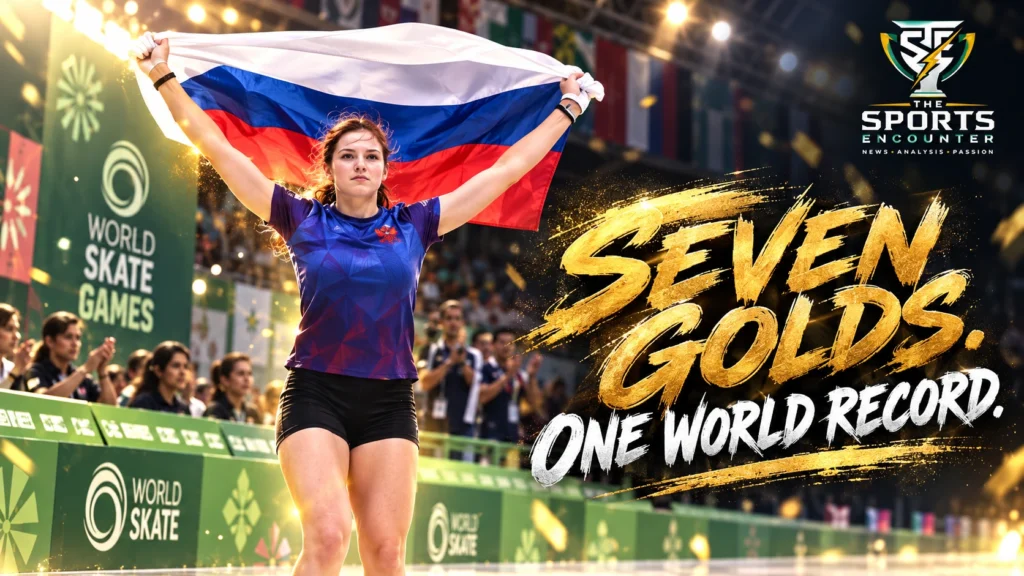
ASUNCIÓN, Paraguay, October 14, 2026: Russia’s return to the World Skate Games under its national flag and anthem has produced seven gold medals, 17 podium finishes and a world record that has made Veronika Zherelnikova one of the standout performers in Paraguay. The junior inline freestyle skater cleared 1.42 meters in the women’s free-jump final, raising her own world record by two centimeters and finishing an extraordinary 15 centimeters ahead of the next-best competitors. Her achievement came during a remarkable opening week in which Russian athletes won world titles across freestyle slalom, slides and pair slalom.
The Russian delegation had collected seven gold, three silver and seven bronze medals by the end of the opening phase of competition, surpassing its reported previous World Skate Games best of 11 medals. Sofia Anisimova emerged as another leading performer with two junior freestyle slalom titles, while Roman Shchapov and Margarita Komarovskaia won the pair slalom championship. The results carry sporting and institutional significance because Russia is competing under its national symbols following the lifting of restrictions by the sport’s international governing body in August 2026. But the performance is also a story of emerging talent, technical mastery and the increasingly demanding standards of international roller sports.
Russia’s World Skate Games 2026 Medal Tally: Seven Golds, 17 Medals
The World Skate Games bring together world championship competitions across multiple roller sports, combining disciplines ranging from inline freestyle and artistic skating to skateboarding, speed skating and roller hockey.
Russia’s first-week medal count demonstrates the strength of its inline freestyle program, with additional podium finishes coming from skate cross and artistic skating.
| Discipline | Gold | Silver | Bronze | Total |
|---|---|---|---|---|
| Inline Freestyle | 7 | 3 | 4 | 14 |
| Skate Cross | 0 | 0 | 1 | 1 |
| Artistic Inline Skating | 0 | 0 | 2 | 2 |
| Total | 7 | 3 | 7 | 17 |
The distinction between the two totals is important. Russia won 14 medals in inline freestyle alone, comprising all seven golds, three silvers and four bronzes. Another three bronze medals brought the delegation’s overall reported tally to 17.
The Russian Roller Sports Federation’s official freestyle championship report identifies the seven winning events and the medal distribution from the October 6-9 competitions.
Russia Surpasses Its Previous World Skate Games Medal Best
Russian sporting reports describe the 17-medal performance as the country’s best at the World Skate Games, already exceeding the totals recorded at Nanjing in 2017 and Barcelona in 2019.
| Edition | Host | Russian Medals | Status |
|---|---|---|---|
| 2017 | Nanjing, China | 8 | Completed edition |
| 2019 | Barcelona, Spain | 11 | Completed edition |
| 2026 | Asunción, Paraguay | 17 | First-week reported tally; Games ongoing |
The current figure is six medals above the 2019 total, an increase of approximately 54.5%.
However, these comparisons require context. The World Skate Games have evolved over successive editions, and the overall competition program, number of participating countries and available medal events may differ. The increase demonstrates a substantial improvement in Russia’s recorded medal haul without necessarily establishing an equivalent improvement across every discipline.
Crucially, the 17 medals are not the final total for Asunción 2026. Competitions continue through October 18, leaving opportunities for further changes.
Veronika Zherelnikova Clears 1.42 Meters to Break the Junior World Record
The most extraordinary individual result came on October 8 at Pabellón 1 in Asunción.
Zherelnikova entered the junior women’s free-jump final as the holder of a world record of 1.40 meters, established at the Lishui Open in China in August 2025.
In Paraguay, she raised the record to 1.42 meters.
It represented an improvement of two centimeters, but the margin separating the Russian champion from the rest of the podium was far larger.
Fifteen Centimeters Separate Zherelnikova From Silver and Bronze
| Position | Athlete | Country | Best Jump |
|---|---|---|---|
| Gold | Veronika Zherelnikova | Russia | 1.42m, World Junior Record |
| Silver | Emilie Bellanger | France | 1.27m |
| Bronze | Polina Zelenokhat | Ukraine | 1.27m |
| Fourth | Milana Fursenko | Ukraine | 1.20m |
| Fifth | Uliana Dudina | Russia | 1.15m |
The official World Skate Games junior free-jump results confirm all five positions and the winning 142-centimeter clearance.
Bellanger and Zelenokhat both cleared 1.27 meters, with the competition’s ranking procedures separating their silver and bronze positions.
Zherelnikova finished 15 centimeters ahead of both.
In an event where competitors clear progressively higher bars, that represents a substantial separation at world championship level.
How Does Free Jump Work in Inline Freestyle Skating?
Free jump is a competitive discipline in which athletes wearing inline skates attempt to clear a horizontal bar without dislodging it.
The event combines approach speed, explosive takeoff, body coordination and controlled landing.
Unlike a running high jump in athletics, competitors must manage the additional technical demands of jumping and landing while wearing inline skates.
The recorded result is the greatest height successfully cleared under the competition’s rules.
That makes the event particularly accessible to new spectators. The objective is simple to understand, while the techniques required to clear elite heights are highly specialized.
Zherelnikova’s 1.42-meter clearance now provides a new junior world benchmark.
She Raised Her Own Record, Not Someone Else’s
Zherelnikova’s performance was not an isolated breakthrough by an unknown challenger.
She had already held the junior world record at 1.40 meters.
Her latest achievement extended that mark by another two centimeters, demonstrating measurable progression rather than a first appearance at the top of the rankings.
SEVEN GOLDS and a WORLD RECORD for Russia at World Skate Games Back under the national flag and anthem, Russians won 17 medals in the opening week in Paraguay Veronika Zherelnikova cleared 1.42m for a junior women’s free-jump WORLD RECORD https://t.co/2Fl3F27fxt
— RTRussia (@RT_Russia_) October 13, 2026
Before her earlier records, the benchmark stood at 1.37 meters, associated with Italy’s Francesca Brivio and France’s Mayrin Burasovitch.
The progression from 1.37 to 1.40 and now 1.42 meters reflects the rising competitive standard within the discipline.
Speaking through the Russian federation’s press service, Zherelnikova described her long-standing ambition:
“Since I was eight, I dreamed of becoming a world champion and trained every day.”
She also acknowledged injuries and emotional difficulties during her development, making the championship and record particularly meaningful.
Her remarks underline the preparation behind a performance that lasted only moments but required years of technical work.
Zherelnikova’s Junior Mark Even Exceeded the Senior Women’s Winning Height
Another remarkable comparison emerged from the same competition program.
Italy’s Francesca Brivio won the senior women’s free-jump title by clearing 1.35 meters.
Russia’s Alena Efimova took silver at 1.30 meters, while France’s Mayrin Burasovitch finished third at 1.25 meters.
Zherelnikova’s junior winning mark was therefore seven centimeters higher than the height that secured senior women’s gold.
This does not mean the junior title and senior title are interchangeable. They are separate competitions with distinct fields and age classifications.
But the comparison demonstrates that Zherelnikova’s result was exceptional even beyond her junior division.
Who Won Russia’s Seven Gold Medals at the World Skate Games?
Russia’s seven gold medals came from a range of inline freestyle events, including technical slalom, slides, pair performances and free jump.
The distribution is important because the total reflects success across different skill requirements rather than seven victories in the same type of event.
| Gold | Athlete or Pair | Discipline | Category |
|---|---|---|---|
| 1 | Sofia Anisimova | Classic Freestyle Slalom | Junior Women |
| 2 | Sofia Anisimova | Freestyle Slalom Battle | Junior Women |
| 3 | Pavel Matveev | Freestyle Slalom Battle | Senior Men |
| 4 | Roman Shchapov and Margarita Komarovskaia | Pair Slalom | Open |
| 5 | Veronika Zherelnikova | Free Jump, 1.42m | Junior Women |
| 6 | Anna Kukushkina | Slides | Senior Women |
| 7 | Uliana Dudina | Slides | Junior Women |
There are seven gold-medal events, although eight Russian athletes are named because pair slalom is a single medal event contested by two athletes.
That distinction prevents double-counting the pair championship as two separate gold medals.
Sofia Anisimova Wins Both Junior Freestyle Slalom Titles
Anisimova was one of the Russian delegation’s most successful individual competitors.
She won the junior women’s classic freestyle slalom and freestyle slalom battle titles.
The two events test related but distinct qualities.
Classic freestyle slalom emphasizes a choreographed routine involving technical moves, rhythm, control and movement around cones.
Battle slalom emphasizes direct competitive comparison through technical execution and the ability to produce difficult moves under pressure.
Winning both championships indicates that Anisimova can translate technical preparation into success across different competitive formats.
Her two titles also account for two of Russia’s seven gold medals, giving her an especially important role in the national total.
Roman Shchapov and Margarita Komarovskaia Combine for Pair Slalom Gold
Shchapov and Komarovskaia won the open pair slalom competition.
The Russian pair defeated representatives of Chinese Taipei, Thailand and several other countries.
Pair slalom requires technical coordination between two competitors, introducing additional challenges beyond individual performances.
Athletes must align their movement, timing and routines while maintaining sufficient technical difficulty.
Shchapov and Komarovskaia also collected individual medals, giving their pair victory broader significance within Russia’s overall freestyle performance.
Pavel Matveev Adds Senior Gold While Kukushkina and Dudina Win Slides
Pavel Matveev supplied a senior men’s title through freestyle slalom battle, defeating competitors from a strong international field.
Meanwhile, Anna Kukushkina won the senior women’s slides competition and Uliana Dudina captured the junior women’s title.
Slides events reward technical control as skaters perform controlled sliding maneuvers on inline skates.
The two gold medals reinforce Russia’s strength in disciplines requiring balance, precision and specialized skating technique.
Collectively, the seven victories demonstrate the range of Russia’s inline freestyle talent.
Three Silver and Seven Bronze Medals Complete Russia’s Opening-Week Haul
Russia’s success extended well beyond the gold-medal winners.
Roman Shchapov took two junior men’s freestyle slalom silver medals, while Alena Efimova earned silver in senior women’s free jump.
The four inline freestyle bronzes came from Margarita Komarovskaia, who finished third in two junior women’s slalom competitions, Semyon Mikhailov in junior men’s classic slalom and Efimova in senior women’s slides.
Another three bronze medals came from different disciplines.
| Athlete | Event | Result |
|---|---|---|
| Uliana Dudina | Junior Skate Cross | Bronze |
| Mariia Kapichnikova | Junior Women’s Artistic Inline Skating | Bronze, 111.87 points |
| Egor Tomilin | Senior Men’s Artistic Inline Skating | Bronze, 104.64 points |
The artistic skating medals were particularly notable because Kapichnikova and Tomilin were making their first world championship appearances, according to Russian delegation reporting.
Kapichnikova moved from fourth after the short program into third overall, demonstrating the importance of delivering a strong later performance across a multi-stage event.
For Dudina, the skate-cross bronze added another medal to her junior women’s slides title.
The combined results show that Russia’s first-week performance was led by freestyle but also produced success beyond the discipline.
Russia vs. Chinese Taipei: Why Gold Medals and Total Medals Tell Different Stories
The inline freestyle standings offer a useful warning about interpreting medal tables.
Russia accumulated seven gold, three silver and four bronze medals in the discipline.
Chinese Taipei collected six gold, seven silver and four bronze medals, giving it 17 overall.
| Nation | Gold | Silver | Bronze | Total |
|---|---|---|---|---|
| Russia | 7 | 3 | 4 | 14 |
| Chinese Taipei | 6 | 7 | 4 | 17 |
Under a gold-first ranking system, Russia finishes ahead because it won more championships.
Under a simple total-medals comparison, Chinese Taipei finishes ahead because more of its athletes reached the podium.
Both comparisons reveal different strengths.
Russia converted more events into first-place finishes.
Chinese Taipei demonstrated slightly broader podium coverage.
Neither figure should be confused with the overall World Skate Games medal table, which includes several other sports and countries.
That distinction is relevant across multi-sport competitions. As The Sports Encounter’s final Asian Games 2026 assessment illustrated, a country’s ranking depends on the applicable medal-table method, while the total count reveals a different dimension of competitive depth.
Russia’s Return Under Its Flag and Anthem Adds a New Dimension to the Medals
The results in Paraguay are attracting attention beyond roller sports because Russian athletes are competing under their national flag and anthem.
According to Russia’s roller sports authorities, the delegation returned under its national symbols following the lifting of sport-specific restrictions in August 2026.
The change follows several years of restrictions affecting Russian participation in international sports after the invasion of Ukraine in February 2022.
Those restrictions have not been identical across every governing body or discipline.
International federations retain substantial authority over eligibility, event access and the use of national symbols within their competitions.
What Russia’s World Skate Return Does and Does Not Mean
The return of Russia’s flag and anthem at the World Skate Games is a confirmed development within that competition.
It should not be interpreted as proof that all international federations have removed their restrictions or that Russia has received unrestricted representation at every future Olympic event.
In July 2026, the International Olympic Committee provisionally lifted the suspension of the Russian Olympic Committee.
At the time, the IOC had not made a final universal determination about the use of Russian national symbols at future Olympic Games.
The Reuters report on the IOC’s July decision explains the distinction between institutional reinstatement and national-symbol eligibility.
World Skate’s position is therefore an important development, but it belongs to a wider international debate that remains unresolved across some sports.
Russia’s Federation President Celebrates the Return
Ilya Vdovin, president of Russia’s Skateboarding and Roller Sports Federation, welcomed the results and their symbolic significance.
Speaking after the opening medal successes, Vdovin recalled the federation’s earlier pledge that Russian competitors would return to international events with medals.
His remarks emphasized that Russia’s anthem had already been played seven times in Asunción.
The federation regards that visibility as an important part of its international return.
For the athletes, however, the sporting achievement remains measurable through official performances, rankings and championship results.
Those are the results by which their competitive level can be independently assessed.
The Bigger Question of National Identity in International Sport
Russian participation remains a contested subject because the war in Ukraine continues to affect athletes, national federations and sporting institutions.
Supporters of broader reintegration argue that eligible athletes should not automatically lose access to competition because of decisions made by governments.
Opponents emphasize the continuing consequences of the war, the use of national symbols as representations of the state and the obligations of international sporting bodies toward Ukrainian competitors.
Both concerns are relevant to decisions about eligibility and national representation.
TSE previously examined those arguments in our August editorial analysis of Russia’s exclusion from international sporting competitions.
The World Skate Games provide a practical example of how one federation’s policies are being implemented.
They do not resolve the broader debate across international sport.
One notable detail from the junior free-jump final is that Russian, French and Ukrainian athletes all reached the podium.
Zherelnikova won gold for Russia, Bellanger took silver for France and Zelenokhat claimed bronze for Ukraine.
That result should be understood as a verified competitive outcome rather than evidence of any wider political reconciliation.
What Zherelnikova’s World Record Says About the Next Generation of Roller Sports
The competitive significance of Zherelnikova’s performance extends beyond Russia’s medal tally.
A junior athlete has produced a record-setting height that exceeded the winning mark in the corresponding senior women’s event.
That demonstrates the level of technical performance emerging from younger competitors.
It also challenges the assumption that junior competitions are primarily developmental rather than capable of producing exceptional global standards.
Younger Athletes Are Raising Standards Across Multiple Sports
The phenomenon is not unique to inline freestyle.
At the recent 2026 Asian Games, China’s Yu Zidi broke the women’s 200-meter individual medley world junior record at just 13 years old.
Her performance was examined in TSE’s report on Yu Zidi’s Asian and world junior record swim.
Japan’s Shin Ohashi then broke the men’s 200-meter breaststroke world record at 17, producing another example of a young competitor performing at the highest international level.
That achievement was analyzed in TSE’s coverage of the major world-record breakthroughs at the Asian Games.
These performances come from different sports with different physical and technical requirements.
They cannot be directly equated, but they demonstrate how emerging athletes can challenge established benchmarks before reaching the senior stages of their careers.
What Makes Zherelnikova’s Achievement Particularly Valuable?
Three separate factors distinguish the new record.
First, she improved a world record she already held, demonstrating continued progression rather than an isolated result.
Second, she finished 15 centimeters ahead of the next-best competitors, showing a substantial advantage in the final.
Third, her 1.42-meter clearance exceeded the senior women’s winning height at the same Games.
Those details provide a more complete assessment than merely reporting that another world record was broken.
The next test will be whether Zherelnikova can continue improving as competition standards rise and her international career develops.
Skateboarding and Inline Freestyle Are Building Different Paths to Global Recognition
World Skate administers several disciplines that have different competitive histories and international opportunities.
Skateboarding has an established Olympic presence.
Inline freestyle, including free jump and slalom, has its own world championship structures but is not currently an Olympic medal discipline.
That distinction matters when discussing an athlete’s future.
A world title in inline freestyle should be recognized for its sporting value without assuming that it automatically creates an Olympic qualification pathway.
Asia’s Skateboarding Breakthrough Offers a Useful Comparison
During the 2026 Asian Games in Japan, 17-year-old Kang Jun-i won South Korea’s first men’s street skateboarding gold medal.
He defeated leading Japanese competitors with a score of 180.85, illustrating how emerging national programs can make major breakthroughs in established international fields.
The achievement was documented in TSE’s September 27 Asian Games report.
While Kang competes in street skateboarding and Zherelnikova specializes in inline free jump, both achievements reveal the growth of competitive sports that have developed strong international identities beyond traditional stadium-based events.
These disciplines are also attracting increasingly young, technically accomplished athletes.
Why Multi-Sport Events Matter to Smaller Disciplines
Many roller sports do not receive the same sustained global attention as soccer, cricket, tennis or major Olympic athletics events.
The World Skate Games provide a concentrated platform for multiple disciplines to compete for world titles while sharing international media attention.
That arrangement helps connect audiences who might ordinarily follow only one branch of roller sports.
It also allows athletes from different countries and disciplines to receive recognition during the same event.
The value of combining emerging and established disciplines was also visible at Aichi-Nagoya 2026, where sports such as skateboarding, teqball and padel featured within a much larger competitive program.
The event’s structure and the importance of newer disciplines were discussed in TSE’s comprehensive Asian Games 2026 preview.
What Comes Next at the World Skate Games in Paraguay?
The World Skate Games continue through October 18, meaning the opening-week results represent only part of the championship program.
Russian competitors are expected to participate in additional events, including street skateboarding, roller hockey, speed skating and scooter competitions.
The delegation has also been active in inline hockey.
Russian reporting stated that the men’s team opened its group-stage campaign with a 2-0 victory over Germany.
Further results will determine whether Russia can add to its 17-medal total before the Games conclude.
Can Russia Add More Gold Medals?
The seven existing golds came entirely from inline freestyle.
Success in skateboarding, hockey, speed skating or scooter events would broaden the delegation’s gold-medal distribution.
That would be an important development because it would demonstrate championship-winning strength across a larger number of sports.
However, the freestyle results alone do not establish that Russia will perform at the same level in unrelated disciplines.
Each competition involves different opponents, qualification structures and technical requirements.
The proper measure will be the final official results rather than projections based on the opening-week medal count.
What Should We Watch Beyond the Medal Count?
The remaining events offer several useful indicators of Russia’s international competitiveness.
One is whether athletes returning to international competition can reach finals in disciplines outside the strongest freestyle categories.
Another is whether Russia’s younger competitors can maintain their performances against established international opposition.
A third is how its results compare with nations that have accumulated medals across a wider range of roller sports.
These questions matter because a large medal total in one group of related events does not necessarily demonstrate equal competitive strength across the entire World Skate Games program.
World Skate Games 2026: Frequently Asked Questions
How many medals has Russia won at the World Skate Games 2026?
Russia had won 17 medals during the opening phase of the competition, including seven gold, three silver and seven bronze medals, according to the October 13 reporting.
Who broke the world record for Russia?
Veronika Zherelnikova set a new junior women’s free-jump world record by clearing 1.42 meters during the final on October 8 in Asunción.
What was Zherelnikova’s previous world record?
Her previous junior record was 1.40 meters, established at the Lishui Open in China in August 2025.
How far ahead of the silver medalist was Zherelnikova?
She finished 15 centimeters ahead of France’s Emilie Bellanger, who cleared 1.27 meters. Ukraine’s Polina Zelenokhat also cleared 1.27 meters and won bronze.
Who won two gold medals for Russia?
Sofia Anisimova won both junior women’s classic freestyle slalom and freestyle slalom battle, accounting for two of the delegation’s seven gold-medal events.
Which other Russian athletes won gold?
Additional titles went to Pavel Matveev, Anna Kukushkina, Uliana Dudina, and the pair of Roman Shchapov and Margarita Komarovskaia, alongside Zherelnikova and Anisimova.
Is Russia competing under its national flag?
Yes. The Russian delegation is participating under its flag and anthem at the 2026 World Skate Games following the lifting of World Skate-related restrictions in August. This does not automatically establish identical eligibility rules across all international sports.
Where are the World Skate Games being held?
The 2026 World Skate Games are being held in Asunción, Paraguay, with competition running through October 18.
Is inline freestyle free jump an Olympic sport?
No. Free jump is a World Skate-governed championship discipline but is not currently an Olympic medal event. Skateboarding is a separate World Skate discipline with an established Olympic program.
The Sports Encounter Verdict: Russia’s Return Has Produced More Than a Medal Count
Russia’s opening-week performance in Asunción has produced several important sporting developments.
Seven gold medals demonstrate a strong concentration of championship-winning ability in inline freestyle.
The 17-medal tally, including artistic skating and skate-cross podiums, gives the delegation a reported national best at the World Skate Games.
Sofia Anisimova’s two titles demonstrate versatility across different slalom formats.
Roman Shchapov and Margarita Komarovskaia combined individual success with a pair championship.
Uliana Dudina collected medals in two different disciplines.
But the defining achievement belongs to Veronika Zherelnikova.
Her 1.42-meter clearance did more than win the junior women’s free-jump title.
It improved an existing world record, established a substantial winning margin and raised the competitive benchmark for future challengers.
The return of Russia’s national symbols gives the results additional international significance, but it should not overshadow the athletes or simplify a complex debate over eligibility and sporting governance.
World Skate has permitted Russian participation under the national flag and anthem.
Other international federations continue to operate under their own policies.
Those institutional distinctions will remain important as global sport moves toward future world championships and the Los Angeles 2028 Olympic Games.
For now, the most compelling sporting conclusion is clear.
Russia has demonstrated considerable depth in inline freestyle, while one junior competitor has moved the world record beyond the previous standard by another two centimeters.
With the World Skate Games continuing through October 18, the final medal table remains open.
Whatever happens during the remaining competitions, the 1.42-meter mark established in Asunción has already given this edition a lasting place in the junior free-jump record books.