


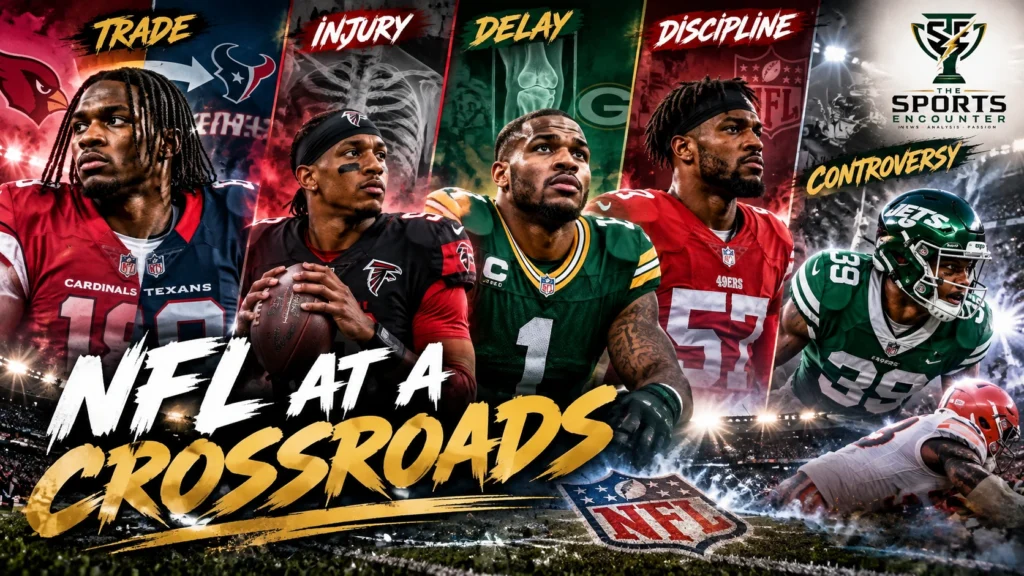
NEW YORK, United States, October 13, 2026: The Arizona Cardinals have traded a receiver they once hoped would define their future. The Atlanta Falcons are evaluating the availability of the quarterback who transformed their offense. The Green Bay Packers must wait longer for a defensive superstar, while the San Francisco 49ers and New York Jets confront two very different questions about discipline and player safety.
Five NFL developments emerged from the same October 12 news cycle. Each initially appeared to belong to a familiar category: a trade, two injury reports, a suspension and a coaching controversy.
Together, however, they reveal something more significant about the 2026 season. Teams are being forced to make decisions with consequences that extend beyond their next game. The choices concern how much patience a franchise owes a highly drafted player, how aggressively a recovering quarterback should be protected, when an injured defensive star should return, and where professional football draws the line between legitimate physicality and unacceptable conduct.
Marvin Harrison Jr.’s move from Arizona to Houston represents an unusually early separation between a franchise and a receiver selected fourth overall in the 2024 NFL Draft. Michael Penix Jr.’s rib injury has interrupted Atlanta’s offensive resurgence just as the Falcons were beginning to develop an identity. Micah Parsons’ continued absence leaves Green Bay approaching a major matchup against Dallas without the pass rusher many expected to be part of the occasion.
Meanwhile, Dre Greenlaw’s suspension has turned a San Francisco victory over Seattle into a defensive personnel problem. In New York, coach Aaron Glenn’s defense of Minkah Fitzpatrick following a collision that concussed Cleveland rookie KC Concepcion raises a different question: can a tackle be dangerous without the defender necessarily intending harm?
These are distinct situations, and they should not be treated as equivalent. An injury involves medical uncertainty. A trade is a personnel and organizational decision. A suspension follows a disciplinary process. A controversial hit requires examination of both the physical action and the rules governing it.
Yet all five stories point toward the same competitive reality. Talent alone does not determine whether an NFL season succeeds. Availability, fit, organizational judgment, roster depth and discipline can be just as decisive.
NFL 2026: Five Major Developments at a Glance
| Player | Team | October 12 Development | Immediate Significance |
|---|---|---|---|
| Marvin Harrison Jr. | Arizona Cardinals to Houston Texans | Trade finalized involving 2027 draft selections | Houston adds a major receiving prospect; Arizona changes its roster-building direction |
| Michael Penix Jr. | Atlanta Falcons | Rib injury reportedly not serious | Week 6 availability remains subject to medical assessment |
| Micah Parsons | Green Bay Packers | Not expected to return to practice this week | Highly anticipated matchup against former team Dallas is expected to come too soon |
| Dre Greenlaw | San Francisco 49ers | One-game suspension for headbutting Ernest Jones IV | San Francisco faces a linebacker absence unless an appeal changes the outcome |
| Minkah Fitzpatrick | New York Jets | Aaron Glenn defends safety after hit on KC Concepcion | Player-safety controversy continues after Concepcion suffered a concussion |
The importance of these developments becomes clearer when viewed against the first five weeks of the season. The Sports Encounter’s NFL Week 5 power rankings identified San Francisco among the league’s strongest teams, Atlanta as an improving contender, and Arizona and the Jets as franchises still searching for greater consistency.
Monday’s news does not settle those judgments. It changes the problems each team must solve.
1. Marvin Harrison Jr. Trade: Why Arizona Moved On and Houston Took the Risk
What Are the Terms of the Marvin Harrison Jr. Trade?
The Arizona Cardinals have sent wide receiver Marvin Harrison Jr. and a 2027 seventh-round draft pick to the Houston Texans. In return, Arizona receives Houston’s 2027 second-round and sixth-round selections.
| Houston Texans Receive | Arizona Cardinals Receive |
|---|---|
| WR Marvin Harrison Jr. | 2027 second-round draft pick |
| 2027 seventh-round draft pick | 2027 sixth-round draft pick |
The transaction reunites Harrison with quarterback C.J. Stroud, his former Ohio State teammate. It also provides one of the clearest examples this season of two organizations reaching opposite conclusions about the same player.
Houston believes Harrison’s remaining potential is worth an important future draft asset. Arizona has concluded that retaining the former fourth overall pick is less valuable than changing direction and recovering selections that can be used to rebuild its roster.
The imbalance between Harrison’s original draft position and the compensation received is impossible to ignore. Arizona invested the fourth overall selection in 2024 and moved on before the end of his third professional season. That does not automatically mean the selection was a mistake, but it confirms that the partnership failed to become the long-term arrangement the Cardinals originally envisioned.
Reported figures credit Harrison with 108 receptions, 1,578 receiving yards and 13 touchdown catches during his Arizona tenure. Those numbers demonstrate that he contributed at the professional level. They also fall short of the sustained dominance generally expected when a franchise invests a top-five selection in a wide receiver.
Why Did the Cardinals Trade Harrison So Early?
The most tempting explanation would be to assign the decision entirely to the player. Harrison did not consistently produce like an elite receiver, so Arizona traded him. That interpretation is convenient, but it is incomplete.
A receiver’s production is influenced by considerably more than his individual ability. Quarterback accuracy, offensive design, protection, route assignments, coverage structure and the quality of other receiving options all affect opportunities.
A player can be talented and still fail to become the centerpiece of a particular offense. Conversely, a receiver with significant weaknesses can look considerably more productive in a scheme that creates favorable matchups.
Arizona’s decision therefore raises two separate questions.
First, did Harrison develop sufficiently to justify his draft position? Second, did the Cardinals construct an offensive environment that consistently allowed him to demonstrate his best qualities?
Those questions cannot be answered by receiving totals alone.
Reports surrounding the transaction suggest that the relationship between the receiver and organization had deteriorated. Arizona coach Mike LaFleur described the move as being in the club’s best interests while declining to explain every internal detail. That restraint matters. Outsiders should not turn an undisclosed personnel disagreement into a definitive account of the player’s attitude or the organization’s motives.
The observable fact is the trade itself. The underlying organizational assessment remains less transparent.
Arizona has now accepted a different strategic calculation. Instead of continuing to devote offensive opportunities to a player who was supposed to become a franchise cornerstone, the Cardinals can redirect attention toward other receivers and future personnel additions.
That choice creates flexibility, but it carries a cost.
A second-round selection provides a valuable opportunity to acquire another player. It does not guarantee a receiver with Harrison’s ceiling. Arizona must also explain, through future results rather than public statements, why changing direction was preferable to continuing the development of a player in whom it invested so heavily.
Why Houston Is a Particularly Interesting Destination
Harrison’s destination is not incidental. Houston offers him a reunion with Stroud, who already understands elements of his receiving style from their time at Ohio State.
Their college partnership provides a foundation of familiarity, although college chemistry does not automatically translate into professional production. NFL coverage is more complex, defensive windows close more quickly, and a receiver must earn trust within a different playbook and offensive hierarchy.
Nevertheless, the existing relationship reduces one source of uncertainty.
Stroud does not have to discover Harrison entirely from scouting reports. He has previously worked with the receiver, experienced his route timing and developed an understanding of how he attacks the football.
That familiarity could help during the adaptation process, particularly on timing routes and contested opportunities where quarterback confidence matters. It does not eliminate the need for Harrison to master Houston’s assignments or demonstrate consistency against professional coverage.
The Texans also have an established receiving option in Nico Collins. That presents Harrison with a different form of opportunity from the one he had in Arizona.
He may not need to function as the unquestioned foundation of the passing offense immediately. Instead, Houston can use him alongside an existing primary receiver and evaluate which alignments create the best balance.
The distinction is important. A receiver can struggle when every defense is designed to account for him first, then become more effective when another player demands equal or greater attention.
Houston will hope the threat of Collins changes the coverage Harrison encounters. Defensive coordinators, however, will adapt to the Texans’ formations, and there is no guarantee that adding a second talented receiver will automatically create better passing efficiency.
How Could Harrison Change the Texans’ Offense?
The immediate tactical possibilities are significant.
Houston could align Harrison outside and use his route-running and catching ability to attack intermediate areas. Collins’ presence could allow the Texans to vary their formations without becoming overly predictable about which receiver is expected to handle a particular assignment.
If defenses devote extra coverage resources to Collins, Harrison could receive more single-coverage opportunities. If Harrison begins producing consistently, opponents may need to distribute their defensive attention more evenly.
This is the strategic attraction of the trade.
Two credible receiving threats can force difficult decisions before the snap. A defense that concentrates on one target risks creating opportunities for the other. A defense that protects both wide areas may become vulnerable elsewhere, particularly if Houston can establish an effective running game.
But those benefits depend on execution rather than reputation.
Harrison must run precise routes, separate sufficiently, catch consistently and communicate effectively with Stroud. The Texans must establish which passing concepts suit him rather than simply reproduce the assignments he received in Arizona.
Houston’s coaching staff also faces an allocation problem. New offensive talent creates opportunities but can complicate target distribution. Giving Harrison too many manufactured opportunities before he understands the offense could reduce overall efficiency. Giving him too few might prevent the organization from identifying why it acquired him.
The most convincing early evidence of success would therefore not necessarily be a spectacular single-game receiving total. It would be improved offensive variety, more dependable third-down execution and evidence that Harrison’s presence makes the entire passing attack more difficult to defend.
Why the Trade Matters Beyond Houston and Arizona
The deal also illustrates the difficulty of evaluating draft investments.
Teams spend enormous resources identifying young players, but the conditions surrounding a selection change constantly. Coaching staffs change. Quarterbacks change. Offensive schemes evolve. Injuries influence development. A prospect initially selected to fill one role may later be asked to perform another.
When a highly drafted player is traded early, the conversation often becomes a referendum on scouting. The more useful question is whether the franchise correctly diagnosed why the initial investment underperformed.
If Arizona’s problem was primarily the fit between Harrison and its offensive structure, Houston may be purchasing an undervalued player. If Harrison’s professional limitations are more fundamental, the Texans may be surrendering an important draft choice without solving their receiving needs.
Both outcomes remain possible.
The deal also affects Arizona’s broader rebuilding context. The Sports Encounter previously examined the season-ending injury to Cardinals offensive tackle Paris Johnson Jr., another development that has complicated Arizona’s efforts to build a reliable offense.
When offensive-line stability and receiving personnel change simultaneously, it becomes harder to assess whether a team’s problems originate with individual players or the system connecting them.
For Houston, meanwhile, the acquisition signals greater urgency. The Texans are investing future flexibility in an effort to improve their present roster.
That is the fundamental difference between the two sides. Arizona is exchanging a former centerpiece for future options. Houston is exchanging future options for a player it believes can contribute sooner.
The eventual trade judgment should measure both organizations against those objectives.
2. Michael Penix Jr.’s Rib Injury Tests Atlanta’s Offensive Revival
What Happened to Penix Against Baltimore?
Atlanta Falcons quarterback Michael Penix Jr. suffered a rib injury late in regulation during Sunday’s 30-23 overtime defeat against the Baltimore Ravens.
The injury occurred after a sack by Baltimore linebacker Tavius Robinson. Penix briefly left the field, returned for an incomplete pass and was subsequently unavailable for the overtime period.
Backup quarterback Tua Tagovailoa handled the decisive extra-period possession and finished with a game-ending interception.
Penix completed 19 of 32 passes for 240 yards, one touchdown and no interceptions before his availability became an issue. His performance was not flawless, but he provided the structure Atlanta had been missing during its difficult opening weeks.
Initial reports indicate the rib injury is not considered serious. Penix also expressed confidence that he would recover, while coach Kevin Stefanski said further evaluation was necessary.
That distinction matters. A positive early prognosis is encouraging, but it is not equivalent to medical clearance or confirmation that a quarterback can withstand another full game of contact.
The immediate question is whether Penix can practice comfortably, throw without significant restriction and absorb the physical demands of his position before Atlanta’s next game against Chicago.
The Falcons’ official account of his injury and postgame comments establishes both his determination to return and the discomfort that prevented him from playing overtime.
Why a Minor Injury Could Still Have Major Consequences
In football, medical severity and competitive importance are not always the same thing.
A rib problem may be relatively limited in expected recovery time yet still interfere with the mechanics that make a quarterback effective. Throwing involves rotation through the torso, transferring power from the lower body and stabilizing the upper body as the arm accelerates.
Even when a quarterback can technically throw, discomfort may influence the velocity, accuracy or timing of individual passes. The greater concern is whether additional contact aggravates the injury.
None of those possibilities establishes that Penix is currently suffering a particular functional limitation. They explain why Atlanta must assess more than the broad description that his injury is not serious.
A quarterback who can make throws during a controlled practice period may still face a different challenge when escaping pressure, rotating through contact or preparing for another hit.
The Falcons therefore have to decide whether the short-term benefit of starting Penix outweighs any medically assessed risk of aggravation.
That calculation is especially important because his history includes a significant knee injury that limited his availability before this season.
His current rib issue is medically distinct from his previous knee problem. The fact that he suffered one injury does not mean another will recur. Nevertheless, Atlanta has already experienced how disruptive quarterback absence can be to its offensive plans.
How Penix Turned Atlanta’s Season Around
The Falcons started the season with two defeats and an offense that struggled to turn individual talent into points.
Atlanta scored just 16 points over its first two games. Against Pittsburgh, promising moments from Bijan Robinson did not become enough sustained production. Against Carolina, the offense managed only three points.
Penix’s return changed the trajectory.
Atlanta defeated Green Bay 35-14 and New Orleans 45-24 in his first two starts of the season. The Falcons produced 80 points across those victories, compared with 16 in their first two games.
That sixfold improvement in the two-game scoring total does not mean Penix personally created every additional point. The running game improved, the offensive line performed more effectively, and the supporting cast became more productive.
What Penix appeared to provide was a structure connecting those elements.
The Sports Encounter’s analysis of Atlanta’s 35-14 victory at Lambeau Field explained how the Falcons used a dominant rushing performance, efficient quarterback play and explosive receiving contributions to overwhelm Green Bay.
Penix completed 18 of 25 passes for 256 yards that night, allowing the Falcons to balance their offense rather than depend on repeated difficult passing situations.
Against New Orleans, that pattern continued.
In The Sports Encounter’s report on Atlanta’s 45-24 victory over the Saints, the central finding was that Penix helped connect an increasingly dangerous backfield with a more efficient passing attack.
Across his first two starts, Penix threw for 479 yards while the Falcons generated a powerful rushing contribution. Atlanta did not need its quarterback to dominate every possession. It needed him to maintain enough passing credibility that opponents could not focus entirely on stopping Robinson.
That is why his potential absence matters.
What Would Change If Tua Tagovailoa Starts?
Tagovailoa provides Atlanta with an experienced alternative, but he is not simply an interchangeable replacement.
Quarterbacks differ in release timing, preferred throwing locations, pocket movement, aggressiveness and comfort within particular formations.
An offense designed around Penix’s strengths may require adjustment if Tagovailoa plays. Coaches must consider which concepts their backup executes most comfortably rather than demanding an identical performance from a different player.
The interception that ended Atlanta’s overtime opportunity against Baltimore will naturally attract attention. It was a costly play in a high-pressure situation, but judging Tagovailoa’s entire ability from one brief appearance would be irresponsible.
The more useful assessment is how Atlanta prepares him if Penix cannot play.
The Falcons can build around their rushing attack, emphasize manageable passing situations and avoid unnecessary exposure to obvious long-yardage downs. That approach would not guarantee offensive success, particularly against a capable defense, but it would reduce the pressure on a replacement quarterback.
There is also a strategic difference between planning a full week with Tagovailoa and asking him to enter a game unexpectedly during its final moments.
Preparation changes the available playbook. Starting repetitions improve communication with receivers. Coaches can select formations around the quarterback rather than make emergency adaptations during a live possession.
Atlanta should be judged on whether it makes those adjustments intelligently, not merely on whether the backup reproduces Penix’s passing totals.
Why the Chicago Game Matters
The Falcons’ next scheduled opponent is Chicago, and Atlanta enters the matchup at 2-3.
That record makes the game important without turning it into a mathematical must-win situation. A third consecutive defeat would undo much of the momentum generated by victories over Green Bay and New Orleans. A win would restore a level record and preserve the argument that Atlanta’s offensive improvement is sustainable.
Chicago will have its own defensive strategy regardless of which quarterback starts.
If Penix plays, the Bears can test his mobility and comfort under pressure, while remaining aware that his injury status does not necessarily imply an identifiable weakness. If Tagovailoa starts, Chicago may attempt to disrupt timing and force the Falcons into longer developing plays.
Atlanta’s response should begin with protection and offensive balance.
Rather than trying to prove that Penix is indispensable or that Tagovailoa can replace him without any reduction in effectiveness, the Falcons should focus on what their available personnel can execute reliably.
Penix’s recovery may ultimately be uncomplicated. The current evidence is encouraging. But the decision to return should follow medical evaluation and functional readiness, not an emotional desire to complete the comeback story.
The difference between Atlanta’s first two weeks and its subsequent offensive improvement has already been substantial. Preserving the conditions that produced that improvement matters more than winning an argument about toughness.
3. Micah Parsons’ Return Delayed as Packers Prepare for Dallas
Why Parsons Is Not Expected to Face His Former Team
Green Bay Packers defensive star Micah Parsons is not expected to return to practice this week as the team prepares to face the Dallas Cowboys.
The development makes his participation in Sunday’s game against his former team highly unlikely, although formal game availability follows the Packers’ medical and roster decisions.
Parsons has been recovering from a torn anterior cruciate ligament suffered last season. Earlier expectations created the possibility that he could return in time for the Dallas matchup, an occasion that would have carried considerable emotional and competitive significance.
The latest reporting suggests that the anticipated comeback will take longer.
There is also uncertainty over the broader timetable. Reports have described both optimism for a return before the end of October and the possibility that November may be more realistic.
Those are projections rather than confirmed medical deadlines.
The central fact is that Parsons has not yet reached the point at which Green Bay expects him to resume practice this week.
Why the Dallas Reunion Was Always More Than Another Game
Professional sports place unusual narrative weight on a player facing a former team.
The matchup offers familiar opponents, personal history, possible tension over the circumstances of departure and an obvious opportunity for supporters to compare life before and after the transaction.
For Parsons, returning against Dallas would have created all of those storylines simultaneously.
There would also have been a legitimate football question: how effectively could the Cowboys contain a pass rusher whose abilities and tendencies they knew from their time together?
But an attractive storyline is not a reason to accelerate rehabilitation.
A player recovering from a major ligament injury must establish readiness through medical examination, strength, mobility, functional movement and football-specific conditioning.
Those measures are more meaningful than the emotional appeal of a particular fixture.
A rushed return could create additional risk or reduce a player’s ability to perform at the standard expected of him. Whether Parsons personally faces a specific heightened risk cannot be determined from the public reporting alone, but rehabilitation decisions properly involve considerations beyond the fixture list.
Green Bay’s long-term interest is to receive a physically capable Parsons for a meaningful stretch of the season.
A dramatic introduction against Dallas would have little value if it compromised that objective.
How Does His Absence Affect Green Bay’s Defense?
Parsons is valuable because elite pass rushers can change offensive decision-making even when they do not record sacks.
An edge defender who consistently threatens the quarterback forces opponents to consider additional protection, quicker throws or movement away from preferred passing locations.
That effect can influence the entire defensive structure.
When an offense sends extra protection toward one defender, another pass rusher may receive a favorable matchup. When the quarterback releases the ball earlier, defensive backs may have less time to cover. When a passing concept is abandoned because pressure is anticipated, the defense has already affected the play before contact occurs.
Green Bay cannot simply replace that influence with one player of similar size or position.
The Packers must distribute responsibilities across their available defenders and select pressure packages that do not expose the secondary unnecessarily.
That creates difficult choices.
Sending additional rushers can compensate for limited individual pressure, but it may reduce the number of defenders available in coverage. Rushing fewer players can protect against explosive passes but place greater demands on the defensive line to win individual matchups.
The best answer depends on the opponent, down, distance and game situation.
Against Dallas, Green Bay will need to assess where pressure can be generated without offering Dak Prescott predictable opportunities to attack the space behind it.
That balance matters particularly because the Cowboys possess enough passing ability to exploit defensive mistakes.
Why the Packers Cannot Build Their Defense Around a Return Date
Green Bay has improved to 3-2 after winning its last two games. That provides a more encouraging backdrop than the early-season difficulties that included a heavy home defeat against Atlanta.
The Sports Encounter’s Week 4 analysis documented the Packers’ narrow 17-14 victory over Tampa Bay and the additional concern created by Edgerrin Cooper’s Achilles injury.
That context makes Parsons’ absence particularly important.
Injuries do not affect every part of a defense equally. Losing a rotational player creates a depth problem. Losing a primary pass rusher can change the way opponents construct their offensive plans. Losing multiple defenders with different responsibilities can require a broader adjustment to the defensive identity.
Green Bay cannot operate as though Parsons is already available.
The Packers need defensive plans capable of functioning with the players currently healthy enough to participate. When Parsons returns, the staff can incorporate his strengths without asking him to immediately compensate for every shortcoming exposed during his absence.
That is an important distinction between roster planning and wishful thinking.
Teams frequently discuss injuries in terms of who will be available next week. Successful organizations also examine how the current group can remain competitive if the timetable changes.
What Would a Successful Parsons Comeback Look Like?
The immediate measure of success should be availability and effective participation, not a predetermined sack total.
A return after major knee rehabilitation involves more than appearing on the active roster. Green Bay must determine how many snaps Parsons can handle, which assignments are appropriate and whether his movement and performance support a larger workload.
A gradual return could be sensible if medical and performance staff believe it appropriate. The specific approach will depend on his condition and the Packers’ assessment.
From a tactical perspective, Green Bay’s defense should become more flexible if Parsons is capable of delivering his established level of pressure.
The Packers may be able to generate disruption without sending as many additional rushers, giving their defensive backs more support.
Opponents could also be forced to adjust protection before the snap, creating opportunities for teammates.
However, those advantages should not be assumed before he demonstrates them on the field.
The Packers’ immediate challenge remains Dallas. The broader challenge is maintaining competitiveness until Parsons can become a dependable part of the defensive plan.
4. Dre Greenlaw’s Suspension Turns a 49ers Victory Into a Discipline Test
Why Did the NFL Suspend Dre Greenlaw?
The NFL suspended San Francisco 49ers linebacker Dre Greenlaw for one game following a sideline incident during Sunday’s 32-29 victory over the Seattle Seahawks.
The confrontation occurred after Greenlaw delivered a late hit on Seattle quarterback Sam Darnold, who had moved out of bounds.
Seattle players confronted Greenlaw near the sideline. During the ensuing confrontation, Greenlaw headbutted linebacker Ernest Jones IV, who was not wearing a helmet.
Officials ejected Greenlaw after reviewing the incident. The league subsequently imposed a one-game suspension without pay for conduct violating its sportsmanship rules.
The NFL’s published account of Greenlaw’s suspension confirms the incident, the disciplinary reasoning and his right to appeal under the collective bargaining agreement.
If the suspension stands, Greenlaw will miss San Francisco’s game against Washington on October 19 and become eligible to return October 20.
The possibility of an appeal is significant. The league has announced a penalty, but the collective bargaining process permits the player to challenge it.
Until that process is resolved, the suspension should be described as imposed rather than unquestionably final.
Why the Helmetless Detail Matters
Football involves deliberate physical contact. Players tackle, block, collide and compete for possession under conditions that routinely generate extraordinary force.
That physical environment does not make every form of contact acceptable.
The distinction between a legal football action and an unsportsmanlike act depends partly on the context in which contact occurs.
A tackle during live play is subject to rules governing technique, timing and player protection. A headbutt during a confrontation after the play is a fundamentally different action.
Jones was not wearing a helmet when Greenlaw struck him. That made the confrontation especially serious because the players did not have comparable head protection.
The league’s disciplinary decision reflects conduct outside the accepted boundaries of normal competition.
Greenlaw’s reputation as an aggressive defender does not change that distinction.
A successful linebacker must be willing to tackle decisively and compete under pressure. But aggression must remain connected to legitimate football actions.
When a defender allows confrontation to replace discipline, the consequences can extend beyond a penalty or personal embarrassment.
His team may lose an important player for a subsequent game.
Why San Francisco Can Win the Game and Still Lose Something Important
San Francisco defeated Seattle 32-29 in one of Week 5’s most consequential divisional contests, improving to 5-0.
The result strengthened the 49ers’ early-season position and reinforced their reputation as one of the NFL’s strongest teams.
Yet Greenlaw’s suspension adds uncertainty to the next stage of that campaign.
He has recorded 37 tackles through five games and occupies an important role in the defensive structure.
Linebackers operate in the space connecting the defensive front and secondary. Their responsibilities can include run fits, underneath coverage, pursuit angles, blitz assignments and communication.
Replacing that combination is rarely a matter of finding another player who tackles with similar intensity.
A replacement must understand the defensive calls, recognize formations and react appropriately when the offense changes the play.
San Francisco demonstrated it could survive Greenlaw’s ejection against Seattle. That is encouraging, but preparing for an entire game without him presents different demands.
An opponent can deliberately attack the positions and responsibilities most affected by his absence. Defensive coaches therefore need to establish how their available linebackers will handle formations, coverage adjustments and run responsibilities before Washington attempts to exploit any uncertainty.
What the Suspension Reveals About the 49ers’ Contender Status
Strong teams are usually evaluated through results, efficiency and the quality of their roster.
Discipline deserves equal consideration.
A penalty that extends a drive can change field position. An ejection can disrupt a carefully planned defensive rotation. A suspension can force a team to alter personnel assignments for an entirely different opponent.
These are tangible competitive costs.
San Francisco’s early success has already demonstrated substantial resilience. The 49ers entered Week 5 unbeaten and then survived a dramatic contest against a Seattle team that began the season as defending Super Bowl champion.
The Sports Encounter’s NFL 2026 season preview examined the changing championship landscape around Seattle, San Francisco and the other leading contenders.
That landscape now includes an undefeated 49ers team dealing with a self-inflicted personnel problem.
The contrast is striking.
A team can demonstrate excellent execution over dozens of plays, win a crucial divisional game and still create unnecessary difficulty through one moment of poor judgment.
Greenlaw’s experience also matters. He is not an inexperienced rookie learning professional expectations for the first time.
Previous disciplinary incidents form part of the context in which his latest conduct is being assessed, although every sanction still requires consideration of its specific circumstances and applicable rules.
For the 49ers, the most productive response is not to abandon the physical identity that makes their defense effective.
It is to ensure that physicality remains controlled.
How Should San Francisco Replace Greenlaw?
Available linebackers including Jaden Dugger and Luke Gifford may have opportunities to assume greater responsibility if Greenlaw is unavailable.
Dugger contributed after the ejection against Seattle, providing some immediate evidence that San Francisco has alternatives.
But the coaching staff must make a broader assessment than individual tackle production.
Run defense requires coordinated spacing and disciplined positioning. Coverage requires communication with defensive backs. Pressure packages depend on defenders reaching assigned areas at the correct time.
San Francisco may adjust its defensive calls to emphasize responsibilities its replacements perform reliably.
That could involve changing linebacker rotations, modifying coverage distributions or asking other defenders to assume additional communication duties.
Each adjustment introduces a different trade-off.
The 49ers have been successful because their roster offers multiple ways to win. The challenge against Washington is preserving that versatility when an important defender is missing.
The larger lesson is straightforward: depth protects teams from injuries and suspensions, but disciplined conduct reduces the need to use that depth in the first place.
5. Aaron Glenn Defends Minkah Fitzpatrick as NFL Player Safety Faces Another Test
What Happened Between Fitzpatrick and KC Concepcion?
New York Jets coach Aaron Glenn defended safety Minkah Fitzpatrick following a controversial hit on Cleveland Browns rookie wide receiver KC Concepcion during Sunday’s game.
The collision occurred in the first quarter as Fitzpatrick attempted to defend a pass intended for Concepcion.
The contact involved the players’ helmets, and Concepcion fell to the turf. Officials penalized Fitzpatrick for hitting a defenseless receiver.
Earlier in the same drive, Fitzpatrick had also been penalized for a facemask violation while defending Concepcion.
The Browns receiver subsequently left the game with a concussion.
Glenn defended Fitzpatrick’s character, arguing that the defender had initially attempted to tackle with his shoulder and that the speed and movement involved in football can create dangerous contact without deliberate intent.
Cleveland coach Todd Monken also declined to characterize Fitzpatrick as a deliberately dirty player.
Those comments are relevant, but they do not remove the significance of the contact or its consequences.
Concepcion suffered an injury serious enough to end his participation, and the officials determined that the hit violated the rules protecting defenseless players.
The controversy therefore contains two separate questions: whether Fitzpatrick intended to injure his opponent and whether the contact was illegal or dangerous.
Those questions should not be collapsed into one judgment.
Why Intent and Responsibility Are Different Questions
Professional football is played at a speed that makes some collisions difficult to anticipate fully.
A defender may begin a tackling motion while the ball carrier or receiver is moving in another direction. The intended point of contact can change rapidly. A player’s body position may shift during the final fraction of a second before impact.
Those realities are part of why judging intent from an isolated replay can be difficult.
But the absence of proven malicious intent does not automatically make a tackle legal.
Rules governing defenseless receivers exist because certain forms of contact create unacceptable risks regardless of whether the defender set out to cause injury.
That distinction is central to modern player safety.
A defender can be responsible for prohibited contact without being a person who routinely attempts to hurt opponents.
Likewise, a player can have a longstanding reputation for professionalism and still commit a dangerous violation.
Glenn’s defense of Fitzpatrick should therefore be understood as a statement about the coach’s assessment of his player, not as an official reversal of the penalty.
Monken’s comments provide a further perspective. The opposing coach acknowledged the unfortunate nature of the incident while also declining to attribute deliberate harmful intent.
Neither coach’s position changes the basic fact that Concepcion was injured.
What Does the Collision Mean for the Browns?
Concepcion is a rookie receiver still establishing himself within Cleveland’s offense.
His development depends on practice repetitions, live-game opportunities and the ability to build consistent timing with the quarterback.
A concussion interrupts that process.
The immediate concern is the player’s health, not the number of catches he might have produced after the collision.
Any return must follow the NFL’s applicable concussion evaluation and clearance procedures.
Concepcion subsequently reassured supporters through social media, an encouraging personal update that should not be confused with formal medical clearance.
Cleveland also faces a competitive adjustment if he remains unavailable.
Receiver depth affects formation choices and target distribution. Removing a player from the rotation may force others into assignments for which they have received fewer practice repetitions.
Coaches must account for those changes while preserving the broader offensive plan.
The same game also produced other injury concerns, illustrating how quickly one physical contest can affect several positions.
For the Browns, the priority should remain Concepcion’s safe recovery. Competitive needs cannot substitute for the medical procedures required after a concussion.
Why the Jets’ Victory Does Not End the Controversy
New York defeated Cleveland 17-12, earning a needed victory after an uneven opening month.
The Jets had previously struggled to establish offensive consistency, a theme visible in The Sports Encounter’s NFL Week 2 analysis, which covered Green Bay’s overtime victory over New York.
A win can provide momentum, but it does not make every aspect of a team’s performance satisfactory.
Glenn has legitimate reasons to defend a player he believes was not acting maliciously. Coaches are responsible for maintaining trust within their teams, and public accusations against a player can carry considerable consequences.
At the same time, strong leadership requires acknowledging that the physical outcome of a play matters independently of the player’s character.
There is room for both positions.
Glenn can believe Fitzpatrick is not a dirty player while recognizing the need to correct any tackling technique that contributed to the penalty.
The issue becomes more difficult when public discussion treats player safety as a choice between protecting defenders and protecting receivers.
Football requires both.
Defenders need clear rules that can be applied consistently. Receivers need protection from prohibited contact. Officials need to enforce those rules without assuming intent that the evidence does not establish.
The Jets’ response should be assessed by whether the team reinforces those standards, not simply by how firmly its coach defends a respected veteran.
Could Fitzpatrick Face Additional Discipline?
The on-field penalties are established facts. Any further league action would require a separate disciplinary decision.
It would be premature to state that Fitzpatrick has been suspended or will inevitably receive an additional penalty without an announcement confirming such action.
The distinction between this incident and Greenlaw’s suspension is particularly important.
Greenlaw’s case involved an act during a confrontation following the play, and the NFL has already announced a specific sanction.
Fitzpatrick’s collision occurred while defending a pass, and the controversy concerns an illegal hit during an attempted football play.
Both incidents raise questions about player safety. They do not involve identical conduct, context or disciplinary findings.
Any comparison must preserve those differences.
Five Stories, Five Different Kinds of Risk
The most useful way to connect these developments is through the risks they expose.
| Case | Primary Risk | Decision-Maker | What Must Be Evaluated |
|---|---|---|---|
| Harrison trade | Talent valuation and organizational fit | Cardinals and Texans leadership | Future production versus surrendered draft value |
| Penix injury | Player availability and offensive continuity | Falcons coaches and medical staff | Readiness, protection and backup preparation |
| Parsons rehabilitation | Recovery timetable and defensive effectiveness | Packers coaches and medical staff | Functional readiness and sustainable workload |
| Greenlaw suspension | Discipline and roster availability | NFL disciplinary process and 49ers staff | Appeal outcome and replacement effectiveness |
| Fitzpatrick controversy | Player safety and tackling standards | Jets staff, officials and league | Rule enforcement, technique and player welfare |
These risks operate on different timelines.
Houston may not know whether the Harrison trade was successful until the receiver has played a substantial number of games in its offense. Arizona may need multiple seasons to assess whether the acquired draft selections justify the move.
Atlanta could receive an answer about Penix’s immediate availability within days, but sustaining its offensive improvement will require a much longer evaluation.
Green Bay’s decision to protect Parsons’ rehabilitation may appear cautious in October while proving valuable later in the season.
San Francisco could lose Greenlaw for only one game, yet the result of that game may matter in a competitive playoff race.
The Jets’ controversy could fade from the weekly news cycle without resolving the broader debate over what safe and enforceable tackling rules should look like.
Different outcomes require different measurements. That is why judging all five developments by their immediate headlines would miss much of their significance.
Which Teams Face the Greatest Immediate Competitive Consequences?
Atlanta and San Francisco face the clearest short-term personnel questions.
The Falcons must determine whether their starting quarterback can play against Chicago. The 49ers must prepare for Washington without Greenlaw if his suspension is upheld.
Green Bay also faces an immediate challenge because Parsons is not expected to practice before the Dallas game. However, unlike Atlanta’s sudden injury concern, the Packers have already been operating without him.
That difference affects planning.
Green Bay has had time to develop defensive strategies without Parsons, even if those strategies are less effective than they might be with him available.
Atlanta’s problem arose during a game after Penix had helped restore its offensive confidence.
San Francisco must account for a disciplinary absence after Greenlaw had already been removed during the Seattle victory.
Houston’s situation is more complicated because adding Harrison may immediately expand its offensive possibilities while also requiring practice time and tactical adaptation.
The Texans do not necessarily have to use him extensively from his first game to justify the transaction.
Indeed, incorporating him carefully could provide more lasting value than forcing the issue for the sake of a prominent debut.
The Jets face a different challenge. Their immediate competitive concern involves maintaining defensive effectiveness while responding appropriately to questions over Fitzpatrick’s tackling.
There is no sound basis for ranking those situations solely by media attention.
The most dramatic headline is not always the development with the greatest effect on the next result.
What These Developments Reveal About NFL Team-Building
Talent Acquisition Is Only the Beginning
Houston’s acquisition of Harrison illustrates how recruiting talented players solves only part of a football problem.
A franchise must integrate that talent into a functional system.
The Texans now possess another receiving option with an impressive amateur résumé and professional experience. The question is how effectively their coaches and quarterback turn that addition into sustained improvement.
Arizona faces the opposite challenge. It must convert draft capital into future contributors while continuing to field a competitive offense.
The two teams have different expectations, but both will be judged on execution.
Roster Depth Is a Competitive Requirement
The injury concerns surrounding Penix and Parsons and the disciplinary uncertainty involving Greenlaw demonstrate why depth remains one of the NFL’s most important competitive resources.
Backups are not merely emergency names listed behind starters.
They must understand the system, communicate effectively and perform under circumstances they cannot always anticipate.
Atlanta’s offense will be tested if it needs Tagovailoa. San Francisco’s linebackers will face greater responsibility if Greenlaw’s absence stands. Green Bay’s defense must continue functioning without Parsons.
Those challenges differ in scale, but each forces a team to rely on preparation beyond its preferred starting lineup.
Earlier in the season, The Sports Encounter’s report on Seattle’s 13-10 comeback against New England offered another example of backup readiness changing a result, as Drew Lock contributed after Sam Darnold’s early injury.
The lesson was not that every replacement performs like a starter. It was that preparation can make an unexpected substitution manageable.
Discipline Has a Measurable Football Cost
Greenlaw’s suspension demonstrates that a player’s availability can be lost through conduct as well as injury.
Teams can invest in medical facilities, performance science and conditioning while still suffering avoidable personnel shortages if players fail to maintain discipline.
The cost of a suspension can be assessed through missed snaps, altered rotations and tactical adjustments.
Those effects are competitive rather than merely reputational.
San Francisco’s challenge will be showing that one player’s conduct does not undermine a defensive unit that has helped the team remain unbeaten.
Player Safety and Competitive Pressure Are Not Opposites
The cases involving Penix, Parsons, Greenlaw and Fitzpatrick approach player safety from different directions.
Penix and Parsons are recovering from injuries. Greenlaw received punishment for an unsportsmanlike action. Fitzpatrick’s incident involved prohibited contact during a play that resulted in an opponent’s concussion.
Each requires a separate response.
Medical decisions should follow medical evidence. Disciplinary decisions should follow established procedures. Coaches should evaluate technique and rule compliance without assuming that every dangerous outcome proves malicious intent.
The NFL cannot eliminate all physical risk from professional football while preserving the sport as it currently exists.
It can, however, establish rules, apply sanctions and require medical protocols designed to reduce preventable harm.
The effectiveness of those measures depends on consistent application, not merely strong language after controversial incidents.
What Should NFL Fans Watch Next?
| Story | Next Development to Monitor | Why It Matters |
|---|---|---|
| Marvin Harrison Jr. | Houston’s initial usage and target distribution | Shows how quickly he can integrate into Stroud’s offense |
| Michael Penix Jr. | Practice participation and official injury designation | Clarifies readiness for Chicago |
| Micah Parsons | Return to practice and recovery progression | Provides firmer evidence than speculative comeback dates |
| Dre Greenlaw | Any appeal decision and 49ers linebacker preparations | Determines whether his one-game absence remains in effect |
| Minkah Fitzpatrick | Any announced league review and Concepcion’s medical status | Separates disciplinary facts from speculation and protects the injured player’s welfare |
The next few days should provide more information, but the five stories should not be treated as resolved simply because the news cycle moves on.
Harrison’s impact needs to be measured over a meaningful sample rather than a single debut. Penix’s confidence about his recovery must be matched by medical readiness. Parsons’ comeback should be assessed through actual participation instead of a repeatedly revised target date.
Greenlaw’s appeal status and San Francisco’s defensive response will determine the immediate consequences of his suspension. Fitzpatrick’s case requires attention to the established penalty, any subsequent league action and Concepcion’s recovery rather than unsupported claims about intent.
Those are the signals capable of changing the analysis.
The Bigger Picture: October Is Exposing the Decisions That Shape an NFL Season
The opening weeks of an NFL season naturally emphasize results. Undefeated teams receive attention. Winless teams face criticism. Quarterback performances dominate discussion, while power rankings attempt to place every franchise into a hierarchy.
By October, the conversation becomes more complicated.
Teams have played enough football for weaknesses to become visible, but not enough to know whether every early trend will last. The schedule creates pressure to act, yet important decisions must still account for uncertainty.
Arizona decided that continuing with Harrison was no longer its preferred path. Houston decided the receiver’s future value justified sacrificing draft assets.
Atlanta now has to balance an encouraging injury prognosis against the responsibility of protecting the quarterback who helped revive its offense.
Green Bay must resist the temptation to measure rehabilitation against the emotional appeal of facing Dallas. San Francisco has to recover from a disciplinary setback without losing the intensity that has contributed to its success.
New York must balance loyalty to Fitzpatrick with respect for the consequences of a collision that injured an opposing receiver.
The decisions are not equal in importance or similar in nature. But each reveals an element of how professional teams manage uncertainty.
Some choices are made through long-term personnel assessments. Others require medical judgment. Some involve disciplinary authority, while others depend on the coaching staff’s ability to make necessary tactical adjustments.
The most successful teams are rarely those that avoid every problem. Injuries, underperforming players and controversial moments occur throughout a season.
Success depends partly on recognizing the type of problem involved and choosing an appropriate response.
For Arizona, that means proving that the Harrison trade creates a better future than continued investment in the receiver would have provided.
For Houston, it means developing a productive role for Harrison without assuming that his previous relationship with Stroud guarantees success.
For Atlanta, it means keeping Penix’s health at the center of the quarterback decision while ensuring the offense can function if he misses time.
For Green Bay, it means remaining competitive until Parsons is ready rather than allowing one highly anticipated fixture to dictate rehabilitation.
For San Francisco, it means using defensive depth effectively while reinforcing standards of discipline.
And for New York, it means acknowledging that a player’s professional reputation and the consequences of an illegal hit can be evaluated separately.
The Sports Encounter’s ongoing NFL results and analysis coverage has already shown how quickly early-season expectations can change through injuries, turnovers and unexpected performances.
The events of October 12 add another dimension.
They show that the most consequential NFL developments do not always occur when the scoreboard is moving.
Sometimes they happen in a general manager’s office, a medical evaluation, a league disciplinary decision or a coach’s press conference.
Those decisions can shape what happens on the field long after the original headline disappears.
Frequently Asked Questions
Which team acquired Marvin Harrison Jr.?
The Houston Texans acquired Marvin Harrison Jr. from the Arizona Cardinals in October 2026. Houston also received a 2027 seventh-round draft selection, while Arizona obtained 2027 second-round and sixth-round picks.
Why did the Arizona Cardinals trade Marvin Harrison Jr.?
Arizona determined that moving on from Harrison was in the organization’s interests. The complete internal reasoning has not been publicly established, so claims attributing the decision to a single disagreement or performance concern should be treated cautiously.
Will Marvin Harrison Jr. play with C.J. Stroud?
Harrison joins Houston’s offense, where C.J. Stroud is the quarterback. They previously played together at Ohio State. Their NFL partnership will depend on Harrison’s integration into the Texans’ system and the team’s personnel decisions.
Is Michael Penix Jr.’s rib injury serious?
Reports published October 12 indicate that the Atlanta Falcons quarterback’s injury is not considered serious. His readiness for Week 6 still depends on medical evaluation and practice participation.
Who replaces Michael Penix Jr. if he cannot play?
Tua Tagovailoa is Atlanta’s experienced backup and replaced Penix during the closing stages of the Ravens game. The Falcons must make their starting decision based on Penix’s availability and the team’s preparation.
Will Micah Parsons play against the Dallas Cowboys?
Parsons was not expected to return to Green Bay practice during the week leading up to the Dallas game, making his participation highly unlikely. The Packers’ official injury reporting and roster decisions determine his formal status.
When will Micah Parsons return?
No definitive return date has been established. Reports have discussed possible returns later in October or November, but his recovery must be assessed through medical progress and participation rather than speculative deadlines.
Why was Dre Greenlaw suspended?
The NFL issued a one-game suspension after Greenlaw headbutted Seattle Seahawks linebacker Ernest Jones IV, who was not wearing a helmet, during a sideline confrontation on October 11.
Can Dre Greenlaw appeal his suspension?
Yes. Greenlaw has the right to appeal under the NFL’s collective bargaining agreement. The outcome of that process determines whether the announced suspension is upheld or modified.
What happened between Minkah Fitzpatrick and KC Concepcion?
Fitzpatrick was penalized for a hit on a defenseless receiver during the Jets’ game against Cleveland. Concepcion suffered a concussion and did not return. Jets coach Aaron Glenn and Browns coach Todd Monken both declined to characterize Fitzpatrick as a deliberately dirty player.
Was Minkah Fitzpatrick suspended?
The reporting reviewed for this article establishes on-field penalties but does not establish a subsequent suspension. Any additional punishment would require confirmation from the NFL.
Why do these five NFL developments matter together?
They illustrate how roster construction, quarterback availability, rehabilitation, discipline and player safety can affect competitive performance. Their common significance is organizational decision-making, although each case involves a distinct set of facts and responsibilities.
Final Assessment
Marvin Harrison Jr. offers Houston the possibility of reshaping its passing offense, but Arizona’s decision to trade him will be judged against the value of the draft selections it receives.
Michael Penix Jr. has reason to feel optimistic about his injury, but Atlanta must confirm his readiness rather than rely on his desire to play.
Micah Parsons’ delayed return deprives Green Bay of a compelling Dallas reunion, although protecting his recovery may serve a more important long-term purpose.
Dre Greenlaw’s suspension creates an avoidable defensive challenge for an undefeated San Francisco team. Minkah Fitzpatrick’s controversial hit raises a separate question about how football evaluates intent, illegal contact and the safety of vulnerable players.
These five developments will not decide the entire NFL season by themselves.
What they reveal, however, is that October’s most important contests are not always fought between opposing players. Some are fought between ambition and patience, individual talent and organizational fit, aggression and discipline, or competitive pressure and medical responsibility.
How the teams navigate those tensions may tell us considerably more about their championship prospects than any single Monday headline.