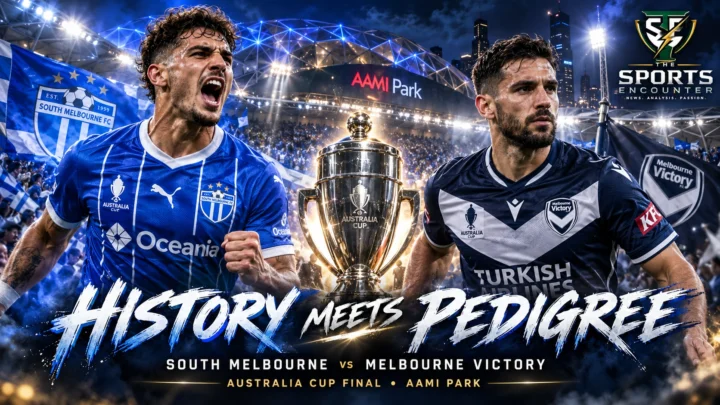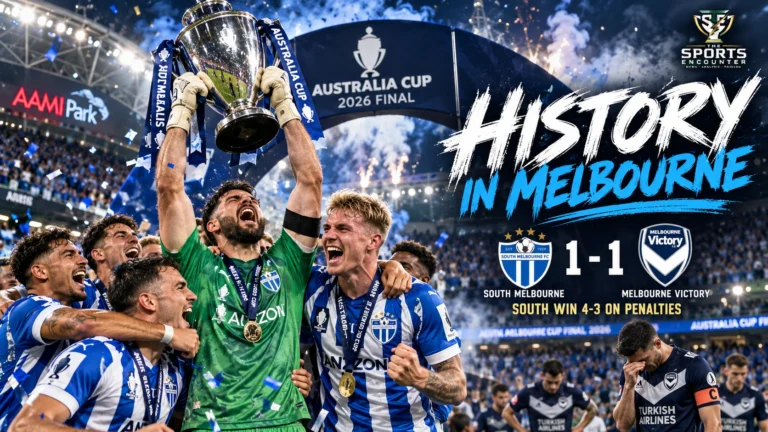
MELBOURNE, Australia, October 10, 2026: South Melbourne have written one of the greatest underdog stories in Australian soccer history, defeating Melbourne Victory 4-3 on penalties in the Australia Cup 2026 final after a dramatic 1-1 draw at AAMI Park on Saturday, October 10. Max Mikkola’s 117th-minute equalizer rescued the former National Soccer League giants after Denis Genreau had put Victory ahead in extra time. Goalkeeper Javier López then became the hero of a remarkable shootout, helping South Melbourne become the first non-A-League club to win the modern national competition in front of a record 29,911 spectators.
The triumph carried extraordinary historical significance. South Melbourne, four-time champions of the former National Soccer League, had spent more than two decades outside Australia’s top domestic division following the introduction of the A-League in 2005. Melbourne Victory, meanwhile, had won the Australia Cup twice and entered their fourth final seeking another major trophy. For 120 minutes, the two Melbourne clubs represented competing chapters of Australian soccer history. When Victory captain Jason Davidson fired the decisive penalty over the crossbar, South Melbourne completed a victory that reignited debate about the country’s professional league structure, competitive opportunities for historic clubs, and the relationship between the national game and its traditional supporters.
Australia Cup 2026 Final: South Melbourne 1-1 Melbourne Victory, 4-3 on Penalties
South Melbourne’s first Australia Cup title arrived through the competition’s first final decided by a penalty shootout.
The two teams were goalless after regulation time. Genreau eventually broke the deadlock five minutes into extra time, but South refused to accept defeat and equalized through substitute Mikkola with just three minutes remaining.
Story at a glance
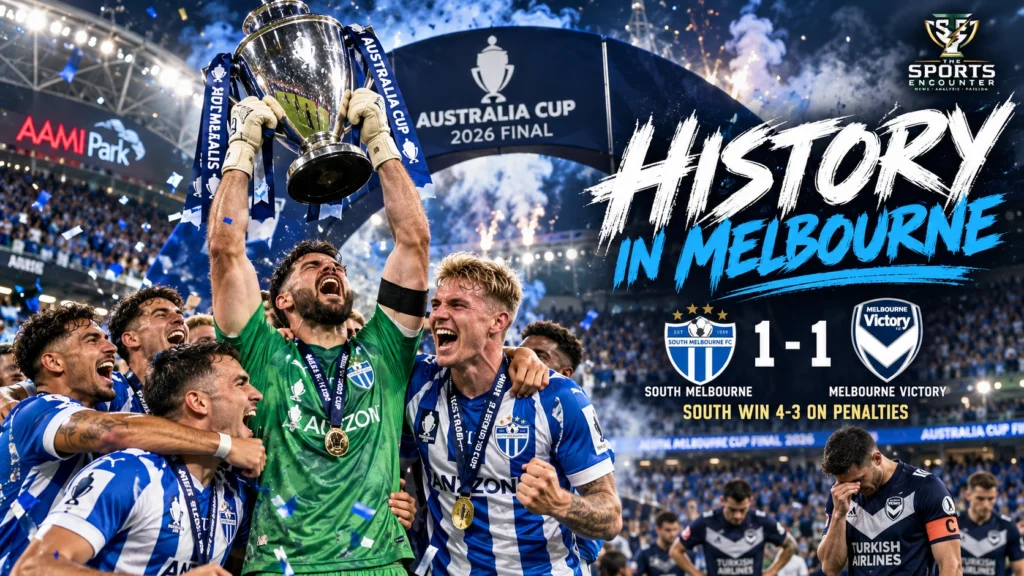
Australia Cup 2026 Final: South Melbourne 1-1 Melbourne Victory, 4-3 on Penalties
South Melbourne’s first Australia Cup title arrived through the competition’s first final decided by a penalty shootout.
How South Melbourne Took the Game to Their A-League Opponents
South Melbourne began the final with considerably more ambition than might have been expected from a club competing outside the professional A-League.
Denis Genreau’s Extra-Time Goal Put Melbourne Victory Within Reach of the Cup
Five minutes into extra time, Victory finally found the breakthrough.
Max Mikkola’s 117th-Minute Equalizer Changes Everything
With only three minutes of extra time remaining, South Melbourne produced the moment that transformed the final.
Javier López Wins the Penalty-Shootout Battle
The final became the first Australia Cup decider to be settled through a penalty shootout.
The shootout provided one final twist when López denied former South Melbourne player Harrison Sawyer twice from the same penalty, the first save having been ruled invalid because the goalkeeper left his line early.
South converted all four of their spot kicks before Davidson missed the fifth attempt for Victory.
| Match Detail | Confirmed Information |
|---|---|
| Competition | Hahn Australia Cup 2026 |
| Round | Final |
| Date | Saturday, October 10, 2026 |
| Venue | AAMI Park, Melbourne |
| Attendance | 29,911 |
| Halftime | South Melbourne 0-0 Melbourne Victory |
| After 90 minutes | 0-0 |
| After extra time | 1-1 |
| Penalty shootout | South Melbourne won 4-3 |
| Melbourne Victory scorer | Denis Genreau, 95′ |
| South Melbourne scorer | Max Mikkola, 117′ |
| Winning manager | Siniša Cohadžić |
| Melbourne Victory manager | Giovanni Savarese |
| Referee | Alireza Faghani |
| Mark Viduka Medal | Javier López, South Melbourne |
| Mike Cockerill Medal | Marco Jankovic, South Melbourne |
Football Australia’s official Australia Cup final report confirms the goals, decisive penalty sequence, team selections and historic attendance.
How South Melbourne Took the Game to Their A-League Opponents
South Melbourne began the final with considerably more ambition than might have been expected from a club competing outside the professional A-League.
Coach Cohadžić started Bul Juach and Jordon Lampard, bringing the attacking threat that had transformed South’s semifinal campaign into the biggest match of the season.
Within the opening quarter-hour, the underdogs had demonstrated that they were prepared to challenge Victory rather than retreat into a purely defensive formation.
Yuki Uchida became particularly influential down the flank.
In the 14th minute, he reached the byline and delivered a dangerous low ball across the face of goal. Jack Painter-Andrews was unable to connect at the far post, but the move exposed the vulnerability of Victory’s defense when South attacked quickly through wide areas.
Uchida continued causing problems, creating another dangerous crossing opportunity that Juach narrowly failed to reach.
South’s attacking willingness mattered because it prevented Victory from establishing the sustained territorial control that might have been expected from the A-League side.
The opening half became an exchange of opportunities rather than a prolonged spell of professional dominance.
Javier López Keeps South Melbourne Alive
Although South made the stronger early impression, Melbourne Victory gradually created the clearer scoring chances.
Keegan Jelacic threatened after a dangerous turnover, but was unable to find a teammate in front of goal.
Brazilian attacker Clarismario Santos subsequently became a major problem for South’s defense.
One powerful attempt forced López into an outstanding intervention, with the goalkeeper turning the ball onto the post.
He made another save from Santos as Victory tried to establish an advantage before halftime.
The score remained 0-0, but South already had reason to recognize that their goalkeeper would play a central role in determining the final.
Victory emerged strongly after the interval, forcing South’s defenders into repeated blocks and clearances.
Thomas Giannakopoulos and captain Marco Jankovic contributed important interventions, while López remained composed when defending crosses, set pieces and shots through crowded areas.
The 78th-Minute Save That Changed the Final
Victory’s best opportunity of regulation time arrived in the 78th minute.
Guillermo May created the opening, delivering the ball into the path of Santos close to goal.
The Brazilian appeared to have the opportunity to break the deadlock from close range.
His contact was imperfect, however, and López reacted brilliantly to prevent what had seemed a likely opening goal.
The importance of that moment became apparent much later.
Had Victory scored, South Melbourne would have been forced to chase the match during the closing stages of regulation time.
Instead, they survived to reach extra time.
At the end of 90 minutes, the final remained goalless, with both clubs still two periods of extra time away from a possible penalty shootout.
Denis Genreau’s Extra-Time Goal Put Melbourne Victory Within Reach of the Cup
Five minutes into extra time, Victory finally found the breakthrough.
A delivery into South Melbourne’s penalty area reached Denis Genreau, who reacted instinctively under pressure.
The midfielder adjusted his body and produced an improvised, acrobatic half-volley that looped toward goal.
The ball struck the underside of the crossbar and crossed the line before López could prevent it from entering the net.
After 95 minutes of frustration, Melbourne Victory led 1-0.
It was a goal worthy of winning a national final.
Genreau had entered the match as a second-half substitute, replacing Matthew Grimaldi in the 57th minute.
His arrival gave Victory another technically capable player in attacking midfield, and his finish appeared to vindicate Savarese’s decision.
For South Melbourne, the consequences were severe.
The club had worked for years to return to a national championship stage. It had survived four difficult knockout rounds and resisted Victory’s pressure throughout regulation time.
Now it faced the possibility of losing the final to one extraordinary piece of attacking improvisation.
Why South Refused to Collapse After Conceding
South Melbourne’s response reflected a quality that had defined their entire Australia Cup campaign.
They continued attacking even after falling behind.
Juach created another dangerous moment when he dispossessed Jason Davidson in an advanced position and fired against the crossbar.
Victory also threatened to extend their advantage.
After a corner, Davidson kept the ball alive near the far post and found Michael Ghossain, whose header struck the woodwork.
Both teams had opportunities to settle the contest before the final minutes.
Neither could.
As the clock approached 120 minutes, Melbourne Victory remained in front, but South Melbourne were still committing players forward.
Max Mikkola’s 117th-Minute Equalizer Changes Everything
With only three minutes of extra time remaining, South Melbourne produced the moment that transformed the final.
Substitute Jordan Swibel attacked down the right and delivered a dangerous ball toward the far post.
Juach met the opportunity, but his shot was blocked.
The loose ball fell to Max Mikkola, who reacted quickest and forced it into the net.
South Melbourne 1-1 Melbourne Victory.
AAMI Park erupted.
Mikkola had entered the match in the 76th minute, replacing Arran Cocks.
Swibel had also come from the bench, replacing Sebastian Pasquali during extra time.
Neither started the final, yet both contributed directly to its defining attacking sequence.
That highlights the importance of Cohadžić’s substitutions.
South needed players capable of bringing fresh energy into a match that had already passed two hours of demanding football.
Swibel created the final opening, Juach forced the defensive intervention, and Mikkola converted the resulting chance.
The equalizer also revealed something important about the teams’ contrasting approaches to the closing stages.
Victory had moved ahead but could not eliminate South’s attacking threat.
South, meanwhile, continued committing players into dangerous positions despite knowing that every unsuccessful attack reduced the time available for a recovery.
The decision to keep attacking was rewarded.
Javier López Wins the Penalty-Shootout Battle
The final became the first Australia Cup decider to be settled through a penalty shootout.
Both clubs had previously survived shootouts on their way through the tournament, but the experience of deciding a national championship from the penalty spot introduced a different level of pressure.
South Melbourne took their penalties with remarkable composure.
Marco Jankovic, Jordan Swibel, James Lackey and Andrew Mesourouni all converted.
Victory converted three attempts but missed twice, with the two failures determining the championship.
Harry Sawyer’s Twice-Saved Penalty
The shootout’s most unusual incident involved Harrison Sawyer, a former South Melbourne player who had joined Victory during the offseason.
Sawyer stepped forward for Victory’s second penalty.
López correctly anticipated his effort and made the save.
However, the goalkeeper was adjudged to have moved off his goal line too early, meaning the penalty had to be retaken.
Sawyer received another opportunity.
López saved again.
For South Melbourne, the sequence provided a significant advantage.
For Victory, it was a devastating missed opportunity to restore control of the shootout.
Jason Davidson Misses the Decisive Penalty
The final penalty added a remarkable personal dimension to the contest.
Victory captain Jason Davidson is the son of Alan Davidson, one of South Melbourne’s celebrated players from its National Soccer League history.
Now representing Victory in a final against his father’s former club, Jason had to convert to keep his team’s hopes alive.
He stepped forward and sent his attempt over the crossbar.
South Melbourne were champions.
The penalty brought the contest to an abrupt conclusion, with players, coaches and supporters celebrating a result that had seemed out of reach only minutes earlier.
Australia Cup Final 2026 Penalty Shootout Summary
| Team | Penalty Record | Key Details |
|---|---|---|
| South Melbourne | 4 scored, 0 missed | Marco Jankovic, Jordan Swibel, James Lackey and Andrew Mesourouni converted |
| Melbourne Victory | 3 scored, 2 missed | Harrison Sawyer was denied by López; Jason Davidson missed over the crossbar |
| Result | South Melbourne win 4-3 | South Melbourne did not need to take a fifth penalty |
Javier López: The Goalkeeper Who Carried South Melbourne Across the Line
Javier López was named the Mark Viduka Medallist as the outstanding player of the final.
The honor was richly deserved.
His contribution extended far beyond the penalty shootout.
He repeatedly protected South Melbourne when Victory created better shooting opportunities, particularly through Santos.
His interventions in regulation time kept the underdogs in contention long enough for their substitutions to influence the final.
He then helped secure the title through his saves against Sawyer.
Importantly, López demonstrated two different goalkeeping qualities during the match.
In open play, he relied on positioning, reactions and the ability to control dangerous situations inside the penalty area.
During the shootout, he needed anticipation, concentration and composure after being instructed to face the same penalty a second time.
Saving a penalty once is difficult enough.
Saving its retake, with the same opponent given another opportunity to adjust, was an exceptional contribution.
That is why López’s performance deserves to be remembered as one of the defining goalkeeping displays in Australia Cup final history.
Max Mikkola, Bul Juach and Jordan Swibel: South Melbourne’s Other Heroes
Max Mikkola: The Substitute Who Refused to Accept Defeat
Mikkola’s equalizer provided the emotional turning point of the final.
He did not require an elaborate attacking sequence or spectacular technique.
He needed the anticipation to reach the loose ball before Victory’s defenders could recover.
His finish ensured South Melbourne remained alive in the competition long enough for López to influence the outcome.
Although the goalkeeper received the individual match award, the late equalizer was the moment that made the shootout possible.
Bul Juach: The Attacking Threat Victory Never Fully Contained
Juach entered the final as one of the competition’s most dangerous players.
His extraordinary semifinal performance against Lions FC had already established his importance.
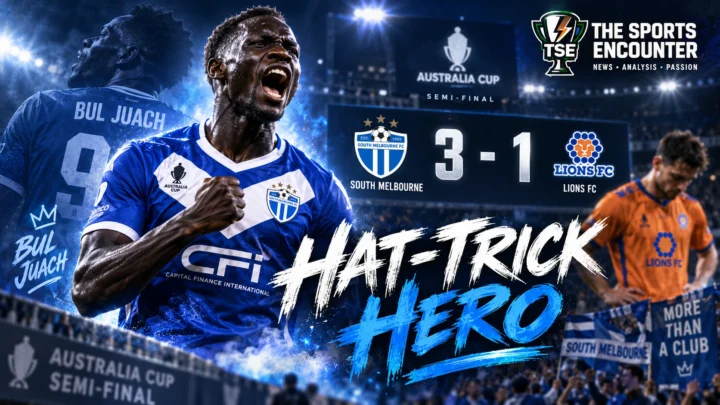
South Melbourne trailed 1-0 at halftime in that match before Juach came off the bench and scored three times to complete a 3-1 comeback.
The Sports Encounter’s detailed report on Juach’s semifinal hat trick explained how his introduction changed the tempo and attacking structure of the contest.
Against Victory, Juach started rather than entering as a substitute.
His direct running and physical presence caused problems from the opening stages.
Although he did not score in the final, he struck the crossbar after winning the ball from Davidson and contributed to the attacking sequence that produced Mikkola’s equalizer.
His influence cannot be measured simply through the goals column.
Jordan Swibel: The Cross That Saved South Melbourne’s Dream
Swibel’s intervention was particularly important because of the timing.
He entered during extra time, when the match had already become physically demanding and South needed a more direct route into Victory’s penalty area.
His delivery created the opportunity from which Mikkola scored.
He then converted during the penalty shootout.
Those contributions turned a relatively brief appearance into one of the most consequential individual performances of the evening.
Marco Jankovic: Leadership at the Heart of the Defense
Captain Marco Jankovic provided another important foundation for South Melbourne’s success.
He was instrumental in protecting the penalty area during periods of sustained Victory pressure.
His blocks, positioning and defensive leadership contributed to keeping the match scoreless through regulation time.
He also converted his penalty in the shootout.
Jankovic received the Mike Cockerill Medal, recognizing his outstanding contribution as a Member Federation player during the competition.
The award reflected his influence throughout South Melbourne’s remarkable run.
Melbourne Victory: Genreau Delivers, but the Third Cup Slips Away
For Melbourne Victory, the final ended in considerable frustration.
Giovanni Savarese’s team had entered the match as the more established professional side and possessed several players with experience of major domestic and international competition.
Victory had already won the Australia Cup in 2015 and 2021, with another final appearance ending in defeat against Macarthur FC in 2024.
Victory were therefore pursuing a third title in their fourth final.
Genreau’s goal appeared to put that achievement within reach.
But their failure to convert chances during regulation time, followed by the late equalizer, allowed South Melbourne to remain competitive.
Santos Will Remember His Missed Opportunities
Clarismario Santos was one of Victory’s most dangerous attacking players.
He forced important saves from López and repeatedly threatened South’s goal.
The 78th-minute opportunity will be particularly painful because it offered Victory a relatively clear chance to take the lead before extra time.
When a cup final ends in defeat on penalties, earlier opportunities often become more significant in retrospect.
Santos had the ability to change the scoreline while Victory still had time to manage a potential lead.
South survived those moments.
Why Victory Could Not Protect Genreau’s Lead
Victory’s late failure reflected a combination of South Melbourne’s persistence and the difficulty of protecting a narrow advantage under pressure.
After scoring in extra time, Victory had opportunities to extend their lead.
Ghossain struck the woodwork with a header, while South continued attacking through Juach and their substitutes.
Victory could not clear the final dangerous sequence before Mikkola equalized.
That does not mean their entire extra-time approach was ineffective.
It means the narrow lead offered no protection against one decisive attacking moment.
Melbourne Victory’s official post-match report confirmed the 1-1 score after extra time and the 4-3 shootout defeat.
South Melbourne’s Victory Reunites Two Eras of Australian Soccer
The historical significance of the final goes far beyond South Melbourne winning a national trophy.
Founded in 1959 by Greek migrants, South Melbourne became one of the most prominent clubs in the country’s former National Soccer League.
The club won four NSL championships and competed at the 2000 FIFA Club World Championship.
It developed a reputation built around strong community support, ambitious soccer and a distinctive identity within Australian sporting culture.
Among the figures associated with South Melbourne’s history is Ange Postecoglou, who played for the club and later coached it to national success before becoming one of Australia’s most internationally recognized managers.
When the National Soccer League ended in 2004 and the A-League was established in 2005, South Melbourne did not become part of the new national competition.
Melbourne Victory emerged as one of the most successful clubs of that new professional era.
For more than two decades, the clubs occupied different levels of the Australian domestic structure despite representing the same city.
The Australia Cup finally brought them together in a national final.
For supporters of South Melbourne, defeating Victory was therefore more than an upset against stronger opposition.
It was an opportunity to demonstrate that the country’s established soccer traditions still possessed competitive strength and public support.
Why the Result Matters to the A-League Debate
South Melbourne have repeatedly expressed ambitions to compete in Australia’s top domestic division.
The club’s exclusion from the A-League structure has remained a sensitive issue for supporters who believe its history, infrastructure and community backing justify greater opportunities.
The Australia Cup victory gives those arguments renewed visibility.
However, winning the tournament does not automatically secure an A-League license.
League expansion, licensing, financial requirements and competition governance remain separate processes.
The final has provided sporting evidence that South Melbourne can defeat elite domestic opposition in a major national match.
Whether that contributes to a future place in the A-League will depend on decisions beyond the Australia Cup.
That distinction matters because a historic victory should not be presented as automatic confirmation of a structural reform that has not been approved.
29,911 Spectators: The Australia Cup Final Sets a New Attendance Record
The atmosphere at AAMI Park provided another powerful statement about the appeal of the matchup.
The official attendance was 29,911.
That established a new Australia Cup final attendance record and was also reported as the largest crowd for a sporting event at AAMI Park.
The previous Australia Cup final record was 18,751, set in 2016 when Melbourne City defeated Sydney FC at the same venue.
| Attendance Benchmark | Spectators |
|---|---|
| 2016 Australia Cup Final | 18,751 |
| 2026 Australia Cup Final | 29,911 |
| Increase | 11,160 |
| Percentage increase | Approximately 59.5% |
TSE calculation: The October 10 crowd exceeded the previous final record by 11,160 spectators, an increase of approximately 59.5%.
The figure matters because the final brought together teams from different levels of Australian soccer, rather than two A-League clubs.
It challenges assumptions that lower-tier clubs necessarily lack the public interest required to generate major national occasions.
At the same time, one sellout final cannot establish what attendance South Melbourne would attract across an entire professional league season.
The event provides compelling evidence of demand for this particular matchup. Consistent league support would require further measurement.
South Melbourne’s Road to the Australia Cup: Four Knockout Battles and One Historic Final
South Melbourne entered the national rounds directly after winning the inaugural 2025 Australian Championship.
Their subsequent campaign demonstrated an ability to win through different kinds of adversity.
| Round | Opponent | Result | Decisive Story |
|---|---|---|---|
| Round of 32 | Adelaide United | 2-1 | South eliminated established A-League opposition |
| Round of 16 | Fremantle City | 3-3, won 3-1 on penalties | Jake Charlston saved three penalties |
| Quarterfinal | Preston Lions | 2-1 | Arran Cocks completed a comeback victory |
| Semifinal | Lions FC | 3-1 | Bul Juach scored a second-half hat trick |
| Final | Melbourne Victory | 1-1, won 4-3 on penalties | Mikkola equalized late; López starred in the shootout |
The Fremantle City Escape
The Round of 16 nearly ended South Melbourne’s campaign.
South took an early 2-0 lead before Fremantle City fought back to move 3-2 ahead.
Juach converted a penalty to restore parity.
The match remained 3-3 after extra time, and goalkeeper Jake Charlston saved three penalties to keep South alive.
That experience was an early demonstration of the team’s ability to survive when the contest stopped unfolding according to plan.
The Preston Lions Comeback
South Melbourne’s quarterfinal against Preston Lions presented a different challenge.
The two Victorian clubs were familiar with each other from domestic competition.
Preston moved ahead, but Jack Painter-Andrews equalized before Arran Cocks completed a 2-1 comeback.
The Sports Encounter’s quarterfinal analysis of South Melbourne and Preston Lions examined the tactical and emotional significance of that rivalry before the teams met.
The Semifinal That Made the Dream Possible
South Melbourne’s semifinal against Lions FC became another demonstration of resilience.
Trailing 1-0 at halftime, Cohadžić introduced Juach and changed the attacking rhythm.
Three goals later, South were through to the final.
Our earlier analysis of the semifinal matchup examined the strengths of the two Member Federation clubs and the significance of their route through the national bracket.
The final against Victory completed a pattern that had been present throughout the campaign.
South Melbourne repeatedly faced situations in which defeat appeared possible.
They repeatedly found a response.
How Melbourne Victory Reached Their Fourth Australia Cup Final
Victory arrived at the final through a more established professional pathway, but their campaign also contained demanding knockout challenges.
| Round | Opponent | Result |
|---|---|---|
| Round of 32 | Kingborough Lions United | 4-0 |
| Round of 16 | Western Sydney Wanderers | 1-1, won 3-2 on penalties |
| Quarterfinal | APIA Leichhardt | 1-0 after extra time |
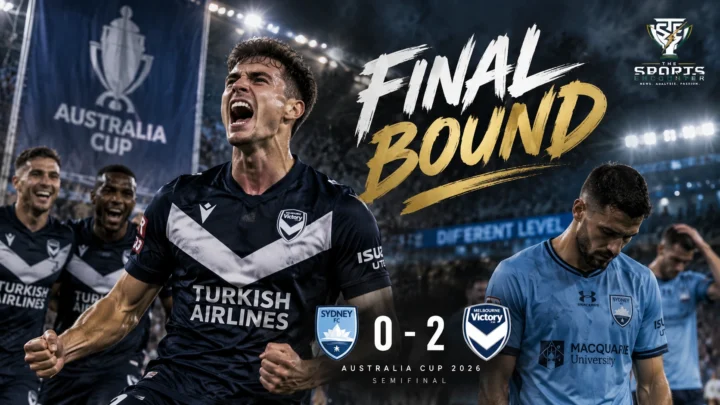
| Semifinal | Sydney FC | 2-0 |
| Final | South Melbourne | 1-1, lost 3-4 on penalties |
The Round of 16 required a penalty shootout against Western Sydney Wanderers, during which goalkeeper Jack Duncan made three saves.
Victory then needed extra time to eliminate APIA Leichhardt.
Sawyer scored the decisive goal in the quarterfinal, continuing an important sequence of knockout contributions.
The Sports Encounter’s report on Victory’s quarterfinal victory over APIA examined why Sawyer was becoming an influential player in high-pressure matches.
Before that game, our APIA Leichhardt vs Melbourne Victory preview identified the risk of another Member Federation upset.
Victory’s Semifinal Victory Over Sydney FC
Victory’s semifinal against Sydney FC produced a more controlled result.
Keegan Jelacic opened the scoring inside two minutes.
Jordan Courtney-Perkins subsequently scored an own goal as Victory secured a 2-0 win.
The Sports Encounter’s full semifinal report documented how Victory established an early advantage and prevented Sydney from converting pressure into goals.
The match had followed Sydney’s narrow quarterfinal victory against SD Raiders, analyzed in our report on Takahiro Sekine’s decisive goal.
Victory therefore reached AAMI Park having survived both penalties and extra time earlier in the competition.
Their eventual defeat illustrated how those experiences do not guarantee success when a final reaches the same pressure points.
Why the Final’s Tactical Story Was More Complicated Than an Underdog Upset
The conventional explanation would focus on a lower-tier team frustrating its professional opponent until penalties.
That does not adequately describe this contest.
South Melbourne attacked Victory from the opening stages and created opportunities through wide players.
Uchida repeatedly threatened with deliveries from advanced areas, while Juach offered a direct attacking reference point.
Victory created more dangerous chances during important passages of the match, especially through Santos and the introductions of Genreau and May.
But South’s refusal to surrender attacking territory meant Victory were never completely comfortable.
Three Tactical Turning Points
| Turning Point | What Changed | Why It Mattered |
|---|---|---|
| López’s 78th-minute save | South prevented Victory from taking a late regulation-time lead | Kept the match alive for extra time |
| Genreau’s extra-time opener | Victory gained the advantage after prolonged pressure | Forced South Melbourne into a final attacking response |
| Swibel, Juach and Mikkola combine | South’s substitutes helped create the 117th-minute equalizer | Sent the final to penalties and reopened the championship |
These moments reveal the importance of both goalkeeping and substitution strategy.
Victory possessed enough attacking quality to score an exceptional goal.
South possessed enough organization and resilience to remain within reach, then used fresh players to exploit one of the last opportunities available.
The shootout ultimately rewarded the team that maintained greater composure from the penalty spot.
Australia Cup Final Team Sheets
Both managers made important personnel decisions before and during the final.
South Melbourne Starting XI
| No. | Player |
|---|---|
| 1 | Javier López (GK) |
| 3 | Jordon Lampard |
| 4 | Marco Jankovic (Captain) |
| 7 | David Yoo |
| 10 | Bul Juach |
| 11 | Yuki Uchida |
| 16 | Arran Cocks |
| 17 | Thomas Giannakopoulos |
| 21 | Sebastian Pasquali |
| 23 | Jacob Eliopoulos |
| 27 | Jack Painter-Andrews |
Manager: Siniša Cohadžić.
Key substitutes used: Paulo Retre, Max Mikkola, Hassan Ramazani, Andrew Mesourouni, Jordan Swibel and James Lackey.
Melbourne Victory Starting XI
| No. | Player |
|---|---|
| 25 | Jack Duncan (GK) |
| 3 | Jason Davidson (Captain) |
| 8 | Jordi Valadon |
| 11 | Clerismario Santos |
| 14 | Matthew Grimaldi |
| 15 | Thomas Lockyer |
| 16 | Joshua Inserra |
| 18 | Franco Lino |
| 22 | Xavier Stella |
| 23 | Keegan Jelacic |
| 44 | Charles Nduka |
Manager: Giovanni Savarese.
Key substitutes used: Denis Genreau, Guillermo May, Harrison Sawyer, Michael Ghossain, Philipp Ziereis and Harrison Shillington.
Australia Cup Final 2026: The First Final With VAR
The final also represented a significant officiating milestone.
Football Australia introduced Video Assistant Referee support for an Australia Cup match for the first time.
Alireza Faghani was appointed as referee, supported by assistant referees Luke Gennimatas and Claire Green.
Shaun Evans served as VAR, assisted by Maddy Allum.
The official Football Australia refereeing announcement confirmed the appointments and the historic introduction of VAR to the competition.
The shootout incident involving Sawyer and López underlined the importance of consistently applying penalty-kick regulations.
When a goalkeeper moves off the goal line too early and the applicable conditions for a retake are met, the original attempt may have to be repeated.
In this case, the decision gave Sawyer another opportunity, but López successfully saved the second effort.
The unusual sequence became one of the final’s defining incidents.
What Does South Melbourne’s Australia Cup Victory Mean for Asia?
The Australia Cup offers a route into continental competition through the AFC Champions League Two.
Under the tournament’s 2026 qualification framework, the champion is allocated a pathway toward the 2027-28 edition, subject to the applicable eligibility and club-licensing requirements.
South Melbourne’s win therefore has potential consequences beyond domestic soccer.
However, a Cup title and confirmed participation in an AFC competition are not necessarily identical administrative milestones.
Any continental participation must satisfy the relevant regulations, licensing criteria and competition-entry approvals.
South Melbourne also have an unusual position in regional club soccer.
The club has participated in the Oceania Football Confederation’s professional club competition and has been confirmed for the 2027 OFC Pro League.
Its domestic Cup success consequently raises important questions about how its future regional commitments and eligibility arrangements will operate.
Those issues should be addressed through official competition confirmations rather than assumptions about automatic entry.
What Happens Next for South Melbourne and Melbourne Victory?
For South Melbourne, the immediate achievement is clear.
The club has won its first Australia Cup and become the first Member Federation representative to lift the modern trophy.
The victory strengthens its sporting reputation, gives supporters a landmark national achievement and creates renewed attention around its ambitions for a place in Australia’s highest domestic league.
Whether it leads to structural change remains unresolved.
For Melbourne Victory, the defeat was a painful missed opportunity to win a third Australia Cup and claim early silverware under Savarese.
The club must also prepare for the demands of its domestic and continental commitments.
Its performance in the final contained positives, including the chances created through Santos and Genreau’s outstanding goal.
But failing to finish those opportunities and then conceding in the closing minutes demonstrated how little protection a narrow lead provides in knockout soccer.
The Sports Encounter Verdict: South Melbourne Won More Than a Trophy
South Melbourne’s Australia Cup victory will be remembered for the drama of its conclusion.
Genreau’s acrobatic goal appeared to have settled the contest.
Mikkola equalized in the 117th minute.
López saved Sawyer’s penalty twice.
Davidson missed the decisive spot kick.
Those moments alone would make the match memorable.
But the longer-term significance lies in what the final demonstrated about Australian soccer’s competitive structure.
A club outside the A-League defeated a leading professional opponent in a national final played before almost 30,000 supporters.
Its victory followed earlier eliminations of Adelaide United and several demanding matches against other Member Federation clubs.
South Melbourne did not arrive at AAMI Park through a single fortunate result.
They earned their place across an entire knockout campaign.
The achievement also brought together two eras that Australian soccer has often treated as separate: the community-driven National Soccer League tradition and the modern professional A-League.
One result cannot settle the debate over expansion, promotion, licensing or the best structure for Australian domestic soccer.
It can, however, provide compelling evidence that competitive ambition and passionate public support remain alive outside the established professional competition.
South Melbourne waited more than two decades for an opportunity to prove their strength on a stage of this magnitude.
When the opportunity came, they converted it into history.
Continue the Australia Cup Story
 Australia CupAustralia Cup 2026: South Melbourne Take On Lions FC with Final Place and History on the Line
 Australia CupMelbourne Victory Thump Sydney FC 2-0 to Storm into Australia Cup Final
 Australia CupSydney FC Meet Melbourne Victory for a Place in Australia Open Final: Can the Big Blue Deliver Another Jubilee Classic?
Frequently Asked Questions About the Australia Cup 2026 Final
Who won the Australia Cup 2026 final?
South Melbourne FC won the Australia Cup 2026 final, defeating Melbourne Victory 4-3 on penalties after a 1-1 draw following extra time at AAMI Park on October 10, 2026.
Who scored in South Melbourne vs Melbourne Victory?
Denis Genreau gave Melbourne Victory the lead in the 95th minute. South Melbourne substitute Max Mikkola equalized in the 117th minute.
What was the final score after extra time?
The match finished South Melbourne 1-1 Melbourne Victory after extra time. South Melbourne then won the penalty shootout 4-3.
Who was the player of the match?
South Melbourne goalkeeper Javier López received the Mark Viduka Medal after making several important saves during the match and twice stopping Harrison Sawyer’s penalty attempt, including the retake.
Who missed penalties for Melbourne Victory?
Harrison Sawyer had his penalty saved by Javier López and was denied again when it was retaken. Captain Jason Davidson subsequently sent Victory’s final attempt over the crossbar.
Why was Harrison Sawyer allowed to retake his penalty?
The first attempt was ordered retaken because Javier López was adjudged to have moved off his goal line too early. López saved the second attempt as well.
How many fans attended the Australia Cup final?
The official attendance was 29,911 at AAMI Park, establishing a new Australia Cup final attendance record and a reported stadium record for a sporting event.
Has a non-A-League club won the Australia Cup before?
No. South Melbourne became the first club outside the A-League to win the modern Australia Cup, which began in 2014.
Does winning the Australia Cup qualify South Melbourne for the AFC Champions League Two?
The 2026 Australia Cup provides a qualification pathway to the 2027-28 AFC Champions League Two. South Melbourne’s participation remains subject to the applicable eligibility, licensing and entry requirements.