


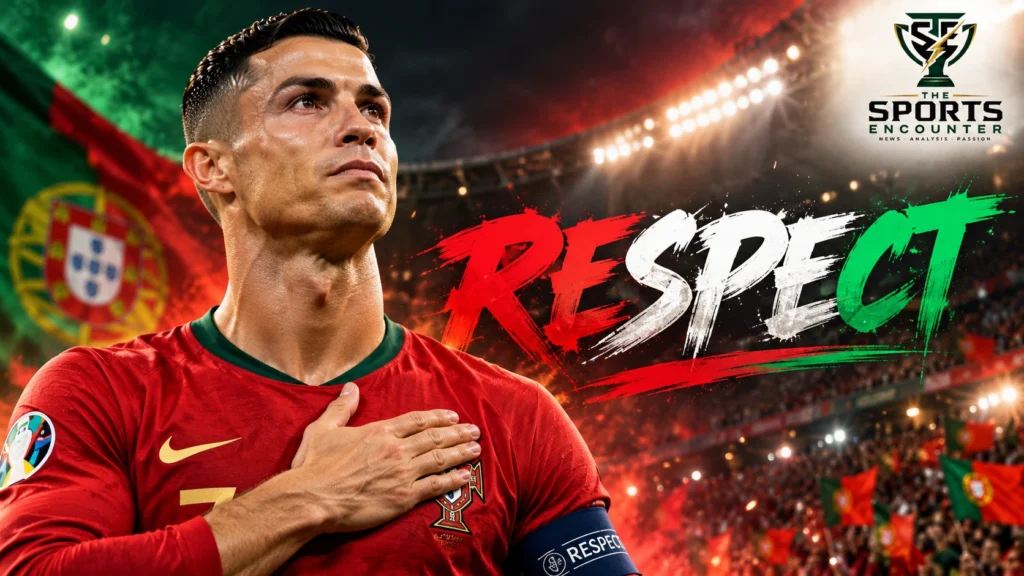
BUENOS AIRES, Argentina, October 8, 2026: Cristiano Ronaldo has paid a public tribute to Lionel Messi following the Argentine’s emotional retirement from international football, acknowledging the achievements of the rival who shared football’s biggest individual spotlight with him for nearly two decades.
The Portuguese captain responded to Messi’s farewell message on October 7, one day after the 39-year-old ended his Argentina career with a goal and two assists in a 3-0 friendly victory over Benin at the Estadio Monumental.
Messi’s final appearance drew more than 85,000 spectators and concluded a 21-year international journey that included the 2022 FIFA World Cup, two Copa América titles and an extraordinary collection of individual records.
Ronaldo, now 41, praised Messi’s contribution to Argentina and the enduring history he had created for his country.
The exchange carries additional significance because Ronaldo’s own international future remains unsettled following his disagreement with Portugal coach Jorge Jesus. Messi has completed his farewell, while the man whose career was compared with his for so long has yet to establish exactly how his Portugal story will end.
What Did Cristiano Ronaldo Say to Lionel Messi?
Ronaldo responded to Messi’s lengthy Instagram message with a personal expression of respect.
He congratulated Messi on his years representing Argentina, describing his achievements as a lasting part of the country’s football history.
The exchange attracted attention because of the extraordinary competitive history connecting the two players.
From their years at Barcelona and Real Madrid to their individual scoring records, Champions League performances, Ballon d’Or campaigns and international tournaments, Messi and Ronaldo have been measured against one another throughout their careers.
Ronaldo’s message acknowledged Messi’s Argentina achievements without reopening the familiar argument over which player should be considered the greatest.
That choice of emphasis matters.
Both men have built international careers that changed expectations for their countries. Messi helped Argentina return to the summit of world football in 2022. Ronaldo helped Portugal win its first major senior men’s international trophy at Euro 2016 and subsequently added Nations League titles.
Their records and individual accomplishments differ, but their influence on national-team football is beyond serious dispute.
TSE examined the competing arguments in its detailed Messi vs. Ronaldo career and legacy comparison, including the importance of World Cup success, longevity and scoring records.
Messi’s Final Argentina Match: One Goal, Two Assists and a Full Monumental
Messi’s farewell against Benin was organized to give Argentine supporters a final opportunity to watch their captain represent the national team.
His competitive international career had effectively concluded after Argentina lost 1-0 to Spain in the 2026 World Cup final.
Messi announced his retirement on August 31, but Argentina subsequently arranged the October 6 friendly at the Monumental to recognize his contribution in front of home supporters.
The occasion became an emotional celebration of a player who had represented Argentina since 2005.
Messi scored from the penalty spot and provided two assists as Argentina defeated Benin 3-0.
He finished his senior international career with 208 appearances and 126 goals.
His final match was therefore productive as well as ceremonial. Argentina’s former captain remained capable of influencing the result, creating opportunities and converting chances even at 39.
The official FIFA account of Messi’s farewell in Buenos Aires describes the significance of his final appearance and the emotional response inside the stadium.
TSE had previously examined why the Monumental was chosen for this occasion in its preview of Argentina’s farewell plans.
Why Did Messi Say He Already Missed Playing for Argentina?
In his October 7 message, Messi acknowledged that he already missed wearing Argentina’s colors despite believing retirement was the correct decision.
He reflected on the sacrifices involved in representing his country, the support of his family, teammates, coaches and clubs, and the emotional weight of a career that had included both disappointment and extraordinary success.
Messi also paid tribute to Diego Maradona, whose legacy had shaped the expectations surrounding every great Argentine footballer who followed him.
The emotional complexity of his decision is understandable.
Messi had spent more than half his life representing Argentina at senior international level. National-team camps, qualifying campaigns and major tournaments had become recurring parts of his professional and personal identity.
Retirement ends those routines while leaving the player’s attachment to the team and its supporters intact.
Messi’s remarks also offer a perspective on the decision he announced in August.
He appears comfortable with his choice, but that does not mean leaving the national team has been easy.
How Messi’s Argentina Career Changed From Criticism to World Cup Glory
The acclaim surrounding Messi’s farewell contrasts sharply with the pressure he faced during the early and middle years of his international career.
Argentina reached major finals without winning the trophies its supporters demanded.
The 2014 World Cup defeat to Germany was followed by losses to Chile in the 2015 and 2016 Copa América finals.
Messi briefly retired from international football in 2016 before returning to continue his pursuit of a major title.
That decision eventually led to a sequence of historic achievements.
Argentina won the Copa América in 2021, the Finalissima in 2022, the FIFA World Cup later that year and another Copa América in 2024.
The 2022 World Cup victory in Qatar was especially important because it ended Argentina’s 36-year wait for a third world championship.
Messi subsequently returned for the 2026 tournament at 39, helping Argentina reach another final before Spain won in extra time.
His international career therefore ended with a very different public understanding of his achievements from the one that surrounded the repeated final defeats of the previous decade.
FIFA’s retrospective on Messi’s Argentina career traces that progression through setbacks, international titles and the final retirement announcement.
TSE’s original report on Messi’s August retirement examined how his international legacy changed after the World Cup triumph and subsequent records.
Messi’s International Career at a Glance
| Milestone | Details |
|---|---|
| Senior Argentina debut | 2005 |
| Final international appearance | October 6, 2026, against Benin |
| Senior appearances | 208 |
| Senior international goals | 126 |
| FIFA World Cup titles | 1, in 2022 |
| Copa América titles | 2, in 2021 and 2024 |
| Finalissima titles | 1, in 2022 |
| Final Argentina match | 3-0 victory over Benin; one goal and two assists |
| International retirement | Announced August 31, 2026; farewell match October 6 |
Why Ronaldo’s Tribute Carries More Weight in October 2026
Ronaldo’s message comes at a sensitive moment in his own international career.
The Portugal captain recently left the national team’s training camp following a disagreement with coach Jorge Jesus over his role and playing time.
Ronaldo has publicly criticized what he considers failures to honor previous discussions about his participation.
The disagreement has generated questions about whether his international career can continue under the current management structure.
However, Ronaldo has not announced his retirement from Portugal.
The distinction is essential because Portugal has continued performing successfully without him.
Jesus’ team won its first four matches of the 2026-27 UEFA Nations League, securing qualification for the quarterfinals and climbing to fifth in the FIFA men’s world rankings.
Those results have given Portugal a different kind of selection challenge.
The national team has demonstrated that it can score goals and win competitive matches without organizing its attack around Ronaldo.
That does not eliminate his experience or remaining scoring ability. It does mean his future role must be considered alongside the performances of players who have succeeded in his absence.
TSE examined these developments in its analysis of Portugal’s rise to fifth in the FIFA rankings.
Can Ronaldo Still Return to Portugal?
A return remains possible, but it is not confirmed.
Ronaldo has indicated that he does not consider his international career finished, while Jesus has left open the possibility of further involvement.
Any return would require the parties to establish a workable understanding of selection, playing time and the responsibilities attached to the captaincy.
Portugal also faces a footballing decision.
Gonçalo Ramos has contributed important goals during the Nations League campaign. João Félix, Bruno Fernandes and other attacking players have helped create a more varied forward structure.
Ronaldo remains one of the greatest scorers in the history of men’s international football, but Portugal must determine how to use his strengths within its current tactical approach.
His final World Cup ended in July when Spain defeated Portugal 1-0 in the Round of 16.
TSE’s complete retrospective on Ronaldo’s World Cup career examines the records he accumulated across six tournaments and the significance of his final appearance at the competition.
Messi and Ronaldo: Two International Careers Approaching Different Endings
Their latest exchange is particularly meaningful because both players have spent so long challenging the normal limits of elite football careers.
Messi remained central to Argentina’s attack until 39. Ronaldo represented Portugal at the 2026 World Cup at 41.
Their longevity reshaped expectations surrounding elite forwards and the age at which international retirement becomes inevitable.
However, their national-team situations are now different.
| Category | Lionel Messi | Cristiano Ronaldo |
|---|---|---|
| National team | Argentina | Portugal |
| Age in October 2026 | 39 | 41 |
| International status | Retired | Future participation unresolved |
| Final World Cup | 2026, runner-up | 2026, Round of 16 |
| Major senior international honors | 2022 World Cup, 2021 and 2024 Copa América, 2022 Finalissima | Euro 2016, 2019 and 2025 Nations League |
| Immediate national-team issue | Argentina’s succession and tactical transition | Selection and relationship with coach Jorge Jesus |
Messi received the opportunity to conclude his international career in front of an appreciative home crowd.
Ronaldo’s final World Cup ended in disappointment, and his subsequent Nations League situation has introduced new uncertainty.
That contrast makes his tribute to Messi significant without requiring assumptions about his own retirement plans.
What Does Messi’s Retirement Mean for Argentina?
Argentina must now develop a national-team structure that no longer includes Messi as its central creative influence.
That process involves more than assigning another player the No. 10 shirt.
Messi spent years determining where Argentina’s attacks developed, when the team slowed possession and how opportunities could be created against compact defensive lines.
He also attracted defensive attention that created space for teammates.
His departure changes the relationship between Argentina’s midfield and forward positions.
Julian Álvarez, Lautaro Martínez, Enzo Fernández, Alexis Mac Allister and the next generation of attacking players must assume greater collective responsibility.
Manager Lionel Scaloni faces the challenge of retaining the team’s competitive organization while allowing different players to establish themselves as creative leaders.
TSE examined those questions in its analysis of Argentina’s next generation after Messi.
Why Argentina Cannot Simply Replace Messi With One Player
Messi contributed goals, assists, ball progression, set-piece quality, positional flexibility and experience across six World Cups.
It would be unrealistic to expect one younger player to reproduce all those qualities immediately.
Argentina’s more sustainable approach will involve distributing creative duties across multiple positions.
That could include greater attacking responsibility for midfielders, more movement from the center-forward positions and different patterns of progression through the wide areas.
The transition is complicated by the fact that Messi remained highly productive until his final appearance.
Argentina has to replace current footballing contributions as well as a historical figure.
Does Ronaldo’s Message End the Messi vs. Ronaldo Debate?
Ronaldo’s respectful tribute is unlikely to end a debate that has lasted for almost two decades.
Fans have compared the players through goals, assists, individual awards, Champions League records, domestic titles, World Cup achievements and playing styles.
Those comparisons will remain part of football history.
However, Ronaldo’s message offers a useful perspective on how the players themselves can recognize each other’s achievements.
Respect for a rival’s accomplishments does not require agreement on every historical comparison.
Messi’s World Cup victory gives him a major distinction that Ronaldo never achieved, while Ronaldo retains extraordinary records of his own, particularly in men’s international scoring and Champions League history.
The full historical context of Messi’s contribution is examined in TSE’s 100-part retrospective on his career and legacy.
That history makes the latest exchange meaningful for supporters who spent years experiencing the rivalry through Barcelona, Real Madrid, Argentina and Portugal.
Ronaldo’s public acknowledgment also helps distinguish competitive ambition from personal respect.
The rivalry shaped an era. The players’ capacity to appreciate each other’s achievements is another part of its legacy.
What Happens Next for Ronaldo, Messi, Portugal and Argentina?
For Messi, the immediate future is club football with Inter Miami.
His international retirement does not mean he has retired from professional soccer.
Argentina will continue its preparation for future competitions without the player who defined its attack and leadership for more than two decades.
For Ronaldo, the next decisive developments concern Portugal’s November international fixtures and whether his relationship with the national-team coaching staff can be resolved.
Portugal is scheduled to complete its Nations League group campaign against Denmark and Wales in November.
The team’s recent success without Ronaldo gives Jesus selection options, but any decision about the captain’s involvement will attract extraordinary attention.
FIFA has documented the emotional and competitive significance of Messi’s departure in its official retrospective on his lasting Argentina legacy.
Frequently Asked Questions About Ronaldo’s Tribute to Messi
What Did Cristiano Ronaldo Say About Lionel Messi’s Retirement?
Ronaldo congratulated Messi on his extraordinary achievements with Argentina and publicly expressed his respect for the legacy he created representing his country.
When Did Lionel Messi Play His Final Argentina Match?
Messi made his final Argentina appearance on October 6, 2026, against Benin at the Estadio Monumental in Buenos Aires.
What Was the Result of Messi’s Farewell Match?
Argentina defeated Benin 3-0. Messi scored once and provided two assists.
How Many Games Did Messi Play for Argentina?
Messi completed his senior international career with 208 appearances.
How Many International Goals Did Messi Score?
Messi finished with 126 senior international goals for Argentina.
Has Cristiano Ronaldo Retired From Portugal?
No. As of October 8, 2026, Ronaldo has not announced his retirement from Portugal, although his future participation remains uncertain following a disagreement with national-team coach Jorge Jesus.
Why Did Ronaldo Leave Portugal’s Training Camp?
His departure followed a disagreement with Jorge Jesus over his role and playing time. Ronaldo subsequently criticized what he considered failures to honor earlier understandings.
Will Messi Continue Playing for Inter Miami?
Messi’s retirement concerns the Argentina national team. He remains an Inter Miami player, and his international farewell does not constitute retirement from club football.
Who Will Replace Messi in Argentina’s National Team?
Argentina has not identified a single direct replacement for Messi’s complete role. Lionel Scaloni must redistribute creative and leadership responsibilities among established players and emerging internationals.
A Rivalry That Helped Define an Era
Messi’s farewell and Ronaldo’s response arrived at a moment when both players are approaching the final stages of extraordinary careers.
Their paths have rarely followed identical timelines, and their international endings may be different as well.
Messi now has the certainty of a completed Argentina career, a final celebration at home and a World Cup winner’s legacy.
Ronaldo must still determine whether his story with Portugal has another chapter.
For the generations who watched them compete, the meaning of Ronaldo’s message lies in its recognition of a career that helped define his own era of football.
The arguments over records and greatness will continue. The years when Messi and Ronaldo represented their countries together have now ended.