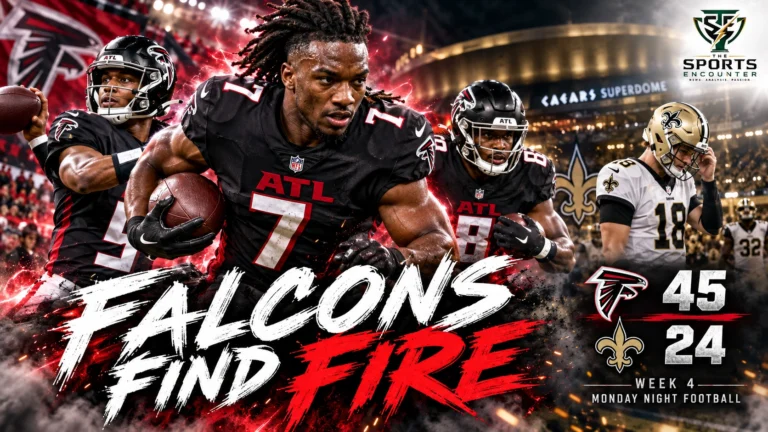
NEW ORLEANS, United States, October 5, 2026: The Atlanta Falcons needed only three offensive plays to change the mood inside Caesars Superdome, and by the end of Monday night they had changed something considerably bigger: the direction of their season.
Bijan Robinson broke through New Orleans for a 59-yard touchdown on his first carry, Brian Robinson Jr. later scored three times, and Michael Penix Jr. completed 15 of 20 passes for 223 yards as Atlanta overwhelmed the New Orleans Saints 45-24.
The Falcons are 2-2 after losing their opening two games. More revealingly, they have scored 80 points in the two games since Penix returned to the starting lineup after producing only 16 across their first two.
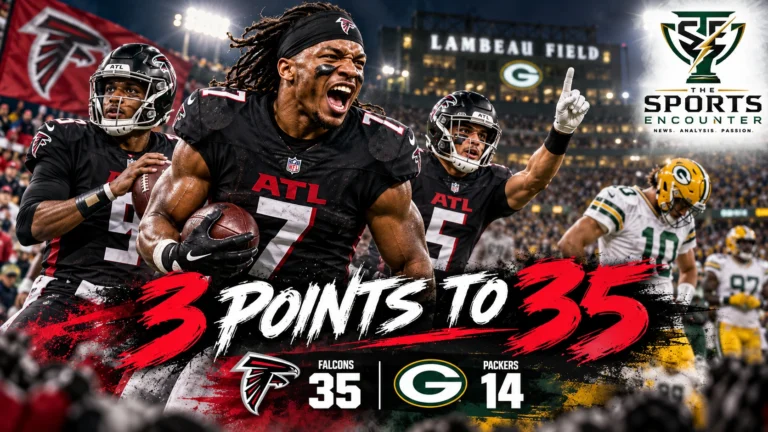
That makes Monday’s result more than another NFC South rivalry win. The question raised by Atlanta’s 35-14 breakthrough against Green Bay was whether one explosive night at Lambeau Field represented a genuine offensive reset. New Orleans supplied a much stronger answer.
Story at a glance
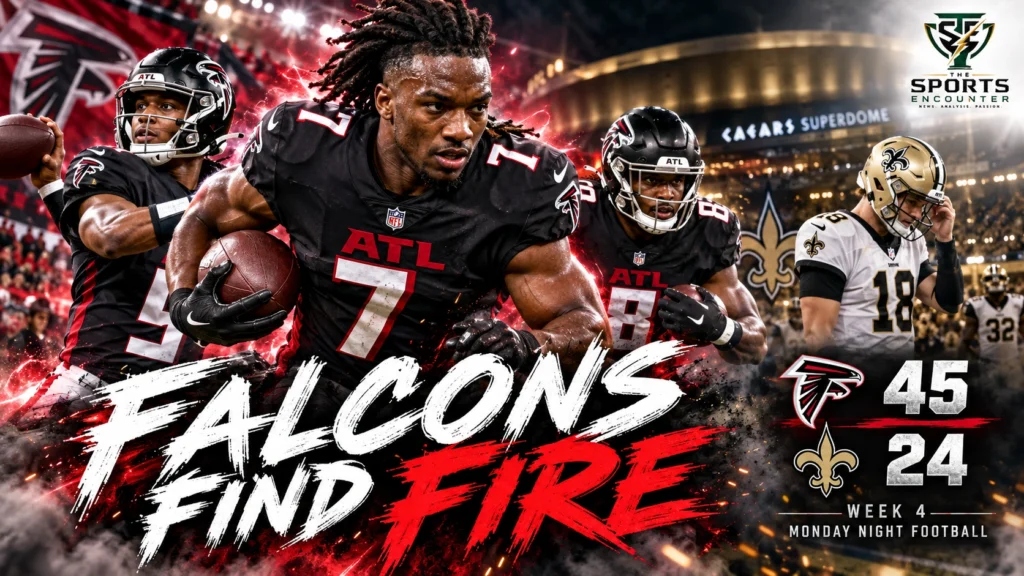
Falcons vs Saints 45-24: Match at a Glance
The Saints’ official game report and box score confirms Atlanta’s 420-320 advantage in total yardage and the individual performances that shaped the result.
How Did Bijan Robinson Change the Game on His First Carry?
Monday had been built around New Orleans.
Why Brian Robinson Jr.’s Three Touchdowns Change Atlanta’s Backfield
Bijan Robinson was the most explosive runner on the field.
What Has Changed Since Michael Penix Jr. Returned?
This is where Atlanta’s first month becomes difficult to dismiss as normal early-season fluctuation.
How Much Did New Orleans’ Defensive Absences Matter?
They mattered, particularly against the strength Atlanta chose to attack.
The NFL’s official postgame analysis confirmed Atlanta’s second straight victory and the Falcons’ third consecutive win over their biggest divisional rival.
Falcons vs Saints 45-24: Match at a Glance
| Category | Atlanta Falcons | New Orleans Saints |
|---|---|---|
| Final Score | 45 | 24 |
| Record | 2-2 | 1-3 |
| Total Yards | 420 | 320 |
| Quarterback | Michael Penix Jr.: 15/20, 223 yards, 1 TD, 0 INT | Tyler Shough: 30/48, 286 yards, 1 TD, 0 INT |
| Leading Rusher | Bijan Robinson: 19 carries, 145 yards, 2 TD | Alvin Kamara: 7 carries, 23 yards, 2 TD |
| Other Key Rusher | Brian Robinson Jr.: 14 carries, 62 yards, 3 TD | Kendre Miller: 6 carries, 9 yards |
| Leading Receiver | Drake London: 5 catches, 96 yards | Chris Olave: 8 catches, 116 yards |
| Turnovers Lost | 0 | 1 |
The Saints’ official game report and box score confirms Atlanta’s 420-320 advantage in total yardage and the individual performances that shaped the result.
How Did Bijan Robinson Change the Game on His First Carry?
Monday had been built around New Orleans.
The Saints were commemorating the 20th anniversary of the Superdome’s reopening after Hurricane Katrina. Steve Gleason, Curtis Deloatch and other members of the 2006 team were part of the pregame emotion. Irma Thomas returned to sing the national anthem, recreating part of an evening that remains deeply connected to the city’s history.
Then Robinson found a hole on Atlanta’s third offensive play and ran 59 yards into the end zone.
The effect reached beyond seven points.
New Orleans had entered the night with an emotionally charged crowd and an opportunity to turn the commemorative atmosphere into an early advantage. Atlanta forced the Saints to chase almost immediately.
Robinson scored again from four yards later in the first quarter. By halftime, the Falcons led 24-7.
He finished with 145 yards on 19 carries, averaging 7.6 yards per attempt, one game after rushing for 194 yards against Green Bay.
That gives Robinson 339 rushing yards across Atlanta’s last two games.
The Falcons’ official game breakdown also highlighted how Robinson and Drake London carried their prime-time form from Green Bay directly into New Orleans.
Why Brian Robinson Jr.’s Three Touchdowns Change Atlanta’s Backfield
Bijan Robinson was the most explosive runner on the field.
Brian Robinson Jr. supplied something Atlanta may need just as badly over a long season: a second back capable of finishing possessions without forcing Bijan to absorb every high-value carry.
Brian rushed 14 times for 62 yards and scored three touchdowns. Combined, the two Robinsons produced 207 yards on 33 carries and accounted for all five of Atlanta’s rushing touchdowns.
That distribution gives the Falcons options.
Bijan can attack defenses in space, punish hesitation and turn an ordinary crease into a play such as Monday’s 59-yard opening touchdown. Brian offers a more direct rushing presence and showed that Atlanta does not need to remove its scoring threat when Bijan comes off the field.
It also makes the offense harder to solve across four quarters. Defenses can no longer assume that surviving Bijan’s first wave means the physical pressure disappears when Atlanta rotates its backfield.
What Has Changed Since Michael Penix Jr. Returned?
This is where Atlanta’s first month becomes difficult to dismiss as normal early-season fluctuation.
The Falcons scored 13 points against Pittsburgh in Week 1 and three against Carolina in Week 2. Their offense produced only 16 points across those two defeats.
The Sports Encounter’s Week 1 analysis showed how Atlanta could generate individual production from Bijan Robinson without turning it into enough points. A week later, the 34-3 defeat against Carolina made the quarterback and offensive questions impossible to avoid.
Penix returned at Green Bay.
Atlanta scored 35.
He started again in New Orleans.
Atlanta scored 45.
| Atlanta Offense | Weeks 1-2 | Weeks 3-4 With Penix Starting |
|---|---|---|
| Record | 0-2 | 2-0 |
| Points Scored | 16 | 80 |
| Points Per Game | 8.0 | 40.0 |
| Penix Passing Yards | Did not start | 479 |
| Penix TD-INT | Did not start | 2-1 |
| Team Rushing Yards | Early offense struggled | 447 |
The important point is not that Penix personally created all 64 additional points between those two-game samples.
He did not.
The offensive line is playing better. Robinson has erupted. London has become dangerous downfield again. Brian Robinson has strengthened the rushing rotation.
Penix has helped connect those pieces.
Across his two starts, he has completed 33 of 45 passes for 479 yards. Against New Orleans, he averaged 11.2 yards per completion attempt listed in the official team statistics, threw a 31-yard touchdown to Jahan Dotson and did not turn the ball over.
Atlanta also did not punt Monday.
That level of offensive continuity is almost unrecognizable compared with the first two weeks.
The transformation is especially striking because Atlanta entered September with genuine uncertainty at quarterback. TSE examined that uncertainty when Tua Tagovailoa was initially chosen to start ahead of the recovering Penix.
A month later, Penix is starting and the Falcons suddenly have one of the hottest offenses in the conference.
How Much Did New Orleans’ Defensive Absences Matter?
They mattered, particularly against the strength Atlanta chose to attack.
The Saints entered the game without linebacker Kaden Elliss and edge defender Carl Granderson. Anfernee Jennings was also inactive, while tight end Noah Fant missed the game on offense.
That does not turn 45 points into an injury excuse. Atlanta still had to block, create lanes and execute.
It does help explain why New Orleans had so few answers once Atlanta established the run.
When a defense loses front-seven personnel against a team coming off 242 rushing yards at Green Bay, the challenge becomes especially difficult. Atlanta followed those 242 yards with another 205 on Monday.
That is 447 rushing yards in two games.
New Orleans knew where much of the danger was coming from and could not stop it.
Why Did Tyler Shough’s 286 Passing Yards Produce So Little Control?
Shough’s final line was respectable: 30 completions, 286 yards, one touchdown and no interceptions.
Chris Olave caught eight passes for 116 yards. Juwan Johnson added six receptions for 59 yards. Devaughn Vele caught six for 54 yards and scored New Orleans’ only passing touchdown.
The problem was what those numbers could not repair.
Atlanta had already forced the game into comeback mode.
New Orleans rushed for only 50 yards as a team. Kendre Miller lost the game’s only turnover. Eight Saints penalties cost another 49 yards. The Falcons could continue leaning on their running game while Shough needed more possessions and more completions merely to keep the Saints within reach.
It was very different from New Orleans’ Week 1 loss in Detroit, when Shough threw for 410 yards and nearly completed a 21-point comeback. That performance was one of the major stories in TSE’s opening Sunday review.
Against Atlanta, the passing volume never translated into comparable leverage over the contest.
What Happened With Alvin Kamara’s Knee Injury?
Kamara briefly left during the third quarter with a knee issue, according to the Saints’ official postgame reporting.
He returned to the game.
That distinction is important because there was no confirmed postgame indication in the sources reviewed that the incident had ended his night or established a recovery timetable.
Kamara finished with 23 rushing yards and two touchdowns on seven carries, while adding five catches for 35 yards. His two rushing scores moved him to 89 career total touchdowns and tied Deuce McAllister’s Saints record with his 14th game containing multiple rushing touchdowns.
For New Orleans, his status still warrants attention ahead of Week 5 because the Saints are already carrying other availability concerns.
Why Does Atlanta’s 2-2 Record Look Different Now?
Two weeks ago, Atlanta was 0-2 after being outscored 54-16.
The Panthers had just beaten the Falcons 34-3.
Now Atlanta has beaten Green Bay and New Orleans by a combined 80-38.
The Falcons have therefore moved from the bottom of the early conversation to 2-2 and a tie with Carolina atop the NFC South. New Orleans is 1-3, while Tampa Bay’s 0-4 start has already put pressure on the division race.
This does not make Atlanta a finished contender four games into the season.
It gives the Falcons something more valuable than September optimism: a repeatable way to play.
They can run through Bijan Robinson.
They can keep the rushing threat alive with Brian Robinson.
They can use that pressure to create favorable throws for Penix.
London remains capable of stretching the field, while Dotson and Kyle Pitts give the quarterback secondary answers.
On the other side of the roster, Atlanta has already signaled its desire to build a sustainable core by giving defensive tackle Gervon Dexter Sr. a four-year extension, a decision TSE examined in detail in its analysis of the Falcons’ $78 million bet on interior pressure.
Kellen Moore Admits the Saints Have a Consistency Problem
Saints coach Kellen Moore did not hide behind the circumstances afterward.
“We’re a 1-3 football team with some good moments, but not enough consistent football,” Moore said in his official postgame press conference.
That is a fair description of the first four weeks.
New Orleans came within a failed two-point conversion of beating Detroit in overtime. The Saints then went to Baltimore and won 24-17, one of the more impressive results covered in TSE’s Week 2 NFL review.
Now they have lost two straight.
There are still encouraging pieces. Shough has repeatedly shown that he can create passing production. Olave remains an elite-volume target. Kamara can still change scoring situations.
The Saints are struggling to make those pieces coexist for four quarters while protecting themselves defensively.
What Happens Next for the Falcons and Saints?
Atlanta returns home for a considerably harder test.
The Falcons host the Baltimore Ravens on Sunday Night Football on October 11. Baltimore entered Week 4 as one of the AFC teams with championship expectations, although Lamar Jackson’s ankle injury during Sunday’s victory over Tennessee creates an immediate availability question.
New Orleans stays at Caesars Superdome and faces the 4-0 Minnesota Vikings on October 11.
That makes Monday’s defeat especially damaging.
The Saints missed an opportunity to reach 2-2 before facing one of the league’s unbeaten teams. Instead, they are 1-3 and trying to repair a run defense that has just conceded five rushing touchdowns.
Atlanta enters Week 5 from the opposite direction.
The Falcons began the season looking for a functioning offense. Two games later, the discussion has shifted toward whether opponents can slow one down.
The Bigger Question: Is Atlanta’s Offensive Reset Sustainable?
That is now the story worth following.
Two games remain a small sample, but they are considerably more informative than one isolated breakout.
Green Bay could have been explained as the night Robinson and London simultaneously caught fire.
New Orleans made that explanation harder to sustain.
Atlanta changed opponents, played another road game and still scored 45 points. Robinson remained dominant. The second running back scored three times. Penix played efficient, turnover-free football. London again produced explosive gains.
The Falcons have scored five times as many points across their last two games as they scored across their first two.
That is the clearest measurement of how quickly their season has changed.
The wider championship landscape remains far more complicated, something TSE examined before opening night in its 2026 NFL season curtain-raiser. Atlanta has not entered that top tier after two wins.
It has entered a far more interesting conversation.
The Falcons may finally know what they want their offense to be.
Continue the NFL Story


Frequently Asked Questions
Who won Falcons vs Saints on Monday Night Football?
The Atlanta Falcons defeated the New Orleans Saints 45-24 at Caesars Superdome in Week 4 of the 2026 NFL season.
How many yards did Bijan Robinson rush for against the Saints?
Bijan Robinson rushed 19 times for 145 yards and two touchdowns, including a 59-yard touchdown on his first carry.
How many touchdowns did Brian Robinson Jr. score?
Brian Robinson Jr. scored three rushing touchdowns while gaining 62 yards on 14 carries.
How did Michael Penix Jr. play against New Orleans?
Penix completed 15 of 20 passes for 223 yards, one touchdown and no interceptions. His touchdown was a 31-yard pass to Jahan Dotson.
What is the Falcons’ record after beating the Saints?
Atlanta improved to 2-2 and moved into a tie with Carolina at the top of the NFC South.
What is the Saints’ record after Week 4?
New Orleans fell to 1-3 after losing 45-24 to Atlanta.
Was Alvin Kamara injured against Atlanta?
Kamara briefly left the game with a knee issue during the third quarter but returned. No recovery timetable should be inferred unless the Saints provide a further medical update.
Who do the Falcons play next?
Atlanta hosts the Baltimore Ravens on Sunday Night Football on October 11.
Who do the Saints play next?
New Orleans hosts the unbeaten Minnesota Vikings on October 11 at Caesars Superdome.