


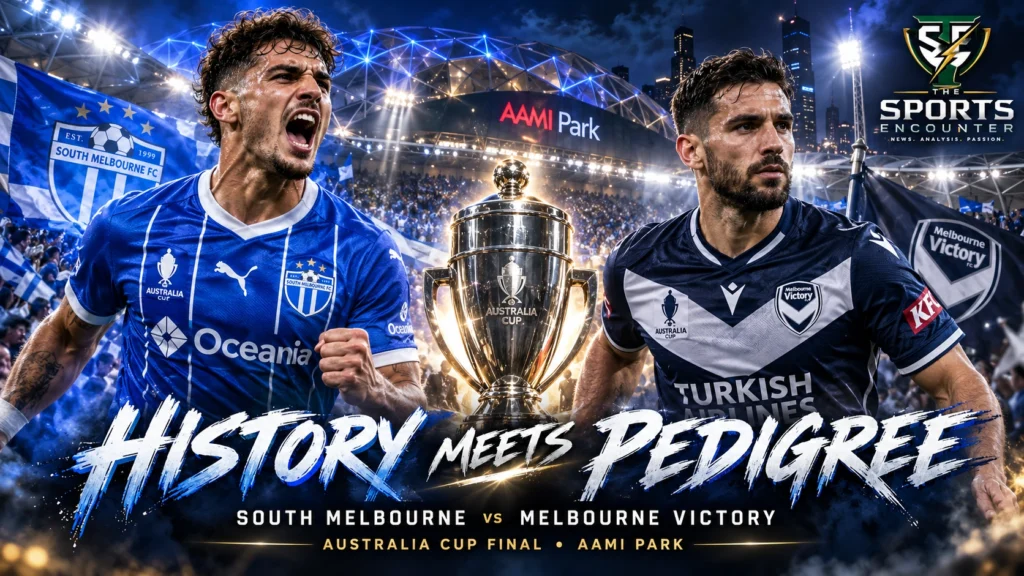
MELBOURNE, Australia, September 26, 2026: The 2026 Australia Cup final has become far more than another knockout match between two clubs from the same city.
South Melbourne FC will face Melbourne Victory FC at AAMI Park on Saturday, October 10 in the first all-Victorian Australia Cup final of the modern era, bringing together two clubs that represent very different chapters of Australian soccer history.
South Melbourne arrive as the inaugural Australian Championship winners, a Member Federation club chasing their first modern Australia Cup title and the chance to become the first non-A-League side to lift the trophy.
Melbourne Victory arrive as one of the competition’s established powers. They won the Cup in 2015 and 2021, both at AAMI Park, finished runner-up there in 2024, and will now contest their fourth final.
The contrast is obvious.
The more interesting story is that both teams have reached the decider by repeatedly surviving different types of knockout pressure.
South Melbourne have recovered from deficits, survived penalties and produced one of the tournament’s defining individual performances through Bul Juach. Victory have moved through a route that demanded early control, extra-time patience, penalty composure and disciplined game management.
Football Australia has confirmed the final for 7:35 p.m. AEDT at AAMI Park, with Network 10 and Paramount+ broadcasting the match. The governing body’s official venue announcement describes the matchup as the first all-Victorian final of the modern Cup era.
The stakes stretch beyond the trophy. Under Football Australia’s 2026 competition framework, the winner earns direct entry into the 2027-28 AFC Champions League Two.
South Melbourne vs Melbourne Victory: Australia Cup Final at a Glance
| Detail | Information |
|---|---|
| Competition | Hahn Australia Cup 2026 |
| Stage | Final |
| Fixture | South Melbourne FC vs Melbourne Victory FC |
| Date | Saturday, October 10, 2026 |
| Kickoff | 7:35 p.m. AEDT |
| Venue | AAMI Park, Melbourne |
| Broadcast | Network 10 and Paramount+ |
| South Melbourne status | First modern Australia Cup final |
| Melbourne Victory status | Fourth Australia Cup final |
| Continental prize | 2027-28 AFC Champions League Two qualification |
Why This Final Carries More History Than the Scoreboard Can Show
South Melbourne and Melbourne Victory share a city but come from different eras of the Australian game.
South Melbourne were one of the major powers of the National Soccer League era and remain one of Australia’s most historically significant clubs outside the A-League structure.
Victory became one of the dominant clubs of the A-League era that followed.
The Australia Cup now brings those histories onto the same national stage with a trophy at stake.
That is what gives the final its unusual scale.
Football Australia has described South Melbourne as one of Australian soccer’s most historic clubs and Victory as one of the Cup’s most successful teams. South are the third non-A-League club to reach the modern final, while Victory are returning for a fourth time. :chatgpt-content-reference{index=”2″}
The Sports Encounter identified that generational contrast as soon as South secured the second final place. Our report on South Melbourne’s semifinal victory examined why the final creates a rare direct collision between Australia’s pre-A-League and A-League football identities.
South Melbourne Have Learned to Win When Matches Turn Against Them
South Melbourne’s path to AAMI Park has not been smooth.
That may be one of their greatest strengths entering the final.
They have repeatedly found themselves in matches that stopped unfolding according to plan.
| Round | Opponent | Result | Defining Moment |
|---|---|---|---|
| Round of 32 | Adelaide United | 2-1 | South recovered after conceding early |
| Round of 16 | Fremantle City | 3-3, South won on penalties | Jake Charlston starred in the shootout |
| Quarterfinal | Preston Lions | 2-1 | Arran Cocks scored the late winner |
| Semifinal | Lions FC | 3-1 | Bul Juach scored a second-half hat-trick |
The pattern matters.
South Melbourne have already trailed during this Cup run.
They have already lost control of a two-goal lead.
They have already been pushed through extra time and penalties.
They have already needed a late winner.
They have already reached halftime in a semifinal behind on the scoreboard.
None of those situations eliminated them.
Their quarterfinal against Preston Lions offered an early version of the same resilience. TSE’s Preston Lions-South Melbourne preview focused on how dangerous that matchup could become because the teams knew each other so well from NPL Victoria.
South eventually came from behind to win 2-1.
That response became even more important in the semifinal.
Bul Juach Has Become the Player Victory Cannot Ignore
South Melbourne’s semifinal against Lions FC changed completely at halftime.
Lions led 1-0.
South coach Siniša Cohadžić introduced Bul Juach.
Eight minutes later, Juach equalized.
Seven minutes after that, he scored again.
His third arrived in the 83rd minute.
The halftime substitute had turned a semifinal deficit into a 3-1 victory with a hat-trick.
TSE’s full semifinal report showed why Juach’s impact was larger than the three goals. His introduction changed the speed at which South attacked the Lions back line and forced the visitors to defend a very different type of threat after halftime.
Juach’s influence did not begin in the semifinal.
He scored against Adelaide United in the Round of 32 and converted from the spot during the 3-3 battle with Fremantle City.
South Melbourne signed him from Pacific FC during the mid-season registration window, and his arrival has become one of the most consequential squad changes of their season.
Victory’s defensive preparation therefore cannot focus only on whether Juach starts.
They also have to consider what happens if he does not.
The semifinal demonstrated that South can change the attacking profile of a knockout match from the bench.
South Melbourne Have More Than One Route to Goal
Juach will attract the attention, but South’s run has depended on more than one attacker.
Arran Cocks has repeatedly shown he can turn a balanced contest with one action. His late winner against Preston carried South into the semifinals.
Jack Painter-Andrews has grown in influence as the tournament has progressed, while David Yoo played an important creative role against Lions and supplied the pass for Juach’s first semifinal goal.
Hassan Ramazani’s delivery created Juach’s second.
That variety is important because Melbourne Victory have shown they can defend for long periods without becoming impatient.
TSE’s first South Melbourne-Lions semifinal preview identified South’s ability to survive different match states as one of the reasons they had become more than a traditional underdog story.
By the time the match arrived, the updated matchday analysis focused more directly on the individual players capable of changing a knockout game without sustained territorial control.
That same requirement becomes more important against Victory.
Melbourne Victory Have Taken the More Controlled Route
Victory’s Cup run has contained its own pressure, but the emotional shape has been different.
| Round | Opponent | Result | Defining Moment |
|---|---|---|---|
| Round of 32 | Kingborough Lions United | 4-0 | Victory opened the Giovanni Savarese era emphatically |
| Round of 16 | Western Sydney Wanderers | 1-1, Victory won 3-2 on penalties | Victory survived an all-A-League shootout |
| Quarterfinal | APIA Leichhardt | 1-0 after extra time | Harry Sawyer scored the extra-time winner |
| Semifinal | Sydney FC | 2-0 | Keegan Jelacic scored inside two minutes |
Victory began with a 4-0 win over Kingborough Lions United in Tasmania.
The tournament then became much harder.
Western Sydney Wanderers pushed them to penalties.
APIA Leichhardt kept them scoreless through 90 minutes before Harry Sawyer finally broke the deadlock in extra time.
TSE’s report on Victory’s quarterfinal against APIA showed how comfortable Giovanni Savarese’s team became with patience once the match stopped offering obvious openings.
That experience could matter enormously in a final where South Melbourne may be happy to turn the contest into a long emotional battle.
Keegan Jelacic Has Given Victory a Different Kind of Threat
Victory’s semifinal against Sydney FC showed the opposite side of their knockout identity.
Instead of waiting, they struck almost immediately.
A high press created the turnover.
Matthew Grimaldi released Keegan Jelacic.
Jelacic finished inside the opening two minutes.
The early goal completely changed the match.
Sydney spent most of the evening trying to recover the scoreboard while Victory controlled the game without needing to dominate every phase.
A second-half own goal, forced by Charles Nduka’s low delivery, made it 2-0.
TSE’s semifinal report from Jubilee Stadium examined how efficiently Victory turned limited decisive moments into a place in the final.
That was also the central question in our Big Blue semifinal preview: could Sydney’s pressure survive Victory’s ability to punish mistakes?
It did not.
South Melbourne will face the same danger.
The Tactical Battle May Be Decided by Who Controls the First Transition
The final has the potential to turn on the first moment when one team loses its defensive structure.
Victory’s opening goal against Sydney came from pressing high and attacking before the defense could reset.
South’s semifinal turnaround came from increasing the speed of its attacks immediately after halftime.
Both sides have therefore shown that they can punish an opponent before the shape behind the ball is properly restored.
For South, that may mean resisting the temptation to overcommit early because of the occasion and the crowd.
For Victory, it means remaining alert to direct attacks and second balls when South bypass the first line of pressure.
Neither team needs 60 percent possession to create its best moments.
That could make transition control more important than territorial dominance.
Can South Melbourne Make the Final Uncomfortable for Victory?
South are unlikely to gain much by trying to make the final look like an ordinary A-League match.
Victory have greater professional depth and more recent experience managing national finals.
South’s advantage comes from changing the conditions.
They have already demonstrated comfort in chaotic games.
The Fremantle match became a six-goal contest.
The Preston quarterfinal became a local rivalry decided late.
The Lions semifinal became a comeback driven by a substitute.
If the final becomes emotionally volatile, full of broken passages, second balls, restarts and momentum swings, South will have recent evidence that they can survive there.
The challenge is avoiding unnecessary chaos in their own penalty area.
Victory do not need many clean openings to score.
Can Victory Use AAMI Park Without Treating It Like a Home Match?
AAMI Park is a highly familiar stage for Melbourne Victory.
It is also the stadium where they lifted the Australia Cup in 2015 and 2021.
Their most recent final there ended differently, with Macarthur FC beating them 1-0 in 2024.
That history gives Victory familiarity without guaranteeing comfort.
This will not feel like a conventional home occasion.
South Melbourne have been allocated a substantial supporter section, and the club announced on September 24 that the match had sold out AAMI Park, including every seat in South Melbourne’s allocated half.
The initial general-public ticket release had begun only days earlier, with Football Australia listing adult seats from $25, concession tickets from $20, juniors from $13 and family tickets from $63 on its official ticket release page.
That demand changes the atmosphere.
Victory may know the stadium better.
South will not arrive without noise.
A Sold-Out Final Has Become Part of the Story Before Kickoff
The final had already carried historical importance before ticket sales opened.
The response from supporters increased it.
South Melbourne announced that AAMI Park sold out in just over a day and said the club’s entire allocation had been exhausted.
The club also stated that sales had passed the previous Australia Cup final attendance benchmark before the match itself.
The Sports Encounter is treating the sellout as a current club announcement rather than a Football Australia attendance figure, because the final has not yet been played and official attendance will only be known after the event.
The significance is still clear.
This is not a final that requires an argument about whether people care.
The stadium response has already answered that question.
South Melbourne Can Make Member Federation History
The modern Australia Cup has repeatedly produced Member Federation runs deep into the tournament.
Winning the final has remained the barrier.
Heidelberg United reached the 2025 decider with an opportunity to become the first Member Federation club to lift the modern trophy, but Newcastle Jets won 3-1 after extra time.
South Melbourne now receive the next opportunity.
Football Australia identifies them as the third non-A-League club to reach the final.
If they defeat Victory, the result would create the most significant Member Federation achievement in the modern competition’s history.
That possibility adds another layer to South’s 2026 route.
Their place in the national rounds was earned differently from most state clubs. South received direct qualification to the Round of 32 after winning the inaugural 2025 Australian Championship.
They have since validated that place on the field.
Adelaide United were eliminated.
Three further knockout rounds followed.
Now only Victory remain.
Melbourne Victory Are Chasing a Third Australia Cup
Victory’s motivation is different.
They do not need to prove they belong at this level.
They have already won the Cup twice.
A third title would move them closer to Adelaide United’s modern competition record of three victories.
Victory won in 2015 and 2021 and lost the 2024 final to Macarthur.
The return to AAMI Park therefore offers both opportunity and unfinished business.
Giovanni Savarese also has the chance to win silverware in the first competitive months of his tenure.
The 2026 Cup began as his first competitive assignment after replacing Arthur Diles during the offseason.
A final victory would turn that opening competition into an immediate trophy.
The Goalkeepers Could Become Decisive Again
South Melbourne already know what it feels like to need their goalkeeper after 120 minutes.
Jake Charlston saved three Fremantle penalties in the Round of 16 shootout.
Victory have also survived a shootout, eliminating Western Sydney Wanderers after their Round of 16 tie remained level through extra time.
Those experiences matter even if the final never reaches penalties.
Players approach the closing stages differently when they have already survived that pressure during the same tournament.
Neither side would enter a shootout facing an entirely unfamiliar situation.
The more important question may be whether either coach changes his late-game risk tolerance because of that confidence.
What Does AFC Champions League Two Qualification Change?
The Australia Cup trophy carries an international consequence.
Football Australia’s current competition framework awards the 2026 champion direct entry into the 2027-28 AFC Champions League Two.
For Melbourne Victory, Asian competition is part of an established professional-club pathway.
For South Melbourne, the impact would be much more disruptive and potentially transformational.
A Member Federation club reaching AFC competition would face a completely different scale of travel, opposition, preparation, licensing and commercial exposure.
The final therefore connects Australia’s domestic football pyramid to continental competition in a particularly direct way.
A single knockout match could determine whether that place goes to an established A-League institution or to a club operating outside the country’s top professional division.
Five Players Who Could Shape the Australia Cup Final
Bul Juach, South Melbourne
Three semifinal goals made him the obvious headline, but his wider Cup contribution is equally important. His pace and timing can change the match whether he starts or enters later.
Arran Cocks, South Melbourne
Cocks has already delivered a knockout winner and gives South a player capable of creating a decisive moment without prolonged domination.
David Yoo, South Melbourne
Yoo’s creativity helped unlock Lions in the semifinal and gives South another route when opponents protect central spaces.
Keegan Jelacic, Melbourne Victory
Jelacic scored inside two minutes of the semifinal and has been directly involved in important Cup moments. South cannot allow him the transition space Sydney conceded.
Harry Sawyer, Melbourne Victory
Sawyer scored in extra time against both Western Sydney and APIA Leichhardt. His tournament record makes him an obvious late-game threat if the final remains close.
What Should Fans Watch in the Opening 20 Minutes?
The first phase could tell us whether South are able to make the final look like their kind of game.
If Victory establish controlled possession, press successfully and force South deep for long periods, the professional side may be able to dictate the tempo.
If South can break the first press and reach Cocks, Juach or Yoo quickly, the emotional balance changes.
Victory’s semifinal showed how powerful an early goal can be.
South’s semifinal showed how little an early deficit has frightened them.
The first goal will matter.
It may not decide the match.
Why the Final Matters Beyond Melbourne
The 2026 Australia Cup began with a record 777 clubs from across the Australian football pyramid.
The final two clubs come from the same city.
They do not come from the same structural world.
That is why this matchup captures so much of what the competition is supposed to represent.
The Cup is one of the few national stages where a club outside the A-League can play through a bracket toward a trophy, an AFC place and a match against one of the country’s biggest professional clubs.
South Melbourne have taken that pathway as far as it can go.
Victory stand between them and history.
For continuing Australia Cup and international football coverage, follow The Sports Encounter’s soccer section.
Frequently Asked Questions
When Is the 2026 Australia Cup Final?
The final will be played on Saturday, October 10, 2026.
What Time Is South Melbourne vs Melbourne Victory?
Kickoff is scheduled for 7:35 p.m. AEDT.
Where Is the Australia Cup Final Being Played?
The match will be played at AAMI Park in Melbourne.
Is the 2026 Australia Cup Final Sold Out?
South Melbourne announced on September 24 that AAMI Park had sold out, including the club’s full supporter allocation. Football Australia’s earlier public ticket release had reported strong demand immediately after sales opened.
How Can Fans Watch the Australia Cup Final?
Football Australia has confirmed that the final will be broadcast on Network 10 and Paramount+.
Has South Melbourne Ever Reached the Australia Cup Final Before?
No. South Melbourne previously reached the semifinals in 2017 and 2024, but 2026 is their first appearance in the modern Australia Cup final.
How Many Australia Cups Have Melbourne Victory Won?
Melbourne Victory have won the competition twice, in 2015 and 2021. They were runners-up in 2024 and will contest their fourth final in 2026.
Can South Melbourne Become the First Member Federation Club to Win the Australia Cup?
Yes. No Member Federation club has won the modern Australia Cup. South Melbourne are the third non-A-League team to reach the final.
How Did South Melbourne Reach the Final?
South Melbourne beat Adelaide United 2-1, survived Fremantle City on penalties after a 3-3 draw, defeated Preston Lions 2-1 and beat Lions FC 3-1 in the semifinal.
How Did Melbourne Victory Reach the Final?
Victory beat Kingborough Lions United 4-0, eliminated Western Sydney Wanderers on penalties, defeated APIA Leichhardt 1-0 after extra time and beat Sydney FC 2-0 in the semifinal.
What Does the Australia Cup Winner Qualify For?
Under Football Australia’s 2026 competition framework, the winner qualifies directly for the 2027-28 AFC Champions League Two, subject to applicable competition and club-licensing requirements.