


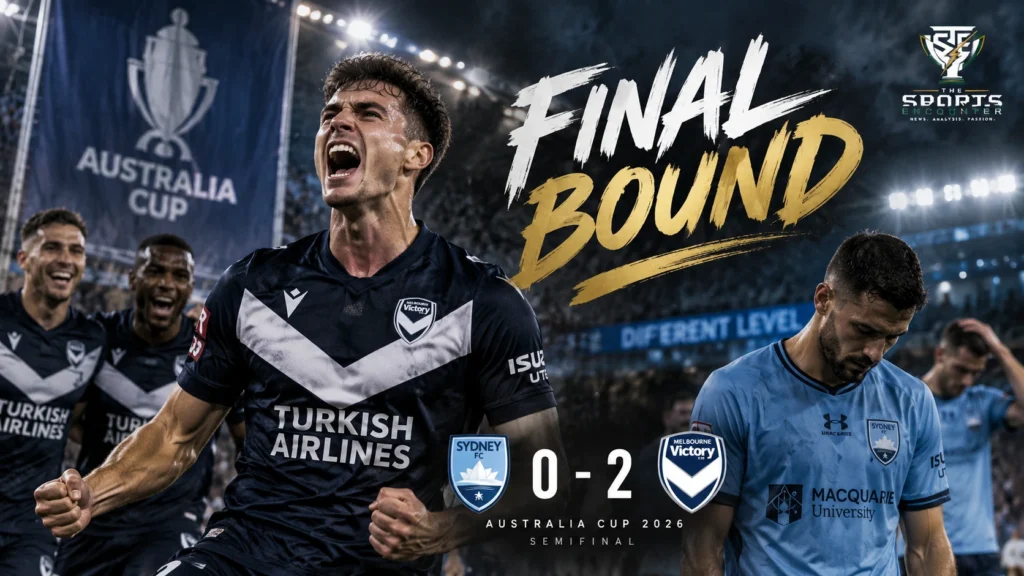
SYDNEY, Australia, September 9, 2026: Melbourne Victory are heading back to the Australia Cup final after beating Sydney FC 2-0 at St George Venues Jubilee Stadium, turning an early Keegan Jelacic strike and a second-half own goal into a disciplined semifinal victory in the first Australia Cup edition of the Big Blue rivalry.
Jelacic punished Sydney inside the opening two minutes after Victory’s press forced a turnover in the home half. The Sky Blues subsequently spent long stretches trying to work their way back into the contest, but Oriola Sunday hit the post, several promising attacks broke down before the final touch, and Sydney were still searching for their first shot on target late in the second half.
Jordan Courtney-Perkins then inadvertently turned Charles Nduka’s low delivery into his own net in the 61st minute, giving Melbourne Victory the breathing room they had spent much of the match protecting. The official Australia Cup match report confirmed a goal in each half was enough to send Victory into their fourth appearance in the national cup final.
For anyone who followed The Sports Encounter’s semifinal preview, the central question was whether Sydney’s ability to generate pressure could survive Melbourne Victory’s greater capacity to punish mistakes. The answer arrived almost immediately.
Sydney FC 0-2 Melbourne Victory: Match at a Glance
| Match Detail | Information |
|---|---|
| Competition | Hahn Australia Cup 2026 |
| Stage | Semifinal |
| Final Score | Sydney FC 0-2 Melbourne Victory |
| Venue | St George Venues Jubilee Stadium, Sydney |
| Melbourne Victory Goals | Keegan Jelacic 2′, Jordan Courtney-Perkins 61′ OG |
| Halftime | Sydney FC 0-1 Melbourne Victory |
| Next Step | Melbourne Victory advance to the Australia Cup Final |
| Final Opponent | South Melbourne or Lions FC |
Jelacic Turns Melbourne Victory’s Press Into an Immediate Lead
Knockout matches often spend their opening stages establishing where the pressure will come from. Melbourne Victory removed that uncertainty before Sydney FC had time to settle.
Victory pressed inside the Sydney half, regained possession and moved the ball quickly through Matthew Grimaldi. His pass released Jelacic into the right channel, and the midfielder finished into the bottom corner before the match had reached the two-minute mark.
The goal mattered beyond the scoreline because it completely altered the tactical conditions. Sydney could no longer wait for the semifinal to develop. Patrick Kisnorbo’s team had to take greater possession responsibility while Victory were given an opportunity to protect space, select pressing moments and attack whenever the home side lost structure.
That early punishment also echoed a warning from Sydney’s previous round. The Sky Blues had needed a Takahiro Sekine goal and several important defensive interventions to escape SD Raiders 1-0, a performance examined in our Sydney FC vs SD Raiders quarterfinal report. Against Victory, the margin for surviving mistakes was considerably smaller.
Sydney Recover Territory but Struggle to Turn It Into Clear Chances
The opening goal did not lead to Melbourne dominating every phase. Sydney gradually became more comfortable with the ball, recovered possession higher up the field and forced the visitors into longer periods of defending.
Akol Akon, Tiago Quintal and Takahiro Sekine were all involved as Sydney searched for a response, while Sunday’s movement through the center gave the Sky Blues a target around the penalty area.
The problem was not an absence of attacking intent. It was the quality of the final action.
Sunday’s Header Becomes Sydney’s Best First-Half Opening
The home side came closest late in the opening half when Sunday attacked a corner and sent his header against the post. It was the kind of moment that could have rewritten the semifinal because an equalizer before halftime would have removed much of Victory’s control over the match state.
Instead, Melbourne reached the interval 1-0 ahead.
Sydney’s own official match review highlighted the hosts’ sustained possession, Sunday’s effort off the post and several other promising attacking situations. The contrast between territorial pressure and actual finishing would eventually define their elimination.
Victory Wait, Absorb Pressure and Find the Second Goal
The second half initially followed a similar pattern. Sydney tried to build patiently, while Melbourne’s defensive shape limited the quality of the chances created around Jack Duncan’s goal.
Victory also retained enough threat to prevent the home side from committing everybody forward. Jason Davidson tested Gus Hoefsloot from distance in the 56th minute, and Clarismario Santos forced another intervention shortly afterward.
Then came the moment that effectively settled the semifinal.
Nduka found space behind Sydney on the right and drove a low ball across the penalty area. Courtney-Perkins attempted to cut out the danger but instead redirected the delivery beyond his own goalkeeper.
At 2-0, Melbourne no longer needed to chase control through possession. The responsibility sat entirely with Sydney.
The Most Damaging Number Was Not the Score
By the 81st minute, the official Australia Cup report recorded Sydney’s ninth attempt of the evening when Sekine drove into the right side of the penalty area and fired over.
None of those nine attempts had been on target.
That detail explains the semifinal more effectively than possession or territory alone. Sydney were capable of reaching attacking areas, but Melbourne repeatedly prevented those situations from becoming saves for Duncan.
A team can survive spells without the ball when the opposition’s possession does not consistently end with the goalkeeper under pressure. Victory did exactly that.
Melbourne Victory’s Route to the Final Has Been Built on Control Under Pressure
This semifinal was very different from Victory’s quarterfinal, but the underlying quality was familiar.
Before reaching Jubilee Stadium, Giovanni Savarese’s team had to survive 120 minutes against APIA Leichhardt. The possibility of an upset had been explored in our APIA Leichhardt vs Melbourne Victory quarterfinal preview, and the NPL NSW side ultimately pushed the A-League club all the way into extra time.
Harry Sawyer eventually decided that contest, coming from the bench to score the only goal. Our Melbourne Victory vs APIA quarterfinal report showed a team that did not panic when the expected breakthrough failed to arrive during regulation.
Wednesday required a different response. Rather than waiting more than 100 minutes for the decisive opening, Victory scored almost immediately and then managed the consequences.
Both performances point toward a side becoming comfortable with knockout football. Victory have now won one Cup tie by remaining patient through extra time and another by defending an early advantage against a rival forced to chase the match.
What Went Wrong for Sydney FC?
The Opening Error Changed Everything
Conceding inside two minutes created a strategic problem Sydney never fully solved. Melbourne could protect central areas more conservatively, while every home turnover carried greater danger because Sydney increasingly needed numbers ahead of the ball.
Possession Did Not Produce Enough Goalkeeper Work
Sydney’s ability to recover territory was real, but the match repeatedly stopped one action short of becoming dangerous. Crosses missed targets, shots were blocked, Sunday’s header hit the post and later efforts failed to force Duncan into the kind of sustained work normally associated with a comeback.
The Second Goal Arrived at the Worst Possible Time
At 1-0, one clean finish could still have transformed the stadium and the semifinal. Courtney-Perkins’ own goal came just as Sydney were trying to increase their second-half pressure, replacing a manageable deficit with a two-goal problem.
The Sky Blues had already shown considerable resilience during their Cup run. They beat Bayswater City 5-1, Brisbane Roar 4-2 and SD Raiders 1-0 before reaching the semifinal. Victory were simply more decisive at both ends when the strongest opponent of Sydney’s campaign arrived.
The Other Side of the Australia Cup Bracket Remains Wide Open
Melbourne Victory will not learn their final opponent until South Melbourne and Lions FC contest the second semifinal on September 15.
Both clubs have built compelling routes through the competition. Lions FC arrived in the final four after a run that included their quarterfinal against North Sunshine Eagles, covered in our Lions FC vs North Sunshine Eagles analysis.
South Melbourne’s road included another major Victorian knockout game against Preston Lions. The stakes and history surrounding that tie were explored in our Preston Lions vs South Melbourne quarterfinal preview.
The consequence is unusual and significant: an A-League heavyweight will face a Member Federation club for the trophy. Our South Melbourne vs Lions FC semifinal preview examines why that second semifinal carries importance well beyond the identity of Victory’s eventual opponent.
What Reaching the Final Means for Melbourne Victory
Victory entered this semifinal as two-time Australia Cup winners, having lifted the trophy in 2015 and 2021. Their latest win puts the club into a fourth final after also finishing runner-up to Macarthur FC in 2024.
Another trophy would therefore add to an already significant modern Cup record.
There is also an international consequence. Under the competition framework published by Football Australia, the 2026 Australia Cup winner receives direct entry into the 2027-28 AFC Champions League Two.
That makes the final more than an opportunity to add another domestic trophy. It carries a pathway into continental competition.
The Sports Encounter Verdict
Melbourne Victory did not need to dominate every phase of the semifinal because they dominated the moments that changed it.
Jelacic converted the first major opportunity before Sydney could establish control. The visitors then remained organized while the Sky Blues built pressure without consistently testing Duncan. Nduka’s run and Courtney-Perkins’ unfortunate intervention produced the second goal, after which Victory managed the match without allowing the contest to reopen.
Sydney’s frustration will come from knowing they were not overwhelmed territorially. Sunday’s header against the post offered a genuine route back into the match, and several attacking sequences suggested an equalizer was possible.
Yet knockout football measures chances differently from possession. Melbourne converted pressure into goals. Sydney converted pressure into possibilities.
That difference sends Victory into the final.
Follow The Sports Encounter’s soccer coverage for the second Australia Cup semifinal, the final matchup, match analysis and major stories from across the global game.
Frequently Asked Questions
What was the Sydney FC vs Melbourne Victory score?
Melbourne Victory defeated Sydney FC 2-0 in the 2026 Australia Cup semifinal at St George Venues Jubilee Stadium.
Who scored for Melbourne Victory against Sydney FC?
Keegan Jelacic opened the scoring inside the first two minutes. Melbourne’s second goal came when Sydney defender Jordan Courtney-Perkins turned Charles Nduka’s cross into his own net in the 61st minute.
Did Melbourne Victory qualify for the Australia Cup Final?
Yes. Melbourne Victory became the first team to qualify for the 2026 Australia Cup Final and will face either South Melbourne or Lions FC.
When is South Melbourne vs Lions FC?
The second Australia Cup semifinal is scheduled for September 15, 2026, with the winner advancing to face Melbourne Victory.
How many Australia Cups have Melbourne Victory won?
Melbourne Victory have won the modern Australia Cup twice, in 2015 and 2021. Their 2026 appearance will be the club’s fourth final.
What does the Australia Cup winner qualify for?
The 2026 Australia Cup winner receives direct entry into the 2027-28 AFC Champions League Two under Football Australia’s competition framework.