


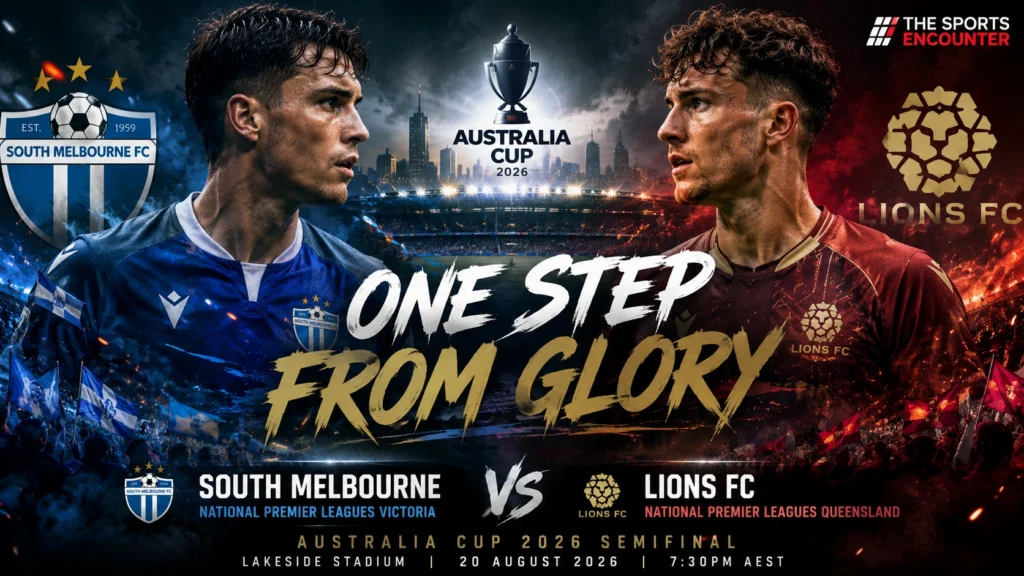
South Melbourne and Lions FC have already removed the usual hierarchy from their side of the 2026 Australia Cup bracket.
There is no A-League opponent left between them and the final. There is no professional giant waiting to define the occasion for them. When they meet at Lakeside Stadium on September 15, one Member Federation club will leave knowing it is only one victory away from lifting the Australia Cup and qualifying directly for the 2027-28 AFC Champions League Two.
That changes the scale of this semifinal.
South Melbourne have arrived through three very different forms of knockout pressure. They eliminated Adelaide United in the Round of 32, survived a six-goal battle and penalty shootout against Fremantle City, then came from behind to defeat fierce Victorian rival Preston Lions in the quarterfinal.
Lions FC have built an equally persuasive case from Queensland. They eliminated Perth Glory on penalties, followed that by beating Melbourne City 2-0, then overwhelmed North Sunshine Eagles 4-0 in the quarterfinal. Their Cup run began as an upset story. It now looks much closer to sustained tournament quality.
The Sports Encounter has followed both journeys closely through its soccer coverage, including our detailed Preston Lions vs South Melbourne quarterfinal preview and the Lions FC vs North Sunshine Eagles analysis.
Now those two paths meet.
What happened next: South Melbourne beat Lions FC 3-1 to reach the Australia Cup final. Read The Sports Encounter’s South Melbourne vs Lions FC semifinal report, then follow the club’s run into our Australia Cup final preview.
South Melbourne vs Lions FC: Australia Cup Semifinal at a Glance
| Detail | Information |
|---|---|
| Competition | Hahn Australia Cup 2026 |
| Round | Semifinal |
| Fixture | South Melbourne FC vs Lions FC |
| Date | Tuesday, September 15, 2026 |
| Kickoff | 7:30 PM AEST |
| Venue | Lakeside Stadium, Melbourne |
| Broadcast | Paramount+ |
| South Melbourne level | NPL Victoria |
| Lions FC level | NPL Queensland |
| Final prize | Place in the 2026 Australia Cup Final |
| Continental prize | Australia Cup winner qualifies for the 2027-28 AFC Champions League Two |
Football Australia has confirmed the semifinal for Lakeside Stadium on September 15, with kickoff at 7:30 PM AEST and live coverage on Paramount+.
How Did South Melbourne Reach the Australia Cup Semifinal?
South Melbourne’s run has been shaped by adaptability more than one dominant tactical pattern.
They have beaten an A-League opponent, survived a penalty shootout after surrendering a two-goal lead, and recovered from going behind against one of their fiercest domestic rivals.
| Round | Opponent | Result | Defining moment |
|---|---|---|---|
| Round of 32 | Adelaide United | South Melbourne won 2-1 | South eliminated three-time Australia Cup winners and established that their direct entry into the national rounds was more than ceremonial. |
| Round of 16 | Fremantle City | 3-3 after extra time; South won penalties 3-1 | Jake Charlston saved three penalties after South recovered from falling 3-2 behind. |
| Quarterfinal | Preston Lions | South Melbourne won 2-1 | Jack Painter-Andrews equalized before Arran Cocks produced the decisive late strike. |
South entered the 2026 competition directly at the Round of 32 because they won the inaugural 2025 Australian Championship. Football Australia’s official competition structure specifically granted the national champion that place.
The reward immediately came with difficulty.
Adelaide United were waiting.
South won 2-1 and moved into the Round of 16 with another significant Australia Cup result against professional opposition.
The next two matches revealed much more about the team’s character.
Why Did the Fremantle City Match Change South Melbourne’s Cup Identity?
The Fremantle game forced South Melbourne to discover whether they could survive after losing control of a match they appeared to own.
Arran Cocks gave South the lead after 12 minutes with a superb finish from the left, and David Yoo doubled the advantage eight minutes later after Jack Painter-Andrews created the opening from the right.
At 2-0, the match appeared to be moving toward a relatively comfortable home victory.
Instead, Fremantle changed everything.
Charles Chechlacz converted a penalty before Cameron Edwards equalized four minutes later. Shubham Mokala then completed the turnaround shortly after halftime, putting South Melbourne 3-2 behind.
Bul Juach’s penalty restored parity in the 70th minute, but neither side found another goal through regulation or extra time.
That moved the responsibility to goalkeeper Jake Charlston.
He saved three Fremantle penalties and transformed a match that had threatened to become a painful elimination into one of South Melbourne’s defining moments of the tournament.
The result matters for this semifinal because South have already experienced nearly every emotional state possible in knockout football: early control, collapse, recovery, extra time and penalties.
How Has Arran Cocks Changed South Melbourne’s Tournament?
Cocks has become the player South can turn to when a match needs an action that cannot be manufactured through structure alone.
His opening goal against Fremantle was one example. He cut inside and found the far top corner through technique and confidence rather than a simple tap-in created by overwhelming pressure.
Then came the quarterfinal.
South Melbourne had gone behind against Preston Lions before Painter-Andrews equalized. The match was approaching the stage where one moment of individual quality was likely to decide it.
Cocks supplied that moment.
He combined with Yuki Uchida just outside the penalty area, created enough space to shoot, and produced the strike that sent South into the semifinal.
The TSE quarterfinal preview identified Cocks as one of South Melbourne’s most dangerous individual match-winners before the game. The prediction proved relevant even if the final scoreline unfolded differently from our forecast.
Against Lions FC, that capacity may matter even more.
Lions have shown they can defend organized attacks for long periods. A player capable of creating a goal from a relatively neutral situation becomes unusually valuable against a team comfortable without giving away clear central openings.
Why Has Jack Painter-Andrews Become More Than a Supporting Player?
Painter-Andrews has influenced goals in consecutive knockout rounds at exactly the point where South Melbourne’s tournament became harder.
Against Fremantle, his right-sided delivery created David Yoo’s early goal.
Against Preston, his impact became even more important.
South had fallen behind shortly after halftime when Cian Cuba punished them in transition. David Yoo’s effort was then blocked, and the deflection fell toward Painter-Andrews, who curled the equalizer beyond Ryan Scott.
That goal prevented Preston from settling into a defensive game built around protecting a lead at home.
Painter-Andrews gives South a useful tactical variation because his influence does not depend entirely on central possession. He can attack from wider areas, arrive around second balls and punish opponents when their defensive shape becomes distorted.
Can Jake Charlston Give South Melbourne an Advantage if the Semifinal Goes to Penalties?
Yes, because South already possess direct evidence that Charlston can dominate a shootout.
Three saves against Fremantle City are difficult to ignore.
Penalty shootouts remain unpredictable, but goalkeeper confidence matters. So does the psychology created when the opposing team knows the goalkeeper has already changed one knockout tie from the spot.
South Melbourne will not want to build a semifinal plan around penalties.
If the game reaches that stage, however, Charlston’s Round of 16 performance gives them a genuine reason for belief.
How Did Lions FC Reach the Australia Cup Semifinal?
Lions FC have taken perhaps the most impressive competitive route of any Member Federation club left in the tournament.
The reason is straightforward: they eliminated two A-League teams before reaching the quarterfinal.
| Round | Opponent | Result | Defining moment |
|---|---|---|---|
| Round of 32 | Perth Glory | 1-1 after extra time; Lions won on penalties | Jerson Lagos scored in extra time and Jacson Riley helped decide the shootout. |
| Round of 16 | Melbourne City | Lions FC won 2-0 | Lions protected an early advantage and Mitchell Hore added the second after halftime. |
| Quarterfinal | North Sunshine Eagles | Lions FC won 4-0 | Mitchell Hore scored twice as Lions effectively settled the match before halftime. |
Our quarterfinal preview argued that Lions had moved beyond the point where their campaign should automatically be described as a surprise.
The 4-0 result strengthened that case considerably.
Why Was Beating Perth Glory the Moment Lions FC Started Believing?
The Perth match proved that Lions could remain alive against professional opposition even when the contest lasted far beyond 90 minutes.
Regulation finished scoreless after both teams created opportunities without finding the breakthrough.
Jerson Lagos then produced an outstanding long-range strike early in extra time to put Lions ahead.
Perth responded through Andriano Labib, forcing penalties.
That was where Jacson Riley became central to the Cup story.
He made consecutive shootout saves before Tommy Jarrard converted the winning penalty.
One Cupset could have remained an isolated result.
The next round prevented that interpretation.
How Did Beating Melbourne City Change the Meaning of Lions FC’s Run?
Perth Glory proved Lions could survive an A-League opponent. Melbourne City proved they could beat one without requiring penalties.
That difference matters.
City created early chances and forced Riley into important saves, but Lions took the lead after a defensive mistake from Melbourne goalkeeper James Nieuwenhuizen.
The key question then became whether Lions could protect the advantage for an entire second half against professional depth.
They went further.
Shaun Carlos released Luke Broderick, whose cutback reached Mitchell Hore for the second goal.
Lions closed the match at 2-0.
The progression from Perth to City revealed something important about Dan Barber’s team.
They were becoming more comfortable with the level of the national competition rather than simply surviving it.
Why Has Mitchell Hore Become Lions FC’s Biggest Australia Cup Goal Threat?
Hore has become increasingly influential as the competition has progressed.
His goal against Melbourne City gave Lions a two-goal cushion against an A-League opponent.
Then he scored twice against North Sunshine Eagles in the quarterfinal.
The first came from the edge of the penalty area after Shaun Carlos created the platform. The second arrived from another Carlos cutback.
That means Hore has scored three times across Lions’ last two Australia Cup matches.
The sequence tells us more than the total.
He is finding opportunities from different zones and through different phases of play. Lions do not need him stationed permanently as a traditional penalty-box striker. His timing allows him to arrive into dangerous spaces after the defense has already reacted to runners such as Carlos, Broderick or Eremugo Debele.
South Melbourne cannot simply mark one center-forward and assume the primary scoring threat has been controlled.
How Has Shaun Carlos Made Lions FC More Dangerous Without Dominating the Score Sheet?
Carlos has become one of Lions’ most important connective players because he repeatedly turns possession into the final action.
Against Melbourne City, he played an important role in the buildup before Broderick created Hore’s goal.
Against North Sunshine, Carlos directly created both Hore goals.
That kind of contribution changes the way South Melbourne must defend.
If Carlos is allowed to receive facing forward around the edge of the final third, Lions can bring midfield runners into the game quickly. If South step aggressively toward him, space can open behind that pressure for Hore, Broderick or runners arriving from wider positions.
The semifinal may therefore be decided partly by whether South can prevent Carlos from becoming the player who connects Lions’ possession to their most dangerous movements.
Why Is Jacson Riley Still Central to the Lions FC Story?
Riley’s influence began before Lions started winning matches comfortably.
He was decisive in the shootout against Perth Glory and then made important early saves against Melbourne City before Lions established control.
That combination matters.
A goalkeeper’s greatest value in a knockout competition often appears before the attacking players produce the moment that receives the headline.
Riley has repeatedly given Lions enough time to find those moments.
South Melbourne’s attacking players therefore need to treat early opportunities seriously. Lions have already shown that when Riley keeps them level during difficult periods, their confidence tends to grow rather than disappear.
What Does the Road to the Semifinal Tell Us About South Melbourne and Lions FC?
| Category | South Melbourne | Lions FC |
|---|---|---|
| National-round matches | 3 | 3 |
| Goals scored | 7 | 7 |
| Goals conceded | 5 | 1 |
| A-League opponents eliminated | 1 | 2 |
| Penalty shootouts won | 1 | 1 |
| Biggest win | 2-1 | 4-0 vs North Sunshine Eagles |
| Key match-winner | Arran Cocks | Mitchell Hore |
| Goalkeeper with shootout impact | Jake Charlston | Jacson Riley |
| Defining tournament trait | Recovery under pressure | Growing control as competition progressed |
The numbers reveal one of the clearest contrasts of the semifinal.
Both sides have scored seven national-round goals.
Lions have conceded only once.
South have conceded five.
That does not automatically make Lions the better defensive team in every context, because South’s six-goal match against Fremantle dramatically affects the total. It does show how consistently Lions have protected their structure since the competition began.
South Melbourne have been forced to recover more often.
Lions FC have increasingly prevented recovery from becoming necessary.
Can South Melbourne’s Home Advantage Change the Semifinal?
Lakeside Stadium gives South Melbourne familiarity, support and one important historical advantage: they do not need to travel after an emotionally demanding Cup run.
The venue has already hosted one of their defining matches of this competition, the Round of 16 thriller against Fremantle City.
That experience could matter if Lions begin strongly.
South already know what the stadium feels like when a home knockout match starts moving against them. They have experienced the anxiety of losing a two-goal lead there and still found a route through.
The danger is assuming that home advantage will naturally create territorial control.
Lions have spent the tournament showing they are comfortable playing away from the psychological expectations attached to league status.
They eliminated Perth Glory and Melbourne City before anybody could reasonably treat them as a semifinal certainty.
The surroundings will favor South.
The mentality of the occasion may not.
Why Should Lions FC No Longer Be Treated as an Underdog by Default?
Because the evidence has moved beyond one upset.
Lions eliminated Perth Glory.
Then they eliminated Melbourne City.
Then they beat another Member Federation club 4-0.
The sequence matters more than any individual result.
Our earlier Lions quarterfinal analysis argued that their NPL Queensland form supported the Cup run rather than contradicting it. That remains one of the most useful ways to understand this team.
Lions are not producing isolated national-stage performances while struggling domestically.
They have been one of Queensland’s strongest sides, and their Australia Cup campaign has translated that domestic quality onto a wider stage.
South Melbourne therefore cannot approach this semifinal as the established Victorian club welcoming a fortunate Queensland visitor.
The football has already removed that hierarchy.
Can South Melbourne’s Individual Match-Winners Break Lions FC’s Defensive Structure?
That is probably the central tactical question.
Lions have conceded only once in three national-round matches.
They can defend deep when necessary, protect the penalty area and rely on Riley when an opponent breaks through the first defensive line.
South’s best response may be variation rather than sustained possession alone.
Cocks can create shots from positions that do not initially look dangerous. Painter-Andrews provides width and secondary runs. Yoo can connect attacks around the box. Juach offers another direct scoring threat.
If South become too predictable, Lions can compress central spaces and wait for transitions.
If the hosts keep changing the point of attack, moving Cocks inside and outside, and using Painter-Andrews to stretch the defensive line, they can force Lions to defend more individual decisions.
That is where South’s attacking quality has a better chance of creating separation.
Can Lions FC Punish South Melbourne in Transition?
Yes, especially if South commit too many players forward while chasing an early home goal.
Preston showed that South can be vulnerable when possession breaks down.
The quarterfinal opening goal came from exactly that type of moment. South had a set-piece situation, Preston escaped, and Cian Cuba punished the backpedaling defense.
Lions have players capable of exploiting the same space.
Carlos can find the next pass quickly. Hore’s timing around the box has been excellent. Broderick can stretch defenders before cutting the ball back into arriving runners.
South therefore need attacking patience.
Trying to overwhelm Lions too early could create the match the visitors want.
Which Player Battles Could Decide South Melbourne vs Lions FC?
Arran Cocks vs Lions FC’s right-side defensive structure
Cocks has already produced two of South Melbourne’s best goals of the tournament. Lions must prevent him from receiving with enough space to shift the ball onto his preferred shooting angle.
Jack Painter-Andrews vs Lions FC’s wide defenders
Painter-Andrews has created or scored important goals in consecutive rounds. If he repeatedly gets beyond the first defensive pressure, South can stretch Lions’ compact shape.
Shaun Carlos vs South Melbourne’s midfield screen
Carlos becomes dangerous when he can receive and immediately involve runners around him. South’s midfield must prevent simple forward passes into his feet.
Mitchell Hore vs South Melbourne’s recovery defense
Hore has scored three times across Lions’ last two national-round matches. His ability to arrive late makes him difficult to track during transitions and cutbacks.
Jake Charlston vs Jacson Riley
Both goalkeepers have already influenced penalty shootouts during this competition.
If the semifinal remains level through 120 minutes, the goalkeeper battle will move from tactical background to center stage.
Why Is This Semifinal Historically Important for Australian Soccer?
A Member Federation club is guaranteed a place in the 2026 Australia Cup final.
That alone gives the match national significance.
South Melbourne are appearing in the Australia Cup semifinals for the third time, having previously reached this stage in 2017 and 2024.
Lions FC are entering unfamiliar territory in the modern national competition, but the club’s history runs much deeper than its current Cup run. Lions trace their origins to 1957 and won the NSL Cup in 1981, a significant part of Queensland football history.
The winner will therefore carry two stories into the final.
South Melbourne would represent one of Australia’s most historically significant traditional clubs returning to a national showpiece.
Lions FC would represent a Queensland powerhouse converting state-level dominance into one of the biggest achievements of its modern era.
Either way, the 2026 final will contain a Member Federation club capable of challenging the remaining A-League finalist.
The other side of the bracket has already been shaped by Sydney FC and Melbourne Victory, whose quarterfinal passages were covered in our Sydney FC quarterfinal report and Melbourne Victory’s extra-time win over APIA Leichhardt.
What Is Really at Stake Beyond Reaching the Australia Cup Final?
This is where the semifinal becomes much bigger than one domestic knockout match.
Football Australia confirms that the 2026 Australia Cup winner receives direct entry into the 2027-28 AFC Champions League Two.
For South Melbourne or Lions FC, that possibility carries extraordinary implications.
A Member Federation club winning the Australia Cup would earn the opportunity to move from domestic state-level competition into an AFC continental tournament.
That means international opponents.
Travel across Asia.
Higher competitive standards.
Greater visibility for players.
Commercial opportunities beyond the domestic game.
A completely different level of institutional exposure.
The semifinal itself does not guarantee that prize.
The winner still has to win the final.
But after September 15, one of South Melbourne or Lions FC will be only 90 minutes, or perhaps 120 minutes and penalties, away from making that continental pathway real.
For clubs operating outside the A-League system, few domestic matches can offer a more meaningful reward.
How Does This Fit Into Australia’s Wider Knockout Soccer Story in 2026?
Australian soccer has already experienced a year dominated by narrow tournament margins.
The Socceroos reached the World Cup knockout stage after surviving a difficult group, then saw their campaign end in a penalty shootout against Egypt. Our Australia vs Egypt World Cup report showed how quickly control can disappear once a knockout game moves beyond regulation.
Earlier in the tournament, Australia had also demonstrated the value of disciplined execution in their 2-0 World Cup win over Türkiye.
The context is different, but the competitive lesson applies.
Knockout soccer rewards the team that handles changing game states better than the one that simply looks stronger on paper.
South Melbourne and Lions FC have both demonstrated that quality repeatedly.
Who Should Start as Favorite?
South Melbourne should begin as a narrow favorite because of home advantage, deeper experience in the latter stages of the Australia Cup and the attacking match-winners they have already relied on during this campaign.
Lions FC’s form makes the margin extremely small.
They have conceded one goal across three national-round matches.
They have beaten two A-League clubs.
They have scored six unanswered goals across their last two Cup matches.
They also enter with a team structure that appears increasingly comfortable under national-stage pressure.
South therefore possess the stronger historical and environmental case.
Lions possess the cleaner recent tournament numbers.
That is why this semifinal is much closer than traditional reputation might suggest.
TSE Prediction: South Melbourne 2-1 Lions FC After Extra Time
The Sports Encounter expects Lions to make South Melbourne work for every attacking opening.
The Queensland side’s defensive record deserves respect, and the combination of Riley, Carlos and Hore gives them influence at both ends of the field.
South’s advantage lies in their ability to produce individual solutions when games become uncomfortable.
Cocks has already done it twice.
Painter-Andrews has become increasingly important.
Charlston gives South confidence if the match goes very deep.
Home advantage at Lakeside may eventually provide the small emotional and territorial difference required in extra time.
Prediction: South Melbourne 2-1 Lions FC after extra time.
Final Verdict: Can One More Night Turn a Cup Run Into Something Much Bigger?
South Melbourne and Lions FC reached this semifinal through different forms of proof.
South Melbourne proved they could handle changing emotions.
They eliminated Adelaide United, survived the collapse of a two-goal lead against Fremantle, recovered from falling behind against Preston and found decisive performances from Cocks, Painter-Andrews and Charlston when those moments were required.
Lions FC proved their quality could travel across competitive levels.
Perth Glory were eliminated after penalties.
Melbourne City were beaten in regulation.
North Sunshine Eagles were beaten 4-0.
Riley protected them when matches were close. Carlos connected the attack. Hore increasingly turned those connections into goals.
The semifinal therefore comes down to a genuine clash of tournament identities.
South Melbourne have become experts at recovering when knockout football becomes unstable.
Lions FC have become increasingly good at preventing instability from developing in the first place.
Lakeside Stadium will decide which identity survives.
The immediate reward is a place in the Australia Cup final.
The larger prize sits one match beyond it.
For the eventual 2026 champion, the season does not end with a domestic trophy. It opens a door into the 2027-28 AFC Champions League Two.
For South Melbourne or Lions FC, that possibility transforms this semifinal from a memorable Cup night into something that could alter the competitive direction of the club.
That is what they are really playing for.
Frequently Asked Questions
When is South Melbourne vs Lions FC?
The Australia Cup 2026 semifinal will be played on Tuesday, September 15, 2026.
What time does South Melbourne vs Lions FC kick off?
The match is scheduled to begin at 7:30 PM AEST.
Where is South Melbourne vs Lions FC being played?
South Melbourne will host Lions FC at Lakeside Stadium in Melbourne.
How can fans watch South Melbourne vs Lions FC?
Football Australia has confirmed that the semifinal will be broadcast live on Paramount+.
How did South Melbourne reach the Australia Cup semifinals?
South Melbourne defeated Adelaide United 2-1, beat Fremantle City on penalties after a 3-3 draw, and came from behind to defeat Preston Lions 2-1 in the quarterfinal.
How did Lions FC reach the Australia Cup semifinals?
Lions FC eliminated Perth Glory on penalties, defeated Melbourne City 2-0, and then beat North Sunshine Eagles 4-0 in the quarterfinal.
Who are South Melbourne’s key players in the Australia Cup?
Arran Cocks, Jake Charlston and Jack Painter-Andrews have been particularly influential. Cocks has produced decisive goals, Charlston saved three penalties against Fremantle City, and Painter-Andrews has contributed directly to important goals in consecutive rounds.
Who are Lions FC’s key Australia Cup performers?
Mitchell Hore, Jacson Riley and Shaun Carlos have been central to Lions’ run. Hore has scored three goals across the last two rounds, Riley has delivered important saves and shootout interventions, while Carlos has become a major creator in the final third.
Has South Melbourne reached the Australia Cup semifinals before?
Yes. The 2026 semifinal is South Melbourne’s third appearance at this stage of the Australia Cup.
Does the Australia Cup winner qualify for the AFC Champions League Two?
Yes. The 2026 Australia Cup winner will qualify directly for the 2027-28 AFC Champions League Two.