LONDON, England, September 25, 2026: Carlos Alcaraz walked away from one of the most punishing nights of his career smiling. More than two weeks later, he has made it clear that tennis should not ask players or fans to keep doing this.
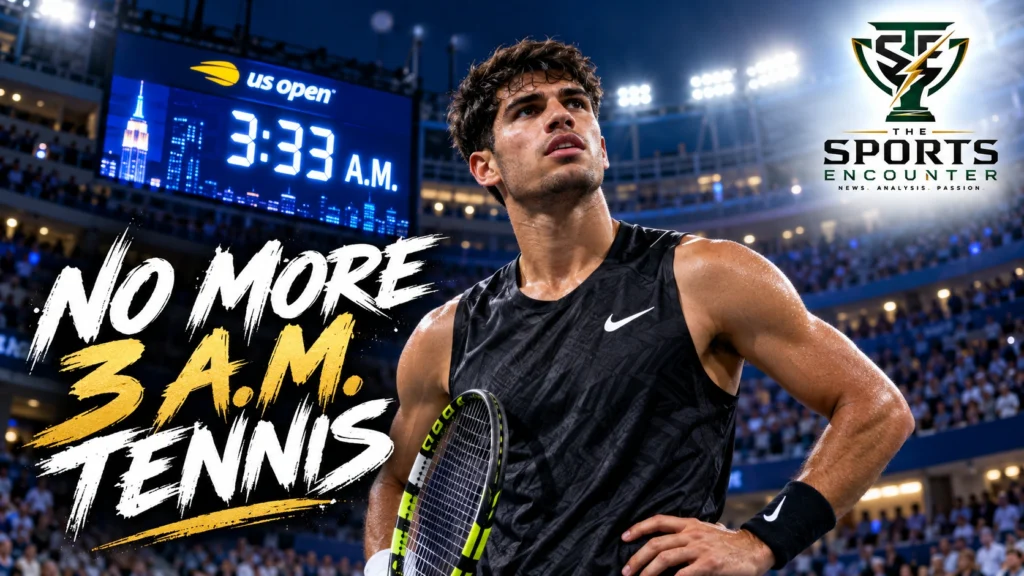
The seven-time Grand Slam champion has called for major tournaments to restructure their schedules so matches finish by around 11 p.m., after his US Open title defense ended against Ben Shelton at 3:33 a.m. in the latest finish in tournament history.
Alcaraz described such finishes as “too much” while speaking ahead of the Laver Cup in London. His proposal turns a familiar player complaint into a much more difficult question for Grand Slam organizers: how much late-night tennis is actually necessary to sell a major tournament?
| Key issue | What happened |
|---|---|
| Alcaraz’s proposal | Grand Slam play should ideally finish by around 11 p.m. |
| Trigger for debate | Ben Shelton beat Alcaraz in a US Open quarterfinal ending at 3:33 a.m. |
| Match duration | 4 hours, 28 minutes |
| US Open significance | Latest finish in tournament history |
| Wider question | How majors balance players, fans, television, ticketing and unpredictable match length |
Why Is Carlos Alcaraz Calling for an 11 p.m. Grand Slam Finish?
The immediate answer is New York.
Story at a glance
Why Is Carlos Alcaraz Calling for an 11 p.m. Grand Slam Finish?
The immediate answer is New York.
The 3:33 a.m. Finish Was Also a Scheduling Problem
The length of Shelton-Alcaraz alone does not explain why the match ended so late.
Alcaraz Is Asking for More Than a Ban on Very Late Starts
This is where his proposal becomes especially interesting.
How Do the Four Grand Slams Handle Late-Night Tennis?
There is no single Grand Slam model.
Why Late Finishes Affect More Than Player Fatigue
The physical concern is obvious, particularly when a player has to recover for another Grand Slam match roughly two days later.
Alcaraz and Shelton produced one of the matches of the 2026 US Open, with the American winning 6-7(5), 6-1, 6-3, 1-6, 7-6(7) after four hours and 28 minutes. Shelton finished it with a 146-mph ace at 3:33 a.m.
The US Open’s official match report confirmed that it was the latest finish in tournament history.
The Sports Encounter’s full analysis of Shelton’s five-set victory over Alcaraz captured the sporting side of the night: Shelton absorbed Alcaraz’s fourth-set recovery, survived the pressure of a deciding tiebreak and produced the biggest victory of his career.
The scheduling story looks different.
Alcaraz believes a match of that quality would have been better served by an earlier window, with more spectators able to remain inside Arthur Ashe Stadium and more viewers able to follow it without staying awake into the early morning.
The 3:33 a.m. Finish Was Also a Scheduling Problem
The length of Shelton-Alcaraz alone does not explain why the match ended so late.
It was scheduled second in the Arthur Ashe Stadium night session. Jessica Pegula and Emma Navarro were due to begin the session at 7 p.m., with Alcaraz and Shelton following them.
That distinction matters because best-of-five tennis has no reliable finishing time. A men’s Grand Slam match scheduled second in an evening session can last two hours. It can also last four and a half.
The US Open knew it was placing one of the tournament’s biggest matches at the end of a two-match evening program. What nobody could know was how long either contest would take.
Alcaraz had already entered New York with an unusual workload question. His straight-sets first-round victory after a long wrist-injury absence marked his return to Grand Slam singles competition after months away.
His run eventually reached the quarterfinals, where the physical challenge became very different.
Alcaraz Is Asking for More Than a Ban on Very Late Starts
This is where his proposal becomes especially interesting.
The ATP already has rules designed to control late scheduling at regular Tour events. The 2026 ATP Rulebook says no more than two evening matches should be scheduled on a court, those sessions should begin no later than 7:30 p.m. without approval, and matches normally should not start after 11 p.m.
Grand Slams operate independently of the regular ATP Tour structure.
Alcaraz is also talking about something stricter than preventing a match from starting after 11 p.m. He is asking organizers to consider a structure where play finishes around that time.
Those are two very different standards.
A no-start rule can prevent a player from walking onto court after midnight. A finish target requires organizers to plan backward, accounting for the possibility that a match already in progress could run for several more hours.
How Do the Four Grand Slams Handle Late-Night Tennis?
There is no single Grand Slam model.
| Grand Slam | Scheduling approach | Late-night implication |
|---|---|---|
| Australian Open | Expanded to a Sunday start and reduced the number of daytime matches on its main show courts | The changes were introduced partly to reduce pressure leading to very late finishes |
| Roland-Garros | Uses a single marquee match for the main Philippe-Chatrier night session | Fewer matches are stacked inside the principal evening ticket window |
| Wimbledon | Operates with an 11 p.m. curfew | Play can be suspended and completed the following day |
| US Open | Arthur Ashe evening sessions can contain two matches | A long opening match can push the second contest deep into the night |
Wimbledon offered a useful real-world example during the 2026 Championships when play in Alexander Zverev’s fourth-round match against Jiri Lehecka was suspended shortly before the 11 p.m. curfew.
The Sports Encounter’s Wimbledon 2026 curtain-raiser examined how the grass-court major combines tradition, scheduling pressure and a two-week championship structure that differs markedly from New York.
Why Late Finishes Affect More Than Player Fatigue
The physical concern is obvious, particularly when a player has to recover for another Grand Slam match roughly two days later.
But Alcaraz’s argument also focuses on the audience.
A major sporting event can produce its most compelling tennis after much of its natural television audience has gone to sleep and some spectators inside the stadium have already left. That creates an unusual contradiction. Tournament organizers successfully build a premium night-session product, then risk pushing its climax beyond the practical limits of many of the people who bought or watched it.
The 2026 US Open repeatedly confronted that tension. Reuters reported that three matches finished after 2 a.m. during the opening week, while several others extended beyond midnight. A Venus Williams match also produced the tournament’s latest-ever start at 12:13 a.m.
This was therefore larger than the Alcaraz-Shelton quarterfinal.
The Sports Encounter had already identified demanding night-session conditions as part of the tournament equation in its complete US Open 2026 preview, while the US Open draw analysis showed how many high-profile players were competing under complicated injury, workload and recovery circumstances.
Why Can’t the US Open Simply Introduce an 11 p.m. Curfew?
It could alter its scheduling model, but every solution creates another decision.
A hard curfew similar to Wimbledon’s can interrupt a match at a decisive stage and require players to return the following day. Earlier evening sessions may collide with commercial, broadcasting or spectator preferences. Moving a delayed match to another court protects time but can remove a marquee contest from the stadium for which fans purchased tickets.
There is also no reliable match clock.
Best-of-five tennis makes that problem particularly difficult. The same matchup could end in straight sets or become a five-set contest lasting well beyond four hours.
A sustainable solution therefore requires more than choosing an arbitrary stopping time.
What Could a More Practical Grand Slam Schedule Look Like?
Several existing tennis policies offer pieces of a possible model.
- Start primary night sessions earlier where local conditions allow.
- Avoid placing two potentially long men’s matches consecutively in the same late session.
- Create a clear threshold for moving a second match when the first contest runs unusually long.
- Protect a latest reasonable start time as well as considering a finishing target.
- Use hard curfews only where organizers are prepared for suspended matches to continue the next day.
- Build television and ticketing plans around the possibility of long matches rather than treating them as exceptional.
None removes every tradeoff. Together, however, they would treat late finishes as a scheduling risk to be managed instead of an unavoidable feature of Grand Slam tennis.
The Debate Also Connects to Tennis’s Wider Workload Problem
Alcaraz made his comments in London ahead of the 2026 Laver Cup at The O2, where another scheduling discussion has been developing.
Team World captain Andre Agassi has argued that players would benefit from a more clearly protected offseason, extending the conversation from late-night matches to the overall structure of the professional calendar.
Those issues should not be confused with Alcaraz’s wrist injury. His injury preceded the US Open and there is no basis for attributing it to late-night scheduling.
What his comeback illustrates is how little recovery margin elite tennis can sometimes provide. Alcaraz returned from a lengthy absence, survived four rounds in New York and then played four hours and 28 minutes in a quarterfinal that finished after most of the city had gone to sleep.
Shelton somehow had to move on from that emotional and physical high. He eventually reached the final, where Alexander Zverev defeated him in four sets, a championship run examined in The Sports Encounter’s US Open final analysis.
Will Grand Slams Change Their Scheduling After Alcaraz’s Comments?
There is no confirmed universal Grand Slam reform.
Reuters reported that the USTA did not immediately respond to its request for comment on Alcaraz’s latest remarks, although the organization has indicated that scheduling options will be evaluated.
The significant development is that the debate now has a specific benchmark.
Alcaraz is no longer simply saying that 3:33 a.m. is too late. He is asking tennis to consider what a reasonable finishing time should actually be.
For a sport that has already changed tiebreak formats, expanded tournaments, modified heat rules and experimented with scheduling protections, that question is unlikely to disappear when the Laver Cup ends.
Follow The Sports Encounter’s tennis hub for Grand Slam coverage, player analysis and major ATP and WTA storylines.
Continue the Tennis Story



Frequently Asked Questions
What did Carlos Alcaraz say about late-night Grand Slam matches?
Alcaraz said extremely late finishes are excessive and suggested Grand Slam schedules should ideally be structured so play finishes at around 11 p.m.
What time did Carlos Alcaraz’s US Open match against Ben Shelton finish?
The 2026 US Open quarterfinal ended at 3:33 a.m. local time in New York.
Who won the Alcaraz-Shelton US Open quarterfinal?
Ben Shelton defeated Carlos Alcaraz 6-7(5), 6-1, 6-3, 1-6, 7-6(7) after four hours and 28 minutes.
Was Alcaraz-Shelton the latest finish in US Open history?
Yes. The US Open officially identified the 3:33 a.m. finish as the latest in tournament history.
Why did the Alcaraz-Shelton match finish so late?
The quarterfinal was scheduled second in the Arthur Ashe Stadium night session after the Jessica Pegula-Emma Navarro match. The Alcaraz-Shelton contest then lasted four hours and 28 minutes.
Does Wimbledon have an 11 p.m. curfew?
Yes. Wimbledon stops play at 11 p.m. Matches that cannot be completed before the curfew can resume the following day.
Can ATP Tour matches start after 11 p.m.?
Under the 2026 ATP scheduling rules, matches normally cannot start after 11 p.m. unless the ATP supervisor approves an exception in consultation with ATP management. Grand Slams operate separately from standard ATP Tour events.
What happens next for Carlos Alcaraz?
Alcaraz is in London with Team Europe for the 2026 Laver Cup at The O2, his first event since reaching the US Open quarterfinals on his return from a lengthy wrist injury absence.
Carlos Alcaraz
- Why Carlos Alcaraz Wants Grand Slams Finished by 11 PM?
- Laver Cup 2026 Returns to Federer’s Farewell Stage as Alcaraz and Zverev Lead Europe in London
- Has Novak Djokovic Really Lost His Mojo? What US Open 2026 Revealed
- Shelton Knocks Out Alcaraz in 3:33 a.m. Epic and Sends America Into the US Open Final
- Ben Shelton Blasts Past Stefanos Tsitsipas to Earn Blockbuster Carlos Alcaraz US Open Quarterfinal