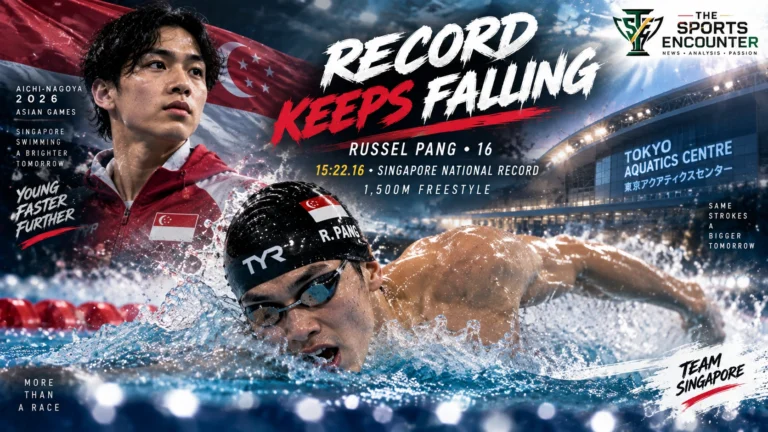
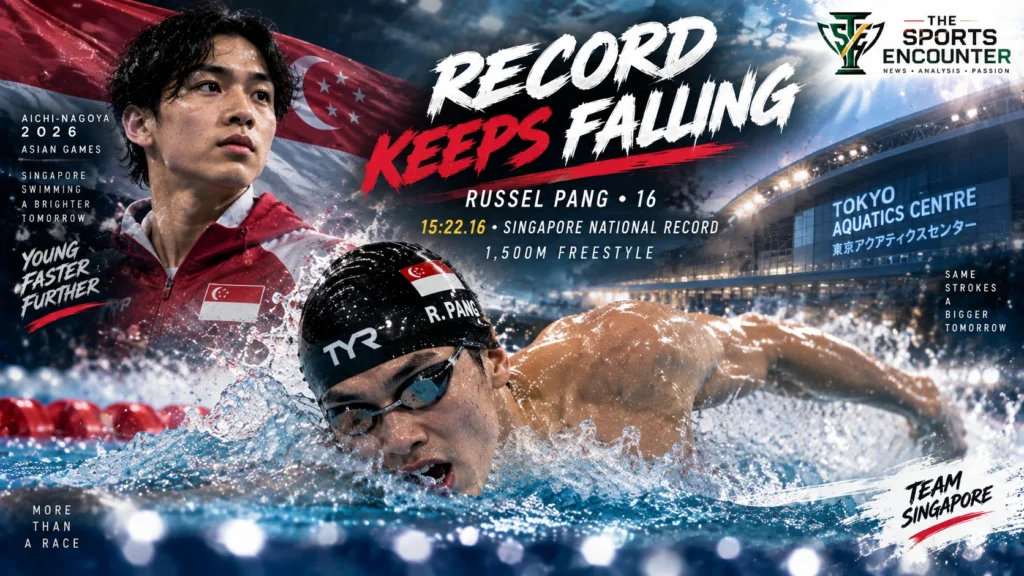
TOKYO, Japan, September 22, 2026: Russel Pang did not leave the Tokyo Aquatics Centre with an Asian Games medal on Tuesday. The 16-year-old Singaporean left with another piece of evidence that his distance-swimming career is moving considerably faster than his age might suggest.
Making his Asian Games debut, Pang finished second in the men’s 1,500m freestyle B final in 15:22.16, lowering the Singapore national record of 15:25.58 he had established at the Glasgow Commonwealth Games less than two months ago.
Qatar’s Saadeddin Saadeddin won the B final in 15:21.33, only 0.83 seconds ahead of Pang. The result did not put the Singaporean on the Asian Games podium, but it extended a striking progression: Pang has now broken the national 1,500m record at three major multi-sport competitions within nine months.
He is also Singapore’s national record holder over 800m freestyle. At an Asian Games where teenagers are already changing the record books, Pang’s performance gives Singapore its own long-distance development story.
Story at a glance
How Much Did Russel Pang Improve Singapore’s 1,500m Record?
Pang took 3.42 seconds off his previous national mark.
Why 15:22.16 Matters Even Without an Asian Games Medal
The B final label could make Pang’s swim easy to overlook amid a program producing Asian Games champions and continental records.
Pang Has Broken the National Record at Three Major Games in Nine Months
The sequence began at the SEA Games in December 2025.
Why Pang Was Chasing 15:20, Not Merely Another Record
Pang’s own target provides useful context for how he views 15:22.16.
Gan Ching Hwee Is Giving Singapore’s Young Distance Swimmers a Reference Point
Pang’s development is taking place alongside one of Singapore’s established distance swimmers.
Russel Pang’s Asian Games 1,500m Swim at a Glance
| Detail | Result |
|---|---|
| Swimmer | Russel Pang |
| Nation | Singapore |
| Age | 16 |
| Event | Men’s 1,500m Freestyle |
| Asian Games result | Second in B final |
| Time | 15:22.16 |
| Previous Singapore record | 15:25.58 |
| Improvement | 3.42 seconds |
| B final winner | Saadeddin Saadeddin, Qatar, 15:21.33 |
| Venue | Tokyo Aquatics Centre |
How Much Did Russel Pang Improve Singapore’s 1,500m Record?
Pang took 3.42 seconds off his previous national mark.
That number becomes more meaningful when his recent progression is viewed as a sequence rather than a single race.
| Competition | Time | Progress |
|---|---|---|
| 2025 SEA Games | 15:28.46 | Singapore national record and bronze medal |
| 2026 Commonwealth Games | 15:25.58 | National record lowered by 2.88 seconds |
| 2026 Asian Games | 15:22.16 | National record lowered by another 3.42 seconds |
Across those three performances, Pang has cut 6.30 seconds from the 15:28.46 national record he established at the SEA Games in December 2025.
His Glasgow performance is recorded in the official World Aquatics results database, which lists the 15:25.58 national record from July 29.
The pattern is important because each improvement has come under major-event conditions rather than in isolated domestic competition. Pang has repeatedly moved the record while learning how to race longer freestyle events on increasingly demanding stages.
Why 15:22.16 Matters Even Without an Asian Games Medal
The B final label could make Pang’s swim easy to overlook amid a program producing Asian Games champions and continental records.
For Singapore’s long-term swimming development, the more relevant question is where Pang is at 16 and how quickly he is moving.
The 1,500m freestyle is particularly useful for measuring development because progress depends on far more than raw speed. The swimmer has to sustain technique and efficiency through 30 lengths of a 50-meter pool while managing pace, fatigue and the temptation to respond too aggressively when competitors change speed.
Pang started swimming when he was five and competing at seven. His eventual move toward distance events came after his aerobic strength emerged as one of his clearest advantages.
That specialization has already produced Singapore records at both 800m and 1,500m.
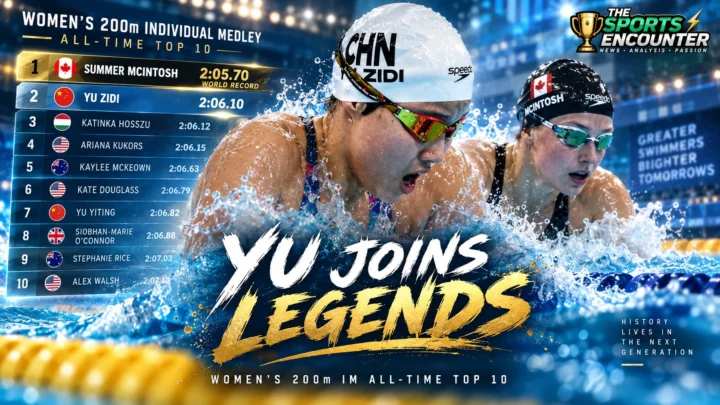
His development also fits one of the strongest themes of these Games. China’s 13-year-old Yu Zidi has already broken Asian and world junior records, while several other young swimmers are using Aichi-Nagoya as their first major continental stage.
Pang’s numbers are not yet comparable with the fastest distance swimmers in Asia, but that is precisely why his trajectory is more useful than any exaggerated comparison. At 16, the record is still moving.
Pang Has Broken the National Record at Three Major Games in Nine Months
The sequence began at the SEA Games in December 2025.
Pang won bronze in the 1,500m freestyle on his debut and clocked 15:28.46, establishing his first senior Singapore national record in the event.
Seven months later, the level of opposition rose considerably at the Commonwealth Games in Glasgow.
Pang raced a field that included established international distance swimmers and finished fifth in the final. His 15:25.58 reduced his own record by almost three seconds.
The performance was documented in Singapore’s official post-Commonwealth Games swimming review, which identified the teenager as one of the team’s breakthrough performers.
Then came Tokyo.
Pang did not qualify for the Asian Games A final, but his B-final swim was faster than anything he had previously produced. Another 3.42 seconds disappeared from the national mark.
Three major Games. Three national records.
The progression is unusually clean for a developing athlete because it gives coaches and observers meaningful race evidence rather than projection based only on age-group results.
Why Pang Was Chasing 15:20, Not Merely Another Record
Pang’s own target provides useful context for how he views 15:22.16.
After the race, he said he had hoped to swim below 15:20. He was pleased with the national record, but the target he carried into Tokyo was already more ambitious than the mark he ultimately broke.
That puts the next benchmark only 2.17 seconds away.
Over 1,500 meters, 2.17 seconds represents roughly 0.07 seconds per 50-meter length. Improvement is never that mechanically simple, particularly as an athlete moves closer to his performance ceiling, but the calculation illustrates how close Pang has moved to a barrier he already considers realistic.
His preparation included a 28-day training camp in Kunming, China. Pang said the work leading into the Asian Games had paid off, while emphasizing technique and execution during the race rather than constantly chasing the clock.
That is significant for a teenage distance swimmer. A 1,500m race offers too many opportunities to lose efficiency if every length becomes a reaction to the stopwatch.
Gan Ching Hwee Is Giving Singapore’s Young Distance Swimmers a Reference Point
Pang’s development is taking place alongside one of Singapore’s established distance swimmers.
Gan Ching Hwee won silver in the women’s 1,500m freestyle earlier at these Games. During the same race, her 800m split of 8:29.56 also established a Singapore national record.
Pang has described Gan as one of his best teammates and credited her with encouraging him through difficult training days.
That relationship matters because youth development is rarely isolated. Pang has access to a teammate who is already navigating the same demanding freestyle distances at senior international level.
The Asian Games pool has repeatedly demonstrated the value of that mixture of youth and experience. China’s 31-year-old Xu Jiayu won a third consecutive 50m backstroke title while swimmers more than a decade younger were simultaneously breaking through around him.
Siobhan Haughey’s successful 200m freestyle title defense offered another example of established Asian stars continuing to set standards while younger swimmers close the gap.
Singapore’s Youth Story Is Bigger Than One National Record
Pang was not the first 16-year-old Singaporean to rewrite a national mark at these Games.
A day earlier, Asian Games debutant Tedd Chan lowered Singapore’s men’s 50m backstroke record to 24.97 before finishing eighth in the final.
The two swimmers operate at opposite ends of the racing spectrum. Chan’s event lasts less than 25 seconds. Pang’s requires more than 15 minutes.
The common ground is age and timing. Both are 16, both are making their Asian Games debuts, and both have already produced senior national records in Japan.
That gives Singapore a development story that extends beyond one promising swimmer.
The wider Games have repeatedly highlighted the same generational movement. South Korea’s 20-year-old Kim Young-beom broke the Asian Games 50m freestyle record twice in one day, while Yu Zidi has pushed age boundaries much further at 13.
The athletes are at different performance levels and stages of development, so direct comparisons would be misleading. What they collectively demonstrate is how rapidly the Asian swimming landscape can change between Olympic cycles.
What Does Pang Need to Close the Gap to Asia’s Leading Distance Swimmers?
The Asian Games also gives Pang an honest measurement of the work still ahead.
His national record came in the B final rather than the medal race. That distinction should not be hidden when assessing the performance.
Asia’s strongest distance programs currently operate at a higher level, particularly China and Japan. The opening night of the Games demonstrated that depth when Li Bingjie retained the women’s 1,500m title as part of a Chinese session that produced six swimming gold medals.
TSE examined that dominance in its opening Asian Games medal report, while the following day showed how quickly the regional standard is moving across different disciplines.
China’s men then erased a 1.89-second deficit against Japan in the 4x200m freestyle relay. Zhang Zhanshuo’s 1:42.92 anchor carried them to 7:00.17, a new Asian record, in a race analyzed in TSE’s breakdown of China’s relay comeback.
Pang’s task over the next several years is therefore clear. Singapore’s national record is a moving target he currently owns, but reaching Asian finals consistently will require further progression against nations whose standards are moving as well.
Why Singapore’s Distance-Swimming Development Is Worth Watching
Singapore swimming is moving through a generational transition.
Joseph Schooling retired in 2024, removing the country’s only Olympic swimming champion from the competitive picture. Quah Zheng Wen subsequently put swimming on hold while pursuing postgraduate studies.
The next Singapore generation therefore has room to develop its own identity rather than being judged only through the country’s previous stars.
Pang’s specialty makes him particularly interesting in that context. Singapore’s most internationally recognizable swimming successes have often come in shorter races. A teenage national-record holder developing over 800m and 1,500m gives the program another route.
There is also no reason to rush the conclusion.
A 16-year-old finishing second in an Asian Games B final is still a developing swimmer, regardless of how impressive the national record progression looks. The useful story is what happens to those times over the next two or three seasons.
That distinction is important in an Asian Games already filled with teenage performances capable of creating enormous expectations.
How Does Pang’s Breakthrough Fit the Wider Asian Games Swimming Story?
The Tokyo Aquatics Centre has become one of the busiest record-producing venues of Aichi-Nagoya 2026.
China dominated the opening session before the competition broadened. Yu Zidi broke Asian and world junior records, Xu Jiayu extended his backstroke reign, Kim Young-beom delivered South Korea’s first swimming gold, and the China-Japan 4x200m relay became one of the races of the Games.
The full scale of that record-filled second medal day is covered in TSE’s September 21 Asian Games report.
Pang’s 15:22.16 belongs lower down the immediate competitive hierarchy because it did not produce a medal or an Asian record. It can still matter enormously to Singapore.
National programs develop when athletes move domestic standards closer to the level required for major finals. Pang has now done that three times in nine months.
The next question is how much further he can move it.
What Comes Next for Russel Pang?
The simplest target is already visible: 15:20.
Pang wanted to break that barrier in Tokyo and missed it by 2.17 seconds. His current progression suggests it is a meaningful short-term benchmark rather than an arbitrary round number.
The larger objective will be harder. Pang must turn national-record swims into consistent qualification for the strongest international finals while continuing to develop the endurance, pacing and efficiency required over 1,500 meters.
He has time.
At 16, Pang has already raced three major multi-sport competitions, won a SEA Games medal, reached a Commonwealth Games final and established himself as Singapore’s fastest man ever over both 800m and 1,500m freestyle.
The broader Aichi-Nagoya 2026 picture is filled with champions, established stars and teenage prodigies. Pang is not yet in the first category.
His record progression makes the journey toward it worth following.
Continue the Asian Games 2026 Story



Frequently Asked Questions About Russel Pang’s Asian Games Record
Who is Russel Pang?
Russel Pang is a 16-year-old Singaporean distance swimmer who holds his country’s senior national records in the men’s 800m and 1,500m freestyle.
What record did Russel Pang break at the 2026 Asian Games?
Pang broke Singapore’s men’s 1,500m freestyle national record with a time of 15:22.16 at the Tokyo Aquatics Centre.
What was Russel Pang’s previous 1,500m record?
His previous national record was 15:25.58, set at the Glasgow 2026 Commonwealth Games in July.
How much did Russel Pang improve his national record?
He lowered his previous 1,500m freestyle mark by 3.42 seconds.
Did Russel Pang win an Asian Games medal?
No. Pang finished second in the men’s 1,500m freestyle B final. Qatar’s Saadeddin Saadeddin won that race in 15:21.33.
How many times has Russel Pang broken Singapore’s 1,500m record?
Pang has set three successive national marks at major Games since December 2025: 15:28.46 at the SEA Games, 15:25.58 at the Commonwealth Games and 15:22.16 at the Asian Games.
What other Singapore swimming record does Russel Pang hold?
Pang also holds Singapore’s senior men’s 800m freestyle national record.
What time is Russel Pang targeting next in the 1,500m freestyle?
Pang said he had hoped to go below 15:20 at the Asian Games. His 15:22.16 national record leaves him 2.17 seconds away from that barrier.
Who is Gan Ching Hwee and why is she important to Pang?
Gan Ching Hwee is a Singaporean distance swimmer and Pang’s national teammate and training partner. Pang has credited her with encouraging him through difficult training days.
Where was Russel Pang’s Asian Games record set?
He set the record at the Tokyo Aquatics Centre during the Aichi-Nagoya 2026 Asian Games.