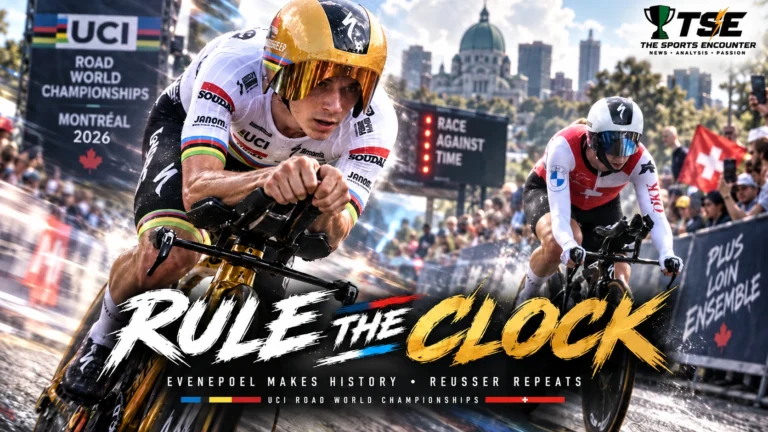
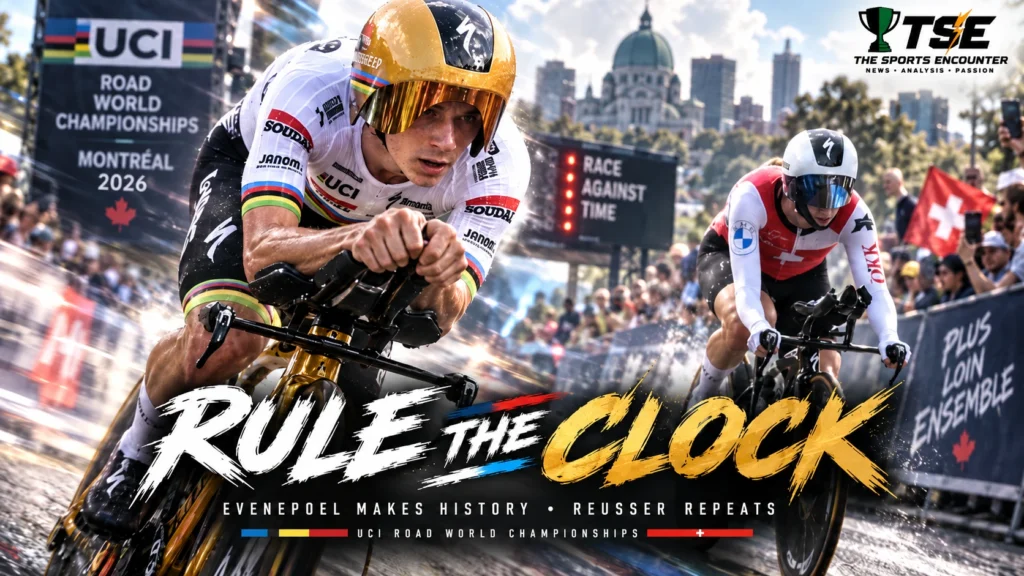
MONTREAL, Canada, September 21, 2026: Remco Evenepoel opened the 2026 UCI Road World Championships by becoming the first man to win four consecutive elite individual time trial world titles, while Marlen Reusser celebrated her 35th birthday by defending the women’s rainbow jersey with a performance built on patience rather than an explosive start.
Evenepoel covered the 39.2-kilometer Montréal course in 44 minutes, 53.13 seconds, finishing 57.31 seconds ahead of Filippo Ganna. French teenager Paul Seixas took bronze at 1:13.04, extending a breakthrough season that has already moved him into cycling’s highest tier.
Reusser won the women’s race in 50:24.44, beating Great Britain’s Zoe Bäckstedt by 40.11 seconds and Germany’s Franziska Koch by 45.54. Her margin looks comfortable on the results sheet. The race itself was much more revealing. Reusser deliberately gave away time during the technical opening section, then dismantled the field over the second half.
The two victories gave Montréal 2026 an immediate historical anchor and provided the first rainbow jerseys of a championship that runs through September 27. Fans can follow the tournament alongside The Sports Encounter’s growing cycling coverage and the championship listing in our global sports events calendar.
Story at a glance
UCI Road World Championships 2026 Elite Time Trial Results
The championships are being staged in Montréal from September 20 through 27, with 13 world-title events across elite, under-23 and junior categories. The official UCI championship hub carries the complete schedule and live results.
How Remco Evenepoel Became the First Man to Win Four Straight World Time Trials
Evenepoel arrived in Montréal with history waiting for him rather than chasing him from behind.
Paul Seixas’ Bronze May Be the Result the Peloton Remembers Later
Evenepoel owned the race, but the youngest rider on the podium supplied the strongest forward-looking story.
Why Marlen Reusser’s Victory Was Really a Pacing Masterclass
The women’s race developed very differently.
Zoe Bäckstedt Put Real Pressure on Reusser Before the Race Turned
Bäckstedt’s silver should not be reduced to finishing 40 seconds behind.
UCI Road World Championships 2026 Elite Time Trial Results
| Event | Gold | Winning Time | Silver | Bronze |
|---|---|---|---|---|
| Men Elite ITT | Remco Evenepoel, Belgium | 44:53.13 | Filippo Ganna, Italy (+57.31) | Paul Seixas, France (+1:13.04) |
| Women Elite ITT | Marlen Reusser, Switzerland | 50:24.44 | Zoe Bäckstedt, Great Britain (+40.11) | Franziska Koch, Germany (+45.54) |
The championships are being staged in Montréal from September 20 through 27, with 13 world-title events across elite, under-23 and junior categories. The official UCI championship hub carries the complete schedule and live results.
How Remco Evenepoel Became the First Man to Win Four Straight World Time Trials
Evenepoel arrived in Montréal with history waiting for him rather than chasing him from behind.
No male rider had ever won four consecutive elite world time trial championships.
The Belgian removed the suspense quickly.
He drove through the 39.2-kilometer course with the authority of a rider who understood exactly where he could take time from his rivals. Ganna, himself a two-time world champion and one of the finest time trialists of his generation, finished almost a minute behind.
Evenepoel’s fourth title also moved him alongside Fabian Cancellara and Tony Martin as the only men to win the elite world time trial four times.
The difference is sequence.
Cancellara’s four victories came across several seasons. Martin built his collection over a longer period. Evenepoel has won every edition since 2023.
Evenepoel’s 57-Second Margin Shows How Large the Gap Has Become
Ganna losing by 57.31 seconds offers the clearest measure of Evenepoel’s performance.
There is no weak comparison being used here. Ganna has spent years as the reference point for long, high-speed time trials and possesses the power profile expected to thrive on a course with extended flat sections.
Evenepoel still produced clear separation.
The course rewarded riders who could combine aerodynamic efficiency, sustained power and technical confidence. Montréal offered long sections where speed could be maintained, but enough direction changes and changes of rhythm existed to punish riders who simply tried to hold one enormous number from start to finish.
The UCI designed the elite men’s and women’s time trials around the same 39.2-kilometer route with 220 meters of elevation gain. The official route description confirms that the course passed Old Montréal, the banks of the St. Lawrence River, Circuit Gilles Villeneuve and Parc Jean-Drapeau before returning toward the finish.
It was fast enough for specialists and technical enough to reward control.
Evenepoel had both.
Paul Seixas’ Bronze May Be the Result the Peloton Remembers Later
Evenepoel owned the race, but the youngest rider on the podium supplied the strongest forward-looking story.
Paul Seixas is 19.
He finished only 15.73 seconds behind Ganna and claimed bronze against riders with far deeper world championship experience.
The result adds to a season in which Seixas has already moved rapidly from exceptional prospect to elite road racer.
A world time trial podium matters because it demonstrates more than climbing talent or race instinct. Riding against the clock strips away most tactical protection. There is no teammate to draft, no breakaway politics to exploit and no peloton to hide inside.
Seixas had to produce the power, pacing and aerodynamic discipline himself.
The bronze suggests France may possess a rider capable of influencing championship racing for years rather than merely another young climber collecting promising results.
A Crash Cost Jakob Söderqvist His Podium Challenge
Sweden’s Jakob Söderqvist had been moving through the intermediate checkpoints with podium-level speed before crashing on a turn late in the course.
He recovered and continued, eventually finishing fifth.
The incident illustrates the balance demanded by a championship time trial. Every second matters, but extracting those seconds means carrying speed into technical sections where the margin between aggressive and excessive can be extremely small.
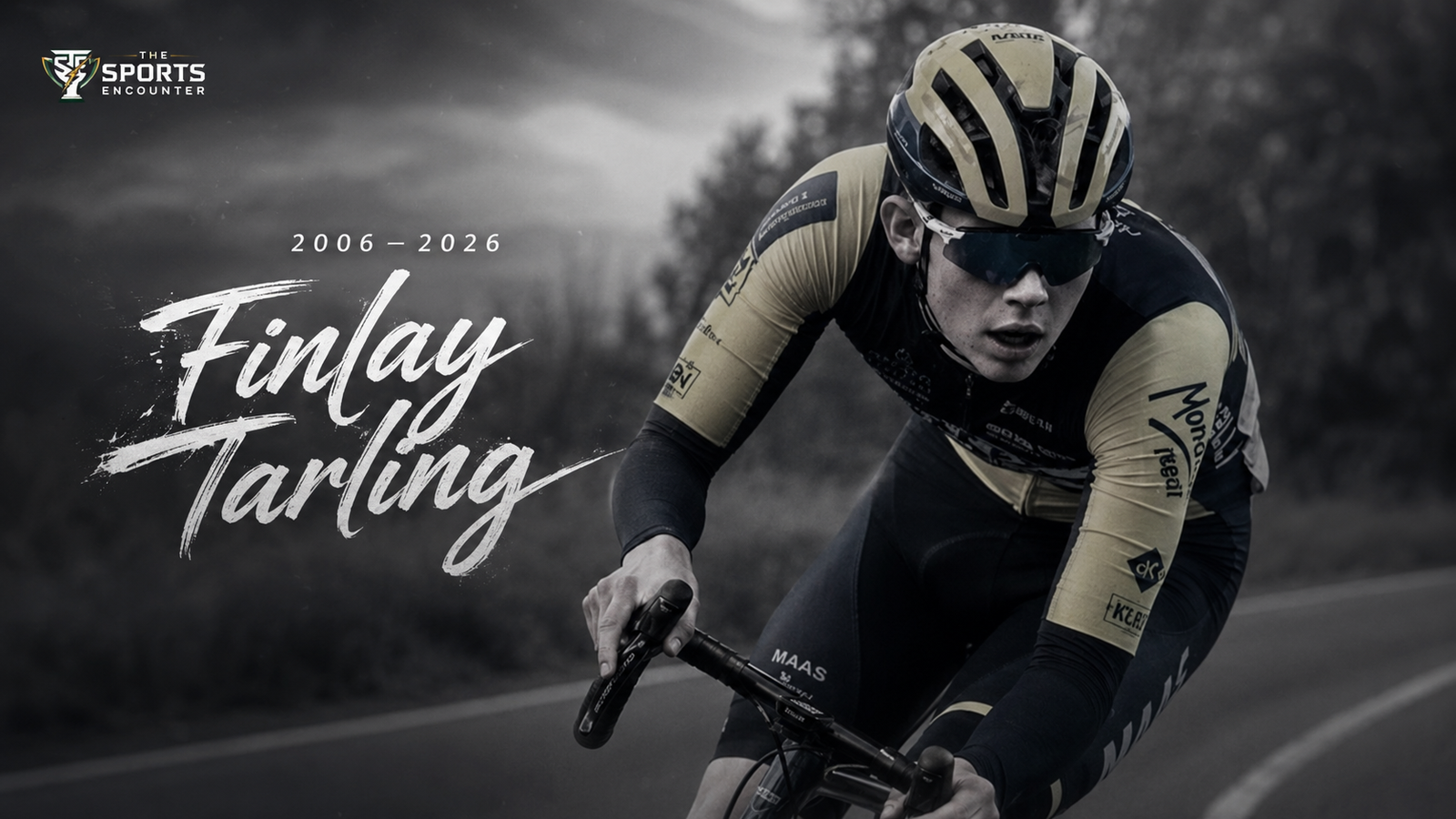
Road cycling has been forced to confront its relationship with risk repeatedly in 2026. TSE examined that wider issue after the death of British cyclist Finlay Tarling at the Volta a Portugal, where the conversation extended well beyond results to course safety, athlete protection and the unavoidable dangers of racing on open roads.
Söderqvist’s crash had a far less serious outcome, but it was another reminder that speed and control remain inseparable in the sport.
Why Marlen Reusser’s Victory Was Really a Pacing Masterclass
The women’s race developed very differently.
Reusser did not dominate from the first checkpoint.
Bäckstedt was faster through the opening part of the course and held a 10-second advantage over the defending champion at the first intermediate split.
That deficit had shrunk to approximately three seconds by the second checkpoint.
At the next timing point, Reusser had moved ahead.
By the finish, she had won by 40 seconds.
The progression tells the story better than the final time.
Reusser had planned for the opening technical section to cost her time. She resisted the temptation to chase an early reference number, preserved energy and then used the faster second half of the course to apply sustained pressure.
That is championship pacing at its most disciplined.
Reusser Won on Her 35th Birthday
The calendar added another layer.
Reusser turned 35 on race day.
She celebrated by winning her second consecutive elite world time trial title after taking the rainbow jersey in Kigali in 2025.
Her career had already included two silver medals and a bronze before she finally became world champion. Montréal now confirms that the breakthrough was the beginning of a championship run rather than the culmination of one.
Experienced athletes sustaining or improving performance deep into their careers remain one of the most compelling stories across elite sport. TSE has followed the same theme in other global championships, including the performances that shaped the final stages of Glasgow 2026, where established champions and emerging athletes repeatedly collided across multiple disciplines.
Zoe Bäckstedt Put Real Pressure on Reusser Before the Race Turned
Bäckstedt’s silver should not be reduced to finishing 40 seconds behind.
For a significant portion of the race, the 21-year-old Briton was the rider forcing Reusser to respond.
She set an early benchmark strong enough to lead at the first split and remained ahead through the second checkpoint.
That matters because Bäckstedt represents another emerging generation arriving in elite women’s cycling with fewer reasons to defer to established names.
Her silver also came ahead of several more experienced riders, including Demi Vollering, who had been expected to challenge much more closely for the title.
Germany’s Koch completed the podium only 5.43 seconds behind Bäckstedt.
Behind them, the gaps expanded rapidly.
What Happened to Demi Vollering in the Women’s Time Trial?
Vollering finished eighth, approximately 1 minute, 49 seconds behind Reusser.
The most striking image of her race came when Reusser, who had started behind her, physically caught and passed the Dutch star on the road.
That moment did not mean Vollering suddenly became a poor rider against the clock.
It showed how specialized this particular event remains.
Vollering’s biggest strength is her ability to combine climbing, endurance and tactical racing across demanding road races and stage races. Reusser is one of the sport’s defining pure time trial specialists.
Montréal rewarded the specialist.
The road race later in the championships will ask a very different set of questions.
Why the Montréal Course Produced Two Different Winning Strategies
Men and women raced the same 39.2-kilometer course.
Evenepoel attacked it with almost immediate authority.
Reusser treated it as an exercise in controlled escalation.
That contrast is useful because time trial racing can look simple from the outside. Riders start individually, follow the course and stop the clock.
The real decisions are continuous.
How aggressively should a rider enter a corner?
How much power should be spent before a technical sector?
Where does the headwind justify restraint?
How much can be saved for the final kilometers without giving away too much earlier?
When should a rider trust the pacing plan rather than the time gap coming from the team car?
Reusser’s victory was built on that last question.
She trusted the plan while behind.
Evenepoel’s performance suggested he was strong enough to make the plan itself almost irrelevant to everyone else.
Why Montréal Hosting the Worlds Matters to Cycling
The 2026 championships carry historical weight before the racing is even finished.
Montréal first hosted the Road World Championships in 1974, when the event was staged outside Europe for the first time.
Eddy Merckx won the elite men’s road race that year and completed a season in which he also won the Giro d’Italia and Tour de France.
The Worlds returned to Canada in Hamilton in 2003 and are now back in Montréal as part of the wider celebration surrounding the 50th anniversary of the 1976 Olympic Games.
Global championships can reshape how cities and countries relate to individual sports. TSE has examined similar long-term questions around other international events, including Nairobi becoming the first African host of the World Athletics Championships.
Montréal already possesses cycling infrastructure, a WorldTour race and an established cycling audience. The Worlds add another layer to that identity.
The Championships Are Also a Bridge Between Road and Track Cycling
Cycling is one sport with several very different competitive worlds.
The 39.2-kilometer road time trial asks for aerodynamic efficiency and long-duration power on public roads.
Track pursuit asks riders to produce sustained speed in a controlled velodrome environment. Sprint events require explosive acceleration. Road races introduce climbing, positioning, team tactics and attrition.
TSE saw that diversity during the Commonwealth Games, where track cycling entered the Glasgow program after swimming concluded and Australia quickly began turning velodrome depth into medals.
Two days later, Australia swept the men’s 4000m individual pursuit podium, showing how specialized national systems can dominate a particular branch of cycling.
The same sport will feature again at the 2026 Asian Games, where track cycling is being staged at the Izu Velodrome.
Montréal offers the road version of that same elite technical arms race.
What Happens Next at the 2026 UCI Road World Championships?
The championships continue throughout the week with junior and under-23 time trials, the mixed relay and the road races.
The elite women’s road race is scheduled for September 26, with the elite men closing the championships on September 27.
Those races shift the emphasis dramatically.
Evenepoel will no longer be racing alone against a stopwatch. Team tactics, attacks, climbing legs, positioning and national alliances will matter.
Reusser’s form makes her impossible to ignore, but Vollering’s disappointing time trial says very little about what she may produce in a hilly mass-start road race.
Seixas’ bronze gives France another rider opponents will have to watch.
And Bäckstedt leaves the opening day with evidence that she can already pressure the best riders in the world rather than merely wait for her generation to mature.
The first two rainbow jerseys have been decided.
Montréal still has 11 world titles left to award.
Continue the Cycling Story

Frequently Asked Questions
Who won the men’s time trial at the 2026 UCI Road World Championships?
Belgium’s Remco Evenepoel won the elite men’s individual time trial in 44 minutes, 53.13 seconds.
How many world time trial titles has Remco Evenepoel won?
Evenepoel has won four elite world time trial titles, all consecutively from 2023 through 2026.
What record did Remco Evenepoel set in Montréal?
He became the first man to win four consecutive elite individual time trial world championships.
Who finished second and third behind Evenepoel?
Italy’s Filippo Ganna won silver, 57.31 seconds behind Evenepoel, while 19-year-old French rider Paul Seixas took bronze at 1:13.04.
Who won the women’s time trial at the 2026 UCI Worlds?
Switzerland’s Marlen Reusser defended her world title in 50 minutes, 24.44 seconds.
How old is Marlen Reusser?
Reusser turned 35 on September 20, 2026, the same day she successfully defended her world time trial title.
Who finished second in the women’s world time trial?
Great Britain’s Zoe Bäckstedt won silver, 40.11 seconds behind Reusser. Germany’s Franziska Koch finished third.
How long was the Montréal world championship time trial?
The elite men and elite women both raced a 39.2-kilometer course with approximately 220 meters of elevation gain.
Where are the 2026 UCI Road World Championships being held?
The championships are being staged in Montréal, Canada, from September 20 through September 27.
When are the elite road races at the 2026 UCI Worlds?
The elite women’s road race is scheduled for September 26 and the elite men’s road race for September 27.