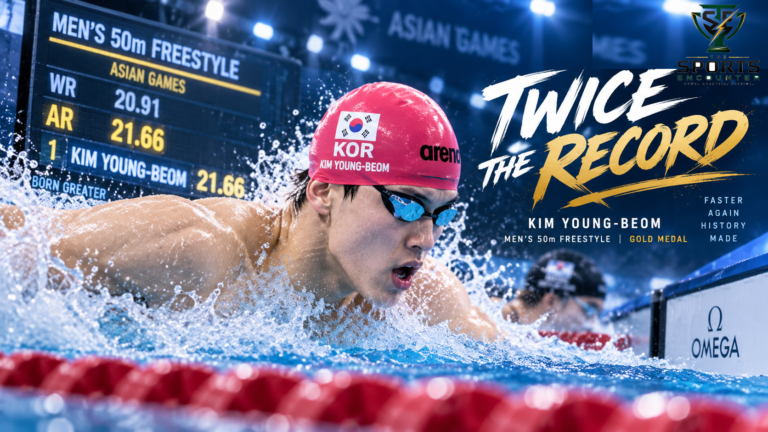
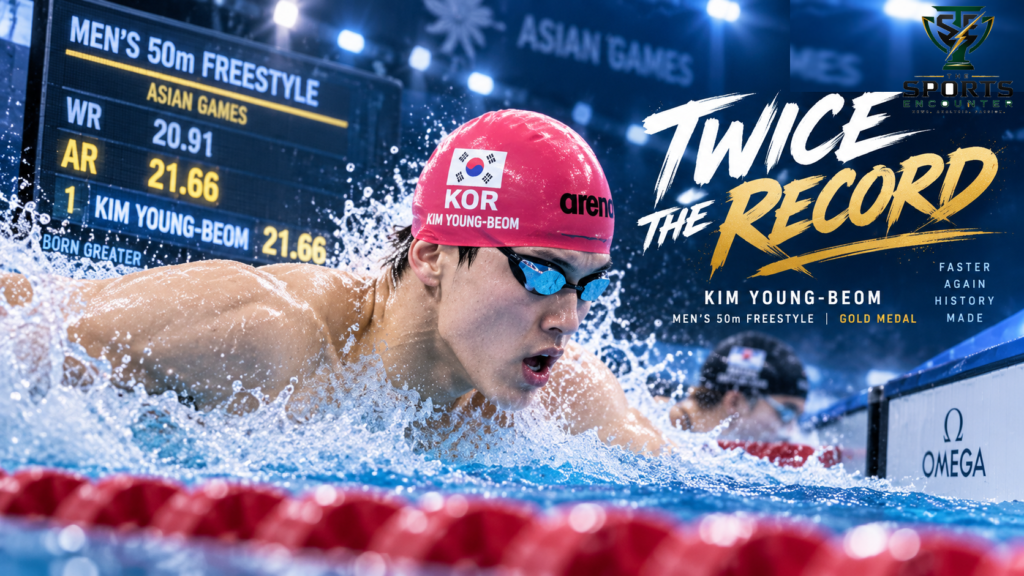
TOKYO, Japan, September 21, 2026: Kim Young-beom broke the men’s 50m freestyle Asian Games record twice in the space of a single day, winning South Korea’s first swimming gold of Aichi-Nagoya 2026 with a 21.66-second sprint at the Tokyo Aquatics Centre.
The 20-year-old had already rewritten the Games record during the morning heats, clocking 21.71 to remove one hundredth from the 21.72 mark fellow Korean Ji Yu-chan set while winning the title at Hangzhou in 2023.
Kim left the pool believing he could go faster.
Hours later, he proved it.
Story at a glance
Kim Young-beom’s Record-Breaking Day at a Glance
Kim’s final left him only 0.02 seconds outside Shuya Matsumoto’s Asian record of 21.64. World Aquatics lists Matsumoto’s 21.64 among his long-course career bests.
Kim Said He Could Break the Record Again, Then Did It
The morning swim became more interesting because of what Kim said afterward.
Why Breaking the Same Games Record Twice in One Day Is So Difficult
Record progression across preliminary rounds can create an unusual championship problem.
Kim Turned a 100m Silver Into 50m Gold in Less Than 24 Hours
Sunday night had ended with one of the narrowest defeats of the opening swimming session.
South Korea Have Now Won the Asian Games 50m Freestyle Twice in a Row
Ji Yu-chan supplied the first half of the sequence in Hangzhou.
His 21.66 in the final lowered his new record by another 0.05 seconds and kept the Asian Games men’s 50m freestyle title in Korean hands. Hong Kong, China’s Ho Ian Yentou took silver in 21.76, while defending champion Ji collected bronze in 21.94.
The victory also completed a rapid emotional turnaround for Kim. One night earlier, he had finished only 0.04 seconds behind China’s Pan Zhanle in the 100m freestyle, taking silver in 47.65 as Pan retained his title in 47.61. TSE documented that opening-night battle in our Asian Games first medal-day report.
Kim Young-beom’s Record-Breaking Day at a Glance
| Stage | Time | Achievement |
|---|---|---|
| Heats | 21.71 | Asian Games record |
| Final | 21.66 | Gold and new Asian Games record |
| Previous Games record | 21.72 | Ji Yu-chan, Hangzhou 2023 |
| Current Asian record | 21.64 | Shuya Matsumoto, Japan |
Kim’s final left him only 0.02 seconds outside Shuya Matsumoto’s Asian record of 21.64. World Aquatics lists Matsumoto’s 21.64 among his long-course career bests.
That proximity gives Kim’s Asian Games record another layer. He did not merely improve a championship mark. He moved to within hundredths of the fastest long-course performance ever produced by an Asian male sprinter over 50 meters.
Kim Said He Could Break the Record Again, Then Did It
The morning swim became more interesting because of what Kim said afterward.
After clocking 21.71, he described himself as tired but relaxed and told the Olympic Council of Asia that if he produced the same kind of race in the final, he believed another record was possible.
He then returned and swam 0.05 seconds faster.
That progression is especially difficult in the 50m freestyle because there is almost no opportunity to repair an error.
A poor reaction can decide the race before a swimmer reaches clean water. A weak breakout costs momentum that cannot easily be recovered. One mistimed breath or an imperfect finish can shift the medal order by hundredths.
Kim’s final reaction time was 0.66 seconds. From there he established enough early speed to prevent the field from drawing alongside him before the wall.
Why Breaking the Same Games Record Twice in One Day Is So Difficult
Record progression across preliminary rounds can create an unusual championship problem.
The athlete has already delivered an exceptional performance but must reset physically and mentally for a race that matters more.
TSE saw the same competitive challenge during the European Aquatics Championships when Sara Curtis broke the 50m backstroke world record in the semifinals and then returned the next day to lower it again while winning gold.
Our follow-up on Curtis’ second world record examined the psychological reset required after becoming the fastest swimmer in history before the championship itself had been secured.
Kim faced a compressed version of that problem in Tokyo.
His first Asian Games record arrived in the morning.
The medal race came only hours later.
Instead of protecting the 21.71, he attacked it.
Kim Turned a 100m Silver Into 50m Gold in Less Than 24 Hours
Sunday night had ended with one of the narrowest defeats of the opening swimming session.
Pan Zhanle won the men’s 100m freestyle in 47.61.
Kim touched in 47.65.
Four hundredths separated gold from silver.
Kim therefore entered Monday’s 50m program carrying strong form but also the frustration of coming within one finish of beating the Olympic champion and world-record holder.
The shorter event demanded a different race.
There was no turn, no back-half strategy and almost no pacing decision. The 50m freestyle is a start, acceleration, maximum sustainable speed and a finish.
Kim handled that transition immediately.
His performances also add another chapter to the sprint environment TSE identified in our Asian Games 2026 preview, where Pan and Korea’s growing men’s freestyle depth were among the pool’s major storylines.
South Korea Have Now Won the Asian Games 50m Freestyle Twice in a Row
Ji Yu-chan supplied the first half of the sequence in Hangzhou.
In 2023, Ji won gold in 21.72, breaking the Asian Games record. The OCA’s official Hangzhou report documented how his victory stopped China’s early sweep of the swimming titles.
Three years later, Ji returned as defending champion but found another Korean occupying the fastest lane.
Kim first removed Ji’s championship record in the heats, then lowered it again in the final.
Ji still reached the podium.
The result gives South Korea consecutive Asian Games champions in the shortest freestyle event and two Korean swimmers among the medalists in Tokyo.
| Asian Games | Champion | Nation | Winning Time |
|---|---|---|---|
| Hangzhou 2023 | Ji Yu-chan | South Korea | 21.72 GR |
| Aichi-Nagoya 2026 | Kim Young-beom | South Korea | 21.66 GR |
Ji Yu-chan Went From Record Holder to Bronze Medalist
Ji’s bronze provides useful context for the speed at which the event has moved.
He arrived in Japan as the defending Asian Games champion and the man whose 21.72 had defined the competition since Hangzhou.
His career has continued progressing since then. At the 2025 World Aquatics Championships in Singapore, Ji swam 21.66 during a swim-off, becoming the first Korean man to reach a major global 50m freestyle final.
World Aquatics records that 21.66 performance in his career results.
Kim has now produced exactly the same time under Asian Games final pressure.
Ji’s 21.94 in Tokyo was still enough for bronze, giving Korea two of the three medals.
Ho Ian Yentou Came Within a Tenth of Gold
Hong Kong, China’s Ho Ian Yentou finished between the two Koreans in 21.76.
He was only 0.10 seconds behind Kim.
That margin is roughly the amount of time consumed by a small hesitation on the blocks or a fractionally mistimed finish in a one-length sprint.
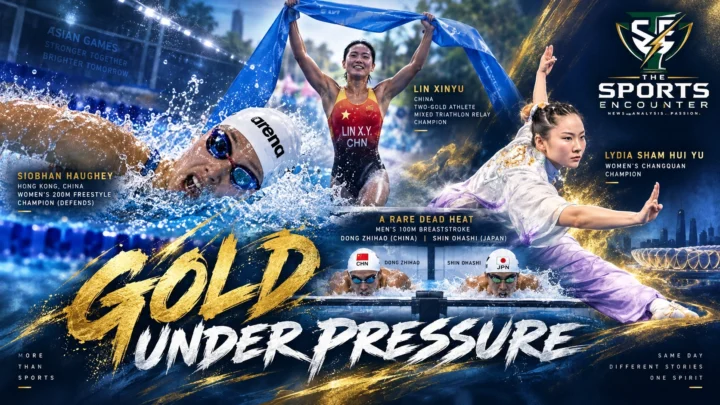
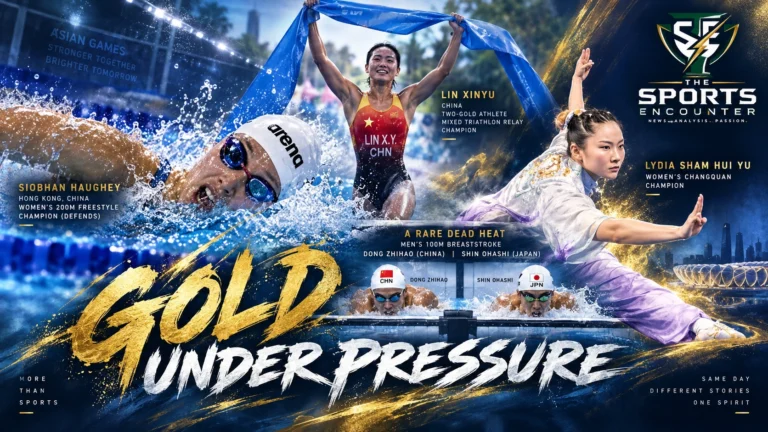
Ho’s silver also continued Hong Kong, China’s strong presence in the pool after Siobhan Haughey successfully defended her 200m freestyle title during the same championship.
The Asian Games swimming competition is producing this kind of depth across multiple disciplines. TSE has already followed similar sprint margins at Glasgow 2026, where the shortest races repeatedly turned on hundredths.
Kim’s 21.66 Is Only 0.02 From the Asian Record
The next number is 21.64.
Japan’s Shuya Matsumoto produced that time in July 2025, and World Aquatics lists it as the Asian and Japanese record.
Kim’s final therefore leaves him within 0.02 seconds of the continental standard.
The progression is striking:
| Swimmer | Time | Significance |
|---|---|---|
| Ji Yu-chan | 21.72 | 2023 Asian Games record |
| Kim Young-beom | 21.71 | 2026 heats Games record |
| Kim Young-beom | 21.66 | 2026 final Games record |
| Shuya Matsumoto | 21.64 | Current Asian record |
Kim does not need a conceptual leap to reach the continental record.
He needs two hundredths.
In swimming’s shortest Olympic freestyle race, finding them is still an enormous technical challenge.
Why Kim’s Rise Matters for Korean Swimming
Korea’s strongest recent men’s swimming identity has often been associated with middle-distance freestyle through athletes such as Hwang Sun-woo and Kim Woo-min.
The 50m result shows another part of the program developing.
Kim is capable of racing across a much wider freestyle range than his Asian Games sprint results alone suggest. His World Aquatics profile includes international results in the 100m and 200m freestyle alongside sprint and butterfly events.
That versatility gives Korean coaches options beyond one individual title.
Sprint depth matters in 4x100m freestyle and medley relays, where a country needs several swimmers operating at international pace.
The broader value of national depth has been a recurring theme in TSE’s international swimming coverage, including the United States’ relay world record during the 2026 Pan Pacific Championships.
A Different Kind of Record Story From Yu Zidi and China
Kim’s gold arrived during an Asian Games session already crowded with records.
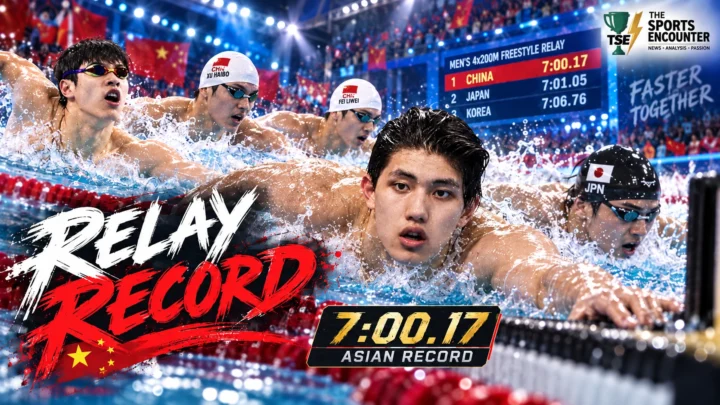
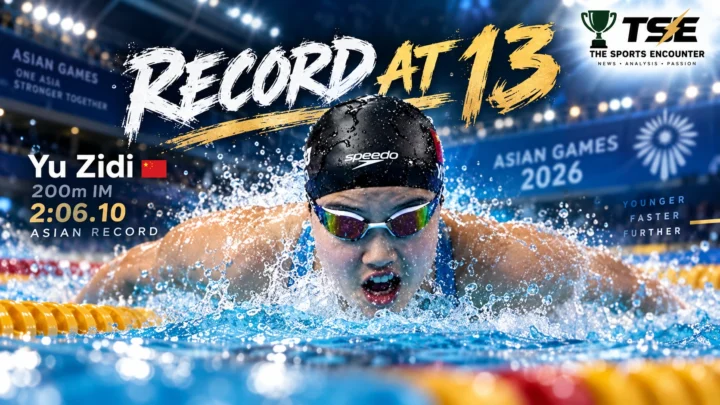
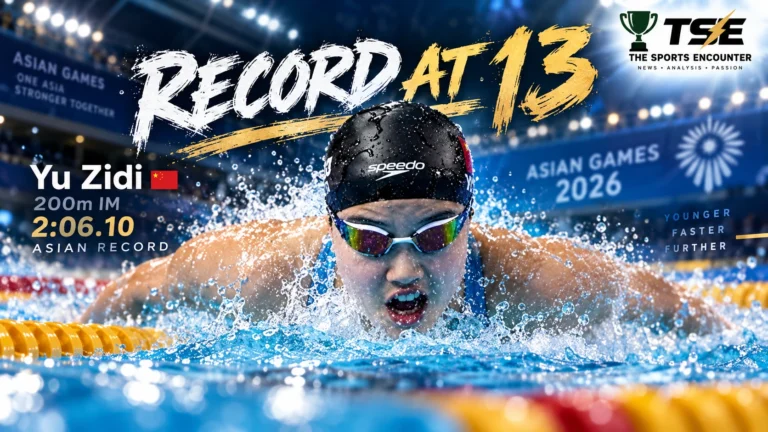
China’s 13-year-old Yu Zidi continued her remarkable championship with another record-breaking performance, while Chinese relay depth and several other Asian standards moved during the opening days.
TSE’s first medal-day analysis documented Yu’s initial Games record and China’s six swimming golds from seven available events.
The wider record environment resembles the international swimming surge seen during Paris 2026, when world, European and championship records fell across the European Aquatics Championships.
Kim’s achievement is different in scale from a world record, but rare in structure.
He broke a major championship record in the morning and returned to break it again while the gold medal was being decided.
What Comes Next for Kim Young-beom?
Kim leaves the 50m freestyle with gold, an Asian Games record and a silver already secured from the 100m.
Those results make him one of South Korea’s leading athletes from the opening swimming sessions.
They also change the target for future sprint races.
The 21.72 Games record is gone.
Kim’s own 21.71 lasted only a matter of hours.
The 21.66 final mark now sits inside the Asian Games record book.
Only two hundredths separate him from the continental standard.
For continuing coverage of Aichi-Nagoya’s 43-sport program and record performances, TSE’s Asian Games opening report and Day 1 competition analysis provide the broader tournament context.
Continue the Swimming Story
Frequently Asked Questions
Who won the men’s 50m freestyle at the 2026 Asian Games?
South Korea’s Kim Young-beom won gold in 21.66 seconds.
What record did Kim Young-beom break?
Kim broke the Asian Games men’s 50m freestyle record twice on September 21, first swimming 21.71 in the heats and then 21.66 in the final.
Who held the previous Asian Games 50m freestyle record?
South Korea’s Ji Yu-chan held the previous Games record at 21.72 from Hangzhou 2023.
Is 21.66 the Asian record?
No. Japan’s Shuya Matsumoto holds the Asian record at 21.64. Kim finished only 0.02 seconds outside it.
Who won silver in the Asian Games 50m freestyle?
Hong Kong, China’s Ho Ian Yentou won silver in 21.76.
Who won bronze?
Defending champion Ji Yu-chan of South Korea took bronze in 21.94.
How old is Kim Young-beom?
Kim is 20 years old.
Did Kim Young-beom also swim the 100m freestyle?
Yes. He won silver in the 100m freestyle in 47.65, finishing only 0.04 seconds behind China’s Pan Zhanle.
Has South Korea won consecutive Asian Games 50m freestyle titles?
Yes. Ji Yu-chan won in 2023 and Kim Young-beom retained the title for South Korea in 2026.
How close is Kim Young-beom to the Asian 50m freestyle record?
Kim’s 21.66 is only 0.02 seconds slower than Shuya Matsumoto’s Asian record of 21.64.