


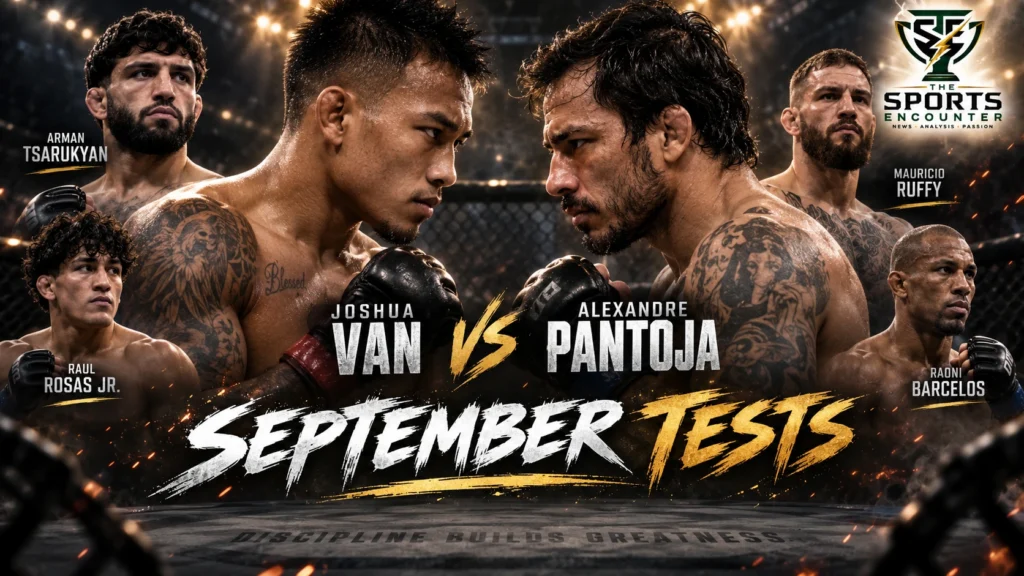
LOS ANGELES, United States, September 16, 2026: Joshua Van and Alexandre Pantoja return to the same rivalry with a very different question hanging over it. Van now owns the UFC flyweight title, Pantoja is trying to reclaim the championship he lost in an injury-shortened first meeting, and UFC 331 gives both men the five-round stage their original fight never really had.
Three days later, the consequences of Saturday’s card will already begin reshaping multiple divisions. Arman Tsarukyan faces Mauricio Ruffy in a five-round lightweight co-main event with championship positioning at stake, while Patrício Pitbull meets Dooho Choi in a featherweight fight built around experience, power and very different career timelines.
Then, on September 26, the UFC moves back to Las Vegas for another card centered on a generational test. Raul Rosas Jr., still only 21, faces No. 13-ranked Raoni Barcelos at Meta APEX in a bantamweight main event that could tell us far more about Rosas than another routine prospect matchup ever could.
These two events arrive during a period in which UFC matchmaking continues rewarding fighters willing to accept difficult stylistic questions rather than comfortable progression. That same tension shaped The Sports Encounter’s UFC 330 analysis of Islam Makhachev vs. Ian Machado Garry, where physical dimensions, wrestling pressure and title consequences mattered as much as the names on the poster.
UFC 331 and UFC Fight Night: At a Glance
| Event | Date | Venue | Key Fight |
|---|---|---|---|
| UFC 331: Van vs. Pantoja 2 | September 19, 2026 | Crypto.com Arena, Los Angeles | Joshua Van vs. Alexandre Pantoja, flyweight title |
| UFC 331 co-main event | September 19, 2026 | Crypto.com Arena, Los Angeles | Arman Tsarukyan vs. Mauricio Ruffy, lightweight |
| UFC 331 featured featherweight bout | September 19, 2026 | Crypto.com Arena, Los Angeles | Patrício Pitbull vs. Dooho Choi |
| UFC Fight Night: Rosas Jr. vs. Barcelos | September 26, 2026 | Meta APEX, Las Vegas | Raul Rosas Jr. vs. Raoni Barcelos, bantamweight |
The official UFC 331 event page confirms Van-Pantoja 2 as the flyweight championship main event, with Tsarukyan-Ruffy and Pitbull-Choi among the major supporting bouts. The official September 26 Fight Night listing places Rosas Jr. and Barcelos at the top of the following week’s card.
Van vs. Pantoja 2 Finally Gives the Rivalry a Proper Fight
The first Joshua Van-Alexandre Pantoja meeting lasted only 26 seconds.
Van became flyweight champion at UFC 323 in December 2025 when Pantoja suffered an elbow injury almost immediately after the fight began. Officially, Van owns the victory. Competitively, the result left too many questions unanswered.
Van has since done what a new champion has to do if he wants the belt to feel unquestionably his. He defended it against Tatsuro Taira at UFC 328, stopping him in the fifth round after a long, demanding championship fight.
The UFC lists Van at 17-2 with nine knockout victories and two submissions. More revealing is his offensive volume: Van lands 8.43 significant strikes per minute, an unusually high number for a fighter operating at championship level, while his takedown defense stands at 76%.
Pantoja presents a completely different form of pressure.
The former champion enters at 30-6 with 12 submission wins. Before losing the belt, he had successfully defended it four times against Brandon Royval, Steve Erceg, Kai Asakura and Kai Kara-France. His strength has rarely been one spectacular tool. It is the ability to keep a fight physically uncomfortable through clinches, scrambles, positional pressure and submission threats.
Van’s Pace Against Pantoja’s Ability to Break Rhythm
The central tactical question is whether Van can turn the rematch into a high-output striking fight.
Van wants repetitions. He throws combinations, works at a pace that forces opponents to make decisions continuously and is comfortable allowing a fight to become physically demanding over several rounds.
Pantoja’s best route may involve reducing those repetitions.
Every clinch exchange that slows Van, every scramble that forces him to carry weight and every takedown attempt that makes him reset can lower the champion’s striking volume.
The age gap adds another layer. Van is 24 and became the second-youngest champion in UFC history. Pantoja is an experienced former champion who has already lived through the pressure of repeated title defenses.
This is therefore a test of championship evolution as much as a rematch.
Van wants to prove the belt changed hands because a new elite flyweight had arrived. Pantoja wants five rounds to show that the first result said almost nothing about how their skill sets actually compare.
Tsarukyan vs. Ruffy May Carry the Heaviest Career Stakes
The co-main event may have even less room for error.
Arman Tsarukyan enters ranked No. 2 in the lightweight division with a 23-3 record. He has won five straight and 10 of his last 11, including victories over Charles Oliveira, Beneil Dariush and Dan Hooker.
Tsarukyan has already lived close to a championship opportunity. A back injury forced him out of a scheduled title fight against Islam Makhachev in January 2025, and he has spent the period since trying to force his way back to the front of the queue.
He has openly described the Ruffy fight as critical to that objective. A defeat would severely damage the title path he has spent years building.
Mauricio Ruffy, meanwhile, arrives with the kind of finishing record that makes every minute dangerous. The UFC lists him at 14-2 with 13 knockout victories, including nine first-round finishes. His most recent win came against Michael Chandler in June.
That creates a clean tactical contrast.
Tsarukyan can wrestle, chain takedowns, control positions and force Ruffy to defend repeatedly. Ruffy wants enough open-space striking exchanges to make his power the defining element.
The scenario resembles a recurring theme in elite MMA: the dangerous striker does not need to control the entire fight if he can control the moment that matters. The grappler needs to reduce the number of those moments.
That strategic tension has appeared repeatedly in TSE’s combat-sports coverage, including our examination of Brock Lesnar’s unusual crossover legacy between wrestling and UFC competition, where genuine grappling credentials changed how opponents had to approach every exchange.
Ruffy Has to Make Tsarukyan Pay Before the Wrestling Settles
Ruffy’s opportunity probably comes early.
If Tsarukyan establishes takedowns without absorbing meaningful damage, the fight can gradually become a positional problem. Every defensive sequence costs energy. Returning to the feet does not help if another entry arrives immediately.
Ruffy therefore needs to punish the space between Tsarukyan’s striking and wrestling.
Knees, uppercuts, short counters and disciplined footwork can make entries expensive. Wild aggression would create the opposite effect by giving Tsarukyan easier access to the hips.
Tsarukyan’s own striking has improved enough that he no longer needs to shoot immediately. That makes the matchup more complicated because Ruffy cannot simply stand waiting for one obvious takedown attempt.
Pitbull vs. Choi Is a Fight Between Two Different Ideas of Experience
Patrício Pitbull has already spent more than two decades competing professionally.
The 38-year-old Brazilian owns a 37-9 record, 12 knockout wins, 12 submissions and championship history across multiple divisions before joining the UFC. He has also competed in 17 title fights during his career.
Dooho Choi brings a different type of veteran profile.
The Korean striker is 17-4-1 with 14 knockouts, giving him an 82% knockout share across his victories. His UFC career has included long absences, memorable wars and repeated attempts to re-establish momentum. He returned in May with a second-round stoppage of Daniel Santos.
Choi lands five significant strikes per minute and has always been most dangerous when opponents agree to exchange in the pocket.
Pitbull’s wider skill set gives him more options. He can strike, clinch, wrestle and threaten submissions. Choi’s clearest advantage may be range, pace and the willingness to force exchanges before Pitbull can slow them down.
The wider combat-sports question around aging elite athletes has surfaced repeatedly on TSE. Our coverage of Tyson Fury’s late-career comeback against Mariusz Wach examined how experience, physical decline and matchmaking begin interacting differently once a fighter moves deeper into his career.
Pitbull-Choi carries a version of that same question. Experience can improve decision-making, but timing and durability still have to survive the speed of a younger or more active opponent.
Rosas Jr. vs. Barcelos Is Exactly the Test a Young Contender Needs
One week after UFC 331, Raul Rosas Jr. headlines at Meta APEX against Raoni Barcelos.
Rosas enters at 13-1 and ranked No. 12 at bantamweight. He has won five consecutive fights and remains one of the youngest ranked fighters on the UFC roster.
The numbers immediately show where his instincts live. Six of his 13 victories have come by submission, and six have ended in the first round.
His March victory over Rob Font was important because it showed he could win across three rounds against an experienced ranked opponent rather than relying entirely on an early finish.
Barcelos represents another step in that education.
The 39-year-old Brazilian is 22-5, ranked No. 13 and enters after beating Montel Jackson in April. He owns 88% takedown defense and lands 4.65 significant strikes per minute, giving Rosas a veteran opponent capable of defending grappling exchanges and making him work on the feet.
Rosas Needs More Than Youth and Athleticism
This matchup should reveal how much Rosas’ game has matured.
Against lower-level opposition, explosive grappling can erase technical mistakes. Ranked bantamweights are harder to overwhelm because they recognize entries earlier, defend positions more calmly and understand when a young fighter is beginning to force the action.
Barcelos has enough experience to test Rosas psychologically as well as technically.
If Rosas cannot secure an early takedown, does he continue making disciplined decisions?
If Barcelos stuffs the first few shots, does Rosas change entries or simply attack harder?
If the fight reaches the championship rounds, can Rosas maintain his pace without becoming predictable?
Those questions matter because the UFC has spent years developing Rosas in public. A convincing win here would move the conversation away from his age and toward his actual position inside one of the promotion’s deepest divisions.
September Shows Where MMA Is Heading in Two Different Ways
The UFC cards arrive during a wider month of growth for mixed martial arts.
MMA will make its Asian Games debut when Aichi-Nagoya 2026 opens in Japan, a development The Sports Encounter explored in its complete Asian Games 2026 preview. Six MMA medal events will introduce the discipline to one of the world’s largest multi-sport competitions.
That expansion reflects how far MMA has moved beyond its early image as a niche combat product.
UFC 331 offers the established professional version: championship stakes, rankings, title pathways and global broadcast exposure.
The Asian Games represent another direction, with national teams and medals creating a different route for young athletes to enter the sport.
The Sports Encounter’s Upcoming Sports Encounters calendar tracks major events across multiple sports, while the growth of MMA alongside boxing and other combat disciplines shows how strongly fight sports continue competing for appointment-viewing attention.
That audience dynamic has also shaped traditional boxing. The continuing uncertainty around Tyson Fury, Anthony Joshua and Oleksandr Usyk demonstrates how much combat sports depend on fights carrying consequences beyond one result.
Four Fights, Four Different Kinds of Pressure
Van faces legitimacy pressure because his first victory over Pantoja ended before the matchup could develop.
Pantoja faces reclaiming pressure because he has to prove his championship era still has another chapter.
Tsarukyan faces career-position pressure because the lightweight title opportunity he has chased could move farther away with one defeat.
Ruffy faces tactical pressure because knockout power means little if Tsarukyan controls where the fight takes place.
Pitbull and Choi face the pressure of time, with both trying to convert veteran experience into relevance in a division that continues moving around them.
Rosas Jr. faces expectation pressure because every victory brings him closer to the point where being young stops being the story.
Those separate pressures are what make the next two UFC cards worth following.
Combat sports often produce their best nights when the result changes a fighter’s direction rather than simply adding another win or loss. That principle has shaped careers across MMA, boxing and professional wrestling, including the broader legacy questions examined in TSE’s cross-sport analysis of greatness alongside Muhammad Ali and other sporting icons.
Los Angeles gets the championship rematch first. Las Vegas gets the prospect-versus-veteran examination one week later.
By the end of September, the flyweight championship picture, lightweight title queue and bantamweight contender ladder could all look different.
Frequently Asked Questions
When is UFC 331: Van vs. Pantoja 2?
UFC 331 takes place Saturday, September 19, 2026, at Crypto.com Arena in Los Angeles, California.
Who is fighting in the UFC 331 main event?
UFC flyweight champion Joshua Van defends his title against former champion Alexandre Pantoja in a rematch of their injury-shortened UFC 323 fight.
Who is fighting in the UFC 331 co-main event?
Arman Tsarukyan faces Mauricio Ruffy in a five-round lightweight bout with major title-contender implications.
When is Raul Rosas Jr. vs. Raoni Barcelos?
Rosas Jr. vs. Barcelos headlines UFC Fight Night on Saturday, September 26, 2026, at Meta APEX in Las Vegas.
For the latest major-fight coverage, previews and combat-sports analysis, continue following The Sports Encounter as September’s UFC schedule develops.