


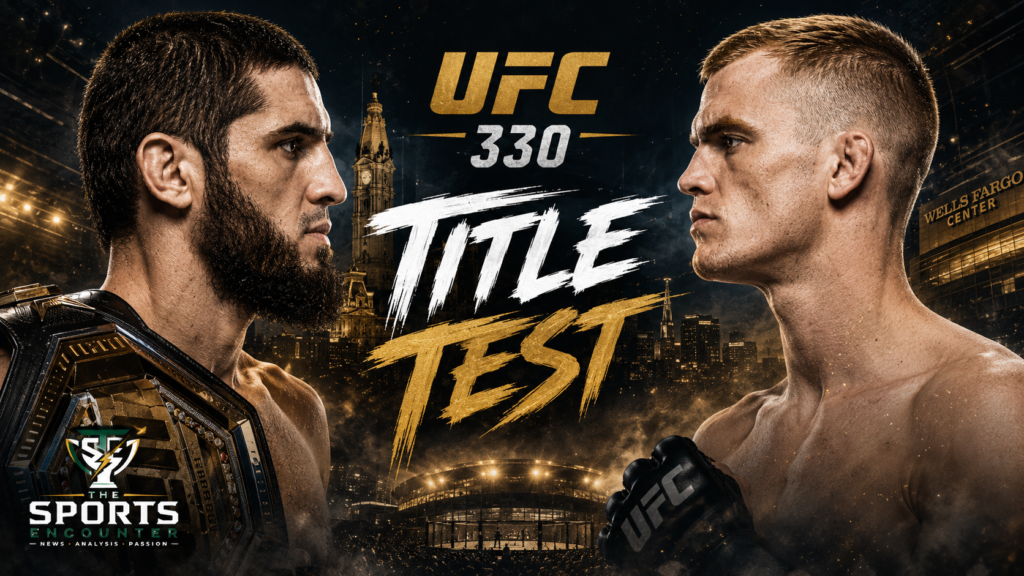
Ian Machado Garry has spent years calling himself “The Future.”
On Saturday night in Philadelphia, the future arrives with almost nowhere left to hide.
The Irish challenger will step into the UFC 330 main event against Islam Makhachev, the reigning welterweight champion, former lightweight king and current No. 1 pound-for-pound fighter in the UFC. A victory would make Machado Garry only the second Irish fighter to win UFC championship gold after Conor McGregor.
The task could hardly be more difficult.
Makhachev enters the fight with a 28-1 professional record and 16 consecutive UFC victories. One more would give him a 17-fight streak and move him beyond Anderson Silva’s long-standing mark for consecutive UFC wins.
Machado Garry brings a very different set of advantages. He is five inches taller, owns more than four inches of additional reach and is a natural welterweight facing a champion who built most of his legacy 15 pounds lighter at lightweight.
The question at UFC 330 is therefore much richer than the familiar striker-versus-wrestler description.
Can Garry’s size, movement and defensive grappling create the kind of physical problem Makhachev rarely faced at 155 pounds? Or will Makhachev’s pressure, positioning and control erase those advantages the same way they have erased almost every previous opponent?
That is the fight Philadelphia is getting.
Makhachev vs Machado Garry: UFC 330 at a Glance
| Detail | Islam Makhachev | Ian Machado Garry |
|---|---|---|
| Professional record | 28-1 | 17-1 |
| Division | Welterweight champion | No. 1 contender |
| Height | 5’10” | 6’3″ |
| Reach | 70″ | 74.5″ |
| Stance | Southpaw | Orthodox |
| Significant strikes landed per minute | 2.45 | 4.78 |
| Significant strikes absorbed per minute | 1.45 | 2.86 |
| Takedowns per 15 minutes | 3.10 | 0.92 |
| Takedown accuracy | 56% | 31% |
| Takedown defense | 91% | 80% |
The career averages come from UFCStats’ official matchup data. They provide useful context, although five-round championship fights can develop very differently from career averages.
For Makhachev, This Is About More Than One Belt
Makhachev already owns a résumé that places him inside serious conversations about the greatest fighters of his generation.
He dominated the lightweight division, beat former champions Charles Oliveira and Alexander Volkanovski, defended that title repeatedly and eventually moved to welterweight, where he defeated Jack Della Maddalena to capture a championship in a second division.
Saturday represents his first defense at 170 pounds.
That detail matters.
Makhachev’s lightweight career established his greatness, but welterweight presents different physical questions. Opponents are naturally larger. Clinches require more strength. Takedowns can become harder to complete against athletes with longer frames and heavier hips.
Machado Garry may be the clearest physical test of that transition so far.
The champion has dismissed suggestions that the Irishman represents his toughest challenge. His confidence is understandable. Makhachev has rarely needed an opponent to cooperate with his preferred style. He presses until the cage becomes part of the trap, connects his hands around the hips, finishes takedowns and turns apparently safe positions into extended control.
That type of competitive legitimacy is also why crossover athletes such as Brock Lesnar carried such unusual credibility between professional wrestling and UFC competition. Wrestling that works against elite resistance creates a different kind of sporting authority.
Makhachev has built his career around that authority.
The Record Waiting Behind Win No. 17
The welterweight championship is only one piece of Makhachev’s Saturday night opportunity.
He arrives tied with Anderson Silva at 16 consecutive UFC victories. Beating Machado Garry would push the streak to 17 and give Makhachev sole possession of one of the promotion’s most prestigious longevity records.
That would strengthen an already serious all-time case.
Combat sports debates rarely produce clean answers because eras, weight divisions and competition levels differ. The same problem appears whenever The Sports Encounter examines sporting greatness, whether comparing Muhammad Ali with other legends in our greatest-athlete analysis or examining why athletes such as Georges St-Pierre, Amanda Nunes and Ali command such enduring respect in our ranking of the most respected athletes in sports history.
Makhachev is moving toward that type of conversation.
A second championship division and a record winning streak would make the argument harder to ignore.
Machado Garry Has Wanted Exactly This Fight
Garry has never hidden what he thinks his career is supposed to become.
He predicted a UFC championship long before reaching the top of the rankings and has repeatedly spoken about becoming Ireland’s next world champion.
Saturday gives him the opportunity to make the prediction real.
His lone professional defeat came against Shavkat Rakhmonov in December 2024, when he lost a competitive five-round decision. Rather than damaging his trajectory, that fight showed Garry could survive a difficult grappling matchup and remain competitive over championship distance.
He responded by beating dangerous striker Carlos Prates over five rounds in April 2025 and former welterweight champion Belal Muhammad later that year.
Those two wins did something important.
They proved Garry could solve different kinds of opponents without requiring the fight to look perfect.
Prates threatened him with dangerous striking and forced difficult moments late. Muhammad brought experience, pressure and wrestling. Garry navigated both.
Now the level rises again.
The Five-Inch Height Advantage Cannot Be Treated as Decoration
Garry stands 6-foot-3.
Makhachev is 5-foot-10.
That is an enormous visual difference for fighters competing at the same championship weight.
Reach adds another layer. Garry’s 74.5-inch reach gives him more than four inches over Makhachev’s 70.
The challenger therefore has a clear tactical incentive: make Makhachev cross as much space as possible before every meaningful exchange.
Long straight punches, body kicks, front kicks and lateral movement can force the champion to enter from farther away than he prefers.
The difficult part comes after Makhachev gets through that first layer.
Garry Cannot Simply Run From the Wrestling
Makhachev has already indicated that he expects Garry to move constantly and intends to pressure him around the cage.
That creates one of the central tactical questions.
Movement can protect Garry early. Excessive movement can eventually help Makhachev if the challenger gives away too much ground and repeatedly ends up near the fence.
The cage is where Makhachev’s wrestling becomes especially difficult to solve.
He does not always need a clean double-leg takedown in open space. He can use body locks, trips, chain wrestling and repeated re-attacks until the opponent’s defensive position breaks.
For Garry, staying upright will require more than sprawling once.
He must win the entire sequence.
Garry’s 80% takedown defense gives him a real base
UFCStats lists Garry with 80% career takedown defense.
That is strong enough to make the grappling discussion more interesting than simply assuming every Makhachev shot ends on the floor.
Garry also has a judo background that helps him understand balance, underhooks, hip positioning and clinch exchanges.
The problem is volume.
Makhachev averages 3.10 takedowns per 15 minutes and completes 56% of his attempts. More importantly, his wrestling tends to come in chains. Stopping the first attack often produces a second. Defending the second may expose the back or body lock.
Garry cannot measure success by defending isolated shots.
He needs to break contact and return the fight to long range.
The Striking Numbers Favor Garry’s Activity, but Not Necessarily His Safety
Garry lands 4.78 significant strikes per minute, almost twice Makhachev’s career rate of 2.45.
That fits what viewers see.
The Irishman is comfortable producing volume at range, changing targets and making opponents reset. He can attack the legs, work behind straight punches and use his height to create awkward angles.
Makhachev fights differently.
He does not need constant striking volume because his offense is built around the threat of everything else.
A left hand becomes more dangerous when the opponent is thinking about the takedown. A body kick works differently when standing still creates a wrestling entry.
The defensive numbers reinforce that point.
Makhachev absorbs only 1.45 significant strikes per minute across his UFC career. Garry absorbs 2.86.
The champion has become exceptionally good at reducing how much clean offense opponents can produce.
The First Two Rounds May Decide the Shape of the Fight
Garry’s clearest route probably begins with making Makhachev uncomfortable before the champion establishes his preferred geography.
If Garry controls the center, lands straight shots and forces Makhachev to shoot from distance, the size difference becomes meaningful.
If Makhachev walks him backward early and establishes clinch control against the fence, Garry may spend too much energy defending rather than attacking.
The first successful takedown could have an outsized psychological effect.
Garry needs evidence that his defensive plan works.
Makhachev needs evidence that welterweight size does not prevent him from imposing the same system that dominated lightweight.
Who gets that answer first may determine how confidently each man approaches the middle rounds.
Can Garry Hurt Makhachev?
He may need to.
Trying to edge Makhachev across five rounds without creating moments that change the champion’s behavior is a difficult assignment.
Garry’s best striking weapon may not be one specific punch. It may be his ability to make Makhachev hesitate before entering.
A clean knee, sharp counter or hard body kick can create that hesitation.
Once Makhachev starts thinking twice about entries, Garry gains more freedom to use his reach.
The challenger does not necessarily need an early knockout.
He does need enough damage or positional success to stop the champion from entering every exchange with complete confidence.
Makhachev’s Most Dangerous Weapon May Still Be Patience
Makhachev’s dominance often gets reduced to wrestling, but patience is a major part of why the wrestling works.
He rarely appears desperate.
If an opponent escapes once, Makhachev resets. If the first entry fails, another arrives. He is comfortable allowing rounds to develop until the positional advantage appears.
That makes him dangerous against fighters who rely on frustration.
Garry cannot expect one or two successful defensive sequences to break Makhachev mentally.
The champion has spent years competing against opponents who knew exactly what was coming and still could not stop it.
Philadelphia Gives the Fight an Appropriate Stage
UFC 330 takes place at Xfinity Mobile Arena in Philadelphia, a city whose sporting identity rarely produces neutral atmospheres.
Philadelphia has spent 2026 hosting major international events as well. The Sports Encounter’s World Cup host-city guide highlighted the city’s compact sports district, passionate crowds and reputation for demanding performances rather than simply applauding famous names.
That personality suits this fight.
Makhachev arrives with the belt and historical momentum.
Garry arrives trying to change the story.
Ireland Has Been Here Before, but This Is Not a McGregor Sequel
Any Irish fighter competing for UFC gold inevitably enters the shadow of Conor McGregor.
Garry has never completely avoided the comparison, but their careers and personalities are fundamentally different.
McGregor turned championship pursuit into theater. Prediction, confrontation and psychological warfare became part of the product.
Garry is confident, sometimes provocative and entirely comfortable talking about his destiny, but UFC 330 has developed with much more mutual respect.
His opportunity also carries a different sporting question.
McGregor became champion by forcing opponents into his striking rhythm.
Garry is trying to become champion by defeating perhaps the most complete pressure grappler of his generation.
If he succeeds, Ireland will have its second UFC champion through a completely different route.
Why This Fight Matters Beyond the Welterweight Division
The Sports Encounter’s boxing coverage frequently returns to a basic combat-sports truth: championship fights matter most when the result changes more than a belt.
Our analysis of Tyson Fury’s latest comeback fight, for example, focused on what the result meant for the much larger Anthony Joshua story.
UFC 330 carries similar consequences.
A Makhachev win extends a historic streak, validates his welterweight move and strengthens his all-time legacy.
A Garry victory creates Ireland’s second UFC champion, ends one of the greatest winning runs in promotion history and completely reshapes the welterweight division.
For readers who follow the wider crossover between wrestling and real combat competition, The Sports Encounter’s wrestling coverage and our examination of Brock Lesnar’s UFC-backed sporting credibility provide another reminder of how much championship legitimacy changes an athlete’s public identity.
TSE Tactical Verdict: Garry Has a Path, but It Is Narrow
Machado Garry possesses real advantages.
His height matters. His reach matters. His movement can make Makhachev cover more distance than he wants. An 80% takedown-defense rate gives the challenger a legitimate technical foundation, and five-round experience against Rakhmonov and Prates has already exposed him to difficult championship-style pressure.
That is enough to reject the idea that Garry has no chance.
It is not enough to make him the favorite.
Makhachev’s ability to connect phases remains the defining difference. He can strike into a clinch, clinch into a takedown, takedown into back control and positional pressure into submission threats without giving an opponent a clean reset.
Garry needs the fight to keep returning to open space.
Makhachev needs only a few extended sequences where it does not.
If Garry spends long stretches with his back near the cage, the champion’s control should gradually remove the reach advantage that makes the matchup interesting.
If the Irishman repeatedly circles out, punishes entries and forces Makhachev into longer striking exchanges, the upset becomes much more plausible.
The most likely outcome still favors Makhachev because he owns more reliable ways to control where the fight happens.
The intrigue comes from Garry possessing exactly the kind of physical dimensions that can force the champion to prove his system works against a genuinely large welterweight.
UFC 330 Main Card
- Islam Makhachev vs. Ian Machado Garry – UFC welterweight championship
- Mackenzie Dern vs. Gillian Robertson – UFC strawweight championship
- Charles Johnson vs. Jose Ochoa
- Mansur Abdul-Malik vs. Dustin Stoltzfus
- Edson Barboza vs. Esteban Ribovics
The UFC 330 main card begins at 9 p.m. ET on Saturday, August 15, with preliminaries beginning earlier in the evening. U.S. viewers can watch through Paramount+.
Frequently Asked Questions
When is Islam Makhachev vs Ian Machado Garry?
The UFC welterweight championship fight takes place on Saturday, August 15, 2026, at UFC 330 in Philadelphia.
Where is UFC 330 taking place?
UFC 330 will be held at Xfinity Mobile Arena in Philadelphia, Pennsylvania.
What is Islam Makhachev’s record?
Makhachev enters UFC 330 with a professional MMA record of 28 wins and one loss.
What is Ian Machado Garry’s record?
Machado Garry enters the title fight with a 17-1 professional record.
How much taller is Ian Machado Garry than Islam Makhachev?
Garry stands 6-foot-3 compared with Makhachev at 5-foot-10, giving the challenger a five-inch height advantage.
Who has the longer reach?
Garry has a listed 74.5-inch reach compared with Makhachev’s 70 inches.
How many consecutive UFC fights has Makhachev won?
Makhachev has won 16 consecutive UFC fights entering UFC 330. Victory over Garry would extend the streak to 17.
Would Ian Machado Garry become Ireland’s second UFC champion?
Yes. A victory would make Machado Garry the second Irish fighter to win a UFC championship after Conor McGregor.
Has Machado Garry ever lost?
Yes. His only professional defeat came against Shavkat Rakhmonov by unanimous decision at UFC 310 in December 2024.
Who did Makhachev beat to win the welterweight title?
Makhachev defeated Jack Della Maddalena to capture the UFC welterweight championship after leaving the lightweight division.
What is the biggest tactical question in Makhachev vs Garry?
The central question is whether Garry can use his size, reach, movement and takedown defense to keep the fight at long range, or whether Makhachev can pressure him to the cage and impose his grappling system.
The Champion Has History. The Challenger Has the Physical Problem.
UFC 330 does not need manufactured hostility to make the main event compelling.
Makhachev is trying to defend a second-division championship and extend one of the longest winning streaks the UFC has ever seen.
Garry is trying to turn years of public confidence into the one achievement that would validate all of it.
The champion has solved almost every style placed in front of him.
The challenger brings something less complicated but potentially disruptive: a much bigger body, longer weapons, strong defensive instincts and the belief that this is exactly the opponent he was supposed to beat.
Philadelphia will determine whether “The Future” finally becomes the present, or whether Islam Makhachev adds another name to a run that is beginning to look historic.