


BERLIN, Germany, September 14, 2026: For one quarter and change, France looked like they had finally found a way to make the United States feel ordinary.
They moved the ball quickly, made threes, attacked gaps before the American defense could organize, and built a 14-point lead that represented the largest deficit Team USA had faced at a Women’s World Cup in two decades.
Then the champions changed the game.
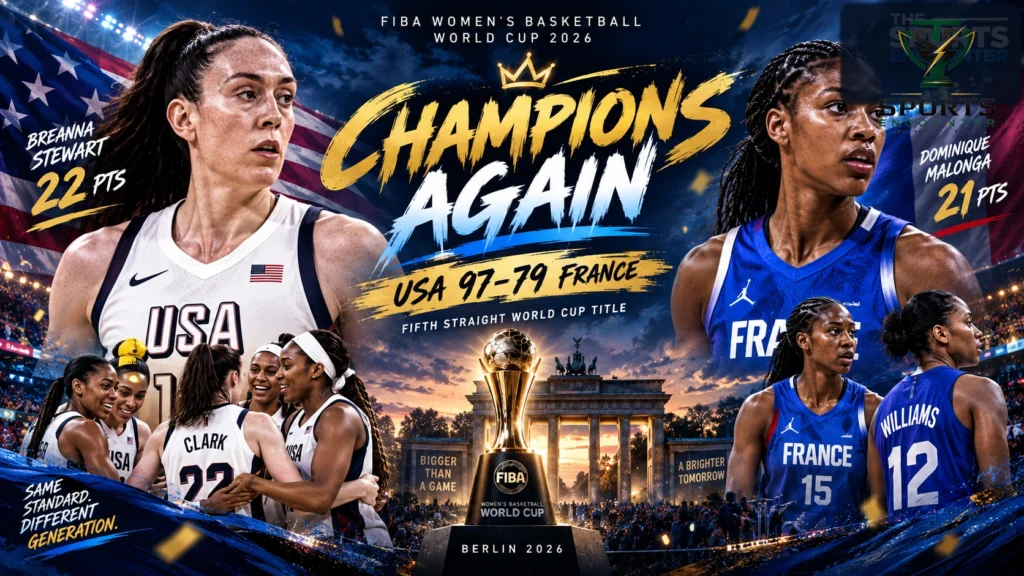
The United States erased the deficit, took control after halftime and defeated France 97-79 in the FIBA Women’s Basketball World Cup 2026 final at Berlin Arena, securing a fifth consecutive world title and the 12th championship in program history.
Breanna Stewart scored 22 points and again became the player USA could trust when the final shifted from talent contest to pressure test. Jackie Young added 18, Kahleah Copper scored 15 and Caitlin Clark finished with 12 as the Americans extended their Women’s World Cup winning streak to 36 games.
France received 21 points from Dominique Malonga and 20 from Gabby Williams, but the French offense that had stretched USA badly before halftime could not survive the defensive pressure and physicality that followed.
For continuing international basketball coverage, follow The Sports Encounter’s basketball coverage and our wider NBA and basketball hub.
USA vs France Women’s World Cup Final at a Glance
| Detail | Information |
|---|---|
| Competition | FIBA Women’s Basketball World Cup 2026 |
| Stage | Final |
| Venue | Berlin Arena, Berlin |
| Final Score | USA 97-79 France |
| USA Top Scorer | Breanna Stewart, 22 points |
| France Top Scorer | Dominique Malonga, 21 points |
| Key Turning Point | USA opened the third quarter with an 11-2 run |
| Historic Achievement | USA won a fifth consecutive Women’s World Cup |
| World Cup Winning Streak | 36 games |
The official FIBA Women’s Basketball World Cup hub provides the tournament bracket, teams and complete Berlin competition history, while the official USA-France final page carries the championship matchup information.
France Did Something Almost Nobody Has Managed Against USA
The final score suggests another comfortable American championship.
The first half tells a different story.
France led 20-17 after the opening quarter and then scored the first 11 points of the second.
When Williams buried a three-pointer to make it 31-17, the gap reached 14.
That was significant for several reasons.
USA had already survived adversity during this tournament, particularly when Italy held the Americans to only 55 points in one of the strangest games of the group stage. TSE’s analysis of the 55-52 escape against Italy showed how vulnerable the champions could look when pace disappeared and possessions became uncomfortable.
France created a different problem.
They were not slowing the game down.
They were beating USA at speed.
France’s Shooting Forced USA Into an Unfamiliar Chase
The French had already established themselves as the tournament’s most destructive perimeter team.
Earlier in Berlin, they made a Women’s World Cup-record 22 three-pointers in a 111-56 victory over Nigeria. The Sports Encounter’s breakdown of that record-setting performance identified France’s spacing and rapid ball movement as the biggest reason defenses kept losing track of shooters.
The same qualities appeared in the final.
France made eight of its first 14 three-point attempts and repeatedly forced the United States to rotate farther and faster than it wanted.
The American defense was late to closeouts.
Williams found space.
Malonga attacked mismatches.
Possessions that normally ended with a contested French shot instead created clean looks.
USA were not being surprised by an unknown opponent. They were being punished by strengths France had demonstrated throughout the tournament.
The Clark Three Before Halftime Changed the Temperature
What happened after France went ahead 31-17 may be the most important sequence of the final.
The Americans did not erase the deficit instantly.
They chipped away at it.
Stewart became more assertive.
Young attacked gaps with greater purpose.
The defensive pressure increased.
Then Clark hit a three-pointer just before halftime.
France still led 45-43.
The scoreboard therefore still belonged to the French.
The emotional direction of the game did not.
A 14-point advantage had become two.
The United States had survived France’s hottest shooting stretch without allowing the final to escape.
Breanna Stewart Became the Championship Stabilizer
USA entered Berlin with one of the deepest rosters in the competition, but depth alone does not tell a team who should control a final when the score begins moving the wrong way.
Stewart answered that question.
She scored a game-high 22 points and later collected tournament MVP honors for the second time in her career.
Her contribution went beyond scoring volume.
When USA needed half-court organization, Stewart gave them a player who could operate inside or outside.
When France switched, she could attack mismatches.
When possessions slowed, she could create without requiring the offense to be rebuilt around one set.
When the Americans needed defensive length, she could switch and contest.
That versatility is why Stewart remained central even in a roster filled with younger stars.
Before the tournament began, TSE’s analysis of USA’s World Cup roster argued that the new generation might attract more attention, but Stewart still provided the championship foundation.
The final confirmed it.
USA Opened the Third Quarter With the Run France Could Not Answer
France entered halftime leading by two.
USA needed only a few minutes to change the scoreboard completely.
The Americans opened the third quarter with an 11-2 run and moved ahead 54-47.
Stewart scored four points during the surge.
France briefly responded and cut the gap to 55-51.
That was the last time the final felt genuinely balanced.
USA then produced a 16-3 burst.
The Americans led 73-57 entering the fourth quarter.
What had been a 14-point French advantage earlier in the game had become a 16-point American lead.
The swing covered 30 points.
TSE Analysis: USA Changed the Game Defensively Before They Changed It Offensively
The natural temptation is to explain the comeback through better American shooting.
That was only part of it.
The larger adjustment was defensive.
USA became more aggressive around the perimeter, reduced France’s time to make decisions and forced the French offense away from the clean catch-and-shoot rhythm that had created the early lead.
France could still score.
They could no longer dictate.
That distinction explains why the second half looked so different.
The Americans began generating more broken possessions.
Those possessions created transition opportunities.
Transition reduced the need to solve France’s half-court defense.
The game accelerated in a way that favored the deeper roster.
This is the recurring American advantage that statistics sometimes struggle to describe.
USA can change the physical level of a game without changing personnel quality.
Jackie Young and Kahleah Copper Made the Depth Matter
Stewart was the anchor.
Young and Copper prevented France from building a defensive plan around her.
Young scored 18 points and repeatedly attacked the spaces France left while trying to contain the frontcourt.
Copper added 15.
Their production mattered because championship depth only becomes an advantage when the secondary options actually punish defensive attention.
USA had several players capable of doing that.
France did not have enough bodies to solve every matchup at once.
Caitlin Clark’s First World Cup Ends With Gold
Clark’s 12 points in the final will not be remembered as her biggest statistical performance of the tournament.
Her late first-half three may be remembered as one of its most important shots.
Clark entered Berlin facing an entirely new international test.
She answered quickly in USA’s opener against China, recording 14 points and 11 assists in a 94-61 victory. TSE’s report on Clark’s World Cup debut examined how quickly she adapted to the pace, physicality and spacing of FIBA basketball.
The tournament then became progressively harder.
Italy disrupted the entire American offense.
Spain pushed USA harder than any semifinal opponent during the current winning streak.
France built a 14-point lead in the final.
Clark therefore leaves Berlin with something more meaningful than a comfortable introduction to international basketball.
She leaves with experience of several very different pressure environments.
The New Generation Had to Learn What American Dominance Actually Requires
This was the second-youngest USA team ever sent to a Women’s World Cup.
Clark, Angel Reese and Paige Bueckers were among the newcomers making their senior World Cup debuts.
That made the tournament unusually important for USA Basketball’s transition.
American dominance has lasted so long that each new generation inherits an expectation rather than a target.
Winning is assumed.
The challenge is discovering what must happen when the assumption stops matching the game.
Berlin supplied those lessons.
China showed the new roster how effective its transition game could be.
Italy showed how ugly international basketball could become.
Czechia then felt the backlash when USA scored 105 points. TSE’s Group D analysis showed how violently the Americans could swing from offensive frustration to complete control.
France then provided the final examination.
France’s Final Was Lost After Its Best Basketball
France should not leave Berlin believing the early lead was accidental.
It was earned.
Williams and Malonga attacked precisely the areas that gave USA problems.
The French moved the ball quickly enough to create open threes.
They also refused to play cautiously simply because they were facing the most successful nation in tournament history.
That mentality had defined France’s run throughout Berlin.
Their semifinal against Germany was another example.
France defeated the hosts 86-64 to reach their first Women’s World Cup final, with Williams delivering one of the tournament’s defining individual performances. The road to that matchup was examined in TSE’s semifinal preview.
The final was not lost because France suddenly forgot how to play.
It was lost because USA took away the things France had been doing best.
Dominique Malonga Showed Why France’s Future Is So Dangerous
Malonga scored 21 points in the biggest game of her international career.
She is only 20 years old.
That combination matters.
France’s current core already contains proven international talent through Williams, Marine Johannès, Valériane Ayayi and others.
Malonga gives the program something even more valuable: elite interior size and scoring that can mature alongside the next generation.
Her tournament had contained inconsistent moments, particularly against China, but the final showed her ceiling.
The United States were forced to account for her physically rather than simply helping off the interior matchup.
That opened space elsewhere.
Gabby Williams Leaves Berlin With Another Painful Silver and a Bigger Legacy
Williams scored 20 in the final and remained the emotional and tactical center of France’s challenge.
The result carries an uncomfortable familiarity.
France came within one point of beating USA in the Paris 2024 Olympic gold-medal game, losing 67-66.
Two years later, Williams again stood between France and the world’s dominant basketball program.
The margin was larger this time.
The significance of France’s tournament may be larger too.
This was the country’s first World Cup final.
France had only one previous podium finish, dating back to the inaugural tournament in 1953.
The French Basketball Federation’s pre-tournament outlook had positioned Les Bleues as serious medal contenders after their Olympic silver in Paris.
They exceeded that minimum expectation.
France’s 22-Three Record Was More Than a Group-Stage Curiosity
One reason the final became competitive was that France’s shooting was never a one-game accident.
The 22 threes against Nigeria represented the loudest example, but the deeper pattern was spacing.
Williams, Johannès and France’s perimeter rotation consistently forced defenders to make long closeouts.
Once those closeouts arrived, Malonga and the interior attack gained more room.
That combination made France one of the hardest teams to scheme against in Berlin.
The problem in the second half of the final was not merely missed shots.
USA shortened the available decision time.
The same offensive concept therefore produced worse looks.
USA’s Route to Gold Was Less Comfortable Than the Final Score Suggests
The Americans finished the tournament undefeated.
The path was anything but uniform.
The China opener was comfortable.
Italy nearly produced one of the greatest upsets in tournament history.
Czechia then absorbed a 105-point response.
Hungary could not handle the quarterfinal pressure.
Spain pushed the Americans deep into the semifinal before USA pulled away 76-66.
France then created the largest American World Cup deficit since 2006.
That variety gives the fifth consecutive title additional weight.
This was not a tournament won through one unstoppable formula.
USA had to solve different problems.
The Italy Scare May Have Helped USA Win the Final
The 55-52 game against Italy looked concerning at the time.
In retrospect, it may have been useful preparation.
Italy forced USA into late-clock offense, disrupted passing angles and made the Americans play through discomfort.
That experience mattered against France.
When the champions went down 14, there was no sense that the game had entered an unfamiliar emotional space.
USA had already experienced a game where its normal advantages disappeared.
That helped make the response calmer.
Spain and Germany Helped Reveal How Deep This World Cup Was
USA-France was the tournament’s defining game, but Berlin produced evidence of a deeper international field throughout the knockout rounds.
Germany reached its first World Cup semifinal after beating Belgium 93-74. TSE’s report on Germany’s historic quarterfinal showed how the hosts controlled every quarter against the reigning European champions.
Spain also reached the final four after defeating Australia 89-66. Our Spain-Australia analysis highlighted how possession quality, assists and defensive pressure mattered more than isolated shooting numbers.
Those results gave USA a stronger field to navigate than the historical winning streak might suggest.
Five Straight World Titles Changes the Meaning of Dominance
One championship can be explained by talent.
Two can be explained by a generation.
Five consecutive World Cups require institutional continuity.
Different coaches.
Different guards.
Different frontcourts.
Different tactical environments.
The United States have still found the same ending.
The current 36-game World Cup winning streak dates back to the 2006 semifinal loss to Russia.
The Americans have not lost a gold-medal game at the tournament since 1983.
That is why this championship cannot be reduced to Stewart, Clark, Young or any one player.
The players change.
The expectation survives.
Breanna Stewart Now Owns Four World Cup Gold Medals
Stewart’s individual résumé inside the national program continues to expand.
This championship is her fourth World Cup title.
She was also named tournament MVP for the second time.
Those achievements place her in an unusual position inside a program already filled with legendary careers.
The important part is that her role has changed across those championships.
She was once part of the next generation entering an established national-team culture.
In Berlin, she was the player responsible for transmitting it.
France’s Silver Medal Should Change Expectations Around the Program
The natural reaction to losing a final is disappointment.
The larger view is more important for France.
This team entered the competition believing it could challenge USA.
It proved that belief was not unrealistic.
France went undefeated through the group stage.
It broke the tournament’s three-point record.
It defeated China convincingly in the quarterfinal.
It eliminated host Germany in the semifinal.
It then led the United States by 14 in the final.
That is not a lucky route to silver.
It is evidence of a program operating close to championship level.
TSE Verdict: France Found a Formula, USA Found Another Gear
The most useful lesson from the final is not that the United States remain better than everybody else.
History already told us that.
The useful lesson is how that advantage appears when the normal script breaks.
France won the opening tactical battle.
They created the better shots, made the American defense move, attacked with confidence and built the biggest lead any opponent had held over USA at a World Cup since 2006.
Then the game became about adjustment.
USA defended closer.
Stewart took greater responsibility.
Young and Copper punished secondary matchups.
Clark supplied an important late-half shot.
The Americans increased the physical pressure and turned broken French possessions into faster offense.
By the fourth quarter, France were no longer playing the same game that had produced the 31-17 lead.
That is why this championship matters.
USA were challenged.
They were forced to change.
They still finished with an 18-point victory.
France leave Berlin knowing the gap can be closed.
The United States leave knowing it has not closed yet.
Frequently Asked Questions
Who won the 2026 FIBA Women’s Basketball World Cup?
The United States won the 2026 FIBA Women’s Basketball World Cup by defeating France 97-79 in the final in Berlin.
How many consecutive Women’s World Cups has USA won?
USA have now won five consecutive Women’s World Cup championships.
How many Women’s World Cup titles has USA won overall?
The 2026 championship is the United States’ 12th Women’s Basketball World Cup title.
Who scored the most points in the USA-France final?
Breanna Stewart led USA with 22 points. Dominique Malonga scored 21 for France, while Gabby Williams added 20.
How large was France’s lead against USA?
France led by 14 points during the second quarter, going ahead 31-17 after opening the period with 11 unanswered points.
What was the halftime score?
France led 45-43 at halftime after Caitlin Clark hit a three-pointer just before the buzzer.
What changed the final in the third quarter?
USA opened the third quarter with an 11-2 run, took a 54-47 lead and later produced a 16-3 burst that pushed the advantage to double digits.
How many World Cup games in a row has USA won?
The United States have won 36 consecutive Women’s World Cup games, a streak dating back to 2006.
Was this France’s first Women’s World Cup final?
Yes. France reached the Women’s World Cup final for the first time and earned its best finish in tournament history.
Who was the 2026 Women’s World Cup MVP?
Breanna Stewart earned tournament MVP honors for the second time.
The Sports Encounter’s basketball coverage follows the NBA, WNBA and international game through match analysis, player performances, major tournaments and the tactical details behind the score.