


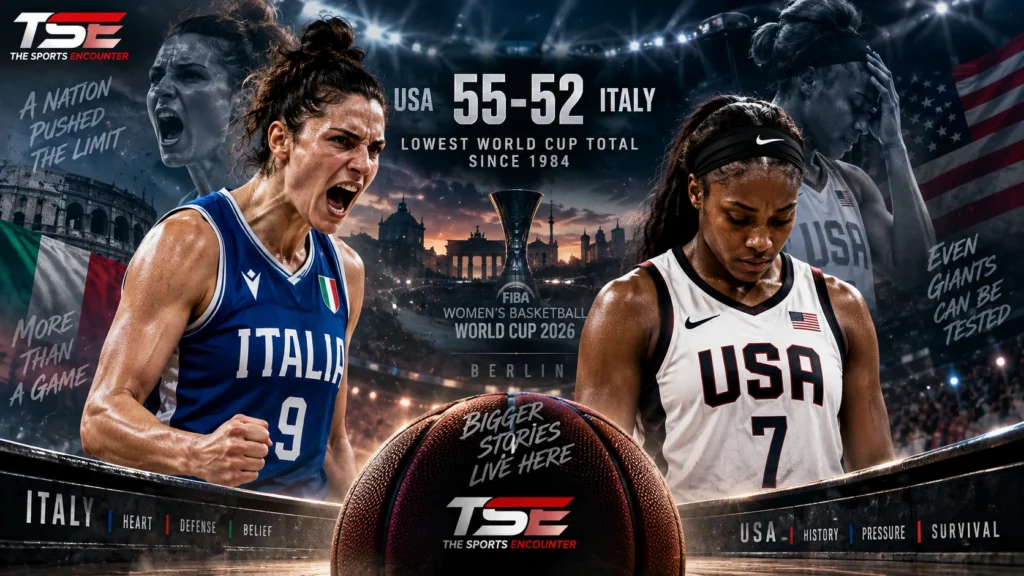
BERLIN, Germany: The United States arrived at the FIBA Women’s Basketball World Cup 2026 carrying decades of dominance, one of the deepest rosters in the tournament and a 94-point opening performance against China. Italy came within one possession of turning all of that history upside down.
Team USA survived 55-52 at Berlin Arena on September 6 after Italy produced one of the finest defensive performances the Americans have faced at a Women’s World Cup. According to FIBA’s official game report, the 55 points represented the United States’ lowest World Cup total since the three-point line was introduced in 1984.
That statistic changes the meaning of the result. Italy did not simply stay close because the favorites endured an ordinary poor shooting night. Their defensive rotations, changing coverages and willingness to contest possession after possession dragged the defending champions into a type of game they rarely have to play at this level.
More than 9,000 spectators watched Italy threaten what would have been the United States’ first Women’s World Cup defeat in two decades. Cecilia Zandalasini eventually had the final opportunity to extend the game, but her three-point attempt to force overtime fell short in the closing seconds.
The Americans escaped, moved to 2-0 in Group D and secured direct qualification for the quarterfinals. Italy walked away 1-1, but perhaps with something more useful than the standings can show: evidence that the gap between the tournament favorite and the chasing field is not always as wide as history suggests.
Italy vs USA: World Cup Game at a Glance
| Match Detail | Information |
|---|---|
| Competition | FIBA Women’s Basketball World Cup 2026 |
| Stage | Group D |
| Result | USA 55-52 Italy |
| Venue | Berlin Arena, Berlin |
| USA Record | 2-0 |
| Italy Record | 1-1 |
| USA Leading Scorer | Jackie Young, 10 points |
| Italy Leading Scorer | Cecilia Zandalasini, 14 points |
| Historic Mark | USA’s lowest Women’s World Cup total since the three-point line was introduced in 1984 |
| Qualification Impact | USA qualified directly for the quarterfinals |
Italy Found the Defensive Answer Nobody Expected
The most important part of Italy’s performance was not that the United States missed shots. It was how difficult Italy made those shots feel.
FIBA described the Italian defense as heroic, and the numbers behind the American perimeter attack explain why. Team USA missed its first 10 three-point attempts before Paige Bueckers finally broke through from outside. Italy’s rotations repeatedly closed space, crowded driving lanes and prevented the Americans from establishing the free-flowing rhythm that had overwhelmed China two days earlier.
That contrast was striking. The United States opened the tournament with a 94-61 victory over China, with Caitlin Clark recording 14 points and 11 assists while the Americans looked comfortable playing quickly and sharing the ball.
Against Italy, nearly everything became harder. Passing windows closed sooner, clean perimeter opportunities disappeared and possessions increasingly had to be solved in the half court. The Americans were still able to defend well enough to stay alive, but their offensive authority disappeared for long stretches.
This was exactly the kind of test that had been difficult to manufacture during years of American dominance. Most opponents eventually lose contact once the United States begins turning defensive pressure into transition scoring. Italy stopped enough of those sequences to force the champions into a game decided almost entirely through execution, patience and late-game nerve.
Jackie Young Became the Player USA Needed
Jackie Young did not produce a spectacular box-score performance by her own standards, but this was a game where context mattered more than volume.
Young scored 10 points and was named FIBA’s TCL Player of the Game. More remarkably, she was the only United States player to reach double figures.
On a roster containing Breanna Stewart, Caitlin Clark, Paige Bueckers, Napheesa Collier, Chelsea Gray, Angel Reese, Aliyah Boston and several other elite scorers, that statistic says more about Italy’s defense than any description of American firepower could.
Young also mattered when possessions became increasingly tense late in the game. The United States needed someone willing to keep attacking rather than waiting for its normal offensive rhythm to return, and she provided that stability.
Her importance is particularly interesting when viewed against the roster disruption that preceded Berlin. The Sports Encounter reported before the tournament that A’ja Wilson and Kelsey Plum would miss the World Cup, taking away an elite interior scorer and another experienced perimeter creator.
The Americans still possess extraordinary depth, but the Italy game showed how quickly individual responsibility increases when the collective offense stops functioning. Young responded when the game demanded it.
Cecilia Zandalasini Nearly Changed World Cup History
Italy’s strongest offensive contribution came from Cecilia Zandalasini, who scored a game-high 14 points and remained central to the contest even as the Americans increased their defensive pressure.
Her final opportunity could hardly have carried more weight.
Italy reached the closing seconds only three points behind. Zandalasini received the chance to force overtime from beyond the arc, but the attempt did not fall. Had it gone in, Berlin Arena would have witnessed another five minutes of a game that the United States had probably expected to settle much earlier.
That miss will inevitably become part of how the night is remembered, but reducing Zandalasini’s performance to the final shot would miss the point. Italy had no business reaching that possession unless its best players had first spent almost 40 minutes making the United States uncomfortable.
The Italians were returning to this World Cup after a long absence from the competition and had already made history by beating Czechia 63-54 on opening day. That result featured in The Sports Encounter’s Day 1 World Cup review, when Italy’s return initially looked like one of several encouraging tournament stories.
Two days later, Italy had pushed the defending champions to the edge.
From 94 Points Against China to 55 Against Italy
The difference between Team USA’s first two games is difficult to ignore.
| USA Game | Result | USA Points | Key Story |
|---|---|---|---|
| vs China | USA won 94-61 | 94 | Clark recorded 14 points and 11 assists in her World Cup debut |
| vs Italy | USA won 55-52 | 55 | Lowest USA World Cup total since the introduction of the three-point line in 1984 |
A 39-point fall in scoring from one game to the next cannot be explained simply by saying the shots stopped falling.
China presented a very different problem. Its size, particularly around the paint, forced adjustments, but the United States eventually created enough pace and movement to take control. Italy attacked the American offense from another direction by disrupting its timing and forcing more difficult decisions in the half court.
That makes the result valuable for USA coach Kara Lawson even if she would have preferred a comfortable victory. Championship teams eventually face games where their preferred offense disappears. Discovering how the roster responds to that problem in the group stage may prove more useful than another 30-point win.
Before Berlin, The Sports Encounter examined why Caitlin Clark’s first senior World Cup represented a different type of international test. The Italy game provided another part of that examination because individual creativity alone could not simply break the contest open.
The Caitlin Clark Question Changes After Italy
Clark’s opening performance against China immediately justified much of the attention surrounding her arrival in Berlin. Her 11 assists demonstrated that she could influence a senior international game without needing to dominate the scoring column.
Italy made that kind of playmaking far more difficult.
The important lesson is not that Clark suddenly became less effective or that the United States should abandon its current structure. International tournaments compress preparation time, change matchups rapidly and expose players to defensive systems that can look very different from what they see during a WNBA season.
Clark, Bueckers and the rest of the newer American generation will have to solve those problems while pursuing a championship, not during a developmental cycle where mistakes carry limited consequences.
That transition has been building for months. The Sports Encounter tracked it from the announcement of the original USA World Cup roster featuring Clark and Paige Bueckers through the late personnel changes that reshaped Lawson’s options before the tournament.
Italy has now supplied the first serious evidence that opponents can make the new-look American offense uncomfortable.
USA Qualify Directly for the Quarterfinals
For all the concern created by the performance, the immediate tournament outcome could hardly be better for the United States.
The victory moved the defending champions to 2-0 and, following the Group D results, secured their direct place in the quarterfinals. FIBA officially confirmed the qualification after the Italy game.
That matters because the 2026 World Cup format gives group winners a meaningful advantage.
Each of the four group winners advances directly to the quarterfinals. Teams finishing second and third must instead contest a single-elimination Qualification to the Quarter-Finals game, while the fourth-place team is eliminated.
Skipping that extra game reduces both risk and workload. At a tournament where the knockout rounds arrive quickly, avoiding 40 additional minutes of elimination basketball can become a considerable advantage.
The USA can therefore separate the result from the performance. The result accomplished exactly what was required. The performance exposed issues that now have time to be addressed before the quarterfinals.
The 42-Year Statistic Needs the Right Context
The headline figure deserves careful wording.
FIBA states that the 55 points were the United States’ lowest Women’s World Cup scoring total since the introduction of the three-point line in 1984. That is the relevant official benchmark and the one that should be used when describing the historical significance of the game.
It does not mean the United States had never scored fewer than 55 points in the entire history of the competition. The record is specifically tied to the three-point era.
That distinction matters editorially because record-driven sports stories are especially vulnerable to being exaggerated as they move through headlines and social media. The official FIBA wording still gives the result enormous historical weight without needing to stretch the claim.
The comparison also makes Italy’s achievement clearer. This was not simply the lowest American output of the current tournament, the current roster cycle or recent years. No opponent in more than four decades of three-point-era Women’s World Cup basketball had held the United States to fewer points.
Italy Have Given the Rest of the Tournament Something to Study
Other contenders will be interested in more than the final score.
Belgium, Australia, France, Spain and other teams with ambitions of reaching the medal rounds now have fresh evidence that the United States can be pushed into uncomfortable half-court basketball. Nobody can simply copy Italy’s plan and expect the same outcome, because personnel, matchups and shooting variance matter, but the principles behind the performance will receive attention.
Can teams prevent the Americans from running after misses and turnovers? Can they force longer half-court possessions? Can they rotate aggressively without surrendering easy interior opportunities? Can they remain close enough through three quarters that the pressure begins affecting the favorite as much as the underdog?
Italy answered those questions well enough to get within one shot of overtime.
This is also why the tournament has already become more interesting than a procession toward another American title. Opening day produced Saki Hayashi’s extraordinary performance as Japan set two World Cup three-point records against Mali, while other groups have delivered historic wins, qualification pressure and unexpected results.
The USA remain the team everyone has to beat. Italy simply demonstrated that “everyone has to beat them” and “nobody can beat them” are not the same statement.
What USA Must Take From the Italy Scare
The instinct after a three-point escape will be to focus on shooting, but the more important issue is whether the Americans can create better shots when their preferred tempo disappears.
They have enough talent to survive occasional cold stretches. What they cannot rely on throughout the knockout phase is the assumption that superior individual ability will eventually solve every possession.
The roster was built around multiple creators for precisely this reason. Clark can manipulate defenses through range and passing. Bueckers can attack seams and operate in the middle of the floor. Gray brings international experience and control. Young can score through contact and defend across positions. Stewart and Collier give the Americans frontcourt versatility.
Getting those pieces to function together under pressure is now the more interesting part of Team USA’s title defense.
The broader basketball audience has spent much of 2026 following individual WNBA storylines, including Clark’s performances and the disciplinary situation surrounding her rescinded eighth technical foul earlier this season. The World Cup removes many of those individual narratives and replaces them with a simpler demand: solve the game in front of you before the tournament moves on without you.
Against Italy, the Americans solved it with almost no margin remaining.
TSE Analysis: Italy May Have Lost the Game and Still Changed the Tournament
There are losses that confirm the distance between two teams. This was not one of them.
Italy left Berlin Arena without the upset, but its performance has altered how the United States can be discussed going into the knockout stage. The Americans are still favorites, still unbeaten and already safely through to the quarterfinals. Nothing about one difficult night erases their depth or their long record of success.
What changed was the assumption of inevitability.
For most of the previous two decades, staying close to the United States at a World Cup has been an achievement in itself. Italy went further. It led late enough for the champions to feel the game slipping away and reached the final possession with overtime still possible.
That is information every serious contender can use.
The Americans will probably shoot better in future games. Their spacing will probably improve. Players who struggled against Italy are too accomplished to remain quiet indefinitely. Yet the knockout rounds do not offer guarantees that the next poor night will arrive against an opponent that scores only 52.
Italy therefore leaves this game with no upset in the record book but a meaningful place in the story of the tournament. It held the most dominant nation in Women’s World Cup history to its lowest total of the three-point era and came within one shot of making that defensive masterpiece even more historic.
USA survived. The quarterfinal place is secure. The warning travels with them.
For continuing World Cup, WNBA and international basketball coverage, follow The Sports Encounter’s basketball and NBA hub.
Frequently Asked Questions
Who won USA vs Italy at the FIBA Women’s Basketball World Cup 2026?
The United States defeated Italy 55-52 in Group D in Berlin on September 6, 2026.
Why was the USA’s 55-point total historic?
FIBA confirmed that 55 was the United States’ lowest scoring total at a Women’s Basketball World Cup since the three-point line was introduced in 1984.
Who was the leading scorer in USA vs Italy?
Italy’s Cecilia Zandalasini led all scorers with 14 points. Jackie Young led the United States with 10 points and was named TCL Player of the Game.
Did Italy have a chance to force overtime?
Yes. Zandalasini attempted a three-pointer in the closing seconds that would have tied the game, but the shot fell short.
Did Team USA qualify for the quarterfinals?
Yes. The victory moved the United States to 2-0 and officially secured direct qualification for the quarterfinals.
How many three-pointers did USA miss before making one?
According to FIBA, the United States missed its first 10 three-point attempts before Paige Bueckers made the team’s first three.
How many people attended USA vs Italy?
FIBA reported that more than 9,000 spectators watched the game at Berlin Arena.
Where can readers check the official USA vs Italy result?
The complete official match information is available through the FIBA USA vs Italy match center.