


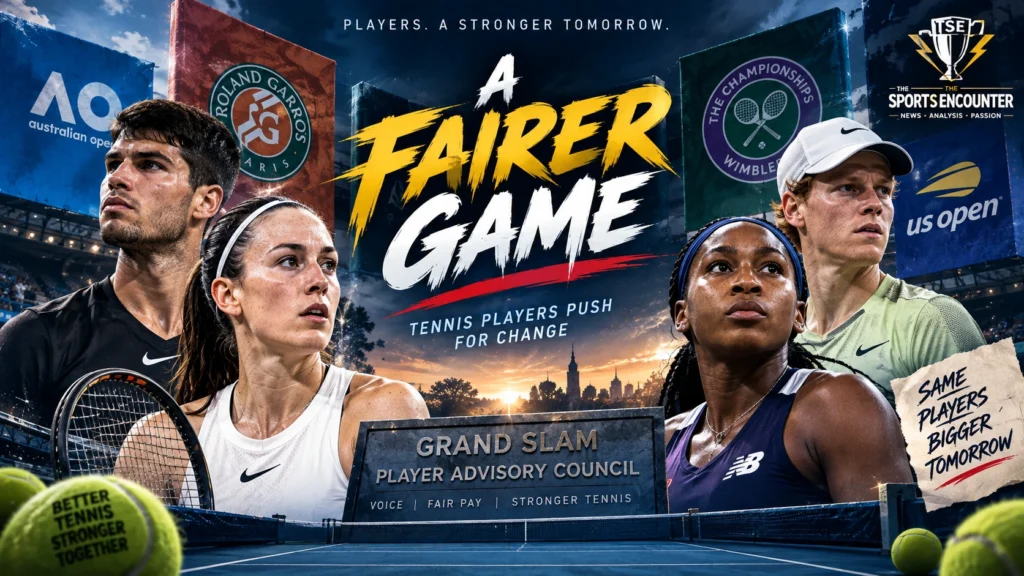
NEW YORK, United States, September 14, 2026: The most important change in tennis this week did not happen on a court.
After more than a year of coordinated pressure over prize money, player welfare, and decision-making power, leading players are moving their campaign into a newly created Grand Slam Player Advisory Council, replacing public protest with direct negotiation for now.
The shift marks a significant change in strategy.
Players have spent much of the past 18 months arguing that the four Grand Slams generate enormous revenues while giving athletes too little influence over how those events operate and how the money is distributed. Their central demands have included stronger welfare support, a formal voice in Grand Slam decision-making, and a long-term target of receiving 22% of tournament revenues as prize money by 2030.
The new council addresses one of those demands directly.
It does not settle the others.
That distinction is the key to understanding what comes next.
The Sports Encounter has tracked the financial tension around the majors throughout 2026, including Wimbledon’s record prize-money increase and the unresolved revenue-sharing debate. The new council now turns that argument from public pressure into an institutional test.
What Is the Grand Slam Player Advisory Council?
The Grand Slam Player Advisory Council is a new forum created by the Australian Open, Roland-Garros, Wimbledon, and the US Open to give players a direct channel for communication, feedback, and consultation with the sport’s four biggest tournaments.
The official US Open announcement states that the council will address sporting matters affecting the Grand Slams collectively while also giving players a regular forum to discuss welfare and compensation issues with each tournament individually.
The structure is important because the four majors do not operate as one commercial company.
They have different ownership structures, economics, governance arrangements, and legal responsibilities.
That means prize money and welfare discussions cannot simply be negotiated through one universal financial agreement.
The council instead creates a shared platform while allowing tournament-specific discussions where necessary.
Why Players Are Moving Away From Public Protest
The shift follows a campaign that began in March 2025 and intensified throughout 2026.
Leading players increasingly argued that consultation was too limited and that prize-money growth was not keeping pace with the commercial expansion of the Grand Slams.
That frustration became visible at Roland-Garros and Wimbledon, where players reduced media obligations as part of coordinated pressure.
The message was straightforward.
Players were no longer prepared to treat compensation, welfare, scheduling, and governance as separate issues that could be managed through occasional individual complaints.
They wanted a formal structure.
Now they have one.
For that reason, the current move should not be read as surrender.
It is closer to a tactical pause.
The players have indicated that they will allow the new council to pursue the remaining objectives through direct engagement. They have also made clear that public campaigning could return if the council does not produce meaningful progress.
The 22% Revenue Target Is Still the Biggest Unresolved Issue
The creation of the council solves the representation problem more clearly than it solves the financial one.
Players have been pushing toward a model in which 22% of Grand Slam revenues would flow into prize money by 2030.
That target remains unmet.
This is why the dispute cannot be reduced to whether total prize funds are rising.
They are.
The argument is about the mechanism.
Players want a clearer relationship between tournament growth and player compensation rather than relying only on year-by-year increases decided by organizers.
That difference matters.
A larger prize fund is an outcome.
Revenue sharing is a structure.
The entire campaign has gradually moved toward the second.
Grand Slam Prize Money Has Already Risen Sharply
The pressure has coincided with major increases across all four Grand Slams.
| Grand Slam | 2026 Prize / Compensation Pool | Key Context |
|---|---|---|
| Australian Open | Approximately $79.92 million | Large increase amid wider player-pay pressure |
| Roland-Garros | Approximately $71.56 million | Has moved closest toward linking payouts with tournament economics |
| Wimbledon | £64.2 million, approximately $86.79 million | Record fund, up 20% from 2025 |
| US Open | $108 million | Largest player compensation package in tennis history |
The US Open’s package is the largest of the four and represents a 20% increase from 2025.
The tournament also raised first-round singles payments to $140,000 and set the singles champions’ prize at $5.5 million each.
The official US Open compensation announcement also introduced a new $2 million Player Support Program, split equally between male and female players.
That welfare component may prove more important than the headline purse.
Why the US Open’s $2 Million Welfare Commitment Matters
One of the most persistent complaints from players has been that the sport’s economic model focuses too heavily on prize money and not enough on the broader realities of professional life.
A player’s costs do not disappear when they lose.
Travel continues.
Coaching costs continue.
Medical bills continue.
Training teams continue.
Retirement planning and mid-career life events rarely fit neatly into tournament prize-money structures.
The US Open’s new Player Support Program is designed to address some of those gaps.
Its initial $2 million commitment will be held pending the development of the program with input from the new council.
That creates a direct connection between governance reform and player welfare.
The council will not simply discuss matches, scheduling, and tournament operations.
It will also influence how new forms of support are built.
Wimbledon Already Showed Why Record Prize Money Was Not Enough
Wimbledon offered one of the clearest examples of the larger dispute earlier this year.
The Championships raised total prize money to £64.2 million, up from £53.5 million in 2025.
The singles champions received £3.6 million each.
Those numbers were historic.
The debate continued anyway.
The reason was simple: players were not only asking for more money.
They were asking for a transparent relationship between what tournaments earn and what players receive.
The Sports Encounter’s Wimbledon prize-money analysis identified that distinction months ago. The dispute was already moving away from “How large is the prize fund?” toward “How is the business model structured?”
That question has now reached the new council.
The French Open May Be the Most Important Test Case
Roland-Garros has emerged as a particularly important part of the negotiation because player representatives have welcomed moves toward tying payouts more directly to tournament profitability.
If that approach develops into a workable formula, it could become the most meaningful structural precedent in the current dispute.
Players would no longer be negotiating prize-money increases only as fixed annual numbers.
They would be negotiating around the economics of the event itself.
That is much closer to the model being demanded.
The official Roland-Garros council announcement confirms that compensation and welfare will be part of the new forum, while emphasizing that each Grand Slam retains its own structure and decision-making process.
Ben Shelton and Jessica Pegula Have Already Framed the Council as a Voice Issue
Two American players have provided some of the clearest public explanations for why the council matters.
Ben Shelton described having a seat at the table as something players had wanted for some time.
Jessica Pegula emphasized that the Grand Slams have an enormous impact on player careers and therefore should include player input in decisions that shape those events.
Those comments are revealing because neither centers the issue only on money.
They center it on influence.
This matters even more after a US Open in which players again raised concerns around scheduling, late finishes, recovery windows, and the demands placed on athletes deep into the night.
The Sports Encounter’s coverage of Ben Shelton’s run to the US Open final showed how quickly elite performance can become intertwined with scheduling, recovery, and tournament structure.
Scheduling May Become the First Issue Fans Actually Notice
Revenue sharing may be the biggest financial issue.
Scheduling may be the first reform fans can see.
The 2026 US Open again produced late-night finishes that placed recovery, television scheduling, and spectator experience under scrutiny.
For players, those are not cosmetic concerns.
A match ending after 2 or 3 a.m. changes recovery schedules, physiotherapy, sleep, nutrition, preparation, and sometimes the competitive balance of the next round.
A formal council gives players a clearer channel to raise those issues before they become another public dispute.
The benefit of the council therefore depends partly on whether it becomes proactive rather than reactive.
Player Voice Has Become a Wider Theme Across the 2026 Season
This governance debate has emerged during a year in which tennis has already undergone significant competitive change.
New champions, injuries, changing rankings, tournament expansion, prize-money growth, and new commercial formats have all increased the pressure on the existing structure.
The Sports Encounter’s Tennis Hub has followed that transition across the Grand Slam calendar, from Paris through Wimbledon and New York.
The financial debate belongs inside that competitive story.
Players are being asked to compete more, travel more, promote more, and adapt to an increasingly global calendar.
The argument over compensation and representation is the business consequence of that evolution.
The Fight Is About Lower-Ranked Players Too
Discussions around player pay often become dominated by names such as Jannik Sinner, Aryna Sabalenka, Coco Gauff, Jessica Pegula, and other stars.
The economic pressure is often greater lower down the rankings.
Top players can absorb travel, coaching, physiotherapy, accommodation, and support costs more easily.
Players outside the elite tier may operate with much thinner margins.
This is why first-round prize money, qualifying payments, pensions, healthcare, and welfare structures matter.
The ITF’s Grand Slam Player Development Programme already demonstrates the scale of that issue. It has contributed more than $68 million to player development since 1986 and provided grants to 65 junior and professional players in 2026.
That system supports development.
The new council could potentially influence what happens once those players reach the professional Grand Slam ecosystem.
The Council Does Not Replace the ATP or WTA
Another important distinction is governance.
The new council is focused specifically on the four Grand Slams.
It does not replace ATP or WTA player representation.
That separation reflects one of professional tennis’ long-standing structural complications.
The tours, the Grand Slams, the ITF, national federations, tournament owners, and player groups all operate with overlapping interests but different authority.
The official 2026 Grand Slam rulebook describes Grand Slam Tennis as a shared governance collaboration among the four majors, managed through a board made up of the four Grand Slam chairs and supported by their chief executives.
The council adds a player-facing layer to that structure.
Whether that layer carries influence or merely consultation will determine how important it becomes.
TSE Analysis: A Seat at the Table Is Not the Same as Power
This is the central question.
Players now have what they repeatedly said they wanted: a formal place inside Grand Slam discussions.
That is meaningful progress.
It is also only the beginning.
An advisory council can create dialogue without creating binding authority.
It can create meetings without creating revenue-sharing agreements.
It can produce recommendations without guaranteeing implementation.
The players’ decision to suspend public campaigning therefore creates a test for both sides.
The Grand Slams now have an opportunity to prove that consultation will lead to measurable reform.
The players have to decide how long they are willing to negotiate before judging whether the structure is working.
The fact that they have explicitly retained the right to revive public action shows that they understand this distinction.
The 2026 US Open Shows Why Player Leverage Is Growing
The financial scale of the US Open illustrates why the debate has intensified.
A $108 million player compensation package would have seemed extraordinary only a few years ago.
Now it is being discussed as evidence of progress within a larger dispute.
That shift says something about tennis economics.
Grand Slam events have become increasingly valuable global sports properties.
Players increasingly see themselves as stakeholders in that growth rather than simply participants receiving prize money.
The same commercial power was visible throughout the 2026 tournament, from major stars returning to New York to an expanded conversation around new formats.
Serena Williams’ US Open mixed-doubles return alongside Carlos Alcaraz showed how individual player visibility can transform the commercial and cultural value of a tournament event.
That star power sits at the heart of the players’ argument.
Grand Slam Economics Are Becoming Part of the Tennis Story
For years, prize money was treated almost as a tournament footnote.
Fans saw the winner’s check at the end of a final and moved on.
That is changing.
The economics now affect how tournaments are perceived before the first ball is struck.
Wimbledon’s record fund became part of its tournament build-up. TSE’s Wimbledon curtain-raiser included prize money alongside injuries, player form, and the changing competitive order because the financial debate had become part of the event itself.
The same is now true at the US Open.
Prize money, welfare, scheduling, and governance are no longer background topics.
They are part of how modern Grand Slam tennis works.
The New Council Arrives After a US Open Full of Player-Led Stories
The timing is notable.
The council is launching immediately after a US Open in which player identity and influence were central themes.
Shelton’s run to the men’s final became one of the biggest stories of the tournament. His semifinal victory over Frances Tiafoe ended a 54-year wait for a Black American man to return to the US Open singles final.
On the women’s side, Jessica Pegula reached another semifinal before losing to Aryna Sabalenka. TSE’s semifinal analysis focused on how Sabalenka attacked Pegula’s second serve, but Pegula’s importance in 2026 extends far beyond one result.
She has also become one of the most prominent voices in the governance conversation.
The competitive and political stories are therefore increasingly connected.
Coco Gauff Represents Another Part of the Player-Power Shift
Coco Gauff has become one of the sport’s most visible athletes and one of the players associated with the broader push for change.
Her influence reflects a wider shift in elite tennis.
The new generation is commercially powerful at a younger age, more comfortable speaking publicly, and more aware of how athlete voice operates in other major sports.
Gauff’s 2026 US Open run again demonstrated that visibility. Her comeback against Mirra Andreeva became one of the tournament’s strongest pressure performances.
Players with that level of audience and commercial reach have more leverage than previous generations often exercised collectively.
The council is the first major test of whether that leverage can be converted into institutional influence.
The Sport Has Already Changed Around Prize Money
The 2026 season also shows how quickly financial expectations are moving.
Wimbledon’s £64.2 million fund is up 20% from 2025.
The US Open is at $108 million.
Masters-level tournaments have also expanded prize money and draws.
The Sports Encounter’s National Bank Open preview documented the growing financial scale of ATP and WTA 1000 events before the North American hard-court season.
That context matters because players compare compensation models across the sport.
The Grand Slams remain the largest stages.
The argument is that their player-revenue model should reflect that status more directly.
What Happens Next?
The next phase will be quieter than the previous one.
That does not mean it will be less important.
The four Grand Slams and player representatives still need to finalize the council’s composition, framework, and operating structure.
Interested players are expected to apply for council positions.
Once established, the group will have to move from principle to detail.
That means discussing how players are selected.
How long they serve.
How men and women are represented.
How lower-ranked players are represented.
How recommendations are recorded.
How disagreements are escalated.
And, most importantly, what happens when players and tournament organizers do not agree.
Three Questions Will Decide Whether the Council Works
1. Can It Produce a Revenue-Sharing Formula?
This is the largest unresolved issue.
If the council produces only annual prize-money increases without a formal framework tied to Grand Slam economics, players may eventually conclude that the central objective has not been achieved.
2. Will Welfare Support Extend Beyond the US Open?
The US Open has committed $2 million.
Players have made clear that they want comparable progress from the other majors.
A broader welfare framework could become one of the fastest ways for the council to demonstrate practical value.
3. Will Players Influence Decisions Before Problems Become Public?
Scheduling, media obligations, recovery periods, late finishes, facilities, and other tournament matters frequently become controversies only after players complain publicly.
A functioning council should reduce that pattern.
If the dialogue is genuine, some disputes should be solved before fans ever hear about them.
TSE Verdict
The Grand Slam Player Advisory Council is the clearest institutional concession players have gained during the current campaign.
That makes it important.
It does not make the campaign complete.
The players wanted three things: a stronger voice, greater welfare support, and a larger, more structured share of Grand Slam revenues.
The first now has a formal mechanism.
The second has begun to move.
The third remains unresolved.
That is why the next stage may be more consequential than the protests that came before it.
Public pressure proved that the players could force the conversation.
The council now has to prove that the conversation can produce binding progress.
Tennis has reached a point where record prize money is no longer enough to end the debate.
The issue is who helps decide how the sport’s biggest events distribute their growth.
The players now have a seat at the table.
The next question is how much power comes with the chair.
Frequently Asked Questions
What is the Grand Slam Player Advisory Council?
It is a new player consultation forum created by the Australian Open, Roland-Garros, Wimbledon, and the US Open to provide direct communication with players on sporting matters, welfare, compensation, and other Grand Slam issues.
Why did tennis players want a Grand Slam council?
Players wanted a formal role in decisions affecting the four majors rather than relying primarily on informal consultation or public pressure.
Are players ending their campaign for higher pay?
No. They are moving the campaign into formal negotiations through the new council. They have also retained the option of restarting public action if their outstanding goals are not met.
What revenue share are players seeking?
The player campaign has targeted prize money equal to 22% of Grand Slam tournament revenues by 2030.
How much is the 2026 US Open player compensation package?
The 2026 US Open committed $108 million in total player compensation, the largest package in tennis history.
What is the US Open Player Support Program?
The US Open has committed an initial $2 million to a new Player Support Program intended to help players with broader career and life needs beyond traditional prize money.
How much prize money is Wimbledon offering in 2026?
Wimbledon’s 2026 total prize fund is £64.2 million, with the men’s and women’s singles champions receiving £3.6 million each.
When does the Grand Slam Player Advisory Council begin?
The council is launching following the 2026 US Open, with its initial composition and operating framework being developed with player input.
Does the council control all four Grand Slams?
No. The four tournaments retain separate economic and governance structures. Collective sporting matters can be discussed jointly, while compensation and welfare discussions may take place with each Grand Slam individually.
Where can readers follow more tennis coverage?
Follow The Sports Encounter Tennis Hub for Grand Slam reporting, player analysis, prize-money stories, rankings context, and major developments across the ATP and WTA tours.
The Sports Encounter’s tennis coverage focuses on match analysis, player stories, Grand Slam economics, scheduling, rankings, governance, and the wider forces shaping the modern game.