Madrid, Spain: Real Madrid did not control their Champions League opener in the conventional sense. Inter had more of the ball, attempted more shots, completed more passes and forced Madrid to defend for long stretches.
Madrid still found the two moments that mattered most.
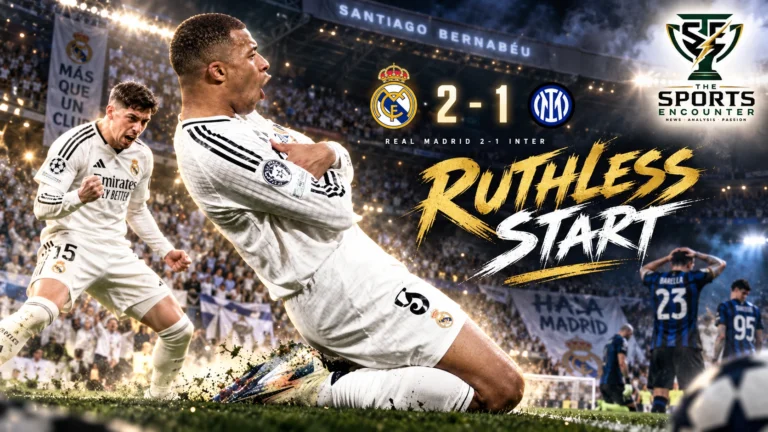
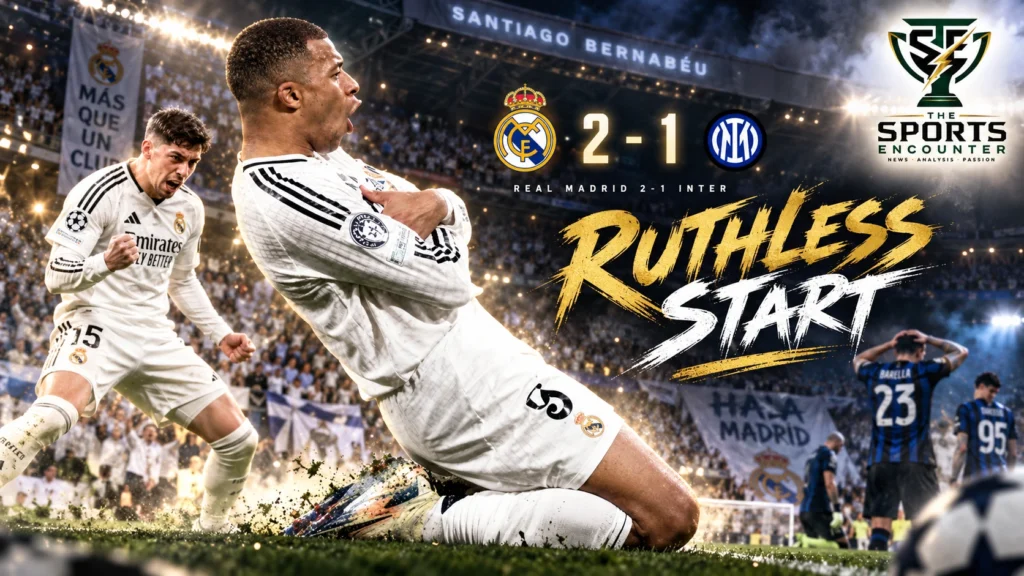
Kylian Mbappé struck in the 14th minute and Federico Valverde doubled the advantage nine minutes later as Real Madrid beat Inter 2-1 at the Santiago Bernabéu, surviving a late Carlos Augusto response to open their 2026-27 UEFA Champions League campaign with three points.
Inter finished with 59% possession, 15 shots and 11 corners, yet Madrid’s early efficiency gave José Mourinho’s side a lead they never surrendered.
Story at a glance
Real Madrid vs Inter: Match at a Glance
Both clubs entered this fixture knowing their league-phase schedules would provide very little room for slow starts. The Sports Encounter’s full Champions League draw analysis had already identified Inter’s schedule as one of the harder assignments, with Liverpool at home and trips to Real Madrid and Borussia Dortmund among their eight fixtures.
Madrid Turned Inter’s Early Mistakes Into Goals
The defining phase of the match came between the 14th and 23rd minutes.
Mbappé Keeps Carrying Madrid’s Biggest Attacking Burden
Mbappé arrived at this Champions League campaign after finishing the 2025-26 edition as the competition’s leading scorer with 15 goals.
Valverde’s Goal Gave Madrid the Cushion They Eventually Needed
At 1-0, Inter still had room to recover.
Inter Controlled More of the Ball but Could Not Control the Score
The possession numbers are striking.
Carlos Augusto pulled one back in the 77th minute and transformed the final quarter-hour into a genuine test of Madrid’s nerve, but the hosts held on despite Inter finishing the game on the front foot.
The result offers an early reminder of why Champions League football often refuses to follow the statistical script. Inter produced more volume. Madrid produced the sharper punishment.
Real Madrid vs Inter: Match at a Glance
| Match Detail | Real Madrid | Inter |
|---|---|---|
| Final score | 2 | 1 |
| Goals | Kylian Mbappé 14′, Federico Valverde 23′ | Carlos Augusto 77′ |
| Shots | 9 | 15 |
| Shots on target | 6 | 5 |
| Possession | 41% | 59% |
| Passes | 362 | 565 |
| Pass accuracy | 87% | 95% |
| Fouls | 12 | 10 |
| Yellow cards | 1 | 3 |
| Offsides | 2 | 4 |
| Corners | 4 | 11 |
Both clubs entered this fixture knowing their league-phase schedules would provide very little room for slow starts. The Sports Encounter’s full Champions League draw analysis had already identified Inter’s schedule as one of the harder assignments, with Liverpool at home and trips to Real Madrid and Borussia Dortmund among their eight fixtures.
Madrid Turned Inter’s Early Mistakes Into Goals
The defining phase of the match came between the 14th and 23rd minutes.
Inter had started positively and looked capable of testing Madrid’s defensive structure, but two avoidable errors changed the entire contest.
Mbappé opened the scoring after Inter failed to clear effectively, allowing Brahim Díaz to find the French forward in a dangerous area.
Nine minutes later, Inter were punished again.
A poor attempt to play out from the back gave Valverde the opportunity to double Madrid’s lead.
Those goals did not emerge from prolonged Madrid pressure. They came from Madrid recognizing vulnerability and acting immediately.
That distinction matters.
Mourinho’s side did not need to dominate possession to dominate the scoreline.
Mbappé Keeps Carrying Madrid’s Biggest Attacking Burden
Mbappé arrived at this Champions League campaign after finishing the 2025-26 edition as the competition’s leading scorer with 15 goals.
UEFA listed him on 70 Champions League goals before this match, already sixth on the competition’s all-time scoring list.
His goal against Inter adds another important entry to a European record that continues to grow.
The broader pattern has also been visible domestically.
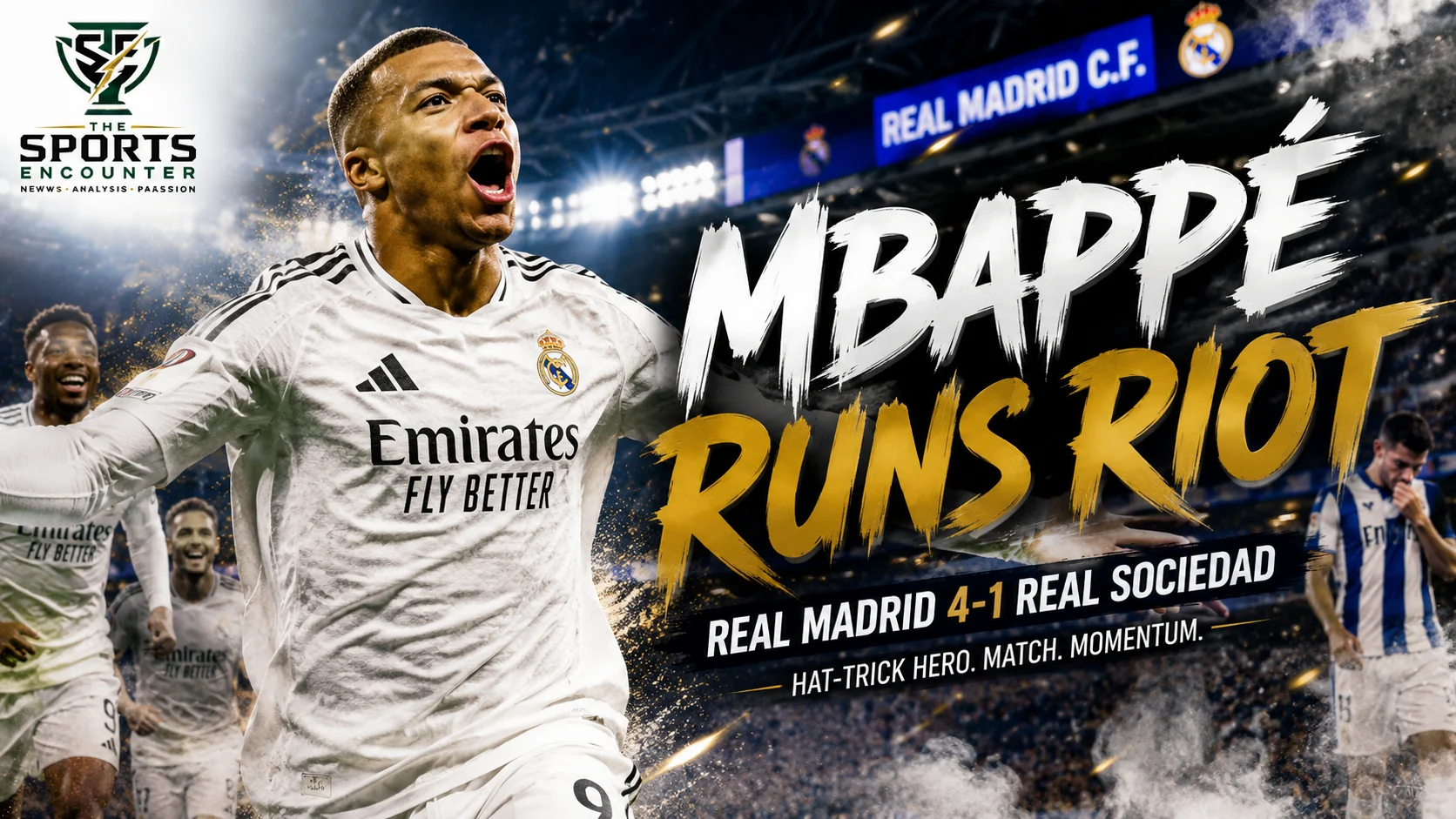
Mbappé scored a hat-trick in Madrid’s 4-1 win over Real Sociedad earlier this season, a performance The Sports Encounter examined in our analysis of Mourinho’s Bernabéu homecoming.
He is increasingly becoming the player Madrid turn to when a game is structurally uncomfortable.
Against Inter, that role appeared again.
Valverde’s Goal Gave Madrid the Cushion They Eventually Needed
At 1-0, Inter still had room to recover.
At 2-0, the psychological shape changed.
Valverde’s 23rd-minute strike gave Madrid enough margin to absorb an Inter response later in the evening.
That became crucial when Carlos Augusto scored in the 77th minute.
Without Valverde’s goal, that late Inter surge could have completely altered the result.
Instead, Madrid had something to protect.
Valverde’s ability to arrive aggressively into decisive areas has been one of the reasons he remains so valuable in a midfield that Mourinho continues to reshape.
Inter Controlled More of the Ball but Could Not Control the Score
The possession numbers are striking.
Inter had 59% of the ball.
They completed 565 passes compared with Madrid’s 362.
Their passing accuracy reached 95%.
They also attempted 15 shots to Madrid’s nine.
On another night, those figures might describe the winning team.
Not here.
Madrid placed six of their nine attempts on target.
Inter managed five from 15.
The difference between attacking volume and attacking efficiency became one of the central themes of the match.
Inter moved the ball well enough to establish territorial control. Madrid found the clearer moments.
Eleven Inter Corners Show How Much Pressure Madrid Had to Absorb
Inter earned 11 corners.
Madrid had four.
That is another statistic that reveals how frequently Inter pushed the hosts toward their own penalty area.
Madrid’s defense therefore deserves more credit than the possession split alone might suggest.
The hosts were not simply sitting comfortably behind a two-goal lead.
They were repeatedly asked to defend deliveries, second balls and recycled attacks.
Inter’s pressure eventually produced a goal.
It did not produce an equalizer.
Carlos Augusto Gave Inter a Route Back Into the Match
The 77th-minute goal changed the atmosphere inside the Bernabéu.
Carlos Augusto completed a flowing Inter move to reduce the deficit to 2-1 and leave Madrid facing more than 10 minutes of sustained pressure.
At that point, the statistical imbalance began to feel more dangerous.
Inter already had more possession and more shots.
The deficit was suddenly only one.
Madrid responded by becoming more conservative and protecting central areas rather than chasing a third goal recklessly.
That decision ultimately preserved the result.
Courtois Became Important When Inter Increased the Pressure
Inter’s 15 shots were not empty territory.
They produced five efforts on target and forced Thibaut Courtois into important interventions, particularly as the game became less controlled late on.
The Belgian goalkeeper’s contribution helped prevent Inter’s territorial advantage from becoming a second goal.
Madrid’s European success over the past decade has often depended on exactly this combination: elite attackers punishing mistakes at one end and a goalkeeper capable of surviving difficult phases at the other.
This opener followed that familiar pattern.
Mourinho’s Madrid Are Showing They Can Win Without Dominating Every Metric
Madrid’s early-season form under Mourinho has already produced different types of victories.
The 4-1 win over Real Sociedad showed how quickly the team could change a game after halftime.
This match required something else.
Madrid were forced to live without possession for longer periods.
They had to protect an early lead.
They had to absorb pressure after conceding late.
Winning those kinds of games matters because the Champions League rarely allows a team to dictate every phase against elite opposition.
The Sports Encounter’s guide to UEFA’s league-phase format explained why each early result carries added value, with only the top eight teams advancing directly to the round of 16.
Inter’s Defeat Exposes the Risk in Their Transition Season
Inter entered 2026-27 as Serie A champions, but their squad has undergone significant change.
The Sports Encounter’s Serie A season preview identified defensive transition as one of the biggest questions facing Cristian Chivu’s side.
Experienced pieces departed.
New players arrived.
The underlying structure remained strong, but the margin for individual mistakes became more dangerous.
Madrid demonstrated exactly why.
Inter played enough good football to compete at the Bernabéu.
Two first-half errors left them chasing the match anyway.
Inter Still Look Like a Strong Team Despite the Result
The scoreline should not obscure the quality of several parts of Inter’s performance.
They controlled possession.
They completed passes at 95%.
They attempted 15 shots.
They earned 11 corners.
They scored late enough to create genuine uncertainty.
Those are not the numbers of a team overwhelmed by Real Madrid.
They are the numbers of a team punished for specific mistakes.
That distinction matters when assessing Inter’s broader season.
The Sports Encounter had already listed the defending Italian champions as the team to beat domestically in our early Serie A title-race analysis.
Nothing about this defeat fundamentally changes that assessment.
Inter’s Domestic Form Adds Context to the Loss
Inter began Serie A strongly and quickly established themselves near the front of the domestic title race.
The Sports Encounter’s opening-weekend Serie A wrap highlighted their 4-1 victory over Monza as one of the strongest performances of the first round.
The contrast with Madrid is therefore useful.
Inter are capable of dominating domestic opponents.
At the Bernabéu, the punishment for isolated mistakes arrived much faster.
That is the Champions League difference.
Vinícius and Madrid’s Wider Attack Remain Part of a Bigger Story
Madrid’s attack is not built around Mbappé alone.
Vinícius Júnior remains central to Mourinho’s plans and Madrid have already moved to stabilize his long-term future.
The Sports Encounter covered that situation in our report on Vinícius staying at Real Madrid.
The deeper challenge for Mourinho is finding the right balance between Mbappé’s finishing, Vinícius’ one-on-one threat, Bellingham’s movement and Valverde’s midfield aggression.
Against Inter, Mbappé and Valverde were the players who ultimately decided the game.
Real Madrid’s League-Phase Draw Now Looks Slightly More Manageable
The opening win matters because Madrid’s European schedule contains several awkward fixtures.
They still have home games against PSV, Leipzig and LASK.
The away schedule is more demanding.
Arsenal.
Roma.
Shakhtar Donetsk.
AEK Athens.
The Sports Encounter’s Champions League draw assessment identified those road assignments as the more dangerous half of Madrid’s schedule.
Taking three points from Inter gives them valuable early breathing room before those trips arrive.
Inter Have Less Margin After Losing Their Hardest Away Game
Inter’s league-phase schedule does not become easier quickly.
Liverpool still visit San Siro.
Inter also have to travel to Borussia Dortmund.
Feyenoord away adds another potentially difficult environment.
They remain good enough to recover, but the opening defeat increases the importance of collecting points from the more manageable fixtures.
The league-phase structure rewards consistency.
Eight games disappear quickly.
Mbappé’s European Scoring Record Keeps Moving Toward the Historic Names
UEFA listed Mbappé with 70 Champions League goals before this season.
Only Cristiano Ronaldo, Lionel Messi, Robert Lewandowski, Karim Benzema and Raúl González were ahead of him on the all-time list.
His strike against Inter therefore moves him even closer to the historic elite.
UEFA’s official Mbappé Champions League profile documents his scoring progression since his Monaco debut.
The numbers are becoming increasingly difficult to treat as simply precocious.
He is moving into the historical conversation.
The Bernabéu Remains a Difficult Place to Finish a Comeback
Inter gave themselves a chance.
That should not be understated.
At 2-1, with 13 minutes of regulation time remaining, they had enough momentum to believe an equalizer was possible.
Madrid still closed the game.
UEFA’s official Champions League hub provides the current league-phase standings, fixtures and tournament information as Matchday 1 continues.
Real Madrid’s own official Matchday 1 schedule confirmed the Bernabéu meeting as their opening European fixture.
The Sports Encounter Verdict
Inter will leave Madrid frustrated because the performance was better than the result.
They had more possession.
They attempted more shots.
They completed more passes.
They earned almost three times as many corners.
Madrid won anyway.
That tells us exactly what separated the teams.
Madrid punished mistakes immediately.
Mbappé converted the first major opening.
Valverde exploited the second.
When Inter finally found the goal their pressure deserved, Madrid had already built enough protection to survive it.
The match was not a demonstration of complete Real Madrid control.
It was a demonstration of Champions League efficiency.
For a team beginning another campaign with expectations of reaching the final stages, that may be just as valuable.
Follow The Sports Encounter’s soccer coverage for continuing Champions League match reports, analysis and major European football stories.
Continue the UEFA Champions League 2026-27 Story
 UEFA Champions League 2026-27Champions League: Madrid’s Perfect Start, Arsenal’s Munich Escape and LASK’s Sporting Upset Redraw the European Race
 UEFA Champions League 2026-27PSG Rattles City, Madrid Escapes Rome, Villa Hits Six as Champions League Serves Up 46 Goals
 UEFA Champions League 2026-27PSG vs Lyon Faces Postponement as France’s Unrest Threatens Ballon d’Or Scheduling Clash
Frequently Asked Questions
Who won Real Madrid vs Inter in the Champions League?
Real Madrid beat Inter 2-1 at the Santiago Bernabéu in their opening league-phase match.
Who scored for Real Madrid against Inter?
Kylian Mbappé scored in the 14th minute and Federico Valverde added Madrid’s second in the 23rd minute.
Who scored for Inter?
Carlos Augusto scored Inter’s goal in the 77th minute.
How much possession did Inter have?
Inter had 59% possession compared with Real Madrid’s 41%.
How many shots did Inter have?
Inter attempted 15 shots, with five on target. Real Madrid had nine shots and six on target.
How many corners did Inter win?
Inter earned 11 corners compared with Real Madrid’s four.
Who is Real Madrid’s coach in 2026-27?
José Mourinho is Real Madrid’s head coach for the 2026-27 season.
How many Champions League goals did Mbappé have before this season?
UEFA listed Mbappé with 70 Champions League goals before the 2026-27 campaign.
Who are Real Madrid’s other Champions League opponents?
Real Madrid also face PSV, Leipzig, LASK, Arsenal, Roma, Shakhtar Donetsk and AEK Athens during the league phase.