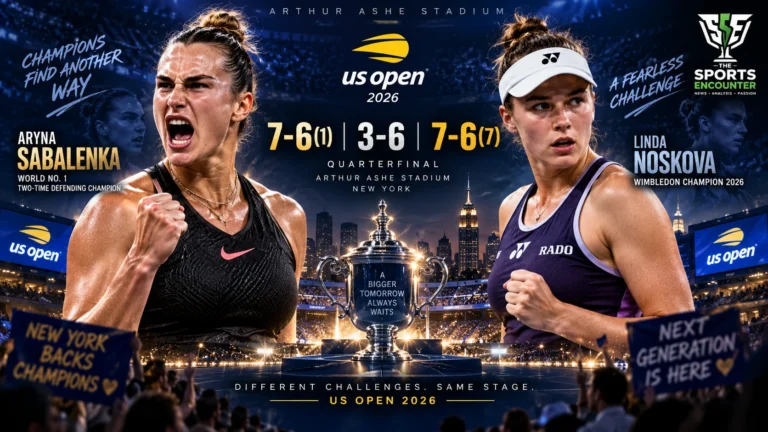
New York, United States: Aryna Sabalenka did not dominate Linda Noskova at Arthur Ashe Stadium. She survived her.
The world No. 1 and two-time defending US Open champion reached another New York semifinal on Tuesday after defeating reigning Wimbledon champion Noskova 7-6(1), 3-6, 7-6(7) in a quarterfinal that became a test of power, nerve and decision-making under extreme pressure.
Noskova served more aces. She won more games. She created enough break opportunities to turn the match in her favor. For long stretches, the Czech looked fully capable of adding another Grand Slam champion to the list of players she has beaten during her breakthrough season.
Sabalenka still walked away with the victory.
Story at a glance
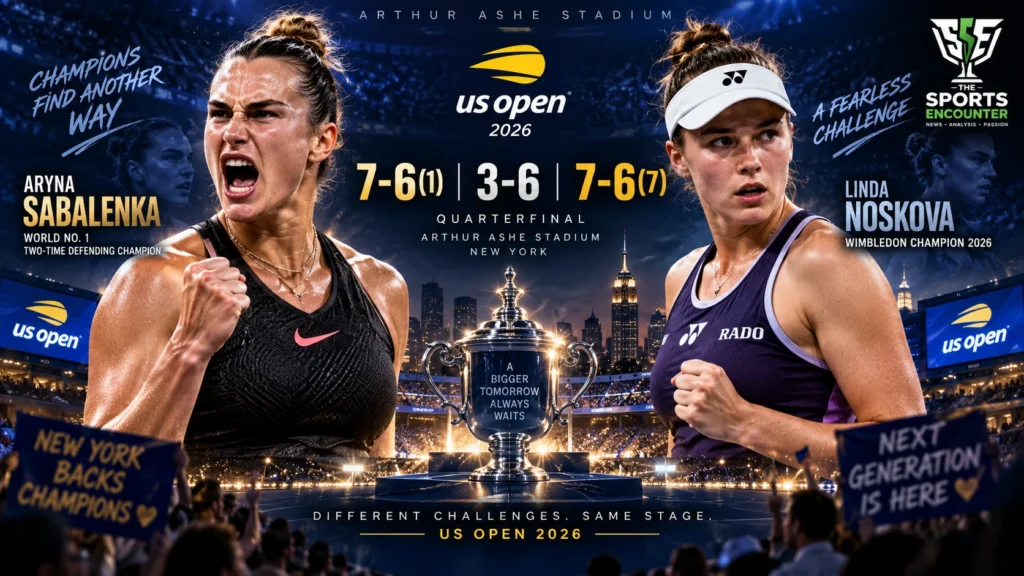
Sabalenka vs Noskova: US Open 2026 Quarterfinal Score
The official US Open preview of Sabalenka vs Noskova had framed the quarterfinal around two reigning Grand Slam champions, Sabalenka in New York and Noskova at Wimbledon.
Sabalenka Won the Match Without Winning the Most Games
The final statistics contain one of the strangest features of the match.
Sabalenka vs Noskova Match Statistics
The numbers reveal a match containing several contradictions.
The First Tiebreak Established Sabalenka’s Pressure Advantage
The opening set offered little separation through 12 games.
Noskova Refused to Let Wimbledon Become Her Only 2026 Grand Slam Story
Noskova’s response showed why her Wimbledon championship changed how the rest of the women’s tour now views her.
That distinction explains why this match matters far beyond a place in the semifinals.
Sabalenka won both tiebreaks, including the deciding match tiebreak 10-7, and once again showed that her greatest advantage in New York may no longer be raw power alone. It is her ability to keep producing aggressive tennis when a Grand Slam match becomes uncomfortable.
The result extends Sabalenka’s pursuit of a third consecutive US Open women’s singles championship after titles in 2024 and 2025. The Sports Encounter identified that three-peat attempt as one of the defining narratives of the tournament in our complete US Open 2026 preview.
For complete tournament coverage, results and analysis, visit The Sports Encounter’s tennis section.
Sabalenka vs Noskova: US Open 2026 Quarterfinal Score
| Player | Set 1 | Set 2 | Set 3 | Result |
|---|---|---|---|---|
| Aryna Sabalenka | 7 (7) | 3 | 7 (10) | Winner |
| Linda Noskova | 6 (1) | 6 | 6 (7) | Eliminated |
The official US Open preview of Sabalenka vs Noskova had framed the quarterfinal around two reigning Grand Slam champions, Sabalenka in New York and Noskova at Wimbledon.
What followed lived up to that billing.
Sabalenka Won the Match Without Winning the Most Games
The final statistics contain one of the strangest features of the match.
Noskova won 18 games.
Sabalenka won 17.
The defending champion still advanced.
That happened because the match was decided by the scoring architecture of tennis rather than cumulative totals.
Sabalenka won two extremely important sets by tiebreak.
Noskova won her only set 6-3.
The Czech therefore collected more total games while losing two sets by the narrowest possible margins.
That is not trivia. It tells us how evenly matched the two players were.
Sabalenka vs Noskova Match Statistics
| Statistic | Aryna Sabalenka | Linda Noskova |
|---|---|---|
| Aces | 12 | 18 |
| Double faults | 4 | 6 |
| Break points converted | 2/9 | 3/6 |
| Tiebreaks won | 2 | 0 |
| Receiving points won | 45 | 27 |
| Total points won | 113 | 105 |
| Games won | 17 | 18 |
| Longest run of games won | 3 | 3 |
| Longest run of points won | 8 | 7 |
| Service points won | 68 | 78 |
The numbers reveal a match containing several contradictions.
Noskova hit six more aces and converted three of six break opportunities. Sabalenka converted only two of nine.
Noskova also won 18 games to Sabalenka’s 17.
Yet Sabalenka won eight more total points and, crucially, every tiebreak the match produced.
That is where the quarterfinal was decided.
The First Tiebreak Established Sabalenka’s Pressure Advantage
The opening set offered little separation through 12 games.
Neither player could create enough sustained control to remove the other from the set.
Then the tiebreak began.
Sabalenka won it 7-1.
A set that had been balanced for nearly its entire duration suddenly became one-sided at the exact moment when every point carried additional weight.
This has become one of Sabalenka’s most important qualities at the US Open.
Her serve and first-strike forehand naturally attract attention, but her New York success has increasingly depended on her ability to shorten her emotional memory.
A poor return does not have to become a poor game.
A missed break opportunity does not have to become a lost set.
When the scoreboard reached 6-6, Sabalenka changed the conversation immediately.
Noskova Refused to Let Wimbledon Become Her Only 2026 Grand Slam Story
Noskova’s response showed why her Wimbledon championship changed how the rest of the women’s tour now views her.
She did not retreat after losing a tiebreak 7-1.
She won the second set 6-3.
That was the first set Sabalenka had lost during this US Open.
Before Tuesday, the defending champion had progressed through four rounds without dropping one.
The official US Open noted after Sabalenka’s fourth-round win over Taylor Townsend that she had reached her sixth consecutive quarterfinal in New York while extending her US Open winning streak. :contentReference[oaicite:1]{index=1}
Noskova disrupted that control.
Her 18 aces were particularly significant.
Against a returner as aggressive as Sabalenka, free points on serve can completely alter the geometry of a match. Noskova repeatedly denied Sabalenka opportunities to establish immediate baseline control.
The Czech’s development had already been clear on grass.
The Sports Encounter followed her Wimbledon breakthrough from the semifinals, when Noskova and Karolina Muchova created an historic all-Czech Wimbledon final.
By arriving in the US Open quarterfinals less than two months later, Noskova proved that Wimbledon was not simply a surface-specific breakthrough.
Noskova Had Already Changed Her Status Before New York
The US Open draw looked very different once Noskova’s name appeared in Sabalenka’s quarter.
The Sports Encounter’s US Open 2026 draw analysis argued that Noskova could no longer be treated as an emerging player hoping to make a deep run.
She arrived as a reigning Grand Slam champion.
Her hard-court record made the matchup even more credible.
Noskova herself said before the quarterfinal that hard courts had traditionally been her favorite surface before her Wimbledon breakthrough. The official US Open also noted that Sabalenka held the previous head-to-head advantage. :contentReference[oaicite:2]{index=2}
Their most important earlier meeting came at Indian Wells in March.
Sabalenka won that semifinal 6-3, 6-4 before going on to win the title. Official WTA statistics from the match showed Sabalenka dominating through serve pressure and return aggression. :contentReference[oaicite:3]{index=3}
Six months later, Noskova was considerably closer.
The Third Set Became a Test of Who Could Keep Taking Risks
The deciding set did not develop into a collapse from either side.
That made it better.
Both women kept holding enough often enough to push the match toward another tiebreak.
At this point, fatigue mattered.
Noskova had already survived a draining fourth-round match against Marta Kostyuk, winning 7-5, 5-7, 6-4 to reach the quarterfinals.
She had needed three sets against Ann Li earlier in the tournament as well.
Sabalenka’s path had been cleaner.
She beat Camila Osorio in straight sets in the opening round, a victory The Sports Encounter covered in our US Open Day 2 report.
She then defeated Polina Iatcenko 6-1, 6-1 before continuing through Kamilla Rakhimova and Townsend without dropping a set.
The contrast in physical workload should have favored Sabalenka.
Noskova refused to disappear.
The Deciding Tiebreak Was the Match in Miniature
By the time the third set reached 6-6, the match had produced nearly every possible form of pressure.
Neither player had established lasting control.
Noskova had the greater ace total.
Sabalenka had accumulated more overall points.
Both had created break opportunities.
The final place in the semifinal would be determined by a first-to-10 match tiebreak.
Sabalenka won 10-7.
Again, the margin was not huge.
The difference was execution at the end.
Sabalenka won the two most concentrated pressure passages of the entire match, the first-set tiebreak 7-1 and the deciding tiebreak 10-7.
Everything between them was far less comfortable.
Sabalenka’s 113 Total Points Reveal Another Layer
The match statistics show Sabalenka winning 113 total points to Noskova’s 105.
That eight-point edge looks modest across three sets.
It becomes meaningful when combined with the game totals.
Noskova won more games but Sabalenka won more points.
This usually indicates that the winner captured certain games decisively while losing others narrowly, or concentrated enough points at the right moments to alter set outcomes.
The two tiebreak victories reinforce that interpretation.
Sabalenka was not consistently superior.
She was more efficient when the match reached moments that could not be recovered later.
Noskova’s 18 Aces Nearly Changed the Match
Noskova’s serving deserves significant credit.
Eighteen aces against the world No. 1 in a Grand Slam quarterfinal is not a decorative statistic.
It is one reason this match remained alive until the final points.
Sabalenka struck 12 aces herself, so both players received substantial direct value from their serves.
The difference appeared on return.
Sabalenka won 45 receiving points according to the completed match statistics, compared with Noskova’s 27.
That 18-point difference helped Sabalenka continue creating pressure even when she failed to convert most of her break opportunities.
She went only 2-for-9 on break points.
Noskova was more efficient at 3-for-6.
Usually that combination could punish Sabalenka.
The tiebreaks rescued her.
Sabalenka Has Been Building Toward This Kind of Survival
Sabalenka’s route to New York had not been perfect.
Her North American summer contained enough vulnerability to raise legitimate questions about whether she could reproduce her previous US Open dominance.
At the National Bank Open, Ekaterina Alexandrova eliminated Sabalenka in three sets.
The Sports Encounter covered that setback in our National Bank Open analysis.
Her Cincinnati run also did not provide an uninterrupted march toward New York.
The wider women’s field had become increasingly open, something evident throughout The Sports Encounter’s Cincinnati Open Round of 16 coverage.
Sabalenka therefore entered the US Open as defending champion but not as an untouchable one.
That context makes Tuesday’s victory more revealing.
Champions do not always defend titles by repeating the form that won them.
Sometimes they have to find another route.
Wimbledon Had Already Exposed Sabalenka’s Vulnerability
Sabalenka’s 2026 Grand Slam season has contained another important reminder.
Naomi Osaka eliminated her at Wimbledon in straight sets.
The Sports Encounter’s Wimbledon Day 7 report examined how Osaka disrupted Sabalenka’s rhythm and ended her run at SW19.
Noskova then went on to win that tournament.
Tuesday therefore brought together two women whose 2026 major seasons were already connected indirectly.
One had lost her Wimbledon opportunity.
The other had taken it.
At the US Open, Sabalenka reversed the hierarchy.
Noskova’s Tournament Still Confirms Her Arrival
Losing this quarterfinal should not reduce Noskova’s season to a missed opportunity.
She is 21.
She is the reigning Wimbledon champion.
She has now reached the quarterfinals of the next Grand Slam after winning her first.
That progression matters because many first-time major winners struggle immediately with the expectations that follow.
Every opponent prepares differently.
Every draw analysis begins mentioning their name.
Every defeat attracts more attention.
Noskova reached New York and won four matches anyway.
She defeated Katie Volynets, Lanlana Tararudee, Ann Li and Marta Kostyuk to reach the last eight. The official US Open documented her difficult three-set victory over Kostyuk, another match that required her to respond under pressure. :contentReference[oaicite:4]{index=4}
Then she took the two-time defending US Open champion to a deciding match tiebreak.
That is evidence of staying power.
The Three-Peat Is Now Two Wins Away
Sabalenka began this tournament carrying a rare opportunity.
No woman has won three consecutive US Open singles titles in the modern era since Serena Williams completed the feat across 2012, 2013 and 2014.
Sabalenka’s back-to-back titles in 2024 and 2025 put that historical possibility into play.
The Sports Encounter highlighted it before the tournament in both our US Open tournament preview and women’s draw analysis.
She is now two victories away.
The significance is growing with every round because the conditions required for history are becoming more specific.
There are no easy matches left.
Sabalenka’s World No. 1 Ranking Adds Another Layer of Pressure
The title defense is not Sabalenka’s only concern in New York.
Her world No. 1 ranking is also under threat.
Before the quarterfinals, Elena Rybakina, Jessica Pegula and Coco Gauff remained among the players with pathways to the top ranking depending on results.
Sabalenka had repeatedly tried to separate herself from those calculations.
Reuters reported before the Noskova match that she was focusing on her own tennis rather than hypothetical ranking scenarios. :contentReference[oaicite:5]{index=5}
That approach makes sense.
The quarterfinal showed how little mental space remained available for anything beyond the next point.
Sabalenka’s US Open Run So Far
| Round | Opponent | Result |
|---|---|---|
| Round 1 | Camila Osorio | Won 6-4, 6-4 |
| Round 2 | Polina Iatcenko | Won 6-1, 6-1 |
| Round 3 | Kamilla Rakhimova | Won 6-3, 6-4 |
| Round of 16 | Taylor Townsend | Won 6-4, 6-3 |
| Quarterfinal | Linda Noskova | Won 7-6(1), 3-6, 7-6(7) |
The quarterfinal was the first match in which Sabalenka dropped a set at the 2026 US Open.
It was also comfortably her most difficult match.
Noskova’s US Open Run
| Round | Opponent | Result |
|---|---|---|
| Round 1 | Katie Volynets | Won 7-5, 6-1 |
| Round 2 | Lanlana Tararudee | Won 6-4, 6-2 |
| Round 3 | Ann Li | Won 6-2, 6-7(6), 6-2 |
| Round of 16 | Marta Kostyuk | Won 7-5, 5-7, 6-4 |
| Quarterfinal | Aryna Sabalenka | Lost 6-7(1), 6-3, 6-7(7) |
This Match Explains Why Grand Slam Experience Still Matters
Noskova owns a Grand Slam title now.
She understands championship pressure.
Sabalenka simply has more repetitions at this particular stage and this particular tournament.
Arthur Ashe Stadium has become familiar territory.
She knows how the court changes during a long match.
She knows how the crowd reacts when momentum shifts.
She knows that a bad set does not remove the next one.
That experience cannot guarantee victory.
It can prevent panic.
Tuesday’s match required exactly that.
Why Sabalenka’s Win Was About More Than Power
Sabalenka’s reputation still begins with physical force.
Few players hit through the court as consistently.
Few can combine first-serve speed with immediate forehand aggression as effectively.
Noskova matched much of that power.
She actually exceeded Sabalenka’s ace total.
That forced the world No. 1 to find another advantage.
She found it in return pressure, total point accumulation and tiebreak execution.
That is why describing the match simply as Sabalenka overpowering Noskova would miss what happened.
She did something harder.
She won without owning every statistical category.
The Sports Encounter Verdict
There are matches where the score tells you who was better.
This was not one of them.
Linda Noskova won more games.
She hit more aces.
She converted a greater percentage of her break chances.
She recovered from losing the opening tiebreak 7-1 and forced the defending champion all the way into a deciding match tiebreak.
Sabalenka won because the match eventually demanded something different from statistical superiority.
It demanded control of a handful of points that could not be taken back.
She won the first tiebreak.
She won the last one.
Those two passages turned an extraordinarily even quarterfinal into another Sabalenka victory at Arthur Ashe Stadium.
Noskova leaves New York having strengthened the argument that Wimbledon was the start of her arrival rather than its peak.
Sabalenka stays because she handled the moments that separate a great performance from a Grand Slam semifinal.
The three-peat remains alive.
Continue the US Open 2026 Story


Frequently Asked Questions
Who won Aryna Sabalenka vs Linda Noskova at the 2026 US Open?
Aryna Sabalenka defeated Linda Noskova 7-6(1), 3-6, 7-6(7) in the women’s singles quarterfinal.
What was the deciding tiebreak score?
Sabalenka won the deciding match tiebreak 10-7.
How many aces did Sabalenka hit against Noskova?
Sabalenka recorded 12 aces.
How many aces did Linda Noskova hit?
Noskova struck 18 aces, six more than Sabalenka.
Who won more games in Sabalenka vs Noskova?
Noskova actually won more games, 18 to 17, despite losing the match because Sabalenka won the first and third sets in tiebreaks.
How many total points did Sabalenka win?
Sabalenka won 113 total points compared with Noskova’s 105.
How many tiebreaks did Sabalenka win?
Sabalenka won both tiebreaks in the match.
Did Sabalenka drop a set before the quarterfinal?
No. Noskova became the first player to take a set from Sabalenka at the 2026 US Open.
Is Sabalenka still trying to win three consecutive US Open titles?
Yes. Sabalenka won the women’s singles championship in 2024 and 2025 and is now two victories away from completing a three-peat in 2026.
Is Linda Noskova the reigning Wimbledon champion?
Yes. Noskova won her first Grand Slam singles championship at Wimbledon earlier in 2026.