BERLIN, Germany: France have spent the opening phase of the FIBA Women’s Basketball World Cup 2026 looking less like a team searching for form and more like one expanding the limits of what opponents can realistically defend.
The latest evidence arrived against Nigeria on September 7.
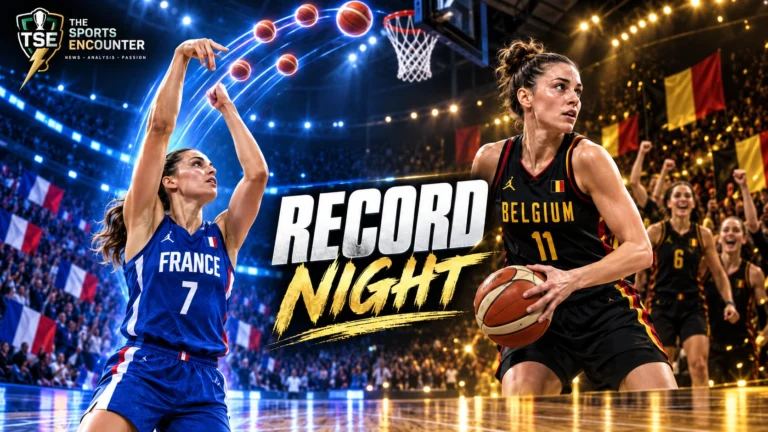
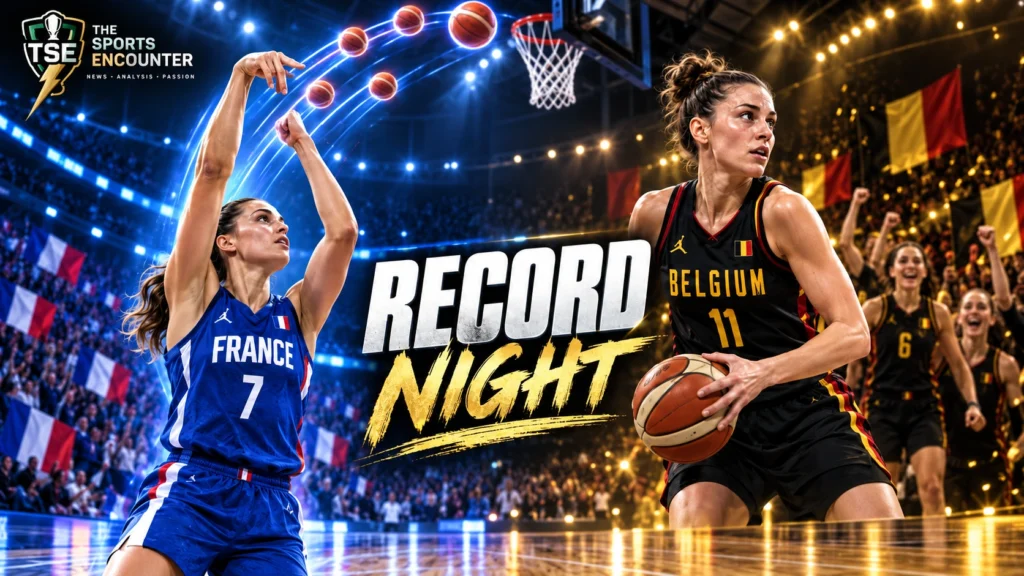
France won 111-56, made a Women’s World Cup-record 22 three-pointers and completed Group B with three victories from three games. Only three days earlier, Japan had made 20 against Mali and appeared to have moved the tournament’s three-point standard into territory that could survive for years.
France erased it before the group phase was even finished.
Story at a glance
FIBA Women’s World Cup September 7 Results at a Glance
Official scores, schedules and tournament information are available through the FIBA Women’s Basketball World Cup 2026 tournament hub.
France 111-56 Nigeria: The Record Is Huge, but the Way France Created It Matters More
Twenty-two three-pointers will dominate the historical record.
France Finish Group B With Numbers That Demand Attention
Records can occasionally distort tournament analysis because one spectacular performance overwhelms everything that happened before it.
Belgium 80-68 Australia: Group C Reveals a Different Kind of Contender
If France are attacking the tournament through speed and shooting volume, Belgium are making their case through control.
France and Belgium Are Building Two Different Challenges to USA
This may be the most important development from the first four days in Berlin.
Yet the larger story in Berlin is no longer simply about a shooting record.
France scored 305 points across their three group games and allowed only 178. They defeated Hungary by 46, Korea by 26 and Nigeria by 55. Across those three games, their average winning margin was approximately 42.3 points.
At almost the same time, Belgium completed a very different statement. The reigning European champions defeated Australia 80-68 to win Group C at 3-0, Emma Meesseman delivered another major performance, and Julie Allemand moved to the top of the Women’s World Cup career assists list.
France are stretching defenses until they break. Belgium are pulling them apart through structure, patience and passing.
Those contrasting methods are becoming increasingly important because the defending champion United States have already discovered that this tournament may not follow the usual script. Italy held USA to only 55 points in a three-point American victory, a performance examined in The Sports Encounter’s analysis of Italy’s extraordinary defensive stand against Team USA.
Berlin is beginning to produce something more interesting than another tournament waiting for the Americans to take control.
FIBA Women’s World Cup September 7 Results at a Glance
| Group | Game | Result | Major Impact |
|---|---|---|---|
| B | Nigeria vs France | France 111-56 Nigeria | France finish 3-0 and set World Cup record with 22 threes |
| B | Hungary vs Korea | Hungary 82-73 Korea | Hungary secure second place in Group B |
| C | Belgium vs Australia | Belgium 80-68 Australia | Belgium win Group C and advance directly to quarterfinals |
| C | Puerto Rico vs Türkiye | Puerto Rico 75-71 Türkiye | Puerto Rico survive and Türkiye are eliminated |
Official scores, schedules and tournament information are available through the FIBA Women’s Basketball World Cup 2026 tournament hub.
France 111-56 Nigeria: The Record Is Huge, but the Way France Created It Matters More
Twenty-two three-pointers will dominate the historical record.
The more useful question for future opponents is how France created them.
This was not simply a case of one player getting hot and carrying an offense through an extraordinary shooting night. France generated perimeter opportunities throughout the roster while repeatedly turning defensive activity and early offense into situations where Nigeria had to protect too much space.
France made 14 three-pointers in the first half alone.
Gabby Williams and Marine Johannès combined to make eight of 11 attempts from outside during that opening half, according to FIBA. Williams eventually became the first French player to make six three-pointers in a Women’s World Cup game.
France scored 65 points before halftime, their highest first-half total in Women’s World Cup history.
The previous overall team record had lasted barely three days.
Japan made 20 threes against Mali on September 4, with Saki Hayashi setting an individual tournament record by making nine herself. The Sports Encounter covered that performance in detail when Hayashi and Japan rewrote the World Cup three-point record book.
That record now belongs to France.
| Rank | Team | Opponent | Year | Three-Pointers Made |
|---|---|---|---|---|
| 1 | France | Nigeria | 2026 | 22 |
| 2 | Japan | Mali | 2026 | 20 |
| 3= | Japan | Kenya | 1994 | 18 |
| 3= | Australia | Mali | 2022 | 18 |
FIBA’s official breakdown of France’s record-breaking shooting performance confirms that the 22 made threes surpassed Japan’s new mark of 20.
France Are Creating Threes From Pressure, Not Just Shooting Talent
This distinction matters.
A team that depends primarily on difficult three-point shooting can often be disrupted by tighter closeouts, better switching or an inevitable drop in efficiency.
France’s perimeter offense is connected to everything else they are doing.
They defend aggressively. They create turnovers and rushed possessions. They run. They move the ball before defenses become settled. Their depth allows coach Jean-Aimé Toupane to maintain intensity without requiring the same five players to carry enormous minutes.
Johannès described France as particularly dangerous when they can push the ball, and the evidence supports her assessment.
Once the French transition game begins forcing defenders to retreat, shooters receive more space. If opponents extend toward the perimeter, France gain additional driving and interior opportunities. If they collapse into the paint, the ball can travel back outside.
The three-pointer is therefore the final action in many possessions, not necessarily the beginning of the strategy.
Gabby Williams Is Becoming the Connector France Need
Williams led France with 25 points and six rebounds against Nigeria, but her significance extends well beyond the scoring column.
She can defend different positions, accelerate transition, attack open space and contribute without requiring the entire offense to be organized around her.
That makes her particularly valuable on a team with several players capable of becoming the primary scorer on a given night.
France do not need Johannès to score 30 every game. They do not need Dominique Malonga to dominate every possession inside. They do not need Williams to carry an enormous usage rate.
The threat comes from how quickly responsibility can move between them.
That depth was already becoming apparent during The Sports Encounter’s weekend World Cup analysis, when France secured direct quarterfinal qualification before playing Nigeria.
Monday turned that depth into a record.
France Finish Group B With Numbers That Demand Attention
Records can occasionally distort tournament analysis because one spectacular performance overwhelms everything that happened before it.
France’s group stage does not have that problem.
| Opponent | Result | France Points | Opponent Points | Margin |
|---|---|---|---|---|
| Hungary | France won 99-53 | 99 | 53 | +46 |
| Korea | France won 95-69 | 95 | 69 | +26 |
| Nigeria | France won 111-56 | 111 | 56 | +55 |
| Total | 3-0 | 305 | 178 | +127 |
France averaged approximately 101.7 points per game while allowing 59.3.
That creates an average scoring differential of roughly 42.3 points.
There is an important caution here. Group-stage dominance does not guarantee anything once elimination basketball begins, and France have not yet faced the United States, Belgium or Australia in Berlin.
But teams can only answer the questions placed in front of them.
France have answered theirs emphatically.
Belgium 80-68 Australia: Group C Reveals a Different Kind of Contender
If France are attacking the tournament through speed and shooting volume, Belgium are making their case through control.
The Belgian Cats beat Australia 80-68 to complete a 3-0 group stage and secure the direct quarterfinal place available to the Group C winner.
Emma Meesseman produced 22 points and 10 rebounds. Belgium entered the fourth quarter holding a five-point advantage and then created the decisive separation with an 11-2 run.
Australia could not recover.
The result deserves additional weight because the Opals had entered the game unbeaten themselves after victories over Puerto Rico and Türkiye.
This was not Belgium beating an opponent already heading home. It was a direct contest between two established medal threats for the most valuable position in the group.
Belgium won it.
Emma Meesseman Continues to Control More Than the Scoreboard
Meesseman scored a Belgian World Cup-record 27 points against Türkiye on opening day before producing another major all-around performance against Australia.
The Sports Encounter identified her influence immediately in our complete opening-day World Cup analysis.
What makes her so difficult to defend is that reducing her scoring does not necessarily remove her influence.
She rebounds. She passes. She can operate from different areas of the floor. She reads defensive help quickly and understands where teammates will become available once opponents commit extra attention toward her.
Australia therefore faced a structural problem.
Leaving Meesseman in single coverage creates obvious scoring risk. Sending additional attention toward her helps activate one of the best passing teams in international basketball.
Belgium have built an offense in which the opponent’s attempted solution can become the beginning of the next problem.
Julie Allemand Makes World Cup History of Her Own
France did not own the only major record of the day.
Julie Allemand finished with seven assists against Australia, taking her career total at the Women’s World Cup to 111.
That moved her beyond Spain’s Laia Palau, who had 108, and USA legends Sue Bird and Dawn Staley.
| Rank | Player | Country | World Cup Assists |
|---|---|---|---|
| 1 | Julie Allemand | Belgium | 111 |
| 2 | Laia Palau | Spain | 108 |
| 3 | Sue Bird | USA | 107 |
| 4 | Dawn Staley | USA | 103 |
| 5 | Kristi Harrower | Australia | 99 |
The importance of the record fits Belgium’s identity unusually well.
Allemand has reached the top of an individual statistical category through the action most closely associated with collective basketball.
FIBA’s official World Cup assists record lists Allemand first with 111, ahead of Palau, Bird and Staley.
France and Belgium Are Building Two Different Challenges to USA
This may be the most important development from the first four days in Berlin.
The United States remain the defending champions and the standard everyone else must eventually confront.
The Americans opened with a 94-61 victory over China, and Caitlin Clark recorded 14 points and 11 assists on her senior World Cup debut. The Sports Encounter analyzed why Clark’s playmaking against China mattered more than the scoring total.
Two days later, Italy changed the conversation.
USA escaped 55-52 and produced their lowest Women’s World Cup scoring total since the introduction of the three-point line in 1984.
The Americans still won. Championship teams often find ways through poor offensive nights.
But Italy demonstrated that the current USA roster can be forced into uncomfortable half-court basketball.
That vulnerability matters when considering what France and Belgium are doing.
France Can Test USA’s Defensive Recovery
France want movement.
If they can defend, run and create early offensive advantages, they can force opponents to make repeated transition decisions before normal half-court coverages are established.
Twenty-two threes against Nigeria will not automatically transfer against the United States.
The underlying mechanisms might.
USA possess the athletes to switch, recover and protect space better than most opponents. France appear increasingly capable of forcing those athletes to make decisions at uncomfortable speed.
Belgium Can Test USA’s Patience
Belgium present almost the opposite examination.
Meesseman and Allemand can force defenses to defend actions for longer, communicate through movement and resist chasing the ball.
The Cats have enough passing intelligence to punish unnecessary help.
Against a USA roster that changed shortly before the tournament, continuity could become valuable. The Americans lost A’ja Wilson and Kelsey Plum before arriving in Berlin, forcing significant rotation adjustments examined in our analysis of the late Team USA roster disruption.
The result is a fascinating contrast.
USA still possess the deepest collection of elite individual talent.
France and Belgium are showing how collective systems might challenge it in completely different ways.
Hungary 82-73 Korea: Dorka Juhász Helps Complete an Impressive Recovery
Hungary’s tournament began with a 99-53 loss to France.
That kind of defeat can easily destabilize a short group-stage campaign.
Instead, Hungary recovered by beating Nigeria 71-67 and then Korea 82-73.
The second victory secured second place in Group B behind France.
Dorka Juhász remained central to that recovery after producing 19 points and 16 rebounds against Nigeria on September 5.
Hungary’s progression is another useful reminder of how the 2026 competition format changes the meaning of group games. A team does not need to win its group to remain alive, but second and third place bring an additional single-elimination hurdle before the quarterfinals.
Under the official FIBA Women’s World Cup competition system, each group winner advances directly to the quarterfinals. Teams finishing second and third must play a Qualification to Quarter-Finals game.
Puerto Rico 75-71 Türkiye: Survival Arrives Through a Fourth-Quarter Response
Puerto Rico entered its final Group C game without a victory.
Türkiye did too.
That made their meeting considerably simpler than many of the complicated qualification scenarios elsewhere in the tournament.
Someone was going to preserve a path forward.
Puerto Rico did it with a 75-71 victory.
Arella Guirantes scored 21 points, but the defining sequence came after Puerto Rico entered the fourth quarter trailing by seven.
Imani McGee-Stafford scored before Pamela Rosado hit consecutive three-pointers, pushing Puerto Rico into a 59-58 lead.
Guirantes later closed the game from the free-throw line.
Türkiye were eliminated, while Puerto Rico moved into the qualification round.
The result also strengthens one of the themes emerging throughout the tournament: teams outside the traditional medal group are capable of creating meaningful pressure when games become condensed into a few decisive possessions.
The Expanded 16-Team Format Is Already Creating More Consequential Basketball
The 2026 Women’s Basketball World Cup expanded from 12 teams to 16.
That change could easily have produced more one-sided games without necessarily creating better competition.
There have certainly been large margins.
France beat Hungary by 46 and Nigeria by 55. USA beat China by 33. Spain beat Germany by 30 on opening day.
Yet the tournament has also produced situations the previous format could not create in the same way.
Mali stunned Spain. Italy came within one possession of USA. Puerto Rico and Türkiye played an elimination game in everything except official terminology. Hungary recovered from a 46-point opening defeat to finish second in its group.
Japan briefly owned a global shooting record before France broke it three days later.
That last point is particularly revealing.
The tournament is creating tactical feedback almost in real time.
Japan showed how dramatically perimeter volume could alter a game when Hayashi made nine threes against Mali.
France then pushed the team record from 20 to 22.
The standard changed twice before the first knockout game had been played.
TSE Analysis: France Have Changed the Question Around This World Cup
Before the tournament, much of the international attention naturally centered on USA.
Caitlin Clark and Paige Bueckers were making their first senior World Cup appearances. The Americans were pursuing a fifth consecutive title. A new generation was joining established champions.
The Sports Encounter examined that transition when Clark and Bueckers were initially named to the USA World Cup roster, and again when we explored why Berlin represented Clark’s first genuine senior global test.
Four days into the tournament, the framing needs to expand.
USA remain the team to beat because championships are decided by more than group-stage point differential.
France, however, have created the most destructive body of basketball in the tournament so far.
Their three group victories came by 46, 26 and 55 points.
They scored more than 100 points per game on average.
They finished their group stage by breaking a World Cup shooting record that had been established only three days earlier.
Belgium have created a different kind of evidence.
The Cats beat Türkiye, Puerto Rico and Australia. Meesseman has remained one of the tournament’s defining players. Allemand has become the competition’s all-time assists leader. Their ball movement continues to give opponents very few simple defensive decisions.
That leaves Berlin with at least three clearly different championship arguments.
USA possess unrivaled depth and championship history.
France possess extraordinary pace, defensive pressure and increasingly frightening perimeter volume.
Belgium possess continuity, elite decision-making and perhaps the most sophisticated collective passing game in the field.
Australia remain dangerous despite losing the Group C decider, while Italy have already shown that even the defending champions can be dragged into a possession-by-possession fight.
The group phase is doing exactly what a good World Cup should do.
It is not settling the championship debate early.
It is giving us more credible ways to imagine how the tournament might be won.
Continue the NBA Story
 NBADale Brown Dies at 90: The Coach Who Built LSU Basketball, Defied March Madness Odds, and Changed Shaquille O’Neal’s Life
 NBABulls Erase 15-Point Deficit to Beat Bucks 132-125 as Chicago Scores 44 in Second Quarter
 NBAThunder Win the Possession Battle as Gilgeous-Alexander’s Streak Ends Against Nuggets
Frequently Asked Questions
What record did France break at the FIBA Women’s Basketball World Cup 2026?
France made 22 three-pointers against Nigeria on September 7, setting a new single-game team record at the FIBA Women’s Basketball World Cup.
What was the previous Women’s World Cup record for three-pointers?
Japan had set the previous record with 20 made three-pointers against Mali on September 4, 2026. France broke that record three days later.
What was the France vs Nigeria score?
France defeated Nigeria 111-56 in their final Group B game.
How many games did France win in the group stage?
France finished Group B with a perfect 3-0 record after defeating Hungary 99-53, Korea 95-69 and Nigeria 111-56.
How many points did France score during the group stage?
France scored 305 points across their three games while allowing 178, producing a cumulative point differential of plus-127.
Who won Belgium vs Australia at the 2026 Women’s Basketball World Cup?
Belgium defeated Australia 80-68 to finish 3-0 and win Group C, earning direct qualification to the quarterfinals.
What record did Julie Allemand break?
Belgium guard Julie Allemand became the Women’s World Cup career assists leader. She finished the Australia game with seven assists, taking her World Cup total to 111.
How did Emma Meesseman perform against Australia?
Meesseman recorded 22 points and 10 rebounds as Belgium defeated Australia 80-68.
Did Puerto Rico qualify for the next round?
Puerto Rico defeated Türkiye 75-71 to finish third in Group C and remain alive in the tournament. They move into the Qualification to Quarter-Finals round, while Türkiye were eliminated.
How does the FIBA Women’s Basketball World Cup 2026 knockout format work?
The winner of each four-team group advances directly to the quarterfinals. Teams finishing second and third play single-elimination Qualification to Quarter-Finals games, while each fourth-place team is eliminated. The quarterfinals then begin the main knockout bracket.