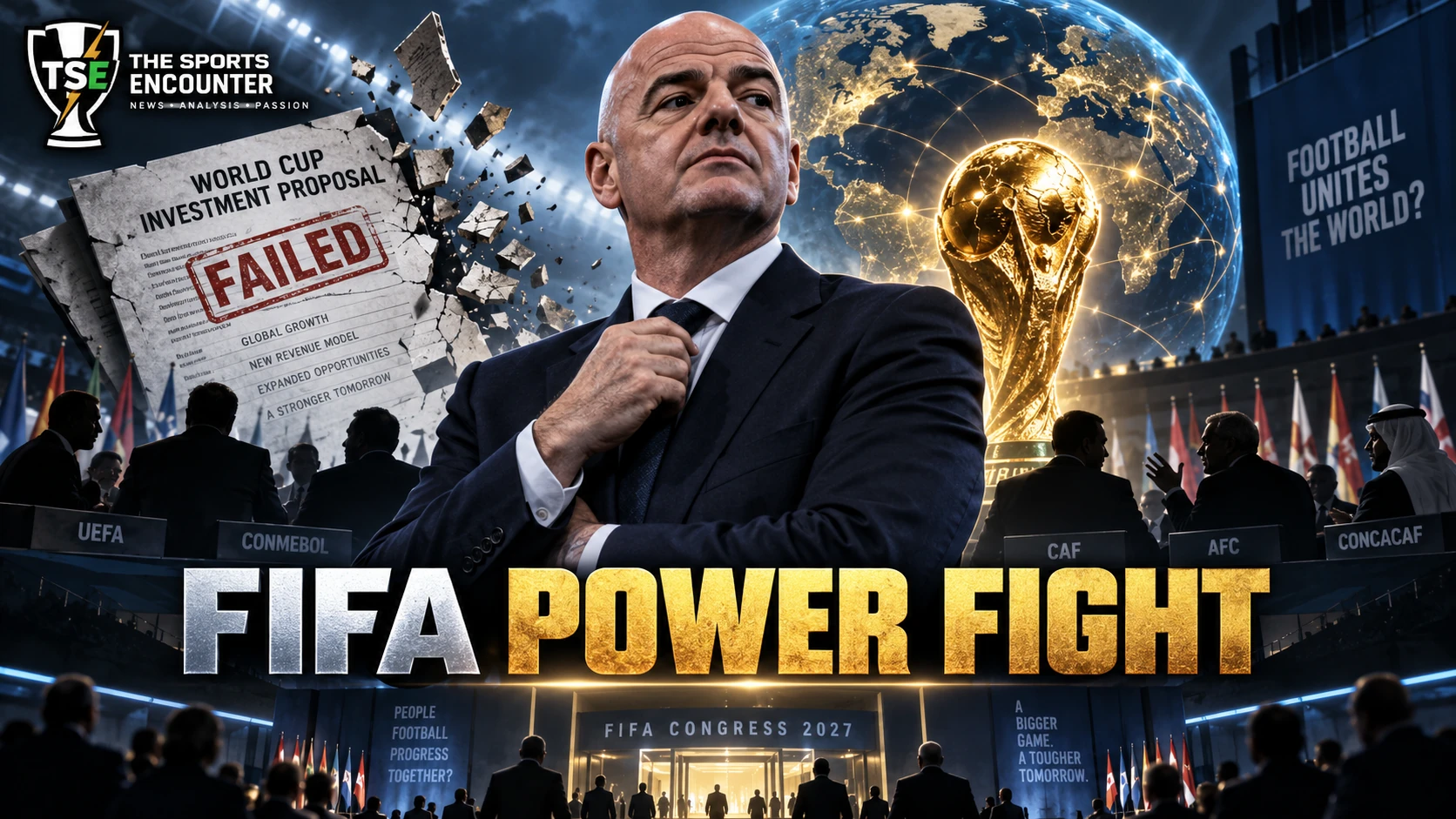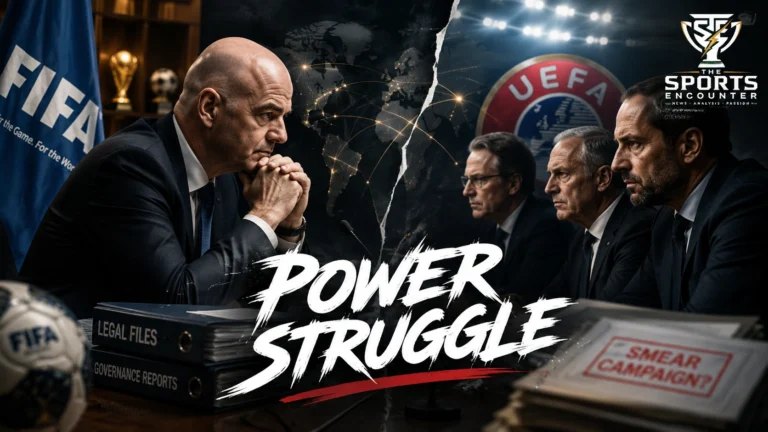
FIFA Accuses UEFA of “Smear Campaign” as Infantino Fight Enters US Courts
FIFA has accused UEFA of using U.S. court proceedings as part of a smear campaign against Gianni Infantino as the fallout from the abandoned FIFA Forward Enterprise plan deepens. The dispute now centers on governance, possible Swiss legal action, FIFA’s 2027 presidential election and who has the authority to shape world soccer’s commercial future.
The battle over Gianni Infantino’s abandoned FIFA Forward Enterprise plan has entered a more dangerous phase.
FIFA is now accusing UEFA of using U.S. court proceedings as part of a “smear campaign” against the organization and its president after European soccer’s governing body sought access to documents and testimony connected to the failed World Cup commercial-rights proposal.
The legal fight matters because the original plan is already dead.
Infantino withdrew FIFA Forward Enterprise, or FFE, on July 31 after a global revolt that included UEFA’s 55 associations, CONCACAF, other confederations, national federations and senior figures inside FIFA itself.
What remains is a fight over how the proposal was conceived, who knew about it, whether FIFA’s governance processes were followed, whether its commercial assets were properly valued, and whether the conduct surrounding the plan could justify legal action in Switzerland.
UEFA has asked U.S. courts for permission to obtain evidence from entities connected to FIFA and the proposed transaction for use in a contemplated Swiss criminal complaint against Infantino and potentially other FIFA officials or advisers.
FIFA has responded aggressively.
In its latest filing, the governing body argues that UEFA’s applications are less about obtaining evidence than damaging FIFA and Infantino politically. FIFA also disputes UEFA’s characterization of the legal situation, arguing that the criminal proceedings referenced by UEFA do not currently exist.
The Sports Encounter has followed this crisis from the moment FIFA’s commercial plan triggered a revolt. Our analysis of why the World Cup stake plan collapsed concluded that the damage would outlive the proposal itself. The latest court fight is the clearest confirmation yet.
FIFA vs UEFA Legal Fight: What Is Happening Now?
| Issue | Current position |
|---|---|
| Original dispute | FIFA Forward Enterprise, a plan to place major FIFA commercial rights into a new subsidiary and sell a minority stake to private investors |
| Status of FFE | Withdrawn by FIFA on July 31, 2026 |
| UEFA’s latest move | Seeking U.S. court-authorized discovery for a contemplated Swiss criminal complaint |
| Potential target | Gianni Infantino and potentially other FIFA officials or advisers |
| UEFA’s concern | How the deal was conceived, valued, structured and approved |
| FIFA’s response | Accuses UEFA of a smear campaign and fishing expedition |
| FIFA’s legal argument | Says UEFA is describing contemplated proceedings as if an existing criminal investigation already exists |
| Political backdrop | Infantino is seeking re-election in March 2027 |
What Exactly Is UEFA Asking U.S. Courts to Do?
UEFA is attempting to use American discovery procedures to obtain documents and testimony that it believes could be relevant to a future criminal complaint in Switzerland.
The requests concern entities and individuals with connections to the proposed FIFA Forward Enterprise transaction.
Earlier filings sought evidence from FIFA-linked entities in the United States and from parties involved in the potential investment structure.
UEFA argues that evidence held in America may help establish how FFE was developed, how the proposed valuation was reached, what advice FIFA received, which officials participated, and whether the appropriate FIFA governance bodies were consulted.
The contemplated Swiss complaint is understood to concern possible criminal mismanagement.
That wording is important.
UEFA has not obtained a criminal conviction, and the latest developments do not establish that Infantino committed a crime. UEFA is gathering material it believes could support a complaint, while FIFA is contesting both the legal basis and the political motivation behind the requests.
Why Is FIFA Calling UEFA’s Court Strategy a “Smear Campaign”?
FIFA’s response goes beyond technical legal objections.
The organization argues that UEFA is using court filings to reinforce a public narrative against Infantino.
According to FIFA’s filing, UEFA’s applications resemble public-relations documents more than neutral efforts to collect evidence.
FIFA also disputes the premise that UEFA is seeking evidence for an existing criminal proceeding.
The distinction is central to FIFA’s defense.
A contemplated complaint is not the same thing as an open criminal prosecution or a formal finding by Swiss authorities.
FIFA therefore argues that UEFA is presenting allegations in a way that risks creating the public impression that criminal wrongdoing has already been established.
This is consistent with FIFA’s broader defense since August.
In an official statement earlier in the crisis, FIFA said there was a “concerted and ongoing effort” to undermine the organization and its president, while insisting that leadership changes must occur through FIFA’s statutes and democratic processes.
Why Does UEFA Believe Further Investigation Is Necessary?
Because UEFA believes withdrawing the proposal did not answer the governance questions that the plan exposed.
The European confederation’s criticism has consistently focused on process as much as economics.
UEFA argues that a project involving FIFA’s most valuable commercial properties was developed without sufficient consultation with the FIFA Council, confederations, national associations and wider stakeholders.
When the plan became public, UEFA’s 55 associations unanimously opposed it.
The Sports Encounter covered that extraordinary vote in our report on UEFA’s 55-0 boycott decision.
UEFA’s official position was unusually blunt.
Its joint statement with all 55 national associations argued that the World Cup should not be treated as an investment product and said Europe would refuse to participate in FIFA competitions while the proposal remained alive.
FIFA eventually withdrew FFE, removing the immediate boycott threat.
UEFA’s position is that cancellation does not remove the need to understand how the plan reached such an advanced stage.
What Was FIFA Forward Enterprise?
FFE was the proposed commercial subsidiary at the center of the conflict.
FIFA wanted to bring together commercial rights and operational activities connected to major competitions, including:
- broadcast rights,
- sponsorship,
- ticketing,
- hospitality,
- licensing,
- new commercial ventures,
- and tournament-related operations.
Private investors could then have acquired a minority stake in the company while FIFA retained majority ownership and sporting control.
The proposed enterprise was discussed at a valuation of approximately $20 billion, with outside investment potentially raising billions in immediate capital.
Infantino argued that the money could transform global soccer development.
FIFA’s official explanation of the proposal said standard FIFA Forward distributions could rise dramatically during the 2027-2030 cycle, helping fund pitches, youth development, women’s soccer and national-team infrastructure.
The economic argument was powerful.
The governance argument proved stronger.
Why Did the FFE Proposal Collapse So Quickly?
The plan failed because opposition spread beyond UEFA before FIFA could build a stable coalition around it.
CONCACAF rejected the proposal, widening the revolt beyond Europe. The Sports Encounter documented that moment in our analysis of CONCACAF’s rejection.
Resistance also moved inside FIFA.
Senior adviser Carlos Cordeiro resigned, while then-chief operating officer Kevin Lamour publicly challenged how the project had been handled.
Our report on the internal revolt examined how criticism from FIFA insiders made it harder for Infantino to portray the dispute simply as a familiar power struggle between Zurich and UEFA.
FIFA withdrew the proposal on July 31.
Infantino’s official statement said the project would not proceed because the level of division had become inconsistent with its stated objective of strengthening football globally.
The withdrawal statement also pledged renewed consultation with FIFA stakeholders.
Why Did Withdrawal Fail to End the Crisis?
Because the dispute had already moved beyond the commercial merits of FFE.
By the time FIFA abandoned the project, critics were asking deeper questions about institutional authority.
Who initiated the proposal?
Which departments evaluated it?
When did the FIFA Council receive the full details?
Who approved the proposed valuation?
How were investors selected?
Why did major confederations claim they had not been adequately consulted?
Why did senior FIFA officials distance themselves from the process?
Those questions survived the withdrawal.
The Sports Encounter’s report on FIFA officials and federations breaking ranks argued that the crisis had changed form. The project was gone, but confidence in how FIFA was being governed had become the real issue.
Why Does FIFA Reject UEFA’s Version of the Governance Story?
FIFA says its proposal was still part of a consultation process and had not reached final approval.
Infantino repeatedly argued that FFE would proceed only if FIFA’s member associations and formal governing bodies ultimately supported it.
FIFA also contends that critics have exaggerated the idea that control of the World Cup itself would have been sold.
Under the proposal, FIFA maintained that it would retain sporting authority and majority control while private investors participated in a commercial subsidiary.
That distinction was always central to FIFA’s argument.
Opponents responded that commercial control and sporting control cannot be completely separated when the value of a company depends on how tournaments are expanded, scheduled, marketed and monetized.
Why Is the $20 Billion Valuation Still Important?
Because valuation is one of the areas UEFA reportedly wants examined.
If FIFA’s commercial assets were worth considerably more than the proposed enterprise valuation, selling a permanent minority stake could have raised questions about whether FIFA was receiving adequate long-term value.
If the valuation was reasonable, FIFA could argue that opponents inflated concerns about a transaction designed to unlock capital for development.
This is why documents from advisers and prospective investors matter.
Valuation is not simply an abstract number.
It determines what percentage of future FIFA commercial income private investors would receive in exchange for their initial capital.
Why Does Joshua Kushner’s Thrive Capital Matter?
Thrive Capital was connected to the proposed investment group through an affiliated vehicle.
The involvement became politically sensitive because Joshua Kushner is the brother of Jared Kushner, a prominent political figure with close connections to the Trump family.
There is no evidence in the material reviewed by The Sports Encounter that Thrive or Joshua Kushner committed wrongdoing.
Kushner has since said his firm underestimated the political complexity surrounding global soccer governance and would not have entered the process had it understood how divisive the transaction would become.
That admission matters because it reinforces the idea that FFE became politically toxic even for investors who believed the underlying economic logic was defensible.
Why Is the Fight Becoming More Personal Between FIFA and UEFA?
The language has changed.
At the beginning, UEFA opposed a commercial proposal.
Then it questioned FIFA’s governance.
Now FIFA is accusing UEFA of deliberately attempting to damage the reputation of Infantino and the institution itself.
That escalation makes reconciliation more difficult.
UEFA’s legal strategy indicates it no longer considers internal FIFA review sufficient.
FIFA’s response indicates it views UEFA’s campaign as politically motivated rather than neutral oversight.
The dispute therefore contains two fundamentally incompatible narratives.
| UEFA’s position | FIFA’s position |
|---|---|
| The proposal exposed potential governance failures requiring independent scrutiny | The project was a consultation-stage development initiative unfairly portrayed as misconduct |
| External evidence gathering is necessary | UEFA is using courts to create political pressure |
| Withdrawal does not answer how the proposal was created | The proposal was withdrawn after stakeholder feedback |
| FIFA cannot credibly investigate itself | FIFA’s democratic institutions and statutes should govern accountability |
| Infantino’s leadership requires deeper examination | Infantino retains a mandate from FIFA’s 211 associations |
How Does This Affect Gianni Infantino’s 2027 Re-Election?
The timing is impossible to separate from the politics.
Infantino has formally announced that he will seek another term when FIFA elects its president in March 2027.
Before the FFE crisis, he appeared to be entering that election from a position of considerable strength.
The 2026 World Cup had delivered enormous commercial success, FIFA revenues were strong and Infantino maintained deep relationships with national federations around the world.
FFE changed the political environment.
European federations withdrew support. Other confederations challenged the project. Senior officials departed. Calls for governance reform grew louder.
The Sports Encounter explored those dynamics in our analysis of the emerging no-confidence movement.
A criminal complaint, even if never converted into charges, would inevitably become part of the election debate.
Can UEFA Remove Infantino Through Political Pressure Alone?
No.
FIFA’s structure gives Infantino an important political defense.
Each of FIFA’s 211 member associations has one vote.
Germany has one vote.
Brazil has one.
Cameroon has one.
Maldives has one.
Commercial power does not translate directly into electoral power.
That is why support from Africa, Asia, the Caribbean and smaller associations remains so important.
Samuel Eto’o recently urged African federations to continue supporting Infantino, arguing that FIFA’s development policies have benefited countries that operate with dramatically fewer resources than Europe’s biggest associations.
The Sports Encounter examined that political divide in our analysis of Infantino’s support among smaller football nations.
Why Is FIFA Development Funding Central to Infantino’s Defense?
Because Infantino’s strongest political argument is that FIFA should redistribute more of global soccer’s commercial value beyond wealthy markets.
FFE was built around that proposition.
Many national federations depend heavily on FIFA funding to build pitches, run youth programs, support women’s teams, improve national training centers and finance international competition.
Infantino’s supporters argue that Europe’s financial power creates a structural imbalance.
They see additional FIFA development money as a way to narrow that gap.
UEFA does not dispute the need for development funding.
The disagreement concerns whether selling a permanent equity interest in FIFA’s commercial structure was an appropriate way to produce it.
Why Are Nordic Federations Taking the Fight Beyond Football?
Finland, Sweden and Denmark have asked for discussions with the European Commission over FIFA governance concerns.
That move matters because it pushes the dispute outside traditional soccer institutions.
The federations have raised issues involving transparency, consultation and decision-making and have referred to the response to the failed European Super League as an example of wider institutional intervention in soccer governance.
If European political institutions begin treating FIFA governance as a regulatory concern rather than an internal sports dispute, the pressure on Zurich could expand significantly.
Could UEFA Still Boycott FIFA Competitions?
The immediate boycott threat has receded because FFE was withdrawn.
UEFA originally said its national teams would refuse to participate in FIFA competitions while the proposal remained active.
Once FIFA abandoned the project, that specific condition disappeared.
However, the underlying confrontation has not been resolved.
A future proposal resembling FFE, an escalation in legal proceedings or another breakdown in consultation could revive discussion of stronger measures.
For now, UEFA appears to be pursuing legal and governance pressure rather than competition withdrawal.
What Happens Next in the U.S. Courts?
The immediate question is whether the judges hearing UEFA’s applications allow the requested discovery.
FIFA is seeking to challenge or delay those efforts.
If discovery is granted, relevant entities could be required to produce documents, communications or testimony connected to the FFE proposal.
That evidence could then influence UEFA’s decision on whether to proceed with a criminal complaint in Switzerland.
If discovery is denied or significantly narrowed, FIFA would gain an important legal victory and could argue that UEFA’s strategy had overreached.
Does a UEFA Criminal Complaint Mean Infantino Would Be Charged?
No.
This distinction should remain clear.
A complaint is an allegation submitted for consideration.
Swiss authorities would still have to assess the material and determine whether any investigation, prosecution or other legal action is justified.
FIFA is emphasizing precisely this gap between allegation and established criminal proceedings.
UEFA believes independent scrutiny is necessary.
Neither position determines what Swiss authorities would ultimately conclude.
Why This Crisis Matters Beyond Infantino and Čeferin
The dispute goes to the heart of who controls soccer’s commercial future.
FIFA owns and administers some of the most valuable sporting competitions on earth.
But their value depends on players developed by clubs, national teams supplied by associations, calendars shared with confederations, stadiums supported by governments, and audiences created over generations.
That makes major commercial restructuring inherently political.
FFE tested how far FIFA could move on its own before the institutions around it demanded a veto.
The answer was clear.
Not very far.
Why FIFA’s “Smear Campaign” Claim Changes the Story
Because FIFA is no longer defending only a failed proposal.
It is defending the legitimacy of its president against an organized political and legal challenge.
That is a much larger fight.
UEFA believes the abandoned transaction exposed governance problems that require external examination.
FIFA believes UEFA is using allegations and court filings to weaken a president it cannot easily defeat through FIFA’s electoral structure.
The Sports Encounter’s earlier analysis of FIFA’s claim that Infantino was being undermined showed that this defense was already developing before the latest legal filing.
Now the accusation has moved into court.
Final Verdict: The World Cup Stake Plan Is Dead, but the Fight Over FIFA’s Power Is Getting Bigger
FIFA Forward Enterprise lasted only days as a public proposal.
Its consequences may last considerably longer.
The original argument concerned whether FIFA should sell a minority interest in a commercial company built around the World Cup and other competitions.
That question has already been answered.
FIFA withdrew the plan.
The new argument is about how the proposal existed in the first place.
UEFA wants documents, testimony and potentially a Swiss legal examination of the process.
FIFA says those efforts are part of a political campaign designed to damage Infantino and weaken his position before the 2027 election.
Both sides now have incentives to keep pushing.
UEFA cannot easily retreat after arguing that FIFA is incapable of investigating itself.
FIFA cannot accept UEFA’s narrative without allowing the abandoned proposal to become evidence against the legitimacy of its own leadership.
That makes compromise increasingly difficult.
The legal outcome remains uncertain. No court has established that Infantino committed criminal wrongdoing, and UEFA’s contemplated complaint should not be confused with a conviction or even a prosecution.
But politically, the damage is already measurable.
A commercial project intended to generate more development money has triggered a boycott threat, confederation revolt, executive departures, demands for governance reform, European political involvement and now litigation in the United States.
The most important question is no longer whether FIFA Forward Enterprise will return.
It is whether the institutions fighting over it can still agree on who has the authority to shape FIFA’s future.
Frequently Asked Questions
Why is FIFA accusing UEFA of a smear campaign?
FIFA says UEFA is using U.S. court applications and allegations surrounding the abandoned FIFA Forward Enterprise proposal to damage FIFA and President Gianni Infantino politically.
Is Gianni Infantino facing criminal charges?
No criminal conviction or formal prosecution has been established. UEFA is seeking evidence for a contemplated criminal complaint in Switzerland, while FIFA disputes UEFA’s characterization of the legal situation.
What is FIFA Forward Enterprise?
FIFA Forward Enterprise was a proposed FIFA-controlled commercial subsidiary that would have consolidated commercial and operational rights linked to major FIFA competitions while allowing private investors to acquire a minority stake.
Why did FIFA withdraw the FFE proposal?
FIFA withdrew the plan on July 31 after widespread opposition from confederations, national associations and FIFA insiders made the proposal politically unsustainable.
Why did UEFA oppose FIFA Forward Enterprise?
UEFA argued that the World Cup should not be treated as an investment asset and objected to what it considered inadequate consultation, governance safeguards and transparency around the proposal.
What is UEFA asking U.S. courts for?
UEFA is seeking permission to obtain documents and testimony from U.S.-based entities connected to FIFA and the proposed FFE transaction for potential use in Switzerland.
Could UEFA still boycott FIFA competitions?
UEFA suspended the immediate boycott threat after FIFA withdrew FFE. The broader dispute over governance and Infantino’s leadership remains unresolved.
Is Gianni Infantino running for FIFA president again?
Yes. Infantino has announced that he intends to seek re-election in 2027.
Why does the 2027 FIFA election matter to this dispute?
The legal and governance controversy is unfolding months before FIFA’s presidential election, making Infantino’s leadership and the support of FIFA’s 211 national associations central to the political battle.
Who decides whether Infantino remains FIFA president?
FIFA’s member associations elect the president. Each eligible association has one vote, regardless of the size or commercial power of its national soccer market.
Breaking News
Aryna Sabalenka Has a Complaint at the US Open
Aryna Sabalenka paused during her third-round US Open match against Kamilla Rakhimova to complain about a strong marijuana smell around Louis Armstrong Stadium. She still won 6-3, 6-4, but the incident raised an unusual question about what tournament organizers can control inside an outdoor New York venue.
NEW YORK, September 4, 2026: Aryna Sabalenka has spent the opening week of the US Open dealing comfortably with opponents, expectations and the pressure of chasing a third consecutive title.
On Friday, something far less conventional briefly interrupted her rhythm.
The world No. 1 complained to the chair umpire about a strong smell of marijuana during her third-round match against Kamilla Rakhimova at Louis Armstrong Stadium, saying the odor was difficult to handle while trying to compete at full concentration.
Sabalenka still won 6-3, 6-4 and moved into the Round of 16, where she will face American Taylor Townsend. The incident did not change the result, but it produced one of the more unusual discussions of the tournament because the US Open operates a smoke-free venue while sitting inside a part of New York where activity outside the grounds cannot always be controlled.
No spectator was identified as smoking inside the tennis center, and nobody was removed over the incident.
The USTA said it remained vigilant in enforcing the smoke-free environment at the Billie Jean King National Tennis Center but acknowledged that it cannot control everything taking place beyond the tournament grounds.
Sabalenka’s complaint therefore leaves the US Open with an awkward problem. The tournament can police behavior inside the gates. Wind, surrounding parkland and activity outside those gates are considerably harder to regulate.
For Sabalenka, the matter was frustrating rather than decisive. She recovered, defeated Rakhimova and continued a title defense that began with a straight-sets victory over Camila Osorio and then accelerated with a dominant second-round performance.
Aryna Sabalenka vs Kamilla Rakhimova: Match at a Glance
| Match Detail | Information |
|---|---|
| Tournament | US Open 2026 |
| Round | Women’s Singles, Round 3 |
| Venue | Louis Armstrong Stadium, New York |
| Result | Aryna Sabalenka beat Kamilla Rakhimova 6-3, 6-4 |
| Sabalenka seed | No. 1 |
| Key interruption | Sabalenka complained about a strong marijuana odor while serving |
| Next opponent | Taylor Townsend |
| US Open objective | Third consecutive women’s singles title |
What Happened During Sabalenka’s Match?
The moment came early.
Sabalenka was serving in the third game when she prepared to begin a point, tossed the ball and then allowed it to drop instead of completing the serve.
She reset and tried again.
The same thing happened.
Something was clearly interfering with her preparation, and Sabalenka eventually walked toward the chair umpire to explain the problem.
She later said the marijuana smell was unusually strong and that she could not determine whether it was coming directly from the crowd or being carried into the stadium by the wind.
Her concern was practical rather than moral.
Sabalenka made clear afterward that what people choose to do away from the court is their own business. Her objection was having the smell reach a professional tennis court while she was trying to serve and compete.
That distinction matters.
This was not a player entering a wider debate about marijuana laws. It was a player asking for the competition environment around her match to remain as controlled as possible.
The US Open Is Officially Smoke-Free
The tournament’s own regulations support Sabalenka’s expectation.
The official US Open Code of Conduct prohibits spectators from smoking, vaping or using electronic smoking devices within the facility.
The tournament’s prohibited-items policy also bars illegal substances from being brought onto the grounds.
The practical difficulty on Friday was enforcement.
Tournament officials did not find a spectator smoking inside the venue. That meant there was nobody to warn or remove.
The USTA’s position was that the tennis center remains smoke-free and that security and guest-services staff will intervene when they become aware of prohibited smoking.
What they cannot guarantee is that air entering the grounds will remain unaffected by activity elsewhere around Flushing Meadows.
The Source of the Smell Was Never Confirmed
That is the most important detail to preserve.
There is no verified evidence that somebody sitting inside Louis Armstrong Stadium was smoking marijuana.
Sabalenka herself did not claim to know the source.
She suggested it could have come from the crowd or from outside because of the wind.
The distinction protects the story from becoming something it is not.
This is a confirmed complaint about an odor.
It is not a confirmed case of a spectator openly smoking courtside.
Why a Smell Can Matter More Than It Sounds
Elite tennis depends heavily on routine.
Players bounce the ball a certain number of times. They regulate breathing. They reset their grip. They control the timing between points and build familiar sequences around serves, returns and changeovers.
Serving is particularly sensitive because the player initiates everything.
Visual movement, crowd noise, unexpected sounds and other sensory distractions can interrupt the sequence before the ball is struck.
Sabalenka’s reaction showed that the odor was strong enough to break that routine twice.
She recovered quickly, but the larger point remains relevant for tournament organizers.
A controlled sporting environment is about more than keeping spectators quiet during serves.
Lighting, sound, movement, temperature, air flow and unexpected distractions all shape how players experience a match.
Sabalenka Still Had to Solve a Much Tougher Tennis Problem
The marijuana episode became the unusual headline, but Rakhimova provided the more persistent challenge.
Sabalenka won the first set 6-3 before being pushed considerably harder in the second.
The second set lasted 54 minutes, which was one minute longer than Sabalenka’s entire second-round match.
That is a useful measure of how much more demanding Friday became.
Sabalenka praised Rakhimova afterward for forcing her to raise her level.
Rakhimova had entered the match after eliminating No. 27 seed Barbora Krejcikova earlier in the tournament and had already shown she was capable of disrupting more established opponents.
Sabalenka handled the challenge without dropping a set.
Her US Open Has Become Progressively More Demanding
Sabalenka arrived in Round 3 after one of the cleanest starts among the leading women.
She defeated Camila Osorio in straight sets to begin her title defense, a performance covered in The Sports Encounter’s opening report on Sabalenka and Carlos Alcaraz.
She then dismantled Polina Iatcenko 6-1, 6-1 in Round 2.
The Sports Encounter’s full first-week US Open analysis noted that Sabalenka had dropped only seven games through her first two matches and appeared to be moving through New York with considerably less physical stress than several other contenders.
Rakhimova changed that pattern slightly.
| Round | Opponent | Result |
|---|---|---|
| Round 1 | Camila Osorio | Won in straight sets |
| Round 2 | Polina Iatcenko | 6-1, 6-1 |
| Round 3 | Kamilla Rakhimova | 6-3, 6-4 |
The third round demanded more problem-solving, more time on court and an unusual interruption.
Sabalenka still left without surrendering a set.
The Complaint Fits an Already Unusual US Open
This tournament has rarely settled into a conventional rhythm.
Rain repeatedly disrupted qualifying and the opening rounds.
First-round matches were still being completed while other players were already reaching Round 3.
Novak Djokovic suffered a major opening-round defeat.
Jannik Sinner withdrew before the tournament because of injury.
Several seeded players departed early.
The full picture was documented in our analysis of the rain, exits and changing title race.
Even when the weather finally became less dominant, New York found another way to remind players that Grand Slam tennis here is rarely sterile.
New York Has Always Been Part of the US Open Experience
The US Open is different from many major tennis events because the tournament has never been isolated from its city.
Aircraft pass overhead.
Trains move nearby.
Crowds are louder than at many other Grand Slams.
Music, food, movement and city noise form part of the atmosphere.
Players who thrive in New York often speak about feeding off that energy rather than trying to remove themselves from it.
That energy has limits.
A player can enjoy a loud stadium and still expect the competition area to respect basic venue rules.
Sabalenka’s complaint sits exactly at that intersection.
This Is Not the First Time a Player Has Raised the Issue
The situation is not entirely new.
Nick Kyrgios and Maria Sakkari have both complained about marijuana odors during previous US Open matches.
Those earlier incidents are relevant because they show that Friday was not a completely isolated occurrence.
The recurring nature of the issue makes the source question harder rather than easier.
If tournament security repeatedly finds no one smoking within the facility, officials have limited options when the odor originates elsewhere.
The USTA can enforce conduct rules within its controlled footprint.
It cannot place a roof over Flushing Meadows.
Sabalenka Eventually Found the Funny Side
Her frustration did not last into the post-match press conference.
Sabalenka later joked about whether spectators might have been trying to slow things down because her matches had been moving too quickly.
The humor was consistent with how she has increasingly handled unexpected moments during the later phase of her career.
Earlier versions of Sabalenka could become visibly frustrated when matches moved outside the expected rhythm.
The current version is far better at separating annoyance from performance.
Friday was another example.
She complained.
The issue was not immediately solved.
She kept playing.
She won.
That Emotional Control Is Part of Why She Is Chasing History
Sabalenka entered New York trying to win a third consecutive US Open women’s singles title.
No woman has achieved that since Serena Williams won three straight championships from 2012 through 2014.
The historical target was one of the central themes in The Sports Encounter’s complete US Open 2026 curtain-raiser.
Her path was also examined after the draw in our analysis of Sabalenka’s route through the women’s bracket.
A third title requires more than superior ball striking.
Grand Slam champions eventually face bad weather, awkward opponents, long matches, hostile crowds, scheduling disruption or moments nobody anticipated.
Friday’s problem happened to involve the air around Louis Armstrong Stadium.
Taylor Townsend Is a Much Bigger Concern Now
Sabalenka can leave the marijuana complaint behind because the tennis challenge immediately becomes more serious.
Taylor Townsend awaits in the Round of 16.
The American defeated No. 15 seed Diana Shnaider 6-2, 6-7(3), 6-3 to reach the fourth round for the second consecutive year.
Townsend entered the tournament playing some of the best serving tennis of her career.
In Round 2, she defeated Taylah Preston 6-1, 6-1 while winning every one of her 23 first-serve points.
The official US Open profile of Townsend’s serving form showed how dangerous she has become in short points.
Sabalenka will therefore move from an unusual environmental distraction into a matchup against a confident left-hander with a strong serve and a home crowd behind her.
Townsend Has Reasons to Believe She Can Make This Difficult
Townsend has already reached the US Open Round of 16 multiple times and has become increasingly comfortable on major New York courts.
She has also developed into one of the world’s best doubles players, giving her superior instincts around the net and more willingness than many modern singles players to shorten points by moving forward.
That creates an interesting stylistic contrast.
Sabalenka will want to control exchanges through first-strike power.
Townsend can change height, direction and court positioning more frequently.
Sabalenka remains the clear favorite.
The matchup is far more complicated than the ranking gap alone suggests.
Sabalenka Has Already Experienced One Unexpected US Open Exit
Her singles campaign has been highly controlled so far, but her New York tournament did include one earlier surprise.
Sabalenka and Novak Djokovic entered the redesigned mixed doubles event as the top seeds and were eliminated by Katerina Siniakova and Henry Patten.
The Sports Encounter’s analysis of that mixed doubles upset showed how specialist movement and partnership instincts overcame superstar singles credentials.
It was another reminder that nothing at this US Open has been entirely straightforward.
Her Cincinnati Exit Also Makes This Run More Interesting
Sabalenka did not arrive in New York carrying perfect form.
Sara Bejlek stunned her 7-6(7), 6-4 in the Cincinnati round of 16, one of the biggest results of the pre-US Open swing.
That defeat is covered in The Sports Encounter’s Cincinnati knockout-round report.
The response in New York has been considerably sharper.
Sabalenka has avoided dropping a set through three rounds and has managed each type of test differently.
Why This Story Matters Beyond the Joke
The marijuana angle naturally attracts attention because it is unusual.
The serious question underneath it concerns competition standards.
Professional tournaments invest heavily in creating consistent playing conditions.
Courts are measured.
Balls are standardized.
Officials enforce time rules.
Security manages crowd behavior.
Players expect distractions that can reasonably be controlled to be controlled.
The difficulty in New York is that an outdoor venue remains connected to its surrounding environment.
The US Open can prohibit smoking.
It can remove people who violate the rule.
It cannot guarantee that every smell reaching an outdoor stadium began inside its security perimeter.
Sabalenka’s complaint exposes that limitation unusually clearly.
The Sports Encounter Verdict
Aryna Sabalenka had a legitimate reason to raise the issue.
The US Open also appears to have enforced the part of the problem it could reasonably control.
No spectator was caught smoking inside the venue, no one was removed, and the tournament maintains an explicit smoke-free policy.
That leaves the hardest part unresolved.
If the odor came from outside the grounds and was carried toward Louis Armstrong Stadium by the wind, there may have been very little tournament officials could do in that moment.
What Sabalenka could control was her response.
She stopped twice.
She spoke to the umpire.
She reset.
Then she beat Rakhimova 6-3, 6-4.
The complaint will generate headlines because of its unusual subject.
The tennis story remains more important.
Sabalenka is into the Round of 16 without dropping a set, her bid for a third consecutive US Open title remains alive, and Taylor Townsend now represents a far more meaningful obstacle than anything drifting through the New York air.
Follow the latest US Open results, player stories and Grand Slam analysis through The Sports Encounter Tennis Hub.
Frequently Asked Questions
What was Aryna Sabalenka’s complaint at the US Open?
Sabalenka complained about a strong smell of marijuana while serving during her third-round match against Kamilla Rakhimova at Louis Armstrong Stadium.
Did marijuana smoke stop Sabalenka’s match?
The match was briefly interrupted while Sabalenka spoke to the chair umpire, but play continued and she completed the match.
Was anyone caught smoking marijuana at the US Open?
No spectator was identified as smoking and nobody was ejected in connection with Sabalenka’s complaint.
Is smoking allowed at the US Open?
No. The US Open Code of Conduct prohibits smoking, vaping and electronic smoking devices within the tournament facility.
Did Aryna Sabalenka beat Kamilla Rakhimova?
Yes. Sabalenka won 6-3, 6-4 to reach the fourth round.
Who does Aryna Sabalenka play next?
Sabalenka faces American Taylor Townsend in the Round of 16.
Has Sabalenka lost a set at the 2026 US Open?
No. Sabalenka has advanced through her first three singles matches without dropping a set.
Is Aryna Sabalenka the defending US Open champion?
Yes. Sabalenka has won the last two US Open women’s singles titles and is attempting to win a third consecutive championship.
When was the last women’s US Open three-peat?
Serena Williams won three consecutive US Open women’s singles titles from 2012 through 2014.
Have other tennis players complained about marijuana smells at the US Open?
Yes. Nick Kyrgios and Maria Sakkari are among players who have raised similar complaints during previous tournaments in New York.
Breaking News
Ipswich Town 0-2 Liverpool: Isak Double Gives Iraola First Win as Gakpo Drives Ruthless Start
Alexander Isak scored twice inside nine minutes and Cody Gakpo assisted both goals as Liverpool beat Ipswich Town 2-0 at Portman Road. The result gave Andoni Iraola his first win as Liverpool manager, while Ronald Araújo made his first start and Bradley Barcola debuted from the bench.
IPSWICH, England, September 4, 2026: Liverpool spent their first two Premier League matches under Andoni Iraola showing enough attacking quality to score twice and enough defensive vulnerability to surrender the same number.
At Portman Road, they finally completed both sides of the job.
Alexander Isak scored twice inside the opening nine minutes, Cody Gakpo created both goals, and Liverpool beat newly promoted Ipswich Town 2-0 to collect their first league victory of the 2026-27 season.
The match was effectively decided before many supporters had settled into their seats.
Isak struck in the sixth minute and again three minutes later, punishing an Ipswich defense that failed to deal with Liverpool’s early movement and the speed of Gakpo’s decisions around the penalty area.
What followed was less spectacular but arguably just as useful for Iraola.
Liverpool controlled the lead, avoided the defensive mistakes that had cost them against Newcastle United and Nottingham Forest, and completed their first clean sheet of the campaign.
Ronald Araújo made his first Liverpool start, Bradley Barcola came off the bench for his debut following his move from Paris Saint-Germain, and Gakpo reinforced his importance at a time when Liverpool’s attacking hierarchy is still being reshaped after Mohamed Salah’s departure.
The Sports Encounter entered the season describing Liverpool as one of the Premier League’s biggest title-race wildcards.
Three matches later, that description still fits.
Liverpool remain a work in progress, but the first win has arrived.
Ipswich Town 0-2 Liverpool: Match at a Glance
| Match Detail | Information |
|---|---|
| Competition | Premier League 2026-27 |
| Matchweek | 3 |
| Venue | Portman Road |
| Date | September 4, 2026 |
| Result | Ipswich Town 0-2 Liverpool |
| Liverpool scorers | Alexander Isak 6′, 9′ |
| Assists | Cody Gakpo, both goals |
| Liverpool manager | Andoni Iraola |
| Major milestone | Iraola’s first competitive win as Liverpool head coach |
| Liverpool record | 1 win, 2 draws from 3 Premier League matches |
| Liverpool points | 5 |
| Ipswich points | 3 |
| Clean sheet | Liverpool’s first of the league season |
The official Premier League fixture list confirms the Matchweek 3 schedule, while Liverpool’s official team announcement confirmed Araújo’s first start and Barcola’s place among the substitutes.
Alexander Isak Needed Nine Minutes to Change Liverpool’s Evening
Liverpool had drawn their opening two league matches 2-2.
That created an unusual early pressure around a club expected to compete for Champions League places and potentially push higher if Iraola could quickly impose his ideas.
The first match at Newcastle had required a stoppage-time Dominik Szoboszlai penalty to rescue a point.
The second, against Nottingham Forest at Anfield, followed a similar pattern. Liverpool twice fell behind before Isak and Victor Muñoz responded to earn another 2-2 draw.
The opening-weekend chaos was documented in The Sports Encounter’s Premier League Matchweek 1 wrap.
Portman Road produced something very different.
Isak gave Liverpool the lead after six minutes.
Three minutes later, he scored again.
Two goals from Liverpool’s £125 million striker had transformed a potentially difficult Friday-night away game into a match the visitors could manage from a position of control.
Cody Gakpo Created Both Goals
Isak supplied the finishing.
Gakpo supplied the openings.
The Dutch international assisted both early goals and became the most important attacking player in Liverpool’s decisive first spell.
His performance carries extra significance because Liverpool’s forward line is undergoing a substantial transformation.
Salah is gone.
Barcola has arrived.
Isak remains the most expensive player in Premier League history.
Florian Wirtz operates behind the attacking line.
Victor Muñoz has begun receiving first-team opportunities.
Gakpo therefore entered the season surrounded by questions about exactly where he would sit within Iraola’s preferred attack.
The answer after three league matches is becoming clearer.
He remains extremely difficult to leave out.
Why Gakpo’s Performance Matters in the Post-Salah Liverpool
Liverpool’s attack used to have an obvious gravitational center.
Salah produced goals at such a consistent rate that many attacking questions eventually returned to the same solution.
His departure for Trabzonspor, covered in The Sports Encounter’s report on the end of his Liverpool career, forced the club to distribute responsibility differently.
Isak offers elite finishing.
Wirtz brings creativity between the lines.
Barcola adds pace and one-on-one threat.
Gakpo provides something slightly different: physical strength, finishing, combination play and enough positional flexibility to connect several versions of the attack.
Iraola had praised him before the match, describing Gakpo as an intelligent player who had trained and performed well despite uncertainty around the transfer market.
Two assists at Ipswich provided the best possible response.
Isak Now Looks Ready to Lead the New Attack
The brace also matters because Liverpool paid an extraordinary price to make Isak their long-term attacking reference.
The Sports Encounter’s analysis of the Premier League’s five most expensive signings placed Isak at the top after his £125 million move from Newcastle.
That fee brings a very specific kind of expectation.
Contribution is insufficient.
Isak is expected to decide games.
He did exactly that here.
His first goal immediately damaged Ipswich’s defensive plan.
The second forced Gary O’Neil’s newly promoted side to chase a match against one of the most talented attacking squads in England.
That is precisely what Liverpool paid for.
Isak Has Already Scored Against Both of Liverpool’s Opening Opponents
His first Liverpool goal of the new league season came against Nottingham Forest.
Now he has added two more at Ipswich.
| 2026-27 Premier League Match | Isak Contribution |
|---|---|
| Newcastle 2-2 Liverpool | Started against former club |
| Liverpool 2-2 Nottingham Forest | 1 goal |
| Ipswich 0-2 Liverpool | 2 goals |
Three goals through Liverpool’s first three league fixtures gives Iraola the reliable central scoring presence he needs while the wider attacking structure continues developing.
Ronald Araújo’s First Start Helped Liverpool Solve a More Urgent Problem
The goals will dominate discussion around Friday night.
The clean sheet may be more important to Liverpool’s coach.
Liverpool had conceded twice against Newcastle.
They conceded twice again against Forest.
Their full-back and central defensive relationships were already becoming one of the first tactical questions of Iraola’s tenure.
Araújo made his first Liverpool start at Portman Road after arriving from Barcelona, replacing Jeremie Frimpong in the only change from the Forest match.
The move itself was examined when The Sports Encounter reported on Araújo’s surprise switch to Liverpool.
His first start coincided with Liverpool’s first clean sheet.
One match does not solve the defensive debate, but it gives Iraola something concrete to work with before the level of opposition increases.
Virgil van Dijk and Liverpool Finally Get a Quiet Second Half
For two league matches, Liverpool’s defenders had been forced into repeated high-pressure situations.
The early Isak double changed that.
Van Dijk, Jérémy Jacquet, Milos Kerkez and Araújo could defend a lead rather than chase a game.
That difference matters tactically.
Iraola’s football asks defenders to operate aggressively when Liverpool push higher.
The danger appears when pressing distances become too large or the first defensive action fails.
Ipswich were never able to exploit those spaces often enough to turn the game.
Alisson therefore completed the clean sheet Liverpool had been missing.
Bradley Barcola Makes His Liverpool Debut
Another major summer signing entered during the second half.
Barcola came off the bench for his first Liverpool appearance following his transfer from Paris Saint-Germain.
The circumstances were ideal for a debut.
Liverpool already led by two.
Ipswich had to move higher.
Barcola could therefore attack space without carrying the responsibility of rescuing the match.
His arrival also creates an intriguing selection question.
Gakpo had just spent the evening producing two assists.
Any expectation that the new signing would automatically displace him now looks far too simplistic.
Iraola may instead have enough quality to rotate different combinations depending on the opponent.
Liverpool’s Summer Spending Is Starting to Appear on the Pitch
English football has just completed another extraordinary transfer window.
The Sports Encounter calculated that Premier League clubs committed approximately £3.46 billion during the summer, a record explored in our analysis of the league’s unprecedented 2026 spending.
Liverpool are part of that financial escalation.
Isak arrived for a British-record £125 million the previous year.
Wirtz cost up to £116.5 million.
Barcola adds another elite attacking investment.
Araújo strengthens the defense.
The club therefore cannot frame this season as a simple transition without expectations.
The squad has been built to return Liverpool to the highest level of English and European competition.
Portman Road was the first night this league season when several pieces looked connected.
Andoni Iraola Finally Has His First Liverpool Victory
Iraola arrived at Anfield after building Bournemouth into one of the Premier League’s most aggressive pressing teams.
The Sports Encounter’s full Premier League season preview identified his appointment as one of the most fascinating managerial changes of the summer.
The tactical fit made sense.
Liverpool have historically been comfortable playing at speed, counter-pressing after turnovers and attacking before opponents reorganize.
The challenge involved control.
The first two draws reinforced exactly that concern.
Friday’s performance offered a better balance.
Liverpool were aggressive when the game demanded aggression.
Once they led 2-0, they did not continue playing as though they were losing.
Liverpool’s Opening Three Matches Show the Evolution
| Match | Result | Main Lesson |
|---|---|---|
| Newcastle United vs Liverpool | 2-2 | Attacking resilience, defensive instability |
| Liverpool vs Nottingham Forest | 2-2 | Again recovered twice, but still vulnerable |
| Ipswich Town vs Liverpool | 0-2 | Early efficiency followed by control and a clean sheet |
The difference is obvious.
Liverpool have scored two goals in every league match.
Until Friday, they had also conceded two in every league match.
The attacking output remained constant.
The defensive outcome changed.
Ipswich’s Match Was Damaged Before Their Plan Could Develop
Gary O’Neil’s side entered the match with some reason for confidence despite their promoted status.
Ipswich had beaten Sunderland 2-1 on opening weekend and followed that by beating Leicester City 3-1 in the Carabao Cup.
Manchester United then exposed them in a 5-2 defeat at Old Trafford.
The larger problem against Liverpool was the timing of the goals.
A promoted team facing a Champions League-level opponent usually needs the opening phase to remain stable.
Ipswich lost that phase almost immediately.
Once Isak scored twice inside nine minutes, the entire tactical assignment changed.
Ipswich’s £200 Million Rebuild Still Needs Time
The Tractor Boys did not approach their return to the Premier League conservatively.
They signed 14 senior players during the summer and invested heavily in an attempt to build a squad capable of surviving immediately.
The Sports Encounter’s investigation into Premier League transfer spending highlighted promoted-club expenditure as one of the defining features of the market.
Ipswich were central to that trend.
Julio Enciso, Abdul Fatawu, Exequiel Palacios, Sasa Lukic, Issa Diop, Daizen Maeda and Chuba Akpom were among a long list of arrivals.
The talent level has clearly increased.
The cohesion still needs work.
Liverpool punished that gap quickly.
Portman Road Remains a Comfortable Premier League Ground for Liverpool
Liverpool’s historical record at Ipswich had already been strong before Friday.
The Reds entered unbeaten across all six previous Premier League trips to Portman Road, winning four and drawing two.
They had also won the previous four Premier League meetings between the clubs while scoring 17 goals and conceding only once.
Liverpool’s official statistical preview highlighted those numbers before kickoff.
The latest result extends the pattern.
The First Win Moves Liverpool Into a More Comfortable Table Position
Liverpool now have five points from three matches.
That return will not satisfy a club with Champions League and title ambitions over an entire season.
It looks considerably healthier than three points from three draws would have.
The bigger benefit is psychological.
Iraola no longer has to answer questions about when his first victory will arrive.
Isak has goals.
Gakpo has influence.
Araújo has a clean sheet from his first start.
Barcola has made his debut.
Those individual developments give Liverpool several positive threads to carry into the next phase.
The Champions League Now Raises the Level Immediately
Liverpool do not have long to enjoy the victory.
Atlético Madrid visit Anfield in the Champions League on September 9.
That fixture will provide a considerably more demanding examination of Iraola’s defensive structure.
Ipswich struggled to create sustained pressure after the early goals.
Atlético will present different problems through game management, physicality and transition attacks.
That makes Friday’s clean sheet useful preparation rather than proof that Liverpool’s defensive problems have disappeared.
Why the Post-Salah Liverpool Is Becoming More Collective
The most encouraging aspect of the opening three matches may be that Liverpool’s goals are already being distributed.
Gakpo scored against Newcastle.
Szoboszlai converted the stoppage-time penalty.
Isak and Muñoz scored against Forest.
Isak scored twice at Ipswich.
That pattern matters because replacing Salah was never going to be about finding one player capable of reproducing 250-plus Liverpool goals.
It required building a different attack.
The financial transformation around the club has also added expectations. The Sports Encounter has followed that wider context through the minority investment that increased Liverpool’s financial flexibility.
The club now has resources, talent and a manager with a clear football identity.
The remaining challenge is turning those ingredients into consistency.
What Comes Next for Liverpool?
The schedule now becomes heavier.
Liverpool host Atlético Madrid in Europe before returning to Premier League action against Fulham.
A Carabao Cup meeting with Tottenham follows soon after.
That means Iraola will have to use the squad rather than rely permanently on one starting XI.
Barcola’s arrival helps.
Araújo’s integration helps.
Gakpo’s form makes selection more difficult in a productive way.
Isak’s goals provide the most important reassurance of all.
What Comes Next for Ipswich?
Ipswich remain on three points from their opening three league fixtures.
That is hardly disastrous for a promoted team that has already faced Manchester United and Liverpool.
The concern is defensive.
They have now conceded seven goals across those two matches.
O’Neil’s job is to ensure the heavy summer recruitment produces greater collective organization before defeats against elite opponents begin affecting performances in more winnable fixtures.
The Sports Encounter Verdict
Liverpool did not need a spectacular 90-minute performance at Portman Road.
They needed a win that looked more controlled than the opening two matches.
Isak provided the decisive advantage almost immediately.
Gakpo created both goals.
Araújo helped stabilize the defensive structure on his first start.
Barcola took his first Liverpool minutes from the bench.
Alisson kept the clean sheet.
The final 81 minutes contained fewer dramatic moments than Liverpool’s opening two league games.
Iraola will probably consider that progress.
The first two matches showed Liverpool could recover from problems.
Ipswich showed they could avoid creating so many of them.
That distinction matters as the Champions League begins and stronger opponents arrive.
The Premier League season is still only three matches old, and Liverpool remain far from a finished project.
Friday night provided the first clear view of what Iraola wants that project to become.
Fast enough to punish mistakes.
Controlled enough to protect the damage afterward.
For continuing Premier League, Champions League and international football coverage, visit The Sports Encounter Soccer Hub.
Frequently Asked Questions
What was the Ipswich Town vs Liverpool score?
Liverpool defeated Ipswich Town 2-0 at Portman Road in Premier League Matchweek 3.
Who scored Liverpool’s goals against Ipswich?
Alexander Isak scored both Liverpool goals, striking in the sixth and ninth minutes.
Who assisted Alexander Isak’s goals?
Cody Gakpo provided the assist for both of Isak’s goals.
Was this Andoni Iraola’s first Liverpool win?
Yes. Liverpool had drawn their opening two Premier League matches 2-2 against Newcastle United and Nottingham Forest before beating Ipswich.
How many points do Liverpool have after three games?
Liverpool have five points from three Premier League matches following one win and two draws.
Did Ronald Araújo start against Ipswich?
Yes. Araújo made his first Liverpool start and was the only change from the side that began against Nottingham Forest.
Did Bradley Barcola make his Liverpool debut?
Yes. Barcola came off the bench during the second half for his first Liverpool appearance after joining from Paris Saint-Germain.
Was this Liverpool’s first clean sheet of the season?
Yes. Liverpool had conceded twice in each of their opening two Premier League matches before keeping Ipswich scoreless.
How many points do Ipswich have?
Ipswich remain on three points after opening with a victory over Sunderland before defeats against Manchester United and Liverpool.
Who do Liverpool play next?
Liverpool host Atlético Madrid in the UEFA Champions League on September 9 before facing Fulham in their next Premier League match.
Breaking News
Genoa 1-4 Como: Diao Brace and Nico Paz Push Fàbregas’ Unbeaten Side Into Early Serie A Spotlight
Como continued their unbeaten Serie A start with a 4-1 win at Genoa. Assane Diao scored twice, while Martin Baturina and Nico Paz also found the net as Cesc Fàbregas’ side moved to seven points from three away matches before their Champions League campaign begins.
GENOA, Italy, September 4, 2026: Como arrived at the Luigi Ferraris carrying one of the more intriguing questions of the new Serie A season.
Was last year’s fourth-place finish and Champions League qualification the peak of a remarkable rise, or the beginning of something more durable?
Three league matches into 2026-27, Cesc Fàbregas’ side are beginning to supply a convincing answer.
Como beat Genoa 4-1 on Friday night, with Martin Baturina, Assane Diao and Nico Paz turning a difficult opening into another statement result. Diao scored twice, while Baturina and Paz added one each as Como recovered from conceding first and then overwhelmed Daniele De Rossi’s side.
Milutin Osmajic gave Genoa the lead in the 19th minute, but Como responded almost immediately. Baturina equalized in the 25th, Diao made it 2-1 five minutes later, and Paz stretched the advantage to 3-1 before halftime. Diao completed the scoring in the 78th minute.
The result takes Como to seven points from three Serie A matches after an opening draw at Udinese and a 2-1 victory away to Napoli.
Genoa remain on zero after three rounds.
The gap between the teams is becoming about more than one scoreline.
Como are learning how to turn difficult away matches into points. Genoa are learning that competitive periods mean very little when every mistake becomes expensive.
The Sports Encounter’s complete Serie A 2026-27 preview identified Como as one of the most dangerous teams outside the traditional title group because Fàbregas had retained Nico Paz while strengthening a squad preparing for Champions League football.
The first three matches have strengthened that argument.
Genoa 1-4 Como: Match at a Glance
| Match Detail | Information |
|---|---|
| Competition | Serie A 2026-27 |
| Matchday | 3 |
| Venue | Stadio Luigi Ferraris, Genoa |
| Date | September 4, 2026 |
| Result | Genoa 1-4 Como |
| Genoa scorer | Milutin Osmajic 19′ |
| Como scorers | Martin Baturina 25′, Assane Diao 30′, Nico Paz 40′, Assane Diao 78′ |
| Como league record | Played 3, Won 2, Drawn 1 |
| Como points | 7 |
| Genoa league record | Played 3, Lost 3 |
| Genoa points | 0 |
The official Lega Serie A website provides the full Matchday 3 schedule, standings and competition information.
Genoa Strike First Through Milutin Osmajic
The opening 20 minutes suggested that Genoa might finally be ready to turn competitive football into a league result.
De Rossi’s side entered the match without a Serie A point and without a league goal through their opening two fixtures.
They had lost 2-0 at home to Napoli and then 1-0 away to Lazio.
That made Osmajic’s 19th-minute goal important for more than the score.
It was Genoa’s first league goal of the season and briefly gave the home crowd something the team had struggled to create in August: a game state they could protect rather than chase.
The problem was how little time Genoa enjoyed that advantage.
Martin Baturina Answers Within Six Minutes
Baturina equalized in the 25th minute.
The Croatian midfielder had already scored in Como’s 2-1 win at Napoli during Matchday 2, and his latest contribution reinforced a useful early pattern.
Como are receiving goals from several areas rather than relying entirely on one forward.
Baturina’s arrival into advanced positions creates another problem for opponents already occupied by Paz, Diao and Tasos Douvikas.
His equalizer also prevented Genoa from settling into a deeper structure around the lead.
Six minutes after the home breakthrough, the match was level again.
Assane Diao Turns the Game Completely
Diao required another five minutes to change the lead.
His first goal arrived in the 30th minute and put Como 2-1 ahead.
The timing was devastating for Genoa because the hosts moved from their first league lead of the season to trailing inside 11 minutes.
Diao’s contribution also underlined why Como’s attacking depth looks stronger than it did during the early stages of their rise.
Fàbregas can now move between different attacking profiles without changing the central idea of his football.
Diao offers direct running and acceleration.
Paz can operate between midfield and defense.
Baturina gives another player capable of progressing the ball and arriving around the box.
Douvikas occupies central defenders and provides a more traditional finishing reference.
That variety becomes difficult to manage once Como establish rhythm.
Nico Paz Makes It 3-1 Before Halftime
Paz scored Como’s third in the 40th minute.
By halftime, the match had moved completely away from Genoa.
The Argentine remains the creative reference point of Fàbregas’ project and was one of the central players highlighted in The Sports Encounter’s early Serie A title-race analysis.
Keeping Paz during the summer may prove as important as any transfer Como completed.
Last season he repeatedly helped the team connect midfield possession with attacking movement. The challenge this year is sustaining that influence while opponents prepare more specifically for him.
Genoa knew what he could do.
They still could not prevent him from scoring.
Como’s First-Half Response Was the Most Impressive Part of the Night
The final score creates the impression that Como controlled the entire match.
The more useful detail is how they responded after falling behind.
| Minute | Event | Score |
|---|---|---|
| 19′ | Milutin Osmajic scores for Genoa | 1-0 |
| 25′ | Martin Baturina equalizes | 1-1 |
| 30′ | Assane Diao puts Como ahead | 1-2 |
| 40′ | Nico Paz adds the third | 1-3 |
| 78′ | Assane Diao scores again | 1-4 |
Como scored three times in 15 minutes after the equalizer.
That is the type of response that separates a team capable of competing around the European places from one still dependent on game momentum.
They did not spend 20 minutes reacting emotionally to conceding.
They accelerated.
Assane Diao Completes the Statement in the 78th Minute
Diao’s second goal arrived in the 78th minute.
By then the result was already heavily tilted toward Como, but the fourth goal mattered because it removed any possibility of a late Genoa recovery.
It also gave Diao a brace in a match where his movement repeatedly stretched the home defense.
That kind of production is particularly useful before Como’s European schedule begins.
Champions League football will force Fàbregas to rotate his attacking players.
A team entering Europe for the first time cannot depend entirely on one combination.
Diao’s performance gives Como another reason to believe their squad is becoming deep enough to survive both competitions.
Como Have Taken Seven Points From Three Away Matches
Perhaps the most remarkable part of Como’s opening month is that all three league fixtures have been away from home.
| Como Match | Result | Points |
|---|---|---|
| Udinese vs Como | 1-1 | 1 |
| Napoli vs Como | 1-2 | 3 |
| Genoa vs Como | 1-4 | 3 |
| Total | Unbeaten | 7 |
The opening-weekend draw at Udinese was already treated positively in The Sports Encounter’s Serie A Matchday 1 wrap.
Como then produced the bigger result at Napoli.
The official club report confirmed that Baturina opened the scoring before Douvikas restored the lead in the 35th minute to complete a 2-1 victory at the Stadio Diego Armando Maradona.
That win made the trip to Genoa interesting.
Friday’s result makes the pattern harder to ignore.
Seven Points From Udine, Naples and Genoa Changes the Conversation
Como entered the campaign with Champions League football creating the biggest uncertainty around their domestic prospects.
The question was never whether the first XI contained enough quality.
Last season had already answered that.
Fàbregas took Como to fourth place with 71 points, 65 goals scored and only 29 conceded.
The Sports Encounter’s season curtain raiser argued that Europe would test the club’s depth more than its tactical identity.
Seven points from three away games give Como an excellent platform before that extra workload begins.
Champions League Football Arrives Next Week
Como’s attention now shifts toward a new chapter in club history.
Their Champions League league-phase campaign begins against RB Leipzig on September 10.
The official Como Champions League ticket announcement confirms that the club is preparing for four home league-phase nights.
The timing gives Friday’s win additional value.
Como can enter Europe with domestic momentum rather than spending the opening weeks trying to repair their Serie A position.
Fàbregas Has Built a Team That No Longer Looks Surprised by Success
Last season, Como’s rise could still be discussed as an extraordinary story.
That framing is becoming outdated.
They finished fourth.
They qualified for the Champions League.
They retained key players.
They have now started the new season unbeaten.
The tactical structure also looks established enough that Como do not need ideal game states to perform.
They drew after going behind at Udinese.
They beat Napoli away.
They went behind against Genoa and scored four.
Those are three different challenges.
Como found a solution to each.
Nico Paz, Baturina and Diao Are Giving Como a Dangerous Three-Line Attack
The attacking structure is becoming one of the most interesting elements of Serie A’s opening weeks.
Baturina has already scored in consecutive league matches.
Paz remains the creative center.
Diao has now produced a two-goal performance.
Douvikas has already scored twice this season and remains a central reference.
This matters because successful possession teams sometimes become predictable when all progression flows through one player.
Como appear less vulnerable to that problem.
Paz can still dictate.
He no longer has to dictate everything.
Genoa’s Situation Is Becoming Serious Earlier Than Expected
For Genoa, the result creates a very different early-season picture.
Three matches.
Three defeats.
The first two came without scoring.
The third produced a first league goal but also four conceded.
De Rossi’s project was one of the managerial stories highlighted in The Sports Encounter’s Serie A preview.
There was reason for optimism because Genoa had enough technical and midfield quality to occupy the competitive middle of the division.
The opening results have placed that optimism under immediate pressure.
Genoa Have Now Lost Twice at Home
The home results are particularly damaging.
Napoli won 2-0 at the Luigi Ferraris on Matchday 1.
Como have now won 4-1 there.
That means Genoa have conceded six goals across two home league fixtures while collecting nothing.
A mid-table side can survive difficult away results.
Repeated home defeats create a much harder season.
Genoa now need their next stretch to establish a reliable base quickly.
Osmajic’s Goal Is One of the Few Immediate Positives
Osmajic at least ended Genoa’s scoring drought.
The importance of that goal should not disappear completely because of what followed.
Genoa had failed to score against Napoli and Lazio.
Breaking that sequence can help attacking confidence.
The concern is what happened after the goal.
A team fighting for its first points cannot concede three times before halftime after moving ahead at home.
That is where De Rossi’s biggest work lies.
Como Are Quietly Becoming Part of the Upper-Serie A Conversation
The early title conversation has understandably centered on Inter, Roma, Milan, Juventus and the other traditional powers.
Roma have been particularly impressive, opening with two four-goal victories. The Sports Encounter’s analysis of Roma’s 4-0 win at Lecce showed how quickly Gasperini’s second-season structure has developed.
Atalanta have also remained perfect, including a dramatic 96th-minute victory over Bologna.
Como now belong in the next layer of that discussion.
Seven points from three away fixtures is too substantial to dismiss as an easy opening schedule.
Napoli and Genoa away are exactly the kinds of matches teams competing around the Champions League places need to survive.
Como have won both.
The Early Serie A Table Is Becoming More Interesting
Matchday 3 has only just started, so the table will continue changing throughout the weekend.
Como have nevertheless already done enough to put pressure on the clubs playing after them.
Seven points means Fàbregas’ team remain unbeaten and can watch the weekend’s major fixtures from a strong position.
Inter face Napoli.
Juventus meet Milan.
Roma host Atalanta.
Several teams near the top therefore have to take points directly from one another.
Como have already banked theirs.
Why This Matters Before Inter, Napoli and Juventus-Milan
Friday’s fixture was the opening match of a fascinating Serie A weekend.
The official Matchday 3 schedule includes Inter-Napoli, Roma-Atalanta and Juventus-Milan.
Those fixtures guarantee dropped points among leading clubs.
Como’s victory therefore has table implications beyond Genoa.
A seven-point start gives them enough early security to treat Champions League football as an opportunity rather than an immediate threat to domestic survival.
Como’s Rise Is Becoming One of Serie A’s Most Important Structural Stories
The broader significance goes beyond three matches.
Serie A has spent several years asking whether clubs outside the traditional powers can build something sustainable.
Atalanta provided one model.
Bologna produced another.
Como are creating their own.
The project combines strong investment with a clear coaching identity, young attacking talent and a willingness to recruit players capable of developing rather than simply arriving with reputation.
Fàbregas is central to that structure.
The club is no longer succeeding because opponents underestimate it.
Everyone knows what Como are capable of.
They are still winning.
The Sports Encounter Verdict
Como’s 4-1 victory at Genoa matters because of the pattern around it.
They drew at Udinese.
They won at Napoli.
They have now won at Genoa.
Every one of their opening league matches has been away from home.
They remain unbeaten.
Friday’s match also showed another step in their development.
Genoa scored first.
Como did not lose structure.
Baturina equalized.
Diao changed the lead.
Paz created separation.
Diao finished the job.
That sequence looked like a team accustomed to solving problems rather than hoping momentum solves them.
Champions League football will create a much harder workload beginning next week.
The question around Como is therefore still alive.
Can this squad maintain its domestic standard while entering Europe for the first time?
Seven points from three away games gives Fàbregas an excellent place to begin finding out.
For continuing Serie A, Champions League and global football coverage, visit The Sports Encounter Soccer Hub.
Frequently Asked Questions
What was the Genoa vs Como score?
Como defeated Genoa 4-1 at the Stadio Luigi Ferraris in Serie A Matchday 3.
Who scored for Como against Genoa?
Martin Baturina, Assane Diao and Nico Paz scored for Como. Diao scored twice.
Who scored Genoa’s goal?
Milutin Osmajic gave Genoa the lead in the 19th minute.
When did Assane Diao score?
Diao scored in the 30th and 78th minutes.
How many points do Como have after three matches?
Como have seven points from three matches after two wins and one draw.
Are Como unbeaten in Serie A?
Yes. Como opened with a 1-1 draw at Udinese before beating Napoli 2-1 and Genoa 4-1.
How many points do Genoa have?
Genoa remain without a point after losing their opening three league matches.
Who scored Como’s third goal?
Nico Paz scored in the 40th minute to give Como a 3-1 lead before halftime.
Who do Como play next in Europe?
Como begin their UEFA Champions League league-phase campaign against RB Leipzig on September 10, 2026.
How did Como perform last season?
Como finished fourth in Serie A in 2025-26 and qualified for the UEFA Champions League.
-
Editor's Choice4 weeks agoPremier League 2026–27 Curtain Raiser: Fixtures, Teams, Title Contenders, Transfers and Season Predictions
-
Editor's Choice4 weeks agoWhen Will Lionel Messi Retire? Argentina President Says Only Messi Has the Answer
-
Editor's Choice4 weeks agoWhich of Last Season’s Premier League Top 10 Can Actually Win the 2026-27 Title?