Connect with us
Ruben Santos | The Sports Encounter

Published

on

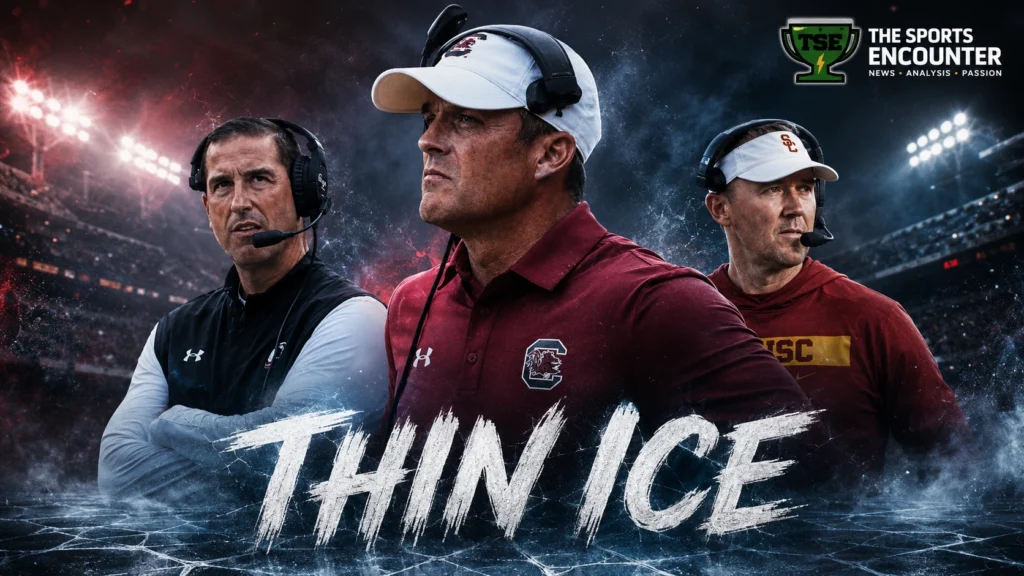
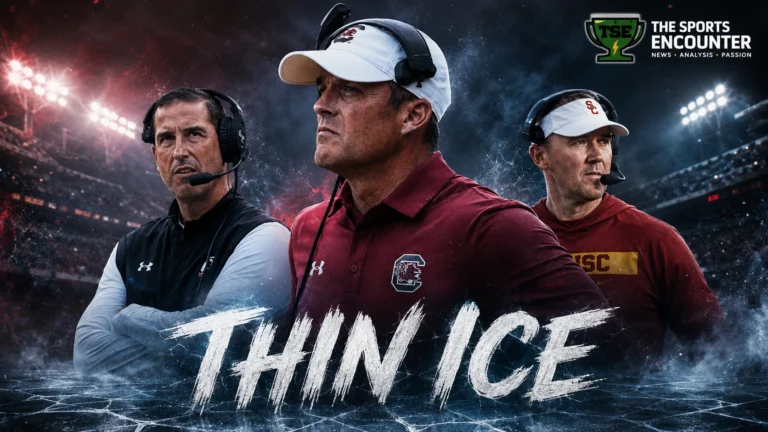
The 2026 college football season has barely begun, yet several high-profile coaches are already working under conditions where an ordinary losing streak could become a career-changing event.

Shane Beamer enters his sixth season at South Carolina after a 4-8 collapse. Luke Fickell survived another losing year at Wisconsin and now opens against Notre Dame at Lambeau Field. Lincoln Riley has already won USC’s first game, but the standard attached to his salary, recruiting reach and program resources remains considerably higher than merely producing winning seasons.

Mike Norvell at Florida State, Bill Belichick at North Carolina and Deion Sanders at Colorado add three more very different examples of coaching pressure.

The temptation is to place all of them on one generic “hot seat” list.

That misses what makes the 2026 coaching market interesting.

These coaches are under pressure for different reasons. Their schools expect different things. Their schedules offer different escape routes. Their previous achievements buy different amounts of patience.

College football’s modern coaching economy has also shortened the time available to prove that a program is moving somewhere useful. Transfer portal movement accelerates roster turnover. NIL resources make talent acquisition more immediate. Conference realignment has altered schedules. The expanded College Football Playoff has raised expectations at programs that believe national relevance should now be easier to reach.

A coach can therefore have a respectable résumé and still reach September knowing that seven or eight wins may no longer settle the argument.

By The Sports Encounter Editorial Desk
Published: September 2, 2026
Updated: September 2, 2026

College Football Coaches Under Pressure in 2026

Coach School Recent Position Main Pressure Point Early 2026 Test
Mike Norvell Florida State 2-10 in 2024, 5-7 in 2025 Collapse after 13-win season SMU, Alabama, Louisville, Miami stretch
Shane Beamer South Carolina 4-8 in 2025, 1-7 SEC Need to prove 2025 was a setback rather than direction of travel Alabama followed later by Tennessee, Oklahoma and Texas A&M
Luke Fickell Wisconsin 4-8 in 2025 Program identity and offensive decline Notre Dame at Lambeau Field
Bill Belichick North Carolina 4-8 in first season Proving NFL greatness translates to college program building Early road test at Clemson
Lincoln Riley USC 9-4 in 2025, 1-0 in 2026 Playoff-level expectations and resource advantage Oregon, Penn State, Wisconsin, Ohio State
Deion Sanders Colorado 3-9 in 2025 Rebuilding momentum after major regression Early Big 12 schedule

The important distinction is that “hot seat” does not mean every coach listed above is equally likely to be fired.

It means the 2026 season can materially change how the administration, boosters, players and supporters evaluate the direction of the program.

Shane Beamer Has Reached the Hardest Stage of a Rebuild

South Carolina presents one of the most interesting cases because Beamer has already shown that he can elevate the program.

The problem is proving that elevation can be sustained.

Beamer enters his sixth season with a 33-30 record. South Carolina’s official coaching biography notes that he has produced three wins over top-10 opponents and seven against top-25 teams during his first five seasons, along with three bowl appearances.

Those achievements matter because South Carolina is not operating with the same historical baseline as Alabama, Georgia or LSU.

The program plays inside the SEC, where a competitive team can improve considerably and still lose four or five games because the schedule offers so few soft landings.

That context also cannot excuse everything.

South Carolina finished 4-8 last season and went 1-7 in SEC play.

The school’s own profile of Beamer acknowledges that fourth-quarter problems contributed heavily to the 2025 record.

That changes the 2026 evaluation.

If South Carolina had been comprehensively outclassed every week, the issue would be straightforward talent deficiency. Losing competitive games late creates a different question about game management, roster depth, conditioning, execution and the ability to close.

Those problems fall closer to coaching responsibility.

South Carolina’s Schedule Gives Beamer a Chance to Build Momentum

The opening three weeks offer something Beamer desperately needs: room to establish confidence before the SEC schedule becomes severe.

South Carolina opens at home against Kent State, hosts Towson and then begins conference play against Mississippi State.

That gives the Gamecocks a plausible pathway to 3-0.

The next section will tell us much more.

The official South Carolina schedule sends the Gamecocks to Alabama on September 26. October eventually brings Tennessee at home and Oklahoma away, followed by Texas A&M in early November and Georgia later that month.

A good September could therefore stabilize the program.

A poor September would make the second half of the schedule extremely uncomfortable.

This is the central challenge for coaches entering a season under pressure.

They rarely receive the luxury of slowly discovering what their team is.

The first month can determine how every later result is interpreted.

Beamer’s Job Is to Restore Belief Before the Difficult Games Arrive

South Carolina does not need to become an SEC championship favorite overnight.

It needs to look like a team moving forward again.

That means avoiding games in which late execution repeatedly wastes three quarters of competitive football.

It means developing enough offensive consistency to prevent the defense from spending entire afternoons protecting narrow margins.

It also means making Williams-Brice Stadium difficult again when Tennessee, Texas A&M and Georgia arrive.

The modern college environment places enormous value on perception.

Players considering the transfer portal watch how programs are trending. Recruits see whether stadiums are full and whether coaches appear secure. Donors judge whether their investment is producing progress.

Momentum therefore becomes partly self-reinforcing.

That principle appears throughout American football. The Sports Encounter’s coverage of Fernando Mendoza, Drew Allar and other young quarterbacks entering the NFL shows how rapidly college performance can shape the next level. Programs need to convince elite players they can develop that same pathway.

Luke Fickell Faces a More Fundamental Question at Wisconsin

Wisconsin’s situation feels different.

The argument is no longer simply about whether Luke Fickell can improve the Badgers’ record.

It is about what Wisconsin football is supposed to be under him.

Fickell arrived with one of the strongest coaching reputations in the country after turning Cincinnati into a College Football Playoff program.

Wisconsin appeared to have found an ideal modernizer.

The results have not followed smoothly.

The Badgers went 5-7 in 2024 and 4-8 in 2025.

Wisconsin’s official biography of Fickell notes that last year’s team played seven ranked opponents and ten eventual bowl-eligible programs. Injuries also created major quarterback instability, with four quarterbacks used during the season.

Those are legitimate mitigating factors.

They do not erase 4-8.

The Badgers also struggled badly to score consistently, which matters at a program historically built on knowing exactly what kind of football it wanted to play.

Wisconsin’s Identity Crisis Matters as Much as the Record

Wisconsin spent decades establishing one of the clearest identities in major college football.

Powerful offensive lines. Productive running backs. Physical defense. Tight games. Player development. A roster that frequently produced more than recruiting rankings predicted.

Modernization was necessary because the Big Ten changed.

USC, UCLA, Oregon and Washington expanded the conference’s geographic and stylistic range. Ohio State and other elite programs continued recruiting at national-title levels. Passing offenses became increasingly sophisticated.

Wisconsin had to evolve.

The problem appears when evolution removes the old strengths before the new ones become reliable.

That is where Fickell’s tenure currently sits.

The university hired him to raise Wisconsin’s ceiling.

The immediate concern is whether the program has lowered its floor.

The distinction is why the 2026 season carries so much weight.

Notre Dame at Lambeau Is an Uncomfortable Opening Test

Wisconsin begins its season against Notre Dame on September 6 at Lambeau Field.

The Badgers officially confirmed the primetime opener, giving Fickell a major national stage before his team has had time to establish rhythm against lesser opposition.

That could work both ways.

Beat Notre Dame and much of the conversation changes immediately.

Wisconsin would suddenly possess a signature victory, national momentum and evidence that offseason adjustments worked.

Lose competitively and the season remains intact.

Lose badly, particularly if familiar offensive problems return, and every subsequent game becomes part of a referendum.

Pressure is rarely created by a single defeat.

The damaging losses are the ones that confirm an existing suspicion.

Fickell Cannot Depend on Schedule Difficulty Forever

There is another reason 2026 feels decisive.

Wisconsin’s Big Ten slate avoids Indiana, Ohio State, Oregon and Michigan.

That removes several of the conference’s most dangerous opponents.

Schedule arguments therefore become less persuasive if the record remains poor.

Fickell deserves credit for the circumstances Wisconsin faced in 2025. Seven ranked opponents and major quarterback injuries would test almost any team.

This season provides a cleaner evaluation.

The Badgers do not need perfection.

They need evidence of a functioning program.

Player development matters here as well. Former Wisconsin players continue to populate professional rosters, and The Sports Encounter recently examined the career consequences of that pipeline through Matt Henningsen’s brutal second Achilles injury during Denver Broncos camp.

Programs such as Wisconsin have historically sold recruits on development as much as five-star glamour.

That proposition becomes harder to maintain when the college team stops winning.

Lincoln Riley’s Hot Seat Is About Expectations Rather Than Collapse

USC requires a completely different standard.

Riley is not coming off a 4-8 season.

His Trojans went 9-4 in 2025 and 7-2 in Big Ten play.

USC’s official biography notes that the Trojans finished fifth nationally in third-down conversion rate, fifth nationally in passing offense and eighth in total offense last season.

Those are strong numbers.

They also demonstrate why Riley’s pressure is unusual.

USC did not hire him to build a consistently respectable nine-win program.

He arrived in Los Angeles with a résumé built around conference championships, Heisman-caliber quarterbacks and College Football Playoff appearances at Oklahoma.

The expectation was that USC would become nationally elite again.

That has not happened consistently enough.

USC’s Opening Win Was Good Enough to Reveal Both Sides of the Riley Debate

USC opened 2026 by defeating San Jose State 42-26.

Quarterback Jayden Maiava completed 25 of 29 passes for 286 yards and two touchdowns while also rushing for a score.

USC generated 505 total yards, converted nine of 13 third downs and led 35-3 after three quarters.

The official USC match report described a strong debut for several new playmakers.

Then San Jose State scored 23 points in the fourth quarter.

Many of those late points came against backups, so treating the final margin as evidence of a defensive collapse would overstate the concern.

It still created a familiar kind of discomfort around Riley’s USC teams.

The offense looks dangerous.

The real question is whether the entire team can remain dependable once Big Ten games become physical, close and strategically uncomfortable.

Jayden Maiava Gives Riley Something Every Coach on the Hot Seat Wants

A reliable quarterback can change the temperature around an entire program.

Maiava entered 2026 after leading the Big Ten with 3,711 passing yards last season and posting a 91.2 QBR, according to USC.

He looked extremely comfortable in the opener.

That matters because coaching pressure frequently accelerates when quarterback instability makes every other problem more difficult to diagnose.

Wisconsin experienced exactly that in 2025.

USC begins this season from the opposite position.

Riley has an experienced quarterback operating within a system widely associated with quarterback production.

That removes one excuse.

It also creates opportunity.

The NFL continues to reward elite college quarterback development enormously. The Sports Encounter followed that pathway during preseason through Fernando Mendoza’s first NFL touchdown and Drew Allar’s strong Pittsburgh performance.

If Maiava performs at a similar trajectory, USC should possess enough offense to challenge the conference’s elite.

USC’s Schedule Will Decide Whether Nine Wins Are Enough

The upcoming schedule explains why Riley remains under scrutiny despite respectable recent results.

USC hosts Fresno State and Louisiana before traveling to Rutgers.

Then the season becomes considerably harder.

The official USC schedule includes Oregon, Washington and Ohio State at the Coliseum, plus road trips to Penn State, Wisconsin, Indiana and UCLA.

There is opportunity in that difficulty.

Riley does not need voters or administrators to imagine that USC is moving toward national contention.

The schedule gives him chances to prove it.

Beat Oregon.

Win at Penn State.

Defeat Ohio State.

Those results would instantly change the narrative surrounding his tenure.

Another season built primarily on victories over teams USC is expected to beat would leave the central question unresolved.

USC Also Has a Fan-Engagement Problem Worth Watching

The opener drew 51,144 spectators at the Los Angeles Memorial Coliseum, USC’s smallest home attendance since Riley took over in 2022.

Extreme heat clearly contributed. Temperatures were above 90 degrees, the heat index exceeded 100, and the university took additional cooling measures.

That context is important.

Attendance still matters.

Major college programs sell belief as much as football.

A packed stadium tells recruits, players and television viewers that the program feels important.

Empty sections create the opposite impression, even when practical circumstances help explain them.

USC possesses one of American college sports’ strongest brands.

Riley’s challenge is to make Saturday at the Coliseum feel nationally consequential again.

Mike Norvell May Have the Most Dangerous Hot Seat of All

If the three headline coaches represent different kinds of pressure, Mike Norvell represents the fastest fall.

Florida State went 13-1 in 2023.

That team was controversially left outside the four-team College Football Playoff after quarterback Jordan Travis was injured.

The program then collapsed to 2-10 in 2024.

Last season brought a 5-7 finish.

Norvell opened 2026 with a 34-17 victory over New Mexico State, but the schedule quickly becomes revealing.

SMU and Alabama arrive later in September.

Louisville and Miami come consecutively in October.

This is where recent achievement collides with recent trajectory.

A coach who produced a 13-win season has demonstrated that he can build an excellent football team.

Two subsequent losing seasons can still destroy institutional confidence.

Bill Belichick Is Being Judged Against His Name as Much as His Record

North Carolina presents perhaps the strangest case.

Belichick’s six Super Bowl championships do not automatically solve the problems of recruiting, NIL management, transfer portal retention, booster relationships and college roster development.

His first season ended 4-8.

North Carolina then opened 2026 with an uninspiring 15-10 victory over TCU in Ireland.

Belichick deserves time to develop a college program because the job is substantially different from managing an NFL roster.

His age complicates the timeline.

At 74, the argument cannot simply be that a five-year reconstruction will eventually mature.

North Carolina needs evidence that the model can work soon enough to justify the unusual project.

The widening connection between college and professional football is one reason this experiment remains fascinating. TSE has covered that bridge extensively through stories such as Jeremiyah Love’s transition from Notre Dame star to Arizona Cardinals top-three draft pick and Jordyn Tyson’s move from Arizona State to the New Orleans Saints.

Belichick is attempting to operate on the other side of that pipeline.

Deion Sanders Needs to Recover the Energy Colorado Once Had

Colorado’s pressure is less about one particular number and more about the direction of the program.

Sanders initially transformed Colorado into one of the most watched teams in American sport.

Attention arrived instantly.

Recruiting changed.

Television audiences followed.

The Buffaloes eventually produced a nine-win season.

Then came 3-9 in 2025.

A charismatic rebuild can survive one difficult season.

Repeated losing seasons change the conversation from transformation to sustainability.

That is why 2026 matters.

Colorado does not need to become a national champion for Sanders to stabilize his position.

It needs to show that the program remains capable of producing competitive Big 12 football after the original surge of attention.

College Football’s Coaching Market Has Become Less Patient

The broader environment explains why these discussions begin so early.

Arkansas, Auburn, Florida, LSU, Oklahoma State, Penn State, UCLA and Virginia Tech all changed coaches during or after the 2025 season.

That turnover reflects something larger than impatient fan bases.

College football is becoming a more expensive enterprise.

Schools spend heavily on coaching staffs, facilities, recruiting departments, strength programs and player acquisition.

Conference distributions and television contracts have increased the financial consequences of winning.

The College Football Playoff has expanded access to national relevance.

When administrators believe their program has the resources to contend, patience contracts.

This mirrors what happens at the professional level.

The Sports Encounter’s analysis of NFL franchise values reaching extraordinary levels demonstrated how commercial growth raises expectations around football operations.

College programs operate under different ownership structures, but the economic principle is similar.

More resources create greater expectations for return.

NIL and the Transfer Portal Have Changed the Meaning of “Give Him Time”

Coaches once argued that rebuilding required several recruiting classes.

There was logic behind that.

Freshmen needed to mature.

Offensive linemen required years of physical development.

Depth charts reflected long recruiting cycles.

The transfer portal has shortened that process.

A coach can now change major sections of a roster in one offseason.

NIL resources create another recruitment tool.

Veteran quarterbacks can arrive immediately.

Experienced linemen can solve depth problems.

Players who are blocked elsewhere can become instant starters.

This does not mean every rebuild should happen overnight.

It means administrations are increasingly skeptical when coaches ask for four years before basic progress appears.

The roster can change faster.

Expectations have changed with it.

Player Development Still Separates Sustainable Programs From Expensive Ones

Portal activity can improve a roster rapidly.

It cannot replace development.

The strongest college programs still turn inexperienced recruits into reliable starters and reliable starters into professional prospects.

The NFL reveals the value of that process every year.

The Sports Encounter recently covered Trystan Colon’s six-year professional career after entering the league undrafted from Missouri.

His path illustrates the type of developmental credibility college coaches need when speaking to recruits who may never become five-star celebrities.

Another example appears in our coverage of Kion Smith earning another NFL opportunity after entering professional football undrafted from Fayetteville State.

Good college programs create NFL players at multiple levels of the recruiting hierarchy.

That development builds trust.

Trust helps recruiting.

Recruiting helps winning.

When development stalls, the cycle begins moving in the opposite direction.

What Each Coach Actually Needs in 2026

Shane Beamer: Get Back Above .500 and Beat Someone Important

Seven wins with a significant SEC victory would probably change the mood considerably.

Eight wins would make 2025 look far more like an isolated collapse.

Another four- or five-win season would make a sixth year difficult to defend.

Luke Fickell: Show Wisconsin Has a Football Identity Again

Six wins may technically represent improvement.

The performance level will matter nearly as much.

Wisconsin needs a functioning offense, stronger week-to-week consistency and evidence that Fickell’s model fits the institution.

Lincoln Riley: Beat Elite Teams

USC already knows Riley can produce good offenses and winning seasons.

The next step requires signature Big Ten victories and legitimate playoff contention.

Nine wins without meaningful progress against Oregon, Penn State or Ohio State may feel less satisfying than the raw record suggests.

Mike Norvell: Stop the Decline Immediately

Norvell probably has the smallest margin for another poor start.

Florida State cannot follow 2-10 and 5-7 with another season outside bowl relevance.

Bill Belichick: Prove the Project Has a Direction

North Carolina needs visible improvement in competitiveness, talent development and conference results.

A second 4-8 season would make the experiment increasingly difficult to justify.

Deion Sanders: Restore Competitive Relevance

Colorado needs enough wins to demonstrate that 2025 was regression rather than the beginning of a deeper decline.

The Most Important Games for the Hot-Seat Coaches

Coach Game or Stretch Why It Matters
Shane Beamer at Alabama First major measuring stick after favorable opening stretch
Shane Beamer Tennessee, Oklahoma, Texas A&M Three-game run could define the season
Luke Fickell Notre Dame at Lambeau Immediate national test with no warm-up game
Luke Fickell USC Home opportunity against another pressured coach
Lincoln Riley Oregon Chance to prove USC can beat a conference heavyweight
Lincoln Riley at Penn State One of the season’s clearest playoff-level measuring sticks
Lincoln Riley Ohio State The kind of home game USC expects to matter nationally
Mike Norvell SMU and Alabama Early stretch can stabilize or accelerate pressure
Bill Belichick at Clemson Early evidence of whether UNC can compete with ACC power

Wisconsin vs USC Could Become One of the Season’s Most Fascinating Coaching Games

October 24 offers a matchup that may carry far more meaning than anyone can know in early September.

USC travels to Wisconsin.

Riley and Fickell could arrive in completely different circumstances by then.

USC might be chasing the playoff.

Wisconsin might be fighting to establish bowl eligibility.

Both could be under significant pressure.

Or one of them could have already changed the entire season with an unexpected upset.

That uncertainty is why coaching hot-seat lists should be treated as snapshots rather than predictions.

College football can change reputations in three Saturdays.

Why Winning Eight Games Means Something Different at Every School

This is one of the most misunderstood parts of coaching evaluation.

Eight wins at South Carolina can represent an excellent season depending on the victories and schedule.

Eight wins at USC can feel disappointing if the Trojans never enter the national playoff conversation.

Seven wins at Wisconsin might save a program after two losing seasons because it restores trajectory.

Seven wins at Florida State could still feel inadequate after consecutive collapses following a 13-win campaign.

Context determines the standard.

History determines another part.

Resources determine another.

The promises made when the coach was hired matter too.

This is why raw records cannot tell us who deserves another season by themselves.

Fans Are Evaluating Direction as Much as Wins

Supporters generally understand when their team loses to a better opponent.

What they struggle to accept is repetition.

The same late collapse.

The same protection breakdown.

The same inability to stop the run.

The same failure to develop a quarterback.

The same recruiting weakness.

The same explanation afterward.

A coach survives difficult seasons more easily when fans can see what the finished product is supposed to become.

That is why identity matters so much for Fickell.

It explains why progress against elite opponents matters for Riley.

It explains why closing games matters for Beamer.

The record tells supporters where the team finished.

Repeated behavior tells them where it may be going.

The NFL Pipeline Adds Another Layer of Accountability

College football programs also compete through player outcomes.

Elite recruits want championships, NIL opportunities, exposure and preparation for professional football.

Coaches therefore sell development alongside victories.

The Sports Encounter’s coverage of the 2026 Pro Football Hall of Fame class illustrated how varied the route from college to professional greatness can become.

At the other end of that pipeline, rookies such as Mendoza, Jeremiyah Love and Jordyn Tyson show why college programs constantly advertise NFL preparation.

A coaching staff that regularly develops professional players gains an important recruiting advantage.

When both the win total and development pipeline weaken, administrations have fewer reasons to remain patient.

Who Is Under the Most Pressure Right Now?

If job security were measured purely by immediate danger, Mike Norvell probably enters September in the most precarious position.

Florida State’s fall from 13-1 to two consecutive losing seasons is difficult to absorb indefinitely.

Fickell follows closely because Wisconsin has already endured back-to-back seasons without a winning record and because the 2026 conference schedule offers fewer obvious excuses.

Beamer has more positive history at South Carolina than last year’s record alone suggests, but a second consecutive collapse would create a major decision.

Riley belongs in a different category.

His issue is ceiling rather than basic competence.

USC can win nine games and still leave supporters asking whether the program is receiving enough return for its resources.

Belichick’s status depends partly on how North Carolina defines the timeline of an unusual experiment.

Sanders needs to reverse Colorado’s decline before the original energy around the project disappears completely.

The Sports Encounter Verdict

College football’s 2026 hot-seat conversation is really six different conversations happening at once.

Shane Beamer needs to prove South Carolina’s 4-8 season did not expose a permanent ceiling.

Luke Fickell needs to show that Wisconsin still possesses a recognizable competitive identity after two losing seasons.

Lincoln Riley needs to turn good USC teams into nationally consequential ones.

Mike Norvell needs to stop one of the most dramatic program declines in recent college football memory.

Bill Belichick needs to demonstrate that championship-level NFL knowledge can become sustainable college program building.

Deion Sanders needs to prove Colorado’s national relevance did not depend on one wave of star power and attention.

The fascinating part is that none of their seasons requires a championship to change the story.

A victory over Notre Dame could transform Wisconsin’s confidence before September is a week old.

A South Carolina upset of Alabama could restore momentum around Beamer almost instantly.

A USC victory over Oregon, Penn State or Ohio State would give Riley the kind of result his tenure has been waiting for.

Florida State could calm the Norvell conversation by surviving its difficult September.

That is how quickly pressure moves in college football.

The coaches most at risk are rarely the ones who simply lose one game.

They are the ones whose losses keep confirming the same unresolved problem.

For Beamer, Fickell and Riley, 2026 is therefore less about escaping a label applied in September than controlling what the evidence looks like by November.

Frequently Asked Questions About the 2026 College Football Coaching Hot Seat

Is Shane Beamer on the hot seat at South Carolina?

Beamer enters 2026 under increased pressure after South Carolina finished 4-8 overall and 1-7 in SEC play in 2025. His earlier success gives him credibility, but another losing season would intensify questions about the program’s direction.

What is Shane Beamer’s record at South Carolina?

Beamer begins his sixth season with a 33-30 record through his first five years as South Carolina head coach.

Is Luke Fickell on the hot seat at Wisconsin?

Yes, Fickell faces significant pressure after Wisconsin finished 4-8 in 2025 following a 5-7 season in 2024. The Badgers need visible improvement during his fourth full season.

What is Luke Fickell’s record at Wisconsin?

Fickell enters the 2026 season with a 16-21 record across his first three seasons at Wisconsin.

Is Lincoln Riley on the hot seat at USC?

Riley’s situation is less severe than those of coaches coming off losing seasons, but expectations remain extremely high. USC went 9-4 in 2025, and the program is expected to become a regular College Football Playoff contender.

What is Lincoln Riley’s record at USC?

Riley entered the 2026 season 36-18 through four years at USC and opened the new campaign with a 42-26 victory over San Jose State.

Who is on the hottest seat in college football in 2026?

Mike Norvell is among the coaches facing the greatest immediate pressure after Florida State followed a 13-1 season in 2023 with records of 2-10 in 2024 and 5-7 in 2025.

Could Bill Belichick be fired by North Carolina?

There is no confirmed indication that North Carolina has decided to move on from Belichick. However, improvement will be important after a 4-8 first season, particularly because the long-term timeline of the program is unusual for a coach in his mid-70s.

What does Lincoln Riley need to achieve at USC in 2026?

USC needs more than another respectable winning record to change the perception around Riley. Victories against top Big Ten opponents and genuine College Football Playoff contention would provide the clearest evidence of progress.

When do Wisconsin and USC play in 2026?

Wisconsin hosts USC in Madison on October 24, 2026, in a Big Ten matchup that could carry major implications for both programs and their head coaches.
Ruben Santos is a North America-focused sports writer covering the NBA, NHL, NFL, MLB, MLS, and major international competitions across the United States, Canada, and Mexico. His work follows the leagues, teams, players, trades, roster decisions, playoff races, and major developments shaping sports conversations across the region. At The Sports Encounter, Ruben contributes breaking news, game coverage, league analysis, player-focused features, and stories examining the wider business, governance, and cultural forces influencing modern sport. His reporting combines clear news judgment with statistical context, historical perspective, and an understanding of the fan experience surrounding major teams and competitions. He also covers FIFA and international soccer stories when they intersect with North American sport, major tournaments, and global sports governance.

Continue Reading

Breaking News

Russell Westbrook Joins Project B: Why His First Post-NBA Move Matters

Russell Westbrook has joined Project B as co-founder and chief strategy officer, taking an ownership stake and board role in a new player-owned global basketball circuit built around elite 5-on-5 competition, athlete equity and international growth.

Published

on

Russell Westbrook featured in a cinematic Project B basketball graphic highlighting his move from NBA superstar to co-founder and chief strategy officer of the player-owned global league.

Russell Westbrook spent 18 NBA seasons attacking basketball as though every possession carried personal consequences. Less than a month after retiring, he has chosen a very different kind of challenge: helping build a new basketball property from the inside.

Project B has named Westbrook a co-founder and chief strategy officer, giving the former NBA MVP an ownership stake, a seat on the board of directors and direct influence over the league’s basketball strategy, partnerships and long-term direction.

The appointment is significant because Westbrook is not joining as a ceremonial ambassador.

He is entering the business structure.

Project B is building a global 5-on-5 basketball circuit for elite women and men, with players positioned as shareholders rather than simply employees. Its stated model combines basketball, culture, live entertainment, global host cities and digital-first distribution.

Westbrook’s arrival brings one of the most recognizable basketball names of the last two decades into that experiment.

For Project B, his value goes far beyond 209 career triple-doubles, nine All-Star selections or an MVP trophy.

He has spent nearly two decades experiencing professional basketball from the athlete side of contracts, trades, sponsorships, media expectations, team politics, global marketing and commercial value.

Now he gets to help decide how some of those systems should work.

That is where the story becomes more interesting than another retired superstar joining another investment group.

Westbrook’s first major post-playing move places him inside a wider change occurring across professional sports: athletes increasingly want ownership, equity and decision-making authority rather than compensation alone.

Project B is betting that players can become part of the product, the ownership structure and the long-term asset value at the same time.

Westbrook is now one of the people responsible for proving whether that model can work at scale.

By The Sports Encounter Editorial Desk
Published: September 3, 2026
Updated: September 3, 2026

Russell Westbrook and Project B: Key Facts

Detail Information
Russell Westbrook role Co-founder and Chief Strategy Officer
Ownership Equity stakeholder
Governance role Board of Directors
Project B format Elite 5-on-5 men’s and women’s basketball
League concept Global Grand Prix-style circuit
Player model Players receive ownership/equity
Number of planned host cities Six
Confirmed 2027 hosts Valencia and Tokyo
Westbrook age 37
NBA career 18 seasons
NBA triple-doubles 209, all-time record at retirement
NBA MVP 2016-17
NBA All-Star selections 9
Scoring titles 2

Project B describes itself as a global Grand Prix-style basketball circuit built around elite men’s and women’s 5-on-5 competition.

Its official operating philosophy is unusually explicit about player ownership: every athlete is intended to participate as a shareholder in the long-term value created by the league.

Westbrook Retired From Basketball, Not From Basketball Business

Westbrook announced his retirement on August 12 after 18 NBA seasons.

His playing résumé gave him little left to prove individually.

He retired as the NBA’s all-time leader in triple-doubles with 209.

He won the 2016-17 MVP award.

He earned nine All-Star selections, two scoring titles and three assist titles.

He averaged a triple-double across four separate seasons, something no other NBA player had done.

The Sports Encounter’s full Russell Westbrook retirement retrospective examined why those numbers only partly explain his legacy.

His defining characteristic was control through force.

He wanted the rebound.

He wanted the ball.

He wanted responsibility.

That personality makes his first major post-NBA move particularly logical.

Westbrook has not moved toward a television desk or a passive advisory role.

He has moved into ownership and strategy.

That keeps him close to basketball while giving him a different form of control.

The Title Matters: Chief Strategy Officer Is Not an Ambassador Role

Sports startups often attach famous names to projects because fame creates credibility.

The celebrity appears at launch events.

The press release receives attention.

The actual business continues elsewhere.

Project B has given Westbrook a much deeper mandate.

As chief strategy officer, he is expected to help shape basketball strategy, long-term vision and strategic partnerships.

He also holds equity and sits on the board.

That means his interests are aligned with the value of the business itself.

If Project B grows, Westbrook participates in that growth as an owner.

If strategic decisions fail, he is connected to those decisions as well.

This is far more meaningful than licensing his name to someone else’s league.

Project B Is Trying to Solve a Problem Athletes Have Discussed for Decades

Professional athletes create enormous economic value.

Most traditional league structures still separate that value from ownership.

Players receive salaries.

Teams and investors own the appreciating assets.

Franchise values can rise by billions of dollars while athletes who helped create that growth eventually retire and move on.

Project B is attempting to change that relationship.

Its core principle is straightforward: players are owners.

Every athlete is intended to receive equity.

That means the player is not only compensated for appearing in the competition.

He or she participates in the long-term value of the platform.

This is increasingly attractive because modern sports valuations have become extraordinary.

The Sports Encounter recently examined that shift through the proposed $12.5 billion sale of the Los Angeles Lakers.

The lesson from transactions like that is impossible for players to ignore.

Sports assets can appreciate far more dramatically than individual salaries.

Ownership changes the equation.

Westbrook Understands the Difference Between Being Valuable and Owning Value

Few players have generated more basketball attention than Westbrook.

He became the emotional identity of Oklahoma City after Kevin Durant’s departure.

His MVP season generated nightly national attention.

His triple-double chase became a commercial and media storyline.

His moves to Houston, Washington, the Lakers, Clippers, Denver and Sacramento generated new fan interest every time he changed markets.

Westbrook understands how much attention elite players create.

Project B is asking a different question.

How much of the value created by that attention should belong to the athlete?

That is why Westbrook’s public emphasis on players having a seat at the table fits the league’s structure rather than functioning as empty branding.

He spent his career as one of basketball’s value creators.

He is now helping design a system where players can become value owners.

Women’s Basketball Is the Ideal Place to Test the Model

Project B’s early player recruitment has focused heavily on women’s basketball.

That makes commercial sense.

Women’s basketball is experiencing one of the strongest growth periods in its history.

WNBA audiences have expanded.

International stars are becoming more visible.

New markets are pursuing franchises.

Athletes have become stronger commercial brands.

The Sports Encounter’s coverage of the 2026 WNBA All-Star Game showed how stars such as Caitlin Clark, Paige Bueckers, A’ja Wilson, Breanna Stewart, Jonquel Jones, Nneka Ogwumike and Kelsey Mitchell now sit at the center of a rapidly expanding entertainment product.

Several of those established WNBA names or peers from the same generation have already committed to Project B.

The timing is deliberate.

Project B is entering women’s basketball at the moment when athlete value is rising quickly and players have greater leverage to question whether traditional structures are giving them enough of the upside.

Nneka Ogwumike and Jonquel Jones Give Project B More Than Star Power

The significance of Project B’s early roster is not simply recognition.

Nneka Ogwumike has been one of the most respected voices in women’s professional basketball.

Jonquel Jones has championship and MVP-level credibility.

Alyssa Thomas is one of the game’s most complete players.

Jewell Loyd brings scoring, championships and Olympic experience.

Kelsey Mitchell represents another generation of elite WNBA offense.

These players have spent enough time inside professional basketball to understand both its opportunities and its limitations.

Convincing them to participate gives the league a different type of validation than recruiting prospects who have never experienced established professional systems.

Project B is asking proven professionals to believe that a player-owned alternative is worth their time.

That is a much harder sell.

The WNBA Is Growing at the Same Time Alternatives Are Growing Around It

Project B does not need the WNBA to fail.

Its opportunity may actually depend on the opposite.

A stronger WNBA creates more recognizable stars.

More recognizable stars create more international basketball interest.

More interest creates space for additional properties.

The Sports Encounter’s analysis of the WNBA’s decision to bring major All-Star programming to the Obama Presidential Center showed how confidently the league is now connecting basketball with culture, community and major commercial partners.

That expanding ecosystem makes alternative competitions more viable.

Players can appear in different basketball products without requiring one league to replace another completely.

That is the model Project B appears to be pursuing.

Project B’s Biggest Difference May Be Geography

Traditional North American leagues are built around permanent home markets.

Project B is choosing a traveling circuit.

Its website describes a global structure across six iconic cities.

Valencia and Tokyo are already confirmed as host cities for 2027.

The official Project B circuit schedule currently lists Valencia from March 12-21 and Tokyo from March 26-April 4.

This model changes the relationship between team and place.

Fans do not need to live near a permanent franchise.

The league travels toward them.

That creates opportunities in markets with strong basketball interest but no NBA or WNBA team.

It also allows Project B to design each stop as a sports-and-entertainment festival rather than a conventional home game.

The Global Circuit Is an Audience Strategy

Project B is not merely choosing international cities for spectacle.

The circuit solves an audience problem.

Basketball is already global.

The NBA has fans throughout Asia, Europe, Africa and Latin America.

The WNBA has an increasingly international player pool.

Major FIBA tournaments attract strong audiences outside the United States.

Yet the highest-value professional basketball products remain overwhelmingly centered in North America.

Project B wants to move elite basketball closer to international fans.

That approach mirrors what The Sports Encounter has been following through the growing globalization of women’s basketball, including Caitlin Clark and Paige Bueckers entering the senior World Cup stage.

Berlin, Tokyo and Valencia are part of the same broader trend.

Elite basketball no longer assumes its most valuable audience sits in one country.

Westbrook Gives Project B Global Recognition Immediately

A startup sports league has to explain itself repeatedly.

Who owns it?

Who plays?

Why does it exist?

Why should fans care?

Westbrook cannot answer all of those questions.

He can make people listen long enough to hear the answers.

His name is recognizable in the United States.

His Oklahoma City years created international fandom.

His Olympic and FIBA experience strengthened his global profile.

His fashion and business interests extend beyond basketball.

For a league that wants to sit at the intersection of sport, culture and entertainment, that combination is unusually valuable.

This Is Also a Brand Decision for Westbrook

Retirement forces elite athletes to answer a difficult question.

What remains when the uniform disappears?

Westbrook has spent years building interests outside basketball through fashion, media, real estate, philanthropy and investment.

Project B gives those interests a single platform connected to the sport that made him famous.

He can influence partnerships.

He can help shape media.

He can connect basketball with consumer brands.

He can help recruit players.

He can advise on athlete experience.

He can use his existing business relationships to strengthen the project.

That makes the role far more coherent than attaching his name to an unrelated investment after retirement.

Social-Native Distribution Is Central to the Model

Project B describes itself as social-native.

That phrase can easily become marketing jargon.

The strategic idea behind it is real.

Traditional sports leagues were built around television first.

Younger audiences increasingly discover sport through clips, creators, short-form video, player accounts and social conversations before they watch a full broadcast.

Project B wants content to circulate across those environments from the beginning.

That may prove especially valuable internationally.

A fan in Indonesia, Spain or Brazil does not need a traditional local television relationship with the league before discovering a player or game.

The discovery pathway can begin through a phone.

Westbrook’s cultural profile gives Project B another advantage in that environment.

The Athlete-Ownership Model Could Change Recruitment

Traditional recruitment offers players salaries, competitive opportunity and exposure.

Project B adds another negotiating tool.

Equity.

For established stars, that can be meaningful.

A salary compensates the athlete for this season.

Ownership gives the athlete an interest in what the league may become five or ten years later.

That does not guarantee value.

Startup equity can become extremely valuable, remain modest or ultimately be worth nothing.

The risk is real.

The incentive is different.

If players believe they are building something they own, their relationship with promotion and audience growth may change.

Every new fan potentially strengthens an asset in which they participate.

Unrivaled Has Already Proved Players Will Respond to Equity

Project B is not operating in complete isolation.

Women’s basketball has already begun testing athlete-ownership models elsewhere.

Unrivaled has demonstrated that high salaries, player equity and a concentrated competition format can attract major stars and substantial investment.

The broader lesson is significant.

Players are increasingly willing to become business partners rather than simply contracted talent.

Project B extends that logic into 5-on-5 basketball and a traveling international model.

The difference in format means the two properties do not need to become direct copies.

They are evidence of the same structural movement.

The athlete wants more participation in the value chain.

Women’s Basketball Is Becoming a Marketplace for Competing Ideas

This may ultimately be healthy for the sport.

For years, women’s professional basketball had too few elite opportunities.

The conversation is beginning to reverse.

The WNBA is expanding.

International leagues remain important.

Unrivaled has created another high-level environment.

Project B is preparing a global circuit.

The Sports Encounter’s analysis of Team USA’s extraordinary depth even after losing A’ja Wilson and Kelsey Plum illustrated just how large the elite player pool has become.

More quality players create the possibility of more quality products.

The challenge becomes scheduling, workload and economic sustainability rather than simple scarcity.

Player Wellness Could Become a Competitive Advantage

Project B’s official principles include fewer back-to-back games, less travel and smarter scheduling.

That sounds unusual for a league built around international host cities.

It also reflects what modern players increasingly value.

Elite basketball calendars can become punishing.

WNBA players often move directly from domestic seasons into international competitions.

National-team commitments create another workload.

The Sports Encounter has seen the consequences of that overlap through the late roster changes affecting USA Basketball before Berlin.

If Project B can offer high-level competition without recreating the most exhausting parts of traditional schedules, that becomes another recruitment tool.

Westbrook’s Personality Fits a Challenger Brand

Project B is attempting to challenge convention.

Westbrook’s career was built around doing exactly that.

His game was never designed to satisfy consensus.

He became an MVP while playing basketball at a statistical scale many analysts initially considered unsustainable.

He averaged a triple-double when the achievement had gone untouched for more than half a century.

He then did it three more times.

His “Why Not?” identity was built around questioning assumed limits.

That makes him culturally compatible with a startup asking whether traditional professional basketball structures are the only way elite leagues should operate.

Brand fit does not guarantee business success.

It gives the partnership authenticity.

Project B Still Has to Prove the Basketball Product

The excitement around ownership and strategy can obscure a basic truth.

Fans ultimately need good games.

A league can have sophisticated ownership.

It can have international cities.

It can have major investors.

It can have recognizable executives.

If the competition does not feel important, audiences eventually leave.

Project B says every game will carry meaningful stakes.

That principle will need to survive contact with the actual schedule.

How teams are formed matters.

Competitive balance matters.

Rivalries matter.

Coaching matters.

Broadcast quality matters.

The best sports-business strategy still requires basketball worth watching.

The Six-City Format Could Help Create Scarcity

Traditional leagues produce enormous inventory.

An NBA season contains 1,230 regular-season games before the playoffs.

The WNBA schedule continues expanding as the league grows.

Project B is taking a different approach.

Its stated principle is impact over inventory.

A smaller number of concentrated events can create scarcity.

Scarcity can make each stop feel more meaningful.

The challenge is maintaining audience habits between stops.

That is where social content, player storytelling and digital distribution become essential.

Tokyo Is a Smart Test Market

Japan already has serious basketball infrastructure.

The domestic game has grown.

NBA stars have strong recognition.

Japanese players have increased international visibility.

The country also understands premium sporting events and global entertainment brands.

A Project B stop in Tokyo therefore tests something valuable.

Can a new league attract fans who already like basketball but have no historical attachment to Project B?

If the answer is yes, the global-circuit model gains credibility.

Valencia Tests a Different Basketball Culture

Spain provides another useful market because basketball is deeply established there.

Spanish fans understand the game at a high level.

Domestic clubs have long histories.

European basketball already has cultural authority.

Project B therefore cannot rely on novelty alone in Valencia.

The product has to feel elite.

That makes the March 2027 stop an important credibility test.

Tokyo measures global attraction.

Valencia can measure basketball credibility.

Could Project B Compete With Established Leagues?

The wrong question may be whether Project B will “beat” the WNBA or NBA.

The more realistic question is whether it can create a valuable place beside existing structures.

Professional sport increasingly supports multiple formats.

Basketball has traditional leagues, international competitions, 3×3, summer circuits and national-team events.

The Sports Encounter’s coverage of Australia’s Commonwealth 3×3 gold over Uganda showed how alternative basketball formats can create their own identities without replacing 5-on-5 competition.

Project B’s opportunity lies in being different enough to justify its existence while remaining familiar enough for basketball fans to care.

The Men’s Component Could Change the Scale Completely

Project B is designed for both women’s and men’s elite basketball.

The women’s side is further along publicly.

A credible men’s circuit could significantly change the size of the opportunity.

That is another reason Westbrook’s role matters.

He has immediate credibility with NBA players.

He understands the conditions veteran stars evaluate when considering new competitive opportunities.

He can speak the language of players deciding whether additional basketball is worth the physical and commercial commitment.

If Project B eventually wants established NBA or international men’s stars involved, Westbrook becomes one of its most useful recruiters.

His NBA Relationships May Be One of the League’s Most Valuable Assets

Eighteen NBA seasons create a network few startup executives possess.

Westbrook has played with and against multiple generations of stars.

He knows agents.

He knows coaches.

He knows brand executives.

He knows broadcasters.

He knows league personnel.

He has relationships throughout Los Angeles and across international basketball.

Those connections can shorten conversations that would otherwise take years for a new league to develop.

This is often what celebrity ownership is supposed to provide.

Westbrook’s advantage is that the network comes with direct basketball experience.

This Is Part of a Larger Shift in Sports Ownership

Professional sport is becoming one of the world’s most valuable asset classes.

NBA franchise prices continue rising.

NFL teams have reached valuations once associated with major corporations.

Soccer clubs are attracting institutional capital.

WNBA expansion has become increasingly competitive.

The Sports Encounter’s analysis of Bill Foley’s Las Vegas NBA expansion push showed how investors increasingly view basketball franchises as scarce long-term assets rather than simple sports teams.

Athletes see the same trend.

Many now want a place on the ownership side of that appreciation.

Project B is attempting to make that principle structural from day one.

The League’s Greatest Opportunity Is Also Its Greatest Risk

Project B is promising players something ambitious.

Ownership.

Voice.

Global exposure.

Premium competition.

Smarter scheduling.

Digital distribution.

Culture.

Long-term value.

Those promises create excitement.

They also create a high standard.

If the league ultimately operates like a conventional sports property with athlete ownership added mainly as marketing language, players will notice.

Westbrook’s presence raises expectations further.

He now shares responsibility for ensuring the philosophy survives once commercial pressures begin.

Westbrook’s Legacy Is Entering a Different Phase

His playing career will always be defined by basketball intensity.

That history is secure.

The next phase will be judged through influence.

Can he build something?

Can he help players gain leverage?

Can his basketball knowledge translate into business strategy?

Can a retired superstar become a credible sports operator?

Those questions cannot be answered by 209 triple-doubles.

Westbrook is beginning again from a different baseline.

The Sports Encounter’s NBA Hub has followed how former stars increasingly move from player identity into ownership, media and business influence.

Westbrook’s Project B role may eventually become one of the most interesting examples.

The Sports Encounter Verdict: Project B Has Added More Than a Famous Name

Russell Westbrook did not need Project B to remain relevant.

His basketball legacy was already secure when he retired.

Project B did not need another investor merely to say it had famous investors.

The importance of this partnership lies in the responsibilities attached to it.

Westbrook is now a co-founder.

He has equity.

He sits on the board.

He is chief strategy officer.

He is expected to influence basketball strategy, long-term planning and partnerships.

That turns the move into a test of something larger than his personal post-career ambitions.

Project B is betting that athletes can help own and govern the sports properties built around their talent.

Westbrook is one of the first major retired NBA stars to place himself this deeply inside that model from launch.

The timing also gives the idea credibility.

Women’s basketball is growing rapidly.

Athlete equity has become increasingly important.

International basketball audiences are expanding.

Streaming and social platforms have weakened the assumption that a new sports league requires a traditional television structure before it can find fans.

Project B is trying to combine all of those trends at once.

That combination creates enormous opportunity.

It also creates execution risk.

A player-owned structure still needs sustainable revenue.

A global circuit still needs manageable travel.

A social-native league still needs viewers willing to watch entire games.

Star names still need competitive basketball underneath them.

Those are difficult problems.

Westbrook spent his playing career building an identity around a simple question.

Why not?

Project B is effectively asking the same question about professional basketball itself.

Why should athletes only receive salary?

Why should elite leagues exist only inside traditional geography?

Why should basketball distribution begin with television rather than the platforms younger fans already use?

Why should players help create billions in sports value without participating directly in ownership?

The answers will not come from a launch announcement.

They will come when the teams take the floor, fans decide whether to care, players decide whether the model is worth supporting and the business has to prove it can sustain itself.

Westbrook is no longer trying to win those possessions with the ball in his hands.

For the first time in his professional basketball life, he is helping design the court on which the game will be played.

Frequently Asked Questions About Russell Westbrook and Project B

What is Russell Westbrook’s role with Project B?

Westbrook has joined Project B as a co-founder and chief strategy officer. He also holds an ownership stake and serves on the board of directors.

Will Russell Westbrook play in Project B?

There is currently no confirmed indication that Westbrook intends to play. His announced role is focused on ownership, strategy and business leadership.

What is Project B?

Project B is a new global basketball platform built around elite 5-on-5 men’s and women’s competition, player ownership and a traveling Grand Prix-style circuit.

When will Project B begin?

Project B is preparing to launch its first season in 2027.

Where will Project B games be played?

The league plans a six-city international circuit. Valencia, Spain, and Tokyo, Japan, are among the first confirmed 2027 host cities.

Do Project B players receive ownership?

Yes. Project B states that every athlete will be a shareholder and participate in the long-term value of the league.

Which WNBA players have joined Project B?

Announced players include major names such as Nneka Ogwumike, Jonquel Jones, Alyssa Thomas, Jewell Loyd, Kelsey Mitchell and Sophie Cunningham, among others.

How many teams will Project B have?

The initial structure has been reported as six teams with 11-player rosters.

Why did Russell Westbrook join Project B?

Westbrook has emphasized athlete ownership, inclusion and giving players a meaningful role in decision-making and value creation.

How many NBA triple-doubles did Russell Westbrook record?

Westbrook retired with 209 regular-season triple-doubles, the most in NBA history at the time of his retirement.

Continue Reading

Breaking News

Caitlin Clark Takes Her Global Test: Why Berlin 2026 Is Bigger Than a World Cup Debut

Caitlin Clark enters the 2026 FIBA Women’s Basketball World Cup in Berlin with proven senior international form, greater offensive responsibility and a chance to turn domestic fame into genuine global basketball influence.

Marcos Wetherfield | The Sports Encounter

Published

on

Caitlin Clark featured in a cinematic Team USA basketball graphic ahead of her senior World Cup debut at the 2026 FIBA Women’s Basketball World Cup in Berlin.

Caitlin Clark has already changed the commercial and cultural scale of women’s basketball in the United States. Berlin now asks a different question: can she carry that influence onto the international stage while helping the United States defend the most dominant dynasty in women’s basketball?

Clark will make her FIBA Women’s Basketball World Cup debut when Team USA opens its 2026 campaign against China in Berlin on September 4.

For most players, a first World Cup would already provide enough pressure.

Clark arrives with several additional layers.

She is one of the most recognizable athletes in American sports. She has helped drive extraordinary attention toward the WNBA. She has already experienced the scrutiny attached to every shot, foul, gesture and public comment. Her omission from the 2024 Olympic team became one of the most debated selection decisions in recent USA Basketball history.

Two years later, there is little ambiguity about whether she belongs.

Clark earned her place through senior international performance.

At the World Cup qualifying tournament in San Juan earlier this year, she averaged 11.6 points and a tournament-leading 6.4 assists, shot 52.9% from the field and 40% from three-point range, helped the United States finish 5-0 and was named TISSOT MVP.

That qualifying run changed the argument around her national-team role.

Berlin now changes the scale.

The World Cup is not simply another stage for Clark’s popularity. It is the first senior global championship where her basketball decisions will matter directly to the United States’ pursuit of another title.

Her responsibilities have also grown since the original roster was announced.

A’ja Wilson and Kelsey Plum are no longer part of the final team, with Sonia Citron and Kiki Iriafen added before the tournament. That removes one dominant interior scorer and one experienced secondary creator from Kara Lawson’s original structure.

The result is obvious.

More of the offense may now run through Clark, Paige Bueckers, Chelsea Gray and Jackie Young.

Clark is therefore entering Berlin with two kinds of spotlight at once.

One follows her because of who she is.

The other has been created by what Team USA now needs her to do.

By The Sports Encounter Editorial Desk
Published: September 3, 2026
Updated: September 3, 2026

Caitlin Clark at the 2026 FIBA Women’s World Cup: Key Facts

Detail Information
Player Caitlin Clark
Age 24
Height 6-foot
WNBA team Indiana Fever
Position Guard
World Cup status Senior World Cup debut
Qualifying tournament San Juan, Puerto Rico
Qualifying scoring 11.6 points per game
Qualifying assists 6.4 per game, tournament best
Qualifying field goal percentage 52.9%
Qualifying three-point percentage 40%
Qualifying record USA finished 5-0
Qualifying award TISSOT MVP
World Cup dates September 4-13, 2026
Host city Berlin, Germany
USA group Group D: China, Czechia, Italy, USA
Opening opponent China

FIBA’s official Women’s Basketball World Cup page confirms that the tournament runs from September 4 through September 13 in Berlin with 16 nations competing.

The official FIBA qualifying review also confirms Clark’s MVP performance in San Juan, where she led the tournament in assists.

Clark Is Entering Berlin With Something She Did Not Have in 2024: Proof

The debate around Clark’s absence from the Paris Olympic roster was emotionally charged because the public discussion moved faster than her senior national-team résumé.

She had already become one of the most famous basketball players in America.

That did not automatically create a senior international body of work.

USA Basketball was choosing from one of the deepest player pools in world sport, and the 2024 roster was loaded with experienced Olympic and World Cup champions.

The decision still produced enormous public criticism.

Clark’s response afterward was notable because she did not spend the following two years trying to win that argument in public.

She kept playing.

Berlin is the result.

Her place in the 2026 team is supported by what happened in San Juan.

She did not simply participate in qualifying.

She controlled it.

That distinction is important.

FIBA named Clark the tournament’s most valuable player after she averaged 11.6 points, 6.4 assists and a team-best 14.6 efficiency rating while the United States swept all five games.

The Sports Encounter had already examined that transition in our analysis of Clark and Paige Bueckers joining the USA World Cup roster.

At the time, the central question was whether two of America’s most visible young guards could translate WNBA influence into senior international basketball.

Clark has already supplied part of the answer.

World Cup basketball will provide the harder part.

San Juan Showed Why Clark’s Game Can Translate Internationally

International basketball changes spacing, pace and defensive habits.

That does not reduce Clark’s strengths.

In some ways, it may sharpen them.

Her most transferable skill is not simply shooting.

It is how far away from the basket defenders have to acknowledge the possibility of a shot.

That alters geometry.

When Clark crosses half court, a defender cannot automatically wait near the three-point line.

If the defender steps higher, screening angles change.

Driving lanes become wider.

Roll players gain space behind the first line of defense.

Weak-side defenders have to make earlier decisions.

Clark can then use the space through passing rather than scoring herself.

That is exactly what appeared in San Juan.

Her 6.4 assists per game led the entire tournament.

Against Senegal, she scored 17 points and added 12 assists in only 19 minutes.

Against Spain, she scored only seven points but still recorded seven assists.

Those numbers matter because they show that Clark’s usefulness does not disappear when her shot volume falls.

International tournaments reward guards who can influence several possessions without requiring 20 attempts.

Clark’s qualifying performance suggested she can do that.

Her Biggest Berlin Test Will Be Decision-Making, Not Shooting Range

Everyone knows Clark can shoot from distance.

Opponents know it too.

The World Cup challenge will be how she responds once defenses design specific solutions.

China can put size around the lane.

European opponents can change pick-and-roll coverages repeatedly.

Australia and Belgium can punish careless turnovers with disciplined half-court offense.

France can pressure guards athletically.

Elite international teams will try to force Clark into uncomfortable decisions rather than simply hoping she misses long shots.

They may blitz ball screens.

They may switch.

They may top-lock her away from the ball.

They may force her right or left depending on personnel.

They may make her defend physically at the other end in an attempt to reduce her offensive energy.

This is why Berlin will tell us more about Clark than another 30-point WNBA night.

She will need to process different defensive pictures quickly while playing within a roster filled with players accustomed to being primary options themselves.

A’ja Wilson and Kelsey Plum’s Absences Change Clark’s Role

Clark’s original World Cup assignment already carried pressure.

The late roster changes increased it.

A’ja Wilson and Kelsey Plum were removed from the final team before Berlin, with Sonia Citron and Kiki Iriafen called into the roster.

The Sports Encounter examined the consequences in our analysis of Team USA losing Wilson and Plum before the World Cup.

Wilson’s absence changes the frontcourt.

She is one of the world’s most complete players and gives an offense a reliable solution when structure breaks down.

Plum’s absence changes the backcourt differently.

She can create on the ball, attack off movement, handle late-clock possessions and play alongside another primary guard.

Without her, Lawson has fewer experienced creators available.

That can push more responsibility toward Clark.

Paige Bueckers becomes more important too.

Chelsea Gray remains the most experienced organizing guard.

Jackie Young can handle creation responsibilities.

Clark now has a clearer pathway to significant on-ball minutes than she might have had under the original roster construction.

Clark and Paige Bueckers Represent the Next USA Backcourt

Clark and Bueckers have spent years being compared because they became stars at roughly the same moment in women’s basketball’s growth.

The comparison often becomes unnecessarily simplistic.

They do not play the same way.

That is precisely why the combination is interesting.

Clark creates pressure through range, pace and passing ambition.

Bueckers plays with more measured tempo, excellent footwork and a strong midrange game.

Clark can stretch the first layer of defense outward.

Bueckers can attack the space created inside that first rotation.

A lineup featuring both guards can also reduce the burden on either one to dominate every possession.

The Sports Encounter’s complete guide to the 2026 WNBA All-Star Game showed how Clark and Bueckers had already become the league’s two biggest fan-vote attractions, with Bueckers receiving 1,045,051 votes and Clark 1,023,321.

Berlin now removes the exhibition context.

Their decisions will affect a world championship.

The USA Roster Is Younger Than Originally Planned

The final American roster still contains championship experience.

Breanna Stewart, Chelsea Gray, Napheesa Collier, Kahleah Copper and Jackie Young understand the demands of major international tournaments.

The supporting structure around them now contains more players taking their first senior World Cup steps.

Clark, Bueckers, Angel Reese, Aliyah Boston, Rhyne Howard, Sonia Citron and Kiki Iriafen all represent different parts of a generational handover.

That makes Berlin important beyond one medal.

USA Basketball is beginning to learn which players can become structural pieces for LA28 and the championships that follow.

The World Cup gives Lawson a rare opportunity to evaluate that transition under genuine elimination pressure rather than during a training camp.

Clark is the most visible member of that group.

She is not the only one being tested.

China Is a Serious Opening Opponent, Not a Ceremonial First Game

Team USA opens against China at Max-Schmeling-Halle.

That immediately gives Clark a useful measuring stick.

China finished second at the 2022 World Cup and enters Berlin with size, international experience and one of the most imposing frontcourt structures in the tournament.

FIBA lists China as having made 12 World Cup appearances including 2026, with runner-up finishes in 1994 and 2022.

The Americans have dominated the historical matchup and hold a 15-0 FIBA head-to-head record entering the tournament.

History does not make the opener irrelevant.

China’s size can challenge American rebounding.

Its half-court execution can punish defensive lapses.

For Clark, the matchup may immediately test how well she handles taller defenders and how effectively she creates passing windows against a defense protecting the paint with length.

The official FIBA USA-China game page confirms the Group D opener in Berlin.

The World Cup Format Leaves Less Room for a Bad Group Game

The 2026 tournament has expanded to 16 teams.

That expansion comes with a new structure.

Four groups contain four teams each.

Group winners advance directly to the quarterfinals.

Second- and third-place teams must play an additional knockout qualification game to reach the quarterfinals.

Fourth-place teams are eliminated.

That makes finishing first disproportionately valuable.

An additional elimination game creates another opportunity for fatigue, injury or upset.

USA therefore has a practical reason to treat every group game seriously.

China comes first.

Italy and Czechia follow.

Clark’s ability to organize early offense could become particularly useful because dominant teams often waste group-stage possessions through impatience rather than lack of talent.

The United States has enough scorers.

It needs guards who can keep those scorers connected.

Clark’s Global Spotlight Is About More Than Social Media Numbers

Clark has become accustomed to public attention.

The scale around her is still unusual.

Every venue she enters attracts demand.

Her games create national discussion.

Her performances move beyond basketball media into mainstream culture.

That attention can become exhausting.

It can also become an extraordinary asset for women’s basketball.

Clark has framed the situation around opportunity rather than burden.

That perspective matters in Berlin because the World Cup gives FIBA access to an athlete whose domestic profile is already much larger than the typical American player entering a first senior global championship.

The question is whether some of that following stays with international basketball after Team USA leaves Germany.

If fans who primarily watch Indiana begin following China, Belgium, Australia, France or Spain because Clark pulled them into the tournament, the World Cup gains something more durable than one celebrity.

It gains new audience pathways.

The WNBA Has Already Shown What Clark’s Attention Can Do

The relationship between Clark and audience growth is visible inside the WNBA.

Her popularity has helped make Fever games national events.

Her presence changes ticket demand in opposing arenas.

She has also become one of the league’s defining television figures.

The Sports Encounter has followed that influence throughout 2026.

During the All-Star process, Clark received more than one million fan votes and became one of the central attractions of the event.

Our analysis of the WNBA’s decision to stage major All-Star events at the Obama Presidential Center examined how the league is increasingly connecting its commercial growth to culture, community and visibility beyond the court.

Clark fits naturally into that expansion.

She draws people toward basketball.

The league’s responsibility is converting that attention into interest in more players and teams.

FIBA now receives the same opportunity.

Clark Has Already Learned How Quickly Attention Can Change Direction

Global fame in sport is rarely comfortable.

The same audience that celebrates an athlete can turn one controversial moment into days of criticism.

Clark has experienced that repeatedly.

One of the clearest examples came in August when she appeared set to receive an automatic WNBA suspension after being assessed what would have been her eighth technical foul.

The league later rescinded the call.

The Sports Encounter’s report on Clark avoiding suspension after the WNBA review showed how quickly a routine in-game moment can become a national disciplinary storyline when she is involved.

That experience may actually help in Berlin.

World Cups are emotionally compressed.

A poor game can create immediate debate.

A turnover late in a knockout contest can dominate the following day.

Clark already understands what it feels like to operate inside that kind of scrutiny.

International Basketball Could Improve Clark’s Game Too

The conversation normally focuses on what Clark can bring to the World Cup.

The tournament can give something back.

International basketball will expose her to different defensive habits and teammates with different timing.

She will have to create without controlling every possession.

She will play beside multiple elite decision-makers.

She will face opponents with years of continuity in national-team systems.

She will also have to defend without the exact schemes Indiana uses to protect or position her.

Those experiences can sharpen a guard.

Learning when not to push the ball may be as valuable as learning when to accelerate.

Playing beside Stewart, Gray and Collier can help Clark see how championship veterans manage possessions where nothing obvious is available.

That education can return to Indiana after the World Cup.

The Aliyah Boston Connection Gives Team USA an Immediate Shortcut

One advantage Clark does not need to develop from scratch is chemistry with Aliyah Boston.

The Indiana teammates already understand each other’s screening angles and preferred passing windows.

That can help Lawson establish offense quickly.

Clark knows when Boston will slip a screen.

Boston knows when Clark wants to reject one.

They understand each other’s transition habits.

That familiarity becomes valuable in national-team basketball because practice time is limited compared with a club season.

The same principle applies across other WNBA relationships on the roster.

International teams often benefit from continuity.

USA traditionally has less collective training time than many opponents.

Existing club chemistry can reduce that disadvantage.

The World Cup Gives Women’s Basketball an Unusually Clean Spotlight

The WNBA has paused its season around the tournament.

That creates a valuable window.

American fans do not have to choose between a Fever game and a Team USA game.

Major WNBA storylines temporarily shift into Berlin.

Clark becomes a USA guard.

Bueckers becomes a USA guard.

Reese becomes a USA forward.

Stewart returns to the international role she has played for years.

This concentration of recognizable WNBA names gives FIBA a stronger entry point into the American audience than it normally receives during an overseas tournament.

The Sports Encounter’s basketball coverage hub has tracked how star power, league economics and changing fan behavior are increasingly connected across the sport.

Berlin is another example.

The product on the floor remains international basketball.

The audience arriving around it is increasingly global and personality-driven.

Women’s Basketball Is Growing Internationally Without Waiting for the USA

Clark’s presence should not turn the World Cup into a one-player marketing exercise.

The wider women’s game has become stronger.

FIBA expanded the tournament from 12 teams in 2022 to 16 in 2026 following the growth of the international game.

Belgium arrives with championship-level ambition.

Australia remains one of the sport’s deepest national programs.

France combines athleticism and development depth.

Spain remains tactically sophisticated.

China has size and recent World Cup pedigree.

Nigeria continues representing the growth of African women’s basketball.

The Sports Encounter has also followed that broader development outside five-on-five competition. Our report on Australia’s victory over Uganda in the Glasgow 2026 women’s 3×3 final showed how women’s basketball is producing important competitive stories across formats and regions.

Clark may draw additional viewers into Berlin.

The tournament’s job is giving them reasons to keep watching once they discover everybody else.

The United States’ Winning Streak Creates a Different Kind of Pressure

USA Basketball does not enter the World Cup trying to prove it belongs among the favorites.

It enters carrying one of the most dominant records in international sport.

The Americans are pursuing a fifth consecutive World Cup championship.

They have not lost a World Cup or Olympic game since the 2006 World Championship.

That history changes expectations.

A semifinal appearance would be an extraordinary achievement for most countries.

For the United States, it would be treated as failure.

Clark therefore enters an environment where development and results have to happen simultaneously.

USA can build for the future.

It is still expected to win now.

This Is Why Clark’s Passing May Matter More Than Her Scoring

Team USA does not lack people capable of scoring.

Stewart can create from multiple levels.

Collier can punish mismatches.

Copper can attack space.

Howard can score from the perimeter.

Bueckers can create in the midrange.

Young can attack off the dribble.

Boston and Reese give the team interior presence and rebounding.

What elite rosters sometimes lack is connective play.

Who moves the defense before the shot?

Who finds a roller instead of taking the first available jumper?

Who turns a defensive rebound into a layup before the opponent organizes?

Clark can provide that.

Her qualifying numbers suggest she already understands the role.

A tournament-best 6.4 assists per game matters more than whether she averaged 11.6 or 18 points.

USA has scorers.

Clark can make those scorers easier to use.

What Success Would Actually Look Like for Clark in Berlin

It would be easy to judge her World Cup by points per game.

That would be incomplete.

A successful tournament should include several things.

  • Efficient playmaking without excessive turnover volume
  • Defensive discipline against experienced international guards
  • Effective chemistry with Boston and the other screeners
  • Comfort playing both on and off the ball
  • Useful late-clock decision-making
  • Adaptation when teams take away her preferred pick-and-roll reads
  • Consistent tempo control
  • Contribution to a deep Team USA run

If Clark averages 13 points and eight assists while making the offense flow, that may be more valuable than averaging 22 points through high-volume shooting.

The World Cup is not asking her to recreate Indiana.

It is asking her to fit elite skills into an elite collective.

Berlin Is Also a Preview of LA28

The Los Angeles Olympics sit less than two years away.

That gives every 2026 national-team decision another layer.

Clark will be 26 during LA28.

Bueckers will be 26.

Boston will be 26.

Reese will be 26.

Howard will still be in her prime.

Several veteran stars may remain central too.

Berlin therefore offers USA Basketball a real-world laboratory for the next Olympic roster.

The players who prove they can handle major international games now make future selection decisions easier.

Clark’s 2024 Olympic absence made her national-team story unusually public.

A strong 2026 World Cup could make the LA28 conversation much simpler.

The Commercial Impact Could Extend Beyond the World Cup

If Clark performs well and Team USA reaches the final, FIBA receives several days of high-value attention from fans who may not normally follow international women’s basketball.

That audience can have downstream value.

More interest can help future sponsorship.

It can strengthen broadcast demand.

It can increase awareness of international stars.

It can make the Olympic women’s tournament even more valuable.

It can also help the WNBA because several international opponents are WNBA players themselves.

Fans following Clark may discover teammates, rivals and future league matchups through Berlin.

This is how modern sports growth often works.

One athlete creates an entry point.

The surrounding competition has to convert that attention into a wider relationship.

The Sports Encounter Verdict: Clark’s Biggest Contribution May Be Making the World Cup Feel Bigger

Caitlin Clark does not need Berlin to prove she is famous.

She does not need the World Cup to prove she can score.

She does not even need it to prove she belongs in a USA uniform anymore.

San Juan settled that part.

She averaged 11.6 points, led the qualifying tournament with 6.4 assists and left Puerto Rico with the MVP trophy.

Berlin asks a more interesting question.

Can she become one of the central decision-makers on a team expected to win every game it plays?

That challenge has become harder because Wilson and Plum are unavailable.

More creation now falls toward a younger backcourt.

Clark and Bueckers will have chances to influence games earlier than many expected.

The United States still has enough experience to protect them.

Stewart, Gray, Collier, Copper and Young provide championship knowledge.

What has changed is the balance.

The future of USA Basketball is no longer waiting politely behind the established generation.

It is beginning to share responsibility with it.

Clark sits at the center of that transition because everything around her becomes more visible.

If she struggles, the reaction will be louder than it would be for almost any other first-time World Cup player.

If she succeeds, the effect may stretch beyond Team USA.

Fans who followed her from Iowa to Indiana may follow her to Berlin.

Some of them may stay long enough to discover Emma Meesseman, Australia, France, China, Spain, Nigeria and the rest of the international women’s game.

That is where Clark’s global influence becomes genuinely interesting.

Her value to women’s basketball is not simply how many people watch Caitlin Clark.

It is how many of those people eventually start watching basketball because Caitlin Clark brought them through the door.

The World Cup now gets its opportunity to find out.

Frequently Asked Questions About Caitlin Clark and the 2026 Women’s Basketball World Cup

Is Caitlin Clark playing in the 2026 FIBA Women’s Basketball World Cup?

Yes. Clark is on the United States roster for the World Cup in Berlin and is preparing to make her senior World Cup debut.

When does Team USA play its first World Cup game?

The United States opens against China on September 4, 2026, at Max-Schmeling-Halle in Berlin.

Who is in Team USA’s World Cup group?

USA is in Group D alongside China, Czechia and Italy.

Has Caitlin Clark played for the senior USA team before?

Yes. Clark made her senior tournament debut at the 2026 World Cup qualifying tournament in San Juan, Puerto Rico.

How did Caitlin Clark perform in World Cup qualifying?

Clark averaged 11.6 points and a tournament-best 6.4 assists per game while shooting 52.9% from the field and 40% from three-point range.

Did Caitlin Clark win MVP in World Cup qualifying?

Yes. FIBA named Clark the TISSOT MVP of the San Juan qualifying tournament after she helped USA finish 5-0.

Why wasn’t Caitlin Clark on the 2024 Olympic team?

Clark was not selected for the Paris 2024 roster during her rookie WNBA season. The decision became one of the most discussed selection stories of those Games, but she has since built senior USA Basketball experience through qualifying.

Are A’ja Wilson and Kelsey Plum playing at the 2026 World Cup?

No. They are not part of the final roster. Sonia Citron and Kiki Iriafen were added to Team USA before the tournament.

How many consecutive World Cups has Team USA won?

The United States enters Berlin seeking a fifth consecutive FIBA Women’s Basketball World Cup title.

When is the 2026 FIBA Women’s Basketball World Cup final?

The tournament runs from September 4 through September 13, with the championship game scheduled for September 13 in Berlin.

Continue Reading

Breaking News

Tacko Fall Joins 76ers as Philadelphia Search for More Than Star Power

Philadelphia has added Tacko Fall, Jameer Nelson Jr. and Saint Thomas ahead of training camp, using September to test specialist size, G League scoring and developmental depth around its championship-caliber core.

Miley Rumer | The Sports Encounter

Published

on

Tacko Fall, Jameer Nelson Jr. and Saint Thomas featured in a Philadelphia 76ers training-camp graphic highlighting the team’s search for size, scoring and low-cost roster depth.

The Philadelphia 76ers already have enough star power to dominate NBA headlines. Their latest roster moves are about something less glamorous and potentially just as important: finding the players who can survive around the stars.

Philadelphia has brought in 7-foot-6 center Tacko Fall, guard Jameer Nelson Jr. and forward Saint Thomas as the organization fills out its training-camp group ahead of the 2026-27 season.

Fall naturally attracts the most attention.

At 7-foot-6 and 311 pounds, the 30-year-old remains one of the most physically distinctive basketball players of his generation. He has not appeared in an NBA regular-season game since 2021-22 and has spent recent years playing overseas, including last season in China.

His path back to an NBA roster is uncertain.

That uncertainty is exactly what makes Philadelphia’s approach interesting.

The Sixers are not asking Fall, Nelson or Thomas to transform a franchise.

They already have Joel Embiid, LeBron James, Jaylen Brown, Tyrese Maxey and VJ Edgecombe carrying the larger championship burden.

The camp question is much narrower.

Can one of these low-cost players provide a specific skill that becomes valuable over an 82-game season?

Fall offers extreme size and rim presence.

Nelson brings scoring, ball pressure and a strong G League résumé.

Thomas provides wing size, familiarity with the Delaware Blue Coats and developmental continuity inside the organization.

For a Philadelphia roster constructed around expensive stars and immediate championship expectations, these are exactly the types of experiments worth running in September.

By The Sports Encounter Editorial Desk
Published: September 3, 2026
Updated: September 3, 2026

76ers Add Tacko Fall, Jameer Nelson Jr. and Saint Thomas: Key Facts

Player Position Height Age Recent Background Primary Camp Question
Tacko Fall Center 7-foot-6 30 Played overseas after previous NBA time with Boston and Cleveland Can his size provide useful specialist minutes?
Jameer Nelson Jr. Guard 6-foot-1 25 19.9 PPG, 3.7 APG in 2025-26 G League play Can his scoring and defense translate into NBA depth?
Saint Thomas Forward 6-foot-7 23 Played for Delaware and Philadelphia’s 2026 Summer League team Can familiarity and versatility win him another organizational role?

The official Philadelphia 76ers roster lists Fall at 7-foot-6 and 311 pounds, while Nelson is listed at 6-foot-1 and 190 pounds. The NBA also lists Saint Thomas as a 6-foot-7, 235-pound forward.

The signings arrive as Philadelphia prepares one of the most closely watched seasons in franchise history.

The Sports Encounter has already asked whether the 76ers now possess the NBA’s best projected starting five.

Training camp will determine what exists behind it.

Tacko Fall Is a Basketball Experiment Before He Is a Roster Solution

The obvious reaction to Fall is visual.

Very few athletes can make NBA centers look ordinary in size.

Fall can.

The Senegal-born center stands 7-foot-6 with a massive wingspan and has already appeared in the NBA with Boston and Cleveland.

His official NBA profile lists career averages of 1.1 points and 2.1 rebounds per game across three seasons.

Those numbers explain why Philadelphia should not be viewed as having discovered a conventional rotation center.

Fall is trying to earn his way back into the league.

His last NBA appearance came during the 2021-22 season.

Since then, his career has taken him abroad, including stops in China.

The Sixers are therefore evaluating whether the physical advantages that made him such an intriguing prospect earlier in his career can still produce a useful basketball role.

The NBA’s official Tacko Fall profile confirms his 7-foot-6 frame, 311-pound weight and three seasons of previous league experience.

What Can a 7-Foot-6 Center Still Give an NBA Team?

Height alone is not enough anymore.

The modern NBA has made life increasingly difficult for traditional giant centers who cannot defend away from the basket.

Teams use five-out spacing.

Centers are pulled into pick-and-roll coverage repeatedly.

Guards hunt slow defenders through switches.

Big men are expected to sprint in transition, defend in space and process increasingly complicated offensive actions.

That is the central challenge for Fall.

His size remains extraordinary.

Opponents cannot teach a player to become 7-foot-6.

If Fall can remain functional enough defensively, that size offers several obvious possibilities.

  • Protect the rim against second units.
  • Change shot selection simply through vertical presence.
  • Provide lob and offensive-rebounding pressure.
  • Absorb short stretches against very large opposing centers.
  • Give Nick Nurse a radically different matchup option.

The difficulty is making sure those advantages outweigh the spacing and mobility compromises.

Training camp gives Philadelphia a low-risk environment to find out.

Philadelphia Does Not Need Tacko Fall to Replace Joel Embiid

This distinction matters immediately.

Fall is not arriving as an alternative franchise center.

Joel Embiid remains the foundation of Philadelphia’s interior game when healthy.

The broader roster now includes Ariel Hukporti, Adem Bona, Dominick Barlow, Dean Wade and other frontcourt options around Embiid.

Fall therefore needs to prove he can fill a narrow specialist role rather than compete with Embiid’s responsibility.

That may actually help him.

The best version of Fall’s camp case is not built around playing 25 minutes a night.

It is built around giving Nurse something different for five or eight minutes when a particular opponent or game state makes extreme size useful.

That kind of specialist can matter during an NBA season if the roster has enough versatility elsewhere to cover his limitations.

Philadelphia increasingly does.

The Sports Encounter’s analysis of LeBron James joining Philadelphia explained how his arrival added another elite organizer around Embiid, Maxey and Brown.

That star construction gives the Sixers freedom to use their final roster positions more creatively.

Jameer Nelson Jr. May Be the Most Interesting Basketball Addition

Fall owns the headline.

Nelson may deserve the closer basketball evaluation.

The 25-year-old guard averaged 19.9 points, 3.7 assists and 3.2 rebounds in 11 games for the Stockton Kings during the 2025-26 NBA G League season.

He shot 46.5% from the field and 36.2% from three-point range.

Those are meaningful numbers for a player trying to force himself into an NBA conversation.

The NBA G League’s official Nelson profile documents that production.

Nelson’s route is also interesting because the Delaware Blue Coats acquired his returning-player rights immediately before Philadelphia added him to camp.

That gives the organization multiple possible outcomes.

He can compete for an NBA opportunity.

If the main roster is too crowded, he can remain inside Philadelphia’s developmental structure through Delaware.

That is exactly how modern NBA teams increasingly use training camp.

The goal is not always to identify 15 guaranteed NBA players immediately.

It is to control useful talent throughout the organization.

The Jameer Nelson Name Creates Attention, but His Game Has to Carry Him

Nelson is the son of former NBA All-Star Jameer Nelson, who now serves as the 76ers’ executive vice president of basketball operations.

The family connection will inevitably attract attention.

It should not become the primary evaluation.

The younger Nelson has built his own professional résumé.

He went undrafted in 2024, played Summer League basketball with San Antonio, spent time with Austin, competed in Canada and China and later produced his best G League scoring stretch with Stockton.

The older Nelson’s position inside Philadelphia naturally makes the story unusual.

The younger Nelson still has to earn every basketball opportunity himself.

That begins with defense.

At 6-foot-1, he will not win an NBA role through positional size.

He needs to pressure the ball, compete physically, create offense and show that his G League scoring translates against faster and longer NBA defenders.

His 19.9-point average earns him a legitimate look.

It does not guarantee anything beyond the look.

Philadelphia’s Backcourt Is Already Crowded

Nelson’s biggest obstacle may have nothing to do with his performance.

The Sixers already have considerable guard depth.

Tyrese Maxey remains one of the franchise’s primary offensive engines.

VJ Edgecombe is expected to play a major role after his rapid development.

Philadelphia has also added or retained players including Anfernee Simons, Labaron Philon, Caleb Love and veteran perimeter options.

That makes a traditional rotation spot difficult to find.

The Sports Encounter’s breakdown of Philadelphia’s projected starting group showed why Maxey and Edgecombe already occupy crucial places in the team’s title plan.

Nelson therefore has to make himself valuable outside the starting-unit conversation.

Can he change pace?

Can he defend full court?

Can he organize a second unit during preseason minutes?

Can he become the type of guard a coaching staff trusts when injuries remove somebody above him?

Those questions will determine whether his scoring numbers matter in Philadelphia.

Saint Thomas Has Something Neither Fall Nor Nelson Has: Philadelphia Continuity

Saint Thomas already knows the organization’s developmental environment.

The 23-year-old played with the Delaware Blue Coats and appeared on Philadelphia’s 2026 Summer League roster.

The official NBA Summer League roster lists him at 6-foot-7 and 235 pounds.

That familiarity gives him a different type of camp advantage.

Coaches already know how he practices.

Player-development staff know where his game has improved.

He understands terminology and expectations.

Thomas also produced some meaningful G League performances.

The official NBA G League statistics list him at 12.5 points, 5.1 rebounds and 3.8 assists per game for 2025-26.

He scored a career-high 33 points against Wisconsin in February and later delivered 32 points with seven assists in an overtime win over Capital City.

Those games do not make him an NBA rotation player automatically.

They show enough offensive versatility to justify another evaluation.

Thomas Fits the Type of Player Every Expensive Roster Needs

Philadelphia’s star contracts make cheap developmental wings valuable.

A contending roster cannot pay premium salaries at every position.

Somewhere, a team has to find useful minutes from players earning much less than its stars.

Thomas has the type of frame that creates opportunities.

At 6-foot-7 and 235 pounds, he can potentially defend multiple forward types.

His G League assist production also suggests he is more than a stationary scorer.

The question will be whether his shot, defensive discipline and decision-making are strong enough against NBA speed.

If they are, a player like Thomas becomes financially valuable precisely because he does not need touches.

Philadelphia does not need another star demanding 18 shots.

It needs players who can survive around stars.

This Is the Other Side of Building a Superteam

The Sixers have spent the summer creating one of basketball’s most extraordinary collections of recognizable names.

LeBron James joined Joel Embiid and Tyrese Maxey.

Jaylen Brown became another established championship-level option.

VJ Edgecombe gives the roster elite young athleticism.

The Sports Encounter described the transformation when LeBron chose Philadelphia for his record 24th NBA season.

That part of roster construction is glamorous.

The next layer is less visible.

Who takes the 13th roster spot?

Who can survive if Embiid misses a week?

Who can absorb five minutes when Maxey gets into foul trouble?

Who can play in December when three regulars are unavailable?

Which developmental player might be useful by March?

Contenders eventually need answers to all of those questions.

Fall, Nelson and Thomas are Philadelphia’s attempt to find some of them before the season begins.

The Sixers’ Championship Window Makes Depth More Urgent

Philadelphia is not constructing a patient five-year rebuild.

LeBron is 41.

Embiid is 32.

Brown is 29.

Maxey is entering his prime.

The roster is designed to compete immediately.

The Sports Encounter’s preview of LeBron’s 76ers debut against the defending champion Knicks highlighted how quickly Philadelphia will be tested.

The full schedule makes the pressure even clearer.

Philadelphia faces New York, Detroit, Indiana and Cleveland twice each inside its first 14 games, according to our analysis of the 2026-27 NBA schedule.

There will be little time to discover depth problems once the regular season starts.

Training camp is where those problems should be exposed.

Fall Could Give Nick Nurse a Matchup Tool Nobody Else on the Roster Can Replicate

There is one simple argument for keeping a player as unusual as Fall around.

No other Sixers player presents exactly the same physical problem.

Hukporti is a legitimate seven-footer.

Embiid is one of the most skilled big men in basketball.

Bona brings mobility and defensive energy.

Fall brings scale.

That can matter in specific matchups.

If an opponent dominates the offensive glass, Fall changes the rebounding geometry.

If a second unit repeatedly attacks the rim, he creates another obstacle.

If a team wants to play through an enormous center, Philadelphia can answer with size rather than asking a smaller backup to absorb the contact.

The problem comes at the other end.

Opponents will immediately test him through spacing and screening actions.

That is why camp is so important.

The Sixers do not need to speculate about whether the idea works.

They can force Fall through those situations every day in practice.

Philadelphia’s Stars Actually Make Camp Experiments Easier

A shallow team cannot afford many specialists.

It needs its final roster players to cover several weaknesses at once.

A star-heavy team has slightly more freedom.

LeBron can organize possessions.

Maxey can generate offense.

Brown can defend and score.

Embiid can control the paint.

Edgecombe can provide athletic energy.

That established talent allows Philadelphia to consider players whose usefulness may be narrower.

Fall can be evaluated almost entirely as a matchup center.

Nelson can be judged as emergency guard depth and a developmental scoring option.

Thomas can compete as a low-usage wing.

They do not need to become complete players before opening night.

They need to become useful ones.

The Blue Coats Are Central to This Strategy

The NBA G League has become far more than a holding area for players who miss NBA rosters.

For Philadelphia, Delaware provides a way to keep developing players while maintaining organizational familiarity.

Nelson’s returning rights were recently moved to the Blue Coats.

Thomas already played there.

Fall could also potentially remain within the broader organization if his camp path leads toward Delaware rather than an immediate NBA role.

That type of flexibility matters.

A player who is not one of Philadelphia’s best 15 options in October may still become useful after months of development or after injuries change the roster.

The organization gets more information.

The player gets more opportunity.

This is one reason September camp signings should not always be evaluated through the binary question of whether somebody makes the opening-night NBA roster.

The developmental pathway itself has value.

Jameer Nelson Jr. Also Represents a Useful Test of Philadelphia’s Development System

Nelson has already shown he can score in the G League.

The next step is refinement.

At 6-foot-1, he cannot rely on size to rescue poor defensive positioning.

He must be disciplined.

He must navigate screens.

He must make fast passing reads.

He must prove that efficient scoring against G League defenses does not turn into forced offense against NBA length.

That is where Philadelphia’s player-development infrastructure becomes relevant.

If the Blue Coats can turn a productive G League scorer into a reliable reserve guard, the organization creates value without spending another major asset.

That matters enormously on a roster already committed to expensive stars.

The Eastern Conference Makes Small Depth Wins More Important

Philadelphia’s larger problem is that everybody around it is trying to improve too.

New York enters as defending champion.

Boston remains a major opponent.

Indiana, Cleveland, Detroit and other teams continue trying to deepen their rotations.

Miami has also been aggressive around its roster, a trend The Sports Encounter examined while assessing a potential Klay Thompson move and the wider Eastern Conference arms race.

In that environment, championship margins become smaller.

A backup guard who gives a team 12 competent minutes can matter.

A developmental wing who becomes playable in February can matter.

A specialist center who changes one matchup in a playoff series can matter.

None of those players will appear on MVP ballots.

Contenders still need them.

Philadelphia’s National Spotlight Raises the Pressure on Everybody

The 76ers will not develop quietly this season.

The addition of LeBron transformed their national profile.

The Sports Encounter previously examined how Philadelphia became one of the NBA’s biggest television products after his arrival.

The team is scheduled for 34 nationally televised games.

That attention affects players fighting for roster positions too.

Every preseason appearance will be discussed.

Every unusual Fall sequence will travel online.

Nelson’s family connection will attract questions.

Thomas will be competing in an organization expecting to reach June.

That pressure is useful.

The Sixers need players who can operate comfortably around noise.

Tacko Fall Will Have to Escape His Own Novelty

This may be Fall’s most difficult challenge.

His height guarantees attention before he touches the ball.

Fans react when he checks into games.

Photos exaggerate the difference between him and ordinary players because the difference is already enormous.

That makes him marketable.

It can also reduce basketball discussion to spectacle.

Fall’s camp has to become about possessions rather than inches.

Can he defend a pick-and-roll?

Can he finish efficiently around the rim?

Can he rebound outside his immediate space?

Can he set effective screens without becoming an offensive traffic jam?

Can Philadelphia play normal basketball while he is on the floor?

If those answers become positive, his height becomes an advantage rather than the entire story.

What Would Success Look Like for These Three Signings?

Success does not require all three to make the final NBA roster.

Philadelphia’s objective should be broader.

If Fall proves he can provide matchup-specific center minutes, the experiment has value.

If Nelson shows enough to become reliable emergency NBA depth or a strong Delaware lead guard, the signing works.

If Thomas continues developing as a versatile wing inside the Blue Coats system, Philadelphia retains another low-cost option.

Even one successful outcome would justify the exercise.

The contracts involved carry nowhere near the franchise-shaping risk of Philadelphia’s star acquisitions.

That allows the Sixers to evaluate aggressively.

The Sports Encounter Verdict: The Headline Is 7-Foot-6, but the Story Is Roster Economics

Tacko Fall will receive most of the attention because 7-foot-6 cannot disappear into a training-camp crowd.

His arrival is unusual, visually compelling and genuinely interesting.

The broader Philadelphia strategy is more important.

The Sixers already know who their season depends on.

LeBron James.

Joel Embiid.

Tyrese Maxey.

Jaylen Brown.

VJ Edgecombe.

The Sports Encounter’s NBA Hub has tracked how Philadelphia’s star-driven summer moved the franchise toward the center of the 2026-27 title conversation.

September is about everybody underneath that layer.

A championship roster needs stars who can decide playoff games.

It also needs players who can keep those stars from carrying unnecessary regular-season workload.

It needs cheap contracts.

It needs injury insurance.

It needs developmental options.

It needs specialists.

Fall, Nelson and Thomas represent three different attempts to find those things.

Fall provides a physical tool no other player on the roster can replicate.

Nelson arrives with legitimate scoring production and a chance to prove that his best G League basketball can survive a higher level.

Thomas already understands the organization’s developmental pathway and gives Philadelphia another forward with size and some playmaking ability.

None of them is guaranteed to matter when the playoffs begin.

That is exactly why training camp exists.

Philadelphia has already made the expensive decisions.

Now it is searching for cheap ones that might become unexpectedly valuable.

Frequently Asked Questions About Tacko Fall and the 76ers

Did the Philadelphia 76ers sign Tacko Fall?

Yes. Philadelphia added Tacko Fall on September 1, 2026, ahead of training camp.

How tall is Tacko Fall?

The NBA officially lists Fall at 7-foot-6, or 2.29 meters.

How much does Tacko Fall weigh?

Fall is officially listed at 311 pounds.

When did Tacko Fall last play in the NBA?

Fall last appeared in an NBA regular-season game during the 2021-22 season with the Cleveland Cavaliers.

Which NBA teams has Tacko Fall played for?

Fall previously played NBA games for the Boston Celtics and Cleveland Cavaliers.

Who else did the 76ers add with Tacko Fall?

Philadelphia also added guard Jameer Nelson Jr. and forward Saint Thomas.

Is Jameer Nelson Jr. related to former NBA player Jameer Nelson?

Yes. He is the son of former NBA All-Star Jameer Nelson, who currently serves as the 76ers’ executive vice president of basketball operations.

How did Jameer Nelson Jr. perform in the G League?

Nelson averaged 19.9 points, 3.7 assists and 3.2 rebounds in 11 games for the Stockton Kings during the 2025-26 G League season.

Who is Saint Thomas?

Saint Thomas is a 23-year-old, 6-foot-7 forward who has played for the Delaware Blue Coats and Philadelphia’s Summer League team.

Will Tacko Fall make the 76ers’ final roster?

His final roster status has not been determined. Training camp will give Philadelphia the opportunity to evaluate whether his size and rim protection can earn him a role within the organization.

Continue Reading

FIFA World Cup 2026 Hub

Leandro Paredes and Argentina players during the fallout from the 2026 FIFA World Cup final as FIFA announces suspensions and disciplinary sanctions. Leandro Paredes and Argentina players during the fallout from the 2026 FIFA World Cup final as FIFA announces suspensions and disciplinary sanctions.
Breaking News2 weeks ago

FIFA Hits Argentina with Heavy World Cup Sanctions as Paredes Gets 10-Game Ban

FIFA has handed Argentina major disciplinary sanctions after the 2026 World Cup final brawl, including a 10-game suspension for Leandro...

Gianni Infantino at the center of a cinematic FIFA power struggle as UEFA, AFC and CONCACAF weigh a possible no-confidence move against the FIFA president. Gianni Infantino at the center of a cinematic FIFA power struggle as UEFA, AFC and CONCACAF weigh a possible no-confidence move against the FIFA president.
Breaking News2 weeks ago

Can FIFA Oust Gianni Infantino? Regional Powerhouses Now Weigh Historic No-Confidence Vote

Gianni Infantino is facing the most serious political challenge of his FIFA presidency as UEFA, the AFC and CONCACAF discuss...

AFC President Sheikh Salman and Qatar football officials depicted in a dramatic split-screen graphic as the Gianni Infantino crisis deepens divisions inside Asian football. AFC President Sheikh Salman and Qatar football officials depicted in a dramatic split-screen graphic as the Gianni Infantino crisis deepens divisions inside Asian football.
Editor's Choice2 weeks ago

AFC-Qatar Rift Deepens as Infantino Crisis Divides Asian Football

AFC President Sheikh Salman bin Ebrahim Al-Khalifa has hit back at Qatar after its football federation challenged the confederation’s stance...

Kevin Lamour and Gianni Infantino feature in a FIFA governance graphic highlighting Lamour’s departure after criticism of the abandoned World Cup investment plan. Kevin Lamour and Gianni Infantino feature in a FIFA governance graphic highlighting Lamour’s departure after criticism of the abandoned World Cup investment plan.
Breaking News2 weeks ago

Why FIFA COO Kevin Lamour Was Shown the Exit Way

FIFA COO Kevin Lamour has left the organization weeks after accusing staff of being deceived over the abandoned FIFA Forward...

Gianni Infantino pictured against an Ireland football backdrop as the FAI withdraws support for his FIFA re-election campaign. Gianni Infantino pictured against an Ireland football backdrop as the FAI withdraws support for his FIFA re-election campaign.
Breaking News3 weeks ago

Ireland Turns on Infantino as FIFA Election Revolt Spreads Beyond Europe’s Heavyweights

Ireland has withdrawn its support for Gianni Infantino’s re-election as FIFA president, adding another national association to a widening governance...

Donald Trump backs Gianni Infantino as UEFA, AFC and CONCACAF intensify pressure on the FIFA president ahead of the 2027 election. Donald Trump backs Gianni Infantino as UEFA, AFC and CONCACAF intensify pressure on the FIFA president ahead of the 2027 election.
Breaking News3 weeks ago

Donald Trump Comes to Gianni Infantino’s Rescue as FIFA Crisis Turns Political

Donald Trump has thrown his support behind Gianni Infantino as UEFA, AFC and CONCACAF deepen their challenge to the FIFA...

Gianni Infantino appears under intense scrutiny as UEFA, AFC and CONCACAF challenge his FIFA leadership over the abandoned World Cup commercial rights stake-sale plan. Gianni Infantino appears under intense scrutiny as UEFA, AFC and CONCACAF challenge his FIFA leadership over the abandoned World Cup commercial rights stake-sale plan.
Editor's Choice3 weeks ago

UEFA, AFC and CONCACAF Turn on Infantino as FIFA Crisis Becomes a Fight for His Presidency

UEFA, the AFC and CONCACAF have jointly accused FIFA President Gianni Infantino of breaking trust over the abandoned World Cup...

Gianni Infantino stands under intense scrutiny in a cinematic FIFA leadership crisis scene, surrounded by press cameras, officials, global football imagery, and the headline “Infantino Under Pressure.” Gianni Infantino stands under intense scrutiny in a cinematic FIFA leadership crisis scene, surrounded by press cameras, officials, global football imagery, and the headline “Infantino Under Pressure.”
Editor's Choice4 weeks ago

FIFA Says Infantino Is Being Undermined as Leadership Crisis Turns Into a Battle Over Legitimacy

FIFA has escalated its defense of Gianni Infantino, warning of a concerted effort to undermine its president as the fallout...

Lionel Messi raises both index fingers toward the sky in Argentina’s No. 10 jersey during a match, illustrating the uncertainty around when the 39-year-old legend will retire from international football. Lionel Messi raises both index fingers toward the sky in Argentina’s No. 10 jersey during a match, illustrating the uncertainty around when the 39-year-old legend will retire from international football.
Editor's Choice4 weeks ago

When Will Lionel Messi Retire? Argentina President Says Only Messi Has the Answer

Lionel Messi’s retirement remains an open question after his eight-goal 2026 World Cup. Argentina president Claudio Tapia says only Messi...

Cinematic FIFA governance graphic showing a somber football executive at a FIFA Congress podium, a glowing FA letter stamped “Support Withdrawn,” the headline “FA Turns Against Infantino,” international flags, a connected globe, and The Sports Encounter logo. Cinematic FIFA governance graphic showing a somber football executive at a FIFA Congress podium, a glowing FA letter stamped “Support Withdrawn,” the headline “FA Turns Against Infantino,” international flags, a connected globe, and The Sports Encounter logo.
Breaking News4 weeks ago

English FA Turns Its Back on Gianni Infantino, Withdraws Support for Re-Election

The English FA has formally withdrawn its support for Gianni Infantino’s bid for another term as FIFA president, adding major...

A suited FIFA official bows at a crisis meeting beneath a fractured world football graphic, surrounded by delegates, torn $4.2 billion deal papers and the headline “World Cup Not for Sale.” A suited FIFA official bows at a crisis meeting beneath a fractured world football graphic, surrounded by delegates, torn $4.2 billion deal papers and the headline “World Cup Not for Sale.”
Editor's Choice4 weeks ago

FIFA President Apologizes to Member Nations After FIFA World Cup Selloff Plan Fails to Inspire

FIFA has apologized to its member associations after abandoning a controversial plan to sell a 20% stake in a new...

Gianni Infantino stands under pressure as FIFA officials hold crisis talks in Morocco following the rejected World Cup commercial stake sale proposal. Gianni Infantino stands under pressure as FIFA officials hold crisis talks in Morocco following the rejected World Cup commercial stake sale proposal.
Breaking News4 weeks ago

Infantino in Survival Mode After World Cup Stake Sale Idea Results in Global Revolt

Gianni Infantino’s abandoned World Cup commercial rights proposal has triggered an internal FIFA revolt, lost European support, and drawn a...

Gianni Infantino stands isolated at a FIFA podium as Arsène Wenger, Mattias Grafstrom, Prince Ali and divided football officials surround him, with fractured blue-and-red VFX imagery, The Sports Encounter logo, and the headline “Allies Break Ranks.” Gianni Infantino stands isolated at a FIFA podium as Arsène Wenger, Mattias Grafstrom, Prince Ali and divided football officials surround him, with fractured blue-and-red VFX imagery, The Sports Encounter logo, and the headline “Allies Break Ranks.”
Editor's Choice4 weeks ago

Crisis Plagues FIFA as Wenger, Grafstrom and Federations Break Ranks

Gianni Infantino’s grip on FIFA is under growing pressure after senior officials, European federations and former allies distanced themselves from...

Gianni Infantino stands between representatives of smaller football nations and the rejected UEFA and CONCACAF blocs, with a glowing world map, voting imagery, and the headline “Small Nations, Big Power” beneath The Sports Encounter logo. Gianni Infantino stands between representatives of smaller football nations and the rejected UEFA and CONCACAF blocs, with a glowing world map, voting imagery, and the headline “Small Nations, Big Power” beneath The Sports Encounter logo.
Editor's Choice1 month ago

Infantino Looks to Smaller Nations After UEFA, CONCACAF Snub

Gianni Infantino’s FIFA future may depend on smaller and emerging nations after UEFA and CONCACAF lost confidence in his leadership....

Gianni Infantino appears under a fractured World Cup trophy as UEFA, AFC, and other football stakeholders reject FIFA’s failed private investment stake plan. Gianni Infantino appears under a fractured World Cup trophy as UEFA, AFC, and other football stakeholders reject FIFA’s failed private investment stake plan.
Editor's Choice1 month ago

FIFA’s World Cup Stake Plan Failed in Three Days. The Damage to Gianni Infantino May Last Much Longer

FIFA’s attempt to sell a 20% stake in a new World Cup commercial entity collapsed within days after a global...

Cinematic tribute to Cristiano Ronaldo’s World Cup career, showing his rise, record-breaking goals and six-tournament journey on one side, and his emotional final farewell with Portugal on the other, under the headline “Goals. Records. Farewell.” with The Sports Encounter logo. Cinematic tribute to Cristiano Ronaldo’s World Cup career, showing his rise, record-breaking goals and six-tournament journey on one side, and his emotional final farewell with Portugal on the other, under the headline “Goals. Records. Farewell.” with The Sports Encounter logo.
Editor's Choice1 month ago

Cristiano Ronaldo’s World Cup Career: Goals, Records and Final Farewell

Cristiano Ronaldo became the first man to score in six FIFA World Cups, but football’s greatest tournament never gave him...

Cinematic VFX featured image showing fictionalized World Cup legend silhouettes walking toward a glowing stadium tunnel, with farewell confetti, The Sports Encounter logo, and the headline “The Last Dance: World Cup Legends Say Goodbye.” Cinematic VFX featured image showing fictionalized World Cup legend silhouettes walking toward a glowing stadium tunnel, with farewell confetti, The Sports Encounter logo, and the headline “The Last Dance: World Cup Legends Say Goodbye.”
Editor's Choice1 month ago

The Golden Generation Saying Goodbye After the FIFA World Cup 2026

The 2026 World Cup did more than crown a champion. It marked the emotional farewell of a generation that shaped...

Cinematic tribute to Neymar Jr.’s World Cup journey, showing his Brazilian flair and rainbow-flick skill on one side and his pain, injuries and emotional heartbreak on the other, with the headline “Skill. Pain. Legacy.” and The Sports Encounter logo. Cinematic tribute to Neymar Jr.’s World Cup journey, showing his Brazilian flair and rainbow-flick skill on one side and his pain, injuries and emotional heartbreak on the other, with the headline “Skill. Pain. Legacy.” and The Sports Encounter logo.
Editor's Choice1 month ago

Neymar’s World Cup Career: Skill, Pain, and the Rainbow Flick Legacy

Neymar carried Brazil’s World Cup hopes across four tournaments, producing unforgettable goals while enduring injuries, criticism and elimination heartbreak. His...

Cinematic FIFA World Cup 2030 graphic showing the golden trophy at the center of a global football revolt, with protesting delegates, distressed executives, collapsing financial charts, torn investment documents, and the headline “World Cup 2030: Not for Sale?” alongside The Sports Encounter logo. Cinematic FIFA World Cup 2030 graphic showing the golden trophy at the center of a global football revolt, with protesting delegates, distressed executives, collapsing financial charts, torn investment documents, and the headline “World Cup 2030: Not for Sale?” alongside The Sports Encounter logo.
Editor's Choice1 month ago

Is the FIFA World Cup 2030 Not for Sale Anymore?

FIFA’s proposal to sell a minority stake in a $20 billion World Cup commercial company appears to have collapsed after...

A cinematic World Cup 2030 graphic compares a 48-team format with a proposed 64-team expansion, surrounded by national teams, global flags, the trophy, and contrasting calls to grow or protect the tournament. A cinematic World Cup 2030 graphic compares a 48-team format with a proposed 64-team expansion, surrounded by national teams, global flags, the trophy, and contrasting calls to grow or protect the tournament.
Editor's Choice1 month ago

FIFA Explores 64-Nation World Cup for 2030: Is Another Expansion Worth It?

FIFA is examining whether the 2030 World Cup should expand from 48 to 64 teams. The proposal could increase global...

ASEAN Championship 2026

English Premier League 2026

NHL 2026

The Hundred 2026

Wimbledon 2026

French Open 2026

Lanka Premier League 2026

Global Super League 2026

The World of LeBron James

NFL 2026-27

Boxing Gloves On

US Open 2026

Breaking News