


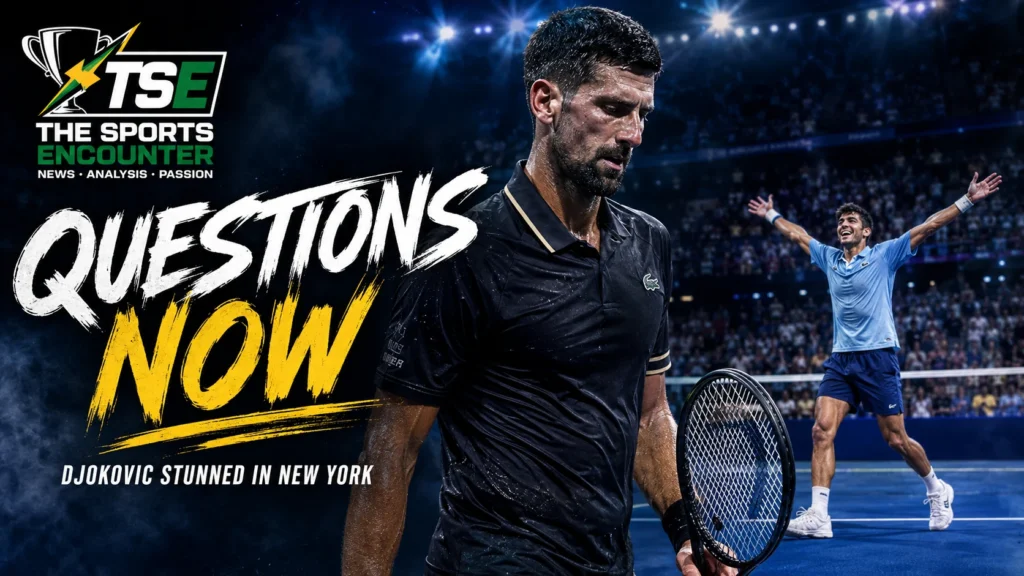
Novak Djokovic came to New York chasing history. He left Arthur Ashe Stadium after the first round with something very different hanging over him: whether his body can still survive the physical demands required to win another Grand Slam.
Mariano Navone’s 7-6(5), 5-7, 4-6, 6-2, 6-1 victory over Djokovic in the opening round of the 2026 US Open was shocking because of the opponent, the stage and the timing.
It was also historic.
The defeat was Djokovic’s first opening-round loss at the US Open in 20 appearances and his earliest Grand Slam exit since the 2006 Australian Open.
For a player with 24 major singles titles, four US Open championships and a career defined by surviving matches other players could not, the concern now runs deeper than one bad night.
The 39-year-old has gone three full years without winning a Grand Slam title.
More importantly, his 2026 season has repeatedly produced the same warning.
At the Australian Open, he reached the final but then spent significant time away because of a right shoulder injury.
At Roland Garros, he struggled physically during a five-set defeat to João Fonseca in extreme heat.
At Wimbledon, he reached the semifinals before Jannik Sinner beat him in straight sets.
Then came Cincinnati, where heat and humidity contributed to another physically troubling defeat.
New York was supposed to reveal whether those episodes were isolated.
Instead, the US Open produced the most serious version yet.
Djokovic vs Navone: Match Summary
| Match detail | Information |
|---|---|
| Tournament | 2026 US Open |
| Round | First round |
| Venue | Arthur Ashe Stadium, New York |
| Winner | Mariano Navone |
| Score | 7-6(5), 5-7, 4-6, 6-2, 6-1 |
| Match duration | 4 hours, 36 minutes |
| Djokovic age | 39 |
| Djokovic Grand Slam titles | 24 |
| US Open titles | 4 |
| Historic significance | First US Open opening-round defeat of Djokovic’s career |
| Earliest major exit since | 2006 Australian Open |
The official US Open match report confirmed that Navone completed the upset after four hours and 36 minutes, while Djokovic struggled increasingly with nausea, cramps, back pain and shoulder discomfort.
Djokovic Actually Led Before the Match Fell Apart
The defeat was not a simple case of Djokovic being outplayed from the first ball.
He lost the opening set in a tiebreak after producing 17 unforced errors, then responded by taking the second 7-5 and the third 6-4.
At that point, the match appeared to be moving toward a familiar Djokovic script.
He had survived early trouble.
He had worked through an opponent playing above expectations.
He had taken control of the scoreboard.
That is usually where Djokovic becomes most dangerous.
Instead, the fourth set exposed the problem that has followed him all year.
Navone broke twice early, Djokovic took a medical timeout before the deciding set, and the physical decline became impossible to ignore.
The fifth set was one-sided.
Navone took it 6-1.
Djokovic finished the match with 70 unforced errors and converted only four of 12 break-point opportunities.
For a player whose greatest strength has always been his ability to remain precise deep into long matches, those numbers were alarming.
Mariano Navone Earned the Biggest Win of His Career
The focus naturally falls on Djokovic, but Navone deserves full credit.
The 25-year-old Argentine entered the match ranked No. 49 and is still better known for clay-court results than for hard-court breakthroughs.
He did not play the occasion.
He played the match.
Navone survived early pressure, recovered after losing the second and third sets, and then accelerated when Djokovic’s movement began to deteriorate.
His ability to extend rallies became increasingly valuable as the match moved beyond three hours.
He also converted six of 17 break points, enough to keep forcing Djokovic back into defensive patterns.
The upset was not built on one hot set.
It required Navone to remain emotionally stable across five.
That composure fits with what we had already seen earlier this summer, when Navone defeated Matteo Berrettini during the National Bank Open by repeatedly extending rallies and forcing a more powerful opponent to play extra balls.
The Warning From Cincinnati Was Real
The US Open loss cannot be separated from what happened two weeks earlier.
Djokovic returned to Cincinnati after skipping Montreal and lost his opening match to Thiago Agustin Tirante.
He won the first set 6-2.
Then the physical problems began.
During an 18-minute service game in the second set, Djokovic dropped to his knees and later required treatment to cool down.
He recovered enough to compete but lost 2-6, 6-4, 6-4.
Our analysis after the Cincinnati defeat argued that the result mattered because the tournament was supposed to test his physical readiness before New York.
That test did not go well.
At the time, there was still a plausible argument that the Cincinnati conditions had exaggerated the problem.
The US Open has now made that explanation much harder to sustain.
Djokovic Has Been Managing His Body All Season
Djokovic’s 2026 schedule has been increasingly selective.
That strategy is understandable.
At 39, he no longer needs ranking points, appearance fees or tournament volume to define his career.
The majors matter most.
Our analysis of why Djokovic skipped Montreal examined how his schedule had become a balancing act between preparation and recovery.
The theory was simple.
Play less.
Arrive fresher.
Save the body for best-of-five tennis.
The problem is that limited match preparation can create another risk.
Djokovic then enters majors without enough competitive repetition.
That mattered in Cincinnati.
It mattered again in New York.
His Grand Slam Results Have Still Been Strong
It would be wrong to describe Djokovic as a player who has suddenly become irrelevant.
He reached the Australian Open final earlier this year.
He reached the Wimbledon semifinals.
At Wimbledon, he also passed Roger Federer’s record for the most men’s singles match wins at the tournament, reaching 106 victories.
Our Wimbledon Day 7 report documented another chapter in a career that has continued to produce records even in decline.
That is why the US Open result feels so important.
Djokovic is still good enough to reach the final stages of majors.
The question is whether he can still survive the physical cost required to win one.
The Gap Against Younger Elite Players Has Grown
Djokovic’s challenge is not simply age.
It is the generation waiting across the net.
Jannik Sinner and Carlos Alcaraz have transformed the physical demands at the top of men’s tennis.
Djokovic can still outthink almost anybody.
He can still return serve at an elite level.
His movement remains exceptional relative to most players on tour.
Against the very best younger opponents, however, every physical drop becomes visible immediately.
That was already clear at Wimbledon.
Djokovic reached the semifinal after another strong tournament but Sinner beat him 6-4, 6-4, 6-4.
Before that match, our Wimbledon semifinal analysis examined whether Djokovic could still overcome Sinner, Alexander Zverev and the younger players trying to take control of the sport.
The answer at Wimbledon was no.
New York has now raised a more basic question.
Can he get far enough in the draw to face them?
US Open 2026 Was Supposed to Be His Best Chance This Year
The men’s draw opened significantly before the tournament even began.
Jannik Sinner withdrew.
Carlos Alcaraz returned after a long injury layoff.
Alexander Zverev entered as the top seed.
That created one of the most open major draws Djokovic had seen in recent years.
Our US Open men’s title analysis identified Djokovic as one of the players who could benefit most from that uncertainty.
His experience in New York was unmatched.
He had won four titles there.
His potential path to the second week looked manageable.
That opportunity disappeared in Round 1.
The Draw Looked Manageable Before It Became a Trap
Djokovic was seeded fourth and opened against Navone.
On paper, it looked like a favorable first-round match.
Navone had limited hard-court pedigree and only two previous US Open match wins.
Our US Open draw analysis described the opener as manageable by Djokovic’s standards.
The same point appeared again in our August 27 US Open wrap, which focused on how Djokovic’s route toward a possible semifinal meeting with Alcaraz had taken shape.
That projection never survived the opening weekend.
The 25th Grand Slam Chase Is Now More Complicated Than Ever
Djokovic’s 24 major singles titles remain the men’s record.
He has been chasing a 25th for three years.
The number matters because one more title would move him beyond Margaret Court’s all-time singles total.
The official US Open historical record documents how Djokovic reached 24 majors and four titles in New York.
When he won the 2023 US Open, No. 25 looked inevitable.
It no longer does.
Since then, Sinner and Alcaraz have taken control of the men’s major landscape, while Djokovic’s body has become less reliable across two-week events.
That does not make No. 25 impossible.
It makes the route increasingly narrow.
The Biggest Opponent May Now Be Recovery Time
Djokovic has built much of his career on physical superiority.
His flexibility, recovery, defensive movement and ability to extend points late into five-set matches made him almost impossible to break down.
At 39, recovery itself has become part of the contest.
A four-hour first-round match is not only about surviving that evening.
The question continues the next morning.
How quickly can the body recover?
Can it repeat the effort two days later?
Then again in Round 3?
Then in the second week?
That accumulation is exactly why our Cincinnati preview framed his US Open preparation around physical management rather than titles.
The US Open ended before the experiment could even reach the second round.
Djokovic’s Own Comments Make the Physical Problem Hard to Ignore
After the Navone defeat, Djokovic described a pattern that has followed him through 2026.
He said he had been dealing with nausea and vomiting in matches, followed by cramping, pain and a broader physical collapse.
He also said his back and shoulder deteriorated late in the match.
The comments matter because they connect several separate tournaments.
They suggest the US Open problem was not a sudden one-night injury.
It is part of something Djokovic has been managing throughout the season.
The ATP’s official Cincinnati coverage confirms that his appearance there was his first match since the Wimbledon semifinal, highlighting how carefully his schedule had already been managed before New York.
Was That Djokovic’s Final US Open Match?
There is no confirmed retirement announcement.
There is no official indication that Djokovic has decided to stop playing.
Anything stronger would be speculation.
The scene after the match still carried unusual emotional weight.
Djokovic waved to the Arthur Ashe Stadium crowd, made a heart shape with his hands and blew kisses before leaving the court.
His family watched from the stands.
The crowd responded with a standing ovation.
At 39, every exit from a major now naturally carries a question that did not exist five years ago.
Will he return?
Djokovic has spent his career resisting deadlines placed on him by other people.
There is no reason to assume he will suddenly let one defeat decide everything.
The decision, whenever it comes, will be his.
Why Retirement Is Still Not the Only Logical Conclusion
The temptation after a defeat like this is to jump immediately to retirement.
That would ignore how competitive Djokovic has remained.
He reached the Australian Open final.
He reached the Wimbledon semifinals.
He still enters major draws as a legitimate contender.
Players who can reach Grand Slam finals and semifinals are not automatically finished.
The issue is consistency across the physical demands of seven best-of-five matches.
Djokovic may decide that one more carefully managed season is worth attempting.
He may reduce his schedule even further.
He may target specific majors where conditions suit him best.
Or he may decide that the training, pain and recovery required to remain competitive no longer justify the chase.
Those are different questions from whether he can still beat top players on a given day.
The 2027 Australian Open May Become the Next Major Test
If Djokovic continues, Melbourne becomes an obvious target.
No major has been more closely associated with his career.
He has won the Australian Open 10 times.
The conditions are familiar.
The tournament also gives him several months to reset physically after New York.
That time could matter.
A return in January would tell us whether the 2026 US Open was a physical collapse at the end of a difficult season or evidence of something more permanent.
The Cincinnati Loss Now Looks Like a Warning, Not an Anomaly
When Djokovic lost to Tirante, the temptation was to dismiss the result as August preparation.
The heat was brutal.
He had not played since Wimbledon.
The tournament was not a major.
Our broader Cincinnati failures analysis still ranked Djokovic’s exit as the most significant because of what he needed from the week.
He needed matches.
He needed evidence that his body could tolerate North American summer conditions.
He needed confidence that the physical problems were manageable.
He did not get those answers in Ohio.
New York has now supplied a much harsher one.
Djokovic’s Legacy Is Already Complete
Whatever happens next, this defeat cannot damage the foundations of Djokovic’s career.
He owns 24 Grand Slam singles titles.
He has won every major at least three times.
He has spent more weeks at world No. 1 than any other player.
He has won all nine Masters 1000 events.
He has four US Open titles and 10 Australian Open championships.
He has broken records once considered untouchable.
The remaining question is not whether he belongs among the greatest players in tennis history.
That argument has already been settled by the résumé.
The question is whether he believes one more major is still worth the physical cost.
Final Analysis: The Record Chase Has Become a Race Against the Body
Mariano Navone deserves to remember August 30, 2026 as the night he produced the biggest victory of his career.
He stayed with Djokovic through five sets, survived losing a two-sets-to-one lead in momentum, and then dominated the final stages.
For Djokovic, the defeat carries a different weight.
Three years without a major can be explained by competition.
One opening-round loss can be explained by an inspired opponent.
A season of recurring physical problems is harder to separate from the future.
Djokovic is still capable of playing brilliant tennis.
He is still capable of reaching the final stages of Grand Slams.
What has changed is the confidence that his body will allow him to stay there long enough to finish the job.
For most of his career, Djokovic’s physical durability was one of the reasons opponents eventually broke first.
At the 2026 US Open, the pattern reversed.
The most difficult opponent in his pursuit of Grand Slam No. 25 may no longer be Sinner, Alcaraz, Zverev or the next young player across the net.
It may be the accumulation of four-hour matches, recovery days, heat, pain and the reality of trying to win seven best-of-five contests at 39.
Djokovic has spent his career turning impossible situations into another chapter.
New York has left him with the hardest chapter yet to write.