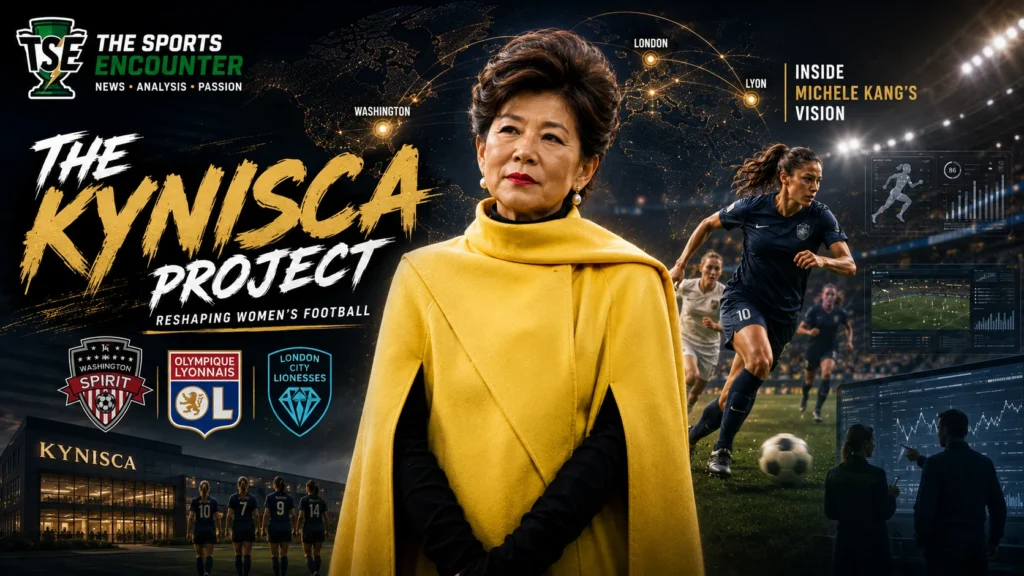
Inside Michele Kang’s Kynisca Project and Her Plan to Reshape Women’s Football
Michele Kang is building far more than a portfolio of women’s football clubs. Through Kynisca, she is connecting ownership, female-focused sports science, scouting, technology and player development across countries. Her ambitious model could raise standards across the women’s game, but its growth also brings important questions about club independence, transfers and governance.
Owning major football clubs in three countries would already place Michele Kang in a small group of global sports investors. Building that portfolio specifically around women’s football makes her project far more unusual.
The South Korean-American businesswoman owns the Washington Spirit in the United States, OL Lyonnes in France and London City Lionesses in England. In June 2025, she was also appointed chairwoman and president of Olympique Lyonnais, extending her influence into the men’s side of one of France’s best-known football institutions.
Yet Kang’s most important idea may have little to do with the number of clubs she controls.
Through Kynisca Sports International, she is attempting to build an interconnected women’s football system in which clubs can share expertise in performance science, data, scouting, coaching, recruitment and player development. At the same time, she is investing heavily in research designed specifically around female athletes.
The ambition is significant. So are the questions surrounding it.
If Kynisca works, it could offer a blueprint for how women’s clubs accelerate professionalization without rebuilding the same infrastructure separately in every market. As the network grows, however, decisions involving coaches, players and resources will increasingly test whether clubs under common ownership can maintain genuine sporting independence.
That tension makes Kang’s project one of the more important experiments taking place in the modern football landscape.
What Is Michele Kang Building Through Kynisca?
Kang formally launched Kynisca Sports International in 2024 as a global organization dedicated to women’s football.
The structure connected Washington Spirit, OL Lyonnes and London City Lionesses under a broader organizational umbrella while allowing each club to retain its own identity.
According to Kynisca’s launch announcement, centrally developed capabilities include performance science and technology, data analytics, global scouting and sporting staff development.
The logic behind the system is relatively straightforward.
A football club traditionally builds its own recruitment network, medical department, performance systems, analytics processes and coaching infrastructure. Another club hundreds or thousands of miles away may be spending money solving many of the same problems.
Kynisca’s model creates the possibility of developing expertise once and applying that knowledge across several organizations.
If a better injury-prevention protocol is developed in Washington, knowledge from that work could eventually benefit players in London or Lyon. Scouting intelligence collected in Europe could potentially help the Spirit. Coaching methods, recruitment processes and performance data could circulate across the network rather than remaining locked inside individual clubs.
For a women’s game still developing professional structures across many countries, those efficiencies could be valuable.
Why the Name Kynisca Matters
The organization’s name comes from Cynisca, or Kyniska, the Spartan princess traditionally recognized as the first woman to win at the ancient Olympic Games.
Women could not compete directly in Olympic chariot racing, but owners of winning horses were officially recognized as victors. Cynisca entered horses and became associated with Olympic victories despite the restrictions placed on women at the time.
The symbolism fits Kang’s wider message. Women’s sport has historically developed inside structures that frequently gave female athletes fewer resources, less research and fewer professional opportunities.
Her investment strategy is aimed at changing some of those underlying systems rather than concentrating entirely on results and transfers.
The 6% Problem Behind Kang’s Sports Science Investment
The most distinctive part of the Kynisca project may be its focus on female-specific sports science.
When the Kynisca Innovation Hub was introduced in 2024, the organization said only around 6% of sports science research focused exclusively on females.
Kang committed $50 million in combined seed and matching funding toward an initiative designed to develop research, training methods and performance systems around female physiology.
Her message was memorable because it addressed a long-standing problem directly: elite women should be trained using evidence gathered from women.
Kang argued that the industry needed to stop training women as though they were simply smaller versions of male athletes.
The consequences of that research could extend well beyond a training session.
Injury Prevention, Recovery and Performance Could All Change
Elite football increasingly depends on marginal gains.
Clubs track workloads, acceleration, recovery, nutrition, sleep, muscular stress, tactical movement and dozens of other performance indicators. Yet systems built largely from research involving male athletes cannot automatically answer every question surrounding female performance.
A deeper female-specific evidence base could improve decisions around injury prevention, recovery, training loads, nutrition and long-term player health.
That becomes especially important as women’s football calendars become more demanding.
Domestic competitions, international tournaments, continental club competitions and expanded commercial schedules are increasing the physical load placed on leading players. Better research could help clubs understand when athletes should train harder, when they need additional recovery and how individual physiological factors influence performance.
The implications also reach youth development. If evidence-based methods become part of academies and development programs, female players could benefit much earlier in their careers.
This matters particularly as the women’s game expands into new markets. The recent rise of nations such as Malawi, who qualified for their first Women’s World Cup, and Algeria, who also secured a historic World Cup debut, shows how quickly competitive opportunities are broadening.
Kang Has Already Expanded the Research Project Beyond Kynisca
Kang’s sports science ambitions are no longer confined to her own clubs.
In April 2025, Kynisca announced that the Innovation Hub’s operations would be integrated into U.S. Soccer’s Soccer Forward Foundation. Kang committed another $25 million to support research, innovation and standards across women’s soccer.
U.S. Soccer described the collaboration as an effort to advance research, improve health outcomes and establish better performance and development standards.
That followed Kang’s other investments in women’s sport, including financial support for the United States women’s rugby sevens program.
Her professional background helps explain the emphasis on data and research. Kang built much of her business career in healthcare technology through Cognosante, an industry where evidence, systems, technology and measurable outcomes influence major decisions.
Kynisca appears to be applying a similar institutional mindset to women’s football.
The Multi-Club Model Creates Its Own Governance Test
The same structure that gives Kynisca its potential also creates its biggest challenge.
Shared knowledge is relatively easy to defend. Shared ownership becomes more complicated when coaches or players move between clubs inside the network.
The issue became visible in 2025 when Jonatan Giráldez left Washington Spirit to become head coach of OL Lyonnes.
Giráldez had arrived in Washington after a hugely successful spell with Barcelona, where he won two UEFA Women’s Champions League titles. Under his leadership, the Spirit reached the 2024 NWSL Championship game and later won the 2025 NWSL Challenge Cup.
Washington promoted assistant coach Adrián González as Giráldez prepared to move to Lyon.
From Kynisca’s perspective, the transition demonstrates one of the network’s advantages. Expertise developed or strengthened within one organization can remain within the broader group.
From the perspective of individual supporters, however, the question looks different.
If two clubs controlled by the same ownership group both want an elite coach, who decides which club needs him more?
And whose interests come first?
The Kadidiatou Diani Transfer Made the Question Harder to Ignore
The issue became even more visible during the summer of 2026.
London City Lionesses signed France international Kadidiatou Diani from OL Lyonnes on a three-year contract.
The clubs did not publicly disclose the transfer fee. French newspaper L’Équipe reported a fee of €800,000 and described it as the biggest player sale in OL Lyonnes’ history.
The significance goes beyond the amount.
Both clubs belong to Kang’s football network.
There is no evidence that the Diani deal was improperly structured or that the reported fee was manipulated. The transaction nevertheless illustrates a governance question that Kynisca will face repeatedly if more players and staff move between its clubs.
When the same ownership network stands behind the buyer and seller, supporters and competitors need confidence that decisions reflect the legitimate sporting and financial interests of each club.
Football is already wrestling with broader questions over ownership, commercial power and institutional accountability. Recent disputes covered by The Sports Encounter, including UEFA’s confrontation with FIFA over private investment and CONCACAF’s rejection of FIFA’s proposed World Cup stake structure, show how sensitive governance becomes when commercial interests intersect with sporting independence.
Can Shared Ownership Strengthen Clubs Without Weakening Independence?
This is the central challenge inside Kynisca.
Sharing sports science, scouting, technology and staff development can make every club more efficient. Moving influential players and coaches between those clubs introduces another layer of responsibility.
A strong multi-club system therefore needs transparent decision-making.
Each organization needs credible sporting leadership, clearly defined responsibilities and safeguards that allow supporters, players and competitors to understand how major decisions are made.
Those questions will become more important if Kynisca continues expanding.
Kang’s argument is that women’s football still lacks resources and infrastructure that men’s clubs have spent decades developing. Completely isolating every organization may therefore force women’s clubs to duplicate expensive research and systems unnecessarily.
There is merit in that argument.
The challenge is proving that collaboration can coexist with genuine sporting autonomy.
Kynisca Could Raise Standards Across Women’s Football
If Kang’s model succeeds, its influence could extend well beyond the three clubs she currently owns.
Competition has a habit of forcing investment.
If Kynisca clubs begin gaining measurable advantages through better performance science, stronger scouting, improved medical support and deeper analytics, rival owners will have an incentive to respond.
That could push other clubs to invest more heavily in training facilities, medical teams, analytics departments, academy structures and specialist coaching.
Women’s football would benefit if competition among owners gradually raises the minimum professional standard across the sport.
Transfer Spending Could Accelerate the Women’s Game
London City Lionesses have already shown how aggressive investment can change expectations around recruitment.
Higher transfer fees create economic value for selling clubs. Greater competition for established players can improve bargaining power for footballers. Better-funded squads can also attract more attention from broadcasters, sponsors and supporters.
There is another side to that development.
Clubs with smaller budgets may struggle to compete if a handful of wealthy ownership groups begin dominating the market for elite talent.
Women’s football therefore faces a familiar challenge: attracting more capital while preserving meaningful competitive balance.
The sport’s rapid growth makes that conversation increasingly important. Wider disputes over commercial control in football, including the recent collapse of FIFA’s proposed World Cup investment structure, have already demonstrated how quickly financial expansion can become a governance issue.
A Global Scouting Network Could Open New Pathways
Kynisca’s geographic spread gives it another potentially important advantage.
The United States, England and France have different football cultures, academy systems, player markets and competitive structures. Connecting those environments can create a wider scouting and development network.
Young players discovered in one market could eventually gain access to expertise or opportunities elsewhere in the organization.
This possibility becomes particularly significant outside football’s traditional elite nations.
The growth of women’s football across Africa offers a useful example. Nations reaching new levels of international competition are producing players who may previously have received limited global exposure. Recent qualification breakthroughs by Malawi and Algeria underline how quickly the player pool is widening.
A genuinely international scouting structure could identify talent earlier and create stronger routes into professional football.
The question is whether those pathways ultimately strengthen local football ecosystems as well as the clubs doing the recruiting.
Could Multi-Club Ownership Concentrate Too Much Power?
The larger the network becomes, the more significant another concern becomes.
If a small number of investors own leading women’s clubs across several countries, they can potentially gain considerable influence over the movement of players, coaches, intellectual property and sporting expertise.
Women’s football needs investment. It also needs competitive diversity.
Kynisca therefore has an opportunity to demonstrate whether multi-club ownership can help professionalize the women’s game while addressing the governance concerns that have followed similar structures elsewhere in football.
The question belongs to a much wider debate about who controls the sport. The Sports Encounter has tracked similar concerns at the international level, including the broader power struggle surrounding FIFA’s leadership and commercial direction.
Kang Wants the Network to Reach Beyond Three Clubs
Washington, London and Lyon may only be the beginning.
In a 2024 interview with The Guardian, Kang said she wanted to have a club in each continent.
She did not attach a firm timetable to that ambition, but the statement makes the scale of the project clear.
Kynisca has also spoken about investing in structures across Africa, the Americas, Asia and Europe.
A broader network could create opportunities for girls who currently live far from established professional pathways. Coaching expertise, scouting systems, research and performance support could reach markets where those resources remain limited.
Expansion would also increase the management challenge.
Football regulations differ across countries. So do league structures, financial conditions, transfer rules, cultural expectations and player-development systems.
A model that works in Washington cannot simply be copied into London, Lyon or another continent without adaptation.
What Would Success Actually Look Like?
The number of clubs Kang eventually owns will attract headlines, but it should not become the primary measure of whether Kynisca succeeds.
A more meaningful evaluation would look at outcomes.
- Are players healthier and missing fewer matches through preventable injuries?
- Are female-specific research and performance methods producing measurable benefits?
- Are academies developing more players?
- Are clubs becoming commercially stronger?
- Are salaries, facilities and professional standards improving?
- Are new international talent pathways opening?
- Can clubs inside the network retain credible sporting independence?
Those questions matter more than portfolio size.
Kang is effectively testing whether women’s football can build some of its future infrastructure differently from the men’s game rather than simply replicating systems that developed over the previous century.
The Bigger Question Facing Michele Kang and Kynisca
Women’s football is entering a period of rapid expansion.
New countries are reaching World Cups. Transfer fees are rising. Major clubs are investing more aggressively. Commercial interest is growing, while debates around governance and competitive balance are becoming more serious.
Kang has placed herself near the center of all those developments.
Her project combines club ownership, female-specific sports science, technology, scouting, player development and international expansion in a way few investors have attempted before.
The model now has to prove that scale can improve the game without compromising the independence of the clubs operating inside it.
If Kynisca can produce healthier athletes, stronger development pathways, better professional environments and commercially sustainable clubs while maintaining transparent sporting governance, Kang’s influence will extend far beyond Washington Spirit, OL Lyonnes and London City Lionesses.
That would represent a meaningful change in how women’s football is built.
If the network expands without equally strong safeguards around transfers, staff movement and club autonomy, the same structure designed to accelerate progress could create new concerns about concentrated power.
That is why Michele Kang’s project deserves attention.
The real story is bigger than how many clubs she owns. It is whether Kynisca can prove that an interconnected global football organization can improve the environment around female athletes while preserving the competition and independence that make the sport worth watching.
Breaking News
How $100 US Open Tickets Expose the Growing Cost of Watching Elite Tennis
New York City and the USTA are offering 1,000 discounted US Open tickets for $100 each, highlighting a wider debate over soaring resale prices and whether major tennis events remain affordable for ordinary fans.
New York City is stepping into one of the biggest debates surrounding the 2026 US Open: how much should ordinary fans have to pay to watch elite tennis live?
Mayor Zohran Mamdani and the United States Tennis Association have announced that 1,000 discounted US Open tickets will be made available to New York City residents for $100 each, offering local fans access to main-draw sessions that have become increasingly expensive on the secondary market.
The tickets go on sale at 10 a.m. ET on Wednesday, August 26, on a first-come, first-served basis. Eligible New York City residents can purchase up to two tickets each.
The offer covers sessions from August 30 through September 8 and includes tickets for Arthur Ashe Stadium, Louis Armstrong Stadium and grounds admission, depending on availability.
On paper, 1,000 tickets represent only a small fraction of overall US Open attendance. In practice, the initiative has landed at exactly the right moment because ticket affordability has become part of the wider conversation around the tournament.
US Open $100 Ticket Offer: Key Details
| Detail | Information |
|---|---|
| Number of discounted tickets | 1,000 |
| Price | $100 per ticket |
| Eligibility | New York City residents |
| Purchase limit | Maximum two tickets per resident |
| Sale begins | August 26, 2026 at 10 a.m. ET |
| Eligible sessions | August 30 through September 8 |
| Ticket types | Arthur Ashe Stadium, Louis Armstrong Stadium and grounds admission |
| Availability | First-come, first-served |
Why $100 US Open Tickets Suddenly Feel Like a Bargain
A $100 sports ticket would not normally be described as cheap.
At the 2026 US Open, however, the comparison changes quickly.
Secondary-market prices for the early rounds have risen significantly as demand builds around the final Grand Slam of the season. Grounds passes and stadium seats that originally entered the market at considerably lower face values have been appearing at multiples of those prices.
That pressure has been especially visible around opening-week sessions, when spectators can move between multiple courts and potentially watch several major players in a single day.
The Sports Encounter’s complete US Open 2026 preview already identified ticket demand as part of a tournament carrying unusual star power across both singles draws.
That demand is not difficult to understand.
Novak Djokovic is chasing another piece of Grand Slam history. Aryna Sabalenka is trying to extend her dominance in New York. Venus Williams is back at 46. Carlos Alcaraz remains part of the tournament picture despite an injury-disrupted preparation.
Add New York tourism, weekend demand and the traditional popularity of night sessions, and the resale market becomes extremely aggressive.
The Resale Market Is Where Fan Frustration Grows
The central affordability problem is not simply that the US Open sells premium tickets.
Major sporting events have always charged more for better seats, later rounds and high-profile sessions.
The frustration begins when ordinary admission products become expensive almost immediately after entering the resale market.
Recent secondary-market listings have shown grounds passes selling well above traditional face values, while Arthur Ashe Stadium tickets for opening-week sessions can quickly climb into several hundred dollars.
That leaves families and casual fans with a difficult choice.
Pay significantly more than expected, wait and hope prices fall, or skip the tournament entirely.
The New York City initiative does not solve that market. It creates a limited alternative inside it.
TSE Analysis: 1,000 Tickets Will Not Fix the Problem, but They Expose It
The most revealing thing about the $100 initiative is not the discount itself.
It is the fact that an affordability program feels necessary for one of tennis’ largest and wealthiest events.
The US Open regularly attracts enormous crowds, generates major broadcast revenue, sells premium hospitality packages and benefits from one of the strongest sporting markets in the world.
That success creates a tension familiar across modern professional sports.
Events want maximum commercial value from demand.
Fans still want to feel that attending in person remains realistically possible.
Those interests do not always move together.
When resale prices climb sharply enough, a tournament can remain financially successful while becoming less accessible to the supporters who give it much of its atmosphere.
New York Is Making Fan Access Part of Sports Policy
The US Open announcement is not an isolated city initiative.
Mamdani’s administration has increasingly framed access to major sporting events as a public-interest issue for New Yorkers.
The official New York City announcement explicitly linked the tennis offer to previous attempts to make major events more accessible to local residents.
The underlying argument is straightforward.
New York provides the infrastructure, workforce, public services and audience base that help make major sporting events commercially valuable.
Residents should therefore have some realistic path into the venues hosting them.
That argument becomes more persuasive when the event itself is deeply tied to the city’s identity.
The US Open is not a travelling tournament arriving in New York for one season.
Flushing Meadows has been its permanent home for decades.
The USTA Already Has a Stronger Accessibility Argument Than Many Major Events
It would be unfair to portray the US Open as a tournament interested only in premium customers.
The USTA has invested heavily in Fan Week, which runs from August 23 through August 29.
Grounds admission during Fan Week is free with a Fan Access Pass, giving spectators access to qualifying, practices, family activities and selected mixed-doubles action.
The official US Open Fan Week program includes qualifying involving 128 men and 128 women, player activities and several free events across the National Tennis Center.
That is genuine access.
It also matters because qualifying can produce some of the best value at any Grand Slam.
Fans can stand close to the courts, watch emerging players and established names trying to recover their ranking positions, and experience the venue without paying main-draw prices.
Free Fan Week Shows the USTA Understands the Access Problem
Fan Week has become one of the strongest parts of the US Open experience precisely because it lowers the financial barrier.
The atmosphere is different from a semifinal night inside Arthur Ashe Stadium, but that is part of its appeal.
Players practice on smaller courts.
Qualifiers compete in matches that can determine the direction of entire careers.
Fans can move more freely around the grounds.
The tournament also used Fan Week to elevate mixed doubles this year.
The Sports Encounter examined that strategy when Novak Djokovic and Aryna Sabalenka were announced as a headline mixed-doubles partnership.
Their involvement helped transform what could have been a secondary event into something capable of drawing major crowds before the singles tournament even began.
Demand Is Being Driven by More Than the Main Draw
The 2026 tournament has expanded the number of reasons for spectators to visit Flushing Meadows before August 30.
Mixed doubles, qualifying, exhibitions and player appearances have turned the first week into a larger entertainment product.
The official US Open ticket platform shows how the event now extends across Fan Week, mixed doubles, premium exhibitions and the traditional main draw.
That expansion has advantages.
More events mean more opportunities to attend.
They also mean more demand around the venue.
The result is a US Open that increasingly operates like a major sports festival rather than a two-week tennis tournament.
Venus Williams Adds Another Layer to the Ticket Rush
Few players illustrate the power of nostalgia better than Venus Williams.
The 46-year-old former champion has received another main-draw wildcard, guaranteeing one more appearance at Flushing Meadows.
The Sports Encounter’s analysis of Venus Williams’ US Open return at 46 examined why her presence matters far beyond her current ranking.
Fans who watched Venus become a champion more than two decades ago now have another opportunity to see her compete in New York.
That kind of generational connection drives demand in a way ordinary ranking numbers cannot capture.
A wildcard becomes a ticket-selling story.
Djokovic Is Creating a Different Kind of Demand
Djokovic enters the tournament with history hanging over every match.
His pursuit of a 25th Grand Slam singles title keeps him among the biggest attractions in tennis even at 39.
The uncertainty surrounding his preparation may actually increase interest.
The Sports Encounter recently examined how Djokovic’s Cincinnati defeat raised fresh questions about his US Open readiness.
Fans buying tickets do not know how many more New York campaigns they will get from him.
Scarcity applies to athletes as well as seats.
That can push demand higher whenever an all-time great enters the final stage of a career.
Carlos Alcaraz Adds Uncertainty to the Market
Alcaraz presents almost the opposite story.
He is still young enough to have many US Open appearances ahead of him, but his current participation carries uncertainty because of the wrist injury that disrupted his season.
His withdrawal from Cincinnati intensified those questions.
The Sports Encounter’s report on Alcaraz’s Cincinnati withdrawal and US Open title-defense concerns explained how limited his competitive preparation has become.
If Alcaraz is healthy enough to play, he remains one of the tournament’s biggest attractions.
If he withdraws or struggles physically, a major part of the ticket-value equation changes for sessions in which fans hoped to see him.
That is one of the risks of buying expensive tennis tickets before the order of play is known.
Tennis Tickets Are Different From Most Team-Sport Tickets
That uncertainty deserves more attention in affordability discussions.
A fan buying an NBA or NFL ticket usually knows which teams will appear.
A tennis fan may purchase a session weeks in advance without knowing which players will be assigned to that court.
Seeds can lose early.
Players can withdraw.
Weather can move schedules.
Matches can be reassigned.
A $300 ticket therefore does not guarantee a particular superstar.
It guarantees access to a session.
That makes price inflation especially frustrating when buyers are effectively paying premium prices for an uncertain lineup.
Cincinnati Already Showed How Quickly the Star Picture Can Change
The final warm-up event before New York reinforced that uncertainty.
The Sports Encounter’s Cincinnati Open roundup followed a tournament in which some leading names advanced while others struggled with injuries, form and changing preparation plans.
Our separate look at the biggest Cincinnati disappointments and early exits showed how quickly expected headline matchups can disappear.
The US Open faces the same basic reality on a larger scale.
Fans can pay for star power.
The draw does not promise that star power will survive long enough for them to see it.
The $100 Tickets Are Also a Smart Public-Relations Move
The USTA benefits from the initiative too.
The number of tickets is modest enough that the financial impact should be limited relative to the size of the tournament.
The reputational benefit is much larger.
The organization can point to a concrete program that gives local residents access during a period of rising concern about ticket costs.
That matters when secondary-market prices are generating headlines beyond tennis.
The partnership also allows the USTA to distinguish between the prices it controls and the prices created after tickets enter resale channels.
Those two markets are often blurred together by frustrated supporters.
Resale Economics Are the Harder Problem
Major events face a recurring dilemma when demand exceeds supply.
Keeping face values artificially low can create a huge arbitrage opportunity for resellers.
Raising primary prices can reduce that opportunity but directly makes tickets less affordable.
Restricting resale can discourage speculation but may also make legitimate transfers more difficult.
Dynamic pricing creates another controversy because fans can see prices change while they are trying to buy.
There is no simple fix.
The US Open’s problem is amplified by the size and wealth of the New York market, tourism demand and the global popularity of the players involved.
TSE Analysis: Sports Access Is Becoming a Class Question
The wider concern reaches beyond tennis.
Elite sport increasingly makes more money from premium experiences.
Hospitality lounges, luxury seating, exclusive access packages and high-demand resale markets can generate enormous revenue.
Commercially, the logic works.
Culturally, there is a risk.
A stadium can become filled with people able to pay the highest prices while supporters who built their relationship with the sport through ordinary attendance are pushed toward television.
That changes atmosphere over time.
It also changes who feels that the event belongs to them.
Mamdani’s statement that New Yorkers should be able to watch the world’s best players when those athletes are competing in their city taps directly into that concern.
A Full Day at the US Open Has Value That Television Cannot Replace
Live tennis offers an experience that is difficult to reproduce through a broadcast.
Television focuses on the biggest match.
A grounds ticket lets a spectator build an entirely different day.
A fan can watch a top-10 player practice, sit courtside for an early-round match on an outside court, discover a qualifier, move to doubles and then follow another match from a neighboring stadium.
That freedom is part of what makes early Grand Slam rounds so appealing.
It is also why expensive grounds passes are particularly sensitive.
They were traditionally the democratic entry point into a major.
The Tournament Still Has Affordable Ways In
Fans unable to secure one of the $100 city tickets are not completely shut out.
Fan Week remains the obvious alternative.
Qualifying and many activities are free with the required Fan Access Pass, subject to capacity.
Mixed doubles has also included free-to-attend matches in Grandstand and Louis Armstrong Stadium during the opening stages.
Those options deserve recognition because they make the US Open more accessible than a price discussion based only on Arthur Ashe resale listings would suggest.
Readers can follow the tournament’s matches, qualifying stories and player developments through The Sports Encounter’s Tennis Hub.
The Real Test Comes After the 1,000 Tickets Sell
There is little reason to expect the discounted allocation to last long.
One thousand tickets in a city of millions, attached to one of the world’s biggest tennis tournaments, creates obvious scarcity.
The speed of the sellout may itself become useful information.
If the tickets disappear almost immediately, it will demonstrate how much demand exists around a genuinely lower entry price.
That could strengthen the argument for expanding similar allocations in future years.
The more interesting question is whether this remains a symbolic program or becomes part of a broader access strategy.
What Should Fans Watch Next?
New York City residents interested in the offer should be ready when sales open at 10 a.m. ET on August 26 because availability is first-come, first-served and purchases are limited to two tickets.
The main draw begins August 30.
Before then, qualifying, Fan Week and the mixed-doubles championship continue shaping the tournament.
The sporting story will soon move back toward players and results.
The ticket debate should not disappear with it.
TSE Verdict: Affordable Access Cannot Become a Luxury Product
The US Open has every right to capitalize on enormous demand.
It is one of the world’s premier sporting events and operates inside one of its most expensive cities.
Fans also have every right to question where the commercial ceiling sits.
When a $100 ticket begins to look like a remarkable bargain, the market is telling us something.
The city and USTA deserve credit for creating 1,000 lower-cost opportunities.
The initiative will help real people attend matches they may otherwise have missed.
Its small scale also reveals the size of the affordability problem surrounding major live sport.
The US Open does not need every ticket to be cheap.
It does need enough ordinary fans inside the gates for Flushing Meadows to continue feeling like a sporting event rather than an exclusive entertainment product.
Frequently Asked Questions
How much are the discounted US Open tickets for New York residents?
The tickets cost $100 each.
How many discounted US Open tickets are available?
New York City and the USTA have made 1,000 discounted tickets available.
When do the $100 US Open tickets go on sale?
Sales begin at 10 a.m. ET on Wednesday, August 26, 2026.
Who can buy the discounted tickets?
The offer is available to New York City residents.
How many tickets can one person buy?
Eligible residents can purchase up to two tickets.
Which US Open sessions are included?
The discounted allocation covers main-draw sessions from August 30 through September 8 and can include Arthur Ashe Stadium seats, Louis Armstrong Stadium seats and grounds passes, depending on availability.
Is US Open Fan Week free?
Yes. Grounds admission during Fan Week is free with a Fan Access Pass, although some premium events require separate tickets and all access remains subject to capacity.
When does the 2026 US Open main draw begin?
The men’s and women’s singles main draws begin on Sunday, August 30.
Why are US Open resale tickets so expensive?
High demand, limited seating, New York tourism, premium matchups and secondary-market resale activity can all push prices well above original face values.
Cricket
How England Cricket’s Drinking Scandals Keep Making the ECB a Laughing Stock
England cricket has spent nearly two decades dealing with repeated drinking and nightlife controversies, from Andrew Flintoff and Ben Stokes to Harry Brook, Gus Atkinson and now Brydon Carse.
Andrew Flintoff and a pedalo. Ben Stokes and Bristol. Jonny Bairstow’s bizarre Perth greeting. Harry Brook outside a Wellington nightclub. Ben Stokes and Gus Atkinson breaking team protocol in London. Now Brydon Carse has been dropped from an England Test squad after being handcuffed outside a Derby nightclub.
Nearly two decades separate some of those episodes, different coaches governed the dressing rooms, different captains delivered the apologies, and the England and Wales Cricket Board repeatedly promised that standards had been reinforced. Yet English cricket keeps returning to an argument it should have settled years ago: how much freedom should international players have when drinking and nightlife repeatedly create problems for the national team?
Carse’s case is still under investigation and requires careful language. He was briefly detained by police after an incident outside a Derby venue, released without charge and subsequently removed from England’s squad for the second Test against Pakistan at Lord’s while the Cricket Regulator examines what happened. No disciplinary guilt has been established.
That distinction protects Carse from a premature verdict. It does not protect the ECB from an uncomfortable historical comparison.
England have spent years alternating between curfews, personal responsibility, disciplinary hearings and declarations that grown professionals should know how to behave. Every new episode makes those policies look less like a coherent culture and more like another reaction to the latest embarrassment.
England Cricket’s Major Drinking and Nightlife Controversies
| Year | Player(s) | Incident | Consequence |
|---|---|---|---|
| 2007 | Andrew Flintoff | Late-night drinking and the infamous St Lucia pedalo episode during the World Cup | Dropped for one match and stripped of England vice-captaincy |
| 2017 | Ben Stokes and Alex Hales | Bristol incident following a night out | ECB disciplinary proceedings, bans and fines after separate legal process |
| 2017 | Jonny Bairstow | Unusual head-to-head greeting with Cameron Bancroft in a Perth bar | No formal punishment, but England imposed a tour curfew amid mounting scrutiny |
| 2025 | Harry Brook | Nightclub incident in Wellington before an ODI | Reported £30,000 fine and final warning |
| 2026 | Ben Stokes and Gus Atkinson | Nightclub visit breached England team protocol after New Zealand Test | Both omitted from second Test and later given written warnings |
| 2026 | Brydon Carse | Handcuffed outside Derby nightclub and later released without charge | Dropped from second Pakistan Test while Cricket Regulator investigates |
Andrew Flintoff and the Night the Pedalo Became an England Cricket Symbol
England cricket had alcohol controversies long before 2007, but Andrew Flintoff’s World Cup misadventure remains the episode against which almost every later drinking scandal is measured.
England had lost to New Zealand in St Lucia when several players went out drinking. Flintoff’s night continued into the early hours and eventually involved a pedalo, the Caribbean Sea and an incident that became instant tabloid mythology.
The consequences were serious. Flintoff was dropped for England’s match against Canada and stripped of the vice-captaincy. Other players were fined for staying out late, but England management treated Flintoff more severely because he had previously been warned about his conduct.
The timing magnified everything. This was a World Cup, not an offseason holiday. Flintoff was one of England’s most important players and had recently captained the Test side.
The episode also exposed a contradiction English cricket would struggle with repeatedly. Drinking could be celebrated when victory followed it, yet become evidence of unprofessionalism when performances deteriorated.
Flintoff’s marathon celebration after the 2005 Ashes triumph had been treated almost affectionately. Less than two years later, similar excess during a failing World Cup became a national embarrassment.
The Problem Was Never Simply Alcohol
That distinction matters because an international cricket team does not need to become a dry organization to behave professionally.
Players can drink.
They can celebrate victories.
They can socialize away from hotels.
The problem begins when personal choices interfere with preparation, create disciplinary issues, expose teammates to avoidable scrutiny or force administrators to spend more time discussing bars than cricket.
Flintoff’s case became damaging because England had to change their team and leadership structure during a World Cup.
Nineteen years later, Carse’s episode matters for essentially the same reason. England are preparing for a Test match and another off-field story has changed their squad.
Ben Stokes and Bristol Took the Issue Into a Different Category
The events involving Ben Stokes and Alex Hales in Bristol in September 2017 were far more serious than a curfew breach or embarrassing late-night adventure.
Stokes was arrested following an incident after a night out. The subsequent criminal case ended with his acquittal on an affray charge, a legal outcome that must remain separate from the ECB disciplinary process that followed.
The ECB’s independent Cricket Discipline Commission later dealt with Stokes and Hales under cricket’s conduct rules.
According to the ECB’s official 2018 disciplinary decision, both players admitted charges of bringing the game into disrepute.
Stokes received an eight-match cumulative England ban, with the matches he had already missed counting toward the suspension, and fines totaling £30,000. Hales received a cumulative six-match white-ball ban, with portions suspended, plus fines totaling £17,500, again with suspended elements.
The cricketing consequences extended far beyond the hearing.
Stokes missed the 2017-18 Ashes tour while the legal process unfolded. England lost the series 4-0.
No responsible analysis can claim the result would have been reversed by one player, but England travelled to Australia without their premier all-rounder because of circumstances created during a night out.
That is precisely the kind of avoidable competitive damage administrators are supposed to prevent.
Then Came Jonny Bairstow and the Strangest Headbutt in Ashes History
The same Ashes tour managed to produce another nightlife controversy.
Jonny Bairstow encountered Australian opener Cameron Bancroft in a Perth bar before the series and greeted him with what Bancroft later described as a headbutt-like gesture.
Bancroft emphasized that there was no malice and said the pair continued talking afterward. Bairstow was not sanctioned.
Yet by the time the story surfaced publicly during the first Test, England were already operating under the shadow of the Stokes affair.
The optics were dreadful.
England had arrived without Stokes because of one late-night incident and suddenly had another player answering questions about behavior in a bar.
Team director Andrew Strauss subsequently imposed a midnight curfew.
The curfew itself revealed the problem that still exists in 2026. England could not decide whether elite international cricketers should be treated as adults capable of managing themselves or employees whose behavior required explicit restrictions.
Harry Brook Brought the Conversation Back in 2025
For several years, the argument appeared to have cooled.
Then Harry Brook became involved in a nightclub incident in Wellington in November 2025 after reportedly being refused entry to a venue shortly before England were due to play New Zealand in an ODI.
Brook later apologized and reportedly received a £30,000 fine and a final warning from the ECB.
The significance extended beyond one poor decision because Brook was no longer merely an exciting young batter. He had become England’s white-ball captain and a potential long-term leader across formats.
Leadership changes the standard.
The same behavior that might be dismissed as immaturity from a fringe player becomes a cultural question when it involves someone expected to set expectations for teammates.
Brook remains central to England’s future. The Sports Encounter examined that leadership tension when Ben Stokes questioned England’s handling of Brook’s captaincy pathway.
Talent has never been the concern.
Judgment is part of leadership too.
England Tried the Curfew Again
Following further scrutiny of the team’s off-field culture, England again moved toward tighter behavioral controls.
A midnight curfew became part of the attempt to prevent nights out from becoming sporting problems.
The theory was simple enough. Players could socialize, but the team drew a line at the point where celebration risked compromising preparation or public confidence.
Then came June 2026.
Stokes and Atkinson Broke Team Protocol After Beating New Zealand
After England defeated New Zealand in the opening Test of the 2026 home series, Ben Stokes and Gus Atkinson were present at a London nightclub in the early hours of June 8.
The ECB investigated a breach of team protocols and informed the Cricket Regulator.
Both players were then unavailable for selection for the second Test.
The ECB later confirmed its disciplinary findings: Stokes and Atkinson breached contractual obligations requiring England players to maintain high standards of conduct and act in the interests of England cricket.
The same official decision also made another point absolutely clear. Neither player was blamed for violent conduct. Stokes was not involved in the altercation at the venue, while the evidence showed Atkinson was the victim of unprovoked attacks and did not retaliate.
Their punishment concerned their conduct obligations and the breach of protocol, not responsibility for violence.
That distinction became important because sensational headlines risked turning a curfew issue into something the evidence did not support.
The Cricketing Cost Was Immediate
England omitted Stokes and Atkinson from the second Test against New Zealand at The Oval.
The Sports Encounter’s report on New Zealand’s 253-run victory in that Test documented an England lineup weakened by several absences, including the two disciplinary omissions.
England made five changes and lost heavily.
Again, no single absence explains a Test defeat. England also dropped chances, batted poorly and were outplayed by a New Zealand side inspired by Matt Henry.
Still, the broader lesson was obvious.
A team rule existed.
Two senior internationals breached it.
England entered an important Test without them.
The damage moved from reputation into team selection.
The Stokes Era Ended Soon After
The timing became even more striking when Stokes retired from international cricket later that month.
The Sports Encounter covered Stokes’ decision to end his England career before his final Test at Trent Bridge, bringing one of the country’s most influential modern captaincies toward an abrupt conclusion.
England then lost the decider as New Zealand completed a 2-1 series comeback, a result we examined in England’s Trent Bridge collapse and the end of the Stokes era.
Suddenly the ECB had to replace its captain, reset the red-ball coaching structure and decide what parts of the previous culture should survive.
Joe Root returned to the captaincy.
Stephen Fleming was chosen to lead the next red-ball phase, a transition The Sports Encounter followed when Fleming emerged as the ECB’s choice for England’s Test rebuild.
Joe Root Then Removed the Curfew
Root’s philosophy was deliberately different.
He argued that international players should be treated as adults and trusted to make sensible decisions.
The midnight curfew disappeared.
The principle has merit.
Professional athletes travel constantly, spend months away from home and operate under intense scrutiny. Treating experienced adults like schoolchildren can create resentment without producing maturity.
A curfew also cannot legislate judgment.
A player can make a terrible decision at 11:30 p.m. and behave impeccably at 1 a.m.
Root’s idea depended on something more sophisticated than a clock: accountability.
Brydon Carse Has Put That Philosophy Under Pressure Almost Immediately
Carse was part of England’s 16-man squad for the opening two Tests against Pakistan. The ECB’s official squad announcement confirmed his return to the Test group after missing much of the year through injury.
The Sports Encounter’s England vs Pakistan series preview identified Carse as part of a deep seam group available to Root.
England then won the opening Test at Headingley as Root’s second captaincy began with the stability the ECB wanted. Our first-Test preview had framed the series as the beginning of Root’s attempt to replace the excesses of the previous era with better judgment.
Days later, England were discussing another nightclub.
Carse had been celebrating Durham’s County Championship victory over Derbyshire when footage emerged showing him being handcuffed outside a venue in Derby.
He was released without charge.
The matter was referred to the Cricket Regulator, and England removed him from the squad for the second Test against Pakistan while the investigation proceeds. Sonny Baker was called in as his replacement.
Those are the established facts.
Anything beyond them must wait for the investigation.
Joe Root’s Frustration Says More Than Another ECB Statement Could
Root’s reaction was revealing because he did not sound interested in producing another polished defense of dressing-room culture.
He expressed frustration that England were once again discussing an off-field incident rather than cricket.
That frustration is understandable.
Root returned to a side already undergoing major structural repair. England had lost the Ashes heavily, lost a home series to New Zealand, changed coaches and lost Stokes to retirement.
The Pakistan series should have been about rebuilding.
Instead, the captain was again answering questions about nightlife.
Why This Keeps Making the ECB Look Ridiculous
The embarrassing part is not that English cricketers drink alcohol.
So do players from other countries. So do athletes in other professional sports. Celebration and socializing have been part of cricket dressing-room culture for generations.
The problem is institutional repetition.
Consider the sequence.
Flintoff was warned, punished and stripped of leadership responsibility.
After Bristol, England talked about standards again.
After the Bairstow story, they introduced a curfew.
Years later, Brook’s nightclub episode revived questions about drinking and leadership.
England reintroduced tighter behavioral expectations.
Stokes and Atkinson breached team protocol.
They were punished.
Root returned and decided adults should be trusted without a curfew.
Within weeks, Carse was removed from a Test squad while another nightlife incident was investigated.
At some point the repetition becomes the story.
The ECB Keeps Changing the Rule Without Solving the Behavior
England have effectively tested both ends of the management spectrum.
Strict curfew?
Players breached it.
No curfew?
Another incident followed.
Formal sanctions?
The issue returned.
Trust the players?
The conversation returned anyway.
This suggests the real problem is less about whether players are allowed out after midnight and more about whether team culture creates meaningful consequences before trouble develops.
A high-performance environment cannot depend entirely on written rules.
Senior players establish norms through behavior. Captains communicate expectations. Coaches understand which personalities require intervention. Teammates stop each other from making poor decisions.
The strongest cultures police themselves before administrators become involved.
England’s Drinking Culture Has Often Been Romanticized
English cricket also carries historical baggage here.
Stories about legendary drinking sessions have frequently been absorbed into cricket folklore.
Players who celebrated all night after famous victories were portrayed as relatable heroes. Drinking together became associated with dressing-room bonding, toughness and team chemistry.
That mythology can become dangerous when younger players receive two conflicting messages.
Celebrate hard when things go well.
Remain perfectly professional when cameras appear.
The line between the two is rarely as clear at 2 a.m. as administrators imagine it is during a morning meeting.
Stokes himself has spoken critically about cricket’s relationship with alcohol since retirement, adding another perspective to the culture he spent years helping lead.
His future remains connected to England. The Sports Encounter recently examined his ambition to return one day as an England coach, which would place him on the other side of exactly these cultural decisions.
Professional Cricket Has Changed Faster Than Some Dressing-Room Habits
The modern England player operates in a different world from the cricketers of previous generations.
Every nightclub has smartphones.
Every argument can become video.
Every social-media account can become a distribution network within minutes.
A story that might once have remained inside a hotel or dressing room can now reach millions before the team wakes for breakfast.
That changes the risk calculation.
The expectation is not that players become saints. The expectation is that highly paid international athletes recognize environments where one bad decision can become a global story.
The ECB cannot control every private action.
It can reasonably expect contracted players to understand that reality.
Carse’s Cricket Makes His Absence More Frustrating
Carse is not a disposable squad player.
His pace, bounce and aggression give England a different seam option, and he had worked his way back into international contention after injury.
The Sports Encounter saw his effectiveness during The Hundred when Carse took three wickets as Sunrisers Leeds crushed Welsh Fire.
That is why his removal matters competitively.
England have depth, but Test attacks are selected around conditions and specific matchups. Losing an available option because an off-field incident requires investigation creates a problem that did not need to exist.
Carse now has to wait for the regulatory process.
England have to prepare without him.
Stephen Fleming Is Inheriting More Than a Cricket Team
Fleming’s eventual arrival as Test coach was supposed to address tactical consistency, decision-making and the excesses that followed England’s aggressive red-ball revolution.
His job is increasingly cultural too.
He inherits a group with enormous talent, experienced senior players and repeated evidence that behavioral standards cannot simply be announced once and forgotten.
Fleming’s reputation was built partly on calm authority and clear roles.
That may be exactly what England need.
The challenge will be avoiding two bad extremes: treating players like prisoners or allowing personal freedom to become institutional passivity.
TSE Analysis: England Do Not Need Another Curfew
Bringing the midnight rule back would make for an easy headline and a weak solution.
England have already tested it.
A player who understands professional responsibility does not need a clock telling him when a situation is becoming risky.
A player who does not understand that responsibility can create trouble before midnight anyway.
The better system begins with consequences that are clear before an incident occurs.
Players should know exactly what England consider unacceptable, how contractual conduct obligations apply when they are away from matches and what selection consequences can follow when behavior compromises the team.
Captains and coaches then have to enforce those expectations consistently, regardless of a player’s status.
That is harder than writing “midnight” into a policy.
It is also how serious professional environments work.
The ECB’s Reputation Problem Is Now Self-Inflicted
Every governing body deals with player misconduct.
No regulator can eliminate poor judgment.
The ECB’s vulnerability comes from how familiar its response has become.
Investigation.
Disappointment.
Reminder of standards.
Possible suspension.
Conversation about culture.
Move on.
Wait for the next incident.
When the same cycle survives different captains and different coaching regimes, outsiders naturally begin questioning whether the organization is changing anything beneath the statements.
That is where the “laughing stock” criticism becomes fair editorial territory.
The phrase should not imply that English cricket itself is a joke. England remain one of the world’s most commercially powerful cricket nations, produce elite players and possess enormous institutional resources.
Those resources make the repetition harder to excuse.
Root’s Reset Now Has a Cultural Test
England’s cricketing reset remains important.
The Pakistan series was supposed to reveal whether Root could make England tactically calmer after the turbulent final months of the Stokes era.
His first challenge away from the field has arrived sooner than expected.
Root does not need to become a disciplinarian obsessed with policing hotel corridors.
He does need the dressing room to understand why he is frustrated.
The captain cannot spend every series explaining another teammate’s night out.
England cannot claim to be rebuilding standards while repeatedly allowing off-field stories to interrupt competitive preparation.
Final Verdict: Twenty Years of the Same Conversation Is the Real Scandal
Andrew Flintoff’s pedalo became funny with distance because the image was absurd and Flintoff eventually rebuilt his reputation.
Bristol was far more serious.
Bairstow’s Perth encounter was bizarre.
Brook’s Wellington episode raised leadership questions.
Stokes and Atkinson showed that even a formal curfew could be ignored.
Carse has now brought the conversation into Root’s new England era, although the investigation must determine whether he committed any regulatory breach.
These incidents differ enormously in severity. They should never be treated as morally or legally equivalent.
What connects them is the administrative question left behind.
Why does English cricket keep reaching the point where nightlife becomes a selection issue?
The ECB has had nearly 20 years since the Fredalo episode to find a credible answer.
It has tried warnings, fines, suspensions, curfews and adult responsibility.
The names keep changing.
The press conference barely does.
That is the part that should embarrass English cricket most.
Frequently Asked Questions
What happened to Brydon Carse in Derby?
Carse was briefly handcuffed by police outside a Derby nightclub after celebrating Durham’s County Championship victory. He was released without charge. The matter has been referred to the Cricket Regulator, and the investigation remains ongoing.
Has Brydon Carse been found guilty of misconduct?
No. At the time of publication, no disciplinary finding had been made. England removed him from the second Test squad while the Cricket Regulator investigates the incident.
Why was Brydon Carse dropped from England’s squad?
England withdrew Carse from the squad for the second Test against Pakistan while the off-field incident is investigated. Sonny Baker was brought into the squad.
What was Andrew Flintoff’s pedalo incident?
During the 2007 Cricket World Cup in St Lucia, Flintoff was involved in a late-night drinking episode that ended with the famous pedalo incident. England dropped him for one match and removed him as vice-captain.
What punishment did Ben Stokes receive after the Bristol incident?
After the separate criminal proceedings had concluded, the ECB’s Cricket Discipline Commission imposed an eight-match cumulative England ban and £30,000 in fines for disciplinary charges that Stokes admitted. The matches had already been missed, meaning he remained available for selection afterward.
Was Ben Stokes convicted over the Bristol incident?
No. Stokes was acquitted of affray in the criminal case. The subsequent ECB disciplinary proceedings were separate and concerned cricket conduct rules.
What happened with Ben Stokes and Gus Atkinson in 2026?
The pair breached England team protocols following the first Test against New Zealand and were not considered for the second Test. The ECB later gave both written warnings. Its investigation specifically concluded that neither should be blamed for violent conduct at the nightclub.
Why did England remove its midnight curfew?
Joe Root argued after returning as Test captain that international players should be treated as responsible adults capable of managing their own behavior rather than being controlled by a fixed curfew.
Does England cricket have an alcohol ban?
No. The issue concerns professional conduct, preparation, contractual obligations and behavior that can affect England cricket rather than a blanket prohibition on players drinking alcohol.
Who is England’s Test captain in 2026?
Joe Root returned to the Test captaincy following Ben Stokes’ retirement from international cricket.
Breaking News
Djokovic and Sabalenka Stunned as US Open Mixed Doubles Rewards the Specialists
Novak Djokovic and Aryna Sabalenka crashed out of the 2026 US Open mixed doubles after Katerina Siniakova and Henry Patten used their doubles experience to win 1-4, 4-2, 10-2.
Novak Djokovic and Aryna Sabalenka arrived at the 2026 US Open Mixed Doubles Championship as the top seeds and one of the most marketable partnerships in the field. They left after 49 minutes, beaten 1-4, 4-2, 10-2 by Katerina Siniakova and Henry Patten in a result that immediately gave the tournament a much sharper competitive identity.
The upset at Arthur Ashe Stadium on Tuesday did more than remove two of the biggest singles stars in tennis from the draw. It reinforced a point the redesigned event was always going to test: celebrity appeal can fill the stadium, but short-format mixed doubles still rewards players who understand spacing, positioning, reflex exchanges and partnership patterns at a specialist level.
Siniakova and Patten entered the main draw through qualifying less than 24 hours earlier. By the end of their first main-draw match, they had eliminated the No. 1 seeds and advanced to the quarterfinals.
The Sports Encounter had already identified Djokovic and Sabalenka as the pairing capable of giving the tournament its biggest spotlight when we examined why their partnership could become the US Open’s headline mixed-doubles attraction.
The first round produced the opposite story.
The stars drew the attention. The doubles players won the match.
Djokovic and Sabalenka vs Siniakova and Patten: Match Facts
| Detail | Information |
|---|---|
| Event | 2026 US Open Mixed Doubles Championship |
| Round | First round |
| Venue | Arthur Ashe Stadium |
| Top seeds | Aryna Sabalenka and Novak Djokovic |
| Opponents | Katerina Siniakova and Henry Patten |
| Result | Siniakova/Patten won 1-4, 4-2, 10-2 |
| Match duration | 49 minutes |
| Deciding format | 10-point match tiebreak |
| Next round | Quarterfinals |
The First Set Looked Like the Star Pairing Might Work
Sabalenka and Djokovic opened the match with enough control to justify their No. 1 seeding.
They won the first set 4-1 and initially looked comfortable with the compressed format.
That mattered because neither player was entering the event as a complete doubles novice.
Sabalenka has previously reached world No. 1 in doubles and won major women’s doubles titles, while Djokovic owns an ATP doubles title and has enough net skill, return quality and tactical awareness to adapt quickly to almost any tennis environment.
The pairing had also generated interest well before the tournament began. The Sports Encounter’s US Open 2026 preview placed both players among the defining personalities of New York, even before the mixed-doubles draw added another layer to their stories.
For a set, the partnership looked capable of turning that attention into a run.
Then the match changed.
Siniakova and Patten Started Playing the Geometry Better
The most important difference was not raw shot quality.
It was court understanding.
Doubles compresses space differently from singles. The middle of the court becomes more valuable. Returns need to be controlled rather than merely powerful. The first volley often determines the entire point. Players have to read the partner as much as the opponent.
Siniakova and Patten are built for those decisions.
Siniakova is one of the most accomplished doubles players of her generation. She completed a Career Golden Slam in women’s doubles, has won multiple major titles and added a Wimbledon mixed-doubles championship in 2025.
Patten is also a multiple Grand Slam men’s doubles champion and shares the top of the doubles rankings with Harri Heliovaara.
The US Open’s official profile of Siniakova and Patten outlined the depth of their doubles credentials before qualifying even began.
Once the match moved away from the opening-set rhythm, those instincts started to matter more.
The Second Set Changed the Match Without Looking Dramatic
Siniakova and Patten took the second set 4-2.
That scoreline is easy to underestimate.
In a conventional best-of-three match, losing a six-game set can still leave room for gradual recovery.
The US Open’s mixed-doubles format removes most of that breathing space.
From qualifying through the semifinals, sets are played to four games, no-ad scoring is used, and a 10-point match tiebreak replaces the third set.
The official US Open mixed-doubles format therefore increases the value of every mini-run.
Once Siniakova and Patten forced the deciding tiebreak, there was no long third set available for Djokovic and Sabalenka to reset.
Ten points became the season.
The 10-2 Tiebreak Was the Real Statement
The deciding score was emphatic.
Siniakova and Patten won the match tiebreak 10-2.
That margin matters because match tiebreaks often become chaotic. One good return, one net cord or one double fault can swing the entire sequence.
This one became increasingly one-sided.
The doubles specialists handled the quick exchanges better and prevented the top seeds from turning the finish into a sequence of individual shot-making battles.
That is precisely where mixed doubles can expose even great singles players.
Djokovic is one of the best returners tennis has produced.
Sabalenka can overpower almost any opponent from the baseline.
Neither strength automatically solves a doubles pattern when the other side is closing space faster, reading the net better and making cleaner first decisions.
TSE Analysis: This Result Helps the New Format More Than a Predictable Star Win Would Have
The US Open has deliberately built mixed doubles around recognizable names.
That strategy is easy to understand.
Star partnerships attract spectators who might otherwise ignore the discipline.
Serena Williams and Carlos Alcaraz, Iga Swiatek and Casper Ruud, Jessica Pegula and Taylor Fritz, Djokovic and Sabalenka all give the event immediate commercial visibility.
The problem with an entirely celebrity-driven event would emerge if specialist doubles players became decorative participants.
Tuesday’s result pushed strongly against that possibility.
Siniakova and Patten had to earn their place through qualifying.
They then beat the top seeds.
That gives the format competitive credibility.
The tournament can market stars without guaranteeing them progress.
Siniakova and Patten Earned Their Main-Draw Place the Hard Way
The route into Tuesday’s match makes the upset more impressive.
Siniakova and Patten were not direct main-draw entrants.
They had to qualify.
On Monday, they defeated Tatjana Maria and Valentin Vacherot 4-1, 4-2 before beating Peyton Stearns and Christian Harrison by the same 4-1, 4-2 scoreline.
Those victories earned them a main-draw place against the top seeds.
The US Open confirmed their qualifying run before they moved straight into Arthur Ashe Stadium the following day.
That means the pair entered the Djokovic-Sabalenka match with two competitive doubles matches already behind them.
That preparation may have mattered.
Match Rhythm Was an Advantage the Top Seeds Did Not Have
Siniakova and Patten had already spent Monday solving the exact tactical problems this format creates.
Short sets.
No-ad points.
Quick changes of momentum.
Compressed pressure.
Djokovic and Sabalenka were encountering those specific competitive rhythms together for the first time.
That does not fully explain the result, but it helps explain why the qualifiers looked increasingly comfortable after losing the opening set.
The difference between knowing the rules and having already played under them can be significant.
Djokovic’s Exit Adds Another Uncomfortable US Open Preparation Question
For Djokovic, the defeat carries a second layer because his singles preparation has already been uneven.
The 39-year-old entered New York after a brief Cincinnati campaign in which he lost to Thiago Tirante after struggling physically in the Ohio heat.
The Sports Encounter examined those concerns in detail after Djokovic’s Cincinnati defeat raised questions about his match sharpness and conditioning.
Mixed doubles is not a reliable predictor of singles form.
The movement patterns are different. The sets are shorter. The tactical demands change.
Still, Djokovic would probably have welcomed additional competitive court time before the singles tournament begins.
Instead, his mixed-doubles involvement ended after one match.
Djokovic’s Bigger Objective Remains Grand Slam No. 25
That is the context that matters most.
Djokovic is still chasing a record-extending 25th Grand Slam singles title.
The Sports Encounter had already framed his return to Ohio as a major preparation checkpoint in our analysis of why Cincinnati mattered to Djokovic’s US Open record chase.
He did not receive the volume of singles matches he wanted there.
Now he will not receive an extended mixed-doubles run either.
The benefit is reduced physical load.
The cost is another missed competitive repetition.
At 39, balancing those two considerations has become central to almost every Djokovic tournament.
Sabalenka’s Singles Outlook Is Far More Important Than This Loss
Sabalenka’s exit should be interpreted differently.
Her mixed-doubles defeat does little to weaken her singles credentials.
She remains one of the strongest hard-court players in the women’s game and enters the US Open period with the power, serve and New York experience required to challenge for another title.
The wider North American swing has already shown how volatile the women’s field can become. The Sports Encounter’s National Bank Open quarterfinal analysis followed a tournament in which Sabalenka and several other major contenders disappeared earlier than expected.
Mixed doubles adds another result to that summer without necessarily changing the singles hierarchy.
The Serena Williams and Carlos Alcaraz Factor Is Now Even Bigger
The early exit of the No. 1 seeds increases attention on another superstar partnership.
Serena Williams and Carlos Alcaraz were awarded a wildcard into the main draw and entered one of the tournament’s most anticipated pairings.
They face qualifiers Erin Routliffe and Lloyd Glasspool, another partnership carrying elite doubles experience.
That matchup now carries an obvious warning.
Fame will not solve the format.
Williams possesses extraordinary doubles credentials, including 14 Grand Slam women’s doubles titles with Venus Williams, so her situation is different from that of a singles specialist learning doubles on the fly.
Alcaraz, however, is entering another tactical environment at a delicate point in his singles preparation.
The Sports Encounter has already tracked his difficult build-up after Alcaraz withdrew from Cincinnati because of his wrist problem.
The mixed-doubles event now gives him competitive court time before the singles draw begins.
The Williams Sisters Already Showed Why Doubles Chemistry Matters
Serena’s return to doubles competition has also provided a useful recent reference point.
She reunited with Venus Williams in Cincinnati, where the sisters lost 2-6, 6-1, 10-8 to Marta Kostyuk and Peyton Stearns.
The Sports Encounter covered that return in our Cincinnati Open wrap featuring the Williams sisters’ doubles comeback.
The sisters won the first set but could not finish the match tiebreak.
That result and Tuesday’s Sabalenka-Djokovic defeat illustrate the same structural reality.
Short-format doubles gives very little time to recover once momentum changes.
The US Open’s Reimagined Mixed Doubles Experiment Needed This Kind of Upset
The tournament was redesigned to make mixed doubles more visible.
The field is smaller.
The schedule is concentrated.
Arthur Ashe Stadium is involved.
The prize money is significant.
The winning team will receive $1 million, while first-round teams earn $40,000.
That is a serious competitive incentive.
It also changes how players approach a discipline that has often existed in the shadow of singles at Grand Slam tournaments.
The event’s second year is therefore testing whether mixed doubles can become appointment viewing rather than a side attraction.
An upset of the No. 1 seeds helps.
The Tournament Still Needs the Specialists to Matter
There is a delicate balance involved.
If every headline focuses exclusively on singles stars, specialist doubles players become invisible.
If the event lacks recognizable stars, casual interest can disappear.
The best version combines both.
Tuesday offered that combination.
Djokovic and Sabalenka brought the audience.
Siniakova and Patten supplied the result.
That gives readers a reason to learn who the doubles specialists are.
Siniakova’s Résumé Deserves More Attention
Siniakova’s career is especially relevant to that conversation.
She has built one of the strongest modern doubles records in women’s tennis.
Her achievements include major championships across all four Grand Slam tournaments, Olympic gold and the No. 1 doubles ranking.
She also owns mixed-doubles success, including the 2025 Wimbledon title and Olympic mixed-doubles gold.
Her movement at net, anticipation and ability to redirect pace make her exactly the type of player who can punish teams relying too heavily on baseline quality.
The Sports Encounter’s wider tennis coverage hub follows the sport beyond singles headlines, including doubles, Grand Slam storylines, tactical analysis and player development.
Patten Gives the Partnership Another Specialist Layer
Patten brings a similar level of doubles familiarity from the men’s side.
He has won multiple Grand Slam men’s doubles titles and operates naturally around fast net exchanges.
That matters in mixed doubles because the male player is often asked to cover significant middle space while still respecting the return patterns of the female opponent.
His partnership with Siniakova gives both players defined responsibilities.
They do not have to invent a doubles identity while playing.
That difference became increasingly visible in the deciding tiebreak.
Venus Williams’ US Open Return Adds Another Doubles-Era Connection
The mixed-doubles event is also unfolding during a US Open already filled with generational crossover.
Venus Williams has received a singles wildcard at 46, extending her relationship with Flushing Meadows more than 25 years after she first reached the final there.
The Sports Encounter examined what Venus’ 2026 US Open wildcard means for her extraordinary New York career.
Serena is returning in mixed doubles.
Djokovic is chasing another singles major at 39.
Meanwhile, Alcaraz, Sabalenka and the younger generation remain at the center of the modern game.
The mixed-doubles championship has become one of the places where those eras overlap most visibly.
What This Upset Says About Short-Format Tennis
The result also demonstrates why compressed formats produce different risk calculations.
In ordinary Grand Slam singles, elite players have time to solve problems.
Five-set men’s matches can last hours.
Women’s singles offers full six-game sets and conventional third sets.
Here, a poor five-minute stretch can remove an entire set.
No-ad scoring increases the value of single points.
A 10-point match tiebreak can turn the deciding phase into little more than a handful of return games and net exchanges.
That structure increases volatility.
It also increases the value of doubles instincts because there is less time to learn them during the match.
TSE Verdict: The Upset Gave the Event Competitive Credibility
The easiest outcome for the tournament commercially would have been a deep run from Djokovic and Sabalenka.
The more useful outcome competitively may have been exactly what happened.
A qualifying team built around elite doubles experience defeated the No. 1 seeds on Arthur Ashe Stadium.
The result told the field that the event cannot be won through reputation.
It told spectators that the doubles specialists deserve attention.
It also gave the US Open something every new format needs: uncertainty.
Djokovic and Sabalenka may have been the biggest names in the draw.
They were not the best team on Tuesday.
Siniakova and Patten were.
What Happens Next?
Siniakova and Patten advance to the quarterfinals, where they are scheduled to face Elina Svitolina and Gael Monfils.
The remaining first-round matches and quarterfinals continue Tuesday, with the semifinals and final scheduled for Wednesday night at Arthur Ashe Stadium.
The championship team will split $1 million.
For Djokovic and Sabalenka, attention now shifts back to the singles tournament and the much larger individual objectives awaiting them at Flushing Meadows.
For the mixed-doubles event, the first major upset has already delivered something valuable.
The format has a story of its own.
Frequently Asked Questions
Who beat Novak Djokovic and Aryna Sabalenka in US Open mixed doubles?
Katerina Siniakova and Henry Patten defeated Djokovic and Sabalenka 1-4, 4-2, 10-2 in the first round.
How long did the Djokovic-Sabalenka mixed-doubles match last?
The match lasted 49 minutes at Arthur Ashe Stadium.
Were Djokovic and Sabalenka the top seeds?
Yes. Aryna Sabalenka and Novak Djokovic were the No. 1 seeds in the 2026 US Open Mixed Doubles Championship.
Who are Katerina Siniakova and Henry Patten?
Siniakova and Patten are elite doubles players with multiple Grand Slam titles and top-level doubles rankings. They reached the main draw through qualifying before defeating the top seeds.
What is the US Open mixed-doubles scoring format?
From qualifying through the semifinals, matches use sets to four games, no-ad scoring and a 10-point match tiebreak instead of a third set. The final uses conventional six-game sets with no-ad scoring and a match tiebreak in place of a third set.
How much prize money do the US Open mixed-doubles champions receive?
The winning team receives $1 million in prize money.
Are Serena Williams and Carlos Alcaraz playing mixed doubles?
Yes. Serena Williams and Carlos Alcaraz received a wildcard into the 2026 US Open mixed-doubles main draw.
Who do Siniakova and Patten play next?
They are scheduled to face Elina Svitolina and Gael Monfils in the quarterfinals.
-
Cricket4 weeks agoIs The Hundred Losing Its Oomph Among English Cricket Fans?
-
Editor's Choice3 weeks agoPremier League 2026–27 Curtain Raiser: Fixtures, Teams, Title Contenders, Transfers and Season Predictions
-
Editor's Choice4 weeks agoUS Open 2026 Curtain-Raiser: Players, Schedule, Title Contenders, New York Storylines and Everything Fans Need to Know