


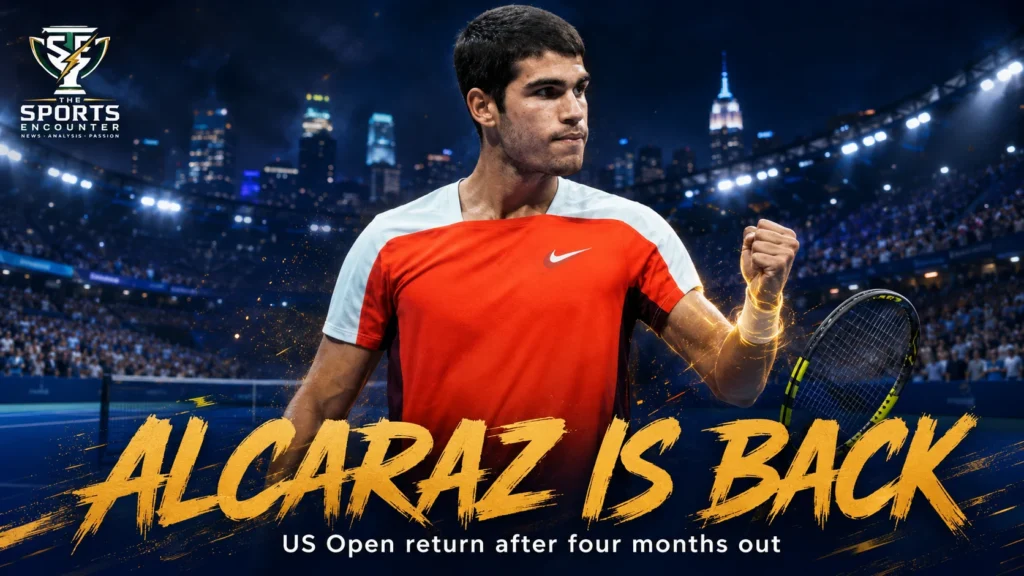
Carlos Alcaraz is coming back where some of his biggest memories were made.
After more than four months away from competitive tennis because of a wrist injury, the seven-time Grand Slam champion has confirmed that he will return at the 2026 US Open and attempt to defend the title he won in New York last year.
That sounds like the best possible comeback stage.
It is also one of the hardest.
Alcaraz has not played an official match since April. He withdrew from the Barcelona Open, missed Roland Garros and Wimbledon, and then sat out the North American hard-court events in Toronto and Cincinnati as his recovery took longer than originally hoped.
Instead of easing back through a smaller tournament, the 23-year-old will walk directly into a Grand Slam title defense at Flushing Meadows.
The official US Open entry list already had Alcaraz among the leading names expected in New York. His August 20 confirmation now removes the biggest uncertainty surrounding the defending champion.
For continuing player updates, injury news and Grand Slam analysis, follow The Sports Encounter’s tennis coverage.
Carlos Alcaraz’s US Open Comeback at a Glance
| Detail | Information |
|---|---|
| Player | Carlos Alcaraz |
| Age | 23 |
| Grand Slam titles | 7 |
| US Open titles | 2022, 2025 |
| Last competitive appearance | April 2026 |
| Injury | Wrist injury |
| Major events missed | French Open and Wimbledon |
| North American events missed | Toronto and Cincinnati |
| US Open singles main draw begins | August 30, 2026 |
| US Open ends | September 13, 2026 |
| Status | Defending men’s singles champion |
The Comeback Is Confirmed, but the Match-Rust Question Is Now Huge
Physical recovery and competitive readiness are not the same thing.
Alcaraz’s team has spent recent weeks gradually increasing his workload, including higher-intensity practice sessions with Holger Rune in Murcia.
That matters.
Practice can test the wrist.
It can test serving volume.
It can test forehand acceleration.
It can test whether Alcaraz is comfortable absorbing pace repeatedly.
What practice cannot fully reproduce is a five-set Grand Slam match with a scoreboard, a crowd and an opponent refusing to cooperate.
That is the central question heading into New York.
Alcaraz may arrive healthy enough to play.
How quickly can he become tournament sharp?
Why Missing Cincinnati Was Probably the Safer Decision
Alcaraz initially targeted Cincinnati for his comeback.
That would have given him competitive hard-court matches before New York and reduced some of the uncertainty around his timing.
Instead, he withdrew and gave the wrist more time.
That decision strengthened the doubts around his US Open defense at the time, which The Sports Encounter had already flagged while following the buildup to the Cincinnati Open.
In hindsight, the choice was understandable.
A Masters 1000 title is valuable.
A healthy wrist for a Grand Slam matters more.
The broader North American swing has repeatedly shown how elite players are prioritizing recovery over routine scheduling. We examined that trend when Jannik Sinner and Novak Djokovic skipped Montreal to manage their bodies before the US Open.
Alcaraz has now made the same basic calculation under more difficult circumstances.
He had an injury to manage, not simply fatigue.
New York Is Where Alcaraz Became Alcaraz
The US Open is not an ordinary comeback venue for him.
It is where his career changed scale.
In 2022, Alcaraz won his first Grand Slam title at Flushing Meadows and became the youngest ATP world No. 1 in history.
Three years later, he returned to New York and won the tournament again, defeating Jannik Sinner 6-2, 3-6, 6-1, 6-4 in the 2025 final.
The official US Open account of the 2025 final records a match in which Alcaraz controlled the biggest moments against the strongest hard-court rival of his generation.
The victory also returned him to the world No. 1 ranking.
That history gives his comeback emotional weight.
It also creates expectation.
The 2025 Final Is the Standard Alcaraz Has to Chase Again
Against Sinner last year, Alcaraz looked complete.
He attacked with the forehand.
He changed pace with the drop shot.
He defended with speed.
He moved forward decisively.
He served well enough to protect his attacking patterns.
Most importantly, he denied Sinner the repetitive baseline rhythm that makes the Italian so difficult to contain.
That version of Alcaraz can win New York again.
The unknown is how quickly that version can appear after four months without competition.
The Sports Encounter’s US Open 2026 curtain-raiser had already identified Alcaraz’s wrist and match fitness as the defining questions surrounding his title defense.
His confirmation answers the first question only partly.
He will play.
Now we need to see how he plays.
The Wrist Will Be Tested Immediately
The physical demands of Alcaraz’s game make the injury particularly important.
His forehand is one of his primary attacking weapons.
He generates heavy acceleration from uncomfortable positions and frequently changes direction at full speed.
His serve also places repeated stress through the wrist and forearm.
During a best-of-five match, those movements are repeated hundreds of times.
Then the player may have to recover and do it again two days later.
The first week in New York will therefore reveal more than the scoreline.
Watch the forehand.
Watch whether Alcaraz accelerates freely when stretched.
Watch the second serve under pressure.
Watch whether he protects the wrist or changes mechanics late in matches.
Those details will tell us more than a routine straight-sets first-round victory would.
Four Months Without Competition Changes the Equation
Elite tennis depends on patterns that training cannot perfectly reproduce.
Return timing.
Scoreboard pressure.
Reading an opponent’s serve.
Recovering emotionally after losing a set.
Managing long service games.
Handling a night session that finishes late.
Recovering again.
The danger for Alcaraz is not necessarily that his level will be poor.
It may be inconsistent.
A player with his talent can look brilliant for 40 minutes after a layoff.
Winning seven matches across two weeks requires something else.
Alcaraz Missed More Than Two Grand Slams
The injury interrupted the entire middle of his season.
He missed Roland Garros.
He missed Wimbledon.
He missed Toronto.
He missed Cincinnati.
That matters because the leading men’s players have spent those months accumulating match information.
They have competed against different styles.
They have experienced pressure.
They have adjusted to surfaces.
They have learned what parts of their games are working.
Alcaraz has been rehabilitating.
The difference is substantial.
Jannik Sinner Has Had Time to Strengthen His Position
While Alcaraz was absent, Sinner continued shaping the men’s game.
The Italian successfully defended Wimbledon and remained the player every major contender had to measure himself against.
The Sports Encounter’s complete review of Sinner’s Wimbledon title campaign showed how the Italian has developed into a player capable of controlling both tempo and pressure over two-week majors.
Sinner also represents the most obvious measuring stick for Alcaraz.
Their rivalry has increasingly defined men’s tennis.
Alcaraz’s absence did not stop that rivalry.
It simply gave Sinner months in which to continue moving.
Djokovic Is Still Hunting History
Alcaraz’s comeback also arrives while Novak Djokovic continues pursuing a 25th Grand Slam singles title.
The Serbian remains one of the great variables in any major draw.
At 39, his schedule is increasingly selective, but his Grand Slam motivation remains obvious.
Before the hard-court swing, The Sports Encounter examined why Cincinnati was supposed to shape Djokovic’s US Open record chase.
The broader point remains relevant even as the field changes.
Djokovic has experience Alcaraz cannot manufacture during rehabilitation.
Alcaraz has explosive athletic and tactical variety Djokovic can no longer simply absorb forever.
If they meet in New York, match fitness may become as important as reputation.
The Men’s Draw Is More Open Than It Looks
The US Open should not be reduced to Alcaraz, Sinner and Djokovic.
Taylor Fritz has built strong hard-court momentum, including his Mubadala DC Open title.
Alexander Zverev has already shown this season that his Grand Slam ceiling has changed.
Ben Shelton, Felix Auger-Aliassime, Alex de Minaur, Flavio Cobolli and several younger players have the serving and first-strike weapons to punish anyone who starts slowly.
The Canadian Masters underlined that instability when established favorites fell and younger contenders pushed deeper into the draw.
That matters for Alcaraz.
A rusty defending champion cannot assume the first week will give him time to find himself.
His Seed Will Help, but It Cannot Remove the Danger
A strong seeding should protect Alcaraz from the very biggest names in the opening rounds.
It cannot protect him from an inspired opponent.
The modern men’s game has enough depth that even a first-round draw can contain:
- a huge server;
- a former Top 20 player rebuilding his ranking;
- a dangerous qualifier already accustomed to the conditions;
- or a young player with nothing to lose.
That is why Alcaraz’s first two matches may be more revealing than usual.
A defending champion typically wants to conserve energy early.
Alcaraz may need those rounds to build rhythm.
The Mental Part of the Comeback Could Be Just as Important
Wrist injuries create another challenge that cannot be measured from outside.
Trust.
A player can be medically cleared and still think about the injury when stretching for a ball.
That hesitation can last a fraction of a second.
At Grand Slam speed, that is enough.
The best sign for Alcaraz will not be whether he talks confidently before the tournament.
It will be whether he swings aggressively when the score becomes uncomfortable.
If he protects the wrist only when he is tired or under pressure, opponents will notice.
Fabrizio Romano Gives Tennis the Full Transfer Treatment
Alcaraz’s announcement also produced one of the more entertaining crossover moments of the week.
Football transfer reporter Fabrizio Romano helped announce the comeback on Instagram using his trademark phrase:
“Here we go!”
The phrase normally signals that a major soccer transfer is effectively done.
This time it introduced one of tennis’s biggest returns.
It was playful, but it also reflected Alcaraz’s global status.
His comeback has become bigger than a routine tournament-entry update.
New York Has Already Given Alcaraz Two Different Versions of Greatness
His two US Open titles arrived at different stages of his career.
The 2022 championship was arrival.
A teenager became a Grand Slam champion and world No. 1.
The 2025 title was confirmation.
Alcaraz had already won majors on multiple surfaces and returned to New York as an established superstar capable of beating Sinner in a major final.
The 2026 tournament could become something else.
Recovery.
If he wins again after four months out, the title would carry a different kind of significance.
What Would Count as a Successful US Open?
For most defending champions, anything short of another trophy can feel disappointing.
Alcaraz’s situation requires more nuance.
If he arrives physically comfortable, survives several demanding matches and reaches the second week without aggravating the wrist, that alone would validate much of the recovery work.
A quarterfinal would restore match volume.
A semifinal would establish that he is already back among the leading major contenders.
A final would be extraordinary after this layoff.
Winning the title would become one of the most impressive comeback stories of his career.
That does not mean expectations should be lowered artificially.
Alcaraz is entering because he believes he can compete.
The standard remains high because the player remains exceptional.
Why Alcaraz’s Return Matters Beyond the US Open
Men’s tennis has developed around an increasingly clear rivalry between Alcaraz and Sinner.
Djokovic remains the historic giant trying to disrupt it.
Zverev has become more dangerous.
Younger players are moving quickly.
Alcaraz being healthy matters to the entire structure.
When he is absent, the men’s game loses its most unpredictable elite attacker.
Sinner can dominate through repetition and precision.
Alcaraz creates disorder.
He changes height, speed, position and geometry during the same rally.
That contrast makes the rivalry compelling.
The US Open Schedule Gives Him No Extra Recovery Time
The official 2026 US Open schedule confirms that the singles main draw begins Sunday, August 30 and runs through September 13.
Alcaraz therefore has little time remaining to move from practice intensity into Grand Slam readiness.
The tournament will not wait for him.
Once the first ball is struck, the rehabilitation story becomes a competitive story.
TSE Analysis: The Biggest Question Is Not Whether Alcaraz Can Win
Of course he can win.
His ceiling is too high to pretend otherwise.
He has already won the US Open twice.
He has already beaten Sinner in a New York final.
He has already shown that he can solve different surfaces and different styles.
The better question is whether he can reproduce that level for seven matches after four months without competition.
That is a much harder demand.
The first week will tell us whether his timing survived the layoff.
The second week, if he reaches it, will tell us whether his body can recover repeatedly.
Then the contenders get stronger.
Final Verdict: No Warm-Up, No Safety Net
Carlos Alcaraz wanted Cincinnati.
His wrist needed more time.
He listened.
Now there is nowhere else to hide.
The next competitive match he plays will come at the US Open, where he is defending the championship and where expectations around him are automatically enormous.
That is risky.
It is also completely consistent with the career Alcaraz has built.
New York was where he first became a Grand Slam champion.
New York was where he reclaimed the title in 2025.
Now New York becomes the place where he discovers what remains after four months away.
The wrist has been given time.
The training has intensified.
The comeback is official.
What nobody knows yet is whether Carlos Alcaraz is returning merely healthy enough to compete or ready enough to win seven matches again.
That question will begin receiving answers on August 30.
FAQs
Is Carlos Alcaraz playing at the 2026 US Open?
Yes. Alcaraz confirmed on August 20 that he will return to competitive tennis at the 2026 US Open after more than four months out with a wrist injury.
When did Carlos Alcaraz last play a competitive match?
His last competitive appearance came in April 2026 before the wrist problem forced him away from the tour.
Which tournaments did Alcaraz miss because of the injury?
He missed the French Open, Wimbledon, the National Bank Open in Toronto and the Cincinnati Open, among other events during his recovery period.
When does the US Open 2026 main draw begin?
The men’s and women’s singles main draws begin on Sunday, August 30, 2026.
Is Carlos Alcaraz the defending US Open champion?
Yes. He defeated Jannik Sinner in four sets in the 2025 men’s singles final to win his second US Open title.
When did Alcaraz win his first US Open?
Alcaraz won his first Grand Slam title at the 2022 US Open and became the youngest ATP world No. 1.
Did Alcaraz originally plan to return in Cincinnati?
Yes. Cincinnati had been targeted as a possible comeback tournament, but Alcaraz ultimately decided to give his wrist additional recovery time.
Has Alcaraz been practicing at full intensity?
His workload has increased gradually, and recent preparation included higher-intensity training with Holger Rune in Murcia. Competitive match conditions, however, remain a different test.
Can Alcaraz win the US Open after four months away?
He remains a genuine title contender because of his talent, history in New York and Grand Slam record, but match fitness, wrist durability and recovery between best-of-five matches will be major uncertainties.