


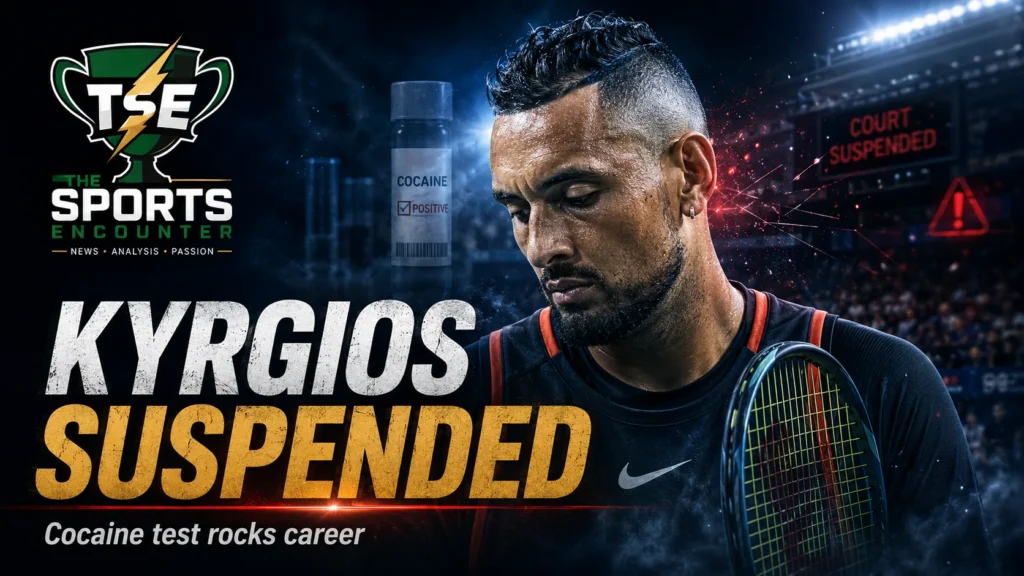
Nick Kyrgios has reached the most troubling crossroads of a career that once appeared capable of challenging tennis’s established order.
The former Wimbledon finalist has been provisionally suspended from professional tennis after testing positive for benzoylecgonine, a metabolite of cocaine, from a sample collected during the ATP 250 tournament in Mallorca on June 22, 2026.
The International Tennis Integrity Agency confirmed that a World Anti-Doping Agency-accredited laboratory returned the positive finding on July 17. Because cocaine is classified as a stimulant and a Substance of Abuse on the WADA Prohibited List and is prohibited in competition, Kyrgios was placed under a mandatory provisional suspension beginning August 4.
He has not appealed that provisional suspension.
Kyrgios has also accepted responsibility publicly, describing the positive test as a serious mistake while apologizing to his family, supporters, sponsors and young people who look up to him.
The immediate story is therefore clear: one of the most recognizable players of his generation has failed an anti-doping test and is temporarily barred from participating in professional tennis.
The larger story is considerably more complicated.
Kyrgios is 31. His body has been repeatedly damaged by injury. He has played only a small number of matches since the beginning of 2023, undergone major wrist reconstruction and knee procedures, watched his ranking collapse, and openly acknowledged struggling emotionally with the possibility that the career around which much of his identity was built may be approaching its end.
There is also an unavoidable reputational contradiction. Kyrgios was among the loudest critics of the anti-doping cases involving Jannik Sinner and Iga Swiatek. He repeatedly argued that tennis had an integrity problem and strongly criticized the handling of positive tests involving the game’s elite.
Now he is the player under suspension.
The Sports Encounter’s tennis coverage has followed the sport through Grand Slam triumphs, injury battles, comebacks and questions of competitive integrity. The Kyrgios case brings all of those themes together in one uncomfortable story about talent, accountability, physical decline and the decisions athletes make when professional certainty begins disappearing.
Nick Kyrgios Suspension: Key Facts
| Player | Nick Kyrgios |
| Age | 31 |
| Positive substance | Benzoylecgonine, a metabolite of cocaine |
| Sample collected | June 22, 2026, Mallorca |
| Laboratory confirmation | July 17, 2026 |
| Provisional suspension | Effective August 4, 2026 |
| Appeal | No appeal filed at time of ITIA announcement |
| Career-high singles ranking | World No. 13 |
| Best Grand Slam result | Wimbledon finalist, 2022 |
What Exactly Has Happened to Nick Kyrgios?
The official process matters because a provisional suspension is not the same thing as a final disciplinary sanction.
Kyrgios provided an anti-doping sample while competing at the Mallorca event in June. Analysis subsequently detected benzoylecgonine.
The International Tennis Integrity Agency, which administers anti-doping programs in professional tennis, announced the provisional suspension on August 19.
The agency stated that the suspension became effective on August 4 and is mandatory because of the substance involved.
Kyrgios had the right to appeal the provisional suspension but had not done so when the ITIA published its announcement.
That distinction is important.
The investigation and disciplinary process still have to determine the appropriate final outcome. A positive test does not automatically tell us every detail about when, why or under what circumstances a substance was consumed.
What is already established is that the prohibited metabolite was present in an in-competition sample and Kyrgios has publicly acknowledged using cocaine.
What Does WADA Say About Cocaine?
Cocaine falls under the stimulant section of the World Anti-Doping Agency’s Prohibited List.
It is also classified as a Substance of Abuse.
This classification matters because anti-doping regulations distinguish certain substances frequently consumed outside sport from substances primarily associated with performance enhancement.
The circumstances of use can therefore significantly affect the eventual sanction.
The ITIA specifically noted that reduced sanctions can apply to substances of abuse when an athlete establishes that consumption occurred out of competition and was unrelated to sporting performance.
That question will form part of whatever comes next.
For now, Kyrgios cannot compete.
What Kyrgios Cannot Do While Suspended
The consequences of the provisional suspension extend beyond entering an ATP singles tournament.
Kyrgios cannot play in, coach at or attend sanctioned professional tennis events covered by the applicable rules during his suspension.
That includes tournaments governed through the major international tennis structures, including ATP events and Grand Slam competition.
The official ATP Tour remains the primary governing platform for the men’s professional circuit and tournament calendar.
For a player already struggling to accumulate matches, that restriction carries an additional competitive cost.
A Career Already Fighting Against Time
The suspension did not interrupt a player operating near the peak of his powers.
It interrupted an attempted comeback that was already hanging by a thread.
Kyrgios’s physical decline has been dramatic.
At his best, his serve was among the most dangerous in tennis. His first-strike aggression, improvisation, touch and willingness to attempt shots other players would not consider made him one of the most naturally gifted competitors on tour.
Then came the injuries.
His wrist required reconstruction. His knee caused additional problems. Competitive appearances became increasingly rare.
The broader challenge resembles what other injury-hit players are discovering as the 2026 season reaches its final Grand Slam. The Sports Encounter recently examined Jack Draper’s battle to rebuild momentum after repeated physical setbacks, while Jannik Sinner’s knee injury has created a very different kind of uncertainty before the US Open.
For Kyrgios, however, injury has lasted long enough to change the question.
It is no longer simply whether he can return.
It is whether there is enough time left to reconstruct a meaningful elite career at all.
Wimbledon 2022 Now Feels Much Further Away
Kyrgios reached the Wimbledon singles final in 2022, losing to Novak Djokovic after producing the deepest Grand Slam run of his career.
For years, supporters had wondered what might happen if his talent, motivation, health and emotional control aligned for two uninterrupted weeks.
Wimbledon provided an answer.
He could contend for one of the sport’s greatest trophies.
That run remains the clearest evidence that Kyrgios’s reputation was never built purely on entertainment.
He possessed championship-level tennis.
The tragedy of the years that followed is how rarely his body allowed him to demonstrate it.
The Sports Encounter’s Wimbledon coverage regularly returns to the players whose careers were transformed by the grass-court major. Kyrgios belongs to that history even without lifting the trophy.
His influence also remains visible in the achievements of younger players. When Arthur Fery reached the Wimbledon quarterfinals this year, he became the first men’s wildcard since Kyrgios in 2014 to reach that stage.
That is what makes the current moment feel especially wasteful.
Kyrgios Had Actually Started Playing Again in 2026
There had been signs of life.
In June, Kyrgios returned to grass-court competition in Stuttgart and won his first match since January, beating Corentin Moutet in straight sets.
It was a modest result compared with his previous achievements, but emotionally it mattered.
Years of surgery and rehabilitation had made simply completing matches meaningful again.
His comeback remained fragile, but there was finally something to build on.
The positive Mallorca sample was collected later that month.
That chronology makes the suspension particularly damaging.
Kyrgios had spent years trying to get his body back onto a tennis court. Once he finally began competing more regularly, an off-court decision created another barrier.
The Sinner and Swiatek Comments Now Return to Haunt Him
No analysis of this case can avoid Kyrgios’s previous position on anti-doping.
He was outspoken when Jannik Sinner and Iga Swiatek became involved in separate anti-doping cases.
Kyrgios argued that the incidents damaged tennis’s credibility and questioned whether the sport was protecting its integrity strongly enough.
His language was severe.
That is why the present situation carries unavoidable irony.
Yet the cases themselves should not be lazily presented as identical.
Sinner’s 2024 case involved trace amounts of clostebol. The ITIA accepted an explanation involving inadvertent contamination through treatment administered by a member of his support team, while later proceedings involving WADA produced a settlement.
The Sports Encounter covered that complicated chapter in our complete analysis of Sinner’s rise and Wimbledon career.
Swiatek’s trimetazidine case involved contaminated medication and resulted in a one-month suspension.
Kyrgios has acknowledged cocaine use and accepted personal responsibility.
Different substances, different circumstances and potentially different levels of fault require separate legal and sporting analysis.
The reputational contradiction still stands.
A player who demanded accountability from others must now accept the same scrutiny himself.
Taking Responsibility Matters, but It Does Not Remove Consequences
Kyrgios has not attempted to portray himself as a victim of the anti-doping system.
That deserves recognition.
He acknowledged the positive test, called his behavior a major mistake and apologized.
Accountability begins there.
It does not end there.
Professional athletes operate inside rules designed to protect competition, participants and public confidence.
Accepting responsibility after a violation is better than denying the undeniable, but it cannot erase the violation itself.
The next stage is demonstrating what responsibility looks like through actions.
His Mental Health Context Cannot Be Ignored
Kyrgios has connected the incident to a period of significant emotional distress.
He described the physical toll of repeated injuries and the difficulty of accepting that his body could no longer do what his mind expected from it.
He also spoke about feeling helpless and alone while confronting the possibility that professional tennis may be nearing its end for him.
This deserves serious treatment rather than ridicule.
Kyrgios has previously spoken publicly about severe mental-health struggles earlier in his career, including suicidal thoughts and psychiatric treatment.
That history does not excuse a prohibited-substance violation.
It does help explain why framing the story entirely as hypocrisy or self-destruction would miss something important.
Elite athletes do not stop being psychologically vulnerable because they are famous, wealthy or talented.
Injury can remove routine, purpose, competition, social structure and identity simultaneously.
A player who has spent most of his life answering the question “Who are you?” with “a tennis player” can experience genuine disorientation when the body begins taking that identity away.
The Difficult Transition Athletes Rarely Prepare For
Professional sport teaches athletes how to chase the next match.
It is less effective at teaching them how to live when there may not be one.
Training structures the morning.
Tournaments structure the year.
Rankings provide measurement.
Coaches create routine.
Competition supplies adrenaline and public relevance.
Retirement, or even prolonged injury, can remove several of those pillars at once.
Kyrgios appears to be confronting that transition earlier and more painfully than he expected.
Other veterans approaching the same stage face their own versions of the problem. Cincinnati’s wild-card selections for aging stars and returning players recently led The Sports Encounter to examine how players such as Gael Monfils, Stan Wawrinka, Grigor Dimitrov and Jack Draper navigate opportunity, injury and the closing phases of careers.
Kyrgios’s situation is more serious because the sporting decline has now intersected with an anti-doping case.
How Bad Habits Can Destroy Promising Careers: A Lesson for Young Athletes
Young athletes should pay close attention to this story without reducing it to a lecture about one famous player.
Talent creates opportunity.
It does not protect anyone from consequences.
A professional career is built through thousands of small decisions made when nobody is watching.
Sleep matters.
Recovery matters.
Nutrition matters.
The people around you matter.
What you consume matters.
How you respond to disappointment matters.
The habits developed away from competition can eventually appear on the scoreboard, in medical reports, in relationships, in disciplinary hearings and in lost opportunities.
Substance misuse is especially dangerous because the damage can travel far beyond one night or one decision. It can affect health, judgment, training consistency, relationships, sponsorships, public reputation and eligibility to compete.
An athlete may spend 15 years building the physical ability required to reach the professional level and then place that work at risk through decisions made during moments of frustration, loneliness or poor judgment.
Kyrgios’s case also offers a second lesson.
When mental pressure becomes difficult to manage, seeking professional help is stronger than trying to numb the problem.
Young athletes are often taught toughness as if toughness means silence.
It does not.
Talking to a sports psychologist, therapist, doctor, coach, trusted family member or qualified support professional can protect both a career and a life.
The smartest young competitors build support systems before they desperately need them.
A promising career rarely collapses from one isolated weakness alone. Trouble usually grows when poor habits, unresolved stress, bad influences and secrecy begin reinforcing each other.
The better habit is asking for help early.
No trophy makes someone immune to addiction, depression, anxiety or destructive coping mechanisms.
No ranking makes treatment embarrassing.
No professional contract is worth sacrificing physical or psychological health.
If there is a useful lesson for the next generation in Kyrgios’s suspension, it is not simply “do not make mistakes.”
Young people will make mistakes.
The lesson is to build a life in which one bad decision does not become a pattern capable of consuming everything that took years to create.
The Difference Between Explaining and Excusing
This distinction is essential.
Understanding why someone made a destructive decision is not the same as declaring that the decision does not matter.
Kyrgios himself appears to understand that.
He provided context about injuries and emotional distress while explicitly refusing to use those circumstances as an excuse.
That is a healthier starting point than pretending mental health and accountability exist on opposite sides of an argument.
Both can be true.
A person can be struggling.
A person can also be responsible for his actions.
Tennis Has an Integrity Obligation Too
The governing bodies now have their own responsibility.
Kyrgios should be treated under the same published anti-doping framework that applies to every player.
His fame should neither increase nor decrease the sanction.
The circumstances, timing of consumption, degree of fault and applicable provisions for substances of abuse should determine the outcome.
That consistency matters because anti-doping credibility depends on transparent process rather than public anger.
Tennis has dealt with several major integrity controversies in recent seasons.
The sport cannot simultaneously ask players to trust its rules and then bend those rules according to popularity.
Kyrgios’s previous criticism of Sinner and Swiatek makes equal treatment especially important.
Could Kyrgios Still Come Back?
Yes, but the practical challenge grows harder with every interruption.
His age alone does not end the discussion.
Players increasingly compete successfully into their mid-to-late thirties.
Kyrgios’s problem is accumulated inactivity.
The tour does not wait.
Young players improve.
Rankings fall.
Entry into tournaments becomes harder.
Match fitness disappears faster than technical knowledge.
The Sports Encounter’s recent analysis of Novak Djokovic’s Cincinnati defeat highlighted how even one of the greatest players in history can struggle when competitive rhythm and physical preparation are interrupted.
Djokovic is attempting to manage age while remaining near the top.
Kyrgios is trying to rebuild from much further away.
The Ranking Problem Will Not Wait for Him
Years of limited competition have already devastated Kyrgios’s ranking position.
That affects tournament access.
A former Wimbledon finalist can receive wild cards because of reputation and commercial appeal, but wild cards are discretionary.
They are not a sustainable professional pathway.
Eventually a player needs results.
The suspension delays that process again.
Even if Kyrgios receives a relatively short final sanction, he will return older, with fewer competitive matches and another rehabilitation project ahead.
There Is Still a Version of This Story With a Better Ending
Professional sport loves comeback stories because they convert vulnerability into something measurable.
A ranking climbs.
A player wins.
A trophy returns.
Real recovery is usually less cinematic.
It may begin with treatment.
It may require stepping away from public attention.
It may involve accepting that professional tennis is no longer the center of everything.
Kyrgios has said he intends to withdraw from social media and public life temporarily while focusing on getting himself into a better place.
That may prove more important than rushing toward another comeback announcement.
Kyrgios’s Legacy Was Complicated Before This Case
Few players of his generation have divided opinion so consistently.
Supporters saw originality, honesty and extraordinary talent.
Critics saw wasted ability, disciplinary issues and unnecessary conflict.
Both groups had evidence.
Kyrgios could produce tennis of astonishing quality against the greatest players in the world.
He could also become consumed by arguments, distractions and self-created chaos.
The cocaine case will inevitably become another chapter in that debate.
It should not erase the quality of his tennis.
It will affect how the career is remembered if this becomes one of its final major episodes.
His Own Words About Integrity Now Carry Greater Weight
Kyrgios spent years insisting that professional tennis must protect its credibility.
That principle should still stand.
Integrity is not invalid because a person who advocated for it later violates the rules himself.
Instead, the principle becomes a test.
Does Kyrgios accept the system when it applies to him?
So far, he has not appealed the provisional suspension and has publicly accepted responsibility for the positive test.
The final disciplinary process will tell us more.
What Happens Next?
The provisional suspension remains in place while the anti-doping case proceeds.
The ITIA will continue applying the Tennis Anti-Doping Programme, and the eventual sanction will depend on the established facts and relevant provisions.
Until that process is completed, speculation about an exact ban should be treated cautiously.
What is certain is that Kyrgios cannot simply return to competition immediately.
His sporting future is once again on hold.
TSE Verdict: This Is Bigger Than a Failed Drug Test
Nick Kyrgios made a serious mistake.
He says so himself.
There is little value in pretending otherwise.
There is equally little value in reducing the entire story to ridicule, hypocrisy or another punchline in a career already filled with controversy.
Kyrgios is a 31-year-old athlete confronting several difficult realities simultaneously.
His body has repeatedly failed him.
His ranking has collapsed.
His competitive identity is disappearing.
His mental health has been fragile before.
Now his own decision has created a disciplinary problem that medical rehabilitation alone cannot fix.
The contradiction with his previous anti-doping criticism is real and deserves scrutiny.
So does the human being behind it.
The most useful response is neither absolution nor humiliation.
It is accountability combined with perspective.
For tennis, that means applying the rules consistently.
For Kyrgios, it means demonstrating that his apology leads somewhere.
For younger athletes watching, the lesson may be even more valuable.
Ability can open extraordinary doors.
Discipline helps keep them open.
When pressure, injury or loneliness become overwhelming, asking for help before destructive choices become habits can preserve far more than a sporting career.
Kyrgios may still return to professional tennis.
He may even produce another memorable chapter.
Right now, though, the most important comeback is not measured in aces, rankings or trophies.
It is getting himself healthy enough, physically and mentally, to decide what the rest of his life should look like.
Frequently Asked Questions
Why has Nick Kyrgios been provisionally suspended?
Kyrgios was provisionally suspended after an in-competition sample collected during an ATP 250 tournament in Mallorca tested positive for benzoylecgonine, a metabolite of cocaine.
When was Kyrgios tested?
The sample was collected on June 22, 2026.
When did the Nick Kyrgios suspension begin?
The ITIA says his mandatory provisional suspension has been in effect since August 4, 2026.
Has Nick Kyrgios appealed the suspension?
At the time the ITIA announced the case on August 19, Kyrgios had not appealed his provisional suspension.
Is cocaine banned in tennis?
Yes. Cocaine is classified as a stimulant and Substance of Abuse on the WADA Prohibited List and is prohibited in competition under tennis anti-doping rules.
Has Nick Kyrgios admitted using cocaine?
Yes. Kyrgios publicly acknowledged the positive test and said he took full responsibility for his actions.
Can Nick Kyrgios play at the US Open while suspended?
No. A player under provisional suspension cannot compete in sanctioned events while that suspension remains in force.
Can Kyrgios coach or attend professional tennis events?
The ITIA says the suspension prevents him from playing in, coaching at or attending covered professional tennis events during the period of suspension.
What is Nick Kyrgios’s best Grand Slam result?
Kyrgios reached the Wimbledon men’s singles final in 2022, where he lost to Novak Djokovic.
What is Nick Kyrgios’s career-high ranking?
Kyrgios reached a career-high ATP singles ranking of world No. 13 in 2016.
Why is the Kyrgios case controversial given his comments about Sinner and Swiatek?
Kyrgios had previously been highly critical of anti-doping cases involving Jannik Sinner and Iga Swiatek. His own positive test therefore creates an obvious reputational contradiction, although the substances, circumstances and anti-doping findings involved in the three cases are different.
Will Nick Kyrgios receive a permanent ban?
No final sanction has been announced. The case remains at the provisional-suspension stage, and the eventual outcome will depend on the anti-doping process and the circumstances established by the ITIA.
Could Nick Kyrgios return to tennis?
Potentially. His ability to return will depend on the final anti-doping outcome, his physical condition and whether he chooses to continue his professional career.
Where can readers follow official updates about the case?
Official anti-doping updates are published by the International Tennis Integrity Agency, while WADA maintains the Prohibited List and the ATP provides information about the men’s professional tour.