


Ten years ago, Leicester City were the most improbable champions English football had ever seen.
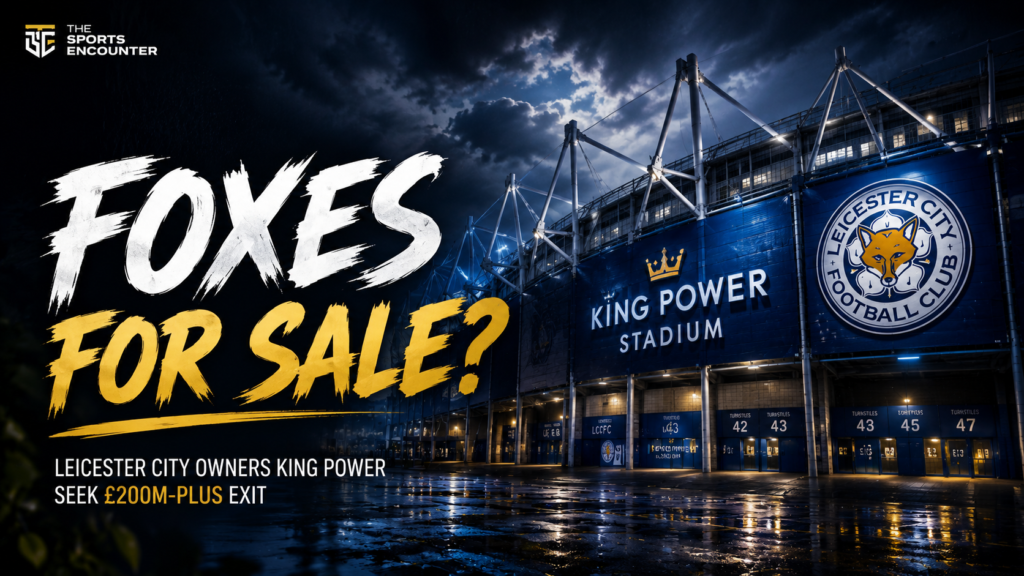
Today, the club that turned 5,000-1 odds into a Premier League trophy is playing in League One while the ownership group that built that miracle prepares to test the market for a sale worth more than £200 million.
King Power’s potential exit would close one of the most extraordinary ownership cycles in modern football: promotion, a Premier League title, Champions League nights, an FA Cup, tragedy, enormous infrastructure investment, mounting financial losses and, finally, successive relegations into England’s third tier.
Reuters reported Thursday, citing the BBC, that Leicester City’s Thai owners are looking to sell after 16 years in control. Investment bank Citigroup has reportedly circulated an eight-page sales document known as “Project Lineup” to prospective investors, presenting Leicester as much more than a struggling League One football team.
The package reportedly includes the men’s team, Leicester City Women, the academy, King Power Stadium, the club’s Seagrave training complex and Belgian sister club OH Leuven.
The headline figure is eye-catching. The context behind it is even more revealing.
A club that won the Premier League in 2016 and competed in the Champions League quarterfinals a year later can now be discussed at a valuation comparable to the cost of two elite Premier League players.
That says as much about Leicester City’s fall as it does about the economics of modern football.
TL;DR: Leicester City Sale Explained
- King Power are reportedly looking to sell Leicester City after owning the club since 2010.
- Reuters, citing the BBC, says the owners are seeking more than £200 million.
- Citigroup has reportedly circulated an eight-page sales document titled “Project Lineup.”
- The wider portfolio includes the men’s and women’s teams, King Power Stadium, academy facilities, Seagrave training ground and Belgian club OH Leuven.
- Leicester are preparing for life in League One after back-to-back relegations in 2025 and 2026.
- The club posted a £71.1 million pre-tax loss for the year ending June 2025.
- A six-point deduction for financial-rule breaches significantly damaged Leicester’s Championship survival fight last season.
- No sale has been completed and Leicester City had not publicly confirmed a buyer at the time of publication.
Leicester City Sale: What We Know
| Key Detail | Current Position |
|---|---|
| Current owner | King Power |
| Ownership began | 2010 |
| Reported sale adviser | Citigroup |
| Sales project | Project Lineup |
| Reported asking level | More than £200 million |
| Separate reported portfolio figure | Approximately £222 million |
| Current division | League One |
| 2024-25 pre-tax loss | £71.1 million |
| Major assets reportedly included | King Power Stadium, Seagrave, academy, LCFC Women, OH Leuven |
| Sale completed? | No confirmed transaction |
This Is More Than a Football Club Being Marketed
The most important detail inside the reported sale process is the asset package.
King Power is not attempting to market only a League One squad carrying the scars of consecutive relegations.
Reports around Project Lineup describe a wider football platform containing infrastructure that many clubs outside the Premier League could only dream of owning.
The King Power Stadium remains a modern 32,000-seat venue with Premier League history and established matchday infrastructure.
Then there is Seagrave.
Leicester moved into the training complex in 2020 after investing heavily in a facility designed for a club expecting to remain among England’s strongest organizations. The campus includes elite training pitches, performance facilities, medical and sports-science infrastructure, academy accommodation and operational space built for top-flight football.
Reported valuations connected to the sales brochure place Seagrave among the club’s most valuable physical assets.
The portfolio also reportedly incorporates Leicester’s Category One academy, the women’s team and OH Leuven, the Belgian club within King Power’s wider football structure.
That creates an unusual investment proposition.
A buyer would be acquiring a third-tier club with first-tier infrastructure.
The £200 Million Figure Needs Context
Headlines describing Leicester City as a £200 million-plus football club risk creating the impression of a straightforward asking price.
The reality appears more nuanced.
Reuters, citing BBC reporting, says King Power are looking to sell for more than £200 million. Separate reporting around the Citigroup brochure has placed the intended value of the wider portfolio at approximately £222 million.
Other reports suggest prospective buyers may negotiate substantially below that level because Leicester’s sporting position has deteriorated so dramatically.
That distinction matters.
A valuation is an expectation.
A sale price is what a buyer ultimately agrees to pay after examining revenue, costs, liabilities, property, squad value, league status, regulatory risk and the amount of capital required after acquisition.
No completed deal currently establishes Leicester’s actual market value.
The Alexander Isak Comparison Shows How Strange Football Economics Have Become
The easiest way to understand how dramatically football money has changed is to compare Leicester’s reported valuation with the transfer market.
Liverpool paid £125 million for Alexander Isak in 2025, making him the most expensive incoming signing in Premier League history. The Sports Encounter’s analysis of the Premier League’s five most expensive transfers found that Isak, Morgan Rogers, Florian Wirtz, Elliot Anderson and Moisés Caicedo carry a combined maximum reported value approaching £590 million.
Leicester’s entire reported portfolio could potentially change hands for an amount not dramatically larger than the cost of one superstar striker.
That comparison should not be pushed too far. Buying a football club means acquiring operating costs, obligations, risks and future capital requirements along with the assets.
It still captures something important about modern football.
Player prices at the top of the Premier League have risen so sharply that the value of a historic former champion in League One can suddenly look surprisingly modest.
Compare Leicester With Liverpool and the Gap Becomes Enormous
The timing of the Leicester sale story makes another comparison impossible to ignore.
Days earlier, The Sports Encounter examined the reported minority investment that could value Liverpool at roughly £4.4 billion to £4.5 billion.
Leicester and Liverpool are obviously different commercial properties today, but both clubs were bought by their current owners in 2010.
Since then, Liverpool have expanded into one of global football’s most valuable brands while Leicester travelled through a much more volatile cycle.
King Power reached a sporting peak almost nobody believed possible.
The difficulty came in sustaining the financial model required to remain there.
King Power Bought Leicester Before the Miracle Existed
It is important not to judge the ownership entirely through the collapse of the past few seasons.
King Power founder Vichai Srivaddhanaprabha bought Leicester from Milan Mandaric in 2010 when the club was still operating in the Championship.
The transformation was rapid.
Leicester reached the Premier League in 2014 after a decade outside the top division. They survived a major relegation battle in their first season back before Claudio Ranieri arrived that summer.
What followed remains almost impossible to explain through normal football logic.
Bookmakers had offered odds of 5,000-1 on Leicester winning the 2015-16 Premier League.
Jamie Vardy scored relentlessly.
Riyad Mahrez became one of the league’s most dangerous creators.
N’Golo Kanté covered midfield space with extraordinary intensity.
Kasper Schmeichel, Wes Morgan, Robert Huth, Danny Drinkwater, Marc Albrighton and Shinji Okazaki formed the spine of a team that consistently made wealthier opponents look uncomfortable.
Leicester finished the job and became English champions for the first time.
The club marked the tenth anniversary of that achievement earlier this year with a legends match at King Power Stadium, a reminder that the 5,000-1 title remains central to Leicester’s identity.
The Champions League Proved Leicester Were More Than a One-Season Story
The 2016 title was followed by Leicester’s first Champions League campaign.
They reached the quarterfinals in 2017 before Atlético Madrid ended the run.
That mattered because Leicester had moved from fighting relegation to facing Europe’s elite in less than three years.
For a brief period, King Power’s ownership model looked like one of football’s great success stories.
The club bought intelligently, developed players, sold stars at enormous profits and reinvested.
Kanté left for Chelsea.
Drinkwater followed.
Mahrez moved to Manchester City.
Harry Maguire joined Manchester United for a world-record fee for a defender at the time.
Ben Chilwell later moved to Chelsea.
Leicester kept rebuilding.
Vichai’s Death Changed the Emotional Center of the Club
Football finances cannot explain everything that happened during the King Power era.
On October 27, 2018, Vichai Srivaddhanaprabha died when his helicopter crashed outside King Power Stadium after a Leicester home match.
Four other people also died.
The tragedy shook the club, the city and supporters far beyond Leicester.
Vichai had developed an unusually close relationship with the fanbase. His ownership combined ambition with visible community involvement, and players repeatedly spoke about the personal connection he created inside the club.
His son Aiyawatt Srivaddhanaprabha subsequently assumed leadership.
Leicester continued competing at a high level.
The 2021 FA Cup Should Not Be Lost Inside the Story of Decline
Five years after the Premier League title, Leicester created another historic moment.
Youri Tielemans’ long-range strike against Chelsea at Wembley delivered the club’s first FA Cup in 2021.
Leicester also finished fifth in the Premier League in consecutive seasons under Brendan Rodgers, narrowly missing Champions League qualification both times.
At that point, the club looked established immediately below England’s richest teams.
The Premier League landscape has only become more financially aggressive since. The Sports Encounter’s analysis of the current title contenders shows how much squad depth and spending capacity are now required simply to remain around the elite positions.
Leicester tried to close that gap.
That decision became part of the problem.
Where Leicester’s Financial Model Started to Break
For years, Leicester’s recruitment structure depended partly on profitable player trading.
The club could buy well, develop talent and eventually sell a major asset for significantly more than the original fee.
That process helped finance the next cycle.
A change around 2021 disrupted the model.
Leicester began spending more aggressively while generating less from outgoing transfers. Patson Daka, Boubakary Soumaré and Jannik Vestergaard arrived during a summer in which the club tried to strengthen rather than continue selling key players.
The expected sporting leap did not arrive.
Financial pressure did.
The club later returned to high-value sales, including Wesley Fofana’s move to Chelsea, but the accumulated cost base and declining sporting results had already created serious problems.
Leicester City’s Recent Financial Results
| Financial Year | Reported Pre-Tax Result | Context |
|---|---|---|
| 2022-23 | Approximately £89.5m loss | Season ended in Premier League relegation |
| 2023-24 | £19.4m loss | Championship season ending in promotion |
| 2024-25 | £71.1m loss | Premier League season ending in relegation |
Leicester’s own 2024-25 financial statement reported a £71.1 million loss before tax, compared with £19.4 million the previous year.
The club stressed that the headline loss did not tell the whole story. Its underlying operating position improved, while staff costs fell to 82% of turnover from more than 100% the previous year.
That context matters, but so does the direction of travel.
A club trying to finance Premier League-level infrastructure and wages becomes increasingly vulnerable when broadcast income collapses through relegation.
The Six-Point Deduction Made a Bad Season Worse
Leicester’s problems eventually moved from accounting statements into the league table.
In February 2026, an independent commission recommended a six-point deduction for breaches of financial rules. The EFL subsequently applied the sanction.
Leicester appealed.
The deduction remained in place.
That penalty significantly reduced the margin for error during a Championship campaign already heading in the wrong direction.
It would be too simplistic to blame relegation entirely on six points.
The football operation had deeper problems. Results declined, defensive reliability disappeared and a highly paid squad failed to perform consistently enough for a club expecting to challenge near the other end of the table.
The deduction turned those weaknesses into an even more dangerous survival fight.
Three Relegations in Four Seasons Tell the Real Story
The trajectory becomes particularly stark when compressed into a timeline.
| Year | Leicester City Milestone |
|---|---|
| 2010 | King Power acquires Leicester City |
| 2014 | Promoted to the Premier League |
| 2016 | Wins Premier League at preseason odds of 5,000-1 |
| 2017 | Reaches Champions League quarterfinals |
| 2018 | Owner Vichai Srivaddhanaprabha dies in helicopter crash |
| 2021 | Wins first FA Cup |
| 2023 | Relegated from Premier League |
| 2024 | Wins Championship and returns immediately |
| 2025 | Relegated from Premier League again |
| 2026 | Six-point deduction and relegation from Championship to League One |
| August 2026 | King Power reportedly begins active sale process |
The back-to-back relegations in 2025 and 2026 place Leicester among a small group of clubs to fall directly from the Premier League into League One across consecutive seasons.
The wider English football environment remains unforgiving. Our 2026-27 Premier League preview shows how quickly promoted teams, established clubs and relegated sides can move between financial realities depending on a single season’s outcome.
Why Leicester Could Still Be Attractive to Investors
League One status weakens Leicester’s value, but it does not erase the reasons an investor might be interested.
1. Premier League infrastructure already exists
A buyer would not need to build a training operation from scratch.
Seagrave already exists.
King Power Stadium already exists.
The academy structure already exists.
That matters because infrastructure projects can consume years and enormous amounts of capital before generating any competitive return.
2. Leicester still have a recognizable global brand
The 2016 championship changed the club’s international identity permanently.
Football fans across Asia, North America, Africa and Europe know Leicester City because they remember the team that broke the Premier League’s normal hierarchy.
That recognition has commercial value even after relegation.
3. Promotion creates enormous upside
English football’s pyramid makes lower-league ownership unusually attractive to some investors.
A successful rebuild can move a club from League One television economics toward Championship revenue and eventually into the Premier League’s much larger broadcast ecosystem.
That potential explains why investors continue examining English clubs outside the top division.
4. The academy can remain a strategic asset
Leicester have a long record of developing or identifying players capable of competing at higher levels.
A well-run academy can support the first team while also creating transfer value.
5. Multi-club infrastructure is already present
OH Leuven gives the ownership structure an existing foothold in Belgian football.
That can provide scouting, development and regulatory options for a buyer interested in a wider football network.
Why a Buyer Would Still Need to Be Extremely Careful
The assets are attractive.
The turnaround is not simple.
Leicester’s next owner would inherit a club whose costs were built during a period of much higher revenue.
Squad contracts may need restructuring.
Recruitment requires discipline.
Promotion pressure will be immediate.
Supporter trust has weakened after years of poor results and boardroom criticism.
Financial-rule compliance will remain central to every major decision.
English football has provided repeated warnings that ownership ambition without financial control can quickly become a sporting penalty. The Sports Encounter recently examined another version of regulatory risk when Chelsea were fined £10 million and handed a suspended registration ban over historical rule breaches.
The Leicester case is different, but the underlying lesson is relevant.
Governance eventually reaches the pitch.
What Any Leicester Buyer Must Solve
- ☐ Build a squad capable of immediate League One promotion.
- ☐ Reduce the wage structure to a sustainable level without destroying competitiveness.
- ☐ Rebuild recruitment around resale value and football fit.
- ☐ Protect and maximize Seagrave and the academy.
- ☐ Restore supporter trust after three relegations in four seasons.
- ☐ Maintain full compliance with EFL and Premier League financial rules.
- ☐ Decide whether OH Leuven remains strategically useful.
- ☐ Determine whether the postponed King Power Stadium expansion still makes financial sense.
- ☐ Create a realistic path from League One to the Premier League rather than funding another unsustainable shortcut.
The Premier League Arms Race Helps Explain Leicester’s Failure to Stay Near the Top
Leicester’s decline happened partly because the financial level required to compete near the Premier League’s leading clubs kept rising.
The biggest teams spend nine-figure sums on individual players.
Infrastructure investment continues.
Wages climb.
Squad depth increasingly determines whether clubs can survive domestic and European schedules simultaneously.
The Sports Encounter’s analysis of Newcastle’s latest rebuild showed how even a club backed by enormous ownership wealth remains constrained by financial-sustainability rules, transfer choices and the cost of retaining elite talent.
Leicester were trying to compete inside that same environment without the global commercial scale of Liverpool, Manchester United or Arsenal.
The 2016 team proved football can still produce an extraordinary sporting exception.
Maintaining that exception for a decade requires a different financial equation.
The Sale Also Reflects a Wider Shift in Football Ownership
Football clubs increasingly attract investors for reasons that stretch beyond ticket sales and broadcasting.
Global audiences, digital media, intellectual property, real estate, multi-club networks, sponsorship, direct-to-consumer commerce and international events all influence valuations.
The Sports Encounter’s Liverpool investment analysis showed how a global elite club can now command a multi-billion-pound valuation.
At the same time, investors are also searching below the top tier for distressed or undervalued assets with promotion potential.
Leicester sits directly between those worlds.
Its current league status suggests distress.
Its facilities and history suggest scale.
That contradiction may become the strongest part of the investment case.
King Power’s Legacy Cannot Be Reduced to the Final League Table
If the sale goes through, supporters will argue for years about how the King Power era should be remembered.
Some will focus on the ending.
Three relegations in four seasons.
Financial penalties.
Recruitment failures.
Falling attendances and visible anger at the board.
Those failures deserve scrutiny.
They do not erase what happened before them.
King Power bought Leicester in the Championship.
The club became Premier League champions.
It reached a Champions League quarterfinal.
It won the FA Cup.
It built one of England’s most sophisticated training bases.
The ownership invested hundreds of millions of pounds into the club, with Leicester’s 2023-24 accounts stating that Aiyawatt Srivaddhanaprabha’s overall investment had exceeded £420 million following debt-to-equity conversions.
That makes this a much more complicated ownership story than success followed by failure.
King Power changed what Leicester supporters believed their club could become.
The painful part is how quickly that belief became difficult to sustain.
TSE Analysis: The Real Leicester Sale Story Is the Gap Between Asset Value and Football Value
A training ground can be valued.
A stadium can be valued.
Land can be valued.
A player can be assigned a transfer price.
A football club is harder.
Leicester City today contains two competing valuations.
The physical organization still resembles a Premier League club.
The sporting organization is in League One.
That mismatch explains both the opportunity and the risk.
A buyer who believes the infrastructure makes promotion highly achievable may see an undervalued asset. An investor who sees recurring losses, regulation, supporter unrest and an expensive squad rebuild may conclude that the headline price is only the beginning of the required commitment.
This is also why comparing Leicester directly with the £4.4 billion Liverpool valuation can be informative without pretending the clubs occupy the same market.
Liverpool’s valuation reflects decades of global brand equity reinforced by continued elite competition.
Leicester’s reported price reflects the damage caused when a club loses access to the Premier League revenue machine twice in succession.
Promotion would immediately begin changing that equation.
Another failed season would push it in the opposite direction.
What Happens Next?
The first question is whether Citigroup’s reported outreach generates credible bidders.
Interested parties will need access to detailed financial information before deciding whether Leicester’s assets justify the asking level.
King Power then faces a choice.
It can accept an offer that reflects Leicester’s current third-tier position, wait for a stronger valuation, seek outside investment without fully exiting, or continue funding a rebuild in the hope that promotion restores some of the club’s lost value.
Nothing currently guarantees a completed sale.
For Leicester supporters, that uncertainty arrives while the team itself has an immediate football problem to solve.
League One does not care that Leicester won the Premier League ten years ago.
The club must earn its way back.
Readers can follow the wider economics, transfers and ownership developments shaping English football through The Sports Encounter’s soccer coverage and our complete 2026-27 Premier League guide.
Frequently Asked Questions
Are Leicester City officially for sale?
Reports say King Power are actively exploring a sale and that Citigroup has circulated a sales brochure to potential investors. Leicester City had not announced a completed sale or buyer at the time of publication.
How much are Leicester City worth?
Reuters, citing the BBC, reports that King Power are looking for more than £200 million. Separate reports concerning the Project Lineup sales brochure have put the wider portfolio asking level at approximately £222 million. A final market value will only become clear if a transaction is agreed.
What is Project Lineup?
Project Lineup is the reported name of an eight-page sales document prepared by Citigroup to market Leicester City and associated assets to prospective investors.
What assets are reportedly included in a Leicester City sale?
Reports identify the men’s team, Leicester City Women, the academy, King Power Stadium, Seagrave training facilities and Belgian sister club OH Leuven among the wider portfolio.
Who owns Leicester City?
Thai travel retail company King Power has controlled Leicester City since 2010. The Srivaddhanaprabha family has led the ownership throughout that period.
When did Leicester City win the Premier League?
Leicester won the Premier League in the 2015-16 season after beginning the campaign at preseason odds of 5,000-1.
Why are Leicester City in League One?
Leicester were relegated from the Premier League in 2025 and then suffered a second consecutive relegation from the Championship in April 2026. A six-point financial-rule deduction made their survival challenge more difficult, although poor results across the season were also decisive.
How much money did Leicester lose in 2024-25?
The club’s official financial statement reported a £71.1 million pre-tax loss for the year ending June 30, 2025.
Why did Leicester receive a six-point deduction?
An independent commission imposed the deduction following breaches of financial regulations. Leicester appealed the sanction, but the six-point penalty was ultimately upheld.
Did King Power invest heavily in Leicester?
Yes. Leicester’s own accounts said Aiyawatt Srivaddhanaprabha’s overall investment in the club had exceeded £420 million by early 2025, including debt converted into equity.
Could Leicester City become valuable again if they return to the Premier League?
Potentially. Premier League status dramatically increases broadcasting revenue, sponsorship exposure and commercial opportunities. The scale of any future valuation would still depend on finances, debt, squad value, infrastructure, performance and investor demand.
From 5,000-1 to the Open Market
Leicester City’s greatest achievement will never lose its value because of what happens next.
The 2016 title remains one of football’s rare moments when the financial hierarchy failed to predict the sporting outcome.
King Power helped make that possible.
The same ownership now appears ready to consider ending its relationship with the club after one of the most dramatic rises and falls English football has seen.
A £200 million-plus sale would put a financial number beside that story.
It could never fully price it.
The next owner would inherit a League One team, Premier League infrastructure, a global underdog identity, wounded supporters and an immediate demand to rebuild.
For the right buyer, that combination could represent an extraordinary opportunity.
For King Power, it may represent the final chapter of an era that delivered more joy than anyone imagined in 2010 and ended much further down the football pyramid than anyone imagined in 2016.