


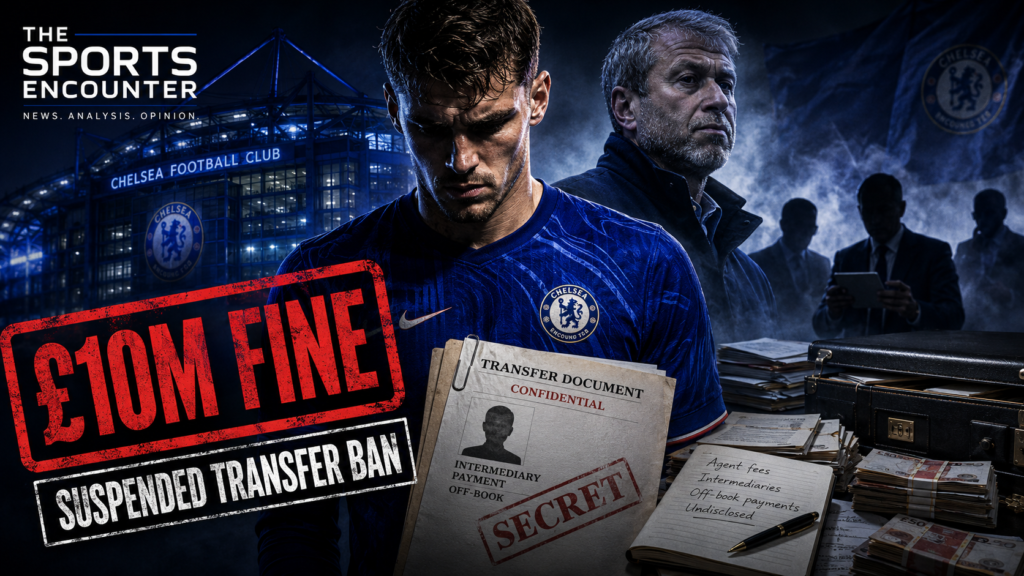
Chelsea can continue signing players, but the club is now operating under a suspended two-window registration ban after admitting 74 breaches of Football Association rules involving agents, intermediaries, third-party investment, and concealed transfer payments during Roman Abramovich’s ownership.
Chelsea have been fined £10 million and handed a suspended two-window transfer ban after one of the largest investigations ever conducted by the Football Association uncovered years of improper transfer activity under the club’s former ownership.
The case covers 44 transactions involving 32 players and stretches from July 2009 to August 2022. Most of the misconduct occurred between the 2010/11 and 2015/16 seasons, when Roman Abramovich owned the club and Chelsea were competing aggressively for the Premier League, Champions League, and Europe’s most sought-after players.
An independent Regulatory Commission initially imposed a six-point Premier League deduction, suspended until June 30, 2027, alongside the £10 million fine.
Chelsea appealed the points sanction successfully.
An independent Appeal Board removed the suspended deduction and replaced it with a ban preventing the club from registering players during two complete and consecutive transfer windows. That ban is also suspended until June 30, 2027.
The immediate consequence is clear: Chelsea remain free to buy and register players.
The longer-term warning is equally important. Another breach of the same or a similar nature during the suspension period could activate the registration ban and seriously disrupt a recruitment model built around frequent transfers, young players, long contracts, and high-value trading.
The official Football Association ruling on Chelsea’s 74 breaches confirmed that the £10 million fine was not appealed and will be invested in grassroots football.
Chelsea’s FA Punishment at a Glance
| Key issue | Confirmed detail |
|---|---|
| FA charges | 74 breaches of FA Rule E1.2 |
| Transactions involved | 44 |
| Players involved | 32 |
| Period covered | July 2009 to August 2022 |
| Main period of misconduct | 2010/11 to 2015/16 |
| Financial sanction | £10 million |
| Original sporting sanction | Suspended six-point deduction |
| Final sporting sanction | Suspended two-window registration ban |
| Suspension expires | June 30, 2027 |
| Can Chelsea sign players now? | Yes |
| Who reported the misconduct? | Chelsea’s current ownership after the 2022 takeover |
| Further investigations | The FA continues to investigate possible individual misconduct |
What Chelsea Admitted
The case goes far beyond a small accounting discrepancy or several forms completed incorrectly.
Chelsea admitted breaches of rules governing football agents, intermediaries, and third-party investment in players. The FA’s case involved payments, relationships, and agreements that were either not declared correctly or were structured in ways that concealed the true people involved in transfer activity.
Unauthorized agents or unregistered intermediaries were sometimes involved in transactions without their work being properly reported.
Official documents could omit an intermediary, identify a different authorized representative, or fail to reveal the complete financial arrangement behind a player’s registration.
Some payments reportedly passed through entities associated with Abramovich rather than appearing transparently in Chelsea’s own football accounts.
The Regulatory Commission concluded that the misconduct helped Chelsea acquire players and provided a sporting advantage. That assessment explains why the first decision included a suspended points deduction rather than relying on a financial penalty alone.
Transfer compliance matters because recruitment directly affects results. A club that uses concealed financial arrangements to obtain players may gain an advantage unavailable to competitors following the rules.
The issue becomes even more significant when viewed alongside Chelsea’s modern recruitment strategy. The club continues to invest heavily in players such as Geovany Quenda, who joined Chelsea’s long-term project through 2034.
How the Undisclosed Payment Arrangements Worked
The exact structure differed across the 44 transactions, but the regulatory findings reveal a recurring pattern.
An agent, adviser, or intermediary would help Chelsea secure a player. That person might not hold the authorization required to appear officially in the transaction.
A payment connected with the work could then be made through another person, a separate agreement, or an entity linked with the former owner.
The documents submitted to regulators might record that an authorized agent had performed the work or state that no intermediary had participated.
This created two versions of the transaction.
The official version appeared in the paperwork supplied to the football authorities. The wider financial reality included people, payments, or agreements that were not fully disclosed.
The written reasons used severe language when describing some of the conduct. The Regulatory Commission found that senior individuals during the previous regime had shown disregard for the rules while attempting to secure registrations.
The case also involved third-party investment regulations, which exist to prevent external parties from holding prohibited economic interests in players or influencing their future transfers.
These rules protect competitive integrity. Clubs must know who receives money from a deal, who represents each party, and whether an outside investor holds rights capable of affecting a player’s career.
Thirty-Two Players and 44 Transactions Were Involved
The FA’s public announcement did not name every player connected with the case.
The appeal documents refer to transactions involving 32 different players. Eighteen were minors at the relevant time, and 24 transactions involved those young players.
The inclusion of minors gives the case another serious dimension.
International youth recruitment has long been one of football’s most sensitive regulatory areas. Payments to relatives, family friends, representatives, or third parties can influence where a young player signs before the player or family fully understands the commercial consequences.
Regulators therefore require clubs to disclose intermediary activity and protect families from hidden financial interests.
The case documents specifically discuss Samuel Eto’o and Willian in connection with third-party investment issues. Previous investigations and media reporting have also examined payments connected with several major Abramovich-era transfers.
A player’s name appearing in a transaction does not mean the player committed wrongdoing.
The regulatory case concerns Chelsea’s reporting, payment structures, use of agents, and compliance responsibilities. Players may have had no knowledge that related payments or intermediary arrangements were being handled improperly.
Why the Current Chelsea Owners Reported the Breaches
The case came to light after the consortium led by Clearlake Capital and Todd Boehly purchased Chelsea in May 2022.
During the acquisition process, the new ownership conducted due diligence into the club’s accounts, transfer records, contracts, and financial commitments.
That review discovered payments and arrangements that raised regulatory concerns.
The current owners reported the matters to the FA, Premier League, UEFA, and FIFA. They also supplied thousands of documents and allowed regulators to examine transactions that might otherwise have remained hidden.
Chelsea admitted all 74 charges in October 2025.
This level of cooperation became one of the strongest factors in reducing the punishment. The FA accepted that the new owners had inherited the misconduct, disclosed it voluntarily, and helped investigators build the case.
Most senior figures involved in the previous transfer operation had left Chelsea or no longer held responsibility for recruitment.
The Appeal Board also recognized that punishing the current administration too severely could discourage future owners from reporting historical misconduct discovered during takeovers.
That does not clear Chelsea as an institution. Clubs remain responsible for their historical conduct even when ownership changes.
However, the distinction between the Abramovich regime and the current BlueCo operation explains why Chelsea avoided an immediate points deduction or active transfer ban.
Chelsea’s official website provides current club information and ownership-era announcements through the official Chelsea Football Club website.
Why Chelsea’s Six-Point Deduction Was Removed
The first Regulatory Commission believed a suspended points deduction was justified because the misconduct produced a sporting advantage.
Chelsea challenged that conclusion.
The club argued that the hearing process had not given it a fair opportunity to address the proposed points sanction. It also questioned whether the findings properly supported a league deduction and whether the punishment was proportionate.
The Appeal Board accepted Chelsea’s challenge and set aside the six-point deduction.
It replaced the points sanction with a two-window registration ban because the misconduct centered on player recruitment, agents, and transfer arrangements.
This creates a clearer relationship between the offense and the possible punishment.
A points deduction would affect league position, European qualification, prize money, and possibly a title race. A registration ban directly restricts the activity in which the breaches occurred.
The new sanction remains suspended, meaning Chelsea will serve it only if another relevant violation occurs before the suspension expires.
What the Suspended Transfer Ban Means in Practice
Chelsea have not been banned from the market.
The club can continue negotiating deals, signing players, registering new arrivals, and managing loans.
This matters because Chelsea’s current model relies on constant squad planning. Recent business has included the arrival of Marco Palestra as part of the club’s young defensive rebuild and negotiations that have reshaped the future of several midfielders.
The Sports Encounter also reported the agreement for Andrey Santos to leave Chelsea in a £50 million Manchester United deal, reflecting the club’s willingness to trade valuable young players when the financial return fits its model.
A two-window ban would interrupt that system.
Chelsea could still sell players during an active ban, but replacing them would become difficult. Loan planning, contract decisions, academy promotions, and squad-depth management would all require significant adjustment.
The suspended sanction may be activated if the FA establishes another breach of the same or similar regulations during the operational period.
A violation committed before June 30, 2027, could remain relevant even if investigators discover it after that date.
Chelsea must now maintain tight control over:
- Agent registrations
- Intermediary agreements
- Representation declarations
- Payments to players’ families or associates
- Third-party ownership interests
- Academy and youth recruitment
- Loan and transfer documentation
- Payments made through connected companies
- Tax and accounting treatment of transfer expenses
The Fine Comes During Another High-Spending Chelsea Era
The current ownership did not create the historical misconduct, but it operates one of football’s most aggressive recruitment programs.
Chelsea have committed enormous sums to young players, long-term contracts, and future resale potential since 2022.
The club’s recent spending includes the reported £117 million acquisition of Morgan Rogers, placing him among the players discussed in The Sports Encounter’s ranking of the five most expensive signings in Premier League history.
That level of activity makes compliance infrastructure essential.
Chelsea do not complete only a few major deals each year. The club manages first-team transfers, academy recruitment, international loans, multi-club relationships, agent negotiations, and long-term contract structures across a large player portfolio.
Every additional transaction creates another point at which paperwork, financial reporting, intermediary declarations, and ownership rules must be checked.
The suspended ban therefore operates as more than a symbolic warning. It places real pressure on Chelsea’s legal, financial, and football operations departments to prevent any repeat.
Chelsea Have Already Faced Other Financial Sanctions
The FA punishment is part of a wider series of regulatory cases connected with the Abramovich era and Chelsea’s more recent financial reporting.
In 2023, UEFA fined Chelsea €10 million after finding that the club had submitted incomplete financial information between 2012 and 2019. The current owners reported those historical concerns after completing their takeover.
Chelsea later entered another UEFA settlement connected with financial sustainability rules covering the 2022/23 and 2023/24 reporting periods. The club published details through its official UEFA settlement announcement.
The Premier League also fined Chelsea £10.75 million in March 2026 for historical financial and youth-development breaches.
That settlement included a suspended one-year first-team transfer ban and an immediate nine-month restriction on academy registrations.
Chelsea now have separate suspended transfer sanctions from the Premier League and the FA.
Neither currently prevents first-team recruitment, but together they create a period of heightened regulatory exposure.
Did Chelsea Receive a Lenient Punishment?
The answer depends on whether the punishment is judged by the seriousness of the misconduct or the actions of the present owners.
Seventy-four breaches across 44 transactions represent extensive wrongdoing. The misconduct involved senior decision-making, concealed payments, unauthorized intermediaries, and player recruitment.
A £10 million fine is small compared with Chelsea’s annual revenues, transfer spending, and the value of the players involved.
The club also avoided an immediate points deduction and an active registration ban.
From that perspective, critics can reasonably argue that Chelsea escaped the type of sporting punishment needed to deter other clubs.
The mitigating evidence points in the other direction.
The current owners reported the breaches, admitted them, supplied the records, and cooperated with several regulatory bodies. Investigators acknowledged that much of the misconduct might never have been uncovered without Chelsea’s disclosure.
An immediate points deduction would primarily punish the current team, supporters, players, and executives who did not participate in the historical conduct.
The Appeal Board had to balance institutional responsibility with the need to encourage self-reporting.
The resulting sanction attempts to do both. Chelsea pay a substantial fine and remain exposed to a serious sporting penalty if the club repeats the misconduct.
Why Agent Transparency Matters
Football transfers involve more than the buying club, selling club, and player.
Agents, lawyers, family advisers, scouts, financial consultants, third-party investors, and connected companies can all participate.
Without transparent declarations, clubs may hide who influenced a deal or who received part of the transfer money.
Secret payments can create conflicts of interest. An intermediary may claim to represent a player while receiving money from a club. A family adviser may push a young player toward the team offering the largest hidden commission. An outside company may hold a financial interest in the player’s next move.
Rules governing agents and third-party investment exist to expose those relationships.
Chelsea’s case shows how a wealthy club can gain access to players when influential participants operate outside the formal paperwork.
The current transfer market continues to grow in scale and complexity. Readers can follow the broader movement of players and club strategies through The Sports Encounter’s football transfer coverage.
What Happens Next?
The club-level regulatory process may be complete, but the wider investigation has not necessarily ended.
The FA has confirmed that it continues to investigate possible individual misconduct arising from the case.
Former directors, executives, employees, agents, or intermediaries could face separate proceedings if the evidence supports charges against them.
Individual sanctions may include fines, suspensions, warnings, or restrictions on working in football, depending on the rules and the person’s role.
Chelsea must also manage the reputational consequences.
The Abramovich era delivered five Premier League titles, two Champions League trophies, five FA Cups, and a transformation that made Chelsea one of the world’s leading clubs.
The FA findings add another layer to the assessment of how that success was built.
The case does not invalidate Chelsea’s trophies. It does confirm that parts of the recruitment system operated outside the standards required by English football.
That history now follows a new ownership attempting to build its own sporting identity through young talent, including players shaped by Chelsea’s academy and transfer network. The wider value of those relationships is explored in The Sports Encounter’s feature on football friendships and possible club reunions, including former Chelsea academy players.
Final Verdict
Chelsea’s £10 million fine and suspended two-window transfer ban close one major chapter in the investigation of Abramovich-era payments, but they leave a complicated legacy.
The admitted misconduct was extensive. It involved 74 breaches, 44 transactions, 32 players, and financial arrangements that prevented regulators from seeing the complete reality behind certain registrations.
The original commission believed the club had gained a sporting advantage and deserved a suspended six-point deduction.
The Appeal Board chose a different approach, replacing the points penalty with a registration ban more closely linked to the transfer-related offenses.
Chelsea’s current owners helped expose the misconduct and cooperated fully. That conduct protected the club from an immediate sporting punishment and established an important incentive for future ownership groups to report historical wrongdoing.
The club can continue signing players, but the freedom comes with strict conditions.
Another serious agent, intermediary, or third-party investment breach could activate a two-window ban and place Chelsea’s recruitment strategy under major pressure.
The £10 million fine will not damage a club of Chelsea’s financial scale. The real punishment is the risk hanging over every transfer completed before June 30, 2027.
For a club that has made high-volume recruitment central to its sporting model, compliance can no longer remain a back-office concern. It now has a direct effect on Chelsea’s ability to build, trade, and compete.
Frequently Asked Questions
Why have Chelsea been fined £10 million?
Chelsea admitted 74 breaches of FA rules involving agents, intermediaries, and third-party investment in players. The misconduct occurred mainly during Roman Abramovich’s ownership.
Have Chelsea been banned from signing players?
No. Chelsea received a two-window registration ban, but it is suspended until June 30, 2027. The club can continue signing and registering players unless another relevant breach activates the sanction.
How many transfers were involved?
The FA charges covered 44 transactions involving 32 players.
Were young players involved in the case?
Yes. The appeal documents state that 18 of the 32 players were minors and that 24 transactions concerned those young players.
Did Chelsea receive a points deduction?
An independent Regulatory Commission originally imposed a suspended six-point deduction. Chelsea appealed successfully, and the sanction was replaced by a suspended two-window registration ban.
When does the suspended transfer ban expire?
The suspension period runs until June 30, 2027.
Who discovered the historical breaches?
Chelsea’s current owners discovered the irregularities during due diligence connected with the 2022 takeover and reported them to football authorities.
Why did Chelsea avoid an immediate transfer ban?
The current ownership self-reported the misconduct, admitted the breaches, supplied extensive documentation, and cooperated with the investigation. Most of the wrongdoing occurred under the previous ownership.
Where will the £10 million fine go?
The FA has said the full fine will be invested in grassroots football.
Is the investigation completely over?
The club-level sanction has been decided, but the FA continues to investigate possible individual misconduct connected with the case.
Can Chelsea appeal the £10 million fine?
No. The club did not appeal the financial sanction. Its appeal concerned the suspended six-point deduction.
Could Chelsea’s transfer ban still be activated after June 2027?
A relevant breach committed during the suspension period may still trigger proceedings even if it is discovered after June 30, 2027.