


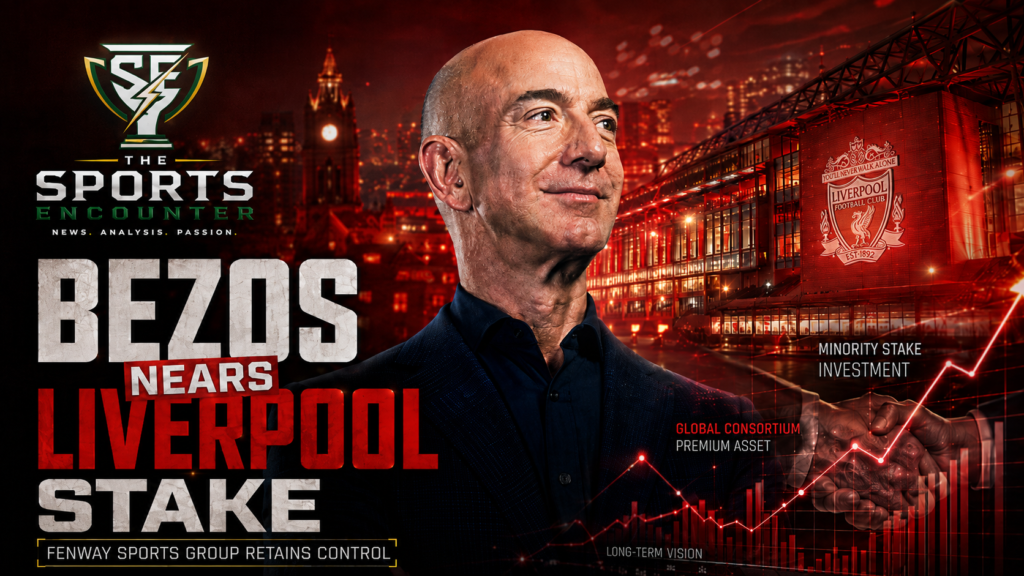
Jeff Bezos is reportedly closing in on his first major football investment, joining a consortium that could acquire roughly 30% to one-third of Liverpool Football Club in a deal valuing the Premier League giant at around £4.4 billion to £4.5 billion.
The key point is that this is not a takeover.
Fenway Sports Group would remain in control of Liverpool.
The reported transaction would instead bring a new layer of billionaire capital into Anfield at a moment when the club is already undergoing one of its biggest sporting and executive resets in years.
The consortium is being led by Amit Bhatia, the former Queens Park Rangers shareholder and son-in-law of steel magnate Lakshmi Mittal. Amazon founder Bezos and Facebook co-founder Eduardo Saverin are also reported to be part of the investor group.
Reuters reported Monday that the group is close to agreeing a deal for about one-third of the club. The Guardian has reported a figure of approximately £1.35 billion for a 30% stake, which would imply a Liverpool valuation around £4.5 billion.
That would place Liverpool among the most valuable football clubs in the world and underline just how dramatically the club’s financial value has grown since FSG bought it in 2010.
It would also raise a bigger question.
What does Liverpool actually gain from selling a major minority stake to some of the wealthiest investors on the planet?
For more English football coverage, readers can follow The Sports Encounter’s soccer section and our latest Premier League 2026-27 title contender analysis.
Liverpool Investment Deal: Key Facts
| Detail | Reported Information |
|---|---|
| Club | Liverpool FC |
| Current controlling owner | Fenway Sports Group |
| Reported stake | Approximately 30% to one-third |
| Reported stake value | Approximately £1.35 billion |
| Implied club valuation | Approximately £4.4 billion to £4.5 billion |
| Consortium leader | Amit Bhatia |
| Reported investors | Jeff Bezos and Eduardo Saverin |
| Control of Liverpool | Expected to remain with FSG |
| Potential announcement | Reportedly possible as early as this week |
This Is a Minority Investment, Not a Bezos Takeover
The most important distinction is also the easiest one to lose in a headline.
Jeff Bezos is not reported to be buying Liverpool outright.
He is part of a wider consortium.
Amit Bhatia is leading the group.
Eduardo Saverin is also reported to be involved.
Fenway Sports Group would remain the controlling shareholder.
Liverpool’s own corporate information currently states that FSG is the club’s sole controller through its controlled subsidiaries.
That makes the potential transaction significant, but structurally different from a full ownership change.
It would add major new economic stakeholders without immediately changing who ultimately controls the club.
Who Is Amit Bhatia?
Amit Bhatia is not a newcomer to English football.
He previously held a senior ownership and board role at Queens Park Rangers and spent years involved with the Championship club.
His connection to billionaire steel magnate Lakshmi Mittal through marriage has long made him a familiar figure in football-business circles.
Reports say Bhatia is now leading, managing and representing the Liverpool investment consortium.
That detail matters.
The potential deal should not be framed as a Bezos-led takeover bid simply because Bezos is the most globally recognizable name involved.
Bhatia appears to be the organizing figure.
Why Jeff Bezos Changes the Scale of the Conversation
Bezos’ presence changes the psychological scale of the deal even if he is not the controlling figure.
He is one of the wealthiest people in the world.
Amazon has spent years expanding beyond retail into entertainment, streaming and sports rights.
That means his potential arrival at Liverpool naturally creates questions about commercial reach, digital distribution and global brand expansion.
But those possibilities should not be confused with confirmed strategy.
There is no public evidence yet that Amazon would gain any direct role in Liverpool’s operations, media strategy or football decisions simply because Bezos personally acquires equity.
Those would be separate questions.
Eduardo Saverin Adds Another Major Technology Fortune
Facebook co-founder Eduardo Saverin is also reported to be part of the consortium.
His inclusion gives the investor group another globally significant technology fortune.
That reinforces the central point.
This is not simply a football investor buying into a football club.
Liverpool could be bringing in investors whose wealth was created in some of the largest technology businesses of the modern era.
That does not automatically change Liverpool’s sporting model.
It does dramatically expand the financial profile of the minority ownership base.
£1.35 Billion for 30% Would Be a Huge Football Transaction
The Guardian has reported that the consortium is close to paying around £1.35 billion for a 30% stake.
That arithmetic values Liverpool at roughly £4.5 billion.
Reuters placed the likely club valuation at approximately £4.4 billion.
The difference is small enough that both reports point toward the same conclusion.
Liverpool are being valued in the very top tier of world football.
Forbes valued Liverpool at approximately £4.6 billion in May 2026, placing the club among the world’s most valuable football organizations.
That independent estimate sits remarkably close to the reported minority-investment valuation.
Liverpool’s Value Has Exploded Under FSG
Fenway Sports Group bought Liverpool in 2010 for approximately £300 million.
A current valuation around £4.4 billion to £4.5 billion would represent roughly a fifteen-fold increase in headline club value.
That transformation reflects far more than player prices.
Liverpool’s commercial footprint has expanded enormously.
Anfield has been redeveloped.
The training infrastructure has improved.
The club has won major trophies.
Global sponsorship revenue has increased.
Broadcasting income across the Premier League has continued to rise.
Most importantly, Liverpool have become one of football’s strongest global commercial brands.
FSG Has Used Minority Investment Before
A minority equity sale would not represent a completely new philosophy for FSG.
In 2023, FSG announced a strategic minority investment from Dynasty Equity.
Liverpool said at the time that the funds would primarily help pay down bank debt and capital costs linked to the pandemic, Anfield improvements, the AXA Training Centre, the repurchase of Melwood and player acquisitions.
That earlier transaction provides useful context for the current talks.
FSG has already demonstrated that it is willing to bring in outside capital without surrendering control.
The scale of the reported Bhatia consortium investment would simply be much larger.
Why Would FSG Sell 30% of Liverpool Now?
The simplest answer is capital efficiency.
Football has become more expensive.
Transfer fees have risen.
Wages have risen.
Infrastructure costs remain high.
Revenue opportunities have expanded, but so have the costs of competing at the elite level.
FSG can monetize part of the value it has created while still retaining control of Liverpool.
That is an attractive ownership proposition.
A 30% sale at roughly £1.35 billion would give FSG significant liquidity without forcing an exit.
It could also bring new relationships and commercial expertise into the club’s broader ownership structure.
The Deal Arrives During Liverpool’s Biggest Sporting Reset in Years
The timing is especially important.
Liverpool are not entering 2026-27 from a position of complete sporting stability.
They finished fifth in the Premier League last season after an expensive transfer campaign.
Arne Slot departed.
Andoni Iraola replaced him as head coach.
Mohamed Salah left after nine seasons at Anfield.
Michael Edwards also stepped away from his senior FSG football role.
The club is therefore changing at ownership, executive, coaching and squad level almost simultaneously.
That makes the potential investment feel less like a passive financial transaction and more like part of a larger transition.
Andoni Iraola Is Already Rebuilding the Football Identity
The Premier League confirmed Iraola’s appointment in June 2026 after three successful seasons at Bournemouth.
His teams are associated with aggressive pressing, vertical attacks and high-intensity transitions.
That style places different demands on Liverpool’s squad than previous systems.
It also increases the importance of transfer recruitment.
Liverpool’s own squad needs now include replacing Mohamed Salah’s output, strengthening the defense and managing departures across the team.
The Sports Encounter recently examined that reset in our report on Liverpool’s move for Ronald Araújo.
Mohamed Salah’s Departure Changed More Than the Attack
Salah’s exit removed one of the most productive players in Liverpool history.
It also removed one of the club’s biggest global commercial faces.
The Egyptian forward had become synonymous with Liverpool across Africa, the Middle East and much of the wider football world.
The Sports Encounter covered his move in our report on Salah’s transfer to Trabzonspor.
Replacing those goals is difficult.
Replacing the global visibility is another challenge entirely.
That makes broader commercial expansion particularly relevant now.
Would New Investment Mean a Bigger Transfer Budget?
This is the question most supporters will ask first.
The answer is: possibly, but not automatically.
A minority investment does not guarantee that £1.35 billion suddenly becomes available to Iraola for transfers.
The structure of the deal matters.
Some proceeds could go directly to FSG shareholders.
Some could be reinvested into the club.
Some could strengthen the balance sheet.
Some could support infrastructure or commercial expansion.
Until the transaction is completed and its financial structure is explained, any claim that Bezos’ arrival equals an enormous transfer war chest would be speculation.
But It Could Increase Liverpool’s Financial Flexibility
That is the more realistic interpretation.
New capital can create flexibility.
It can reduce pressure elsewhere on the ownership structure.
It can support longer-term projects.
It can provide financial resilience around large transfer cycles.
It can help fund infrastructure without forcing the club to choose between stadium investment and squad investment.
Those effects can indirectly influence football spending even if the investment is not simply handed to the manager.
Liverpool Have Already Spent Heavily
Reuters reported that Liverpool spent around £446 million on new players before finishing fifth last season.
That statistic matters because it complicates the idea that Liverpool’s problem is simply a lack of money.
The club already demonstrated the ability to spend aggressively.
The bigger challenge is converting expenditure into a coherent, sustainable squad.
That is why Iraola’s recruitment structure matters as much as the size of any new investment.
The Real Value May Be Commercial Rather Than Sporting
Bezos and Saverin are technology-era investors.
Liverpool are already one of football’s biggest global brands.
The potential crossover is obvious.
Digital commerce.
Streaming.
Global memberships.
Direct-to-consumer products.
Data.
International sponsorship.
Media distribution.
Again, none of those areas should be presented as confirmed plans.
But they explain why a club like Liverpool is attractive to investors whose wealth was built around global scale rather than local football ownership.
FSG Would Still Call the Shots
This is the part supporters need to remember.
A 30% stake is significant.
It does not equal control.
Liverpool’s corporate governance still places FSG as the controlling owner.
Unless the new deal includes unusual voting rights, veto provisions or governance arrangements, FSG would still be expected to determine the club’s strategic direction.
That means John Henry, Tom Werner and the existing FSG leadership structure would remain central.
Could the Consortium Eventually Buy More?
That is impossible to know at this stage.
Minority investments sometimes remain minority investments for decades.
Others become the first step toward larger ownership positions.
The current reporting does not establish that Bezos, Saverin or Bhatia are preparing a full takeover.
So any suggestion that this is automatically the beginning of the end of FSG ownership would be premature.
The deal should be judged on what is actually being discussed today.
A strategic minority investment.
Liverpool Are Already Worth More Than Several Elite Clubs
Forbes’ 2026 valuation estimated Liverpool at approximately $6.2 billion, equivalent to around £4.6 billion at the time of calculation.
That placed Liverpool above several elite clubs in the global value rankings, including Manchester City, Arsenal, Chelsea and Tottenham.
The reported Bhatia consortium valuation therefore does not look wildly detached from the broader market.
It instead reinforces Liverpool’s position among football’s most valuable properties.
Football Club Valuations Are Entering a New Era
Traditional football valuations were once driven heavily by matchday revenue, broadcasting and local commercial relationships.
The modern game is different.
Global digital audiences matter.
Brand licensing matters.
Streaming rights matter.
International sponsorship matters.
Direct-to-consumer business matters.
Premier League clubs now operate more like global entertainment assets than traditional local sporting institutions.
Liverpool fit that model almost perfectly.
Why Liverpool Are Especially Attractive to Global Investors
Few clubs combine all of Liverpool’s commercial advantages.
A global fan base.
A historic stadium.
Major domestic titles.
European pedigree.
Strong merchandise demand.
International recognition.
A presence in the Premier League, the world’s most commercially powerful domestic football competition.
That combination gives Liverpool something investors cannot easily recreate from scratch.
Brand equity built over generations.
The Timing Before the Premier League Season Is Significant
Liverpool begin their 2026-27 Premier League campaign away to Newcastle United on August 23.
That means a deal announcement could arrive immediately before the competitive season begins.
The Sports Encounter has already ranked Liverpool among the major wildcard contenders in our 2026-27 Premier League title analysis.
The club has enough talent to challenge.
It also carries more uncertainty than Arsenal or Manchester City because of coaching, squad and leadership changes.
A major ownership investment would add another storyline before a ball is kicked.
The Deal Could Strengthen Liverpool Without Changing Its Model
This may be the most important long-term possibility.
FSG has historically tried to operate Liverpool through disciplined financial management rather than unlimited owner funding.
That model has produced major success.
It has also occasionally frustrated supporters who believe the club should spend more aggressively.
A substantial minority investment could theoretically strengthen the same model rather than replace it.
More capital.
Same control.
Same governance philosophy.
Greater financial flexibility.
That may be exactly why the deal appeals to FSG.
What Could Go Wrong?
Minority investments are not automatically positive.
More shareholders can create more complicated governance.
Different investors may have different time horizons.
Commercial priorities can clash with supporter expectations.
Questions may arise over dividend policy, reinvestment and future ownership strategy.
The identities of investors also invite scrutiny around influence and decision-making.
Liverpool supporters have historically been highly engaged in ownership issues.
Any deal of this scale will therefore be examined closely.
Supporters Will Want Transparency
The major supporter question is simple.
Where does the money go?
If the investment primarily allows existing owners to realize part of their gain, fans may view it differently from a transaction that directly strengthens the club.
If substantial capital goes into infrastructure, football operations or long-term commercial development, the interpretation changes.
The details will matter far more than the headline names.
The Bezos Name Should Not Distract From the Structure
There is an obvious temptation to turn this into a celebrity ownership story.
Jeff Bezos is a globally famous billionaire.
His name drives attention.
But the transaction should be understood structurally.
Bhatia is reportedly leading the consortium.
FSG is retaining control.
Bezos is one investor within a wider group.
The real football-business story is the valuation and the scale of outside capital entering Liverpool.
What This Means for FSG
For Fenway Sports Group, the reported deal would validate one of the most successful football ownership value-creation stories of the modern era.
FSG acquired a distressed Liverpool in 2010.
Sixteen years later, a minority stake alone could reportedly be worth more than four times the amount paid for the entire club.
That is extraordinary.
It also explains why FSG does not need to sell Liverpool outright to realize enormous financial value.
It can monetize part of its position while continuing to control one of world football’s strongest assets.
What This Means for Liverpool
The club could gain more than cash.
New investors can bring networks.
Commercial expertise.
Technology relationships.
Access to international capital.
Experience scaling global consumer businesses.
Whether Liverpool actually use those resources effectively will depend on the final agreement.
But the potential upside extends beyond transfer fees.
What This Means for the Premier League
The deal would provide another example of extraordinary capital flowing into English football.
Premier League clubs are becoming increasingly valuable global assets.
The arrival of investors such as Bezos and Saverin would further blur the boundary between sport, technology, media and global finance.
That evolution is already visible throughout the league.
Ownership groups increasingly span multiple sports and industries.
Football clubs increasingly function as platforms within larger investment portfolios.
Could Liverpool Become Even More Commercially Aggressive?
Possibly.
But that should not automatically mean changing what makes the club valuable.
Liverpool’s emotional identity remains tied to Anfield, local supporters, history and sporting tradition.
The commercial challenge is expanding globally without weakening that foundation.
Any new investors will quickly discover that Liverpool’s value comes partly from exactly the traditions that cannot be manufactured.
The £4.4 Billion Number Is the Real Headline
Bezos will attract the clicks.
The valuation tells the deeper story.
Approximately £4.4 billion for Liverpool suggests the club has entered an elite financial tier alongside the world’s biggest sports properties.
FSG bought the club for around £300 million.
The difference is one of the clearest illustrations of how dramatically elite football economics have changed.
The Bigger Question: What Does Liverpool Want to Become?
That is ultimately where the story leads.
Liverpool already have history.
They already have global support.
They already have major trophies.
The next phase is about scale.
Can they compete financially with the richest ownership groups while retaining their existing operating identity?
Can Iraola rebuild a title-winning team?
Can Liverpool replace Salah’s football and commercial influence?
Can new capital accelerate growth without changing the club’s culture?
Those questions matter more than the novelty of Jeff Bezos appearing on a shareholder list.
Final Analysis: New Money, Same Controller, Bigger Stakes
The reported Liverpool investment is easy to misunderstand.
Jeff Bezos is not buying Liverpool.
A consortium led by Amit Bhatia is reportedly nearing a deal for a major minority stake.
Eduardo Saverin is also said to be involved.
FSG would retain control.
The potential £1.35 billion investment would value Liverpool at around £4.4 billion to £4.5 billion.
That is the real significance.
Liverpool have grown from a £300 million acquisition in 2010 into one of football’s most valuable institutions.
Now FSG may be preparing to monetize part of that growth without walking away.
For Liverpool, the opportunity is equally important.
The club is rebuilding under Iraola.
Salah is gone.
The squad is changing.
The executive structure has changed.
And the Premier League remains brutally competitive.
New minority capital cannot solve those football problems by itself.
But it can give Liverpool more room to solve them.
That is why this deal matters far beyond the Bezos name.
Liverpool may be entering a new capital era without entering a new ownership era.
Frequently Asked Questions
Is Jeff Bezos buying Liverpool?
No. Reports say Bezos is part of a consortium seeking a minority stake of roughly 30% to one-third in Liverpool. Fenway Sports Group is expected to retain control.
Who is leading the Liverpool investment consortium?
Amit Bhatia, the former Queens Park Rangers shareholder and son-in-law of Lakshmi Mittal, is reported to be leading the consortium.
Is Eduardo Saverin involved?
Yes. Reports say Facebook co-founder Eduardo Saverin is part of the investor group.
How much is the Liverpool stake worth?
The Guardian has reported approximately £1.35 billion for a 30% stake.
How much would the deal value Liverpool at?
Reports place the implied valuation at approximately £4.4 billion to £4.5 billion.
Will Fenway Sports Group still own Liverpool?
Yes. FSG is expected to remain the controlling shareholder even if the minority investment is completed.
How much did FSG pay for Liverpool?
Fenway Sports Group acquired Liverpool in 2010 for approximately £300 million.
Has FSG sold minority stakes before?
Yes. FSG announced a strategic minority investment from Dynasty Equity in 2023.
Will the Bezos investment increase Liverpool’s transfer budget?
That is not yet known. A minority investment can increase financial flexibility, but there is no confirmed evidence that the reported investment would be directed entirely toward player transfers.
Who is Liverpool’s manager in 2026-27?
Andoni Iraola is Liverpool’s head coach after replacing Arne Slot in June 2026.
When does Liverpool begin the Premier League season?
Liverpool open their 2026-27 Premier League campaign away to Newcastle United on August 23.
Where can readers follow more Liverpool and Premier League coverage?
Readers can follow the latest transfer, ownership and Premier League analysis through The Sports Encounter’s soccer coverage.