


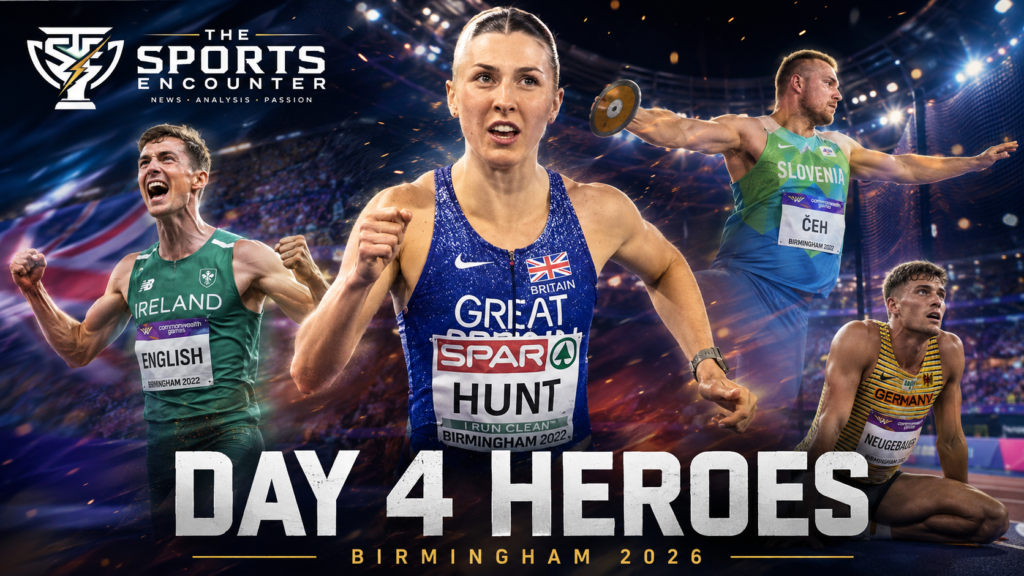
Seven European titles were decided at Alexander Stadium on Thursday, but Birmingham 2026 Day 4 was defined by far more than the number of medals handed out.
Amy Hunt completed a home sprint double while managing health problems that have made the 200 meters physically frightening this season. Mark English finally reached the top of a major outdoor podium after more than a decade of European Championship racing. Leo Neugebauer crossed the decathlon finish line so exhausted that he collapsed before he could properly celebrate. Gesa Krause returned to the top of Europe eight years after her previous continental title. Kristjan Čeh produced one of the greatest discus performances in championship history.
Elsewhere, Angelica Moser successfully defended her pole vault crown, Dariya Derkach turned years of international persistence into European triple jump gold, and the women’s 800m semifinals produced enough chaos to create one of the most anticipated finals of the entire championships.
The fourth day of the 2026 European Athletics Championships became a showcase for different versions of elite resilience.
Some athletes won because they were dominant. Others survived pressure, setbacks, fatigue or years of waiting.
By the time Hunt crossed the line in front of the biggest crowd of the championships so far, Birmingham had produced one of its richest nights.
Birmingham 2026 Day 4: Medal Finals at a Glance
| Event | Gold Medalist | Winning Mark | Defining Story |
|---|---|---|---|
| Women’s 200m | Amy Hunt, Great Britain | 22.19 | Completed the European 100m-200m sprint double |
| Men’s 800m | Mark English, Ireland | 1:45.26 | Became Ireland’s first male European outdoor champion |
| Men’s Decathlon | Leo Neugebauer, Germany | 8,611 points | Held off Niklas Kaul after an exhausting 1500m finale |
| Men’s Discus | Kristjan Čeh, Slovenia | 72.51m CR | Defended his title with a championship record |
| Women’s 3000m Steeplechase | Gesa Krause, Germany | 9:12.69 | Won a third European title eight years after her previous gold |
| Women’s Pole Vault | Angelica Moser, Switzerland | 4.80m | Successfully defended her European outdoor crown |
| Women’s Triple Jump | Dariya Derkach, Italy | 14.60m | Captured her first European outdoor title |
Official schedules and complete event results are available through the European Athletics Birmingham 2026 results center.
Amy Hunt Is No Longer Chasing Europe’s Sprint Order
Amy Hunt entered Birmingham looking for her first major senior individual title.
Four days later, she owns two.
The 24-year-old followed her 100m victory with a brilliant 22.19-second performance in the women’s 200m final, holding off a furious late challenge from Ireland’s Rhasidat Adeleke and former European champion Dina Asher-Smith.
| Position | Athlete | Nation | Time |
|---|---|---|---|
| 1 | Amy Hunt | Great Britain | 22.19 |
| 2 | Rhasidat Adeleke | Ireland | 22.28 |
| 3 | Dina Asher-Smith | Great Britain | 22.29 |
| 4 | Jessica-Bianca Hoenke | Germany | 22.55 |
| 5 | Gémima Joseph | France | 22.63 |
Only 0.10 seconds separated gold from bronze.
That margin tells part of the story. Hunt had to beat two athletes with completely different championship strengths.
Asher-Smith carried years of major-final experience and was dangerous on the bend. Adeleke, whose path into the final was detailed in The Sports Encounter’s report on her 200m semifinal victory, had enough speed left to close aggressively over the final meters.
Hunt attacked the bend, established the advantage she needed and then fought to preserve it as fatigue arrived.
The physical strain was more significant than viewers may have realized.
After the race, Hunt discussed the extremely low blood pressure she has experienced this year and revealed that she has fainted after several 200m races. That helps explain why she described the longer sprint as physically more intimidating than the 100m.
There was no visible caution once the gun fired.
She committed to the bend, trusted her preparation and reached the line before Adeleke’s late surge could erase the gap.
More than 20,000 spectators were inside Alexander Stadium, the largest attendance of Birmingham 2026 so far. Hunt gave them the result most had come hoping to see.
The sprint double changes Hunt’s place in British athletics
Her 100m victory earlier in the championships already represented a change in Britain’s sprint hierarchy.
The 200m makes the argument much stronger.
Asher-Smith remains one of Britain’s greatest sprinters and still reached another European podium. Hunt, however, is no longer simply the emerging athlete expected to inherit responsibility at some point in the future.
She owns both European sprint titles today.
Her Birmingham campaign may not be finished either. Relay opportunities remain, meaning Hunt can still add to a championship that has already changed her career.
Mark English Waited 12 Years for This Version of the Finish Line
Mark English’s European Championship story began long before Thursday night.
He won 800m bronze in 2014.
He returned to the podium eight years later in Munich.
He reached Birmingham at 33 years old with international medals, enormous experience and a championship record from Wednesday’s semifinal, but still without a senior outdoor European title.
That final gap disappeared in 1:45.26.
English tracked Croatia’s Marino Bloudek rather than forcing the early pace, preserved his energy through the middle of the race and attacked when the final straight demanded a decision.
Bloudek held on for silver in 1:45.62. Spain’s Mohamed Attaoui took bronze in 1:45.71.
| Position | Athlete | Nation | Time |
|---|---|---|---|
| 1 | Mark English | Ireland | 1:45.26 |
| 2 | Marino Bloudek | Croatia | 1:45.62 |
| 3 | Mohamed Attaoui | Spain | 1:45.71 |
The time was slower than English’s sensational 1:43.49 championship record from the semifinal, but that comparison misses the point.
Wednesday showed how fast he could run.
Thursday asked whether he could win.
He answered it.
The victory made English the first Irish man to win an outdoor European Athletics Championships gold medal, ending a wait stretching back through the entire 92-year history of the competition.
For an athlete who had already collected bronze medals 12 years apart, the achievement carried the weight of persistence rather than sudden arrival.
Burgin’s withdrawal changed the final minutes before the gun
The race also lost one of its major British contenders moments before the start.
Max Burgin withdrew because of injury during the warm-up, removing one of the athletes expected to challenge English and adding another frustrating chapter to a difficult summer after illness disrupted his Commonwealth Games.
Ben Pattison carried Britain’s remaining hopes but finished outside the medals after leaving himself too much ground to recover late.
English did not need anyone else’s misfortune to validate the victory. His championship record in the semifinal had already established him as the fastest man in Birmingham.
The final established him as the champion.
Leo Neugebauer Won the Decathlon With Almost Nothing Left
The most physically revealing image of Day 4 came after the men’s decathlon 1500m.
Leo Neugebauer crossed the finish line and went down.
He stayed there, flat on his back, initially too exhausted to celebrate properly.
There was a good reason.
Germany’s world champion entered the final event knowing teammate Niklas Kaul possessed a major advantage over 1500 meters. Kaul needed to beat Neugebauer by approximately 24 seconds to overturn the remaining points deficit.
The gap began growing.
Neugebauer was visibly struggling. Kaul kept moving away.
The decathlon title that Neugebauer had controlled for much of two days suddenly became a race against arithmetic, fatigue and the finish line.
He survived.
| Position | Athlete | Nation | Points |
|---|---|---|---|
| 1 | Leo Neugebauer | Germany | 8,611 |
| 2 | Niklas Kaul | Germany | 8,573 |
| 3 | Sander Skotheim | Norway | 8,433 |
| 4 | Jeff Tesselaar | Netherlands | 8,378 |
Only 38 points separated Germany’s two leading decathletes after 10 events.
Neugebauer’s success had been built across the entire competition. On Day 1, he established control through a powerful long jump and a 17.13m shot put, a championship-best mark within the decathlon. The Sports Encounter’s Day 3 review followed him into the overnight lead.
Thursday belonged more strongly to Kaul’s traditional strengths. The former world champion threw 73.54m in the javelin, collecting 943 points and forcing Neugebauer to defend his advantage through the 1500m.
Neugebauer’s 60.10m javelin was enough to leave him 154 points ahead with one event remaining.
He then spent almost every available reserve protecting it.
The pole vault error added unnecessary strain
The decathlon also produced an organizational mistake European Athletics was forced to address publicly.
During the pole vault, seven athletes believed they were attempting 4.80m when officials had mistakenly left the bar at 4.70m. The additional round was subsequently canceled and the competition resumed at the correct height, with athletes given proper attempts.
European Athletics said the operational error did not affect the final outcome.
Even so, the mistake mattered in a decathlon because unnecessary vault attempts consume physical and mental energy during a competition in which athletes must complete five disciplines on the second day.
Neugebauer ultimately ensured the championship would be remembered more for the finish than the officiating error.
Kristjan Čeh Turned a Loaded Discus Final Into His Own Competition
The men’s discus final contained enough elite talent to make predicting a winner uncomfortable.
Kristjan Čeh made the uncertainty disappear.
The defending European champion opened with 70.83m, immediately breaking the championship record and forcing the rest of the field to chase.
He was not finished.
Čeh eventually extended the record to 72.51m, producing a performance worthy of one of the strongest discus fields assembled at the championships.
World-record holder Mykolas Alekna took silver for Lithuania with 69.89m. Germany’s Henrik Janssen delivered a season-best 69.53m to earn bronze, the first German men’s discus medal at the European Championships since Robert Harting’s title in 2014.
| Position | Athlete | Nation | Mark |
|---|---|---|---|
| 1 | Kristjan Čeh | Slovenia | 72.51m CR |
| 2 | Mykolas Alekna | Lithuania | 69.89m |
| 3 | Henrik Janssen | Germany | 69.53m SB |
Olympic champion Daniel Ståhl finished fourth despite throwing 68.22m.
That statistic helps explain the level of the competition.
Čeh did not win because the field underperformed. He beat athletes capable of winning almost any global discus competition and did so with a mark beyond 72 meters.
Defending a continental title is difficult enough.
Defending it with a championship record against Alekna and Ståhl gives the performance another level of authority.
Gesa Krause’s Third European Gold Arrived Eight Years After Her Second
Gesa Krause has experienced almost every version of European Championship competition.
She won bronze as a 19-year-old in 2012.
She became champion in 2016.
She defended the title in 2018.
Years later, after injuries, another Olympic cycle, motherhood and the inevitable changes that come with a long distance-running career, Krause returned to the top.
The German won the women’s 3000m steeplechase in 9:12.69, beating defending champion Alice Finot of France, who finished in 9:14.24.
Germany’s Olivia Gürth took bronze in 9:15.33.
| Position | Athlete | Nation | Time |
|---|---|---|---|
| 1 | Gesa Krause | Germany | 9:12.69 |
| 2 | Alice Finot | France | 9:14.24 |
| 3 | Olivia Gürth | Germany | 9:15.33 |
The race could easily have produced a different German medalist.
Lea Meyer was running in podium position when she fell heavily at the final water jump, a cruel echo of her fall at the 2022 World Championships. She recovered quickly enough to finish fourth but lost the medal opportunity in a single moment.
Britain’s Elise Thorner had entered Birmingham as Europe’s fastest woman of the season but could not sustain her challenge in the closing stages.
Krause kept the race under control and delivered the finishing strength the moment demanded.
Eight years separated her second and third European titles.
Very few athletes remain capable of winning at continental level across that kind of time span.
Angelica Moser Confirms That Rome Was the Start of an Era
Angelica Moser arrived in Birmingham as defending European pole vault champion.
She leaves the final with the title still belonging to her.
The Swiss athlete cleared 4.80m to win gold, five centimeters ahead of Finland’s Wilma Heltelä.
Belgium’s Elien Vekemans claimed bronze at 4.70m.
| Position | Athlete | Nation | Height |
|---|---|---|---|
| 1 | Angelica Moser | Switzerland | 4.80m |
| 2 | Wilma Heltelä | Finland | 4.75m |
| 3 | Elien Vekemans | Belgium | 4.70m |
Moser continued after securing victory and attacked 4.85m, but the missed attempts changed nothing about the result.
Her success means the European outdoor title she won in Rome two years ago was not an isolated career peak.
She has now defended it.
Championship pole vault can be especially unforgiving because one technical error can suddenly change the order. Moser managed the heights efficiently enough to ensure the rest of the field had to respond to her.
None could get above 4.80m.
Dariya Derkach Turns Consistency Into European Gold
Dariya Derkach has spent years close enough to major European medals to understand how difficult the final step can be.
In Birmingham, she finally made it.
The Italian triple jumper produced 14.60m to win her first European outdoor title.
Belgium’s Saliyya Guisse built an excellent competition behind her, producing three consecutive personal bests while climbing into silver-medal position. Bulgaria’s Aleksandra Nacheva completed the podium.
Derkach had led with 14.53m before improving to 14.60m, extending the margin at the moment the competition was approaching its decisive stage.
The victory carried additional meaning because Derkach’s senior career has been built through persistence rather than one sudden breakthrough.
She won European indoor silver in 2023 and remained a regular presence in major championship fields. Outdoor European gold had remained out of reach.
Birmingham supplied it.
Audrey Werro’s Fall Nearly Destroyed Friday’s Dream 800m Final
The most consequential non-final of Thursday happened hours before the seven evening gold medals were decided.
Switzerland’s Audrey Werro entered the women’s 800m semifinals as one of the central figures of Birmingham 2026.
She nearly left the competition on the track.
Werro was well positioned on the final bend when contact involving France’s Anaïs Bourgoin disrupted her stride. The Swiss athlete fell heavily, while Lithuania’s Gabija Galvydytė was also brought down in the chain reaction.
Werro eventually got back to her feet and completed the race in last place.
For roughly 50 minutes, one of the championships’ most anticipated matchups appeared to be gone.
Video review changed the outcome.
Officials reinstated Werro and Galvydytė after determining that the incident had materially affected their races. Friday’s final will therefore contain 10 athletes rather than the conventional eight.
Britain’s Jemma Reekie won that semifinal in 1:58.61.
Keely Hodgkinson had a far less chaotic path through the other race, controlling the semifinal from the front and winning in 1:57.38 ahead of Femke Broeders-Bol.
The reinstatement preserves the final Birmingham wanted:
- Olympic champion Keely Hodgkinson
- Swiss star Audrey Werro
- former 400m hurdles world champion Femke Broeders-Bol
- Jemma Reekie and the rest of a deep European field
The women’s 800m has spent much of the week carrying expectations of becoming the race of the championships.
Thursday nearly took that away.
Friday will settle it on the track.
The Women’s 400m Final Is Suddenly Much Harder to Predict
The women’s 400m semifinals also produced one of Day 4’s strongest statistical statements.
Five athletes broke 50 seconds across the round, underlining how quickly the European one-lap standard has moved.
Norway’s Henriette Jæger won a loaded semifinal in 49.80, while Great Britain’s Amber Anning ran a season-best 49.96 behind her to qualify automatically.
Spain’s Paula Sevilla ran a personal-best 50.21, and Belgium’s Helena Ponette also produced a personal best at 50.31 in the same race.
The immediate lesson is straightforward.
Friday and Saturday’s medal races will not offer much room for conservative tactics.
Sub-50-second performances are no longer exceptional enough to guarantee control of a European final.
Owen Ansah and Zharnel Hughes Set Up a Fast Men’s 200m Final
The men’s 200m semifinals supplied another indication of what is coming next.
Germany’s Owen Ansah produced a personal best and European-leading 20.04 to become the fastest qualifier for Friday’s final.
Great Britain’s Zharnel Hughes was only 0.01 slower in another semifinal, clocking 20.05 while appearing to keep something in reserve before the line.
Hughes’ progression matters after cramp affected him at the Commonwealth Games. He looked controlled in Birmingham and immediately becomes one of the principal home hopes for Friday.
The difference between Ansah and Hughes in qualification is effectively meaningless once the final begins.
The relevant point is that both reached it looking fast enough to win.
Day 4 Completed the Transformation of Birmingham 2026
The early days of these championships produced questions about attendance and atmosphere.
Thursday looked and sounded different.
More than 20,000 spectators filled Alexander Stadium for the evening session, giving Hunt, English, Neugebauer, Čeh and the other finalists a setting worthy of the performances.
The progression of the championship has also become increasingly clear through The Sports Encounter’s daily coverage.
Day 1 belonged to Hunt’s first sprint title, Jakob Ingebrigtsen’s comeback and Norway’s mixed relay team.
Day 2 brought Romell Glave’s British 100m victory, Nadia Battocletti’s title defense, Nadine Visser’s photo finish, Miltiadis Tentoglou’s fourth straight long jump crown and Bence Halász’s enormous hammer throw.
Day 3 delivered Matthew Hudson-Smith’s historic third European 400m title, Silja Kosonen’s breakthrough, Emma Zapletalová’s Slovakian landmark and Mark English’s 48-year-old championship record.
Thursday took those storylines and added emotional depth.
Hunt proved the first gold had not emptied her.
English converted record-breaking speed into the title he had spent years chasing.
Neugebauer demonstrated why the decathlon remains athletics’ most unforgiving test of completeness.
Krause showed that a championship career can stretch across generations without losing its edge.
Čeh delivered the night’s purest expression of dominance.
Moser defended territory she had earned two years earlier.
Derkach finally converted years of persistence into outdoor gold.
Different events. Different careers. Different paths to the same podium.
TSE Verdict: Day 4 Was About What Athletes Had Left When the Easy Part Was Gone
The best championship performances are rarely explained by raw numbers alone.
Čeh’s 72.51m can be measured cleanly. Hunt’s 22.19 can be placed beside every other European sprint performance. Neugebauer’s 8,611 points can be compared with generations of decathletes.
The human context explains why Thursday will be remembered.
Hunt had to trust a body that has frightened her after 200m races this year.
English had to keep believing that a career containing European bronzes in 2014 and 2022 could still end with gold.
Neugebauer had to keep moving when every visible sign suggested his body wanted to stop.
Krause had to rebuild a championship-winning career across eight years and a completely different stage of life.
Werro had to get back up after a fall that appeared to end her championship and wait while officials decided whether she would receive another chance.
That is why Day 4 felt richer than a conventional results sheet.
Europe crowned seven champions.
The most memorable moments came from understanding what each of them had needed to overcome before reaching the podium.
What to Watch on Birmingham 2026 Day 5
Friday now inherits several storylines created directly by Thursday.
The women’s 800m final is the obvious centerpiece, with Hodgkinson, Werro and Broeders-Bol finally sharing the same championship race after a semifinal round that nearly broke the matchup apart.
The men’s 200m final places Hughes against Ansah and a field that already showed sub-20.10 speed in the semifinals.
The women’s 10,000m will award another distance title, while the men’s high jump, women’s discus and men’s 400m hurdles add three more major finals.
The heptathlon also begins, adding another combined-events storyline only hours after Neugebauer’s exhausting decathlon victory.
For complete daily reporting, records, medal performances and athlete stories, follow The Sports Encounter’s Birmingham 2026 hub.
Frequently Asked Questions
Who won the women’s 200m at Birmingham 2026?
Great Britain’s Amy Hunt won the European women’s 200m title in 22.19 seconds. Ireland’s Rhasidat Adeleke took silver in 22.28, while Dina Asher-Smith won bronze in 22.29.
Did Amy Hunt win both the 100m and 200m?
Yes. Hunt won the women’s 100m earlier in the championships in 11.00 seconds and added the 200m title on Day 4, completing the European sprint double.
Who won the men’s 800m?
Ireland’s Mark English won in 1:45.26 ahead of Croatia’s Marino Bloudek and Spain’s Mohamed Attaoui.
Why was Mark English’s gold historic?
English became the first Irish man to win an outdoor European Athletics Championships gold medal. He had previously won European 800m bronze medals in 2014 and 2022.
Who won the Birmingham 2026 decathlon?
Germany’s Leo Neugebauer won with 8,611 points, only 38 ahead of teammate Niklas Kaul. Norway’s Sander Skotheim took bronze.
What happened to Leo Neugebauer after the 1500m?
Neugebauer crossed the finish line visibly exhausted and collapsed onto the track. He had done enough to preserve his points advantage over Kaul and secure the European title.
What was Kristjan Čeh’s winning discus throw?
Čeh won with a championship record of 72.51 meters, ahead of Mykolas Alekna and Henrik Janssen.
Who won the women’s 3000m steeplechase?
Germany’s Gesa Krause won her third European title in 9:12.69, beating defending champion Alice Finot. Olivia Gürth took bronze.
Who won the women’s pole vault?
Switzerland’s Angelica Moser retained her European title with a clearance of 4.80 meters.
Who won the women’s triple jump?
Italy’s Dariya Derkach won the European title with a best jump of 14.60 meters.
What happened to Audrey Werro in the women’s 800m semifinal?
Werro fell after contact during the final bend and initially finished last. Officials reviewed the incident and reinstated both Werro and Lithuania’s Gabija Galvydytė into Friday’s final.
Who qualified fastest for the men’s 200m final?
Germany’s Owen Ansah led the qualifiers with a personal-best and European-leading 20.04 seconds. Great Britain’s Zharnel Hughes ran 20.05 in another semifinal.
Where can fans find official Birmingham 2026 results?
Official schedules, start lists and complete results are available through European Athletics, while The Sports Encounter continues daily reporting and analysis throughout the championships.