


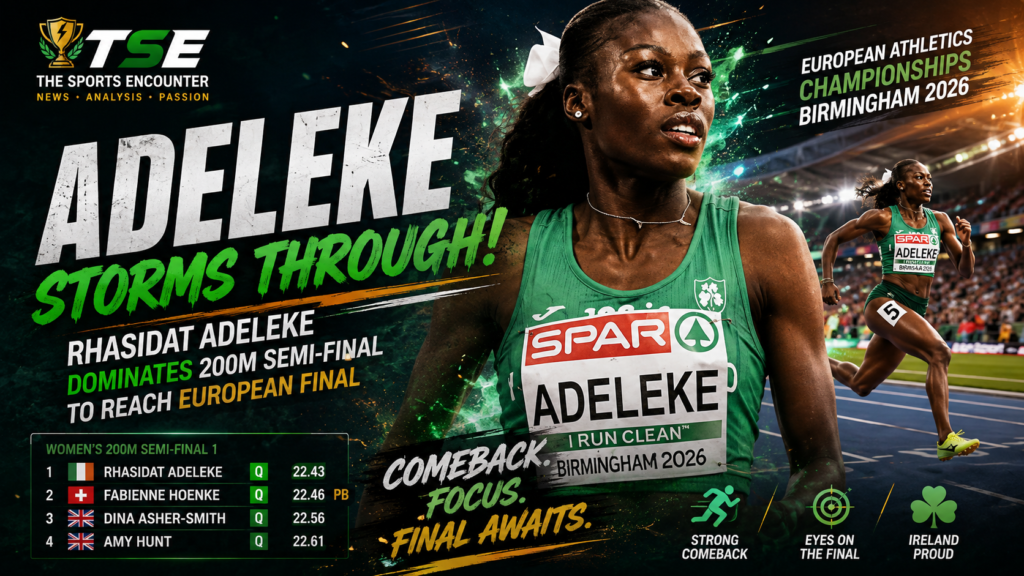
Rhasidat Adeleke has turned an injury-disrupted season into a shot at European gold after winning her women’s 200m semifinal in 22.43 seconds at the 2026 European Athletics Championships in Birmingham.
The Irish star produced a controlled performance at Alexander Stadium on Wednesday evening, holding off Switzerland’s Fabienne Hoenke, who ran a personal-best 22.46, to secure automatic qualification for Thursday’s final.
For Adeleke, the result carried significance far beyond winning a semifinal.
Her 2026 season has repeatedly been interrupted by injury. Only a few weeks ago, her place at the European Championships was still uncertain. She eventually qualified at the final opportunity by winning the Irish 200m title in 22.80 seconds at Morton Stadium.
Now she is one race away from a European medal.
“I’m having fun,” Adeleke said after reaching the final, reflecting a noticeably relaxed mood after months spent managing setbacks.
The final promises considerably greater pressure. Adeleke will face a high-quality field that includes Britain’s Amy Hunt and Dina Asher-Smith, giving Irish fans another major medal race to anticipate in Birmingham.
Rhasidat Adeleke’s 200m Semifinal Result
| Position | Athlete | Nation | Time | Status |
|---|---|---|---|---|
| 1 | Rhasidat Adeleke | Ireland | 22.43 | Qualified |
| 2 | Fabienne Hoenke | Switzerland | 22.46 | PB, Qualified |
| 3 | Dina Asher-Smith | Great Britain | 22.56 | Qualified |
The official championship schedule, results and competition information are available through European Athletics.
Adeleke Looks Like Herself Again
The time mattered.
The victory mattered.
Yet perhaps the most encouraging part of Adeleke’s semifinal was how comfortable she appeared while producing it.
She ran the bend with control, entered the straight in contention and maintained enough speed through the closing stages to resist Hoenke’s challenge.
Adeleke did not have to chase qualification desperately at the line. She remained composed as the race developed around her.
Afterward, she explained why the performance felt different.
“It’s probably the first race this year that I’ve been able to just go out there and execute,” Adeleke told reporters after the semifinal.
That may be the most important sentence attached to her Birmingham campaign so far.
For much of 2026, Adeleke has been trying to get healthy enough to compete.
Now she can start thinking about how to win.
Two Hamstring Injuries Changed Adeleke’s 2026 Season
The road to Birmingham became much more difficult than expected.
Adeleke suffered two separate hamstring injuries during the season, disrupting her training and competition schedule.
Each setback cost valuable preparation time.
For a 200m and 400m athlete, hamstring problems are particularly damaging because sprinting depends on repeatedly producing force at high speed. Returning to competition involves more than becoming pain-free. An athlete also has to rebuild confidence in acceleration, top speed and the ability to attack a bend without subconsciously protecting the injured area.
Adeleke therefore entered the summer without the smooth progression normally expected before a major championship.
Her qualification position became increasingly uncertain.
Eventually, everything came down to one race in Dublin.
22.80 in Dublin Saved Her European Championships
On July 25, Adeleke lined up for the women’s 200m at the Irish National Track and Field Championships at Morton Stadium knowing she needed a performance.
The European qualifying standard was 22.85 seconds.
Adeleke ran 22.80.
She did it into a 1.1 meters-per-second headwind.
The performance gave her the Irish title and, more importantly, secured her place in Birmingham.
It came at almost the final possible moment.
That context changes the way her 22.43 semifinal should be viewed.
In less than three weeks, Adeleke moved from fighting simply to reach the European Championships to winning a semifinal against some of the continent’s best sprinters.
The improvement from 22.80 to 22.43 does not provide a perfect direct comparison because wind, track conditions and race circumstances differ.
It does show that her speed is moving in the right direction at exactly the right time.
Fabienne Hoenke Makes Adeleke Work for It
Adeleke did not receive an easy semifinal.
Hoenke produced the fastest 200m of her career, stopping the clock at 22.46.
The Swiss sprinter stayed close enough to keep Adeleke working through the finish rather than allowing the Irishwoman to shut down significantly before the line.
That may ultimately prove useful.
Championship semifinals are about qualification, but athletes also want enough competitive intensity to prepare their bodies for the final.
Adeleke received exactly that.
Hoenke finished only 0.03 seconds behind her.
Asher-Smith followed in 22.56.
All three advanced.
Amy Hunt Raises the Standard Ahead of the Final
Adeleke’s semifinal victory does not automatically make her the favorite for gold.
Amy Hunt made that clear elsewhere in the semifinals.
The British sprinter produced the fastest semifinal performance of the round, clocking 22.37 seconds.
Hunt already has momentum at Alexander Stadium after winning the European women’s 100m title earlier in the championships.
That victory established her as one of the central figures of Birmingham 2026 and gives her the opportunity to chase a sprint double in front of the home crowd.
The Sports Encounter has been following Britain’s sprint success throughout the championships, including Amy Hunt’s European 100m gold and the host nation’s wider breakthrough during the opening days.
Adeleke now becomes part of the next major chapter.
Dina Asher-Smith Adds Championship Experience
Dina Asher-Smith presents a different type of challenge.
She finished behind Adeleke and Hoenke in the semifinal, but few athletes in the field possess comparable championship experience.
The British sprinter has won world and European medals across the 100m, 200m and 4x100m relay during a long international career.
Her semifinal time of 22.56 was enough to move her into another European final.
That means Adeleke cannot judge Thursday’s race only from Wednesday’s finishing order.
Finals often change athletes.
Some runners conserve energy during qualifying rounds. Others respond differently when medals replace qualification places as the objective.
Asher-Smith knows that environment extremely well.
Adeleke’s 400m Reputation Makes Her 200m Dangerous
Adeleke is best known internationally for the 400m.
She became the first Irish woman to reach an Olympic sprint final when she contested the 400m final at Paris 2024.
Her ability over one lap helps explain why she can be particularly dangerous during the closing stages of a 200m race.
Pure 200m specialists often build their advantage through acceleration and bend speed.
Adeleke brings another weapon.
Strength.
Her 400m background means she is accustomed to maintaining form while fatigue increases dramatically.
That can become particularly valuable during the final 50 meters of a championship 200m.
If Adeleke remains close coming off the bend on Thursday, her ability to maintain speed through the line could put her directly into the medal fight.
'Just having fun and enjoying the process has really brought me down to earth – now I'm just enjoying everything' – a content Rhasidat Adeleke on reaching the 200m final at the European Athletics Championships #rtesport #EuropeanAthletics pic.twitter.com/i9QbqeQrO8
— RTÉ Sport (@RTEsport) August 12, 2026
The 200m May Be Exactly What Adeleke Needed in Birmingham
There is another interesting aspect to her decision to focus on the shorter sprint.
A difficult season can change what an athlete needs from a championship.
Adeleke has spent years carrying major expectations in the 400m. Every race brings comparisons with her Irish record, Olympic performances and the fastest quarter-milers in the world.
The 200m creates a slightly different challenge.
She can race aggressively.
She can rediscover speed.
Most importantly, she can compete without every performance being measured against her established 400m identity.
Her comments after the semifinal suggest that freedom may be helping.
From Fighting the Calendar to Fighting for a Medal
Adeleke’s championship position has changed remarkably quickly.
In July, the concern was qualification.
Would she recover?
Could she race?
Would she achieve the standard before the deadline?
Those questions disappeared when she ran 22.80 in Dublin.
Birmingham then introduced another set.
Could she reproduce that form against stronger opposition?
Could her hamstring tolerate championship rounds?
Could she move closer to her best?
Wednesday provided encouraging answers.
A 22.43 semifinal victory means the conversation has moved again.
Now the question is whether she can win a European medal.
Ireland’s Birmingham Momentum Keeps Growing
Adeleke’s qualification continued an encouraging championship for Ireland.
Mark English also advanced to the men’s 800m final on Wednesday, while Nicola Tuthill finished fifth in the women’s hammer.
Athletics Ireland described it as an excellent third evening for the national team.
That momentum stretches beyond Alexander Stadium.
At the European Aquatics Championships in Paris, Ellen Walshe won the women’s 400m individual medley in an Irish record 4:34.42, while Mona McSharry collected silver in the women’s 100m breaststroke.
The Sports Encounter covered Ireland’s European swimming performances as part of a remarkable week for the country’s athletes across two major championships.
Adeleke now has the opportunity to add another major result.
What Adeleke Needs to Get Right in the Final
The women’s 200m final will likely be decided by tiny margins.
Her semifinal demonstrated that.
Only 0.03 seconds separated Adeleke and Hoenke.
Hunt was just 0.06 quicker than Adeleke across the semifinal round.
At that level, the race can turn on execution rather than raw ability.
Adeleke’s start will matter because she cannot afford to give Hunt and the strongest bend runners too much ground.
Her transition off the curve will be equally important.
The 200m frequently changes at that point. Athletes who attack the bend too aggressively can tighten as they enter the straight. Those who remain too conservative can leave themselves too much work.
Adeleke’s task is to arrive in the final 80 meters close enough to use her greatest strength.
Her ability to keep running when others begin to shorten.
Semifinal Times Give Us a Preview, Not a Prediction
It would be tempting to rank Thursday’s contenders simply by semifinal time.
Championship sprinting rarely works that neatly.
Hunt’s 22.37 establishes her form.
Adeleke’s 22.43 establishes hers.
Hoenke’s 22.46 shows she is capable of challenging the favorites.
Asher-Smith carries experience that cannot be captured by one semifinal clocking.
Lane assignments, wind, reaction times and how aggressively each athlete ran the semifinal will all influence what happens next.
The important conclusion for Ireland is simpler.
Adeleke belongs in the race.
A Medal Would Transform the Story of Her Season
Elite sport can change its narrative remarkably quickly.
A few weeks ago, Adeleke’s 2026 season looked defined by interruption.
Two hamstring injuries had taken away training time and competition opportunities.
Her European Championships place remained uncertain until the Irish Nationals.
A medal in Birmingham would reshape the entire year.
The injuries would remain part of the story, but they would become the obstacle rather than the ending.
That possibility explains why Thursday’s final carries so much weight.
Adeleke has already rescued her European campaign.
Now she can turn it into something memorable.
Birmingham 2026 Has Become a Championship of Comebacks and History
The third day at Alexander Stadium produced another series of significant performances.
Matthew Hudson-Smith won the men’s 400m in 44.17 seconds, becoming the first man to claim three individual European titles over the distance.
The Sports Encounter’s Birmingham 2026 hub is tracking the championship’s major results, records and athlete stories.
Hudson-Smith’s home-track victory showed how quickly a championship can turn years of work into one defining moment.
Adeleke now stands 200 meters away from her own opportunity.
TSE Verdict: Adeleke Has Changed the Question
The most encouraging part of Rhasidat Adeleke’s semifinal was not the 22.43 beside her name.
It was what the performance allowed everyone to stop asking.
The conversation no longer needs to revolve around whether she recovered quickly enough.
She has qualified.
It no longer needs to focus on whether the disrupted training left her too far behind Europe’s leading sprinters.
She just beat several of them.
Adeleke entered Birmingham trying to rebuild momentum after a season repeatedly interrupted by hamstring trouble.
She arrived at the Irish Championships needing 22.85 and delivered 22.80 into a headwind.
Less than three weeks later, she ran 22.43 to win a European semifinal.
That progression has put her exactly where she wanted to be.
Thursday night.
Alexander Stadium.
Eight finalists.
One European title.
For the first time in months, Adeleke can forget about recovering and simply race.
Frequently Asked Questions
Did Rhasidat Adeleke qualify for the European 200m final?
Yes. Adeleke won her semifinal at the 2026 European Athletics Championships in Birmingham and qualified automatically for the women’s 200m final.
What time did Rhasidat Adeleke run in the semifinal?
Adeleke won her semifinal in 22.43 seconds.
Who finished second behind Adeleke?
Switzerland’s Fabienne Hoenke finished second in a personal-best 22.46 seconds, only 0.03 behind Adeleke.
How did Dina Asher-Smith perform in Adeleke’s semifinal?
Asher-Smith finished third in 22.56 seconds and advanced to the final.
What was Amy Hunt’s semifinal time?
Hunt ran 22.37 seconds, the fastest performance across the women’s 200m semifinals.
When is the women’s 200m final at Birmingham 2026?
The women’s 200m final is scheduled for Thursday, August 13, at the European Athletics Championships in Birmingham.
Why was Adeleke’s place at the European Championships uncertain?
Her 2026 season was disrupted by two hamstring injuries, limiting her preparation and leaving her needing a late qualifying performance.
How did Adeleke qualify for Birmingham 2026?
She won the Irish national 200m title in 22.80 seconds on July 25, beating the European Championships qualifying standard of 22.85 despite running into a 1.1 m/s headwind.
Where can I follow more European Athletics Championships coverage?
Visit The Sports Encounter’s Birmingham 2026 coverage hub for results, records, athlete features and championship analysis.